
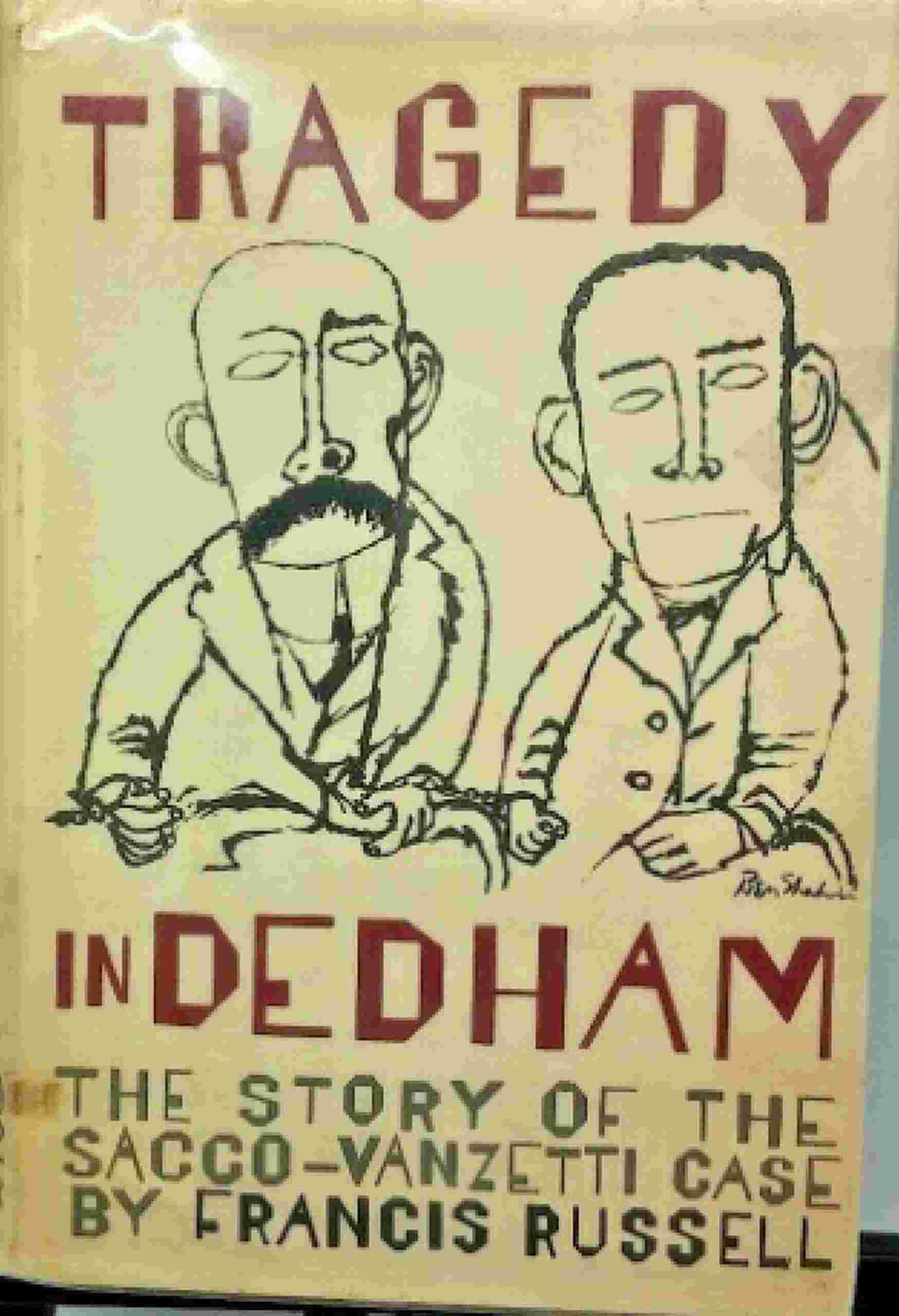
CHAPTER THREE
APRIL 15, 1920
Thursday mornings Shelley Neal, the South Braintree agent for the American Express Company, met the 9:18 local from Boston to pick up the payrolls of the Slater & Morrill and Walker & Kneeland shoe factories. Until January 1920, the payrolls had been sent down on Wednesdays, but recently there had been so many holdups around Boston that the head office had altered its delivery schedules.
It was an uneasy time, that year after the soldiers returned. In November the savings bank in the neighboring town of Randolph, a few miles west of Braintree, had been held up and robbed. A month later, on the day before Christmas, four men in a touring car had tried to rob the paymaster of the L. Q. White shoe factory in Bridgewater, sixteen miles to the south. An unknown gang had recently stolen several freight-car loads of shoes belonging to Slater & Morrill. Almost every week Neal received a notice from the Boston office warning him to take every precaution, particularly to watch out for suspicious strangers. He now carried his 38-caliber Colt in his pocket with the pocket flap tucked inside so that he could reach for it quickly.
South Braintree was the other side of the New York, New Haven & Hartford tracks, at the wrong end of town. Had there been a national-bank branch there, the payroll money would not have had to be sent down by train, but the triangle of factories and narrow streets and workers’ houses was not commercially important enough. Braintree itself, lying ten miles south of Boston, was an undistinguished community of about fifteen thousand inhabitants that one passed through almost absent-mindedly on the old turnpike road to Cape Cod.
On Thursday morning, April 15, Neal, in his customary dark suit, derby, and overcoat, waited on the station platform with Art Stevens, one of his expressmen. The 9:18 was late. Neal drew out his gold Waltham on its heavy chain with the Masonic seal. Nine twenty-one. He could hear the wail of the steam-whistle—two long notes, a short, and a long—as the train approached the Braintree crossing. It would take another five minutes to reach South Braintree.
His express wagon was backed up to the curb, the driver hunched forward on the seat, his coat collar over his ears. Between the shafts the horse jingled his brasses, stamped, steamed, and tossed his head. Although the sun was four hours up, the air still held an aftermath of winter. Neal’s blunt hands with their hairy knuckles showed red, the diamond set in the thick gold band on his left ring finger reflected the light coldly.
A cumulus puff from the invisible train billowed up, blurring the horizon outline of the water towers on Penns Hill, Quincy. Within a minute the engine rounded the curve, growing larger as it moved soundlessly against the wind. Then the whistle echoed again and suddenly the train loomed up on the Union Street crossing by the Victorian brick aggregate of Thayer Academy. The station windows began to vibrate with the sound.
Almost before Neal was aware of it the train had slipped into the station, the brass bell on the boiler clanging, the driving wheels slurring to a halt. He waved to the engineer as the cab passed. Below the station at the Pearl Street crossing Mike Levangie, the lank-mustached, one-legged gate-tender, hobbled out of his shack and cranked down the double gate, then clumped over the tracks and lowered the single one.
Several passengers got off, a man and a woman got on, the stationmaster came out to check a bundle of Boston newspapers. Neal and Stevens walked to the baggage car where the freight clerk was waiting for them. Neal did not know his name—he was a new fellow—but he was a Mason. “Cold morning,” he remarked as he shoved an iron box across the floor. It contained some thirty thousand dollars in bills and coin. After Neal had signed the receipt book the clerk handed him the box’s key in a sealed envelope.
Neal and Stevens carried the box across the platform to the wagon and pushed it under the seat. Then Neal climbed up beside the driver. The driver flicked the reins and the horse started forward. Stevens, who had climbed over the tailboard, remained standing. Just as the wagon began to move, the locomotive backed up suddenly with a clank of couplings. Its piston rods reversed, a jet of steam shot from the cylinders, and the train started off in the direction of Weymouth, Hingham, and the South Shore.
The shadow of the wagon moved diagonally across Railroad Avenue toward the Hampton House, a mansard-roofed structure, four stories high, that had been built in the seventies for a trunk factory. It now housed the Slater & Morrill offices as well as the cutting rooms of the upper factory—Slater & Morrill’s lower factory was some distance away on Pearl Street. On the ground floor of the Hampton House, to the left of the center entrance, was the express company’s office. The gilt sign over its door, unchanged from an earlier day, read New York & Boston Despatch Express Co.
Its clapboarding flaked and blistered, the gray building lay full in the slanting sunlight that burnished its windows. A narrow grass border divided the avenue from an indented strip of pavement in front of the porticoed Slater & Morrill entrance. Six or seven cars were parked along the outside of the border. Neal recognized them. It was still possible to know all the cars in town at sight. “A lot of autos here this morning,” he remarked to the driver. There was one auto parked by the granite curb near the central entrance that Neal had never seen before: a touring car, dark and shiny as if it had just been polished. The top was up, the rear side curtains were fastened in place, and the motor was running. Neal’s driver had to turn out sharply to avoid scraping its fender. A man slumped down in the driver’s seat did not turn or look at them. He wore a felt hat, and his shoulders were hunched so that all Neal could see was the back of his neck, and his right hand on the steering wheel. Then, standing in the doorway under the portico, Neal noticed a second man, thin and fair-haired, with a pale sunken face. He had on a brown coat like an old army overcoat and he wore a gray hat pulled over his forehead. Neal did not like his looks.
The driver backed the wagon into the space in front of the express office, and Neal and Stevens carried the box inside. After the outside chill the office was warmly pleasant, smelling of floor oil and cigars. Neal took the key from the envelope and opened the box. Inside were the payrolls for the two companies, each in a brown canvas bag stamped National Shawmut Bank. He took out the Slater & Morrill bag and put the box containing the Walker and Kneeland money in the safe. Then he closed the safe door, pressed down the nickel-plated handle, and spun the dial.
With the bag tucked under his arm Neal motioned to Stevens and they started out the door toward the building’s center entrance. Neal now noticed another strange car. This one was parked across the avenue, facing south. He could not tell what kind it was. It was streaked with mud. He heard its driver call out “All right!” to the man in the first car. The pale man was still standing under the portico leaning against the door post. His hands were thrust into his overcoat pockets, and he held his head low, but as Neal and Stevens passed he stared up at them, moving his eyes without lifting his head. Neal felt for the reassurance of the Colt in his pocket. The man did not move. He had blue bulging eyes, the whites muddied, and his skin was yellowish, sickly, as if he were tubercular.
There was something queer about him, about his being there, Neal felt as he trudged up to the second floor. “Some funny-looking people round here today,” he told the girl at the desk. Margaret Mahoney, the paymistress, was at her desk by the water cooler. Neal had known Margaret Mahoney for years. The payroll bag was heavy for her so he walked across the office and put it in the safe himself. She gave him the receipt for it, and he and Stevens started downstairs.
From the top of the landing Neal could see the pale man still standing in the doorway but when he was about halfway down the man took his hands out of his pockets, walked over to the touring car, opened the rear door, and got in. Neal kept his hand on his Colt. By the time he reached the doorway the car had started up and swung round the corner of Holbrook Avenue. The mud-streaked car had already disappeared.
South Braintree Square was empty at half-past ten when Harry Dolbeare, a piano tuner, finished a cup of coffee at Torrey’s Drugstore on the corner and started up Washington Street to Cuff’s Music Store. Cuff had called him the day before to see about the felts on a secondhand upright, and Dolbeare told him he would have a look at it. As he reached Gregor’s Restaurant he noticed a black touring car turning left from Holbrook Avenue to Washington Street. He could see two men in front and, although the rear side curtains were up, three more men in the back seat. One of the men in back was leaning forward talking to the driver. Dolbeare had never seen any of them before, or the car either. They looked to him like foreigners, maybe some of that Dago bunch from the Fore River shipyards. Tough tickets, the lot of them, he thought to himself after the car had passed him.
At 11:15 Lola Hassam, a hard-faced woman in her forties, got off the train from Quincy with Julia Campbell, the old woman who rented one of her two rooms in the Alhambra Block there. Lola now called herself Lola Andrews, her name before her divorce, although some people said she had never been married. At various times she had been a waitress, a cleaning woman, and a practical nurse. Men often used to come to her room in the Alhambra. Since things were slack in Quincy, she and Julia had decided to come to South Braintree and look for work in one of the shoe factories.
They crossed the tracks by the gate-tender’s shack at the end of Railroad Avenue, walked down Pearl Street past the double pipe fence in front of Rice & Hutchins, and continued another twenty-five yards to the lower Slater & Morrill factory. Julia Campbell was developing cataracts, and she took the younger woman’s arm going downhill.
About thirty feet from the factory they passed a black touring car parked at the side of the road. A dark stocky man with high cheekbones was bending over the raised hood adjusting the motor. Lola Andrews saw another man sitting in the back of the car, a pale, sick-looking sort of fellow in a khaki overcoat.
The men paid no attention to them and the women walked up the steps of Slater & Morrill. Once inside they could not locate the employment office. As they stood there undecided, a middle-aged man in a business suit came down the corridor and asked them what they wanted.
“We want work, mister,” Lola Andrews said. The man said that three months ago he could have given them both jobs. Now they were not taking on any new help. She was not to be put off so easily, insisting she had heard in Quincy that the factory needed people. He told her she had heard wrong. “Isn’t this Rice and Hutchins?” she asked him finally.
No, he told her, Rice & Hutchins was up the road.
When the women again passed the touring car, the pale man in the overcoat was standing behind it and the dark man had crawled underneath and was working on the motor from below, his head and shoulders just visible through the spokes of the front wheel. Lola had almost to step over his feet to get by. He had a screwdriver in his hand, and just as she was opposite him he glanced up at her.
“Pardon me,” she said, “could you tell me how to get to the factory office?”
He crawled out from under the car, stood up, and asked her what factory she wanted. When she told him Rice & Hutchins, he pointed out the brick building and told her to take the driveway to the left; that was the office up there.
Lola and old Julia went down the gravel walk along the side of the brick building, up the stairs, and through the double folding doors. They could see the Employment Office sign there plainly enough.
Whenever William Tracey drove to the square on an errand, as he did two or three times a day, he liked to drive by his building, the wooden three-decker he had built in 1907 at the corner of Hancock and Pearl. Torrey’s Drugstore occupied the ground floor. That Thursday morning as he parked on Pearl to pick up his wife’s groceries at Dyer & Sullivan’s, just across from the drugstore, he noticed two strangers standing with their backs to Torrey’s window where the big glass vase of red water hung from its chains. The men were swarthy, about medium height, one just a little taller than the other. If it had been twelve o’clock the streets would have been full of factory hands and he probably would not have noticed them, but it was still half an hour before the noon whistle and the square was empty. He could not help but notice them.
After Tracey reached home with the groceries he found he had forgotten bread, so he drove back again, past his building and left to Schrout’s Bakery on Pearl Street. The strange men were still leaning against the window as he went in. When he came out they were gone.
Not quite an hour later William Heron, a railroad detective, noticed the same two men in the station. They were sitting on a bench by the gents’ toilet smoking cigarettes and talking in some foreign language. Dagos, he thought they were. He had come down on the 12:27 from Boston, and he was scarcely off the train before he spotted a fresh kid who had climbed on top of the Union News stand and was trying to tip it over. Eleven or twelve years old he was, one of that gang that hung around the station afternoons. Heron grabbed him by the collar and ran him into the operator’s room. The Dagos didn’t even look up as he went by.
McNamara was the kid’s name. The operator said his old man was all right, worked for the railroad, so Heron told the kid what he’d do to him if he ever caught him hanging round the station again, and let him go. He was not in the operator’s room more than five minutes, but when he stepped out again the Dagos had left. Somehow they stuck in his mind, and he wondered where they had gone to.
By trade Ralph DeForest was a shoemaker, though he had been unemployed for two months now. When he had nothing else to do, and that was most of the time, he wandered around South Braintree Square or sometimes dropped in at Magazu’s poolroom on Pearl Street. At 2:20 he was talking with Officer Shea on the corner next to Torrey’s when he spotted two men in front of the jewelry store. In the last two months he had seen everyone in town, but he had never seen those two before. Shea left to go up to the town hall and DeForest walked down by the fruit store past the jeweler’s. The two men looked him over as if they wanted to make something of it. Dark men they were, tough babies. He wasn’t going to let them think he was scared of them, though. Deliberately he turned round and walked past them again. They stared at him, and he stared at them, and finally he said: “I don’t think I owe you fellows anything.”
Without answering him they started off down Pearl Street, one about five feet ahead of the other. DeForest decided he would follow them. At the crossing they turned left toward the station. Just in front of the station a pinch-faced man in a brown coat was tinkering with the engine of a black touring car. The other two paused on the platform and DeForest brushed right by them and through the station into the toilet. When he came out the car and men had disappeared.
At ten minutes to three Jenny Novelli, a nurse, was on her way down Pearl Street to call on her friend Mrs. Knipps, who lived on Colbert Avenue, a dead-end dirt road just beyond Rice & Hutchins on the left. As she passed Schrout’s Bakery she noticed a large curtained touring car abreast of her and going in the same direction scarcely faster than she was walking. The car kept level with her until she reached the cobbler’s shop on the corner. At first she thought the man next to the driver was a friend of hers, William Mooney, but at second glance she realized she was mistaken. The pale driver she scarcely noticed.
For sixteen years Lewis Wade had been working in the sole-leather room at Slater & Morrill. Then, late in 1919, the boss had put him in charge of the shed and gasoline pump in front of the lower factory. Any time the company cars needed gas he went out to take care of them. Every afternoon at the same time Hans Behrsin, Mr. Slater’s chauffeur, would come round to fill up Slater’s Marmon sedan, and Wade was always ready for him with the shed door open and the pump unlocked.
On this April 15 just before three o’clock, Behrsin dropped by as usual and said he was on his way to the garage and that he would be back in ten minutes. A couple of minutes after three, as Wade was hitching the hose onto the pump, he happened to see a touring car below the factory in front of the little wooden house that belonged to the carpenter at Rice & Hutchins. A man was bending over the hood of the car fixing something.
Behrsin pulled up alongside the shed with the gray Marmon and Wade put in about eight gallons of gas. While he was cranking he kept watching the black car until before he knew it the tank had overflowed. Behrsin and he wiped up the overflow, then Behrsin drove off up Pearl Street toward the station.
As he passed Rice & Hutchins he saw two men sitting on the pipe fence near the end of the building, their feet on the lower bar. He knew they were strangers, but that was all he noticed about them.
From the time Shelley Neal brought in the payroll money, Margaret Mahoney had been dividing it to make up the envelopes for the lower factory. There were almost five hundred separate envelopes to be filled, and dividing the $15,776.51 took her right up to three o’clock, with only about ten minutes off for lunch. After she had sealed the envelopes she packed them in two wooden cases that went inside steel cashboxes with Yale locks. Hardly had she got the locks fastened before Mr. Parmenter and his guard Berardelli, the one everyone called the detective, stood there waiting for them.
Frederick Parmenter was in his middle forties, a full-faced man with a short mustache. The solidness of his body, his slightly sagging features and thinning brown hair made him seem older. Margaret Mahoney and the other girls in the office looked forward to his weekly visits. He liked to joke and pretend to make dates with them, though it was only in fun, for he had been married for years and did not play around. He was always very careful of his dress. That day he wore a white shirt with black and pink stripes and a new brown felt hat. Before he left he kidded a bit with the bookkeepers, Frances Devlin and Mary Splaine. He said he would take his pay now while there was still some money, and Margaret Gabney, the assistant bookkeeper, told him he had better, for there might not be any tomorrow. Then he took one of the cashboxes by the handle, and the detective took the other. The detective was just another Italian who never said anything.
Margaret Mahoney remembered afterward how Parmenter stood for a moment in the doorway and then how the stairs creaked as he and the detective walked down. It was a few minutes past three.
Outside the main entrance of the Hampton House, Parmenter, with Berardelli behind him, met Albert Frantello from the lower factory. Frantello said he was on his way to the office to get some cardboard tags. The paymaster and his guard walked on out of the shadow of the Hampton House.
Frances Devlin and Mary Splaine watched them for some minutes from their window on the second floor. Parmenter, without an overcoat, kept to the outside of the gravel walk and the detective, his overcoat buttoned up, walked a little way behind him. Just before they reached the crossing Parmenter shifted the cashbox from his left to his right hand. Fifteen feet beyond him the gate-tender was out washing a window of his shack.
From the cutting room on the third floor, Mark Carrigan, also looking out a window, kept his eye on the paymaster and the detective with their boxes as they passed the cobbler’s shop on the corner and went on toward the railroad-crossing sign. Just beyond the crossing, they stopped to talk with a man coming uphill from the other direction. Then they went on down, behind the high board fence by the water tower.
The first-floor windows of the lower Slater & Morrill factory were open, and Minnie Kennedy and Louise Hayes at their workbench noticed a touring car parked by the side of the street only about ten feet from them. A slight fair-haired man in a blue suit was fussing with the motor, lifting one side of the hood and then the other. Finally he stood by the front mudguard and lit a cigarette. A sickly young man he seemed, but not bad-looking. While he was standing there with a screwdriver in his hand, Thomas Treacy drove up with a wagonload of coal for Slater & Morrill, noticed the man’s light hair, and remembered that he had seen the same car with another man in front of the railroad station early that morning.
After a while the two girls watched the fair-haired man get into the car, drive down Pearl Street toward the swamp, turn round, and start back again.
Roy Gould had invented an oil-and-pumice paste for sharpening safety razor blades. All you needed to do was smear a little on the edge of a blade, run the blade a couple of times around the inside rim of a glass tumbler, and it was as good as new. He used to go to the different South Shore factories on paydays and sell his paste at the gates as the men came out. On April 15 he arrived at South Braintree on the 2:59 train. There was a young fellow standing on the platform and Gould asked him if he knew where and how they paid off at the shoe factories. The other pointed to two men walking down the street to the railroad crossing. “There goes the paymaster now,” he told him. “Just follow him.”
Gould started off toward the gateman’s shack. He could see the paymaster stop briefly at the crossing to talk with someone, then disappear behind the board fence the other side of the tracks.
Jimmy Bostock, the bandy-legged machine repairman, hurrying up Pearl Street from the lower factory to get the 3:15 trolley to Brockton, was near the water tower when he saw Parmenter and Berardelli coming down the street. He crossed over to meet them.
“Bostock,” Parmenter said as he came up, “there’s a pulley off one of the motors up at Number One.”
“I can’t look at it, not today,” Bostock told him. “I got to get this quarter-past-three trolley to Brockton to do a job there.”
“Well,” said Parmenter amiably, “they just told me to tell you if I saw you. That’s all.” While they were talking, Behrsin drove by in the Marmon sedan, honking and waving as he passed. Bostock said he would have to leg it to catch his trolley. “Don’t let me keep you,” Parmenter told him. He and his guard continued down the gravel walk.
Parmenter shifted the cashbox from his right to his left hand. The afternoon sun was warm on his back. To his right was the garage with the tin roof, and beyond it the tower of Rice & Hutchins. The lilac bush on the little dirt triangle in front of the factory was just coming into bud. A flock of pigeons circled over the tower, then headed back to their loft in Cain’s livery stable. Across the street, beyond a pile of bricks, some Italians were digging the cellar for a new restaurant. A loaded truck had just started up out of the excavation. Jim McGlone’s dump cart was pulled up to the curb beside a couple of little carts into which the Italians were shoveling dirt.
Parmenter passed the telephone pole with the red fire-alarm box on it. Two strangers were standing by the fence in front of Rice & Hutchins, dark squat men, their hands in their pockets. One wore a cap, the other a felt hat. He kept on past them, one step, two steps, three....
As his guard, still following, reached the telephone pole, the strangers whipped their hands from their pockets, and the man in the cap lunged forward, pinning Berardelli by the shoulder with his left hand while his right brought up a pistol. Berardelli tried to grapple with him, but before he could get a grip the man fired into him three times. Parmenter turned like a cat to find the same man now facing him, pistol in hand, and Berardelli just behind, his knees buckling. Then the gun muzzle flashed and a bullet struck him in the chest. He flinched, took a few steps sideways, and the man fired again. This time the bullet struck him in the back, and as he staggered across the street his legs began to go limp. Berardelli lay in the gutter, his arms twitching, the second cashbox just beyond the reach of his right hand. The man in the felt hat snatched up the box, then darted out toward the box Parmenter had dropped.
The man in the cap, who had followed Parmenter halfway across the street, now signaled with his pistol and fired again. As he did so the dark touring car that had been parked below Slater & Morrill seventy-five yards away started jerkily uphill with a grinding of gears.
The staccato sound of the shots echoed from the factory walls. From the loft of the livery stable the pigeons swirled up into the sunshine, then wheeled over the Hampton House. At the end of the wooden fence, almost at the crossing, Jimmy Bostock turned to see Berardelli doubling up and the gunman firing. Parmenter was walking jerkily across the street, and Bostock did not realize the paymaster had been hit until he began to sag. Seeing him fall, Bostock took a few steps toward him, but as he did so the man in the cap froze him by the fence with two shots.
The touring car churned along the street, sputtering and skipping, the driver furiously working the spark lever on the steering wheel. Berardelli had managed to get to his hands and knees. Before the car stopped a man, crouched on the running board, sprang off near the brick pile. He had an automatic in his hand. Stepping to the swaying Berardelli, he fired point-blank. Berardelli collapsed in the gravel. The first two bandits had piled into the back seat with the cashboxes. After firing several shots at the upper factory windows, the third bandit climbed in the back seat after them. As the car whined toward the crossing he crawled over into the front seat, leaning out, pistol in hand.
Wade was just snapping the lock on the gas pump when he heard the noise and looked up the street, thinking the Italians had started a fight. He saw Parmenter drop behind the cart and then watched a wavy-haired man shoot at Berardelli.
Along the front of each floor of Rice & Hutchins were nine rows of frosted-glass windows. Even if the sash of the middle cutting-room window on the first floor had not been jammed several inches above the sill, the cutters at their benches might still have heard the shots above the noise of the machinery. The jammed window made this certain. At the sound William Brenner leaned forward from his cutting board to peer through the slit, as did Louis Pelser on his right. As they looked down they saw Berardelli writhing in the gutter almost directly below them and a man with a pistol standing over him. Afterward they found it difficult to remember just what or how much they had seen in that one glimpse. As Pelser later testified, “We seen a glance of the whole thing.” From behind them Peter McCullum sprang on top of the bench, kicking the cutting boards aside and throwing the window up to the sash. What he saw was a dark man pushing a box in a car with his right hand. The sunshine was flickering on a whitish pistol in his left hand.
“Duck!” McCullum yelled, “There’s shooting going on!” Another shot echoed, and there was a tinkle of broken glass. McCullum, Brenner, Pelser, and the rest of the cutters threw themselves on the floor under the benches. A few seconds later a cutter at the other end of the room shouted that the automobile was crossing the tracks. They crawled out from under the benches, and Pelser pushed down to the end of the room where someone had opened the last window. He managed to see only the rear of the car jolting over the tracks but he could still make out the license plate. Going back to his cutting board he wrote down the number: 49783.
From the treeing room on the floor above, the foreman, Edgar Langlois, glanced incredulously down at the slumped Berardelli and the two strangers. “Someone’s been shot!” he shouted and ran for the wall telephone in the corridor. Barbara Liscomb peered from the window to see the paymaster and his guard on the ground, and just below her a dark, short, hatless man with a pistol in his hand. As she looked, he lifted his head and stared directly at her, a face that she could never afterward get out of her mind. He pointed his pistol, but before the bullet crashed through the pane over her head she had fainted. Langlois, dashing back, looked out again to see the dark car rolling toward the crossing. The glass had been removed from the back window and a rifle or shotgun barrel was sticking through the opening.
In the Slater & Morrill lower factory Minnie Kennedy and Louise Hayes had gone upstairs to the ladies’ room. When they heard the shots they dashed to the window just in time to catch a glimpse of the vanishing car.
From the kitchen of the frame house in back of the excavation Annie Nichols, so startled that she could hardly breathe, had watched the shooting, seen Berardelli and Parmenter fall, and the laborers scatter and dodge toward her fence. Then the touring car appeared and a man tossed the cashboxes into it. In his house next door Maurice Colbert, a carman for the railroad, had just gone into the kitchen to take off his coat when he heard the shots and saw the Italians running. He started for the front door only to find that his wife, sensing trouble, had locked it and removed the key. All he could see from the window was the auto and the two men with boxes running toward it.
As the car approached the railroad crossing, it came so close to Bostock that he could have reached out and touched it. Levangie, washing the windows of his shack, had heard the shots without heeding them until he saw a man come out from behind the brick pile and commence shooting. At that very moment the warning bell began to ring for the Brockton train, and he left his cloth and bucket to crank down the gates. Just as he brought the bars horizontal the touring car came to a halt in front of him, a man leaning out with a pistol that he jerked up sharply, shouting “Up! Up!” The train was still beyond the Hood Rubber Works, the engine just rounding the bend. Again the man jerked the pistol, then pointed it. Levangie raised the barrier. The touring car jolted across the ties, passing within a few feet of Roy Gould on his way to the factories with his razor-blade paste. A bareheaded gunman fired at Gould almost point-blank, the bullet piercing a lapel of his overcoat. Gould fixed the man’s look in his mind: the blown wavy hair, the blue suit, and oddly enough the watchchain that he was wearing across his waistcoat.
Mary Splaine and Frances Devlin from their Hampton House office, Mark Carrigan from the cutting room above, watched the topheavy car with its flapping curtains as it crossed from the tracks to the cobbler’s shop on the corner. The gunman in the front seat was firing at random. Workers scurried out the side entrance of Rice & Hutchins. Someone was chasing up the street from the factory calling “Stop them! Stop them!” A railroad gang working beside a sandpile stood gaping, their shovels still in their hands, Angelo Ricci, the foreman, trying to keep them back.
On the corner of Railroad Avenue in front of the cobbler’s shop the car almost brushed Frank Burke, an itinerant glassblower down for the day from Brockton. The gunman in the front seat aimed directly at him and pulled the trigger, but the hammer merely clicked. “Get out of the way, you son of a bitch!” he bellowed at Burke, the curtains blurring his face.
Louis DeBeradinis in his cobbler’s shop was giving an order to a salesman, Merle Averill, when he heard the tattoo of shots. “What the hell’s that?” Averill asked him, dropping his order book and running to the door. DeBeradinis followed. Together they saw the touring car sputter past the shop. The gunman leaned out and fired almost in DeBeradinis’ face. Again the weapon misfired.
At the poolroom at 66 Pearl Street, beyond the stable, Carlos Goodridge, a Victrola salesman, had been having a quick game with Peter Magazu, the proprietor, who also owned the shoe store next door, when he heard the first shots. He walked to the window, saw nothing, came back, and was chalking his cue when he heard more shots and people shouting. This time, stepping out to the edge of the sidewalk, he saw the dark touring car only twenty feet away and a swarthy man leaning out of it pointing a revolver at him. He ducked back inside and slammed the poolroom door, then peered out through the glass as the car spun by. The gunman had lowered his hand now, but he still held the revolver. Goodridge, his stomach tightened in a knot, watched the car swerve past the bakery, a gun barrel protruding from the gap of the rear window.
It gathered speed, running more smoothly, rolling past the stores and the frame two- and three-family houses and the barber shop with its spiraling striped pole. At 54 Pearl Street Nicola Damato, the barber, watched it pass, as did a shoe worker, Olaf Olsen, who had just come out of Torrey’s Drugstore. Both of them saw the gunman leaning out. Olsen noticed how he kept his left hand over his mouth as he held the pistol in his right. As the car swung left onto Washington at the top of Pearl Street, the tires spewing up the gravel, one of the men in the rear seat threw out several handfuls of tacks.
Elmer Chase, loading a truck in front of the Co-operative Society a hundred yards down Washington Street, heard the squeal of brakes and the grinding of gears. He looked up at the oncoming car, expecting a smashup. It slowed slightly as it passed him, and he had a glimpse of a sickly-looking driver and a stocky dark man with blowing hair bent over next to him.
Scarcely a minute had elapsed from the first shot until the getaway car vanished, but with its disappearance the actuality faded and the myth took over. All in all there were more than fifty witnesses of the holdup in its various stages, yet each impression now began to work in the yeast of individual preconceptions. The car was black, it was green, it was shiny, it was mud-streaked. There were two cars. The men who did the shooting were dark, were pale, had blue suits, had brown suits, had gray suits, wore felt hats, wore caps, were bareheaded. Only one had a gun, both had guns. The third man had been behind the brick pile with a shotgun all the time. Anywhere between eight and thirty shots had been fired. On some points there was a rough agreement: The car was a touring car, there were five men in it, the driver was a fair, sallow man, and the two men who had begun the shooting were short and clean-shaven.
The three gunmen had scarcely climbed into their car before Jim McGlone crawled from the excavation to where Parmenter lay sprawled on a stone. “I got him by the shoulder,” McGlone related two days later at the inquest, “and asked him where he was hurt and he didn’t answer, and I lowered his head to the ground. I went to the double team and got a horse blanket to put under Parmenter’s head and my brother came along and we lifted Parmenter up and they spread the horse blanket out and we put Parmenter in, and my brother and two other fellows took hold of a corner of the blanket and we carried him into the house.”
As soon as the car had passed the water tower Jimmy Bostock ran back to Berardelli. The detective lay on his side, his lips open, and with every breath blood foamed from his mouth. Bostock propped the guard’s head up slightly and wiped his face with a handkerchief.
Berardelli gave a shudder, the bright bubbling at his mouth stopped, and Bostock knew that the man was dead. In the gravel Bostock noted four spent shell cases. He picked them up and put them in his pocket.
All the factory entrances were now clogged with gesticulating figures. Those who remained inside lined the open windows. From the shops and tenements and the Hampton House beyond, people were streaming across the tracks to where the two men were lying. Around Berardelli they gathered ten deep. Fred Loring, who had run out with the others from the lower factory, saw a dark cloth cap lying a foot or so from the guard’s body. He picked it up and tucked it into his pocket. McGlone kept pushing the crowd back from the groaning Parmenter. Then he and his brother and Bostock carried the paymaster into the Colbert house, just behind the excavation. Crowds swarmed into Pearl Street: men in shirtsleeves, women in work aprons, small boys underfoot pushing their way through the others. The roadway was soon blocked from the factories to the railroad crossing. The voices of the men and women mingled, a collective murmur of incredulity that a thing such as they might have read about in newspaper headlines could actually have happened in South Braintree.
Shelley Neal arrived with his special police badge pinned on his coat and his Colt in his pocket just as they were carrying Parmenter into the Colbert house. The paymaster looked almost gone. As soon as Neal saw him in the blanket his one thought was to get back to the office and call the man’s wife. It took him five minutes, bucking the crowd, to reach the Hampton House and once there he found all the telephone lines busy. After trying several times to get central, he hurried down the steps to his harnessed wagon and headed for the telephone exchange.
Police Chief Jeremiah Gallivan, driving up in his Ford, passed the careening wagon, Neal with his feet braced against the dashboard and slashing at his galloping horse. By the time Gallivan covered the mile and a half from his home to Rice & Hutchins, Parmenter had been taken inside and Berardelli was dead. The chief shouldered his way through the crowd until he stood looking down at the familiar body with the unfamiliar glazed eyes. The mill workers pressed about him, their voices clamorous as they pointed out where the shots had been fired and the route of the car. Fire Chief Fred Tenney, already on the spot, told him it was a touring car with a green body. Its motor was acting up, Tenney said. He thought there might still be a chance to catch the gunman. Gallivan was willing to try. Together they started off in the red department runabout, forcing their way up Pearl Street, Tenney sounding the brass bell mounted on the radiator. After a left turn onto Washington Street they had to stop to brush away the scattered tacks, but after that they were in the clear. At the Plain Street railroad crossing Gallivan shouted at Joe Buckley, the gate-tender, that there had been a killing. Had he seen a car pass? Buckley had not. Gallivan and Tenney continued straight south toward Holbrook, two miles away.
At Holbrook Square they found a soldier who had seen just such a green touring car ten minutes before on the way to Abington. They swung east on the Abington road, Gallivan gun in hand, Tenney clanging his bell as he held the accelerator to the floor. The flat wooden town came on them with a rush, but beyond, in the network of roads between Whitman and Cox’s Corner, they lost the trail. Back and forth through the barren landscape they circled, along dirt ways that looped back on themselves or ended in the litter of some squatter’s chicken yard. The dust rose behind them and the afternoon shadows lengthened as the red runabout pushed on—until after almost two hours of driving they gave up.
Gallivan’s revolver was back in its holster and the fire chief’s bell silent when they again reached the Plain Street crossing. Buckley waved for them to stop. “I forgot to tell you about a car that came down here and went up that way,” he told them, pointing north. “It went out of my mind. The brakes screeched so much I thought it was going into the river.”
“Well,” said Gallivan, “it’s too late now.”
Instead of continuing over the tracks at Plain Street the car—with the screech that Buckley noted—had made a hairpin turn and headed back toward South Braintree on the almost parallel Franklin Street. But at the hill corner by the white-spired South Congregational Church it had swung west on Pond Street, following the curve of Sunset Lake on the right, and past the cemetery and the Torrey Elementary School on the left. After following Pond Street west for a mile, slapping and jolting, side curtains billowing and the motor roaring, the car turned south on Granite Street toward Randolph.
Mrs. Alta Baker saw it near the Randolph line, moving at fifty miles an hour. At twelve minutes after three it passed Walter Desmond, a tobacco salesman, on his way from Randolph to South Braintree. Then at the junction with the Randolph highway it swung right along the broken surface of Oak Street, cut through the scrubby outskirts of the Randolph Woods for a mile and a half, and took the left fork near an old cemetery into Orchard Street. On this obscure lane it passed Albert Farmer and his wife Adeline with their horse and wagon that they had just taken from the barn where the two roads joined. The Farmers noticed the swirl of dust as the car moved toward them and they watched it make the abrupt turn south into Orchard Street.
The driver must have soon realized he was off course, for ten minutes later George Chisholm, a road laborer working on Main Street, a stone’s throw from Oak, saw the car beating up north with flaring curtains, hurtling by him so fast he thought the tires were coming off. It turned right into Oak Street and continued a quarter of a mile east, bearing down Orchard until it again arrived at the junction. The driver stopped, hesitated, then swung the car into the yard of the Hewins house on the corner just across from the Farmers. Mabel Hewins was standing on her porch when the swarthy man in the front seat leaned out and asked her the way to Providence. She told him to follow Oak Street to Chestnut across North Main and keep going. He grunted, reversed the car jerkily, and started back the way he had come. She could see both men in the front seat clearly, but not the others.
Not quite two miles farther, a mile beyond Tower Hill where Chestnut Street merges with the Stoughton Post Road, John Lloyd and Wilson Dorr, working in a sandpit, saw the car jouncing south along the road that was “all hills and hollows and ruts.” Dorr noticed that the glass was missing from the back window. On the sharp gradient of Tucker Hill leading into Stoughton it overtook Francis Clark and Elmer Pool in their bakery wagon, veered out, and continued on the left-hand side of the road and over the crest. Clark, too, noticed the oblong gap in the back of the cloth top and told Pool to copy the license plate. All Pool could spot was 49.
The car disappeared south in the isolation of the old turnpike and was not glimpsed again until it reached the outskirts of Brockton at a quarter to four. A high school girl, Julia Kelliher, saw it coming down very fast over the hill from Brockton Heights, churning the dust behind it, the curtains fluttering in the wind. As it went over a bump she saw something tossed up in the back seat behind the curtains. There were two men in front. After the car passed she tried to take down the license number. She could made out an 83 at the end and a 9 and a 7, and these she wrote in the sand beside the road.
At 4:15 Austin Reed, the railroad-crossing tender at Matfield, a small settlement on the outskirts of West Bridgewater, eight and a half miles southeast of Brockton Heights and twenty-two miles from South Braintree, stepped out of his shanty at the approach of the train from Westdale. As he stood in the middle of the road with the yellow Stop sign in his hand, he saw a touring car racing down the hill from West Bridgewater. He walked toward it holding up his sign. The driver did not seem to want to stop, but finally he pulled up about forty feet away. A man sitting next to the driver leaned out and shouted, “What the hell are you holding us up for?” Then the train passed between them. After it had rumbled by, the car started up over the crossing and the man in the front seat pointed his finger at Reed as if it were a pistol and bellowed again: “What the hell did you hold us up for?” He was only four feet away.
The rattling car took the right fork on Matfield Street, then, as if it had made a circle, returned three minutes later on the left fork of Belmont Street and recrossed the track. Reed saw it edge over the hill and watched the cloud of dust that slowly settled behind it. That was the last seen that day of the touring car.
Parmenter lay propped up on the sofa in the front room of the Colbert house. Scarcely conscious, he managed to whisper that one gunman was dark, short, and stocky and the other short and thin.
When the Weymouth medical examiner, Dr. John Chisholm Frazer, arrived at four o’clock there were several other doctors already in the room with Parmenter. Frazer stopped by Berardelli’s body—it had been carried into the Colbert kitchen—only long enough to note that he was dead and that blood was oozing from his back and arms. Shortly after the medical examiner’s arrival, the ambulance from the Quincy City Hospital came for Parmenter. As the paymaster was carried down the steps the onlookers surged in toward the stretcher. They surged in again twenty minutes later when Berardelli’s body was taken away in a wicker basket.
After the hearse had disappeared the crowd began to thin. Most of the workers headed home, leaving behind a diminishing core of the young and idle. The long shadow of the afternoon moved along the factory fronts and the sun turned the Slater & Morrill windows orange. A group—mostly boys in corduroy knickers—still stood around the stains in the gravel where Berardelli had fallen.
Later, as the sun edged toward the Blue Hills and the light began to fade, the crowd increased again. Workers and their wives strolled down Pearl Street after supper for a second look, voluble witnesses repeated the details, and as the news spread to the neighboring towns the curious and the morbid began to arrive from the compass points—Randolph, Quincy, Holbrook, Weymouth.
Dr. Nathaniel Hunting operated on Parmenter shortly after his arrival in the hospital. A bullet that had apparently glanced off his ribs, causing an elongated but superficial wound, was shaken out of his jacket. The second bullet, the one that had struck him after he turned, had cut horizontally through his abdomen, perforating the vena cava, the body’s largest vein. Hunting was able to remove it easily from a mass of blue flesh just below the surface of the abdomen. He marked the bullet with a cross on the base. After the operation Parmenter recovered consciousness for a few minutes and managed to tell Assistant District Attorney George Adams, who had been waiting at his bedside, that he did not recognize the men who shot him. Then he drifted off again. He died at five in the morning, some fourteen hours after he was shot.
Dr. George Burgess Magrath, the medical examiner of Suffolk County, made the autopsy on Berardelli, assisted by the Norfolk County examiner, Dr. Frederick Jones. He found four visible wounds: the first in the left back upper arm, the second near the left armpit, the third lower down on the left side, and the fourth at the right shoulder. According to Dr. Magrath, Berardelli might have recovered from the first three wounds, but not from the fourth. The bullet there had pierced the right lung, severed the great artery issuing from the heart, and continued down through the intestines until it lodged in the hipbone.
All four bullets had remained in the body. As Dr. Magrath recovered them he took a surgical needle and scored each in turn on the base with a Roman numeral. The mortal bullet he marked with three vertical scratches.
The shell cases that Jimmy Bostock had picked out of the gravel he handed to Thomas Fraher, the Slater & Morrill superintendent. These consisted of two Peters shells, one Remington, and one Winchester—the last identifiable by a W stamped on its base. Fraher in turn gave them to Captain William Proctor, the head of the State Police, who had driven down from Boston as soon as he heard of the shootings. Several hours later Fred Loring gave the cap he had picked up to Fraher, who kept it overnight and then passed it on to Chief Gallivan.
Over that week end South Braintree bubbled with gossip. State Police and Pinkerton detectives, occasionally at crosspurposes, combed the town, interviewing and filling out their reports. Chief Gallivan spent Sunday with a state policeman searching the Braintree woods for abandoned cashboxes. He found nothing. That was his last discouraged gesture in the case.
A rumor floated round that Berardelli had recognized the man who shot him, that he had known in advance something was up, and that was why he had been killed. There was a lot of such talk in the Hampton House. Mary Splaine and Jimmy Bostock told a young Pinkerton operative, Henry Hellyer, they thought a man named Darling who worked in the order department might have been the front man for the bandits. Darling had a bad reputation. Two of his friends had been arrested some years back for stealing shoes from the factory, and only a few weeks ago the police had found some stolen shoes at his house. Mary Splaine supposed that Darling had probably hatched the scheme and tipped off his accomplices as to the time the payroll went out. But when Hellyer asked Fraher about this, the superintendent told him that Darling was completely trustworthy and that Mary Splaine was too irresponsible for anyone to take her seriously.
On Saturday, when the inquest was held before Judge Albert Avery in the Quincy District Court, several witnesses said they had seen two cars during the holdup, a large touring car and a small sedan. Levangie, the gate-tender, described the driver of the touring car as having a “dark complexion, dark brown mustache, soft hat, and brown coat.” Everyone else described him as a pale, fair-haired man with a smooth yellowish face.
Detectives brought down a selection of rogues’-gallery pictures from Boston. Bostock, Wade, and several others who riffled through the assortment picked out a New York bank robber, Anthony Palmisano, as one of the South Braintree bandits. On April 23 a group that included Bostock, Wade, Albert Frantello, and Mary Splaine was taken to Captain Proctor’s office in the State House and shown a number of photographs, including Palmisano’s. Mary Splaine positively identified his picture as that of the man she had seen leaning out of the car with the revolver. Frantello and Bostock said it was an excellent likeness.
Unfortunately for their promising identification, it was soon learned that Palmisano—also known as Tony the Wop and Baby Tony—had been arrested in Buffalo in January and was still in jail there.