
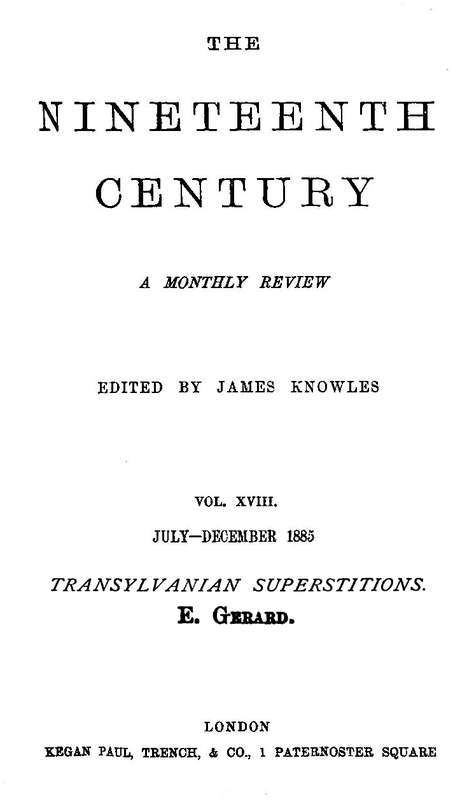
Transylvanian Superstitions / From: The Nineteenth Century (Vol. 18), London, July-December 1885, pp. 130-150
Explore more books like this:
About This Book
A survey of regional folk belief traces three main sources: native imaginative responses to rugged landscape, traditions imported by long-settled colonists, and practices of itinerant fortune-tellers. The account catalogs spirits, witches, dragons, and place-named devils linked to caves, forests, and lakes, and explains calendars and hours deemed perilous. Particular weekdays and festivals carry prohibitions on tasks like spinning, baking, or washing, while protective rituals and superstitious diagnostics — for example hearth-leaf divination at New Year or planting a fork to repel a midnight dragon — govern daily life and agriculture.
About the Author

More Books by This Author
1 picks

You May Also Like
6 picks
 "Five-Head" Creek; and Fish Drugging in the Pacific / 1901
by Louis Becke
"Five-Head" Creek; and Fish Drugging in the Pacific / 1901
by Louis Becke
 "Pennsylvania Dutch," and other essays
by Phebe Earle Gibbons
"Pennsylvania Dutch," and other essays
by Phebe Earle Gibbons
 "Sterminator Vesevo" (Vesuvius the great exterminator) / Diary of the Eruption of April 1906
by Matilde Serao
"Sterminator Vesevo" (Vesuvius the great exterminator) / Diary of the Eruption of April 1906
by Matilde Serao
 21 Jahre in Indien. Dritter Theil: Sumatra.
by Heinrich Breitenstein
21 Jahre in Indien. Dritter Theil: Sumatra.
by Heinrich Breitenstein
 21 Jahre in Indien. Erster Theil: Borneo.
by Heinrich Breitenstein
21 Jahre in Indien. Erster Theil: Borneo.
by Heinrich Breitenstein
 A Bakony (1. kötet)
by Károly Eötvös
A Bakony (1. kötet)
by Károly Eötvös