
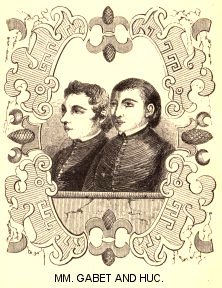
No doubt the Mongols are often dupes of the fraud of those who have an interest in making a Great Lama out of this puppet. Yet we believe that often all this proceeds on both sides with honesty and good faith. From the information we obtained from persons worthy of the greatest credit, it appears certain that all that is said of the Chaberons must not be ranged amongst illusion and deception. A purely human philosophy will, undoubtedly, reject such things, or put them, without hesitating, down to the account of Lama imposture. We Catholic missionaries believe that the great liar who once deceived our first parents in the earthly Paradise still pursues his system of falsehood in the world. He who had the power to hold up in the air Simon Magus may well at this day speak to mankind by the mouth of an infant, in order to maintain the faith of his adorers.
When the titles of the living Buddha have been confirmed, he is conducted in triumph to the Lamasery, of which he is to be the Grand Lama. Upon the road he takes, all is excitement, all is movement. The Tartars assemble in large crowds to prostrate themselves on his way, and to present to him their offerings. As soon as he is arrived at his Lamasery, he is placed upon the altar; and then, kings, princes, mandarins, Lamas, Tartars, from the richest to the poorest, come and bend the head before this child, which has been brought from the depths of Thibet, at enormous expense, and whose demoniac possessions excite every body’s respect, admiration, and enthusiasm.
There is no Tartar kingdom which does not possess, in one of its Lamaseries of the first class, a living Buddha. Besides this superior, there is always another Grand Lama, who is selected from the members of the royal family. The Thibetian Lama resides in the Lamasery, like a living idol, receiving every day the adorations of the devout, upon whom in return he bestows his blessing. Everything which relates to prayers and liturgical ceremonies, is placed under his immediate superintendence. The Mongol Grand Lama is charged with the administration, good order, and executive of the Lamasery; he governs whilst his colleague is content to reign. The famous maxim, Le roi règne et ne gouverne pas, is not, therefore, the grand discovery in politics that some people imagine. People pretend to invent a new system, and merely plunder, without saying a word about it, the old constitution of the Tartar Lamaseries.
Below these two sovereigns, are several subaltern officers, who direct the details of the administration, the revenues, the sales, the purchases, and the discipline. The scribes keep the registers, and draw up the regulations and orders which the governor Lama promulgates for the good keeping and order of the Lamasery. These scribes are generally well versed in the Mongol, Thibetian, and sometimes in the Chinese and Mantchou languages. Before they are admitted to this employment, they are obliged to undergo a very rigorous examination, in presence of all the Lamas and of the principal civil authorities, of the country.
After this staff of superiors and officers, the inhabitants of the Lamasery are divided in Lama-masters and Lama-disciples or Chabis; each Lama has under his direction one or more Chabis, who live in his small house, and execute all the details of the household. If the master possesses cattle, they take charge of them, milk the cows, and prepare the butter and cream. In return for these services, the master directs his disciples in the study of the prayers, and initiates them into the liturgy. Every morning the Chabi must be up before his master; his first task is to sweep the chamber, to light a fire and to make the tea; after that he takes his prayer-book, presents it respectfully to his master, and prostrates himself thrice before him, without saying a single word. This sign of respect is equivalent to a request that the lesson he has to learn in the course of the day may be marked. The master opens the book, and reads some pages, according to the capacity of his scholar, who then makes three more prostrations in sign of thanks, and returns to his affairs.
The Chabi studies his prayer-book, when he is disposed to do so, there being no fixed period for that; he may spend his time, sleeping or romping with the other young pupils, without the slightest interference on the part of his master. When the hour for retiring to bed has arrived, he recites the lesson assigned him in the morning, in a monotonous manner; if the recitation is good, he is looked upon as having done his duty, the silence of his master being the only praise he is entitled to obtain; if, on the contrary, he is not able to give a good account of his lesson, the severest punishment makes him sensible of his fault. It often happens, that under such circumstances, the master, laying aside his usual gravity, rushes upon his scholar, and overwhelms him at once with blows and terrible maledictions. Some of the pupils, who are over maltreated, run away and seek adventures far from their Lamasery; but in general they patiently submit to the punishment inflicted on them, even that of passing the night in the open air, without any clothes and in full winter. We often had opportunities of talking with Chabis, and when we asked them whether there was no means of learning the prayers without being beaten, they ingenuously and with an accent manifesting entire conviction, replied, that it was impossible. “The prayers one knows best,” they said, “are always those for which one has got most blows. The Lamas who cannot recite prayers, or cure maladies, or tell fortunes, or predict the future, are those who have not been beaten well by their masters.”
Besides these studies, which are conducted at home, and under the immediate superintendence of the master, the Chabis may attend, in the Lamasery, public lectures, wherein the books which relate to religion and to medicine are expounded. But these commentaries are mostly vague, unsatisfactory, and quite inadequate to form learned Lamas; there are few of them who can give an exact account of the books they study; to justify their omission in this respect, they never fail to allege the profundity of the doctrine. As to the great majority of the Lamas, they think it more convenient and expeditious to recite the prayers in a merely mechanical way, without giving themselves any trouble about the ideas they contain. When we come to speak of the Lamaseries of Thibet, where the instruction is more complete than in those of Tartary, we shall enter into some details upon Lama studies.
The Thibetian books alone being reputed canonical, and admitted as such by the Buddhist Reformation, the Mongol Lamas pass their lives in studying a foreign idiom, without troubling themselves at all about their own language. There are many of them well versed in the Thibetian literature, who do not even know their own Mongol alphabet. There are indeed a few Lamaseries where the study of the Tartarian idiom receives some slight attention, and where they sometimes recite Mongol prayers, but these are always a translation of Thibetian books. A Lama who can read Thibetian and Mongol is reputed quite a savant; he is thought a being raised above mankind, if he has some knowledge of Chinese and Mantchou literature.
As we advanced in the Ortous, the country seemed more and more desert and dismal. To make matters still worse, a terrible storm, solemnly closing in the autumn season, brought upon us the cold of winter.
One day, we were proceeding with difficulty through the arid sandy desert; the perspiration ran down our foreheads, for the heat was stifling; we felt overpowered by the closeness of the atmosphere, and our camels, with outstretched necks and mouths half open, vainly sought in the air a breath of cooling freshness. Towards noon, dark clouds began to gather in the horizon; fearful of being surprised by the storm, we determined to pitch our tent. But where? We looked round on all sides; we ascended to the tops of the hillocks and anxiously sought with our eyes for some Tartar habitation, which might provide us with fuel, but in vain; we had before us on all sides nothing but a mournful solitude. From time to time, we saw the foxes retiring to their holes, and herds of yellow goats running to take repose in the defiles of the mountains. Meantime, the clouds continued to rise and the wind began to blow violently. In the irregularity of its gusts it seemed now to bring us the tempest, now to drive it from us. While we were thus suspended between hope and fear, loud claps of thunder, and repeated flashes of lightning, that seemed to enkindle the sky, gave us notice that we had no other resource than to place ourselves entirely in the hands of Providence. The icy north wind blowing fiercely, we directed our steps to a defile, which opened near us; but before we had time to reach it the storm exploded. At first, rain fell in torrents, then hail, and at last snow half melted. In an instant we were wet through to the skin, and felt the cold seizing upon our limbs. We immediately alighted, hoping that walking would warm us a little, but we had hardly advanced ten steps amidst the deluge of sand, when our legs sank as in mortar. When we found it impossible to go any further we sought shelter by the side of our camels, and crouched down, pressing our arms closely against our sides, in order to attain, if possible, a little warmth.
While the storm continued to hurl against us its fury, we awaited with resignation the fate which Providence destined for us. It was impossible to pitch the tent; it was beyond human power to spread cloth saturated with rain, and half frozen by the north wind. Besides it would have been difficult to find a site for it, since the water streamed in every direction. Amid circumstances so dreadful, we looked at each other in sadness and in silence; we felt the natural warmth of our body diminishing every minute, and our blood beginning to freeze. We offered, therefore, the sacrifice of our lives to God, for we were convinced that we should die of cold during the night.
One of us, however, collecting all his strength and all his energy, climbed up an eminence, which commanded a view of the contiguous defile, and discovered a footpath, leading by a thousand sinuosities into the depths of the immense ravine; he pursued its direction, and after a few steps in the hollow, perceived in the sides of the mountain large openings, like doors. At this sight recovering at once his courage and his strength, he ascended once more the eminence in order to communicate the good news to his companions. “We are saved,” he cried; “there are caves in this defile; let us hasten to take refuge in them.” These words immediately aroused the little caravan; we left our animals upon the hill, and speedily descended into the ravine. A footpath led to the opening; we advanced our heads, and discovered in the interior of the mountain, not simple caves formed by nature, but fine, spacious apartments excavated by the hand of man. Our first exclamation was an expression of thankfulness for the goodness of Providence. We selected the cleanest and largest of these caverns and in an instant passed from the utmost misery to the height of felicity. It was like a sudden and unhoped-for transition from death to life.
On viewing these subterranean dwellings, constructed with so much elegance and solidity, we were of opinion that some Chinese families had repaired to this country to cultivate the soil; but that, repelled by its barrenness, they had given up their enterprise. Traces of cultivation, which we perceived here and there, confirmed our conjecture. When the Chinese establish themselves anywhere in Tartary, if they find mountains, the earth of which is hard and solid, they excavate caverns in their sides. These habitations are cheaper than houses, and less exposed to the irregularity of the seasons. They are generally very well laid out; on each side of the door there are windows, giving sufficient light to the interior; the walls, the ceiling, the furnaces, the kang, everything inside is so coated with plaster, so firm and shining, that it has the appearance of stucco. These caves have the advantage of being very warm in winter and very cool in summer; the want of sufficient air, however, sometimes makes a sojourn in them dangerous to the health. Those dwellings were no novelty to us, for they abound in our mission of Si-Wan. However, we had never seen any so well constructed as these of the Ortous.
We took possession of one of those subterranean abodes, and commenced proceedings by making a large fire in the furnaces, with plentiful bundles of hemp-stems, which we found in one of the caves. Never, on our journey, had we at our disposal such excellent fuel. Our clothes dried very soon, and we were so happy at being in this fine hotel of Providence, that we spent the greater part of the night enjoying the delightful sensation of warmth, while Samdadchiemba was never tired of broiling little cakes in mutton fat. It was altogether quite a festival with us, and our flour felt somewhat the effects of it.
The animals were not less happy than we. We found for them stables out in the mountain, and, which was better still, excellent forage. One cave was filled with millet stems and oat-straw. But for this horrible storm, which had nearly killed us, our animals would never have got so grand a treat. After having for a long time enjoyed the poetry of our miraculous position, we yielded to the necessity of taking repose, and laid down upon a well-warmed kang, which made us forget the terrible cold we had endured during the tempest.
Next morning, while Samdadchiemba was using the rest of the hemp stems, and drying our baggage, we went out for a nearer inspection of these numerous subterrenes. We had scarcely gone ten steps, when we beheld, to our great astonishment, whirls of smoke issuing from the door and windows of a cave adjoining our own. As we fancied we were alone in the desert, the sight of this smoke excited a surprise, mingled with fear. We directed our steps to the opening of the cavern, and, on reaching the threshold of the door, perceived within a large fire of hemp stems, whose undulating flame reached the ceiling, so that the place looked like an oven. On further investigation we observed a human form moving amidst the thick smoke; we soon heard the Tartar salute, Mendou! uttered by a sonorous voice; “Come and sit beside this fire.” We did not like to advance. This cave of Cacus, that loud voice, presented to our minds something phantastic. Finding that we remained silent and motionless, the inhabitant of this sort of vent-hole of Erebus, rose and came to the threshold. He was neither a devil nor a ghost, but simply a Mongol Tartar, who, the night before, having been surprised by the storm, had fled to this cave, where he had passed the night. After a few words about the rain, wind and hail, we invited him to breakfast with us, and brought him to our dwelling. While Samdadchiemba, aided by our guest, made the tea, we went out again to pursue our researches.
We walked amid these deserted and silent abodes with a curiosity not free from terror. All were constructed upon much the same model, and still preserved their pristine integrity. Chinese characters engraved on the walls, and pieces of porcelain vases, confirmed our impression that these caves had been inhabited not long since by Chinese. Some old woman’s shoes, which we discovered in a corner, removed any remaining doubt. We could not shake off a feeling of sadness and melancholy, when we thought of those numerous families, who, after having lived a long time in the entrails of this large mountain, had gone elsewhere to seek a more hospitable soil. As we entered the caves, we alarmed flocks of sparrows, which had not yet left these former dwellings of man, but had, on the contrary, boldly taken possession of these grand nests. The millet and oats strewn around profusely, induced them to remain. “Undoubtedly,” said we, “they too will fly away when they no longer find here any more grains, when they find that the old inhabitants of these caves return no more, and they will seek hospitality under the roofs of houses.”
The sparrow is a regular cosmopolite; we have found it wherever we have found man; ever with the same vivid, petulant, quarrelsome character; ever with the same sharp, angry cry. It is, however, to be remarked that in Tartary, China, and Thibet it is, perhaps, more insolent than in Europe; because there, nobody makes war upon it, and its nest and brood are piously respected. You see it boldly enter the house, live there on familiar terms, and peck up at its leisure the remnants of man’s food. The Chinese call it Kio-nio-eul, (bird of the family).
After having inspected about thirty of these caves, which did not present anything remarkable, we returned to our own. At breakfast, the conversation naturally turned upon the Chinese who had excavated these dwellings. We asked the Tartar if he had seen them. “What!” said he, “have I seen the Kitats who inhabited this defile? Why, I knew all of them; it is not more than two years since they left the country. For that matter,” he added, “they had no right to remain here; as they were rascals, it was quite proper to turn them out.” “Rascals, say you? why, what mischief could they do in this wretched ravine?” “Oh, the Kitats are sly, cheating fellows. At first, they seemed very good; but that did not last long. It is more than twenty years ago that a few of their families sought our hospitality: as they were poor, they got permission to cultivate some land in the vicinity, on condition, that every year after harvest they should furnish some oatmeal to the Taitsi of the country. By degrees, other families arrived, who also excavated caverns wherein to dwell; and soon this defile was full of them. In the beginning, these Kitats showed a gentle, quiet character; we lived together like brothers. Tell me, Sirs Lamas, is it not well to live together like brothers? Are not all men brothers?” “Yes, that is true; you speak the words of justice; but why did these Kitats go hence?” “Peace did not last long; they soon showed themselves wicked and false. Instead of being content with what had been given them, they extended their cultivation at their pleasure, and took possession of a large territory, without asking anyone’s leave. When they were rich they would not pay the oatmeal they had agreed to pay as tribute. Every year, when we claimed the rent, we were received with insults and maledictions. But the worst thing was, that these rascally Kitats turned thieves, and took possession of all the goats and sheep that lost their way in the sinuosities of the ravine. At last, a Taitsi of great courage and capacity, called together the Mongols of the neighbourhood, and said,—‘The Kitats take away our land, they steal our beasts, and curse us; as they do not act or speak as brothers, we must expel them.’ Everybody was pleased with these words of the old Taitsi. After a deliberation, it was decided that the principal men of the country should go to the king, and supplicate an order condemning the Kitats to be expelled. I was one of the deputation. The king reproached us for having permitted foreigners to cultivate our lands; we prostrated ourselves before him, observing profound silence. However, the king, who always acts with justice, had the order written, and sealed with his red seal. The ordonnance said, that the king would not permit the Kitats to live any longer in the country; and that they must leave it before the first day of the eighth moon. Three Taitsi rode off to present the ordonnance to the Kitats. They made no answer to the three deputies, but said amongst themselves, ‘The king desires us to go; very well.’
“Afterwards we learned that they had assembled and had resolved to disobey the orders of the king and to remain in the country, in spite of him. The first day of the eighth moon arrived, and they still occupied calmly their habitations, without making any preparation for departure. In the morning, before daybreak, all the Tartars mounted their horses, armed themselves with their lances, and drove their flocks and herds upon the cultivated lands of the Kitats, on which the crop was still standing: when the sun rose, nothing of that crop was left. All had been devoured by the animals, or trodden down. The Kitats yelled and cursed us, but the thing was done. Seeing that their position was desperate, they collected, the same day, their furniture and agricultural implements, and went off to settle in the eastern parts of the Ortous, at some distance from the Yellow River, near the Paga-Gol. As you came through Tchagan-Kouren, you must have met on your route, west of the Paga-Gol, Kitats cultivating some pieces of land; well, it was they who inhabited this defile, and excavated all these caves.”
Having finished his narrative, the Tartar went out for a moment and brought back a small packet, which he had left in the cavern, where he had passed the night. “Sirs Lamas,” he said on his return, “I must depart; but will you not come and repose for a few days in my dwelling? My tent is not far hence; it is behind that sandy mountain which you perceive there towards the north. It is at the utmost not more than thirty lis off.” “We are much obliged to you,” answered we. “The hospitality of the Mongols of Ortous is known everywhere, but we have a long journey before us; we cannot stop on our way.” “What are a few days, sooner or later, in a long journey? Your beasts cannot always be on their feet; they need a little rest. You yourselves have had much to endure from the weather of yesterday. Come with me; all will then be well. In four days we shall have a festival. My eldest son is going to establish a family. Come to the nuptials of my son; your presence will bring him good fortune.” The Tartar, seeing us inflexible, mounted his horse, and after having ascended the pathway which led to the defile, disappeared across the heath and sand of the desert.
Under other circumstances, we should have accepted with pleasure the offer thus made; but we desired to make the shortest possible stay amongst the Ortous. We were anxious to leave behind us that miserable country, where our animals were wasting away daily, and where we had ourselves met with such fatigue and misery. Besides, a Mongol wedding was no new thing to us. Since we had entered Tartary, we had witnessed more than once, ceremonies of that kind.
The Mongols marry very young, and always under the influence of the absolute authority of the parents. This affair, so grave and important, is initiated, discussed, and concluded, without the two persons most interested in it, taking the least part in it. Whatever promises of marriage may take place in youth, or at more advanced age, it is the parents who always settle the contract, without even speaking to their children about it. The two future consorts do not know, perhaps never saw each other. It is only when they are married that they have the opportunity to inquire whether there is sympathy between their characters or not.
The daughter never brings any marriage portion. On the contrary, the young man has to make presents to the family of his bride: and the value of these presents is seldom left to the generosity of the husband’s parents. Everything is arranged beforehand and set forth in a public document, with the minutest details. In fact, the matter is less a marriage present than the price of an object, sold by one party and bought by the other. The thing is indeed very clearly expressed in their language; they say, “I have bought for my son the daughter of so and so.” “We have sold our daughter to such and such a family.” The marriage contract is thus simply a contract of sale. There are mediators, who bargain and haggle, up and down, till at last they come to an agreement. When it is settled how many horses, oxen, sheep, pieces of linen, pounds of butter, what quantity of brandy and wheat-flour shall be given to the family of the bride, the contract is at length drawn up before witnesses, and the daughter becomes the property of the purchaser. She remains, however, with her family till the time of the nuptial ceremonies.
When the marriage has been concluded between the mediators, the father of the bridegroom, accompanied by his nearest relations, carries the news to the family of the bride. On entering, they prostrate themselves before the little domestic altar, and offer to the idol of Buddha a boiled sheep’s head, milk, and a sash of white silk. Then they partake of a repast provided by the parents of the bridegroom. During the repast, all the relations of the bride receive a piece of money, which they deposit in a vase filled with wine made of fermented milk. The father of the bride drinks the wine, and keeps the money. This ceremony is called Tahil-Tébihou, “striking the bargain.”
The day indicated by the Lamas as auspicious for the marriage having arrived, the bridegroom sends early in the morning a deputation to fetch the girl who has been betrothed to him, or rather whom he has bought. When the envoys draw near, the relations and friends of the bride place themselves in a circle before the door, as if to oppose the departure of the bride, and then begins a feigned fight, which of course terminates with the bride being carried off. She is placed on a horse, and having been thrice led round her paternal house, she is then taken at full gallop to the tent which has been prepared for the purpose, near the dwelling of her father-in-law. Meantime, all the Tartars of the neighbourhood, the relations and friends of both families, repair to the wedding-feast, and offer their presents to the new married pair. The extent of these presents, which consist of beasts and eatables, is left to the generosity of the guests. They are destined for the father of the bridegroom and often fully indemnify him for his expenses in the purchase of the bride. As the offered animals come up they are taken into folds ready constructed for them. At the weddings of rich Tartars, these large folds receive great herds of oxen, horses and sheep. Generally the guests are generous enough, for they know that they will be paid in return, upon a similar occasion.
When the bride has finished dressing, she is introduced to her father-in-law; and while the assembled Lamas recite the prayers prescribed by the ritual, she first prostrates herself before the image of Buddha, then before the hearth, and lastly before the father, mother, and other near relatives of the bridegroom, who, on his part, performs the same ceremonies towards the family of his bride, assembled in an adjacent tent. Then comes the wedding-feast, which sometimes continues for seven or eight days. An excessive profusion of fat meat, infinite tobacco, and large jars of brandy, constitute the splendour and magnificence of these repasts. Sometimes music is added to the entertainment, and they invite Toolholos, or Tartar singers, to give more solemnity to the festival.
The plurality of wives is admitted in Tartary, being opposed neither to the laws, nor to the religion, nor to the manners of the country. The first wife is always the mistress of the household, and the most respected in the family. The other wives bear the name of little spouses (paga éme), and owe obedience and respect to the first.
Polygamy, abolished by the Gospel, and contrary in itself to the happiness and concord of families, may, perhaps, be regarded as a blessing to the Tartars. Considering the present state of society with them, it is, as it were, a barrier opposed to libertinism and corruption of morals. Celibacy being imposed on the Lamas, and the class of those who shave the head and live in lamaseries being so numerous, it is easy to conceive what disorders would arise from this multiplication of young women without support and abandoned to themselves, if girls could not be placed in families in the quality of second wives.
Divorce is very frequent among the Tartars. It takes place without any participation of the civil or ecclesiastical authorities. The husband, who repudiates his wife, has not even occasion for a pretext to justify his conduct. He sends her back, without any formality, to her parents, and contents himself with a message that he does not require her any longer. This proceeding is in accordance with Tartar manners, and does not offend any one. The husband thinks himself entitled to the privilege, in consideration of the oxen, sheep and horses he was obliged to give as nuptial presents. The parents of the repudiated wife do not complain at having their daughter back; she resumes her place in the family till another husband presents himself, in which case, they even rejoice over the profit they make by thus selling the same merchandise twice over.
In Tartary, the women lead an independent life enough. They are far from being oppressed and kept in servitude, as with other Asiatic nations. They may come and go at their pleasure, ride out on horseback, and pay each other visits from tent to tent. Instead of the soft, languishing physiognomy of the Chinese women, the Tartar woman presents in her bearing and manners a power and force well in accordance with her active life and nomad habits, and her attire augments the effect of her masculine, haughty mien.
Large leather boots, and a long green or violet robe fastened round the waist by a black or blue girdle, constitutes her dress, except that sometimes she wears over the great robe a small coat, resembling in form our waistcoats, but very large, and coming down to the hips. The hair of the Tartar women is divided in two tresses, tied up in taffetas, and hanging down upon the bosom; their luxury consists in ornamenting the girdle and hair with spangles of gold and silver, pearls, coral, and a thousand other toys, the form and quality of which it would be difficult for us to define, as we had neither opportunity, nor taste, nor patience to pay serious attention to these futilities.
CHAPTER IX.
Departure of the Caravan—Encampment in a fertile Valley—Intensity of the Cold—Meeting with numerous Pilgrims—Barbarous and Diabolical Ceremonies of Lamanism—Project for the Lamasery of Rache-Tchurin—Dispersion and rallying of the little Caravan—Anger of Samdadchiemba—Aspect of the Lamasery of Rache-Tchurin—Different Kinds of Pilgrimages around the Lamaseries—Turning Prayers—Quarrel between two Lamas—Similarity of the Soil—Description of the Tabsoun-Noor or Salt Sea—Remarks on the Camels of Tartary.
The Tartar who had just taken his leave had informed us, that at a short distance from the caverns we should find in a vale the finest pasturages in the whole country of the Ortous. We resolved to depart. It was near noon already when we started. The sky was clear, the sun brilliant; but the temperature, still affected by the storm of the preceding day, was cold and sharp. After having travelled for nearly two hours over a sandy soil, deeply furrowed by the streams of rain, we entered, on a sudden, a valley whose smiling, fertile aspect singularly contrasted with all that we had hitherto seen among the Ortous. In the centre flowed an abundant rivulet, whose sources were lost in the sand; and on both sides, the hills, which rose like an amphitheatre, were covered with pasturage and clumps of shrubs.
Though it was still early, we gave up all idea of continuing our journey that day. The place was too beautiful to be passed by; besides, the north wind had risen, and the air became intolerably cold. We pitched our tent, therefore, in a corner, sheltered by the hills. From the interior of the tent, our view extended, without obstruction, down the valley, and we were thus enabled to watch our animals without moving.
After sunset, the violence of the wind increased, and the cold became more and more intense. We thought it advisable to take some measures of security. Whilst Samdadchiemba piled up large stones to consolidate the borders of the tent, we went about the adjacent hills, and made, by aid of a hatchet, an abundant provision of fuel. As soon as we had taken our tea and our daily broth, we went to sleep. But sleep did not last long; the cold became so severe that it soon roused us. “We can’t remain so,” said the Dchiahour; “if we don’t want to die of cold on our goatskins, we must get up and make a large fire.” Samdadchiemba’s words were full of sense; it was not advisable to sleep at such a time, and accordingly we rose, and added to our usual dress the great sheepskin robes that we had bought at Blue Town.
Our fire of roots and green branches was hardly lighted, when we felt our eyes as it were calcined by the biting acid influence of a thick smoke, which filled the tent. We opened the door; but as this gave admission to the wind, without getting rid of the smoke, we were soon obliged to shut it again. Samdadchiemba was not in any way molested by the thick smoke, which stifled us and drew burning tears from our eyes. He laughed without pity at seeing us crouched by the fire, our heads bending over our knees, and our faces buried in both hands. “My spiritual fathers,” he said, “your eyes are large and bright, but they cannot endure a little smoke; mine are small and ugly, but, never mind, they perform their service very well.” The jests of our camel driver were not much adapted to cheer us up; we suffered dreadfully. Yet, amid our tribulations, we saw occasion to feel our happiness to be very great. We could not reflect without gratitude upon the goodness of Providence, which had led us to caves, whose great value we now fully appreciated. If we had not been able to dry our clothes, if we had been surprised by the cold in the piteous state in which the storm had left us, we certainly could not have lived long; we should have been frozen with our clothes in one immovable block.
We did not think it prudent to proceed amid such severe cold, and to leave an encampment, where at least our animals got sufficient herbage to browse upon, and where fuel was abundant. Towards noon, the weather having grown milder, we went out to cut wood on the hills. On our way we observed that our animals had left the pasturage, and collected on the banks of the rivulet. We at once conceived that they were tormented by thirst, and that the stream being frozen, they could not quench it. We bent our steps to them, and found, in fact, the camels eagerly licking the surface of the ice, while the horse and the mule were kicking upon it with their hard hoofs. The hatchet we had brought with us to cut wood, served to break the ice, and to dig a small pond, where our animals could quench their thirst.
Towards evening, the cold having resumed its intensity, we adopted a plan for enabling us to obtain a better sleep than we had in the preceding night. Until morning, the time was divided into three watches, and each of us was charged, in turns, with keeping up a large fire in the tent, while the others slept. Thus we did not feel much of the cold, and slept in peace, without fear of setting our linen house on fire.
After two days of horrible cold the wind abated, and we resolved to proceed on our way. It was only with great difficulty that we got down our tent. The first nail that we tried to draw out, broke like glass under the hammer. The sandy, humid soil on which we had made our encampment, was so frozen that the nails stuck in it as if they had been incrusted in stone. To uproot them, we were obliged to wet them several times with boiling water.
At the time of our departure, the temperature was so mild that we were fain to take off out skin coats, and to pack them up until further occasion. Nothing is more frequent in Tartary than these sudden changes of temperature. Sometimes the mildest weather is abruptly followed by the most horrible frost. All that is needed for this is the falling of snow, and the subsequent rise of the north wind. Any one not inured to these sudden changes of the atmosphere, and not provided, in travelling, with well-furred robes, is often exposed to dreadful accidents. In the north of Mongolia especially, it is not unusual to find travellers frozen to death amidst the desert.
On the fifteenth day of the new moon, we came upon numerous caravans, following, like ourselves, the direction from east to west. The road was filled with men, women, and children, riding on camels or oxen. They were all repairing, they said, to the Lamasery of Rache-Tchurin. When they had asked whether our journey had the same object, they were surprised at receiving an answer in the negative. These numerous pilgrims, the astonishment they showed upon hearing that we were not going to the Lamasery of Rache-Tchurin, excited our curiosity. At the turn of a defile, we overtook an old Lama, who, laden with a heavy pack, seemed to make his way with great labour and pain. “Brother,” said we, “you are old; your black hairs are not so numerous as the grey. Doubtless your fatigue must be extreme. Place your burden upon one of our camels; that will relieve you a little.” Upon hearing these words the old man prostrated himself before us, in order to express his gratitude. We made a camel kneel, and Samdadchiemba added to our baggage that of the Lama. So soon as the pilgrim was relieved from the weight which had oppressed him, his walk became more elastic, and an expression of satisfaction was diffused over his countenance. “Brother,” said we, “we are from the West, and the affairs of your country not being well known to us, we are astonished at finding so many pilgrims here in the desert.” “We are all going to Rache-Tchurin,” replied he, in accents full of emotion. “Doubtless,” said we, “some grand solemnity calls you together?” “Yes, to-morrow will be a great day: a Lama Boktè will manifest his power: kill himself, yet not die.” We at once understood what solemnity it was that thus attracted the Ortous-Tartars. A Lama was to cut himself open, take out his entrails and place them before him, and then resume his previous condition. This spectacle, so cruel and disgusting, is very common in the Lamaseries of Tartary. The Boktè who is to manifest his power, as the Mongols phrase it, prepares himself for the formidable operation by many days fasting and prayer, pending which, he must abstain from all communication whatever with mankind, and observe the most absolute silence. When the appointed day is come, the multitude of pilgrims assemble in the great court of the Lamasery, where an altar is raised in front of the Temple-gate. At length the Boktè appears. He advances gravely, amid the acclamations of the crowd, seats himself upon the altar, and takes from his girdle a large knife which he places upon his knees. At his feet, numerous Lamas, ranged in a circle, commence the terrible invocations of this frightful ceremony. As the recitation of the prayers proceeds, you see the Boktè trembling in every limb, and gradually working himself up into phrenetic convulsions. The Lamas themselves become excited: their voices are raised; their song observes no order, and at last becomes a mere confusion of yelling and outcry. Then the Boktè suddenly throws aside the scarf which envelopes him, unfastens his girdle, and seizing the sacred knife, slits open his stomach, in one long cut. While the blood flows in every direction, the multitude prostrate themselves before the terrible spectacle, and the enthusiast is interrogated about all sorts of hidden things, as to future events, as to the destiny of certain personages. The replies of the Boktè to all these questions are regarded, by everybody, as oracles.
When the devout curiosity of the numerous pilgrims is satisfied, the Lamas resume, but now calmly and gravely, the recitation of their prayers. The Boktè takes, in his right hand, blood from his wound, raises it to his mouth, breathes thrice upon it, and then throws it into the air, with loud cries. He next passes his hand rapidly over his wound, closes it, and everything after a while resumes its pristine condition, no trace remaining of the diabolical operation, except extreme prostration. The Boktè once more rolls his scarf round him, recites in a low voice, a short prayer; then all is over, and the multitude disperse, with the exception of a few of the especially devout, who remain to contemplate and to adore the blood-stained altar which the Saint has quitted.
These horrible ceremonies are of frequent occurrence in the great Lamaseries of Tartary and Thibet, and we do not believe that there is any trick or deception about them; for from all we have seen and heard, among idolatrous nations, we are persuaded that the devil has a great deal to do with the matter; and moreover, our impression that there is no trick in the operation is fortified by the opinion of the most intelligent and most upright Buddhists whom we have met in the numerous Lamaseries we visited.
It is not every Lama that can perform miraculous operations. Those who have the fearful power to cut themselves open, for example, are never found in the higher ranks of the Lama hierarchy. They are generally lay Lamas of indifferent character, and little esteemed by their comrades. The regular Lamas generally make no scruple to avow their horror of the spectacle. In their eyes, all these operations are wicked and diabolical. Good Lamas, they say, are incapable of performing such acts, and should not even desire to attain the impious talent.
Though these demoniac operations are, in general, decried in well-regulated Lamaseries, yet the superiors do not prohibit them. On the contrary, there are certain days in the year set apart for the disgusting spectacle. Interest is, doubtless, the only motive which could induce the Grand Lamas to favour actions which in their conscience they reprove. The fact is, that these diabolical displays are an infallible means of collecting together a swarm of stupid and ignorant devotees, who communicate renown to the Lamasery, and enrich it with the numerous offerings which the Tartars never fail to bring with them on such occasions.
Cutting open the abdomen is one of the most famous sié-fa (supernaturalisms) possessed by the Lamas. There are others of the same class, less imposing, but more common; these are practised in people’s houses, privately, and not at the great solemnities of the Lamaseries. For example, they heat irons red-hot, and then lick them with impunity; they make incisions in various parts of the body, which an instant afterwards leave no trace behind, etc. All these operations have to be preceded by the recitation of some prayer.
We knew a Lama who, according to every one’s belief, could fill a vase with water, by the mere agency of a prayer; but we could never induce him to try the experiment in our presence. He told us that as we held not the same faith with him, the experiment, in our company, would not be merely fruitless, but would expose him to serious danger. One day, however, he recited to us the prayer of his sié-fa. It was brief, but we readily recognised in it a direct appeal to the assistance of the demon. “I know thee, thou knowest me;” thus it ran: “Come old friend, do what I ask of thee. Bring water, and fill the vase I hold out to thee. To fill a vase with water, what is that to thy vast power! I know thou chargest dear for a vase of water; but never mind: do what I ask of thee, and fill the vase I present to thee. Some time hence we’ll come to a reckoning: on the appointed day thou shalt receive thy due.” It sometimes happens that the appeal remains without effect: in such cases, praying is discontinued, and the being invoked is assailed with insults and imprecations.
The famous sié-fa that was now attracting so large a number of pilgrims to the Lamasery of Rache-Tchurin, inspired us with the idea of repairing thither also, and of neutralizing, by our prayers, the satanic invocations of the Lamas. Who knows, said we to each other, who knows but that God even now has designs of mercy towards the Mongols of the Ortous land; perhaps the sight of their Lama’s power, fettered and overcome by the presence of the priests of Jesus Christ, will strike upon the hearts of these people, and make them renounce the lying creed of Buddha, and embrace the faith of Christianity! To encourage each other in this design, we dwelt upon the history of Simon Magus, arrested in his flight by the prayer of St. Peter, and precipitated from the air to the feet of his admirers. Of course, poor missionaries, such as we, had not the insane pretension to compare ourselves with the prince of the Apostles; but we knew that the protection of God, which is sometimes granted in virtue of the merit and sanctity of him who seeks it, is also often accorded to the omnipotent effacity in prayer itself.
We resolved, therefore, to go to Rache-Tchurin, to mingle with the crowd, and, at the moment when the diabolical invocations should commence, to place ourselves, fearlessly, and with an air of authority before the Boktè, and to solemnly forbid him, in the name of Jesus Christ, to make a display of his detestable power. We did not disguise from ourselves the possible results of this proceeding; we knew that it would assuredly excite the fury and hatred of the adorers of Buddha; and that perhaps a violent death would be an instant reward for the endeavour to convert these Tartars; “But what matter!” exclaimed we; “let us do courageously our work as missionaries; let us employ fearlessly the power that we have received from on high, and leave to Providence the care of a future which does not appertain to us.”
Such were our intentions and our hopes; but the views of God are not always in conformity with the designs of man, even when these appear most in harmony with the plan of His Providence. That very day there happened to us an accident which, carrying us far away from Rache-Tchurin, involved us in the most distressing perplexities.
In the evening, the old Lama who was travelling with us asked us to make the camel kneel, so that he might take his pack from its back. “Brother,” said we, “are we not going to journey together to the Lamasery of Rache-Tchurin?” “No; I must follow the path which you see meandering towards the north, along those hills. Behind that sand-hill is a trading place, where, upon festival days, a few Chinese merchants set up their tents and sell goods. As I want to make a few purchases, I cannot continue to walk in your shadow.” “Can we buy flour at the Chinese encampment?” “Millet, oatmeal, flour, beef, mutton, tea-bricks, everything is sold there.” Not having been able to purchase provisions since our departure from Tchagan-Kouren, we considered this a favourable opportunity for supplying our deficiency in this respect. In order not to fatigue our beasts of burden with a long circuit across stony hills, M. Gabet took the flour-sacks upon his camel, separated from the caravan, and went off at a gallop towards the Chinese post. According to the indications furnished by the old Lama, he was to meet us again in a valley at no great distance from the Lamasery.
After travelling for nearly an hour along a rugged road, continually intersected by pits and quagmires, the Missionary Purveyor reached the small heath, on which he found a number of Chinese encamped, some of their tents serving as shops, and the rest as dwellings. The encampment presented the appearance of a small town full of trade and activity, the customers being the Lamas of Rache-Tchurin and the Mongol pilgrims. M. Gabet speedily effected his purchases; and having filled his sacks with flour, and hung two magnificent sheep’s’ livers over one of the camel’s humps, rode off to the place where it had been arranged the caravan should await him. He soon reached the spot, but he found no person there, and no trace of man or beast having recently passed was visible on the sand. Imagining that perhaps some derangement of the camels’ loads had delayed our progress, he turned into the road, which it had been agreed we should follow; but it was to no purpose that he hastened along it, that he galloped here and there, that he ascended every hill he came to,—he could see nothing; and the cries he uttered to attract our attention remained unanswered. He visited several points where various roads met, but he found merely another confusion of the steps of horses, camels, oxen, sheep, tending in every direction, and crossing and recrossing each other, so that he was left, at last, without even a conjecture.
By-and-by be recalled to mind that our aim, as last resolved, had been the Lamasery of Rache-Tchurin; he turned round, and perceiving the Lamasery in the distance, hurried thither as fast as he could go. When he reached the structure, which stood in the form of an amphitheatre upon the slope of a hill, he looked every where for us, and asked everybody about us, for here, at least, there was no lack of persons from whom to seek information, and our little caravan was composed in a manner likely to attract the attention of those who saw it at all: two laden camels, a white horse, and, above all, a black mule, that everyone we passed stopped to remark, on account of its extreme diminutiveness, and the splendid tint of its skin. M. Gabet inquired and inquired, but to no purpose; no one had seen our caravan. He ascended to the summit of the hill, whence the eye extended over a large expanse, but he could see nothing at all like us.
The sun set, yet the caravan did not appear. M. Gabet beginning to fear that some serious accident had befallen it, once more set off, and searched in every direction, up hill and down dale, but he could see nothing of us, and learn nothing of us, from the travellers whom he met.
The night advanced, and soon the Lamasery of Rache-Tchurin disappeared in the darkness. M. Gabet found himself alone in the desert, without path and without shelter, fearing alike to advance or to recede, lest he should fall into some abyss. He was fain, therefore, to stop where he was, in a narrow, sandy defile, and to pass the night there. By way of supper, he had to content himself with an Impression de Voyage. Not that provisions were wanting, by any means, but fire was, and water. Besides, the feeling of hunger was superseded by the anxieties which afflicted his heart as to the caravan. He knelt on the sand, said his evening prayer, and then lay down his head upon one of the flour-sacks beside the camel, keeping its bridle round his arm lest the animal should stray during the night. It is needless to add that his sleep was neither sound nor continuous; the cold, bare ground is not a very eligible bed, especially for a man preyed upon by dark anxieties.
With the earliest dawn, M. Gabet mounted his camel, and though well nigh exhausted with hunger and fatigue, proceeded anew in search of his companions.
The caravan was not lost, though it was terribly astray. After M. Gabet had quitted us, in order to visit the Chinese post, we at first exactly followed the right path; but before long we entered upon a vast steppe, all trace of road insensibly faded away amidst sand so fine that the slightest wind made it undulate like sea-waves; there was no vestige upon it of the travellers who had preceded us. By-and-by the road disappeared altogether, and we found ourselves environed with yellow hills, which presented not the slightest suggestion even of vegetation. M. Huc, fearing to lose himself amid these sands, stopped the cameleer. “Samdadchiemba,” said he, “do not let us proceed at random. You see yonder, in the valley, that Tartar horseman driving a herd of oxen; go and ask him the way to Rache-Tchurin.” Samdadchiemba raised his head, and looked for a moment, closing one eye, at the sun, which was veiled with some passing clouds. “My spiritual father,” said he, “I am accustomed to wander about the desert; my opinion is, that we are quite in the right road: let us continue our course westward, and we cannot go astray.” “Well, well, since you think you know the desert, keep on.” “Oh, yes; don’t be afraid. You see that long, white line on the mountain yonder? that’s the road, after its issue from the sands.”
On Samdadchiemba’s assurance, we continued to advance in the same direction. We soon came to a road as he had promised, but it was a road disused, upon which we could see no person to confirm or contradict the assertion of Samdadchiemba, who persisted that we were on the way to Rache-Tchurin. The sun set, and the twilight gradually gave place to the darkness of night, without our discovering the least indication of the Lamasery, or, which surprised us still more, of M. Gabet, who, according to the information of the old Lama, ought to have rejoined us long ago. Samdadchiemba was silent, for he now saw that we had lost our way.
It was important to encamp before the night had altogether closed in. Perceiving a well at the end of a hollow, we set up our tent beside it. By the time our linen-house was in order, and the baggage piled, the night had completely set in; yet M. Gabet had not appeared. “Get on a camel,” said M. Huc to Samdadchiemba, “and look about for M. Gabet.” The Dchiahour made no reply; he was thoroughly disconcerted and depressed. Driving a stake into the ground, he fastened one of the camels to it, and mounting upon the other, departed mournfully in quest of our friend. He had scarcely got out of sight, when the camel that was left behind, finding itself alone, sent forth the most frightful cries; by-and-by it became furious; it turned round and round the stake, backed to the very limit of the rope and of its long neck, made longer by painful extension, and applied every effort to get rid of the wooden curl that was passed through its nose: the spectacle of its struggle was really frightful. At last it succeeded in breaking the cord, and then dashed off boundingly into the desert. The horse and mule had also disappeared; they were hungry and thirsty; and about the tent there was not a blade of grass, not a drop of water. The well beside which we had encamped was perfectly dry; in fact, it was nothing more than an old cistern which had probably been for years useless.
Thus our little caravan, which for nearly two months had journeyed, without once separating, through the desert plains of Tartary, was now utterly dispersed; man and beast—all had disappeared. There remained only M. Huc, solitary in his little linen-house, and a prey to the most corroding anxieties. For a whole day he had neither eaten nor drunk; but under such circumstances you do not ordinarily feel either hunger or thirst; the mind is too full to give any place to the suggestions of the body; you seem environed with a thousand fearful phantoms: and great indeed were your desolation, but that you have for your safety and your consolation, prayer, the sole lever that can raise from off your heart the weight of sombre apprehensions that would otherwise crush it.
The hours passed on, and no one returned. As, in the obscurity of night, persons might pass quite close to the tent, and yet not see it, M. Huc, from time to time, ascended the adjacent hills and rocks, and, in his loudest tones, called out the names of his lost companions, but no one replied; all still was silence, and solitude. It was near midnight, when at length the plaintive cries of a camel, apparently remonstrating against being driven so fast, were heard in the distance. Samdadchiemba soon came up. He had met several Tartar horsemen who had no tidings, indeed, of M. Gabet, but from whom he learned that we had gone altogether astray; that the road we were pursuing led to a Mongol encampment, in precisely the contrary direction to Rache-Tchurin. “By day-break,” said Samdadchiemba, “we must raise the tent, and find the right path; we shall there, no doubt, meet the elder spiritual father.” “Samdadchiemba, your advice is a bubble; the tent and the baggage must remain here, for the excellent reason, that they cannot be moved without animals.” “Animals!” exclaimed the Dchiahour, “where, then, is the camel I fastened to the stake?” “It broke the rope and ran away; the horse and the mule have run away too, and I have not the least idea where any of them are to be sought.” “This is a pretty business,” grumbled the cameleer; “however, when day breaks we must see what can be done. Meanwhile, let us make a little tea.” “Make tea, by all means, if you can make tea without water, but water there is none; the well is perfectly dry.” This announcement completed the discomfiture of poor Samdadchiemba; he sank back quite exhausted upon the baggage, and his weariness soon threw him into deep slumber.
With the first streaks of dawn, M. Huc ascended an adjacent hill in the hope of discovering something or somebody. He perceived, in a distant valley, two animals, one black, one white; he hastened to them, and found our horse and mule browsing on some thin, dusty grass, beside a cistern of soft water. When he led the animals back to the tent, the sun was about to rise, but Samdadchiemba still slumbered, lying in exactly the same position which he had assumed when he went to sleep. “Samdadchiemba,” cried M. Huc, “won’t you have some tea this morning?” At the word tea, our cameleer jumped up as though he had been electrified; he looked round, his eyes still heavy with sleep, “Did not the spiritual father mention tea? Where is the tea? Did I dream I was going to have some tea?” “I don’t know whether you dreamed it, but tea you may have, if you wish, as there is soft water in the valley yonder, where, just now, I found the horse and the mule. Do you go and fetch some water, while I light the fire.” Samdadchiemba joyfully adopted the proposition, and putting the buckets over his shoulders, hastened to the cistern.
When tea was ready, Samdadchiemba became quite comfortable; he was absorbed with his beloved beverage, and seemed to have altogether forgotten the disruption of the caravan. It was necessary, however, to recall the circumstance to him, in order that he might go in search of the camel that had run away.
Nearly one half the day elapsed, yet his companions did not rejoin M. Huc. From time to time there passed Tartar horsemen or pilgrims returning from the festival of Rache-Tchurin. Of these M. Huc inquired whether they had not seen, in the vicinity of the Lamasery, a Lama dressed in a yellow robe and a red jacket, and mounted on a red camel. “The Lama,” said he, “is very tall, with a great grey beard, a long pointed nose, and a red face.” To this description, there was a general answer in the negative: “Had we seen such a personage,” said the travellers, “we should certainly have remarked him.”
At length, M. Gabet appeared on the slope of a hill; from its summit he had recognised our blue tent pitched in the valley, and he galloped towards his recovered companion as fast as his camel could go. After a brief, animated conversation, wherein both spoke and neither answered, we burst into a hearty laugh at the misadventure thus happily terminated. The reorganization of the caravan was completed before sunset, by Samdadchiemba’s return with the missing camel, which, after a long round, he had found fastened to a tent; the Tartar, who owned the tent, having seen the animal running away, had caught it and secured it until some one should claim it.
Though the day was far advanced, we determined to remove, for the place where we had encamped was miserable beyond all expression. Not a blade of grass was to be seen, and the water I had discovered was at so great a distance, that it involved quite a journey to fetch it. “Besides,” said we, “if we can only, before night, manage to get within sight of the right road, it will be a great point gained.” Our departure thus determined, we sat down to tea. The conversation naturally turned upon the vexatious mischance which had given us so much fatigue and trouble. Already more than once, on our journey, the intractable, obstinate temperament of Samdadchiemba had been the occasion of our losing our way. Mounted on his little mule, as we have described, it was he who led the caravan, preceding the beasts of burden. Upon his assumption that he thoroughly understood the four cardinal points, and that he was perfectly conversant with the deserts of Mongolia, he would never condescend to inquire the route from persons whom he met, and we not unfrequently suffered from his self opinion. We were resolved, therefore, to convert the accident which had just befallen us, into the basis of a warning to our guide. “Samdadchiemba,” said we, “listen with attention to the important advice we are about to impart. Though in your youth you may have travelled a good deal in Mongolia, it does not follow that you are master of all the routes; distrust, therefore, your own conjectures, and be more willing to consult the Tartars whom we meet. If yesterday, for example, you had asked the way, if you had not persisted in your practice of being guided wholly by the course of the sun, we should not have endured so much misery.” Samdadchiemba made no reply.
We then got up to make the preparations for departure. When we had put in order the different articles that had been confusedly thrown about the tent, we remarked that the Dchiahour was not occupied, as usual, in saddling the camels. We went to see what he was about, and to our great surprise found him tranquilly seated upon a large stone behind the tent. “Well!” exclaimed we, “has it not been determined that we are to encamp elsewhere this evening? What are you seated on that stone for?” Samdadchiemba made no reply; he did not even raise his eyes, but kept them fixedly directed towards the ground. “Samdadchiemba, what is the matter with you? Why don’t you saddle the camels?” “If you wish to go,” replied he drily, “you can go; as for me, I remain here. I cannot any longer accompany you. I am, it seems, a wicked man, devoid of conscience; what occasion can you have for such a person?” We were greatly surprised to hear this from a young neophyte who had seemed so attached to us. We, however, thought it best to attempt no persuasion, lest we should aggravate the sullen pride of his character, and render him still more indocile for the future. We accordingly proceeded to do the necessary work ourselves.
We had already folded the tent and packed it on a camel, not a word being spoken by any of the party. Samdadchiemba remained seated on the stone, covering his face with his hands, and probably watching through his fingers how we got on with the labour which he was accustomed to fulfil. When he saw that we were doing very well without him, he rose, without uttering a word, loaded the other camel, saddled his own mule, mounted it, and led the way as usual. M. Gabet and M. Huc exchanged smiles, but they said nothing, for they feared that any observations at that moment might irritate a temperament which evidently required the greatest care in its management.
We halted in a spot beside the road, not very magnificent, certainly, as a station, but at all events, infinitely preferable to the ravine of desolation in which we had experienced such misery. There was this great blessing, that we were once more united; an immense satisfaction in the desert, and which we had never sufficiently appreciated until the occurrence of the mischance that had for a while separated us. We celebrated the occasion by a splendid banquet, of which the flour and sheep’s liver, purchased by M. Gabet, formed the basis. This unaccustomed treat relaxed the frowning brow of Samdadchiemba, who applied himself to the culinary arrangements with absolute enthusiasm, and effected, with very limited resources, a supper of several courses.
Next morning, at daybreak, we were in motion. We had not proceeded far when we discovered before us, outlined on the yellow ground of a sandy hill, several large buildings, surrounded with a multitude of white huts. This was the Lamasery of Rache-Tchurin, which, as we approached it, seemed to us a well-built, well-kept place. The three Buddhist temples which rise from the centre of the establishment, are of elegant, of majestic construction. The entrance to the principal temple is through a square tower of colossal proportions, at each angle of which is a monstrous dragon, elaborately carved in stone. We traversed the Lamasery from one end to the other, along the chief streets. There was throughout religious and solemn silence. The only persons we saw were a few Lamas enveloped in their large red scarfs, who, after giving us the salutation of the day in a tone scarce above a whisper, gravely continued their melancholy walk.
Towards the western extremity of the Lamasery, Samdadchiemba’s little mule shied, and then dashed off at a gallop, followed in its irregular flight, by the two baggage camels. The animals on which we were mounted were equally alarmed. All this disorder was occasioned by a young Lama, who was stretched at full length in the middle of the street, performing a rite in great vogue among the Buddhists, and which consists in making the circuit of a Lamasery, prostrating yourself, with your forehead to the ground, at every single step you make. Sometimes the number of devotees performing together this painful pilgrimage is perfectly prodigious; they follow each other, in Indian file, along a narrow path which encircles the entire Lamasery and its appendant buildings. Any one who deviates in the slightest degree from the prescribed line, is considered to have failed in his devotion, and loses all the fruit he would otherwise have derived from his previous toil. Where the Lamasery is of any extent, the devotees have hard work to get through the ceremony in the course of a long day; so that the pilgrims, who have undertaken this exercise, and have started early in the morning, think themselves lucky if they can complete the operation by nightfall. For the pilgrimage must be performed without intermission, so strictly, that the pilgrims are not allowed to stop for a moment even to take a little nourishment. If, after commencing the rite you do not complete it offhand, it does not count; you have acquired no merit, and you are not to expect any spiritual profit.
Each prostration must be perfect, so that the body shall be stretched flat along the ground, and the forehead touch the earth, the arms being spread out before you, and the hands joined, as if in prayer. Before rising, the pilgrim describes each time a semi-circle on the ground by means of a goat’s horn, which he holds in either hand, the line being completed by drawing the arm down to the side. You cannot but feel infinite compassion when you look upon these wretched creatures, their face and clothes all covered with dust or mud. The most inclement weather will not check their intrepid devotion; they continue their prostrations amid snow and rain and the most piercing cold.
There are various modes of performing the pilgrimage round a Lamasery. Some pilgrims do not prostrate themselves at all, but carry, instead, a load of prayer-books, the exact weight of which is prescribed them by the Great Lama, and the burden of which is so oppressive at times that you see old men, women, and children absolutely staggering under it. When, however, they have successfully completed the circuit, they are deemed to have recited all the prayers contained in the books they have carried. Others content themselves with simply walking the circuit, telling the beads of their long chaplets, or constantly turning a sort of wheel, placed in the right hand, and which whirls about with inconceivable rapidity. This instrument is called Tchu-Kor, (turning prayer.) You see in every brook a number of these Tchu-Kor, which are turned by the current, and in their movement are reputed to be praying, night and day, for the benefit of those who erect them. The Tartars suspend them over the fire-place, and these in their movements are supposed to pray for the peace and prosperity of the whole family, emblemed by the hearth. The movement itself is effected by the through draught occasioned by the openings at the top of the tent.
The Buddhists have another mode of simplifying pilgrimages and devotional rites. In all the great Lamaseries you find at short intervals figures in the form of barrels, and turning upon an axle. The material of these figures is a thick board, composed of infinite sheets of paper pasted together, and upon which are written in Thibetian characters the prayers most reputed throughout the country. Those who have not the taste, or the zeal, or the strength to carry huge boards of books on their shoulders, or to prostrate themselves, step after step, in the dust and mire, or to walk round the Lamasery in winter’s cold or summer’s heat, have recourse to the simple and expeditious medium of the prayer barrel. All they have to do is to set it in motion; it then turns of itself for a long time, the devotees drinking, eating, or sleeping, while the complacent mechanism is turning prayers for them.
One day, on approaching a prayer barrel, we found two Lamas quarrelling furiously, and just on the point of coming to blows, the occasion being the fervour of each for prayer. One of them having set the prayer automaton in motion, had quietly returned to his cell. As he was entering it he turned his head, doubtless to enjoy the spectacle of the fine prayers he had set to work for himself, but to his infinite disgust, he saw a colleague stopping his prayers, and about to turn on the barrel on his own account. Indignant at this pious fraud, he ran back, and stopped his competitor’s prayers. Thus it went on for some time, the one turning on, the other stopping the barrel, without a word said on either side. At last, however, their patience exhausted, they came to high words; from words they proceeded to menaces, and it would doubtless have come to a fight, had not an old Lama, attracted by the uproar, interposed words of peace, and himself put the automaton in motion for the joint benefit of both parties.
Besides the pilgrims whose devotion is exercised within or about the Lamaseries, you find many who have undertaken fearfully long journeys, which they execute with a prostration at every step. Sad and lamentable is it to see these unhappy victims of error enduring, to no purpose, such terrible and painful labours; one’s heart is pierced with grief, and one’s soul impressed with yearning for the day when these poor Tartars shall consecrate to the service of the true God that religious energy which they daily waste upon a vain and lying creed. We had hoped to profit by the solemnities at Rache-Tchurin to announce the true faith to the Ortous; but such was doubtless not the will of God, since He had permitted us to lose our way on the very day which seemed most favourable for our project. We accordingly passed through the Lamasery of Rache-Tchurin without stopping, eager as we were to arrive at the very source of that immense superstition, of which, as yet, we had only witnessed a few shallow streams.
At a short distance from Rache-Tchurin we reached a road well marked out, and covered with travellers. It was not, however, devotion that had set these people in motion, as it had the pilgrims whom we saw at the Lamasery; mere matter of business was leading them towards the Dabsoun-Noor, (the Salt Lake,) celebrated throughout Western Mantchou, and which supplies with salt, not only the adjacent Tartars, but also several provinces of the Chinese Empire.
For a day’s journey before you reach Dabsoun-Noor the soil changes by degrees its form and aspect; losing its yellow tint, it becomes insensibly white, as though thinly covered with snow. The earth swelling in every direction, forms innumerable hillocks, cone-shaped, and of a regularity so perfect that you might suppose them to have been constructed by the hand of man. Sometimes they are grouped in heaps, one on the other, like pears piled on a plate; they are of all sizes, some but just created, others old, exhausted, and falling to decay. Around these excrescences grow creeping thorns, long-pointed, without flowers or leaves, which, intertwining spirally, surmount them with a sort of net-work cap. These thorns are never found elsewhere than about these hillocks; upon those of more recent growth they are firm, vigorous, and full of shoots. Upon the elder elevations they are dried up, calcined by the nitre, brittle, and in shreds.
As you look upon these numerous mounds, covered with a thick efflorescence of nitre, it is obvious to your sense that beneath the surface, and at no great depth, some great chemical operation is in progress. Springs, generally so rare in the Ortous country, are here of frequent occurrence, but the water is for the most part excessively salt. Here and there, however, by the very side of a brackish pool, there is a spring of soft, sweet, delicious water; all such are indicated to travellers by a small flag, fluttering from the end of a long pole.