
WeRead Powered by ReaderPub
Travels in Western Africa in 1845 & 1846, Volume 1 (of 2) / comprising a journey from Whydah through the Kingdom of Dahomey to Adofoodia in the interior cover

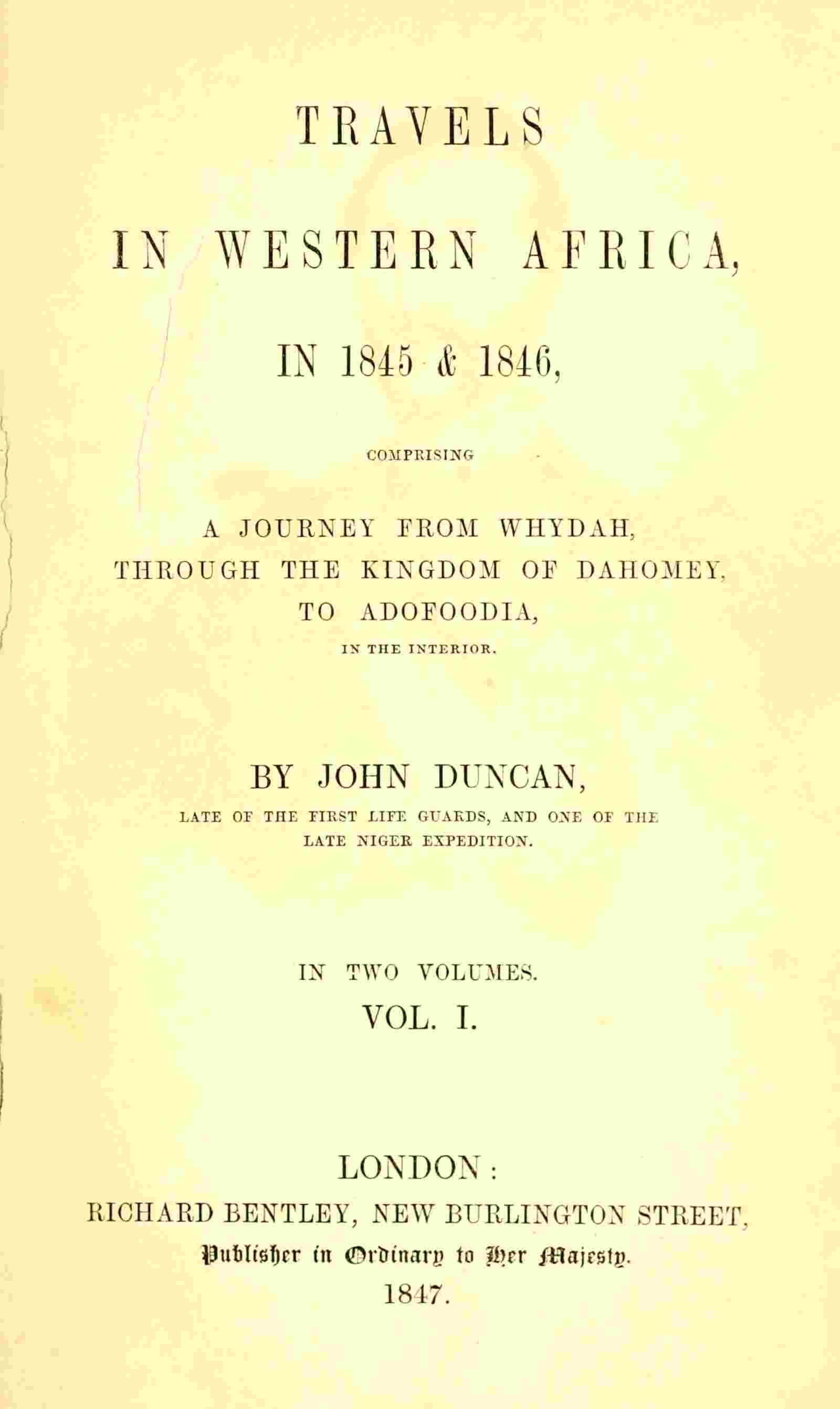
Travels in Western Africa in 1845 & 1846, Volume 1 (of 2) / comprising a journey from Whydah through the Kingdom of Dahomey to Adofoodia in the interior

Chapter 6: DESCRIPTION OF THESE WEAPONS:—
Open in WeRead

About This Book

The narrative recounts journeys along the West African coast and into the interior, moving from coastal ports through Dahomey and neighboring polities. It blends travel incidents—ship movements, local encounters, fever and recovery—with detailed observations of markets, social customs, funeral rites, religious fetishes, and court ceremonies. The account notes agricultural practices, natural history, material culture (weapons, tools), missionary activity, and relations with European officials, while offering maps and illustrations to contextualize routes and objects. Practical advice on provisioning and labor, and reflections on climate and disease, recur throughout the chapters.

ILLUSTRATIONS TO THE FIRST VOLUME.


Portrait of the Author To face the Title.
Map of the Author’s Route p. 1

Wood Cuts.


Dahoman Weapons 226

DESCRIPTION OF THESE WEAPONS:—

No. 1.—A long straight dagger, with snake on the hilt, to bite the Mahee people.

No. 2.—A large heavy knife, with imitation of tigers’ claws on the back, to hook the Mahee people when running away. This knife is about the substance of the English bill-hook.

No. 3.—A very broad, thin knife, with a Dahomey man in the act of shooting a Mahee man. This knife is made of silver, and is more for ornament than use.

Nos. 4 and 5 are King’s battle-sticks: the angle of the handle into which the blade is fixed is the natural growth of the wood.

No. 6 is a battle-stick, carried by all soldiers, male and female. This stick is used to beat people to death, when silence is necessary, as the report of a gun might give an alarm. By examining No. 6, five large knobs of iron are seen fixed to the under part of the head of the weapon.