
PLATE VI.—ARTH FROM THE LAKE OF ZUG.
(From the water-colour by Turner in the National Gallery)
"Elaborate and lovely," wrote Ruskin. "We sleep at Arth, and are up, and out on the lake, early in the morning; to good purpose. The sun rises behind the Mythens, and we see such an effect of lake and light, as we shall not forget soon."
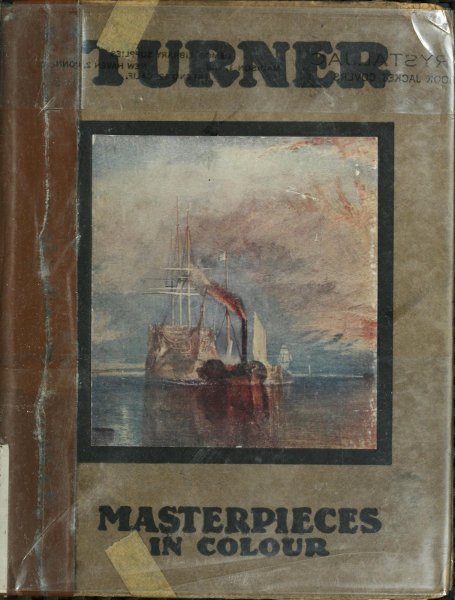
Here I pause to ask myself how I can possibly give you, who have never seen it, an idea of the Turner room at the National Gallery. I close my eyes and visualise the route. I ascend the stairs, and am detained by two Turners that have, against his will, overflowed into an outer room—the beautiful heat-hazy Abingdon, and distant London, seen from Greenwich. Almost reluctantly I walk into the large gallery, and pass from the glorious sunrise in Ulysses to the glorious sunset in "The Fighting Téméraire," painted just ten years later. Claude and the others have been left far behind. Here is Turner the visionary, alone with the sun and the sea, untroubled by the necessity of painting the puny figure of man, but glorying in the symbols of man's power, the new tug dragging the stately old battleship to her last berth, a theme near to his heart—the end of a period in man's history flickering out in the ageless glory of Nature.
Pages, chapters, have been written about the untruth of this picture. "His light and shade," says Mr. Wyllie, "is very seldom correct. His tones are almost always wrong. The place where the sun is setting in the 'Téméraire' is the darkest part of the picture." But what does it matter? This is his vision, of the absolute end of man's work in this daily death of Nature. Who would have one inch changed? About this, as about almost all the pictures, there is a story. The Téméraire "killed" a portrait by Geddes hanging above it, whereupon Geddes began to lay in a vivid Turkey carpet on his canvas. "Ho! ho!" cried Turner, who loved a fight; and the unfortunate Geddes watched him loading on orange, scarlet, and yellow with his palette knife.
I close my eyes to the splendour of the "Téméraire" and see "The Burial of Wilkie," a silvery blue sky and sea shimmering with delicate reflections, the mourning, black-sailed vessel severed by the flare of the torches, their brilliancy and the black of the sails forming vast tracks of light and gloom on the water. On Varnishing Day Stanfield urged that the sails were untrue. Turner grunted—"Wish I had any colour to make 'em blacker."
Then I see the "Snowstorm—Steamboat off a Harbour's Mouth making Signals in Shallow Water and going by the lead," which Punch called "A Typhoon bursting in a Simoon over the Whirlpool of Maelstrom, Norway, with a ship on fire, an eclipse, and the effect of a lunar rainbow." Turner is now sixty-seven. He is prepared to push paint to its ultimate limit so that he can achieve the impossible. To study the effect of this hubbub of snowstorm and gale he put to sea in the tempest, and made the sailors lash him to the mast for four hours. It was the hostile reception of this picture following the attacks on others in previous years, the jeers of Punch, the shafts of Blackwood, that inspired Ruskin to compose "Modern Painters." The first volume was published the following year, 1843, but that colossal work had its beginnings in a letter Ruskin wrote in 1836 defending Turner's picture of Venice called "Juliet and her Nurse."
Turner was famous long before "Modern Painters" was published, and although that pæan of appreciation has carried his fame to the ends of the English-speaking world, the riot of its praise has tipped the pens of some critics with gall. The "Slave Ship" exalted so eloquently by Ruskin, and now in Boston, was described by George Inness, the American artist, as "the most infernal piece of clap-trap ever painted."
The aged Turner suffered from the criticisms of the "Snowstorm." Ruskin tells how he heard the old man one evening muttering to himself "Soapsuds and Whitewash." On the "Graduate of Oxford" attempting to soothe him, he burst out—"What would they have? I wonder what they think the sea's like? I wish they'd been in it!"
Beneath the "Snowstorm" at the National Gallery hang two pictures, shining with a radiance not of the earth, "The Sun of Venice going to Sea," and "The Approach to Venice," wrecks perhaps of what they were, but still lovely, in one all the pomp of Venice, in the other all her haunting and elusive beauty. A little further along the wall in the direction of the "Ulysses" is the parent picture of Impressionism, that incomparable presentment of movement, mist, and moisture, aptly named "Rain, Steam, and Speed." The fools called this a phantom picture, complained that the locomotive has not the appearance of metal. Turner was not painting the fact of an engine; but the effect of an engine rushing through rain and mist. "My business," he once said to Cyrus Redding, "is to draw what I see: not what I know is there."
In the years 1845 and 1846, when his sense of form began to fail, but not his sense of colour, he re-saw the sea and the sun, to the exclusion of other aspects of Nature. Of the thirteen pictures painted in those two years, all but three were of Venice or of Whalers.
I wish, after our visit to the National Gallery, I could have taken you to the Old Masters Exhibition, and there bid you look at his "Mercury and Hersé," painted in 1811, when he saw with the eyes of Claude. Pleasant are the blue lakes, the distances and the veiled horizon, the faint hills and the arching sky; but they are derivative as the drawing-master trees and the wooden foreground with its score of dummy figures, its posed Mercury, its unrealised Hersé, and its architectural litter. When you had absorbed this "Mercury and Hersé" of 1811, I would have turned your gaze to the "Burning of the Houses of Parliament" of 1835, the real Turner, seeing with his own eyes the fury of burning buildings, an orgy of flames roaring up to the star-sown sky. The far end of the stone bridge, a nocturne in the palest blues and yellows, drops into the fire, half the sky is aglow, half is a night blue, and the gold and sapphire are reflected in the water, where dim boats push out from the shade into the dazzle, and thousands of figures, mere suggestions of forms, watch the two towers, molten silver, standing solitary and self-contained like Shadrach, Meshach, and Abed-nego in the flames.
It was such spade-work as the "Liber Studiorum" that enabled him to triumph in such an impossible subject as "The Burning of the Houses of Parliament." Imagine what this series of drawings meant! Claude's "Liber Veritatis," to rival which the "Liber Studiorum" was designed, was a mere record of his pictures. Turner's "Liber Studiorum" was a survey of Nature, classified under six heads,—architectural, pastoral, elegant or epic-pastoral, marine, mountainous, and historical or heroic. These divisions were suggested by "Dad." "Well, Gaffer," said Turner, "I see there will be no peace till I comply; so give me a piece of paper." He made each drawing in sepia; he etched the essential lines, and he trained a school of engravers (not without quarrelling) to engrave them.
Men have loved the "Liber." Connoisseurs, like Mr. Rawlinson, have specialised in it. I know an enthusiast who spends hours in the course of the year, smoking his pipe, gazing at (a poor impression, but his own) No. VII., "The Straw Yard," that hangs on his study-wall against a reproduction of Girtin's "White House at Chelsea," and he wonders which he would save first if the house caught fire. I have been a quarter of an hour late for an appointment through returning twice to a certain house to enjoy again Mr. Frank Short's engravings of two of the unpublished drawings—the "Crowhurst" and the "Stonehenge." But I never knew what the "Liber" really was until I saw Mr. Rawlinson's collection, the depth and velvety richness of a very early state of the "Raglan Castle," and the large and still simplicity of the "Junction of Severn and Wye." Some day it may be your privilege to see them; but first we will descend to the ground floor of the National Gallery and please ourselves by making a choice among the seventy and more sepia drawings for the "Liber" that hang on the wall of the first room.
But I doubt if you will have patience to go through all, for around, and in little rooms beyond, are the water-colours.
PLATE VII.—LAUSANNE.
(From the water-colour by Turner in the National Gallery)
It may be Lausanne: it may be Berne, or merely a Turnerian Swiss dream of flushed spires, and a dim foreground where anything may be happening. This is one of the water-colours permanently on view at the National Gallery. The others are preserved in two large cabinets in an inner room, and shown in detachments at intervals of three months.
LETTER V
THE FLAME LEAPS, EXPANDS, AND EXPIRES
When I think of Turner it is the later water-colours that flash before me. The oils are magnificent, tremendous, wrought in rivalry and for fame: the water-colours, lyrical impressions, moods of elation inspired by beauty, are himself. We will go straight to the six studies that hung on the wall by the fireplace, essential effects selected with unerring instinct from the unessential, called "Running Wave in a Cross-tide: Evening;" "Twilight on the Sea;" "Sunshine on the Sea on a Stormy Evening;" "Breaking Wave on Beach;" "Sunset on the Sea;" and "Coasting Vessels." The very titles are lyrics. Yet they are not more beautiful than other interpretations, pushed into the region where feeling and vision merge into ecstasy—those I have already mentioned, and some, my particular favourites, hanging on the wall to the left of Ruskin's bust—the "Pilatus," the careful alchemy of "Carnarvon," and the atmospheric veils that part above the "Lake of Uri." Year by year other of his water-colours shine out momentarily at exhibitions, such as at the last Old Masters, when we saw the blue and gold "Lake of Thun," and the visionary "Lake of Zug" about which Ruskin wrote so enthusiastically in "Modern Painters"; and the "apocalyptic splendour" of the "Zurich" at Messrs. Agnew's.
But one never reaches the end of his achievement in the National Gallery collection. A selection of the four hundred is permanently on view, but a greater number are stored in cabinets in an inner room, whence once in three months an assortment is withdrawn for exhibition. Apart from these there are the thousands of drawings and studies disinterred from the tin boxes which have been arranged chronologically by Mr. A. J. Finberg, in a hundred vast drawers, preparatory to his long labour on the Catalogue Raisonné.
Mark their range and you will realise that the whole world was his province. Think of the books he illustrated—the Rivers, Harbours, and Southern Coast Scenery of England, the Rivers of France, to name but four—travelling often on foot, with his luggage in a handkerchief tied to the end of a stick, flushing in the inn at night transparent washes of colour on paper, flowing tint into tint, knowing exactly what to do, sponging, scraping, using knife and finger, anything to force the material to express his vision. Once after a Rhine tour he appeared at Farnley Hall with a roll of fifty-three water-colours, painted at the rate of three a day.
I must show you the map of England and Scotland compiled by Mr. Huish, showing Turner's tours. It is covered with the lines of his tracks; you may see where he trudged or coached, and note the fourteen cathedrals, twenty-seven abbeys, and sixty-six castles which he drew. Similar maps might be made of France, Italy, and Switzerland.
Thinking of his wanderings, I look from the window of one of the Turner water-colour rooms near to the bust of Ruskin, who arranged and catalogued them; I look from the window and see a line of the new, dandy, taximeter cabs, and plan a little journey through London we two would take, if you were here. We would visit Van Tromp at the Soane, and then drive straight to the South Kensington Museum, where there are golden dreams by Turner such as the "Royal Yacht Squadron, Cowes"; but we would not tarry with the oils, for I should be impatient to show you the wall of water-colours, some behind protecting blinds,—the early "Wrexham," ageing houses and grey-blue tower; the perfect suggestion of the spirit of place called "Sketch of an Italian Town," and the fairy-like blue, gold, and purple "Lake of Brienz," pure flame of Turner.
Then we would speed to Millbank, enter the Tate Gallery, and stand in Room VII. where the recovered sunshine Turners hang in radiant array. Ruskin, you will remember, after Turner's death, separated the "finished from the unfinished." The "finished" are in the National Gallery; the "unfinished" are among the forty-four at Millbank. Fifty years ago they were deposited, hidden from public gaze, in the National Gallery; early in 1905 they were examined by order of the trustees, cleaned, restored, and found to be brilliant and fresh, as on the day when the greatest landscape painter the world has known, painted them.
These forty-four pictures should be sorted. Some show but the tumbling splendour of his decline when he fumbled with his visions, and produced such chaotic failures as the two Deluges, the "Burning Fiery Furnace," "The Angel standing in the Sun," "Undine," and "The Exile and the Rock Limpet." The holiday crowd, when I was last at the Tate Gallery, laughed as their forerunners laughed when the pictures were first exhibited. Their laughter enabled me to understand why Turner was secretive and boorish in old age, when his imagination outsoared his dwindling power to express his dreams in paint. Many visitors giggled and made flippant comments, just as Punch did when the old lion's eyes began to fail and his hand to tremble. Had Turner ceased painting when he was nearing seventy he might have been spared much, but he could not stop. His inward eye still saw gorgeous scenes, and amid the grime of his dingy house in Queen Anne Street he struggled with such unearthly themes as this Deluge in the evening and the morning, and Napoleon in the sunset of his exile. These are the pictures of his magnificent decline at which the crowd laughed, and at that riot of forms, so glorious in colour, called "Interior at Petworth." But they did not laugh at the "Norham Castle, Sunrise," a flush of the prismatic varieties of light against the blue mists of dawn, or at "The Evening Star," a nocturne thrown off long before Whistler popularised the word, done at the period when, the crepuscular hour of bats and owls obsessing Turner, he produced those small moonlight mezzotints, wonderful, dim, silver things, that were found in his house after he was dead. They did not laugh at the "Hastings," delicate blues and golden greys, with splendour in the upper sky, and the whole canvas aflame with the orange sail of the boat drawn up on the beach; or at the Yacht racing, an impression of sails against a tumbling sea, or at "A Ship Aground," the ground-swell rolling by the helpless vessel, and the sun setting angrily behind a bank of cloud; or at the Tivoli, an imaginative classical landscape probably painted as a pendant to the "Arch of Constantine." The setting suggests the scenery of Tivoli; but when Turner's imagination was fired, he cared little about topographical accuracy.
That day I waited until closing time, loth to leave these visions, noting with what art he had piled the chrome on the white ground in "Sunrise, with a Boat between Headlands," the delicacy of the faint hues, the gold in the sky, the gold on the cliff, splashed yonder with blue, and the golden boat sailing ever on.
The hour drew near five. The attendant appeared, drew the curtains one by one over the sunshine pictures, hiding them with red hangings, all but the four large valedictory scenes from classical mythology, and the other splendid failures which have no curtains.
When I left the Gallery and stood upon the terrace overlooking the Thames and thence towards Chelsea, I saw, in the mind's eye, the print published after Turner's death that I had picked years ago from a twopenny portfolio in the Brompton Road, showing the little house by Cremorne Pier where he died, under the assumed name of Booth. The sun shines upon the building. The Thames flows in front of it. It is said that as long as strength held he would rise at daybreak, and wrapped in a blanket, stand upon the roof watching the colour flush the eastern sky.
PLATE VIII.—TIVOLI.
(From the oil painting by Turner in the Tate Gallery)
An imaginative classical landscape probably painted as a pendant to the "Arch of Constantine, Rome," which also hangs in the Tate Gallery. It has been suggested that the phantom figures are Tobit and the Angel. The setting suggests the scenery of Tivoli; but when Turner's imagination was fired, he cared little about topographical or historical accuracy.
The Chelsea hiding-place was discovered, but he was sinking when a friend found him. He died on December 18, 1851, at the window, looking upon the river, propped upon his couch. A full, and, I think, with occasional lapses—the lot of all—a happy life, for his work never ceased to be less than absorbing. He died in the light, having run his race to the goal.
The account of that dinner at David Roberts' house, not long before his death, when he tried to propose his host's health, "ran short of words and breath, and dropped down in his chair, with a hearty laugh, starting again, and finishing with a 'hip, hip, hurrah!'" shows that the power to enjoy, and the sense of fun, had not withdrawn from the solitary genius, the "very moral of a master carpenter, with lobster red face, large fluffy hat and enormous umbrella," who wrestled with the sun, read Ovid, and Young's "Night Thoughts," tramped Europe in pursuit of beauty, and who was seen on the old Margate steamer studying the movement of the water, and the boiling foam in the wake of the "Magnet," and making his luncheon off shrimps strewn over an immense red handkerchief spread across his knee—Turner.
POSTSCRIPT
TURNER AND TWO OTHERS
Climbing the stairs to the flat, I passed a girl who was toiling upwards.
Pressing the button of the electric bell I watched her ascend the last flight. She paused. I inferred that our destination was the same, noted that she carried a satchel, a thick notebook, and a paper-covered sixpenny reprint. Mildly curious as to the title of the novel, I dissembled, and read "Endeavours after the Christian Life," by James Martineau. Therewith the stone staircase faded away, the stone walls opened to the past, and I saw my youth, and the figure of my father returning one night to the old home, his face illumined, his eyes shining; heard again the earnest words between him and my mother; how he had been at Martineau's valedictory address, how with the teacher's communication telling of deep things of the spirit moving within him he had avoided friends, unable to return suddenly to earth, and how he had walked home as if with wings. Those were the days when the "Endeavours" was a costly, exclusive, and somewhat revolutionary book. A few quick years, and lo! it becomes one of Allenson's sixpenny series, bought by the hundred thousand.
The door of the flat opened, Martineau slept again with his forefathers, the saints of all time, and the girl and I passed into the modest room dedicated to one who was no saint. Yet I do not know. If a saint be he who by his life makes this world for others more wonderful, more beautiful and better worth living in, then Joseph Mallord William Turner was a saint. Which is strange.
I did not speak of saints to our hostess, for Turner is her god, and a god is greater than a half-god. There is one severe note in her room—the bust of Cæsar on a pedestal; all the rest is beauty—sheer beauty. I wonder what a far-horizon Colonial, who had never seen Turner's later water-colours, would feel in this room; walls covered with sensitive copies of those flushes of radiant colour, waning blue dawns, purple mysteries of eve, sunlighted Swiss lakes, dream buildings, rainbow reaches of the Rhine, opalescent distances stretching past headlands into infinity.
The head of Cæsar, from his tall pedestal, surveyed these lyrics in colour, as strange to him as would have been the "Endeavours after the Christian Life," that paper book, tightly clutched, hidden from view, in a girl's hand. Then twilight came, the lamp was lighted, and I went away to carry out an idea that had just shaped itself.
I had never seen the house in Queen Anne Street where Turner lived with Mrs. Danby and the cats. Should I find the house changed—houses rather, for he owned three, two in Harley Street, and one in Queen Anne Street, communicating mysteriously at the back, and leaving the corner building in other hands.
As I walked through the Bloomsbury Squares I thought not of Turner, but of another, a man, very old, very frail, bent almost double, with the face of a spirit and the eye of a seer, whom years ago I had met on this very spot, creeping round the railings which encircle the grass and trees—James Martineau, still lingering in the world which his spirit had long outsoared. I saw, in the mind's eye, that shrivelled octogenarian figure, and I asked at three shops for the "Endeavours after the Christian Life," found it in the fourth, and under lamp-post and by lighted windows, turned the familiar pages and read fragments.
The chapter headings stirred old thoughts, and there was one passage in the discourse on "Immortality" that seemed the voice of the dead murmuring as I went westward through the dark squares, saying that we see here only the partial operation of a higher law, that we witness no extinction, but simply migrations of the mind, which survives to fulfil its high offices elsewhere, and find perhaps in seeming death its true nativity.
As I walked that voice stilled the tumult of the traffic, companioned me through unfamiliar streets, until I knew by the brass plates on the doors, and the lighted rooms shining through holland blinds in upper stories, that I was in Harley Street, and near to Turner's house. Which was it?
A frock-coated, shining-hatted, prosperous personage, carrying a small black bag, was inserting a latch-key in one of the brass plate doors. As I advanced, his black bag swung up to cover his watch-chain.
"Which was Turner's house?" said I.
"Turner! What Turner? Was he a medical man?"
"No! the great Turner, I mean the Painter."
He collected himself, reflected, and said: "Ah! I do remember something! Yes, there is a tablet on the house yonder."
I peered up at the dwelling and saw, half way to the roof, a medallion, and the lamplight shining upon the first letters of the name Turner. This was the house of him who interpreted the feel of Nature, the movement of sea and wind, the glory of the sun, the mystery of its veiled face, the pomp of the world, the magic influence of light so transcendently that we say: "Yes! this magician was initiate! This queer Englishman was near to the eternal dream of his Maker."
As I stood in the dark street and looked up at Turner's house, the Shades gathered about me. A wizard in words joined this son of a London barber, and that saint whose works have gone into a sixpenny edition.
This was the house that Ruskin knew. Behind these walls, were stored the pictures and water-colours in praise of which the most eloquent, the most inspiring, the most wilful and bewildering book that has ever been written upon art, was composed. Book? A library! The index alone of "Modern Painters" fills one volume. On the doorstep of this house Turner once stood and said to his disciple, who was about to start forth on a foreign tour—"Don't make your parents anxious. They'll be in such a fidge about you." He did not understand literary enthusiasm, and I doubt if he ever read a page of the copy of "The Stones of Venice" that Ruskin presented to him.
Three ghosts in a walk through London! Three great figures that trailed through the nineteenth century—a wizard in paint, a wizard in words, a wizard in holiness. Which is the greatest? Ruskin and Martineau explained, taught, chided, interpreted, and uplifted. Turner just acted, was content merely to express himself, to state his wonder at the wonder of the world. Is not his influence the most enduring? A man of few words and those mostly incoherent, who taught nothing, believed nothing, gazed on the sun with hope, and did superhuman things. His prayers were his pictures.
The plates are printed by Bemrose & Sons, Ltd., Derby and London
The text at the Ballantyne Press, Edinburgh