
WeRead Powered by ReaderPub
Two Dramatizations from Vergil: I. Dido—the Phœnecian Queen; II. The Fall of Troy cover

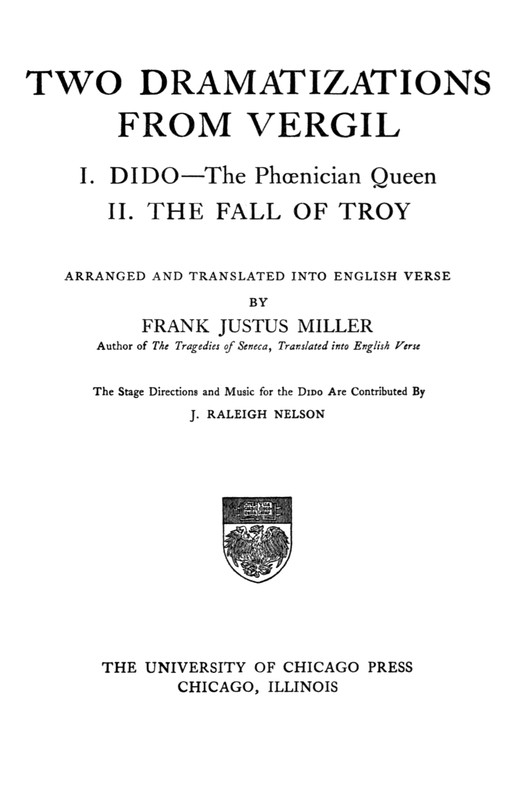
Two Dramatizations from Vergil: I. Dido—the Phœnecian Queen; II. The Fall of Troy

Chapter 27: INVOCATION
Open in WeRead

About This Book

A volume presents two stage adaptations drawn from Virgil’s epic: one dramatizes the tragic love between a Trojan exile and the queen of Carthage, tracing their meeting, passion, and the doomed fallout imposed by fate; the other stages the fall of Troy, concentrating key episodes of siege and destruction. Both are rendered into English verse with added lyrics, stage directions, and musical accompaniment for performance, condensing epic narrative passages into theatrical scenes and emphasizing dramatic speech, action, and scenic suggestions intended for classroom or stage presentation.

Sweet pledges of my lord, while fate and god allowed,
Accept this soul of mine, and free me from my cares.
For I have lived and run the course that Fortune set;
And now my stately soul to Hades shall descend.
A noble city have I built; my husband’s death
Have I avenged, and on my brother’s head my wrath
Inflicted. Happy, ah too happy, had the keels
Of Troy ne’er touched my shores!—And shall I perish thus?—
But let me perish. Thus, oh thus, ‘t is sweet to seek
The land of shadows.—May the heartless Trojan see,
As on he fares across the deep, my blazing pyre,
And bear with him the gloomy omens of my death.

She rushes forth from the chamber in her frenzy. The sailors’ chorus is repeated fainter and fainter. In a moment her death cry is heard. The servants rush in, and finding their mistress gone, hasten in the direction of her cry. Their lamentation is heard. They return bearing the body of the queen upon a couch. She has fainted, and upon her bosom the wound shows red and terrible. Anna enters, beside herself with grief.

Anna, kneeling beside the couch, addresses Dido, who revives enough to smile upon her sister (676-685):

Was it for this, O sister, thou didst seek to hide
Thy heart from me? Was this the meaning of the pyre,
And this the altar fires? What plaint in my despair
Shall I offer first? And didst thou spurn me, in thy death?
Thou shouldst instead have bidden me to share thy fate;
The selfsame moment should have reft the lives of both.
And with these impious hands did I thine altar rear,
And with this voice unto our country’s gods appeal,
That, heartless, I might fail thee in this final hour?
O sister, here hast thou destroyed thyself and me,
Thy people, thy Sidonian fathers and thy realm.
With soothing water let me bathe her flowing wounds,
And if there hovers on her lips the fleeting breath,
With my own lips I claim it in the kiss of death.

The sailors’ chorus sounds in the distance. Aroused by this, the dying queen half raises herself upon the couch. The servants throw open the casement and the Trojan ships are seen far away, sailing off over the sea.

Dido falls back lifeless. Curtain.

MUSIC

SONGS

  PAGE
Prelude 57
 
The authors are indebted to Professor A. A. Stanley of the University of Michigan for the accompaniment to this air.
 
Hymn to the Dawn 61
 
Invocation 69
 
Song of Iopas 72
 
Slumber Song 81

PRELUDE

To be sung in unison before the curtain.

HYMN TO THE DAWN

Act I. Scene 1
Chorus of Carthaginian Maidens

INVOCATION

Act I. Scene 3

SONG OF IOPAS

Act I. Scene 3
Adapted from Chopin, Nocturne in G minor

SLUMBER SONG

Act IV. Scene 3 Chorus of Maidens
Words from Tasso; Ger. Lib. II. 96