
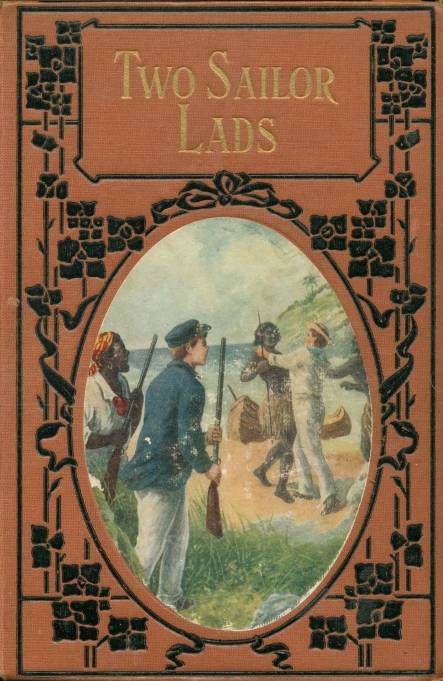
"What a mercy the monster didn't fall on us. Where would we have been, Fred?"
"Look there," said Fred, pointing over the gunwale.
Frank gazed fearfully in the direction indicated. Two monster tiger sharks were floating quietly about near the boat.
Suddenly Fred sprang to his feet.
"Oh, men," he cried, "where is the dog? Where is poor Hurricane Bob?"
The question was by no means difficult to answer. Without doubt in the extremity of his terror he had sprung overboard, and been instantly devoured by the sharks. What a sad and sudden ending to a moonlight concert!
Bob was a favourite, not with Cassia-bud only, but with everybody, and to lose the noble fellow, and lose him thus. It was altogether too shocking to think about!
Straight away for the shore they rowed now, but in silence all. They had received a shock that it would take weeks to get over. Not from the terror of the apparition, but from the loss of the honest dog, who had really come to be considered one of themselves.
Their astonishment and delight therefore may be better conceived than described, when, as soon as the boat rasped upon the silvery sand, Hurricane Bob himself came joyfully bounding and barking to meet them.
Instead of attempting to get into the boat again he had simply headed away for the beach, and landed in safety. But, strange to say, the dog from that day forward could seldom be prevailed upon to go even a little way into the water, and when taken anywhere in the boat he invariably crouched down beneath the thwarts, lying there quietly until once more safe on shore.
But the adventure of this evening quite cleared up the mystery, of Cassia-bud's "debbil with nuffin but his head on."
CHAPTER XXIII.
A SWIM FOR DEAR LIFE—PURSUED BY SHARKS.
As long as the moonlight lasted the evenings were very pleasant indeed, and every night Fred, Frank, and Quambo went out for a row and a song. Hurricane Bob begged so earnestly to be excused that it was thought best to leave him on shore.
Magilvray and Cassia-bud also expressed themselves as perfectly content to take a back seat at the evening concert, or, in other words, to lie on the beach and listen there. Probably they thus had the best of it; for the sound of the singing floating over the water was weirdly tremulous and beautiful.
The singers, however, thought it safest to keep well away from the reef. There was something decidedly uncanny in the sight of that black and terrible apparition springing over the reef. Besides, as Frank said, if that was the brute's usual way of coming home of an evening, the wisest plan was to give him a wide berth. Explorations of the island, which was many miles in extent, took place every day. These little excursions formed a very pleasant way of spending the greater portion of the day, there was so much that were strangely foreign and beautiful to be beheld, and so many pretty peeps of scenery. The whole island, indeed, and everything in it, was as different from anything that Fred and Frank had seen before, as if it had been part and parcel of some other planet.
Sometimes it was Cassia-bud who came with them, at other times Quambo or Magilvray, and sometimes it was Hurricane Bob only. Whoever stayed at home had to cook the dinner, and just as often as not had to catch it also.
Cassia-bud was the fisher-boy par excellence. He was never better pleased than when out on the water all by himself, armed with rod and reel, or with hand-line only! His whole evenings used to be devoted to the study of bait, and when he went fishing he seemed to know the very spot at which to sink his line in order to procure some particular kind of fish.
He found several species of skates and rays, a huge kind of conger-eel—the first he caught frightened poor Cassia-bud, and almost as much as "de debbil fish" had—many other nameless and curious fishes, all good to eat, and mackerel. These last were not such as we in England are used to, but cooked as Quambo cooked them they were very delicious indeed. They were very numerous too in some parts of this reef-locked bay, and Quambo's plan was to start Cassia-bud out to catch two or three just half an hour before dinner, and pull on shore with them immediately. The fish were killed and cleaned, then cut up the back after the fashion of kippered salmon, and roasted before a clear fire. Served hot then with the acid juice of a species of lemon that grew on the Isle of Good Hope, they made a dish that might have graced the table of a king.
About every second day a visit was paid to the top of Beacon Hill, and the horizon eagerly scanned for sight of some passing vessel. Had any such appeared a huge pile of brushwood, both withered and green, would have been kindled in hopes of attracting attention. But days and weeks flew by and no sail was ever sighted.
When men are stranded on an island as our heroes were, it is always the first month or six weeks that seem the longest time. After this the Crusoe or Crusoes settle down more, and the time flies more quickly on.
As to reckoning the days, Fred and Frank were not reduced to the necessity of notching a tree, for one of them happened to possess a note-book with an almanack in it, and every noon one day was ticked off.
Of wild beasts the island possessed not a single specimen, but a curious kind of coney or cavy, they could not tell which, even after Cassia-bud one day succeeded in shooting one with a bow and arrow he had made. Cassia-bud roasted the beast and ate it for supper, for the lad had a wonderful appetite. Bob enjoyed the bones.
"Was it nice?" said Frank. "Did you enjoy it, Kashie?"
"Oh, sab, he just too awful jolly for anything!" replied the boy, licking his lips and rolling his eyes.
"Well, Kash, you must shoot some more you know, and then perhaps we'll all have a taste."
These creatures were to be found in very great abundance on one particularly rocky glen, where they had their burrows.
On the very next morning, after receiving his commission, Cassia-bud and Hurricane Bob both disappeared in the woods, and about noon emerged again, Bob carrying a coney that he himself had captured, and Cassia-bud carrying four.
"Bravo!" cried Fred, picking the lad up as soon as he had thrown down his burden; "now for a game of live-ball to make Kashie hungry."
"Play!" he shouted, pitching the little laughing black ball of a boy towards Quambo.
"Play!" cried Quambo, throwing him to Magilvray.
"Keep the pot a-boilin'," roared Magilvray, and next moment Frank had caught the lad and pitched him back to Fred.
They kept the game up for ten minutes. It was as good as dumb-bells, Fred said. The rule of the game was, that when anyone dropped the live-ball on the sand he was to stand out. At last there was nobody in except Quambo. He hoisted Cassia-bud right up on his shoulders, and there the boy stood erect while the giant went capering up and down the sands, with Hurricane Bob barking around them for joy.
Well, Cassia-bud's conies, or cavies, proved most delightful eating, and were quite a change from fish fish, fish morn, noon, and night.
But it must not be supposed that because there were no wild beasts in the island, there were no wild adventures to be had. No; for there was the sea, and adventure is inseparable from the briny ocean.
It would be difficult indeed to say how many different species of sharks there were in the bay. Quambo was rather an authority on the natural family Squalidæ, and both Fred and Frank had seen a shark or two in their time. Well, there were at all events the blue shark, the basking shark, the white shark, and the most dread monster of all, the tiger shark. This last was admitted by the other species to be facile princeps, for whenever one appeared the others modestly retired.
Strange as it may appear, Cassia-bud had not the slightest fear of these awful demons of the sea. But an adventure he had one day while fishing was surely enough to scare the senses out of any boy one whit less brave.
He was fishing as usual one afternoon when Fred and Frank had got home earlier than usual from their woodland rambles, and were lying on the sands watching his sport. The boy had caught about a dozen or more good-sized fish, stringing them one by one as he did so on a long, supple wand, that after he landed he could carry across his shoulder—so many fish behind, so many in front of him. Every now and then near Cassia-bud's boat the ominous-looking fins of a huge shark could be seen protruding from the water. The very sight made Frank's spine feel cold.
Suddenly, to their horror, they noticed that in leaning over the gunwale of the gig and hauling in his line, to which it appeared afterwards a huge conger was attached, the boat was capsized, and with a frightened scream Cassia-bud was precipitated into the water. Probably there is not an English boy who lives that would have done what this negro child did then. He seized his stick of fish, and commenced swimming rapidly shorewards. For a moment or two perhaps the sharks were frightened off, but they were speedily in pursuit of the boy. One, two, three, four great fins could be counted in his rear.
Both Fred and Frank started to their feet, and stood staring, speechless and aghast. They would have given a good deal could they have turned away their eyes from watching the threatened tragedy. On and on came the black, round head, with the frightened face and rolling eyes, and on and on came the sharks.
The onlookers marvelled, however, to notice that every now and again the pursuing sharks paused, and their heads seemed to be turned towards each other. But only for a moment or two; then they speedily took up the chase again, but only to pause as before.
Nearer and nearer comes Cassia-bud. Greater and greater becomes the suspense of Frank, Fred, and the others.
Will he be saved? Can he be saved? Is it possible he can elude his fiendish pursuers?
But now a new feature is added to the terrible interest of the scene. With a howl of rage and terror, Hurricane Bob comes dashing down the beach, and with a plash springs far into the sea.
Cassia-bud is not twenty yards away when the dog meets him, and tries to seize him by the shoulder. But the boy throws his arms around Bob's great neck, and in half a minute more both are safe and sound on the silvery sand.
And Hurricane Bob shakes gallons of water out of his hide, the spray of which makes a circular rainbow in the sunshine; and Cassia-bud stands there all white teeth, smiles, and dimples, holding up a solitary mackerel.
"On'y one po' fish," he says, "left out ob all dat lubley stickful! On'y one, sah, but I stick to he!"
"But how could you have escaped, my poor boy?" said Fred, who was trembling all over.
"Simply dis," said Cassia-bud coolly, "I feed de sharks all de time I keep swimming, one fish at a time, you see, massa. De shark say all de time day chasee me, 'Go on, little nigger-boy, gib us anoder fish, and we won't eat you.' Soon's all dey fish is done den de sharks gobble de poor boy up plenty quick."
"But weren't you dreadfully frightened, Kashie?"
"I dessay," said Kashie, "I'se looking radder pale, cause I 'llow I'se a kind o' sceered."
The idea of Cassia-bud turning pale with fear was so ridiculous, that both Fred and Frank burst into a fit of hearty laughing, and so happiness was restored once more.
After shaking another gallon of water out of his splendid coat, and making another rainbow, it seemed suddenly to occur to the noble dog that his little friend Cassia-bud really was saved, that the sharks had not eaten him up; and he was so overjoyed that, after taking his tongue across the nigger-boy's ear, he set off to allay his feelings in a mad circular gallop all around the silvery sands. Round and round he flew, and when he was too tired to run any longer, he sat down beside Cassia-bud and barked at the sea.
It really looked as though he was barking defiance at the sharks, for between every volley of "wowffs" he turned round and licked Cassia-bud's face, as much as to say, "Those awful fishes were going to eat my little Cassia-bud; but they haven't got him yet, nor won't."
It is needless to say that the negro lad was one of the heroes at dinner that day, and Hurricane Bob another. For it was evident that Cassia-bud had meant to hold on to the last fish; and it is just as evident that this resolve on his part would have cost him his life, had not Hurricane Bob dashed bellowing into the water at the moment he did.
However, all's well that ends well.
About an hour afterwards the boat and the oars also were picked up on the sands.
CHAPTER XXIV.
STINGAREE.
The love for adventure, which four years of a roving life in so many parts of the world had engendered in both Fred and Frank, was not to be bounded by the coral reef that shut in the bay near which they were encamped. So whenever there was a breeze with perhaps a bit of sea on, the Crusoes hoisted sail and, steering through the gap, went off on a long delightful cruise around the island or far beyond it.
On these occasions Magilvray and Cassia-bud were usually left to keep camp.
More than once, however, the boatmen found themselves benighted, and had to pass the long hours of darkness on some lonesome part of the coast, to the no small anxiety of those they had left behind them.
On one of these expeditions they had a strange and wonderful adventure with the dreaded stingaree, or huge sting ray of Pacific seas. While out boating Fred had several times come across these veritable "sea devils" floating on the surface of the water, and the desire to capture a specimen got possession of him. It would form a desirable change of diet at all events, for the red flesh of this fiend-fish is said to be exceedingly palatable.
These "terrible skate," as Frank termed them, grow to an immense size, some being as much as twelve feet long without the tail, and nearly ten feet in breadth of beam. The strength of a monster like this is truly astonishing. But the stingaree is armed with a dart and spines in his tail that make him the most dreaded of all fish that swim.
Some species have but a single barbed dart at the end of the tail. If a human being is struck with this in the body, there is no chance of life left; for the dart is poisonous, and a painful, nay even agonizing, death is the only result that can be looked for. If the dart has struck the arm or leg it breaks off, and if it be not cut out from the other side the flesh soon mortifies, and the unhappy man dies more lingeringly.
But this creature, at least one species, has also the power to shoot poisoned spines or darts at his foe, and these latter can pierce even a boat, so hard and strong are they. One would have thought that monsters like these were best left alone. Fred was of a different opinion quite.
So all preparations were made to go on the war-path after them.
Quambo was for many evenings busily engaged fashioning the harpoons from a species of very hard wood found in the island, rendered doubly hard by being half burned in the fire. He also made several long spears from the same tree. To one of these he attached a strong double-edged or dagger knife.
Assisted by Cassia-bud, Quambo also made a large number of fathoms of stout rope from fibrous stuff obtained from the cocoanut and pandanus trees.
All being ready the boat was watered and provisioned one evening, and next day at early dawn, and after a still more early breakfast, they put to sea in quest of adventure.
There was the slightest bit of a breeze on; just enough and no more to fill the mainsail, and keep the boat moving along at the rate of about five knots an hour. But there certainly was no occasion for hurry, and the wind was rather disadvantageous than otherwise, for it roughened or rippled the water, thus distorting the vision very much when they attempted to look at anything under it.
While sail was on her, Quambo stood in the bows on the outlook, Frank managed the sheet, and Fred had the tiller.
They had sailed half way round the island, on tack and half tack, and were preparing for a run the other way, and standing more out to sea, when suddenly Quambo's great bulk was seen to rise more erect and to quiver about, as he grasped his harpoon. He looked indeed like a tiger about to spring on his prey. Without turning round he motioned with his left hand to Fred which way he should steer, and next moment, with a whirring sound, the harpoon flew seaward from his right.
There was the sound of a dull thud; Frank grasped the gunwale of the boat, prepared, as he afterwards said, for anything.
In a few seconds Quambo drew in his line, and bursting into a loud laugh at his own expense, turned about and showed his shipmates the harpoon broken right across the centre.
"No good, then," said Frank, "after expecting such wild sport and such a capital dinner?"
"No, sah," answered Quambo, "not much good. I think I see one big stingaree, and let fly. All de same, sah; I strike the back ob one big turtle."
Fred and Frank both laughed.
"Better luck next," said the former.
"Perhaps," said Quambo; "but I not like de wind. He make too much bobbery on de water all de time, and I not can see."
But early in the afternoon the wind went down, and the water became as calm and still as a fish-pond. Sail was taken in and stowed, and Frank got out the oars.
Whole shoals of turtle were seen, but no rays, no stingarees, so they consoled themselves with dining, and after a drink of cocoanut water, Frank resumed the oars, and Quambo, smoking his huge pipe, once more took his station at the bows.
The afternoon wore on, the sun was declining in the west, and they were all beginning to show signs of weariness, for the day had been drowsily hot, when once more Quambo stood erect, grasping a fresh harpoon, and signing to Fred as before.
There was no mistake about the stingarees this time. The boat seemed to be in the midst of a huge shoal of them, and in a moment Quambo had hurled the harpoon into one of the very largest.
The commotion that ensued baffles description. The huge brute seemed for a time to be right under the boat, and almost lifting it up. Then he darted ahead, and the appearance of the creature now was terrible in the extreme. He had come right up to the surface of the sea, which was red with blood, while not only was the water lashed into foam by the dart-armed tail, but by the fins or wings at each side.
If ever any creature in the world merited the name of sea devil, it was that monster stingaree just then.
Meanwhile Quambo was making lunges at it with his dagger-pointed spear. This seemed to lash the monster to fury at last, and after a dreadful struggle or two to free itself from the galling harpoon it plunged forwards and stood straight away out to sea.
* * * * * *
Now as the day wore on, after putting the dinner all ready for cooking—for our heroes were expected to return to the island before sun-down—Magilvray, with Cassia-bud and Bob, determined to walk to Beacon Hill. The road now was easily found, and in less than an hour they had stationed themselves beside the broomstick, as it was called, whence Magilvray could sweep the horizon with the spy-glass. They were just in time to see the striking of the stingaree, and witness the monster's fearful struggle for freedom. Then they saw it dash away seawards, pulling the boat behind it as a salmon might the float of a fishing-line.
They saw Quambo's efforts to round in the line in order to be able to ply his dagger-lance once more; then they noticed that the stingaree seemed suddenly to change its course. They saw Quambo cut the line, but almost at the same moment the boat turned turtle, and its occupants were thrown into the sea.
"Oh, oh, oh!" shrieked little Cassia-bud. In his agony he ran round and round the beacon, then threw himself on the dog, frantically weeping.
"Oh, golly, golly!" he sobbed. "Poor massa, for true, dey will all be drown. De big shark will gobble massa up plenty quick. Oh, I not can look no mo'! I not can look no mo'!"
Not heeding the boy's lamentations Magilvray sat there as if rooted to the spot. He saw the boat still afloat there, bottom upwards, with Fred and Frank clinging to its keel, after many ineffectual attempts to right it. He saw big Quambo swim after an oar, and picking it up come with it to the bows, and tie it with the others to the painter; and he could not help admiring the giant negro's wondrous coolness in what appeared to be the hour of death.
Then a long, very long time seemed to elapse without any change of scene or situation.
Was the boat drifting nearer to the island shore he wondered, or being carried further out to sea? At all events the poor fellows that clung to her keel must soon sink exhausted beneath the sea, or—and the thought made this sailor's blood run cold—they would be hauled under water, one by one, by the sharks, and torn in pieces.
Lower and lower sank the sun. It was already beginning to shimmer red across the sea.
But what was that moving slowly towards the upset boat and the clinging men? He brought the glass to bear on the spot.
Horror! it was the dark triangular fin of a huge blue shark, and it was moving in the direction of the boat—nearer and nearer. Not always in a direct line though, and often remaining for a time immoveable, as if picking up the scent.
Magilvray felt as if under the spell of some fearful nightmare. Then he sprang to his feet and closed the telescope with a snap.
"I shall go mad, mad," he cried, "if I gaze but a minute longer. Come, Kashie, come."
"Is it all ober, Mac?" cried the boy pitifully.
"Yes, Kashie, all over, boy, and we are alone. Come, boy, come."
The sun shot one blood-red glare across the world of waters, then sank, and all was gloom and night.
* * * * * *
Neither Magilvray nor Cassia-bud could ever explain how they found their way back to camp that evening, through the rocky glens and the darkling forest. Perhaps they were beholden entirely to the dog.
But they did reach the beach at long last. The fire had gone very low, and hardly knowing what he did the sailor made it up and sat down near it, while Cassia-bud threw himself moaning on the sands. Hurricane Bob, satisfied in his own mind that the boy was ill or in pain, lay down beside him, and gently licked his face and hands.
Dinner was not even once thought of—grief was all-absorbing.
After a time Cassia-bud probably slept, for he lay there very still and quiet. But Magilvray still sat in the same position, dazedly gazing at the flickering fire.
A bright moon, that had been high in the heavens when the sun went down, sank lower and lower, and at last disappeared behind the western waves, and the clear stars had the sky all to themselves.
Not a sound now was to be heard, save the moan of the breaking water on the reef, and occasionally the eeriesome cry of some belated sea-bird.
Why, I have often wondered, are sea-birds sometimes to be heard at the dreary hour of midnight? What takes them away from their rocks at such a time? and in the darkness too. Sailors shudder when they hear them.
It is not the call of birds, they will tell you, but of disembodied spirits.
Magilvray half roused himself at last; but he sought not the shelter of the friendly boughs. He only crept a little closer to the fire, shuddering slightly as if cold, then exhausted nature claimed her due and the sailor slept.
CHAPTER XXV.
"ROW, BROTHERS, ROW"—QUAMBO'S SHARK
STORY—FAST TO A SWORD-FISH.
The night wore on apace. It must have been well into the middle watch when there began to mingle with the toilsome dreams of the grief-stricken sailor the melody of song, and the sound of oars keeping time to the rhythm.
He woke up at last.
Cassia-bud was also awake, and both were sitting up, straining their ears to listen.
Yes, there it was again sure enough, very faint and far away certainly, beyond the reef, but, borne along towards them on the air of night, it was plainly audible.
"Row, brothers, row, the stream runs fast,
The rapids are near, and the daylight is past."
The song really appeared to come from the sky itself, and in the sky Cassia-bud evidently believed it was.
"O Mac," he said tremblingly; "I'se dreffully frightened. I'se as pale as def (death) with fear. Po massa! dat song he lub so much when he libin', and now, Mac, he am dead and is singin' same song in hebbin. Po massa!"
The music ceased at last, and there was a pause; then it once more rose on the air, but higher and nearer, and a song of a different sort. "Auld lang syne," to wit.
"And surely ye'll be your pint-stoup,
As sure as I'll be mine;
And we'll spend the evenin' thinking, boys,
Of auld lang syne."
"No Kash," cried Mac joyfully; "it aint in heaven they are. 'T aint blessed likely there'd be pint stoups in heaven. And I don't think they're ghosts at all."
He jumped to his feet.
"Speak, Bob, speak, boy;" he said to the great dog.
Hurricane Bob required no two tellings; he barked till reefs and hills re-echoed back the sound.
Then cheering was heard from seaward, which Magilvray and Cassia-bud gladly returned, and soon something dark appeared in the reef gap, and in about five minutes more our lost stingaree hunters were standing on the beach, receiving the congratulations of their friends, whom they had never expected to see again in life.
"Oh, Kashie is so glad now, massa!" cried the nigger boy. "I jes want to run and shout all de while. And you is sure you is alive, massa?"
"I believe so, Kashie."
"And de sharks not hab done gone gobble you up for true?"
"Not one of us. And now, lads, stir up the fire, and let us have supper, we're dying of hunger. That's what's the matter with us now."
"Shall we cook ye a slice o' stingaree, sir," said Magilvray slyly.
"Oh, bother the stingaree, Mac! Don't chaff us about the beast."
"No more stingaree for me," said Frank; "not even a little bit."
Mac was very busy now, and as he set about cooking the supper Fred told him how they had escaped.
They had heard the sharks splashing near them in the darkness; then, in an agony of fear, they made one more despairing effort to right the boat, and succeeded. Fred and Frank got in first, then Quambo.
"So you see, Mac, we've disappointed the sharks for once, and done them out of a good supper, and now we're going to make a good supper ourselves."
* * * * * *
One evening, about three weeks after the adventure with the stingaree, as they all lay round the fire, and Quambo and Mac were blowing great curling clouds of the wild tobacco, the smoke from which, however, was not considered Rimmellian by either Fred or Frank, said the latter:
"D'ye know, lads, that I think flying fish is about the nicest fish in the sea—to eat I mean?"
"Well," said Fred, "I think Kashie here might catch some."
"Fly fish?" said Cassia-bud. "Oh, massa, you expects po' Kashie to catch the big debbil dat fly over de reef, with nuffin but his head on. Kashie not can do."
"No, no, Kashie. It is the little flying skip-jack business I mean."
"Oh, I see, sah! de flying herrings, sah?"
"A good name too. Well, Fred, do you know that a flying fish once saved my life?"
"Ah! a story? Eh? Out with it, Frank. 'Saved by a flying fish: a tale in two chapters; or, a romance of sea life!'"
"Well, lads, you'll admit there isn't much romance about it when you hear it. Scene first then opens with me lying sick and ill in a hammock on deck, on board the old Resolute. We were at sea you know, and a long way from land. I must say the skipper was just as kind to me as he knew how to be. He used to bring his bottle of rum on deck, and sit beside me and drink it for company's sake like; for you know I wouldn't have any. He was a very straightforward chap that skipper, I hope he is still alive and afloat, though I doubt it very much. 'If ye're so grand as not to drink the rum, young man,' he said to me sometimes, 'why I guess the next best thing you can do is to lie there, and see me drink it.' Well, until I gave up eating entirely the skipper had good hopes of me; but when I lay in my hammock as weak as a baby, and couldn't pick a morsel of salt junk or dried cod, then he told me plainly there wasn't a ghost of a chance for me.
"Then we got becalmed, and there was a blue shark, about twenty feet long, kept close to the ship all the time, waiting and watching.
"'He's waiting and watching for you, young man,' the skipper told me, consolingly. 'He's a fine big beast, and you'll fit in there nicely! Now if you've anything to say, or if there's anything you'd like done arter your de—mise, you had better speak now, for I calculate ye haven't got more'n a day to get ready.'"
"Oh!" I groaned, "if there was anything I could eat I think I'd get round even yet."
"'Well,' he said, 'we're having jest the nicest bit o corned horse and sauer-kraut for dinner ever ye smelt. It's just stale enough to be tender. If ye can't tackle that I guess ye ain't much good any more!'
"That is chapter first, Fred, and now for the romance. I was lying in my hammock, dozing I think, that same evening, only looking up at the clear bright stars now and then, and wondering how far heaven is beyond them, and if I shall know my dear father when I meet him there, when all of a sudden some cold splashy thing jumped right against my face, then commenced a very lively dance on top of the hammock. It was a flying-fish."
Frank paused.
"Well," said Fred, "but I don't see where the romance comes in, or how the creature saved your life."
"Why, man alive, I ate it!"
"You eatee he alive, sah?" cried Cassia-bud.
"No, Kash, I had it cooked; and it was the most delightfully tasty and toothsome morsel ever I put inside my lips. Another was caught next day, and lots more after; and I grew better from that very night, and so that also was a disappointed shark."
"Ah! yum! yum!" said Quambo, "dey is good food. I likee some now. Yum!"
"What, flying-fish, Quambo?"
"Oh, no, sah, de shark!"
"Well, Quambo," said Fred, "you can catch some for yourself, only you'll have to dine all alone when you have shark for dinner."
"When I a leetle boy," said Quambo thoughtfully, "I catchee plenty big shark—I and some oder nigger-boy, and two, tree, four nigger-men."
"Now for Quambo's story," cried Frank. "Heave round with your yarn, Quambo, lad."
"I lib along o' my ole mudder in Africa befo' I go to de States. On de Gold Coast dat were, gen'lem. Shark plenty value dere. Good fo' food and good for de skin, wot we cure and de white man buy.
"Plenty reef on dat coast, gen'lem. Well, we go close to de reef, all same's we were de night de big black head jump ober and swamp de boat. We go close to de reef. Den we hab one long strong rope wid a runnin' noose on de end o' he for to catchee de shark."
"Certainly, Quambo; but tell us the modus operandi."
"What ship's dat, sah?"
"I mean, how did you catch the beggars, Quambo?"
"Bery easy, sah, indeed. You see de sharks mos'ly goes to sleep in de middle ob de day. Dey creep into de coral caves. All de same, sah, de tail all lef stickin' out ob de holes, you see."
"And do you mean to tell us, Quambo, that you went and pulled their tails?"
"Not quite, sah Quambo not quite so big a fool as dat. But I myse'f and two more tiny boys go dive down, and plenty quick Quambo slip de noose ober a tail, den signal. De noose he tighten now, and de shark is pull right out and lift up all de way to de boat. How dat shark do squirm to be sure! When de man in de boat hab kill he propah, den down Quambo go again."*
* This is no sailor's yarn. This terrible mode of catching sharks is really adopted in the South Sea islands and elsewhere.
"Well, Quambo, that is very awful, if true."
"Oh, he true, sah! I gib my word of honah on dat, sah."
"But, Quambo, did the sharks never retaliate?"
"Yes, sah, de shark 'taliate my leetle brudder, sah. I see my brudder try to make fast to one bery big tail. He not can do. Den de owner of dat big tail come out plenty quick. I dive up, sah."
"An' your brother, Quambo?"
"Oh, I guess, sah, he dive down. I hab no mo' leetle brudder after dat. I spose he 'taliated."
* * * * * *
But flying fish were very plentiful round the island, and I think Cassia-bud must have lain awake a whole night trying to find out a plan to get some. He was completely successful. A kind of big butterfly neb was manufactured by Quambo and him. This was part of the flying-fish tackle, but not all. It is a well-known fact that flying fish will come towards a light held near the surface of the sea at night. Now it only remained to manufacture a torch, and Quambo came to the rescue.
In the South Sea islands one of the most lovely trees that grows in the forest is the Dooee-Dooee or Candle-mat tree. The broad silvery-green leaves, and the bunches of charmingly white and shapely flowers, render it an object of great beauty, especially if it stands near other trees of a darker green. The nuts that grow on this tree are heated, then cracked to get the kernel out. These kernels are strung together like beads, and the strings of kernels tied round with bark, and lo! the candle is complete.
So Quambo and Cassia-bud started out together one night, and splendid sport they had, and just as splendid a breakfast next day; for nothing could exceed in flavour the flesh of those flying fish.
But as often as not now Fred and Frank used to go after the flying fish together.
One night Quambo happened to be in the boat, and it was well he was, else an adventure that befel our heroes would, in all probability, have had a sad termination. On this particular evening flying fish were very numerous; and while rowing on a spurt after a shoal, suddenly the boat seemed to strike a rock, with such violence too as to throw both Fred and Frank over the thwarts. It was no rock, however; for immediately after the boat was shaken with terrible violence, and several times all but capsized.
Luckily, Quambo was equal to the occasion. He was forward in the bows, and lancing and lunging at the enemy—an immense sword-fish—almost before our heroes had time to gather themselves up. Suddenly the boat was pulled almost under water by the head; then there was a dull report, and she was free from the monster, and slowly righted herself once more.
She was now making water so fast that it was deemed prudent to get on shore with all speed. So her head was turned towards the gap in the reef. Quambo kept bailing all the time, and Fred and Frank rowed as they had never rowed before. They got her run up at last on the sandy beach; but it took all hands three whole days to make good repairs, for it must be remembered they had no tools worthy of mention to work with.
Little did they imagine, however, that they would soon be possessed of tools enough and to spare.
CHAPTER XXVI.
"WHAT WAS THE MYSTERY SURROUNDING THAT STRANGE VESSEL?"
In the isle of Good Hope clumps of fine cocoa-nut-trees grew close to the sandy beach, and single, very large, pandanus, trees not far off. This pandanus or screw pine I have already mentioned; it is a truly marvellous tree, and bears truly marvellous fruit or drupes. This fruit is treated in various ways, and after a time a taste for it is acquired, so that it becomes quite an article of diet, and is relished even more than cocoanut; for this soon palls on one. But even the flowers of this tree are edible, at least Quambo and Cassia-bud found them palatable enough, though the others much preferred their perfume. Quite a quantity of the leaves of the pandanus were cut down to be used as thatch for the huts. They are long, strong, and tough, and being fastened on with string make very excellent thatch indeed.
It is in connection with this tree that I have now to relate an adventure, which it will be owned was of a very startling character indeed.
About two hundred yards from the camp, and about seventy from the beach, grew a clump or grove of pandanus. Some of the trees therein were very tall and spreading, and in addition to their aerial roots had let down props or stays from the upper branches to help them to sustain the weight of the branches. It was up these prop-roots that Quambo or Cassia-bud used to shin to cut down leaves or flowers.
It was the custom of Fred and Frank, of an evening after dinner, to take a walk back and fore on the sand, and they were usually accompanied by Cassia-bud and his friend Hurricane Bob.
One evening while strolling quietly in the clear starlight towards the pandanus grove they were surprised to see the great dog suddenly pause, and pointing towards the dark trees utter a low and ominous growl; but they were still more astonished, and not a little frightened, to note almost immediately after what appeared to be the form of a gigantic man stalk from out the shadow, and walk with a curious rolling shambling gait towards the sea. About half-way down he stopped, standing out clear against the snow-white sands, and fiercely waved his long arms in the air, but made no sound.
A more awful apparition it would be difficult even to imagine. Cassia-bud dropped half dead with fear on the sand, uttering only a sound that was half cry, half moan, as from one in a nightmare. Both Fred and Frank experienced a fearful kind of impulse to rush towards the terrible being, but next moment it dashed on towards the sea, into which it threw itself with a loud splash.
"In the name of heaven," cried Frank, "who or what was that?"
"Some dreadful mystery," replied Fred, "that I cannot solve. Come," he added, "you are superstitious, Frank."
"I am, for once in a way, Fred. If that wasn't an evil spirit, then no such being exists in the world, What did it seem to you like?"
"Well, you know the awful water fiend or kelpie, that is supposed to haunt deep, dark mountain lochs in the Scottish Highlands, and often, they say, carries away children and women to devour at the bottom of the lake. He is a hideous, tall figure, but with wings like a bat, that stretch 'twixt arms and legs. Frank, we have seen a water kelpie!"
"May the Lord be near us, Fred. I never felt so frightened in all my life."
They went slowly back to camp, giving many a furtive glance behind, for more than once they thought they could hear the sound of footsteps stealing softly up behind them.
They slept in their green tent that night, making a big fire up near the mouth of it, and more than once Cassia-bud started and screamed in his sleep.
But they were not molested, and the sun was shining very brightly indeed when they awoke, and Quambo proceeded to cook breakfast.
The first thing Fred and Frank did after their morning meal was to walk, somewhat fearfully it must be confessed, towards the pandanus grove.
They half expected to see human foot-prints in the sand. There was a trail across the beach, but no impression of feet of any kind, and this fact deepened the mystery that hung around the dread apparition.
That day Quambo ascended a pandanus tree to throw down leaves and flowers. These last are of a yellow or lemon colour, and look sweetly pretty against the dark-green of the long, screw-like leaves.
Quambo busied himself culling flowers for some time, then he hailed those below sailor-fashion.
"On deck dere, gen'lems!"
"Ay, ay, lad," cried Fred.
"Somebody else been heah las' night sah, gaddering flowers foh true."
"Who? what, Quambo?"
"Dunno, sah; surely de debil himse'f, sah."
That night all hands went along the beach and waited quite a long time, but the kelpie failed to put in an appearance.
Next evening it was suggested they should hide in the bush—not certainly in the grove itself. So here once again they waited and watched.
Nothing came out of the sea; but before they had been in hiding for half an hour they heard noises in the trees that convinced them the creature was there. Almost at the same time the dog barked loud and angrily, and something dropped with a dull, heavy thud to the ground.
As if by one impulse, but with Quambo firmly holding the dog by his collar, lest he might force the fighting with the awful unknown, they dashed forward. The creature could be distinctly seen against the background of sand, and strange to say it assumed various shapes, and moved but slowly away, as if in anger. At one moment it was the tall, dark kelpie-like monster waving its arms in the air, next it took the appearance of a huge frog, and immediately after rolled seaward in the form of a gigantic wheel. There was the same splashing noise when it took the water as before, and though they sat on the beach for a fall hour after this it made no further signs.
The kelpie, as Fred persisted in calling it, appeared many times after this, always coming from the pandanus grove, and it was not until one bright and radiant moonlight night that our heroes found out what it actually was.
They had been out after flying-fish, Quambo being in the boat, when it occurred to them to land near the grove. The boat was pulled cautiously near to the beach, and while Fred and Frank lay on their oars the giant negro stood forward in the bows with his terrible lance.
"Stand by," shouted Fred shortly after, "yonder is the kelpie. It is coming straight for us!"
So it did, and the boat was beached almost on the creature, which had come rolling like a wheel towards it.
A triple attack was made on it; Fred and Frank with oars, the huge negro with his lance, while armed with another spear Magilvray rushed along the beach and attacked it from the rear.
But the oars were seized and twisted in our heroes' hands, even the gunwale of the boat was grasped by those awful arms.
They knew now, however, what they were fighting with. It was no fiend or kelpie, but a huge specimen of the gigantic octopus, kraken, or devil-fish of southern seas.
It was literally hacked to pieces before it could be killed.
Lying on the beach there next day, with its mangled body, awful face, and snake-like arms, it had really a terrible appearance, and reminded Fred of some of the pictures of Doré's monsters in Dante's Inferno.
* * * * * *
The castaways had now been over six months on this lonely island, and all that time had never seen a ship or sail of any kind.
How much longer they were to remain prisoners no one, of course, could even guess.
"Surely," they thought, "some day some ship must come."
Yes; and one day a ship did come,
Summer and autumn had ended. It was winter now, if the name can possibly be applied to such a climate as this. The time was June anyhow, which is midwinter in these regions, and it was the season of clouds and storms and dense fogs at times.
They had fully prepared for it, however, having greatly strengthened their hut, and thatched it round and round with pandanus leaves and cocoanut fibre.
The coneys or cavies had been very abundant of late, and the skins were stretched, salted, and dried. They might come in handy by-and-by to make articles of dress.
One day all hands had gone to the Beacon Hill for the purpose of repairing the broom, which had got nearly blown away.
They had been working very hard and earnestly, and had seldom looked about them, but having finished the work, they sat merrily down to eat their well-earned luncheon.
Quambo and Mac were lighting their pipes afterwards, and Fred was scanning the ocean with his glass.
"Oh, Frank!" he cried suddenly. "A ship! a ship!"
"A ship! Oh, you don't say so!"
Every eye was strained towards a little dark dot that appeared far away on the sea's deep blue. She must have been twenty miles to the south when first seen, and all that afternoon they watched her creeping ever so slowly nearer, and still more near, but at sunset she was at least ten miles off, as near as could be judged.
She was becalmed, and only moving with the ocean's current. But never a stitch of canvas could be descried on her when the great red sun went down, and night and darkness fell.
What was the mystery surrounding that strange vessel? It seemed inexplicable. However, they would have to wait for another day seemingly, before it could be revealed.
Slowly down the hill they went, and by many a devious path through forest and glen, till they stood once more beside their tent.
So anxious were they that hardly an eye was closed in sleep that night, and long before the stars had paled before the coming day they were en route for Beacon Hill.
CHAPTER XXVII.
FRANK GAZED AGHAST.
The sun had already risen when the party once more found themselves by the beacon. Frank gazed aghast almost; for almost close to the southern beach of the island, and evidently running ashore, was a strangely dismantled old brig. It was the Resolute.
Her sails hung in tatters from the yards, her jibboom and foretopgallant mast had been carried away as if she had been in collision, and there was not a sign of life to be seen anywhere about her decks. She was drifting almost broadside on towards the shore, on which, long before they could possibly reach her, it was evident enough she would dash like a heap of drift wood. There was, however, no sea on, and until it came on to blow she might lie quietly enough.
No time was now lost in getting back to camp and taking the boat out.
Hardly anyone spoke a word as they rowed out through the gap, round the point, and bore up towards the brig. They were willing to wait to find some solution of the seeming mystery of her arrival, rather than to hazard guesses concerning it.
Yes, she had grounded, but not broadside on to the beach, as they all thought she would. The send of the tide had caught her stern and brought her round, and she lay on the soft sandy bottom—bows on to the shore.
Evidently she was half full of water, else she would have drifted farther in.
It was by no means difficult to scramble on board, therefore, despite the fact that her iron works were a mass of rust, and her bulwarks green and slimy. So too were the decks. She lay with a slight list to port, and our heroes, who had boarded at that side, found it somewhat difficult to reach the companion, so slippery were her decks.
Before going below they stood for a few minutes to gaze about them.
Dilapidation everywhere! She looked as a ship that has been long sunk beneath the salt seas would appear, if suddenly raised again.
Frank and Fred exchanged glances.
"How do you feel, Fred?"
"I feel," was the reply, "like one who stands on the confines of another world. Oh, mercy on us, Frank! where has this ship been during these long six months and over, and where is her unhappy crew?"
"They must have left her, Fred. See, there isn't a single boat visible, and the iron davits are slued round towards the sea."
"Yes, it is evident, Frank, she is a derelict. And the probability is she had run on shore on some reef after being deserted, and has lain there ever since till floated by an extra high tide.
"Well, Fred, it's all a puzzle to me; but I'd give a good deal to know where the skipper and the crew are. Come below."
The ship had been partially battened down, making it evident that she had been deserted soon after, or even during, a gale of wind, the crew believing she was settling down.
Before going below they proceeded to open the hatches in order to let both light and air between decks. They had just passed the fore hatch, when their nostrils were assailed by a foul and awful odour proceeding from the galley.
"There's something wrong here, sir," said Magilvray.
"Mac," said Fred, "will you venture down?"
"That I will, sir."
Presently he re-appeared. He was looking scared and amazed.
"Oh, sir," he cried, "there be two skeletons yonder in irons, sir! I mean what I say," he added, in reply to the looks of astonishment depicted on Fred's face and Frank's. "And what is more, sir, they're the self-same chaps as we picked up afore we found the Resolute in the southern sea of ice."
"This is awful," said Fred. "Frank, will you come below?
"Yes, Fred."
Down the fore ladder they went.
It was a horrible sight their eyes alighted on. For a few moments the semi-darkness dazed them; but soon every detail became distinct enough. Both corpses lay on their backs, their skeleton legs still encompassed by the iron staples that bound them to a long strong bar of steel. Only by their clothes, and by a ring on the finger of one, could they have been distinguished. The old place was alive with gigantic cockroaches, and loathsome centipedes crept about the skulls of the skeletons, and disappeared to hide in their eye sockets, while rats, tame from starvation, crawled here and there on the deck. It was evident enough that the wretched men had been guilty of some crime that had necessitated their being put in irons, and that they had been entirely forgotten during the hurry and scurry of lowering the boats and leaving the ship. And so—awful fate!—they must have slowly starved and died. Probably been partly eaten alive by the rats, with which Frank said the ship had always abounded.
The young men were glad indeed when they found themselves once more on deck under the blue sky, and breathing the sweet pure air of heaven.
"I shan't be sorry," said Frank, "when we get on shore out of this awful charnel-house of a ship. I hope there is nothing dreadful to see in the saloon."
Thither they now bent their steps, and descended the slimy ladder.
There was everywhere below the same evidence of hurried desertion. The store-room door was open, boxes and small casks had been partially hauled out, and left where they stood. The compass that usually hangs under the skylight had been taken down, but left on the table beside the chronometer. In the captain's stateroom the bedclothes in the bunk were in disorder, and on a table near stood propped up a half-empty bottle of rum.
The ship's log lay on the saloon floor, and a glance at it showed that the last entry had been made on the very day our castaways had left the San Salvador for the mirage island.
"I'm glad," said Frank, "there are no more corpses here."
"So am I; but now, Frank, it is a duty we owe ourselves to save all we can out of this derelict vessel, that Providence has guided to the shores of our island."
"By the looks o' the horizon, sir," said Mac, "it won't be long afore we has a storm."
"In that case, Mac, we ought to begin work at once."
So a consultation was hurriedly held as to what should first be saved.
There were plenty of rifles on board and ammunition, and there were also carpenters' tools of all sorts. These to the castaways were by far and away the most valuable portions of the brig's cargo. So without any unnecessary delay these were got up and safely landed on the beach. None too soon, however, for already a heavy swell was rolling in from the south and lifting and bumping the after part of the vessel.
With the exception of some tinned meats and soup the provisions on board were found to be utterly worthless; but Quambo's eyes brightened, and so did Mac's, when they came across the tobacco cask. That was saved. There was rum in abundance, but no one evinced the slightest inclination to take a single bottle on shore. Books, the compass, and the chronometer were the last things to be taken away.
But the breakers were now roaring and thundering on the beach, and so it was deemed unsafe to go off to the derelict any more that day. Instead therefore of returning to their camp they built themselves a tent under the trees with spars and canvas taken from the vessel, and prepared to pass the night here, so as to be ready to begin work early next day again.
It was a very dark night, for the sky had become overcast with heavy clouds, and the wind was beginning to moan through the trees with a sound that betokened a coming storm. But dinner had put everyone in good temper, and luxuries to-night had been enjoyed that they had never expected to taste again. Besides, they had a lamp to burn and books to read. What more could any castaway desire?
They had saved also two chests of clothing, and would therefore be quite independent of cavies' skins for many a day to come, or, as Frank said, until the real living ship arrived with living beings on it instead of corpses, and took them away back to their far-off home beyond the seas.
I am afraid that long before dinner was discussed that evening, they had forgotten all about the terrible fate of the poor wretches who had been left chained up in the derelict to be eaten alive by rats. They were all very happy and very hopeful too to-night. A ship was sure to come some day, and a few months more or less on this island could not signify a great deal.
"Give us a song," cried Frank.
And it was not one song they sang, but half a dozen at least; and then they lay around the lamp and talked of home and old, old times.
* * * * * *
It was just about this time, if they had only known it, that Captain Cawdor, after landing Señor Sarpinto at San Francisco, had left his ship, and crossing to New York, had taken the mail for Liverpool.
He went thence to Glasgow, and after meeting and reporting himself to his brother shipowners, and telling them of all his adventures and doings, he set out for Methlin, to break the sad news to Fred's people.
What a lovely summer's-day it was when Captain Cawdor, on board the cutter he had hired, sailed slowly into Methlin Bay.
How blue the hills looked, asleep under the cerulean sky; how sweetly green the birchen trees; how peaceful the village, with the wee, white, brown-thatched cottages. And he, this truly good and kind old sailor, had come to bring grief to all it contained.
"Oh," he thought, "if I could only give them even an atom of hope! But, alas! I cannot."
Eean was glad to see him. They had met before; but a glance told the old fisherman and his wife that the white-haired sailor was the bearer of bad tidings.
Long, long after Toddie—from whom the sad news was withheld—had gone to bed and was fast asleep, the old people sat beside the fire, and it is needless to say what the subject of their conversation was. But though Eppie's eyes were red with weeping, and she had even forgotten her spinning-wheel, neither she nor Eean were entirely hopeless.
"No, no," said Eean, "something tells me my boy still lives. He is somewhere in those seas; and though I am willing to submit to the will of our heavenly Father, I believe that he will yet return.
"And tell me now, Captain Cawdor, all about this Señor Sarpinto. Do you know, captain, I'm strangely interested in this man. And what is more, his very name seems familiar to me. But where I have met him, or how or when, is to me a mystery. I must dream over it, and—yes, and pray over it. Yet somehow I think Sarpinto is mixed up in our history."
Then Captain Cawdor told them all he knew.
* * * * * *
"Why, Fred," said Frank, "the wind is rising! Listen!"
The wind was undoubtedly getting up. The canvas of the rude tent began to flap, and mingled with the boom of the breakers on the shore came the steadier roar of the breeze in the trees overhead.
In these regions storms come on at times with terrible suddenness, and rage with wondrous force. And this occasion proved no exception.
Half an hour after the wind had commenced to moan through the leaves of the pandanus forest, the storm was at its height, accompanied by such terrible thunder and such vivid lightning as none of our castaways had ever experienced before. Anon the rain came down in torrents, but the wind lost none of its force.
All that night the hurricane raged, and for the first time since they had come to the island our heroes knew what it was to feel cold. They were wet too, as well as cold, for the frail impromptu tent proved but a poor protection against the violence of so awful a storm.
Towards the earlier hours, despite the incessant noise, all must have slept, and it was broad daylight before they again awoke.
Fred sat up rubbing his eyes, and for a time wondering where he was. Then all the strange events of the previous day rushed back to his mind, and he got up and staggered out.
The wind still blew high, but it was evidently dying down.
But where was the brig Resolute? Was she gone again, or had it all been a dream?
CHAPTER XXVIII.
COULD HE BE——DEAD?
Gone the Resolute most assuredly was. Hardly a timber of the old craft was left together, only a portion of the hull and some dark skeleton ribs pointing skywards through the white chaos of surf that boiled and swirled around them.
And the beach on both sides was strewed with wreckage.
"Frank," said Fred that same morning:
"I had a dream, a happy dream,
I dreamt that I was free;
That in a boat that we had built
We sailed across the sea."
"Bravo!" cried Frank, "I didn't know you were a born poet. Pass the sardines and the pickles, like a good boy. Fancy eating sardines in this world again. But, I say, you know, touching that dream, it is a real jolly one, and as soon as I've time I'll think it out Why shouldn't we, now that we have tools, commence to build a ship?"
"I don't see why we shouldn't really. But mind you it isn't quite such a simple business as you may imagine. She would require to be a biggish boat, you know, and there are two difficulties to be thought out at the very commencement.
"First and foremost, Fred, if we are going to build her close to the beach, we may reckon on getting our work all destroyed in the first gale of wind that blows; secondly, if we build her a safe distance from the sea, how are we to launch her?"
So no more was said about building a ship just then, but, nevertheless, the idea had taken root in the minds of all hands, and even Hurricane Bob pretended to look very wise when Cassia-bud broached the subject to him.
* * * * * *
It took our castaways three whole days to get their stores round to the place where the camp was, as they were mostly all removed by sea. But the planks of the wreck that they thought might one day come in handy were dragged off the beach, and piled in a heap far beyond the reach of the water.
While engaged at this work they suddenly came face to face with those awful brothers in death, the ironed skeletons. They were sitting on the beach, having evidently been floated out of the wreck on a piece of the deck. Sitting there bolt upright, their sightless eye-sockets turned towards the sea, the arm of one of them slightly raised, the fleshless fingers pointing towards the distant horizon.
"Why this is awful!" said Frank.
"Yes," said Fred, "and it seems to me those spectres will haunt us unless we bury them out of sight."
It was determined to do so at once therefore, and Magilvray and Fred set about digging a grave high up on the beach.
"Poor wretches," said Frank. "Suppose, Fred, we read the English burial service over them. They had sinned, but oh, they have suffered! Shall we?"
"You're a right good fellow, Frank. Yes."
Among the books brought on shore was a church service, and Frank, being more English than Fred, in a solemn voice read the service. The bodies were then lowered into the grave and covered up.
Some weeks after this they raised a cross above the spot where they lay, and carved the names of the unfortunate sailors on it.
"Those wretches may have had friends and relations in America, who may be even now waiting and waiting, and hoping and hoping, for their return. Who knows?"
That is what Fred said, as in company with his friend he left the lonesome grave to return to camp.
For two months after the destruction of the derelict the weather continued unsettled and heavy. A deal of rain fell occasionally, and there were at times storms of wind that appeared to shake the island to its very foundations.
One evening, on their return from the woods, where they had been cavy shooting, Frank seemed quieter and duller than usual.
"What's the matter, old man? You don't appear to be your own saucy self to-night at all."
Fred laughed a kind of a ready-made laugh.
"No, strangely enough," he said, "I feel dull in spirits. I don't know if I am looking old, but I really feel to be about ninety-three or ninety-four."
"It's best to be exact, old man," said Fred, "but a good dinner will set you as straight as a plummet."
The good dinner was all ready, but it did not set Frank straight.
He lay down soon after, and Fred really for once felt sorry that his bed was one of green boughs. He sat till nearly morning beside his friend, who was now in a high and raging fever.
From the very first Frank's illness assumed a vigorous type. He was quite delirious. Sometimes, indeed, it took all Quambo's force to keep him still. He raved too, talking constantly of home and of his mother, and even of his dead and gone father. Or at one moment he seemed to be far away among the stormy seas of Antarctic regions, and the next sailing in the little yacht Water Baby, with Toddie and Fred, on the wild and beautiful coast around Methlin.
For a whole week he continued thus, being nursed and watched constantly by Fred and the others. Then he became quieter, and his friend feared weaker also. His ravings now were far less wild. It almost broke Fred's heart to hear him talking so constantly about his mother and Toddie. It was always mother now or Toddie.
He grew weaker and weaker, in spite of all they could do for him.
But he knew those around him now, and was very seldom delirious. When he did sink into a moment's raving lethargy, he would keep repeating over and over again the words, "I'm going home; oh, I want so much to go home!"
One evening, while seated beside him, Fred thought he could see the hand of death busy on his face; then he broke down entirely, and sat sobbing and weeping beside Frank's couch of boughs, as if surely his heart would break.
Frank awoke, and seeing Fred crying, stretched out his hand to him.
"Don't cry, poor Fred," he said, "We're brothers yet."
"Ay," said Fred, "brothers ever."
"Brothers till death," Frank muttered.
"Oh, Frank, Frank, do not talk thus! I will not, I cannot let you go!"
It did seem, nevertheless, that poor Frank was going home that night.
The scene in that tent of boughs was a strange but a solemn one; the sick lad—he was not yet twenty years of age—lying on the couch in the corner, with sad-faced Fred holding his hand as he squatted near him, little Cassia-bud sitting dolefully by the door, Quambo towering high above him, and the great dog, as sad as anyone, lying on the floor watching all. The lamp gave but a feeble light, for it was shaded by green branches; and this only added additional gloom to everything around.
"Are you there, Fred?"
It was Frank's voice, though it sounded very weak and very far away.
"I'm by you, dear Frank."
"Isn't it very dark?"
Fred's heart gave an uneasy thud. Had he attempted to speak now the tears would have choked him. Frank was dying, he thought.
"I'm going to sleep, Fred. Good night. Hold my hand."
There was not a hush now in the tent. Fred kept his friend's thin hand in his, his eyes on his face.
Fred was praying; and praying perhaps with greater earnestness than ever he had prayed before. Oh, if his heavenly Father, who had saved them from so many a danger, that loving tender Father, who heareth in secret, and to whom all the ends of the earth are well known, would but deign to hear him now, and spare his friend even at the eleventh hour!
How quietly Frank was breathing! How very still he lay! Could he be—dead?
Fred put his ear down to listen. Yes, he could hear his gentle breathing. This was not death, it was sleep—gentle sleep.