
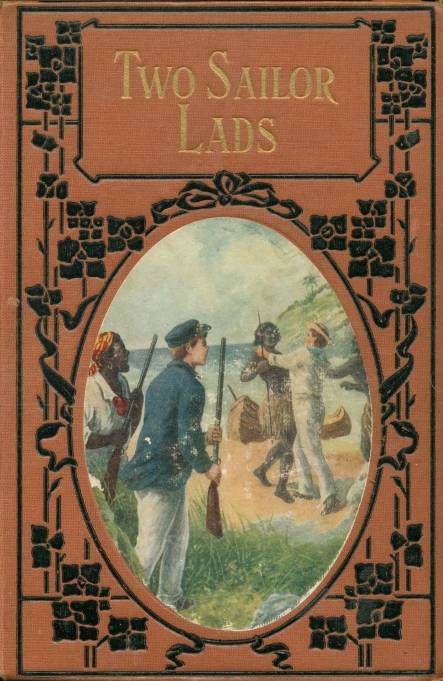
Never once did Fred move from his position all that livelong night; and when the sun rose and cast the shadows of the mountains across the placid bay, the lad was still at his post.
At length Frank opened his eyes, and seeing Fred, gently pressed his hand and smiled.
The sleep had done its kindest work.
Just a little cocoanut water, so cool and refreshing, then, like a baby, Frank dropped off again; and Fred went right away into the bush all by himself, and kneeling down beside a pandanus tree, returned thanks to Him who had heard his prayer.
* * * * * *
Slow indeed, but steadfast, was Frank's recovery now from his terrible illness. For weeks he scarce could walk; but now in the matter of cookery Quambo quite excelled even himself. With the aid of herbs he concocted the most delicious cavy stews; he wrapped flying fish in fragrant leaves, and did them over a clear fire, and he even concocted strengthening broths, from birds they shot in the woods.
But Cassia-bud went wandering all by himself round the island one day, and, lo and behold! he found a bed of clams near the shore. The clams proved an unexpected delicacy to all, but more especially to Frank. Turtles' eggs, also discovered by Cassia-bud, completed the cure.
And so Frank grew strong again once more, and happiness and joy reigned again in the little camp by the sea. And now, not knowing how much longer they should have to live on this unknown island, Fred planned the building of a house and laying out of a garden; for though a tent of boughs is all very well in times of health, it is wanting in comfort when sickness comes.
For weeks the four men—note, I have come to call them men at last—the four men laboured hard in effecting a clearing, while the catering and cooking devolved entirely upon little Cassia-bud and Bob. Not that Bob did much, but he often caught a cavy, and besides he was such a companion to Cassia-bud, it is doubtful if the lad could have got on at all without him. For gardening tools our castaways were worst off, but they managed to manufacture spades of a rough sort from the wood of the pandanus tree.
So the work of clearing and digging went merrily on, and the exercise it evolved strengthened every muscle in their bodies, and caused them to feel as happy as the birds that sang in the boughs.
All round the garden they wove a snake fence, and hung gates; but the fence was more for show than utility, as there really was nothing to protect themselves from; all their enemies lived in the water, and, with the exception of robber-crabs, and an occasional octopus, never came on shore.
Trees were now sawn into planks, and exposed to dry, by being piled up so that the warm air could blow over them.
Twenty-four feet long by twelve wide, that was the size they measured out for their cottage; and it would be seven feet high at the eaves, and consist of two rooms. So they proceeded at once to plant or put down the uprights and strong cross-beams to support the roof. For these purposes many of the planks saved from the wreck of the Resolute came in very handy. The uprights were firmly fixed in the ground, and the cross-beams fastened with hard wooden pegs on top of these.
The plan they adopted for boring holes was certainly original and expeditious also. Quambo had proposed to burn holes in the planks.
"No," said Fred, "I know a quicker plan."
"You do, sah!"
"Now make a mark at the very place you want a hole drilled."
Quambo did as he was told. Fred picked up a loaded rifle, and in less than a second the hole was made.
Quambo laughed at this till the woods rang again, and Bob ran off to the woods expecting that there must be game of some kind to retrieve.
The making of doors and shutters for the openings that had to do duty as windows required considerable time, and an expenditure of skill also; but these were finished at last. Instead of being hinged on, they were made to slide backwards and forwards, and this also was Fred's idea.
There were no fire places, but ventilators; for it would be always best to do all the cooking out of doors.
At long last the cottage was finished, and when the slanting roof was thatched with leaves of the pandanus—some of these being six feet in length—very neat and wholly rustic it looked.
Table and seats were next made. These were rough enough in all conscience, but they suited very well indeed.
"I think," said Frank, "the front of the cottage looks rather plain and squatter-like."
"Well," said Fred, "let us build a porch, and plant wild climbing flowers from the forest around it."
So this was done.
The castaways now turned their attention to the garden. Walks were laid out and bordered with old plank, and covered thickly over with silver sand from the beach. Then flowers and flowering shrubs were planted, and when all was finished proud indeed were they of their charming cottage and grounds. Even the snake fence they had run up round the compound sprouted and grew rapidly, so it was partly hedge and partly railing.
There was no occasion to plant vegetables in the garden, for everything they wanted grew wild in the woods, including many kinds of spices and turmeric also, from which Quambo, after they settled down again, concocted many a fragrant and delicious curry.
Well now, on the whole, our castaways were not badly off. They owned a house and grounds, they owned a boat, they had rifles and ammunition, and no lack of food.
All they longed for was the sight of a ship.
But the climate in which they lived is not only healthful and balmy, but calmative as well, so they did not pine so much as might have been expected.
"I say," said Fred one evening, "to-morrow will complete our first year on this island.
"How the time has fled!" said Frank. "I couldn't have believed it."
So they celebrated their advent-day by having quite a banquet in their new-built cottage, and everyone admitted—including Hurricane Bob—that Quambo had never spread before them such a dinner as this, such fragrant curry, nor such delightfully cooked fish.
* * * * * *
It was early summer in the woods now; early summer with the trees, with their gorgeous and glittering foliage, and their wealth of flowers—snow-white, yellow, lemon, and crimson; early summer with the forest birds, whose sweet low songs filled every grove and glen; early summer with the wild bees, the gorgeous beetles, and still more lovely butterflies; early summer with many species of seafaring birds as well, who built on the rocks and cliffs—gulls and noddies, and the swift-winged frigate bird; early summer on land and on sea, which shimmered in the sunshine like polished steel.
It was well that our castaways had saved tinned meats from the wreck; for among the cavies or coneys it was thought advisable now to institute a kind of close season. It was breeding time, and to slay the parents, leaving perhaps the young to starve to death, would have been cruel in the extreme.
CHAPTER XXIX.
THE ARRIVAL OF SAVAGES.
It soon became evident that the supply of petroleum oil saved from the brig would run short, but here again Quambo came to the rescue. He and Cassia-bud collected an immense heap of ripe cocoa-nuts, and every day for weeks were busy doing something or other to them. I think they wished them to decay. At all events at the end of that time they set to pounding them up by degrees, and gradually extracted from the mess quite a large quantity of clear and beautiful oil. This in a less warm country would have been solid. The lamps in which the oil was burned were simply cocoa-nut shells cut down. A little water was put in first, then the oil over this, and wicks of pith floated on top by inserting them in disks of wood. So the difficulty of light was got over. And this was certainly something to be thankful for, because the sun set every night soon after six o'clock, and to have had to sit for long hours in the dark before turning in, would have been anything but pleasant.
Besides they had books now, and Fred and Frank took it in turns to read to the others every night.
Sunday was kept as a complete Sabbath, or day of rest, and prayers were said and the Bible read, and long walks taken in the woods or along the rocks.
Fred and Frank could not help marvelling at the wonderful tameness of the sea-birds as they sat on their nests. Even the frigate-bird, for example, on its one big white egg, looked like Patience on a monument, and was not averse to being handled.
I must tell you something about Cassia-bud's pets. First and foremost he one day found a strange wee bird, that had in some way or other tumbled out of its nest. He brought it home, nursed it and fed it regularly day and night, but allowed it as much freedom as it cared for.
It grew so tame that it followed the boy wherever he went, and was as often perched on his shoulder or head as anywhere else. It had a low, long, plaintive cry too, but this was reserved for Cassia-bud's especial delectation, or for Bob's. The bird, if not on the top of Cassia-bud, or not eating its food, one would be sure to find on Hurricane Bob's back. Perhaps his long hair kept its toes comfortable, then the dog's coat glittered so that the bird often pretended it was water, and went through all the motions of bathing in it.
This pet of Cassia-bud's was pure white, with two long trailing tail feathers of charming crimson. A robber-crab was another strange pet the boy had. How he had managed to tame this droll and uncouth-looking monster I cannot say. He fed him regularly with cocoa-nut, perhaps that was the secret. The crab was at least two feet in length, and lived in the hollow root of a tree, always coming out, however, when the boy called him.
Now in early spring, that is, between September and October, the turtles used to come on shore at some parts of the coast to lay their eggs. It was very curious to watch them. They were exceedingly shy, and usually chose a moonlight night for their work. So having now no fear of kelpies or other apparitions, our heroes, accompanied by Cassia-bud, used to go to a distant part of the beach and lie in wait for the turtles. By-and-by a great beast would be seen waddling slowly and cautiously towards the scrub.
After listening, apparently to make sure no one is looking, she quietly digs a deep hole about a yard in width. Then presently the eggs are laid, probably a hundred or two, and one by one taken by the flipper, as if it were a hand, and gently placed side by side in the hole. In about an hour's time the business is finished, Then the eggs are covered with sand, and carefully patted down. Her wonderful wisdom is shown by the tact that she even tries to conceal the place by snapping down twigs and leaves and covering it up. She then waddles off towards the sea again. Now would have been the time for Fred and Frank to have rushed out and tried their hands at turtle-turning. But it seemed the height of cruelty at such a time. Besides, it would have taken them a long time indeed to have eaten a turtle.
But the eggs were very delicious. Pure white they are and round. They have no shell, only a skin, and in size are about four inches to five inches round.
Our castaways soon discovered a plan for supplying themselves with plenty of young turtle. They simply took the very wee ones, after they were hatched, and kept them in a natural sea-water reservoir near the reef, feeding them on different kinds of weeds. They could in this way have stewed turtle for dinner any day, just as in our country we have fowls.
Well, one day among the rocks, while gathering algae to feed the juvenile turtles, Cassia-bud noticed Bob coming wading out of the water with some huge brown thing. It was a turtle of small size, and probably not very old. Bob held it by the flipper. When he attempted, however, to put it down he found that this was impossible. The turtle had seized him by the collar, and held fast on to it.
Bob looked very serious over it. His catching the turtle was all very well and very clever he thought, but to be caught by the turtle in turn was turning the table with a vengeance. He had caught a Tartar. He shook himself again and again, but all in vain. Then he walked straight up to Cassia-bud.
"Look here, Kashie," said the dog, talking with his eyes and his tail, "here is a pretty piece of business! I don't want to wear this beast dangling on my breast all my life night and day. Can't you choke him off?"
Cassia-bud couldn't choke him off, however, but he unloosed the dog's collar; and Bob carried collar, turtle, and all home in his mouth. Strange to say, the beast became as great a pet with the nigger-boy as either the bird or the robber-crab. Nor was the turtle a bit particular as to what he ate, so long as he could swallow it.
* * * * * *
The difficulties to be encountered in building a vessel of any size, that should be at all seaworthy, seemed at the first blush almost insurmountable. It was long talked about before anything was done.
Meanwhile the castaways had not been idle, as far as the preparation of wood was concerned. Even the youngest of my readers must be well aware that no ship or boat even can be built of wood that has not been properly seasoned. Here on this strange island timber was certainly not lacking, but the seasoning of it, as experience soon proved to our heroes, was by no means so easy as might be supposed; for it is as much the wind as the sun that dries the wood, and if done too quickly it not only warps but cracks, and is therefore practically useless.
Many different kinds of trees were cut down and sawn up and placed in various situations by way of experiment; some out in the open, others in the woods, while planks were even steeped for a time in salt water and afterwards dried.
It was found that planks of the pandanus tree, first steeped for a week and afterwards dried in the shade, would, as nearly as possible, suit the purpose for which they were required; so with greater hopes now in their hearts they went merrily and earnestly to work.
But many months went by before they had sufficient wood of a reliable nature to fairly commence work with. Wooden pegs had meanwhile been carefully fashioned, and these had all to be fire-hardened, and were, of course, of different sizes; they were stored in the woods under dry fibre from the cocoanut and pandanus trees. The next thing to be done was to build a neat little furnace in which different sized boring-irons could be heated to redness, for Fred laughingly confessed that his plan of making holes with rifle bullets, though eminently practicable in warfare and house building, was inapplicable to the building of ships.
Many and many was the sleepless night that the planning of the yacht gave Fred, or at all events parts of nights, for he would lie and toss about and think till well on in the middle watch, and very often even after he did fall asleep his tired brain kept on working at all kinds of ridiculously impossible vessels, on the stocks and off, till it was time to get up.
Frank did not trouble himself so much about it
"I leave it all to you, Fred," he said; "your head is far longer than mine, and not half so thick, so you must be like Noah of old—master, ship-builder, and engineer all in one."
"Poor Noah," sighed Fred, "I have a higher opinion of him now than ever; my work is nothing compared to what his must have been."
"And I guess, sah," said Quambo, "de tools he hab am not so good as ours, sah."
"No, Quambo, so I mustn't grumble."
"I've been thinking," said Frank one morning as they sat together at breakfast.
"Have you really?" said Fred, pretending to look very much surprised.
"Yes, really and truly, Fred."
"Well then, Frank, will you be pleased to enlighten us all as to the nature and result of your cogitations?"
"Well, Noah the Second, instead of worrying your self into skin and bone over this yacht business, why don't we build a raft and be done with it? If we once embarked on a raft we would get blown somewhere."
"No doubt of it, wise Frank, we might very likely be blown on to a coral rock in mid-ocean, and have to begin life all over again, only in this case it would be the life of a cockroach that has tumbled into a basin of water, very brief but full of excitement."
"Very well," said Frank, "I shan't think any more. I beg leave to descend from the platform. Pass the clams."
"That's better for you, Frank."
* * * * * *
But one day an event occurred that gave Fred quite a fresh impulse, and made him determine to proceed with the building of his yacht against every difficulty that could be thought or dreamt of.
This was nothing more nor less than the arrival on the island of a couple of naked savages in a small dug-out.
It had been blowing all night a strong breeze from the direction of the island, that from Beacon Hill could just be seen by the aid of the telescope. Doubtless the savages had been carried out to sea, or they never would have attempted so long a voyage in so small and clumsy a craft as an outriggered dug-out.
As they drew near to the beach—exactly at the spot where the brig went to pieces—the castaways hid themselves in the bush, lest they should frighten them.
They landed at last, and stood wonderingly on the sands, pointing to the ribs of the Resolute, that was still visible, black and ghastly in the surf. Tall and noble-looking figures these savages presented. They were entirely naked, with the exception of a kind of cummerbund of fibrous grass around the waist, and each held a long spear in his hand.
The castaways now stalked out.
The savages uttered a yell, threw their spears at them, one glancing close past Fred's head, and made a rush for their boat. But before ever they could get her afloat again our men were upon them and had made them prisoners.
CHAPTER XXX.
"THERE IS NO GOING BACK NOW," FRANK SAID.
Frightened the savages certainly had been at the sudden rush of three white men and one black giant—Quambo—from the bush in what they must have thought an uninhabited island; but cowards they were not. Indeed, as soon as they found themselves captured they submitted to the inevitable with a grace that was highly dignified.
Quambo had sailed in the Southern Pacific for many years, and was not now surprised that he could understand the language of these men. He was very proud, however, at being suddenly raised to the dignity of interpreter. With all the inborn courage of island warriors those savages seemed to possess the simplicity of childhood. They were talking to Quambo, and pointing to Fred, when the latter begged Quambo to translate. "They say," said Quambo, "they not have eat since yes'day; they say, suppose you gib 'em banana now to eat and cocoanut water to drink, the savages will taste yum yum when we cook and eat them."
Quambo laughed, but Fred shuddered. What ghastly humour was hidden in those words!
But the poor savages were at once supplied with food and drink, and told that the white man was their friend, and that, although they must keep them on the island, it was only for the white man's safety, as they did not wish to be discovered.
It is to be presumed that Quambo proved a very faithful interpreter indeed; for the savages seized Fred's hand, and bending low pressed it for a moment to the forehead in a way that was most affectingly dignified.
Very much surprised, indeed, were both Cassia-bud and Hurricane Bob, who had been left as camp keepers, to see the party return in company with two tall and soldierly-looking savages. Bob at first seemed much inclined to resent the intrusion, but as soon as matters were explained to him he walked up to the new-comers and licked their hands, as much as to say, "So long as you're good you won't be touched, but I'm going to keep my eye on you."
That evening the prisoners were allowed to dine on the floor of the cottage, and appeared to adapt themselves at once to their new mode of life. They were afterwards shown their bed under a bush. Their canoe had been drawn up quite close to the garden gate. Quambo and Cassia-bud took it by turns to do sentry duty all night, but the weary savages slept soundly, and awoke happy, hungry, and contented.
After breakfast was over our castaways sat down under the shadow of the trees, and the savages were made to squat near them. They then told their story, and an interesting one it was.
Their home was in a group of islands far, far away to the west. While fishing they had been caught in a squall and blown out to sea. The weather had continued very thick and bad all night, and at daybreak they found themselves near to a strange island, and had therefore landed in quest of food and water. Had they ever seen white men before? they were asked. "Oh, yes!" they answered, holding up both hands, with fingers outspread to indicate the number ten. Ten men had come, many, many moons ago, to their islands in canoes. They were hungry and thin, and were accordingly housed and well fed, because the flesh of white men is so much sweeter than that of black. They had been well fed, better fed than pigs, the savages explained, but would not grow fat. But they began to teach the natives many curious things, and to heal the sick, and staunch blood, and do much good; so instead of being killed and cooked they were permitted to live, and were now slaves to the king on the far-away islands. Where these white men had come from, they were, of course, unable to tell. They had come from the sea, was all they were able to say for certain; and reckoning on their fingers and toes the time, counted by moons, would correspond pretty nearly with the date of the abandonment of the brig Resolute. Then Fred got Quambo to enquire what the white men looked like.
Quambo laughed when he received their reply.
"Like de debbil hisself," he explained, "suppose the debbil wore clothes."
Now Fred was a very fair artist in his way, for Eean had taught him the rudiments of drawing, and besides he seemed to have a natural gift for caricature; so on the fly-leaf of a book he sketched a very good likeness of the skipper of the Resolute—jacket, hat; hooknose, and goatee beard all complete—in fact as he had last seen him.
When Quambo showed the savages this they roared with delight and astonishment, so much so in fact that Hurricane Bob had to put himself on the defensive.
"If there is much more of that sort of thing," Bob gave them to understand, "I'll be obliged to bring you to your senses."
"Did they ever see that man, Quambo?" asked Fred.
"Oh, yes! They say, sah," replied Quambo, "he de biggest and de cleberest debbil ob all de ten, sah."
This was conclusive enough.
It was evident, therefore, that the ten poor fellows who had landed on one of this unknown but cannibal group of islands were a portion of the crew of the lost brig Resolute, and that they still lived there as slaves.
The savages, as soon as they found out that they were to be well fed and treated, instead of being cooked and eaten, became very happy and contented indeed. As a mere matter of precaution their clumsy old dug-out was broken up and used as firewood, and after this it became quite unnecessary to set sentries of a night Hurricane Bob was sentry enough. He tolerated the savages, that was all. He never quite trusted them.
* * * * * *
And now the building of the yacht was commenced in earnest.
The first thing to be done was to erect a shed on the beach under which the keel could be laid, and the work carried on pleasantly and as coolly as possible. The dimensions of the yacht were carefully studied and planned out; she was to have a twenty-feet keel, and to be sufficiently narrow in beam to permit of her being easily towed through the gap in the reef. This did not give her quite so much breadth as Fred could have wished, and he determined, therefore, to give her a good deep keel, and a not too high free-board, though the latter must of course be consonant with safety.
The building of the workshed occupied the castaways for the best part of a week, although they were ably assisted by their slaves the savages.
On the particular part of the beach where the shed was erected there was a nice slope towards the water, though it was not too steep; and so determined was Fred that his yacht should take the water like a duck, that he not only laid a slip for her descent, but had a strong railing of stanchions built on each side, so that an accident was simply out of the question.
He was determined also that in building his yacht, beauty and appearance should be sacrificed to safety and strength.
And now came the laying down of the keel. He and Cassia-bud had wandered in the woods for weeks scanning the trees, and at last, half-way up a hill they had been fortunate enough to find a tree, the upper part of whose trunk had been bent by the winds in such a way that it would suit admirably. When trimmed for the keel the bent portion would represent the fore part, that and the keel would be all in one piece. Well knowing that the whole build of a craft greatly depends upon the straightness, strength, and justness of the keel, much time was spent in forming this, and getting it fixed in position. But at long last Fred felt certain he had made a fair beginning. And now came the question of knees and ribs, the general skeleton, including the cross-beams, to keep all in place and to support the decks.
As they proceeded with the making of the skeleton, all hands, including even the savages, began to take an intense interest in the work, and to go at it morn, noon, and evening cheerfully. But until he commenced to plan and make and place the ribs, Fred had had no idea there was so much study and thought required in building even a boat like this. It should be remembered too that he was not only deficient in some most important tools, but in iron and nails as well.
One day he held a regular survey on nails, and finding he had so few he resolved to use pegs of hard wood wherever possible, reserving the iron for the most important parts.
After three weeks of the hardest work and study ever Fred had endured in his life, the whole framework and skeleton of the vessel was completed, and great was the joy of the castaways accordingly. And to give the young man his due as a ship-builder, it must be confessed that though her lines would not be by any means perfection, and would neither rival those of the model yacht Thistle or an Aberdeen clipper, they were not so far out by any manner of means. Nor would she be lopsided or in any way askew.
Being quite certain and satisfied on these points, the work of planking the craft was cautiously and carefully commenced. Luckily they had the best of planes, and they had splendid wood, so this part of the work went on smoothly and merrily enough, and every day Fred's men, as he called them, improved in the niceties of their trade of ship-carpentering.
But how genuinely tired and hungry they used to be of an evening!
Ah! well, the dinner that Cassia-bud prepared entirely banished the hunger, and a rest afterwards either in the cottage-ornée as a book was being read, or outside around the camp fire, made them forget all the toils and worries of the day. In fact, every evening the castaways gave themselves up body and soul to the enjoyment of the dolce far niente. In plainer language, they had nothing to do, and they did it well.
Reading indoors was all very well, but they enjoyed lazing in the sand by the camp fire far better. The nights at present were nearly always fine. There was the glitter of stars or glimmer of moonlight on the quiet sea.
There were fire-flies and a hundred other phosphorescent things flitting or crawling in garden, trees, or bush; there was the soft whispering of the breeze through the branches; the lulling sound of falling waters on the far-off reef; and above all there was the companionship of the log fire itself, that somehow never failed to talk to Fred and Frank, and tell them tales of their British home.
Songs were never forgotten around the camp fire, and there is no saying how much good they did not effect. Why, those songs used to please even the savages, and it was amusing, if not affecting, to hear them join in singing "Home, Sweet Home," or "Auld Lang Syne."
Before the deck of the vessel was completely planked over, the ballast was carefully adjusted and fastened down to the sturdy boat's bottom.
While digging in the garden Quambo had come upon quite a store of a curious kind of amber-like gum. This was melted and mixed in a cask containing a reddish pigment kind of earth, and lo! a paint of a pitchy nature was formed, and every seam of the yacht, outside and in, was carefully done over with this twice, and they had the satisfaction of finding that it did not become too brittle when dry. The same red earth was mixed with oil and a portion of the gum, and formed an excellent paint to go over all the work with before the vessel was launched.
Two hatches were fitted, each having rough, short ladders descending to the hold, or fore-cabin and saloon, as Fred grandly termed them.
The rudder was next made, and properly and scientifically shipped, and a handy tiller adjusted. Then the mast and a short jibboom were stepped, and after this the vessel was ready for launching, for they longed to prove if she was seaworthy.
Fred could not remember ever having longed for anything half so much as he longed to see the yacht afloat, and if real shipbuilders are as anxious for some days before they succeed in launching their ventures, then they must have a very uneasy time indeed.
But the eventful morning arrived at last, and the vessel was duly christened, not with a bottle of wine it is true, but with the milk of a beautiful green cocoanut, and named the Island Queen.
"Let go all now!" cried Fred.
Props were knocked out, the little ship swerved and swayed for a moment, then gently commenced her descent, moving on without a hitch, and finally taking the water just like the perfect duck she was unanimously declared to be. Of course they gave her three times three cheers as she slid into the water, with another little cheer for luck; then everybody crowded round Fred Arundel, the worthy shipbuilder, and shook hands with him in the most approved style; after which all retired to a sumptuous breakfast, quaffing the cocoa-nut of peace, as Frank called it, and wishing jolly good luck to the Island Queen.
"I think I can eat to-day," said Fred, with a soft sigh of satisfaction.
"Well, you ought, Fred," said Frank, "for you are positively getting thin."
They had not considered yet what they were going to do with their yacht, or where they should venture to sail to. They were possessed of no chart of the seas around here, but as near as Fred could judge they must be fully a thousand miles from either Auckland or Fiji. Would it or would it not be dangerous to make so long a journey in so small and frail a craft? All agreed, anyhow, that an attempt should be made to rescue the ten men who were still held prisoners, if not even made slaves of, in the cannibal islands from which the two savages had arrived.
Every preparation for the voyage was set about, therefore, without any loss of time.
Luckily they had plenty of spare canvas that had been found in the wreck, so the rigging, &c., of the Island Queen was perfected in a few days' time.
Then the first trial trip was made. The boat was sailed and manoeuvred all round the bay at first. Then she was towed with a boat ahead through the gap. It would have been risking too much to have sailed through, for at any moment a sea might have lifted her and carried her against the sharp coral rocks, after which there would have been no more Island Queen.
Once away out on the billowy breast of the blue ocean, all sail was set, and the craft was tried in every manner that could occur to a thorough seaman, and behaved herself in everything as a beauty.
"She's a beauty, Fred, a beauty," Frank said, over and over again, "and does you ample credit."
"Does us, you mean."
"No, no, Fred, old man. Honour to whom honour is due. Yours was the working head, ours only the willing hands."
* * * * * *
On a bright and beautiful morning, with a gentle breeze blowing from the nor'ard and west, the manned and armed cruiser-yacht Island Queen left her anchorage in the bay near which our heroes had resided so long, and sailing easily through the reef gap, hoisted all sail again, and steered to the east away.
The Isle of Good Hope kept receding and receding as the day wore on, till at eventide it was seen but as a green cloud far away on the ocean's horizon.
But higher land was steadily rising ahead. Other green clouds appeared. A whole group of islands stretched out before them, and be their fate what it might they would cast anchor among them early next morning, if the wind but held.
Both Fred and Frank were uneasy in their minds.
"There is no going back now," Frank said.
"Come weal or come woe," replied Fred with great earnestness, "we shall do our duty, and trust all the rest to a Higher Power."
"Amen," said Frank.
CHAPTER XXXI.
IN CANNIBAL ISLANDS.
The crew of the derelict brig Resolute had certainly not been idle during the year and a half and over they had been prisoners on the cannibal islands. It was perhaps a lucky day for the natives when their boats drew up upon the beach with the sailors, more dead than alive, without arms or clothes, except what they wore, completely at the mercy of the naked and fierce-looking savages that crowded round them.
Here was a chance for these islanders, such as might not occur again in a score of years. Nothing could be more to their taste than the programme mapped out by their chief, and to be carried out on the following day.
First, Revenge. For they could not forget that long ago a white man's ship had cast anchor in this very bay, and that they had treated the men who landed with kindness and hospitality, albeit they would have preferred picking their bones. They remembered that event, and they did not forget either that in return for their hospitality those white fiends stole their women and their little ones, and put out to sea. Revenge is sweet.
Secondly, a short but bloody massacre of these innocent white men.
And thirdly, a glorious feast of roasted flesh to follow—a feast of white men's flesh, that they should look back to with satisfaction and delight as long as they lived.
So next morning the island had been all en gala. Huge fires were built on which to roast the sailors whole, and big round stones made hot to place in their insides, so that both outside and inside they might be done to a turn.
But, lo! when they had dragged the miserable sailors out of the compound, and everybody was itching to club them, they had found they were little more than skin and bone and grief.
This would never do; they must be fed and fattened. So they were penned in the king's own compound. But somehow they couldn't or wouldn't fatten; and besides, the king began to be mightily entertained with them. Seeing that this was the case, not only the Yankee skipper himself, but his nine men—all the rest of his crew, by the way, had been drowned—set themselves to please. They danced, they sang, and they even boxed with each other, all for this sable and savage King Ota's delectation.
Ota soon found out he had drawn a real prize in the lottery of life, and would now no more have consented to kill and eat his prisoners than you, reader, would your pet and expensive pigeons.
But meanwhile another savage king on another island had heard of Ota's luck, and sent to beg for half the white men, that he too might be tickled and amused. Ota replied, saying he would see the other king skinned first.
Well, there was some skinning after this; for that other king invaded Ota's island, and the battle on the beach raged fierce and bloody for many a long hour. The Yankee skipper and his merry men had been obliged to join the fight on Ota's side, and victory was at last obtained. The other king's men fled seaward in their boats, leaving more than a hundred dead and wounded on the beach. But the dreadful cruelties to the prisoners, and the awful orgies that were carried on for many days afterwards, I have no language to describe.
When all the killed were eaten, the bones were taken to "ornament" the kraal of the king, round which the savage soldiers danced and howled for days and nights to the unearthly music of tom-toms and conch-shells, accompanied by rattles made of the dead men's skulls with pebbles in them, and much yelling and brandishing of spears.
This feast, from first to last, was so terrible that the hair of several of the sailors turned white before it ended.
But peace ever since then had reigned in King Ota's island, and he had even become friendly again with the king who lived on the other side of the water. However, Ota would never permit his white men to go on the sea in a boat or canoe. They were too useful to risk. They built him a whole cottage, and taught his people to do many wonderful things. They laid out gardens even, in which yams and sweet potatoes, with cassava root and many other vegetables, flourished most luxuriantly.
But for all the king's kindness to them—and in a savage kind of way he really did treat them well—the poor white men pined, and longed to see a ship appear on the horizon.
Every morning of their lives when they left the huts in which they slept, guarded as prisoners, they betook themselves towards the hill-top.
They told Ota they went thither to pray. Well, to their credit be it said, they did pray; but many was the wistful glance they cast seawards in hopes of catching sight of the coming ship.
* * * * * *
One morning the ship did heave in sight.
That ship was the little Island Queen.
Just an hour after she had first been sighted, Ota, the king, called his prisoners before him.
A translation of the speech he made then would read somewhat as follows:
"White men people. King Ota is the biggest king in all the wide world. There is no end to his greatness or his glory. He has destroyed his enemies in many a bloody battle both by sea and land, and cooked and eaten them afterwards. Even the birds of the air fly round the head of King Ota when he takes his walks abroad, and scream their worship in his large and willing ears. And the dark frigate bird, the eewaoo, carries the story of King Ota's glory to the utmost regions of the earth. King Ota's arm is very strong, but King Ota's heart is as big and soft as a jeetee (the jelly fish). When Ota saw the poor white sailors land on his shore, his first thought was to club and eat them, after smearing his wives and little ones with their bright red blood. But his soft jeetee heart forbade; so he has kept them, and is very kind to them. But now behold a white man's ship has appeared in the bay, and they may want to take the king's dear prisoners away. But they must not know they are here. I must hide them in the innermost shades of the forest, and keep them secure until the ship departs. Away with them guards, and if they attempt to escape kill them, and we will feast ourselves on their bodies."
This was a sad sentence, but there was no relenting in King Ota, so they were marched away into the depths of a dark wood, and imprisoned in a bamboo hut, which was guarded by the spearsmen of the savage king.
* * * * * *
"Now, Frank," said Fred, "what is to be done first?"
That is what Captain Arundel, of the model yacht Island Queen said, as soon as the anchor was let go in the beautiful bay off the Isle of Ota.
"That's what I should like to know, Fred," was Frank's reply. "I'm ready to obey you in everything, and fight for you, and stick by you to the last; but, faith, Fred, I'm a poor hand at giving advice."
"I should say," said Mac, "we'd better first try to make friends with these black beggars."
"They don't look very friendly," said Frank.
This was true; for though many dug-outs had shoved off from the shore, they kept severely aloof from the little yacht.
Quambo was sent down below to question the two captured savages, whom it was thought advisable for the present to keep out of sight.
The savages assured Quambo that this really was Ota's island, but that he would doubtless not permit the white men to appear. If they could lure the crew of the Island Queen on shore, they would, said they, kill and eat them, but they would not attack the vessel till nightfall.
This was a rather gloomy outlook, and as no white men could be seen on the beach, Fred could only come to the conclusion that they were hidden away somewhere. He determined, however, that he would not be deterred from landing and seeking an interview with the king on the beach.
So Fred, with Quambo and Mac, lowered the boat, and boldly proceeded to row towards the shore. Quambo was to act as interpreter.
The boat was fully armed with revolvers and rifles, with spears also, lest they might have to come into close quarters with the cannibals.
The canoes certainly did not scatter in all directions at the approach of the white men's boat, but they drew sullenly off.
When within thirty yards of the shore they lay on their oars, and immediately afterwards the beach swarmed with spear-armed, wildly-gesticulating savages. Among them was a personage arrayed in an old pilot jacket, and nothing else, so that with his long black legs sticking out from under he had anything but a very imposing appearance.
He had a spear in his right hand, and by a string in the other was leading along a good-sized pig, of all creatures in the world.
Conversation was at once opened up, and proceeded somewhat as follows:
Quambo. "Are you the king of this island?"
Ota. "I am King Ota, the greatest king in all the world."
Quambo. "And we are poor white men who want food and water."
Ota. "I have brought this pig to make you a present of. How much will you pay me for this pig?"
"That's a queer way of making a present," said Fred, when the king's words were interpreted. "Tell him we will give him a beautiful jacket and a pair of white duck trousers to hide his dirty black legs. Hold up the garments."
Quambo (holding up the trousers and blue jacket). "Here, O great and good king, we have brought you a coat for your brave body, and a pair of white ducks for your lovely legs!"
Ota. "Land and leave them."
Quambo. "No, leave the pig, and we will land and exchange; but you must retire."
Fred now determined to bring matters to a crisis. These savages had never seen or heard of fire-arms, so now raising a rifle to his shoulder he took aim and fired, and, lo! Ota's pig dropped dead at his feet. The smoke had hardly cleared away till, with terrible shouts and shrieks, the savages had fled in all directions. For just one brief moment the greatest king in all the world stood looking down at poor piggie weltering in its gore, then with an eldritch scream he too fled away.
"Pull on shore quickly now, lads," cried Fred, and the boat was quickly beached. The pig was lifted on board, the jacket and trousers laid on the sands, and off they shoved again, and were soon once more safely on their own quarter-deck.
In an hour's time, however, they had the satisfaction of seeing King Ota come down to the beach, dress in the new clothes, then stride gallantly away, followed by all his sable suite.
Instead of lying at anchor all night, and probably thus courting an attack, it was thought advisable to put out to sea, where they could bid defiance to a whole fleet of armed canoes.
The king presented himself on the beach next day, but he had no pig. It was noticed too that not a woman or child was permitted to appear; and this Quambo assured Fred was a certain sign that these savages meant to fight.
Now fighting was no part of Fred's policy. With all his courage and daring it would be ruinous not only for his party, but for those he sought to rescue, to go to war with these savages. Against such numbers he could only act on the defensive, and this but for a very short time. So he determined to make friends by every means in his power. He once more, therefore, drew near to the beach and held parley with King Ota, or King Breeches, as Magilvray called him.
Fred informed him that he came now on a friendly mission; that he desired everlasting peace between the white men and the blacks; and that in proof of this if he, King Ota, would venture on board he should be treated kindly and receive many more presents, even a fire-stick such as he, Fred, had slain the pig with the day before.
The offer of a gun was certainly a great temptation, but it evidently was not great enough to induce King Ota to risk his sacred person on board the Island Queen.
"Would the white man leave the fire-stick on the beach and go away?" he asked.
"No; the white man would do nothing of the sort."
"Would the white man then kill something else?"
To this Fred made reply, that if the greatest king in all the world wanted a pig for his own dinner, and would bring one to the beach, the white man would kill it.
On this the king seemed suddenly to be struck by a happy thought. He held communication with his dusky warriors; a few of them retired to the bush, and after a while re-appeared dragging along a poor woman. She was stationed on the fore-shore, and stood there with drooping head patiently waiting for the death she expected. The king and his warriors stood aside at a safe distance. Then pointing to the woman Ota hailed the boat. "That is the pig that the greatest king in all the world wants to eat for dinner, make fire, quick, quick."
Fred felt strangely tempted to give the king himself a shot. So inhuman a monster he had never before held communication with.
At this moment a huge black-brown kite came wheeling round his dusky majesty's head; slowly it sailed tack and half tack.
Now Mac had been the best shot in the San Salvador. Fred gave him the rifle.
"Bring down that bird," he cried. "Pray don't miss."
Steady was the aim Magilvray now took. Bang went the rifle. The king's eyes were turned towards the poor woman, his face beaming with fiendish delight in the expectation of seeing her fall. Instead of that there alighted on his royal head a huge mass of blood and feathers. He uttered a yell that could have been heard a good mile off, and threw himself struggling on the ground.
It was a rash thing for Fred to do; but there was no help for it now, and almost before Quambo and Magilvray could get way on the boat spears were hurled after them, and a wild rush made towards the canoes.
That was indeed a race for life; but Quambo and Mac made the gig fly and skip across the water, and not only were they aboard, but the boat was hauled up, before the savages in their clumsy canoes could get alongside.
"Shake out the mainsail. Get the anchor up." These were the orders now.
Just one volley was fired at the advancing canoes, which staggered and sent them back, and before they had recovered from their consternation the sails were set, and the Island Queen stood steadily out to sea.
But the shooting of that foul bird had ruined everything, as far as peace was concerned.
CHAPTER XXXII.
THE WHOLE BEACH WAS LINED WITH YELLING SAVAGES.
Captain Fred Arundel, of the Island Queen, now left the island of King Ota far astern, and proceeded to take a quiet survey of the whole group.
The islands were five in all, although one was so small as hardly to be worthy of notice. It is nevertheless the most important of all to our story. This little isle, although well treed, was evidently not inhabited, and had only one landing-place, all the rest of its shore being as inaccessible as the Bass Rock itself.
The other islands were inhabited, as well they might be; for in rugged grandeur of contour, and in beauty of tropical foliage, they exceeded anything that Fred or Frank could have imagined or dreamt about.
Waving cocoa-nut and palm trees, gigantic tree ferns, bananas, pandanus, and bread fruits, and a wealth of waving woods and grasses and flowers, that made them look like veritable fairy-lands afloat, or the fabled islands of the blessed dead we read of in the classics. Yet everyone of them was the abode of savages and cannibals. No boats came off from either, though in one of the bays Fred lay at anchor for very many hours.
He was concocting a bold and daring scheme, which if successful should mean freedom for the white prisoners, whatever might befall them next; but if unsuccessful it would mean death, or a slavery far worse than death, for all concerned.
That the inhabitants of these islands were not really bad at heart was Fred's evident thought, from the kindly way their own two prisoners took to work and civilization.
Could the latter be trusted in a matter of life and death? Fred made up his mind to try them.
So they were now brought on deck and questioned by Quambo, questions and answers being very much as follows:
Why did they—the white men—see nothing of their brothers who were held as slaves by King Ota? King Ota was too clever. He kept them in the forest prison. Did they know the road from the beach to this prison? They knew many roads to it.
Could they and would they be willing to guide a party to this bamboo prison through the forest at the darkest hour of midnight? Yes, they could and would gladly, the white men had been very good to them; but if they guided them to their white brothers they must promise to take them—the guides—away with them, else King Ota would put them to death with much terrible torture.
So far then everything seemed satisfactory, and Fred and Frank resolved to risk all in one bold effort to set the white men free.
"To dare is to do, Frank," said Fred.
"Yes," replied Frank, "and I should never forgive myself if we went away and left these poor fellows prisoners and slaves among these terrible cannibals. I cannot forget, Fred, that the Yankee skipper was kind to me when I was sick, and that he was my captain, you know."
"Well, then, Frank, when does the moon rise, to-night?"
"What, will you venture so soon?"
"Oh, you know what a nervous coward of a chap I am! If I've got to face anything I like to go at it at once. Besides, it is best to strike the iron when it is hot."
"All right," said Frank. "I must say, however, Fred, that your cowardice is of a very peculiar kind, from all the specimens I've had of it lately."
And now the two savages were once more interrogated, and it was soon found that from the back part of the island, where the pandanus forest grew right down to the water's edge, a footpath led up through the woods to the bamboo prison or fort. It would no doubt be well guarded, but nothing venture nothing win.
"He either fears his fate too much,
Or his deserts are small,
Who dares not put it to the test,
To win or lose it all."
These lines are well worth remembering, and everyone who reads British history must be struck with the fact, that nearly all our greatest victories have been won by downright pluck and derring-do.
Well, everything seemed to favour our heroes to-night; for the moon would not rise until nearly two o'clock, a favouring breeze was blowing, and there would be light enough from the stars to creep round to the back of King Ota's island and let go anchor. All the rest must be left.
The sun went down at six o'clock. Then dinner was got through, and preparations at once made for the adventure.
Luckily they had plenty of revolvers on board, saved from the brig, and good ones too, the revolver being a tool as common on board all Yankee foreign-going ships as toothpicks, more or less.
A dozen and a half of these were most carefully loaded with ball cartridges. Ten of these were placed in a hand-bag or grip-sack, and this Quambo was to carry. Fred, Frank, and Quambo, with one of the savages, were to take part in this cutting-out expedition; little Cassia-bud, all by himself, was to remain with the other savage as ship-keeper; while Mac would come along to take charge of the boat.
Cassia-bud would be captain of the Island Queen therefore for once in a way, and Hurricane Bob assured the boy that he would keep his eagle eye on the remaining black fellow.
"Would it not, sir," said Mac, "be as well to handcuff the darkie we leave behind?"
"No," said Fred boldly. "I have told these men I trust them, and trust them now I must and will."
About ten o'clock the Island Queen quietly got up anchor and sail, and began her dangerous voyage.
It was indeed in every way an expedition fraught with the greatest danger. To begin with, they were in an unknown sea, where they must trust to Providence to keep them off rocks and shoals. Secondly, after they landed their lives were in the hands of the guide, who might, if he chose, lead them into the very midst of the enemy; and even if he proved true, they had the guards to silence, if nothing worse.
All hands were armed to the teeth, and the boat's oars were muffled.
It still wanted half an hour of midnight when the yacht crept slowly in towards the darkling shore, and the anchor was let silently down.
Finally the boat was lowered, and everything being ready, she was shoved off and silently rowed towards the shore.
Stars were all out and shining, but the woods lay still and quiet under their feeble light. Not a word was spoken by any one on board; but just before the boat was run upon the soft white sand Fred felt for Frank's hand and pressed it.
Frank well knew what was meant.
Then the landing was effected, Fred whispering some words in Mac's ear just before the three brave men headed by their savage guide, dipped into the dark woods and commenced the march.
Silently, and in single file, they followed on and on. It seemed a very, very long mile, and more than once Fred suspected treachery. So too did Frank. If treachery it was going to be, they at all events had resolved to sell their lives as dearly as possible; and it was satisfactory to remember they were venturing those lives in a worthy cause.
"Hist!" It was a signal from the guide.
All stopped, then cautiously advanced again. In a minute more they came in view of the bamboo prison. And yonder were the guards, seated by a blazing log fire—a fire that revealed their fiercely-savage faces, but left all else in Rembrandtesque darkness.
Savoo, the guide, pointed to a spot just behind them, and whispered to Quambo.
Quambo in his turn conferred with Fred and Frank, and in a moment a plan of action was agreed to.
Quambo was to rush on, and throwing his huge bulk against the door, burst it open, while the other three settled matters with the spear-armed sentries.
For that matter they might have shot them where they sat; but Fred was averse to using firearms before it was absolutely necessary.
Savoo was armed with a huge club. Fred and Frank, in addition to their revolvers, had each a sword.
"Are we all ready?"
"All ready."
"Then dash on."
Quambo was first. He thrust at one of the guards with his spear as he passed; but, rushing on and heeding nothing, hurled his whole gigantic force against the frail bamboo door.
It gave way at once. It flew into flinders in fact. Meanwhile, Savoo, club in hand, had followed Quambo to the fire.
Thud! thud! Two awful blows; and the two remaining sentries were disposed of, and stretched beside the one Quambo had speared.
There was nothing left for Fred or Frank to do.
"Friends," cried Quambo as soon as the door flew open, "are you all here, men?"
"The Lord's name be praised!" cried the Yankee skipper, "whoever you are. But we're all tied and trussed like fowls goin' to the market."
Frank was beside his old captain in a minute, and Fred showed a light from his bull's-eye lantern.
What a fearful sight! Every man was tied up in a bundle, as it were; and when the cords were cut, for a few moments they scarce could stand.
Here was a new danger that had not even been thought of. They could not carry the men, and what if they could not walk?
But the odour of their prison was like that of some vile charnel-house; and it was as much this as their cramped position that rendered them so helpless.
They revived very soon after they were brought into the open air, and were able to receive each a revolver from Quambo's grip-sack. Then the return journey was at once commenced.
They reached the beach in safety, and half the party were at once rowed off to the vessel. Fred, Frank, and Quambo remained behind with two men—one being the Yankee skipper himself. This was the most anxious time of all for Fred and Frank, and the longest too, apparently.
Do what Fred would, he could not keep that Yankee skipper's tongue silent.
To be sure he talked in a kind of half whisper, but the night was so terribly still that even this could be heard a good long way off.
"What I'm terribly vexed about," was one of the skipper's remarks, "is that I didn't have it out wi' that rascal, King Ota."
"Hush, hush!" whispered Frank. "Not so loud please, captain."
"The skunk," he continued, "to truss us all up like fowls."
Fred lost his temper now. "Look here, sir," he said, "I'm in command here, and if you say another word I'll gag you—there!"
"I say, youngster," whispered the Yankee in a kind of wheedling tone, "gag me with a lump o' baccy. I'd give ten years of my sinful life for a chew."
In spite of the extreme danger they were in Fred could not keep from smiling.
But Quambo stuck a big lump of tobacco in the skipper's hand, and he was silent after this. "Hist!" It was the voice of the guide again. He had clutched Fred's arm and was pointing away to the woods.
Fred could hear nothing for a time. At last, however, a confused noise of tom-tom beating, couch blowing, and yelling, was borne to his ears on the night breeze. It was only too evident that the escape of the prisoners had already been discovered, that the whole island was alarmed, and that the savages had found their trail.
Again and again Fred flashed his light towards the Island Queen, to induce the speedy return of the boat. But seawards all was silent.
And every minute the shouting and yelling in the woods drew nearer and nearer.
Both Frank and Fred did feel fear now. They stood almost face to face with a terrible death, knowing well too that if caught alive they would be put to the torture.
Nearer and nearer! Would the boat never come?
At last, oh, joy! a black spot suddenly appeared among the surf, and they made a dash towards it.
None too soon, for hardly had they left the shore ere the whole beach was lined by the howling savages. Spears whirled past them in the darkness, and shots were returned from the boat.
Fred presently heard a dull thud close beside him in the boat.
"Oh!" groaned the Yankee skipper. "That's got me. Poor Silas is to be sewed up at last."
"Has the spear hit you?" said Frank anxiously.
"Gone clean through and through me. Oh, don't attempt to draw it out! Blood will flow in bucketfuls if you do. No, let me just collect my thoughts and try to pray a bit. Oh! ain't got nary a cigar about you, 'ave you?"
Meanwhile the boat was speeding across the water towards the Island Queen.
"Oh, be careful now!" cried Silas. "I tell you I'm pinned clean through the body on to the gunwale of the boat."
Fred showed his light. The spear certainly appeared to be sticking right through Silas like a pin through a moth. But more minute investigation showed it had only gone through his jacket and shirt, grazing his skin.
"Oh," he said coolly, "well shiver me if I didn't think I was a gone coon!"
In less than ten minutes after, all were on board, the sails were filled, and the Island Queen was standing rapidly out to sea.
CHAPTER XXXIII.
SOUTH AND SOUTH SAILED THE GOOD BARQUE.
The word "Sarpinto" kept ringing in the old fisherman bard's ears as he retired to bed that night.
I believe the last words he said to himself as he laid his head on the pillow were "Sarpinto, Sarpinto, where on earth have I heard the name! Sar——"
He was asleep before he could finish the word, but when he awoke next morning he did finish it. "Pinto," he muttered to himself, "Pinto, yes, now I have it. That was part of the word that I read on the bill of lading that came on shore with dear Toddie, and that Bunko afterwards found in the log of wood. Pinto! I have it. How singular now if this Señor Sarpinto turned out to be nobody else but Toddie's wicked uncle."
Captain Cawdor was not an early riser, as the term is understood by the fisherfolks of Methlin, but on this particular morning he was up and out by seven o'clock.
He found Eean anxiously waiting for him.
"Come with me for a stroll," said Eean, "as far as a cave I have here. Ah! Toddy darling, here you are."
Toddie, who was quite a tall and very pretty girl, now threw her arms about the old bard's neck to give him a morning kiss, and receive his blessing. Then she shyly gave a hand to Captain Cawdor.
"Yes, you can come with us, pet," said the bard. "It is about you we are going to talk."
So the three walked along the cliff-top, and finally descended to the cave.
And there Eean, with the paper in his hand, told Captain Cawdor the whole of Toddie's strange story, as far as he himself knew it.
It was a strange story certainly, but simple enough in the main. There surely was nothing in it to strike so sturdy and hardy an old seafarer as Captain Cawdor speechless. But that is precisely the effect it had on this ancient mariner.
His eyes had got bigger and bigger as Eean proceeded, and as he finished his jaw had actually dropped.
He found his tongue at last, however. Then three times in succession he thumped his red round fist on the deal table in front of him, and three times in succession he muttered the words:
"Bless my soul, sir! Bless my soul!"
"Why, what is it?" said Eean. "Do you know anything?"
"Do I know any thing, man? Bless you and me both, I know every thing. I declare I'm half afraid wonders will never cease."
"Well," said Eean, "it is all very wonderful, but tell us all you know; for I am certain my little girl here is quite as anxious to hear about her early history as I am. And I pray God this moment, Captain Cawdor, that you will tell us nothing that can result in parting me and my more than child."
"Nay, nay," cried Captain Cawdor, earnestly and thoughtfully, as Toddie had thrown herself on old Eean's lap, and was nestling close to his breast.
"I'm certain sure you won't be parted; for Señor Sarpinto—and he really is Toddie's uncle—is one of the kindest men that ever breathed, and an ill-used man he has been."
"But," said Eean, "the paper here calls him a villain. See! Read for yourself."
Captain Cawdor adjusted his glasses, and glanced at the frayed and worn manuscript Eean placed in his hands.
"Nay, nay, sir, here you have made a great mistake. You will note, sir, that the words 'uncle'—'villain'—and 'malediction' are widely separated, and that a deal that has been written between them has been frayed out and obliterated. The word 'villain' doesn't refer to my dear, kind-hearted friend Sarpinto, nor the word 'malediction' either."
"You relieve my mind considerably, Captain Cawdor, but pray proceed."
"Well, sir, on our passage back from the southern seas, Sarpinto and I got very chummy indeed. Although he is a Spaniard, he is a man nobody could help loving. He told me all his life story. But I need tell you no more at present than what refers to the dear wee lady there.
"They were twins, sir, the brothers Sarpinto, and loved each other as dearly as brothers should. The only misfortune in their lives was their both falling deeply in love with the same young lady. No fault of hers, mind you. By all accounts that child's mother was an angel. She loved the sailor brother best, however, and she married him, and sailed with him wherever he went. And never, mind you, did this sailor know his brother's secret. But, between you and me, it broke this brother's heart, though he still lives. And while he lives he'll roam and rove around the wide world in quest of adventures, for, alas! he cannot rest.
"Now, sir," continued Captain Cawdor, "do you begin to see how the land lies?"
"I do," said Eean.
"Señor Sarpinto's sailor brother, on his last voyage, carried with him much specie, and it was not till long after he had sailed that the Señor found out there had sailed with him in disguise one of the blackest-hearted villains that ever drew a knife. The ship was the Santa Maria sure enough, and the very commonness of the name threw the Señor off the scent, and he does not know now, of course, that his niece here is alive and well, and in such fatherly arms."
The captain ceased to speak, and after a moment's pause Eean rose slowly from his seat and held out his hand, which the sailor grasped right heartily.
"You are a good man," he said, "and God has sent you."
"And now," he added, as he reseated himself, "my duty lies before me more clearly than before."