
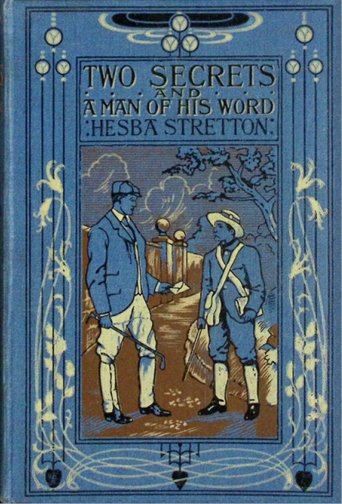
The Project Gutenberg eBook of Two secrets, and, A man of his word
Title: Two secrets, and, A man of his word
Author: Hesba Stretton
Illustrator: F. E. Hiley
Sydney Seymour Lucas
Release date: March 21, 2025 [eBook #75676]
Language: English
Original publication: United Kingdom: The Religious Tract Society, 1897
Transcriber's note: Unusual and inconsistent spelling is as printed.
"I'VE SAID I'LL PUT A STOP TO IT AND I'LL DO IT."
TWO SECRETS
AND
A MAN OF HIS WORD
BY
HESBA STRETTON
AUTHOR OF "JESSICA'S FIRST PRAYER," "ALONE IN LONDON,"
"NO PLACE LIKE HOME," "THE CHRISTMAS CHILD," ETC.
London
THE RELIGIOUS TRACT SOCIETY
4, BOUVERIE STREET AND 65 ST. PAUL'S CHURCHYARD
BUTLER & TANNER
THE SELWOOD PRINTING WORKS
FROME, AND LONDON.
The Children of Cloverley | The King's Servants
Enoch Roden's Training | Little Meg's Children
Fern's Hollow | The Lord's Purse-Bearers
In the Hollow of His Hand | Alone in London
Pilgrim Street | Lost Gip
A Thorny Path | Max Kromer
Cassy | The Storm of Life
The Crew of the "Dolphin" | Jessica's First Prayer
Jessica's Mother | Under the Old Roof
Left Alone | No Place Like Home
THE RELIGIOUS TRACT SOCIETY, 4 BOUVERIE STREET
CONTENTS
TWO SECRETS
AND
A MAN OF HIS WORD
ABOUT a stone's throw from the last house in the small country town of Armitage stood a cottage which had scarcely changed in aspect since it had been built two hundred years ago. The gambrel roof was high-pitched and closely thatched, with deep eaves, under which the swallows built their nests; the little elbow in the slope of the gable gave it a quaint look, as if the cottage had drawn a hood over its head. Along the top of the roof grew a row of purple flags, which contrasted well with the brown thatch and golden lichens. Casements, with small diamond windows, glistened in the light. A garden full of old-fashioned flowers ran down from the road to the little porch, which sheltered the door from rough weather, and made a pleasant and shady seat in the summer. It was certainly the most picturesque dwelling in the neighbourhood.
"What is the name of your cottage?" asked an artist, who had just finished a sketch of it.
"Oh! It hasn't any name, sir," answered Joanna Terry—"it's nothing; only our home."
She had been born there, and had not been away from it for a whole week at a time for fifty-five years. She hardly knew any other house. The ground floor of the cottage contained a large, old-fashioned living-room, with two very small ones opening out of it, one of which was a kind of scullery, and the other the bedroom in which she had been born, and where she had slept all her life. Under the gable of the thatched roof there was a large attic covering the whole area of the cottage, with sloping ceiling and two windows, one at each end, looking east and west. Joanna's mind could not grasp the idea of any improvement in the arrangement of her little homestead.
The tall, spare old woman was still very active and alert, with an eye keen to detect every weed venturing to grow in the garden, and every speck of dust that might blow in through the open window and door. Scarcely a bud opened on the roses and clematis climbing up the half-timber wall without her notice. The hollyhocks and sunflowers, standing as erect as herself, were every one known to her. The potato-patch behind the cottage, which her husband, Amos Terry, cultivated in his leisure time; the long rows of peas and beans; the beds of onions and lettuce; the fruit-trees which paid their rent—they were almost like children to her. Indoors, the old oak settle by the fireside, the oak table and dresser, all shining with the active work of her own hands, teemed with associations and memories which formed the sum and substance of her life. The roof-tree was not more planted to the spot than Joanna was.
Still more firmly rooted there, if possible, was her only child, Charlotte, who lived in the pleasant attic under the roof. She was lame, and an invalid from a spinal complaint, the result of a fall when she was a little child. It was very seldom that she felt well enough to creep painfully down the rude staircase to the ground floor. But from her two windows her eye could overlook both of the garden patches lying before and behind the house; and she knew everything growing in them as well as her mother did. Eastward her view was bounded by a low ridge of hill, above which the morning clouds hung tinged with lovely hues some time before the sun showed itself over the wooded outline. To the west there was a wide stretch of undulating land, with meadows and coppices and scattered cottages, ending far-off in a glimpse of the sea, which often glittered like gold under the setting of the sun. Charlotte seldom missed seeing both sunrise and sunset.
She was thirty years of age now, pallid and emaciated, with the pathetic look in her eyes which cripples and deformed people so often have. She looked almost as old as her mother. The mother and daughter had been slowly changing places for the last fifteen years. Charlotte was the adviser now, the head of the little household, the referee to whom every question was brought. She was always brooding over schemes for her father and mother's comfort, and suggesting gently what their actions should be from day to day. Joanna was still young in spirit, apt to act impetuously; occasionally giving way to almost girlish fits of temper, which she confessed and repented of by Charlotte's bedside. It did not seem possible there could ever come a secret between these two.
Amos Terry, who was two years older than his wife, had been a rural postman for thirty-seven years. The daily routine of his work had never altered. At six o'clock, summer and winter, he presented himself at the post-office in the town, and received the various letter-bags which he had to convey along a route, the farthest point of which was seven miles away. As it was out of the question for him to return home and walk the same distance again, he remained at this farthest point all day, and hired a small out-building, where he occupied his time profitably in mending the boots and shoes of a considerable circle of customers who valued his careful work. At four o'clock he started homeward, collected the bags he had distributed in the morning, and was timed to be at the post-office again at half-past six, soon enough to make up the evening mail. The old church clock never struck seven before he was at home, going first thing upstairs to his daughter's attic. The sight of her face, wan and drawn as it was with pain, but always lit up with a smile of welcome, was the most precious sight in the world to him. He had never had a secret from her in his life. His whole heart and mind and soul lay open to her as absolutely as it is possible for one human being to be open to another.
"I don't think there's anybody in the world as happy as me," said Amos, perfectly convinced of the truth of his assertion, "at least, not one bit happier; they couldn't be."
"Not if Charlotte was strong and well?" suggested Joanna, with a sigh. It was she who had let her child fall when a baby.
"Maybe I should have gone away and left you," said Charlotte; "it 'ud never have done for me to live idle here. Or I might have been married, you know," she added, with a faint blush and a smile.
"Anyhow, it is as the Lord has willed it," Amos answered, "and sometimes I think He'll be weary of me sayin' how happy I am."
There was very little to disturb that happiness. Ambition was unknown to them. No religious or political questions perplexed their humble souls. Care was a long way off, for they had more than enough for their simple wants. They needed neither fine clothes, nor dainty food, nor costly furniture. A few old-fashioned books, gathered together by Joanna's forefathers, were enough for their mental requirements. The "Pilgrim's Progress" and "Holy War," the "Vicar of Wakefield," the "Fool of Quality," and "Paradise Lost," were ranged on a little hanging shelf in Charlotte's attic, and with their Bible and a hymn-book provided amply for Joanna and Amos, whilst more modern books were now and then lent to Charlotte by friendly visitors from the town. They had beautified their little home, and cultivated their garden according to their own fancy; and if three wishes had been given to them, they would have been puzzled to fix upon one.
If Joanna knew and loved her house almost as her own soul, Amos also knew and loved the route he traversed daily in all weathers. More than six hundred times a year he passed the same cottages, tramped along the same lanes between high hedgerows, and looked up to the same constantly changing sky overhead. He loved it ardently though dumbly, possessing no language that could express his feelings. He was fond of singing, but he sang somewhat as the birds sing, that know only a strain or two. Amos knew only a few hymns, and he generally sang them through again and again as he went to and fro, until the cottagers on his route knew when he was drawing near, and hastened to their doors or windows to give him a friendly nod.
It was getting well on In October. The low-lying hills were covered with coppices of beech-trees, now wearing the loveliest tints of autumn. Down each valley ran a little rivulet, joining a broad and rapid but shallow stream, which hurried along a stony channel to the sea. Amos seldom went home without taking some flower or leafy branch for Charlotte; and he was gathering a cluster of crimson berries from a climbing bryony, when a young man, the eldest son of Squire Sutton, of Sutton Hall, where he had just called for the letter-bag, came running quickly, though cautiously, after him. He did not shout or call to Amos; and he was almost out of breath when he reached him.
"Amos," he gasped, "here's a letter. It's a matter of life or death to me. Let me put it into father's bag."
He had brought the key with him, and Amos watched him unlock and lock the bag again. He had recovered his breath now, and he looked at Amos with a world of anxiety in his face.
"You are never too late, I suppose?" he said.
"Now, Master Gerard, you've known me all your life," answered Amos, "and you might almost as well ask if the sun 'll set at the right time. I have come and gone on this road nigh on forty year, and never missed yet. Nobody ever gave me a letter for life or death afore; and it 'ud be odd indeed if I missed tonight."
As Amos trudged on the sun went down behind the sweet round outline of one of the low hills, and the sky looking nearer than in the summer, seemed about to close, like brooding wings, over the quiet woods. Two or three robins were chirping cheerfully among the thinning leaves, which came down with a rustle as the cool evening breeze blew up the valley from the sea. A profound peace rested on all the silent lanes and meadows he traversed, which would have been too solemn if he had not loved it so profoundly.
But all in a moment a tumult of children's voices scattered the silence, and Amos saw a troop of terrified little ones running towards him and screaming for help. Looking beyond them he saw that one of their playfellows had fallen into the stream, which was carrying the child swiftly away towards the sea. He had no time to deliberate; there was not a moment to lose. In another minute the drowning child would be abreast of the spot where he stood. He laid his bags down safely on the bank, and waded into the shallow river, which, a few minutes ago, was running like a thread of gold between its banks in the radiance of the setting sun.
There was no great risk in what Amos was doing. The river, unless it was swollen by rain, was never more than breast-high. He caught the child in his hands as the current bore it past him, and carried it in safety to the bank. But there was no one in all the band of its companions old enough to take care of the little creature. The child's head had struck against a stone, and it lay a heavy load in his arms. He must carry it himself to the nearest cottage, which was almost a mile away. With his letter-bags slung across his shoulders, and his clothes heavy with water, Amos could not make very rapid progress. The cottagers were not very willing to take in a strange child, belonging to nobody but gipsies, and he had some trouble to get them to relieve him of his charge. More than an hour was gone before he could hasten on his ordinary way.
And he did hasten. In spite of his wet clothes and sodden boots, he pushed on along the darkening lanes, and across the dusky meadows, not losing a moment. It was always Charlotte's custom during the summer to be at the window about the time he was due, to give him a smile as he passed by; and when the evenings closed in early she placed a candle on the window-sill, that its feeble glimmer should show him a welcome. The candle was shining through the diamond panes, but he hardly saw it as he rushed past. What Amos did see was the world of anxiety in the young squire's face, as he said, "You are never too late, I suppose?"
The postmaster was standing out on the pavement, looking down the quiet street, and the gaslight was turned low in the office, usually so busy a scene till the time for closing, when Amos staggered, breathless and worn out, up to the familiar door.
"Why, Amos, my man!" exclaimed the postmaster. "However is this? We waited till the last moment, and the mail has gone down to the station these ten minutes. Hark! There's the whistle! The train's off!"
Amos reeled up against the door, as if struck by a gun-shot. He was too late! It was some minutes before he could tell his story; and the postmaster, with a good deal of sympathy and approbation, tried to console him.
"Nobody could blame you, Amos," he said. "I must report the matter to headquarters, of course, and there will be some inquiry about it, no doubt. Ten to one there is no letter of importance in your bags."
"Oh, sir!" cried Amos. "Is there nothing can be done? Think if there is anything can be done."
"Well," he answered, after a moment's pause, "you might catch the express at Norton Junction. It's perhaps worth trying, but I'm afraid the department will not allow the expenses. We'll see about that. A light cart and a good horse would run you into Norton in two hours."
"I'll try for it," said Amos. "Please send word to my wife and Charlotte, or they'll be fretting all night."
It was an anxious night to Joanna and Charlotte, even though the postmaster called himself to tell them all that had happened, and to praise Amos to them. The praises were very gratifying; but the two women could not help thinking of him driving through the chill October night in his wet clothing. How sharp the air felt, when they opened the window to see if there was any rain or fog! The hours wore slowly away. Joanna kept up a good fire, and had the kettle boiling, and put the old brass warming-pan ready to warm the bed as soon as Amos came in cold and famished. But no one came.
"Mother," said Charlotte, towards four o'clock in the morning, "of course they'd never drive straight there and back again. The poor horse 'ud have to rest, you know."
"Ay, dear love," answered Joanna; "but Amos might come home by the mornin' mail, and that's just due, I'm thinkin'."
Still the time crept on slowly, and there was no click of the garden gate, and no step coming down the gravel walk. At the first dawn Joanna looked out on the garden, with its tall hollyhocks and sunflowers still bearing a little blossom; but all appeared dull, and grey, and gloomy to her sleepless, aching eyes. If anything should happen to Amos, even the Garden of Eden would be a desert to her.
But the worst that happened was a sharp attack of rheumatic fever for Amos, following upon a kind of fainting fit, which seized him just as he delivered up his letters to the clerks in the travelling post-office at Norton Junction. He was promptly carried to the Norton Cottage Hospital; and there Joanna found him the following afternoon; and she wept tears of mingled joy and sorrow as she sat at his bedside and listened to the tale of his remarkable adventures.
"We shall never leave off talkin' of them," he said with a smile, "when I come home to you and Charlotte."
It was six weeks before he came home. The doctors told him he was quite well again and might resume his work, but he must take care of himself. Amos knew this even better than they did. The old buoyant strength, the careless, untiring delight with which he had been wont to stride along the old familiar roads, were gone for ever. He loved them as much as ever; but he did not go out of his way now to look into some secluded dingle, and he could not afford to pause and listen to any strange cry in the wintry woods. It was as much as he could do to accomplish his task. He was even compelled to hire a substitute when the snow lay heavy on the road, or when torrents of rain were falling. He had paid a heavy price for saving the life of a tramp's child. No one had thanked him for it; and he had not even the satisfaction of knowing whom or where the little creature was.
When he first called at Sutton Hall after his long illness, the servants told him how the young squire had made a runaway match, much to his father's displeasure. The young squire and his bride had gone to foreign parts, nobody knew where; and his father refused to continue his allowance, though he could not cut off the entail. This was the matter of life or death; and Amos was not sure that he would have driven off to Norton in his wet clothes if he had known the secret of the young squire's anxiety.
"But what's done is done," said Amos to himself; "and I thought I was doin' what the Lord set for me."
As time went on it became the custom for Joanna to take her husband's bags, at least every other day, and always in bad weather. The postmaster, who was friendly to them both, winked at this irregularity; and none of the great people on the road complained of it. It was little to Joanna to walk the seven miles out and back again; and the load was never very heavy. But the long wait of seven or eight hours at the farthest village was a severe trial to her. She took some sewing or knitting; but her heart was at home, wondering how Amos and Charlotte were going on, and longing after her accustomed work in the house and the garden. Her home seemed, if possible, to grow dearer to her every day; and her love was heightened by these enforced absences. There was no other real place in the world to her; it was her world. The joy of going back to it, and to those who lived in it, was the deepest earthly joy her soul could feel.
This home was held on a peculiar tenure, which she had all but forgotten. Joanna's father and uncle had clubbed their money together to buy it for three lives: their own, and the life of Joanna's cousin, a lad fifteen years younger than herself, whose probable term of existence was so far longer than hers. But as her father paid the larger share of the purchase money, he had stipulated that Joanna should have the right of inhabiting the cottage on payment of a low rent to her cousin. When the three lives were ended the freehold went back to the original owner.
It was nearly three years after Amos met with those adventures, which had formed the topic of endless conversations, before the postmaster succeeded in persuading him to resign his post and take the small pension due to him for his forty years' service. This step would make a radical change in their lives, and it was as important to him personally as the resignation of a prime minister.
"We shall get along rarely," said Joanna, though with a shade of anxiety in her voice; "the garden is worth £12 a year to us; and when you're at home to help, we shall make more of it. We can hire a bit o' land, and grow more things, and your pension 'll be a grand help."
"Surely! Surely!" assented Amos.
"And, mother," said Charlotte gently, "let us remember the words of our Lord Jesus, how He said, 'Take no thought for the morrow—'"
"Ay; but somebody must take thought," Joanna interrupted, "or how 'ud the work get done? How 'ud the seeds get sown, and the house minded, and food bought in? Thee and Amos mayn't take thought, but it falls upon me to do it."
ONE MORNING, AFTER A NIGHT OF HEAVY RAIN,
JOANNA SET OUT FOR THE POST OFFICE.
"But, mother," said Charlotte, "it means, 'Be not anxious for your life.' I used to puzzle over it hours and hours, because one must use forethought, till Mr. Seaford told me the words meant, 'Never be anxious.' Our Lord says, 'Your Father knows ye have need of these things'—food, and clothing, and shelter—and He will provide them. Yes, we shall get along finely."
The question troubled no more any of the three simple souls. Amos was to give up his work at Christmas, when he would complete the fortieth year of daily work as a rural letter-carrier, and until then he or his wife would carry the letter-bags along the familiar roads. One morning late in October, after a night of heavy rain, Joanna set out for the post-office, leaving Amos at home in bed, bearing his rheumatic pains courageously and patiently. She made the fire up with a huge lump of coal which would smoulder for hours, until Amos got up.
It was still dusk when she passed the cottage on her journey out, and the beloved roof, with its deep eaves, stood darkly against the cold grey dawn. A thin column of smoke wavered upward in the dank air. Joanna held a letter in her hand, directed to herself, which she had got at the post-office; and the temptation was strong to go in and strike a light and read it before she went on her way. She received a letter so seldom! But then every other letter entrusted to her would be delayed; and who could tell what might be the consequences if she was unfaithful to her charge? Besides, Amos would be worried. She passed by steadily, giving a loving nod to the old home under whose roof her only two beloved ones were sleeping.
It was not until she reached the end of her journey, and had delivered the last bag at the village post-office, that she sat down in the shed where Amos was wont to work as a cobbler, and took up the letter. She read the outer inscription to herself solemnly, and carefully opened the blue envelope. It was dated from Norton, and began with the word "Madam!"
"Oh, it's a mistake," cried Joanna, half aloud. "Nobody never called me Madam!"
But the address was plainly "Mrs. Amos Terry."
"There's nobody else of that name in our place," she reflected, and went on slowly spelling her way through the letter.
It was to the effect, expressed in formal phraseology, that her cousin, the third beneficiary under the tontine by which her cottage was held, being now dead, the freehold fell to the original owner; and the writer of the letter, being his agent, was instructed to give her immediate notice to deliver up the cottage in good and tenantable repair.
Joanna read and re-read the letter. She was an intelligent woman, but at first she could not grasp the meaning in its full bitterness. No word had come to her of her cousin's illness and death. It was true they did not correspond except on the quarter-days when she sent the rent and he acknowledged it. By-and-by her brain began to act clearly. If her cousin was really dead, a man not much more than forty years of age, then, of course, the tontine was ended, and the cottage was hers no longer. At the thought of it, her heart died within her.
She leaned her trembling grey head against the wall, and shut her aching eyes. A phantasmagoria of the beloved home passed swiftly through her mind. She saw it in winter with snow upon the thatch, and long icicles fringing the eaves, all the garden round it sleeping in wintry sleep, and nursing the roots and seeds in its frozen bosom; in spring-time, with the young, fresh green of the lilacs and roses and honeysuckles budding out around it; in summer, almost smothered in blossoms; and in autumn, as she had seen it this morning, dank with rain, but snug and dry as a nest within. Every flower that had bloomed during the last summer, the fruit-trees laden with fruit, the long rows of beans and peas—all seemed to stand up clearly before her eyes, asking if it was possible for them to grow out of that soil under any other care than hers.
Then she had visions of herself: a baby crawling over the low door-sill; a little child running in and out with her prattle to the father and mother; a tall girl going to school and winning prizes to take home to them; and then, when Amos came courting, how the click of the garden gate sent her in trembling and blushing to her mother's side. And all the years since—the long stretch of nearly forty peaceful happy years—lived under the old roof, until every lifeless thing had become alive with memories. Not a nail had been knocked in any wall, not a patch put into the thatch, but she knew all about it: and having not much else to think about, she could remember how and when and why each slight change had been made.
Joanna did no work that day. She sat still in the little shed, oblivious of cold and damp and hunger, brooding over the terrible letter. She forgot to eat the dinner she had brought with her. One decision only she could come to—to keep her secret as long as she could. Why should Amos and Charlotte suffer as she was suffering, until she had done all she could do?
It was hard to go in home that night. She must be her usual self, cheery, and a little talkative, asking trifling questions about what they had done all day, whilst her heart felt breaking at the sight of every familiar object. But she did her best, not daring to complain of any ache or pain, lest Amos should insist upon going out in the continued bad weather. At last, the first fine day, when he could undertake his duty, Joanna found some excuse for going to Norton. She had learned to know the place well while Amos lay ill in the hospital.
The agent who had written to her was in his office; and after a little delay she was admitted to see him. He was a busy man, pompous in his manner, and he could see nothing to interest him in a plain, ill-clad country woman, whose homely face was no more eloquent than her words. She had but little language in which to plead for what was a matter of life or death to her.
"My good woman," he said at last, rather angrily, "I have no time for further discussion. I am instructed to sell the property; and £150 has been offered for it. If you can make me a better offer, I am willing to take it. If not, you must be out before Christmas."
It was like listening to a death-sentence. The house was going to be sold! Could she offer more than £150? She might as well think of buying one of the crown jewels. Leave before Christmas! Why, that was only six weeks off; and Amos and Charlotte had no thought of such a thing yet. She went home stunned, not knowing what to do. It was as if Fate had put a dagger in her hand, and bade her pierce the hearts of her two beloved ones. She did her best to shake off the feeling of doom which was crushing her; and for some days she went about her daily work with a Spartan-like cheerfulness. But the bitterest anxiety and despondency were gnawing at her heart. The only relief was when Amos was obliged to stay at home, and she could trudge along the wintry lanes, unseen by eyes that loved her homely face and watched it.
But the time came at last when she could no longer delay to strike the blow which would wound Amos and Charlotte as her own heart was wounded. It was necessary to seek some other roof to shelter them; for December was come, and on Christmas Eve they must leave the old home.
"Amos," she said, in a tremulous voice one cold, dark night, after she had come in from her long tramp, "my cousin's dead."
"Ah! Dear heart!" he answered her. "And did he die happy?"
She had never thought of that.
"I don't know," she cried, bursting into tears, "but oh! Amos, we shall have to lose our old place!"
He had been stirring up the fire to make a cheerful blaze, but now he sat himself down beside her on the oak settle, and put his old arm round her, drawing her closely to him. He was trembling too with the suddenness of the shock her words had given to him. The firelight played upon their wrinkled faces, and upon the hard and withered hands which clasped each other so fast. Both of them were silent for a few minutes. Amos knew full well the anguish that filled his wife's heart.
"Let us go and tell Charlotte," he said at last.
It was one of her bad days, and she had not left her bed. A patchwork counterpane, made by Joanna, covered her, and patchwork curtains sheltered her from the draught of the window. Her aching head and pallid face lay on a down pillow, with a linen slip spun and woven by Joanna's mother. The attic looked like a home that had been long and intimately occupied. Joanna sank down on her knees, with a deep moan, beside the bed; whilst Amos, in a faltering voice, told the sad news briefly.
"Then that's what it means!" cried Charlotte, lifting up her head, and looking at him with shining eyes. "All day long, for the last five or six days, there's been a whisperin' in my mind, 'Though He slay me, yet will I trust in Him.' It's God's voice, father. He's spoken beforehand to me, to comfort you and me."
Joanna raised her care-worn and tearful face, and Amos laid his rough hand tenderly on his daughter's head. Neither of them doubted that God had indeed spoken to her.
"A father couldn't do anything to his child that seems worse than slaying it," continued Charlotte, "but I've read of fathers, loving fathers, that have done it rather than let them fall into the hands of wicked men that would kill them cruelly. The children would trust their fathers to kill them. 'Though He slay me, yet will I trust in Him.'"
"Ah! Dear heart! We'll trust in Him," Amos answered.
They sat up late that night talking over the utter change in their future life, and trying to face the calamity from every point of view. But, after all their discussion, there was nothing for it but to accept the sorrow as God's will, to which they must meekly submit their own.
The trouble fell most lightly on Amos. His home was where his wife and daughter were; and he had lost neither of these. All his days had been passed away from the cottage, and his life had not been so closely interwoven with it. Besides, he was almost as ignorant as a child about ways and means. His weekly wages had always been handed over, as soon as he received them, to Joanna, who provided for him everything he needed, leaving him only a few pence in his pocket to meet any unforeseen contingency. The faculty of dealing with money, which is one of the latest we acquire, and one of the earliest we lose, had never been developed in Amos. No anxious foreboding troubled him as to food, shelter, and clothing. Joanna was there; she would see to all that.
Charlotte, also, had never had the spending of five shillings in her life. All she needed came to her as the air and the light came, without care and without thought. Joanna had shielded her always from all anxiety. It would be a great grief to quit the old home; but there rose in her something of the self-sustaining spirit of a martyr. If she must suffer, she would suffer with rejoicing. There had been women who trusted in God whilst they were wandering about in deserts, and mountains, and caves, and holes in the earth, being destitute, afflicted, tormented. This trial of her faith was nothing compared with theirs. God should find her trusting Him through sorrow and trouble, as she had trusted Him in peace and tranquility. She would take up the cross willingly, and follow the Lord whithersoever He pleased to lead her.
Was the burden lighter to Joanna because the others bore it lightly? All her life had been spent laboriously in providing for and shielding her two beloved ones. Every shilling, for their sakes, had been made to do the duty of thirteenpence. She had diligently practised industry, and thrift, and forethought every hour of every working day; and now she could not enter into the Sabbath rest of Charlotte and Amos. The future loomed very dark and dreary. There would be no immediate distress; for had not she scraped painfully together as much as £50, which was safely deposited in the post-office savings bank? But she always regarded that as a nest-egg for Charlotte, if she should happen to outlive her and Amos. As she sought for some cheap and comfortless lodging in the town, she wondered how she could manage where there was no garden where she could grow vegetables and savoury herbs, and where she could keep a few fowls. Every egg, every potato even, would have to be bought; and the only money coming in would be the small pension due to Amos. She foresaw herself spending, with a constant heart-pang, the nest-egg laid by for Charlotte.
Joanna fought hard against distrust of God. She listened, with a ghost of a smile, to Charlotte's consoling and courageous thoughts, but she could not enter into them. It was strange how this new misery made everything about her start into greater vividness. Every object about the cottage, and within it, seemed to be almost alive and thrusting itself into her notice. Even the old cracks in the window-panes impressed themselves upon her mind. Still more keenly did she see and read afresh the familiar faces of her husband and daughter. Perhaps we see least those whom we love most. They live so closely beside us that, though their voices are in our ears, and the sense of their presence is always with us, we hardly look at them, and time leaves traces on their beloved features undetected by us. Joanna was startled to recognise how Amos was looking an old man, and how pallid and worn was Charlotte's face. Oh! If the blessed Lord would only let them all pass away together from this world before the great sorrow came!
A few days before Christmas the postmaster handed a foreign letter to Amos when he came at six o'clock in the morning for the bags. He read it, as Joanna had read hers, in his cobbler's shed. It came from Madeira, and was written by young Squire Sutton, whose runaway marriage he had unconsciously helped. There were only a few words, for in it was enclosed a letter to Joanna, which was not to be opened or spoken of till Christmas Day. Amos put the letter carefully aside, smiling a little sadly to himself as he thought he had a secret as well as Joanna. But he did not dwell upon his secret much. The dreaded crisis had come, and his old home was being dismantled. These few days were full of slow, suppressed anguish to Joanna, as one by one she carried the smaller treasures of her home to the dreary lodgings in the town.
Each night when Amos came in some familiar household goods were missing, and their empty places stared him eloquently in the face. Forebodings of the immediate future began to peer at him through the shadow of the coming event. He almost forgot he had any secret, and he ceased to smile when it crossed his mind.
Christmas Eve came at last—the dreaded day. Heaven had not interfered to prevent their exile. Only the heavier pieces of furniture remained to be moved—the oak settle from the hearth; the old four-post bedstead on which they had slept so peacefully all their married life, on which Joanna's forefathers had died, and on which she and Amos had expected to lie down and die as peacefully as they had slept. The tall clock in the corner, which had stood there over a hundred years, must be taken down. It was to Joanna as if she saw the roof-tree give way when she watched their old friends touched by strange hands. Every stroke of a hammer stunned her; every creak of the old furniture pierced her to the heart.
The doctor came in the middle of the day, and kindly carried Charlotte away in his carriage to their new abode. Joanna was left alone, for she had insisted upon Amos going this last day of all upon his round. He would come back rich with Christmas boxes; but what were any gifts to Joanna just then? She watched the cart-load of heavy goods start off, and then she looked round with bitter despair at the dismantled rooms. She went outside and paced mournfully round the beloved garden, dearer to her than any other spot on earth. It was a clear wintry day, with a blue sky, and a white frost which silvered over every leaf of the evergreen bushes and every bare branch and twig of the trees. A fringe of icicles hung from the eaves, sparkling like diamonds in the sun. But there was no smoke rising from the chimney, no face at any window, no sign of habitation. The cottage seemed to feel itself deserted. Such forlornness had not befallen it for uncounted years. It and Joanna were going to part, and it had already a forsaken look, which brought a burst of bitter tears to her old eyes.
She walked feebly away, looking neither to the right hand nor the left, and the neighbours had compassion on her, leaving her alone with her grief. The two rooms which formed their new home were in a state of utter confusion. The men who had removed the heavy furniture were putting up the bedstead in the room which must now be bed-chamber, kitchen, and all. A little room at the back, opening on to walls, and chimneys, and roofs, was to be Charlotte's.
Joanna set to work at putting things to rights a little; but she was bewildered and confused, and Charlotte, with a tender and gentle voice, told her what to do, as if she had been in the habit of directing household matters. Joanna obeyed her as if in a dream.
Amos came in at his usual hour, and gave Charlotte a kiss, as he had done each night ever since she came into the world. Then he looked hesitatingly and shyly at his wife's sad face, and his old arm went round her neck, and her head sank upon his breast. There was something sacred and sacramental in the unwonted caress. It was the first moment of consolation that had come to Joanna, and her face was brighter when she lifted it up. At any rate, she had lost neither Amos nor Charlotte, she said to herself.
There was little sleep for any of the three that night. The unaccustomed noises in the street, the closer air, the sense of being in a strange place, all kept them awake. Joanna got up early in the dark Christmas morning, and pottered about with a candle among their littered goods to find the articles necessary for breakfast.
"A happy Christmas to you, mother!" called Charlotte from the inner room.
A lump rose in Joanna's throat, and for a minute or two she could not bring herself to speak. Fifty-seven happy Christmases had found her in her old home; but now! Then she said in a whisper, "Lord, forgive me!"
"A happy Christmas to you, Charlotte!" she called back in a shrill and strained voice.
It was a comfortless breakfast amid their disorderly possessions; but Amos kept making light of it, and apologizing, as if in some way it was his fault. As soon as it was ended, he and Joanna went into Charlotte's room to reckon up the presents which had been given to him the day before. He was an old man, and a favourite, and his Christmas boxes amounted to more than five pounds.
"But good sake!" he cried suddenly. "I've got a Christmas letter for you, mother, and I shouldn't wonder if there weren't a pretty card or something in it. It's from young Squire Sutton, and it came to me a week ago, but I weren't to speak a word of it till Christmas Day in the morning. Here, Charlotte; it's for your mother, my dear, but you'll read the writin' the easiest."
The young Squire began his letter by saying that but for Amos Terry's promptitude in carrying on the letters entrusted to him he would himself have missed the happiness of his life. He had heard the whole story from a friend in the neighbourhood.
"We were sorry to hear Amos was ill with rheumatism, and now we hear
that he is obliged to give up being postman. We have often wished to
share our happiness with you two old friends, and as soon as we heard
your cottage was for sale we commissioned an agent to buy the freehold
for you, and we ask you both to accept it as our Christmas gift. With
all our hearts we wish you a happy Christmas."
Joanna fell down on her knees, and bowed her grey head upon her hands. "Lord, forgive me! Lord, forgive me!" she sobbed. A positive pang of gladness ran through her; it was like a rush of life poured into dying veins. All the anguish and forlornness, all the dread and foreboding were gone. The old home, dearer to her than ever, was hers again, and by no uncertain tenure. Not only hers, but Charlotte's, if she should outlive her. There was no danger now that Charlotte would ever be homeless. When she lifted herself up and looked at her two beloved ones, Charlotte's pale face had a tinge of colour, and Amos was looking almost frightened at his fortune.
"Amos!" cried Joanna. "We must go and look at it this minute!"
They stood together, the old man and woman, at the garden gate, gazing down on the paradise they had almost lost. It looked more lovely, more desirable, more home-like than it had ever done, and now it was their own. It seemed almost as if God had sent them the gift direct from heaven.
"If it hadn't been for that tramp's child,"' said Amos slowly, "I shouldn't ha' missed the mail that evenin'. And if I hadn't missed the mail, the young Squire 'ud never have thought o' buyin' the house for us. I've often and often wondered about that tramp's child; but there now! 'Ye are of more value than many sparrows.'"
"Ay! That's true," said Joanna, with a sob of happiness.
CHAPTER I
His Only Child
IF you take a railway map of England and Wales, you will see that, in spite of its close network of railroads, meeting and crossing in all directions, there are still many tracts of country where the villages must be several miles from any station. In these out-of-the-way spots life is more at a standstill now than even in the days when stage-coaches and wagons were wont to run from town to town, taking the villages in their route, and carrying with them the common gossip of a whole neighbourhood. Twenty-five or thirty years ago, before the railway system was as fully developed as it is at present, but when it had already given a death-blow to the old coaching business, many a village was cut off thus from its former intercourse with the outer world, and left to live apart from the common life of the nation, or to find its own way to a reunion.
In such a remote place, on the borderland which is half English and half Welsh, lived Christmas Williams. The village was scarcely more than a hamlet, having no pretension to a village street, its scattered cottages standing alone in their own gardens. A brown, shallow, brawling little river, which filled the quiet air with its singing, ran along under the churchyard walls, over which the tall lime-trees threw their deep shadows on the busy stream. West of the churchyard, still on the bank of the river, lay Christmas Williams' garden: his special, favourite garden, not the common piece of ground beside his house open to every foot, but his own locked up, fenced-in plot, reached by a footpath across his orchard.
Just within sight of the church stood Christmas Williams' house, the village inn, holding a conspicuous position on a slope of ground, with a primitive sort of terrace in front of it; over the wall of which he could often be seen leaning, to look down on the carts and wagons passing in the lane below, and to send messages, some friendly and some hostile, by the drivers to their masters, on the various farmsteads lying round the village.
There was no one in the neighbourhood who was considered better off, or who had so widespread an influence as Christmas. He had been churchwarden for many years, as well as constable of the township; for rural police were not yet in existence. It was he who kept the keys of the church, as well as of the crib, which was a small jail built in one corner of the churchyard, and the terror of all the children of the parish.
Yet the crib was seldom occupied, except sometimes after a club-day at the village inn, when any drunken brawl was sure to excite Christmas Williams' wrath, and bring down swift punishment on the offenders. It was in vain to urge the argument that hard drinking was to his own profit; he only permitted his customers to have as much as he considered good for them; and if by any mischance they overstepped the doubtful line between sobriety and drunkenness, down came the keys of the crib, to which, as constable, he felt pledged to commit all brawlers and disturbers of the public peace.
There was not a soul for miles round, as far as the distant town to which he went to market twice a month, who did not know Christmas Williams to be a just, upright man, and, above all, a man of his word. His word was as good as another man's oath. His father had kept the village inn before him, and had borne the same character. His grandfather, too, had been landlord, churchwarden and constable; an honest, plodding man. The house, with its wainscotted walls, and its large, open kitchen, spacious enough to hold comfortably all the men in the village; the office of churchwarden, with its close connection with the rector; and the post of constable, making him the official guardian of the public peace: all these had become almost as hereditary as the estates of the duke, who owned a good part of the county. The duke was not prouder of his descent and name than was Christmas Williams.
It was a peaceful, pretty village, with low round hills encircling it, their soft outlines stretching across the sky, with coppices of young larch-trees and dark Scotch firs climbing up their slopes. The air, sweeping over a thousand meadows, where cowslips and buttercups grew in profusion, bore no slightest taint of the smoke of cities. A soft tranquility seemed to brood over the place in almost unbroken silence. The grey old church, with no charm about it except its age, wore a look of idleness and disuse, as if it had done with active service, and was resting before settling down into ruins. Even on Sundays the doors yawned merely to admit a handful of old-fashioned, steady-going people, who listened sleepily to the old rector, as he read to them one of Blair's Sermons, out of a volume from his library, not even taking the decent trouble of making a manuscript copy of it.
The rector was an unmarried man, with few ideas beyond the pursuit of country pleasures, which he had followed so long that they had mastered him, and now held him in utter bondage. He was keen after a fox, and could not keep away from a coursing match. His parishioners saw much more of him in Christmas Williams' snug fireside corner than in his desk and pulpit.
Who can tell how the mischief crept in? Little by little, step by step; first a Sunday-school class in Widow Evans' cottage; a quiet prayer-meeting or two; then an afternoon preaching. A change was coming over the village; or, more truly speaking, over a small portion of the villagers, but those were the steadiest and best. Christmas took no notice of it at first; and the rector cared for none of those things.
The Sunday-school could hardly come under Christmas Williams' eyes, for he spent the most of every Sunday in his garden by the churchyard, scanning his well-kept beds, and strolling to and fro along the walks, from which he could see the headstones on his father's and grandfather's graves, and be forced sometimes to think of the far-off time when his own should be standing beside them. It was the chief trouble of his prosperous life that he had no son to carry on the name of Christmas Williams. Still, his trouble was a slight one, for he had a gentle, pretty little daughter, whom he had christened Easter, and whom he loved almost as if she had been a son. Easter must marry young and well, that he might hear her children call him grandfather.
But when the afternoon preaching began, and Widow Evans' son, a young stripling who was not yet out of his time as a draper's apprentice, stood up boldly, and with ready speech taught his fellow-villagers what he himself was learning in the distant market-town, of eternity, of the Saviour, and of God, Christmas roused himself. Worse than that, by-and-by the lad brought with him a grave, earnest, eloquent man, who preached such words as pricked the people to their hearts, and sent them home talking and pondering over these new things. It was high time for Christmas to bestir himself, both as churchwarden and constable.
"You can do nothing, Christmas," said the rector, sitting in his favourite chimney-corner; while Easter, as she went about her work softly and quickly, filled his glass for him from the brown jug on the table between him and her father. "Come, live and let live. They don't hurt me, and they ought not to hurt you. What harm is there in a bit of psalm-singing and Bible-reading in a cottage? Bless you! I wonder any one of them sets his foot inside the church; and I'll be the last to blame them if they don't."
"I've said I'll put a stop to it, and I'll do it," cried Christmas. "I'm a man of my word. I'll duck young Evans in my horsepond, if I can only catch him. They shall be cut up root and branch. You'll see I'll make short work of it."
"You cannot hinder them from meeting in Widow Evans' house, my man," replied the rector; "and you cannot stop them singing, and praying, and preaching, as they please. She's my tenant, and I'll not disturb her, poor soul! Let the thing alone, I say. Nobody knows better than me that it was a mistake putting me into the Church; I'm no more fit for it than for heaven itself. If I believed it would do me any good, I'd go to their meetings myself."
He spoke sadly, and bent his head down for a minute; and Easter, seeing it, drew nearer to the grey-haired old clergyman, whom she had known and loved all her lifetime.
"Well, if I cannot put a stop to it," exclaimed Christmas, "no man, woman, or child goes from my house to any of those fools' meetings. Whoever does that, shall never cross my threshold again."
Easter's fair face grew pale, and her hands trembled as she rested them for support on the table at which they were sitting. But there was a steady light in her eyes, resolute as her father's, as she fastened them upon his angry face.
"Father," she said, in a low, tremulous voice, "father, I've been there every Sunday since they began. And I am converted, and believe in God, and I must obey Him rather than you."
CHAPTER II
"Cast Out"
EASTER hardly knew how heroic an act was her confession of faith in God. She was a little afraid of her father, but her love of him was deep, though untried; and, like thousands of other converts to Christianity, from the days of our Lord Himself, when the man born blind was cast out and disowned by his parents, she had felt no fear of the cruel and unnatural separation which might befall her through any bigotry and obstinacy of her father. She stood in the flickering firelight, which was bright enough for them to see, without any other light, her eyes glistening, and the colour coming and going on her face, ready to fling her arms round her father's neck, and burst into a passion of tears upon his breast.
But his face was harsh and stormy, as he stood up with his stern eyes riveted upon her. "Say that once more, Easter," he muttered, "and you'll never darken my doors again."
"No, no, my man! No, no, Williams!" interposed the rector hastily. "Let Easter alone. I'll answer for her. She has always been a good girl, and she'll be a good girl now."
"What does the girl mean, then," asked Christmas angrily, "talking of being converted, and believing in God? I can say, 'I believe in God Almighty,' and all the rest of it, as well as any man or woman in England. Easter means more than that; don't you, girl?"
"Yes, father," she answered, in a firm, low voice; "I mean they've taught me how sinful I am, and how the Lord Jesus Christ did really die on the cross to save me, and that God loves me as if He was my real father. I'm not saying it like I used to say it in church, out of a book. I believe it with all my heart."
"Then you've taken up with a lot o' cant, and you may march out of my house, and see what cant and them that cant will do for you!" said Christmas, white with fury.
It was all in vain that the rector remonstrated and pleaded for Easter, and that Easter herself knelt at his feet and with many tears besought him to let her stay at home. He vowed that unless she would recall all she had said, and promise solemnly never to hold intercourse with any of the canting lot again, he would never more call her daughter, or look upon her in any other light than as an enemy.
Next morning, at the earliest dawn of day, Easter quitted her home. She had not tried to sleep; and she knew her father had not slept, for she had heard his heavy footstep moving to and fro in his bedroom. It had been his command that she should leave the shelter of his roof as soon as it was light, and she was obeying him. For the last time she opened her little casement, and looked out on the garden below, where the roses and hollyhocks and sunflowers were in blossom, and where the bees in the hive under her window were already beginning to stir. She was going away, not knowing whither she went: but she believed that God would be as faithful to His promises as her father was to his word.
As she went slowly and sadly along the village lane, where the cottagers were still asleep, all the old familiar places looked strange at this strange hour and in the grey dawn. Even the churchyard, where she had played for hours together as a child, seemed different and foreign to her, as though she was cut off from all relations with it and her past life. Where was she to go? Whom could she turn to? She must not stay with Widow Evans, lest it should displease her father more. She was passing under the rectory wall, when she heard the old rector's voice calling her.
"Easter!" he cried. "Easter, what are you about to do? Are you going to forsake your father?"
"He has cast me off," she answered, weeping; "he will not let me stay if I do not deny God."
"Dear! Dear! Dear!" cried the old rector. "He's an obstinate man, and I don't know what to say between you. You are two wilful ones, I fear. But I'll do my best to bring him round; and here, my lassie, here's five pounds for you, and a letter to my cousin, who will find you a place somewhere. Good-bye, and God bless you, Easter!"
"Do you believe in God?" asked Easter, looking up at him through her tears.
"Of course I do," he answered testily, "and so does your father. We believe in Him after one fashion, and you after another. But, Easter, yours is the best, I know."
He uttered the last words in a mournful tone, and watched her as she went sadly on her lonely way, until the hawthorn hedge hid her form from his sight. She was as nearly as possible like his own child to him; he had watched her growing up from day to day through all the changes of childhood and girlhood. He was a kindly old man, and loved to be at peace and on good terms with every one. And here was a brangle in the very centre of his parish, making desolate the house he frequented most. Besides, he could recall a time when he had felt the worth of a courageous faith like that which had sent Easter out into a world she knew nothing of, in simple reliance upon God and implicit obedience to the Saviour whose name she had taken. She was a Christian. Was he a Christian, too? The old rector thought of his self-indulgences, his country pleasures, and his neglected people; but he felt his heart heavy and dull. He could not lift it out of the miry clay in which it had grovelled so long.
Easter's absence made a greater difference to Christmas Williams than he would ever have owned in words. He had never let her toil laboriously with her own hands, as her mother and grandmother had done before her; he had been too choice of her for that. Easter had been like his favourite garden, where no common fruit or flowers were suffered to grow. He had delighted in her dainty, winsome ways, as he had delighted in his splendid show of roses, and of peaches growing ripe in the sun. He missed her sorely. There was no pretty, smiling face blooming opposite to him when he sat down to his now solitary meals. There was no light footstep tripping about the house; no sweet voice singing gaily or plaintively the old songs he had taught her himself. She was never to be seen leaning over the terrace-wall, watching for his coming along the lane. He had no one to buy some pretty trifle for when he went to market. Christmas had not foreseen the dreary change. Possibly, if he had foreseen it, he would never have uttered the oath he had bound upon his conscience.
All the neighbourhood took notice of the gloom that had fallen upon Christmas and his once pleasant house. He had always been a masterful man, but he grew morose and tyrannical as time passed on. His servants, who had been used to stay long periods with him, were constantly quitting his service, and carried away with them stories of his harsh and unreasonable conduct. The home gradually became dull and dirty, with no mistress to look after the maids. It was less and less tempting to gather about the large fireplace of an evening, as had been the practice for generations past.
The rector had offended Christmas by interceding for Easter, and by pooh-poohing his fiery zeal against the meetings in Widow Evans' cottage, and he turned into the village inn but seldom now. Christmas felt this to the very soul; but he was too proud to speak of it, or to yield an inch to his clergyman. It was reported, moreover, that the ale was badly brewed, or was kept in sour casks: a fact that might possibly have had something to do with the rector's fewer visits, and with their brevity when he came.
Christmas made no effort to learn any tidings of his daughter; but the neighbours took care he should hear them. She had taken a place as upper nurse in the family of the rector's cousin, who lived in the market-town he attended; and now and then he fancied he saw her threading her way through the busy streets on a market-day.
A year or two after she left home, he heard she had married Widow Evans' son, a poor, delicate young man, assistant only in the draper's shop where he had served his apprenticeship. Christmas cursed him bitterly in his heart; though he never uttered his name, or Easter's, with his lips. The letters Easter wrote to him he returned unopened; but none the less bitter was his resentment that she should marry without his consent. She was his daughter still, though he vowed she was not.
Presently came the news that a grandson was born to him. His own grandson! He heard it on market-day, and the farmers who were about him, buying and selling their corn, watched him inquisitively to see how he took the news. Not a change came over his hard, grim face; yet suddenly in his mind rose up the memory of that sunny Easter Sunday, when the bells were ringing joyously in the old church-tower for the resurrection of the Lord, and some one brought to him his first-born child. Another memory followed close upon it—the evening shadows of the same day closing round him as he knelt beside his dying wife, and heard her whisper in her last faint tones, "I leave my baby to you, dear Christmas!" All his lonely way home that night these two visions haunted him.
Still six months later further tidings reached his ears. Two or three of his oldest and most faithful guests, who yet lingered of an evening on the old hearth, were talking together, seated within the old screen, which concealed him from their sight, though they had a shrewd guess that he was within hearing.
"Widow Evans' son is dead," said one, "and he's left poor Easter a widow, with her babe!"
"What's she going to do?" asked another of the party.
"They say she's bound to come home to Widow Evans," was the answer. "She's ailing, is Widow Evans, and growing simple; she wants somebody to fend for her. And who so natural as Easter, poor lass? They were praying for her at the meeting last Sunday, and praying hard for 'him,' as the Lord 'ud soften his heart. You know who! It'll take a deal o' softening, I'm thinking."
"Ay! Ay!" agreed all the company.
"They say Easter's as white as a corpse," went on the speaker. "Eh! But she'll be a sight to move a heart o' stone, I say, with her babe and her pretty young face pinched up in a widow's cap. She's naught but a girl yet; I recollect her birthday as if it was yesterday. Oh! But what a feast we should ha' been sure of, in this very house, if Easter had never taken up wi' those new-fangled ways, and had married to please her father! But Christmas is too hard, I say."
"Ay! That he is," rejoined the other voices with one consent.
"Widow Evans' money is no more than five pounds a quarter," he continued, "and it dies when she dies. It will be close living for two women and a growing boy; though women know how to starve and famish better than men do, God help them! And to think of Christmas being so well off! Better than anybody knows fairly, with heaps of money in the bank. He oughtn't to be so hard!"
CHAPTER III
His Grandson
CHRISTMAS, as they guessed, overheard all their gossip, as he sat in his own little room behind the screen, with the door ajar. He felt pricked and stung, and he stole away noiselessly, that none of them might know he had been there, and went down to his garden beside the river, where he was secure of being alone. His heart had always been readily melted at the thought of a widow's loneliness and helplessness; and now Easter was coming back to her native place, his little daughter, a poor, friendless widow, burdened with a child! Why! It seemed but a few days ago that she was tottering along these smooth walks, her little feet tripping at the smallest pebble, and her little fingers clasping his own thick finger closely. How long was it since she watched with him the ripening of the fruit upon the trees, and with all a child's delight took from his hands the first that was ready for gathering! How many a time had Easter been seated dry and warm on his wheelbarrow, and watched him at work, digging, and pruning, and grafting with his own hands, while he listened all the while to her prattle! Those were happy, blessed days! And all these pure and innocent joys might be beginning for him again. His little grandson would soon be old enough to totter along these same garden paths, and to call him grandfather. He felt almost heartsick as he looked at the dream for a moment.
But it was only for a moment. Christmas could not relent; his long-cherished pride in being a man of his word could not so easily be conquered. He lashed himself up into more bitter anger against Easter for this momentary weakness. She might pinch and starve, for him. It was a strange sort of religion that set a daughter at variance against her father; and those who preached it might provide for those who believed them. He would not suffer it, or any one who professed it, in his house—no, not for a day. He would let Easter know that if she would humble herself, and promise, even now, to have done with these new notions, he would take her and her boy home again. But never—he looked across at his father's and grandfather's graves as he swore it—never should any canting nonsense be spoken under his roof!
Easter was reluctant to come back to her native village, but there was no one else to wait upon and nurse her aged mother-in-law. It was harder work than any one supposed to live on eight shillings a week; what had been just enough for one was far too little for three. Easter hoped that it would be possible to get a little needlework from some of the neighbours' wives; if not, she must take to field-work, and go out weeding and hoeing with the poorest of the villagers. There proved to be very little work for her needle; so Easter might be seen going out to the fields early in the morning on those days when her mother was well enough to take care of little Chrissie: for she had called her boy after her father, both because she loved the old name and because she cherished a secret hope that he would own him as his grandson.
But that hope slowly yet surely died away as year after year passed by, and no sign was given by Christmas Williams that he ever saw his daughter. He could not but see her almost daily about the village, and he could not go to his meadows without passing the little cottage where she and her baby dwelt. He saw her plainly enough: the sad girlish face, worn with sorrow and hard times, that gazed at him with beseeching eyes. He had sent his message to her, and she had answered firmly that she could not go back from professing her faith in Christ. The first time they met after that, Easter turned pale, nearly as pale as her dead mother had been when he saw her last in her coffin; and she had uttered, in the same clear yet faint voice as that in which her mother had breathed good-bye, the one word "Father!"
Christmas heard her as distinctly as if the word had been shouted in his ear, but he passed on in silence with a heavy frown upon his face; though in his heart of hearts there was a secret hope that she would run after him, and catch him by the arm, and hang about his neck, and not let him go—let him speak as roughly as he might—until she had forced him to be reconciled to her. If Easter had but known!
Now that Easter was at home in her mother's cottage, the meetings, which had become irregular on account of Widow Evans' failing health, began again with renewed vigour. Every Sunday a large class was held in the cottage, and Easter started a singing-class, taught by herself, which attracted all the young folks of the place to it. There was a slow, but quite a perceptible change in the little village. Even the farmers and their wives would sometimes condescend to be present at the service when some preacher from town was coming, for the old rector was growing more and more careless of his duties, and the conviction was spreading that there was need of some change. There was a rumour that the duke had been asked to grant land for the purpose of building a chapel, and that he was willing to do it if the majority of the parishioners wished it. The rector said nothing against it, but Christmas Williams, as churchwarden, opposed it with unflagging vehemence. The scheme, if ever indeed there had been one, must have fallen through for want of funds; but the mere rumour of it helped to widen the breach between him and his daughter.
In the meanwhile Chrissie was growing as fast as a healthy child grows who is always out in the open air, braving all kinds of weather, and only kept indoors by sleep. He was a lovely baby, and a bold, bonny little boy, restless, daring, and resolute; a favourite with all the neighbours, as Easter herself had been in her motherless childhood. Chrissie was free of every house in the village: there was no door closed to him except his grandfather's, and a seat at every table was ready for Easter's child. His mother, busy with making both ends meet, hardly knew how to put a stop to the boy's vagrant life. As soon as he was old enough to dress himself, he would be up and away at the earliest dawn, rambling about the fields and hedgerows, climbing the trees, or helping to bring in the cows to be milked from the meadows, where they had passed the short, cool, summer nights. Chrissie seemed to be everywhere, and to know everything that passed in the neighbourhood. Many an hour of silent prayer while she was at work, and many an hour of wakeful anxiety during the night, did Easter pass. So long, however, as Chrissie did not fall into any evil ways, she was wise enough to leave him free. He was truthful and affectionate, and, on the whole, obedient; and no child could be more apt to learn and remember the little lessons she tried to teach him whenever she had time.