
Forgiveness thus to leave you here so long;
I did not mean it, but I swooned away
Before I knew it.
The Lady.
I liked the vigil.
The Maiden (going to the bedside).
How calm! I would not bring life to him now
E’en if I could; gone to his God—at rest
From all earth’s toil.
Dear love, upon thy breast
I lay my hand; I yield thee back to Him
Who gave thee to me; and, if thou hast wrought
Wrong to our troth in deed, or word, or thought,
I now forgive thee. Sleep in peace; the dim,
Dark grave has its awaking.
As the hart
Longed for the water-brooks, so have I yearned
For token, Willie, that thy love returned
To me at last. Lo! now I can depart
In peace.—My picture, letters! Thou wast true,
Wast true to me, thank God!—
(Turning.) Madam, to you
I owe apology.
The Lady.
The Maiden.
Who loved him also; though to me was due
This love of his; at least—
The Lady.
I grant thee all. But, as I kneel, O bless
This heart that bows before thee; all its sin—
If it be sin—forgive; and take, within
Thy pure love, me, thy sister, who must live
Long years—long years! O child, who dost forgive
More than thou knowest, lay thy sister-hand
In blessing!
The Maiden.
Yet will I thus content thee: Now the Lord
Bless thee, and keep thee by his holy word;
Be gracious to thee, that thy faith increase;
Lift up his countenance, and give thee peace,
Now and forever!
The Lady.
This peace—what thou dost think it.
The Maiden.
The horses wait for me. Now that I know
He’s safe with God, the living claim my care.—
My mother—ah, full selfish was the love
That made me leave her so; I could despair
Of mine own self, if God were not so good,
Long-suffering, and kind.
O could I stay!
But I must reach the train at break of day.
I take my letters and the picture.—Should
Your duties call you not so soon, oh wait,
See his dear head laid low by careful hand,
And say a prayer above the grave.
The Lady (aside).
How doth she innocently torture—rack
My soul with hard realities! I stand
And hear her talk of graves!—O God, the black,
Damp earth over my darling!
The Maiden (turning to the bedside).
I kiss thee once.—Lady, you do not mind?
It was but once. I would not seem unkind;
I would not wound you needlessly.
The Lady (aside).
Proud heart, to bursting, but gainsay her not!
The Maiden.
Dear lady; but, forgive me, he was mine
Long, long before. It were too much to ask
That I should not be glad his heart returned
To me, his bride betrothed—to know he yearned
For me before he died. I cannot mask
My joy because you loved him too.
The Lady.
All joy that thou canst take; I would not rob
Thee of one little hair’s-breadth.
The Maiden (laying her head on the pillow).
My love! my love! my love! [Weeps.
The Lady.
Woman of the House (below).
The Maiden.
Indeed, I love you now.
The Lady.
To make you. [They embrace.—Exit Maiden.
The Lady (throwing herself down beside the body).
EARTH TO EARTH.
The soldier dead, dead in his gallant strength,
Young manhood’s prime. The heavy fold withdrawn
Showed his calm face; while all his rigid length
Lay stiff beneath the covering, the feet
Turned up to heaven like marble. Breezes played
Soft in his curling hair, the fragrance sweet
Of the wild-brier roses incense made,
And one bird sang a chant.
Yet recks it not,
This quiet body going to its grave,
Feet foremost, folded hands, if the storm rave
Or the sun shine. Henceforth nor part nor lot
Hath it with men—the tale is told, all’s o’er;
Its place shall know its step, its voice, no more;
Its memory shall pass away; its name,
For all its evil or for all its worth,
Whether bedecked with reverence or blame,
Shall soon be clean forgotten.—
Earth to earth!
Still held its roses crushed; the chill despair
That numbed her being could not dim the light
Of all her flashing jewels, nor the bright
Sheen of her draperies.
The summer sun
Rose in the east and showed the open grave
Close at her feet; but, ere the work begun—
Lowering the clay (O proud humanity!
Is this thy end?)—she gentle signal gave
To lay the body down, and, by its side
Kneeling, kissed brow and lips, fondly as bride
Might kiss; and, as she clung there, secretly
A shining ring left on the cold dead hand,
And covered it from view; then slowly rose
And gave them place.
But ere the tightening rope
Had done its duty, o’er the eastern slope
Rode horsemen, and the little group of those
Who gazed, drew back, and eyed askance the band.
They turned, they drew their reins—a sight to see
Indeed, this lady clad so royally,
Alone, beside a grave.
She raised her eyes,
And the bold leader bared his lofty head
Before her to his saddle-bow; the guise
Of bold, rough-riding trooper could not hide
The gallant grace that thus its homage paid
To so much beauty. At his signal mute,
The little band, Kentucky’s secret pride,
His daring followers in many a raid
And many a hair-breadth ’scape, made swift salute,
And, all dismounting, honor to the dead
Paid silently, not knowing ’twas their own
Bullet by night that laid him there:—so strange
The riddle of men’s life, its little range
Thick with crossed fates, though each one stands alone
To mortal eyes.
The rope slackened, the clay
Had reached its final resting-place. Then she
Who loved him best, in all her rich array
Stepped forth, and, kneeling, with her own hands cast
The first clod on his heart. “I yield to thee,
Nature, my only love. Oh, hold him fast
As sacred trust!
‘Earth to earth, ashes to ashes, dust to dust!’”
Then, rising, with her lovely face upturned
To the clear sky, where the first sunbeams burned,
“I know that my Redeemer lives,” she said;
“He that believes on him, though he were dead,
Yet shall he live!”
And so passed from their sight.
On to the south; the men who fill the grave
With hurried shovelfuls in whispers say,
“That’s part of Morgan’s band.” And one, a slave,
Looks down the road, and mutters: “That was him—
Young Cap’en Morgan’s self! These eyes is dim,
But they knows Morgan! Morgan!—what! why, bless
Your hearts, I know him, and I know Black Bess—
’Twas Bess he rode.”
On from their northern raid the troopers pass
Fleet to the south; the grave is filled, and gone
Even the slave.
Forever still, alone,
Her letters and bright picture on his breast,
Her sparkling spousal-ring on his dead hand,
The golden-haired young soldier lies at rest
Where o’er his head the steely shadows pass,
Far in the fair Kentucky border-land,
The lovely, rolling land of the Blue Grass.
1864.
WASHINGTON.
The Lady (with an open letter).
That troubled the calm hollow of my grief
With its small aching is withdrawn, and clear
The certainty—she never loved him. Brief
Her forgetting—brief!—But I will not chide;
All happiness go with thee, gentle bride,
And of my gold a sister’s share!
To wed
Another, and once his! O golden head
Under the grass, how jealous is my heart
Of thy remembrance! Yet I should be glad
She loved thee not, for then no evil part
I played, e’en though unconsciously.
Oh, mad,
Mad, mad my love for thee! the same to-day—
The same, the same. I could not be a wife—
I could not stop the sun! No love but thee,
My own, my own! no kiss but thine—no voice
To call me those sweet names that memory
Brings back with tears. Ah! had I any choice,
I still must love thee down beneath the sod
More than all else—though grandest soul that God
Had ever made did woo me. Love, my heart
Is thine, and ever must be thine; thy name
Is branded there!
Yet must I live my life.
Servant (announcing).
The Lady.
Doth while away my time. Yes, I do play
My part with smiles that are not wholly feigned,
For life is strong, and I am young.—There reigned
A queen once, who, though dead, could not lay down
Her long-used sceptre; with her jeweled crown
Upon her head, she sat and meted out
Reward and justice; nor did any doubt
Her life was gone. Were not her robes the same—
Her jewels bright? And had she not a name
Borne wide upon the winds for loveliness?
She could not stop—she needs must reign—noblesse
Oblige! So I.
But she—married! a wife!
Who once was his! Oh, horrible! a life
Of treason to his memory, a long
Lie! But, ah! no, she never loved him. I
Do hold myself as his, and loyally,
Royally, keep my vow.
Servant.
Madam?
The Lady (speaks).
The Count (entering).
LAKE ERIE.
The Maiden (rising from her knees).
For the new duties of a wedded life.
The letters have I burned;
And now—the picture. Oh, dear boyish face,
One look—the last! Yet had I been thy wife,
Willie, I had been true to thee—returned
All thy affection to the full.
She said
Love was “a sacrifice.” It is; as—thus:
Get thee behind me, Past! [Burns the picture.
—Which one of us
Was truest? But why ask? She wronged the dead
With many lovers—nay, her very dress
Showed not one trace of sorrow.
—I confess
I never thought her fair, although the throng
Do call her so, they tell me.
—Long, how long
I wore the heavy crape that checked my breath,
And went about as one who sorroweth;
And I did sorrow! Slow months passed, and I
Gave every thought to tearful memory;
My grief grew selfish.
Then—he brought his suit—
My mother wept and prayed. What right had I
To crush two lives? If by the sacrifice
I make them happy, is it not large price
For my poor, broken years? How earnestly
I strove to do the right!
The patient fruit
Of years of prayer came to my aid, and now
I stand in bridal white. Lord, hear my vow:
Oh, may I make him happy! Not a thought
Of any other love shall mar the troth
I give for this life. Evils, troubles, naught
But death, shall part us. Thus the marriage-oath.
But after—then—O Willie!
The Mother (entering).
THE END.
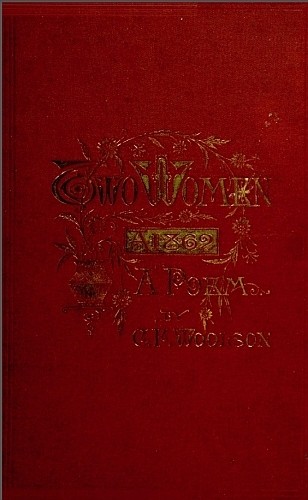
T W O W O M E N :
A POEM.
By CONSTANCE FENIMORE WOOLSON.
[REPRINTED FROM APPLETONS’ JOURNAL.]
From the Springfield Republican.
“Miss Constance Fenimore Woolson’s poem, ‘Two Women,’ begun in the January and finished in the February number of Appletons’ Journal, is of such remarkable quality as to deserve a wider reading than it is likely to have. To read it in completeness gives one, beyond its faults—which are principally those of imperfect versification and a certain formality of phraseology—a sense of power in character-drawing (coloring enough, too, for that matter), in dramatic situation and in expression of deep emotions, which is rarely met with. The contrast between the magnificent woman of the world and the Puritan country-girl is done in true masterly way, and that the one should continue faithful to love through her life, though still reigning in social royalty, while the other marries as piously as she mourned, and puts away the dead youth’s memory forever—is perfectly true to their natures. To present such marked types in rivalry, and show the self-abnegation in the rich nature and the innocent self-absorption of the narrow nature, was well worth while. The poem would make quite a little book, and better merits such treatment than most verses that receive it.”
From the New York Evening Post.
“In the poem ‘Two Women,’ the first half of which appeared in the January number of Appletons’ Journal, and the last half of which has just now come to us in the February number of that magazine, there is something, we think, which takes the piece out of the category of ordinary magazine-work, and entitles it to special attention. The poem is long enough, for one thing, to fill a little volume, if it were printed as it is the custom to print books of poetry, and while it is rugged, faulty, and in many respects defective, it is nevertheless strong, dramatic, and full of the flavor of the soil. The two women who gave it its name are types of two well-defined classes of American women, but they are sharply drawn as individuals also, and their characters are presented with a boldness and a degree of distinctness which is possible only at the hands of a writer of very considerable dramatic power.”
From the Providence Journal.
“A story in verse, which enchains the attention with fascinating power, ... produces an intensely emotional effect upon the reader, and at the same time an involuntary tribute to the originality and noteworthy ability of the writer.”
From the Detroit Post.
“One of the most powerful pieces of magazine-writing we have seen in a long time.... Shows a far-reaching knowledge of human nature, a dramatic grasp and force, and a power of description and expression seldom seen.”
One Volume. Cloth. 12mo.
D. APPLETON & CO., Publishers.