
CHAPTER X.
UNDER CUBA’S FLAG.
“Ten lives shall not pay for that one!” exclaimed Juan.
But hardly were his words out when Hal sat up, wiping away the blood from his forehead.
“I’m a long ways from dead yet,” he gritted, wiping away the blood.
Ramirez ran to his side.
His nervous fingers glided swiftly over the American’s forehead, making quick examination of the wound.
“Santa Maria be praised!” cheered the Cuban. “The wound is not a deep one.”
“Glancing bullet, likely,” muttered Hal, rising to his knees, and picking up his rifle once more. “The shock knocked me over, I suppose. Perhaps fright had something to do with it.”
“Fright?” echoed Juan, indignantly. “Nothing of the sort.”
“Well, I’m certainly feeling some fright,” smiled Hal, his face more than a trifle pallid as he took another look down below at the squad trotting upward.
They were just aiming for another volley, those Spaniards, who were now hardly more than an eighth of a mile away.
“Down!” warned Maynard, himself setting the example.
He had no more than ducked when the volley came.
“Up!” quivered Hal. “Give ’em some of their own medicine!”
Six shots rang out, almost simultaneously. Two saddles were emptied.
“Keep a-pumping,” ordered Hal, breathlessly, as he discharged his own piece as fast as he could work the mechanism.
His own wound had been caused undoubtedly by a glancing bullet, but this is the most painful kind of injury. It maddened him, made him utterly reckless.
Five more saddles were quickly emptied By this time the firing was general.
Clack! clack! clack! rang the hoofs. The cavalry, firing at will like their opponents, were now within a few yards of the top of the hill.
The Cubans were overmatched. Hal felt that the last few moments of his life had come.
Yet only one thought actuated him. Before he closed his eyes he would send as many Spaniards as possible to their last account.
Crack! crack! crack! Half of the Spaniards were out of the fight by the time the two forces came face to face at little more than arm’s length.
Bang! A ball from Juan Ramirez’s rifle passed clean through the head of the lieutenant in command, killing him instantly.
“No quarter!” yelled Juan as the six leaped to their feet for hand-to-hand combat.
“On the contrary!” thundered Hal. “Any enemy who throws down his gun must not be harmed!”
A ball from a cavalryman’s revolver sent one of the pacificos staggering back—dead.
Hal immediately avenged by killing the trooper.
Now one of the enemy threw down his sabre and revolver, crying for quarter.
“Spare his life, then,” shouted Hal, running forward.
That command acted like magic. Not another shot was fired, for not one of the eight surviving Spaniards lost a second in surrendering.
This they followed up by dismounting and submitting to being tied.
Ramirez, with blood running from a wound in his left shoulder, superintended the work of tying.
There were eight of the prisoners. As soon as bound, they were ordered to remount, and were next lashed to their saddles.
“The dogs!” vented Juan, gnashing his teeth as he looked the troopers over. “Of course they surrender, for the Cubans treat their prisoners of war kindly, and it is easier to surrender than to be shot. Besides, these fellows know that the Cubans cannot be bothered long with prisoners and that they will be set free.”
“This is horse fair day for us,” laughed Hal. “Besides the horses which the Spaniards ride, there are four more below which appear to be uninjured.”
This was the fact. Hal’s little command now had eighteen horses in all.
As soon as these had been corralled, the field was gone over for every weapon and cartridge that could be found.
Fifteen minutes were thus consumed.
At last Hal had time to think of the pacifico who had been killed.
He was dead beyond a doubt.
“My brother,” huskily murmured another of the pacificos.
“He died nobly, in a good cause,” said Hal, soothingly.
“He died for Cuba!” cried the dead man’s brother, throwing back his head proudly. “I shall pray to the Almighty that I may die in the same splendid way.”
Hal was ready to proceed, now, yet before the start could be made there was one sad duty to perform—the saddest that belongs to war.
A shallow trench was dug, and in this the man who had been slain was laid.
Then, while the rest stood by with uncovered heads, murmuring silent prayers, two of the pacificos covered the still form over.
There was no time to bury the Spanish slain.
Indeed, the Cubans, embittered by more than three years of suffering under the infamous war methods of Spain, were in little mood to do anything decent by the remains of the slain foe.
“The buzzards shall get them,” cried Juan, disdainfully. “The buzzards alone, in Cuba, do not go hungry!”
As Hal’s little command and considerable train moved forward, our hero heard the story of the pacificos.
Some fourteen months before they had broken away from Havana. Since then they had lived in hiding in the woods, subsisting mainly on roots and fruit.
Once in a while they had received morsels of meat from passing bodies of Cuban soldiers.
But the law of the Republic of Cuba forbade them to join the army without weapons and ammunition, which was the only reason they had remained pacificos.
That very morning they had been surprised and surrounded while sleeping.
Incapable of resistance for lack of arms, they had been forced to surrender.
They were on their way to Havana when rescued. Had their journey been finished they would undoubtedly have been shot in the prison yard of either Morro Castle or the Cabanas Fortress.
From these men Hal learned that the Cuban commander, Major Alvaredo, was supposed to be somewhere in the neighborhood, though that officer’s exact location could be only a matter of conjecture, for the Cubans moved from point to point with the speed of human lightning.
“I shall volunteer to the first Cuban commander I meet—no matter who he is,” declared Hal.
“Volunteer?” echoed Juan, smiling. “It is too late for that, mi amigo! Judging by the trail we have left behind, you are already a full-fledged Cuban commander. Never has so small a command done handsomer work.”
At noon they halted, in the midst of one of nature’s blooming wildernesses. Here there had been no plantations, no homes, hence the blighting hand of Spanish devastation had not left its mark.
For the first time our hero remembered the food with which Captain Blodgett had provided Juan and himself the night before.
It was brought to light now, and given entirely to the three late pacificos. They devoured it like famished creatures.
“It seems as if I lived again,” declared one of the poor, thin fellows, when he had finished.
“It is like a touch of Heaven,” said the second.
“The first real food I have touched in weeks,” sighed the third. “With this in my stomach I can fight for a week without feeding.”
It was still dangerous to delay. Hal gave the word to start.
It took an hour to cover the next five miles, for the road was now all the way up grade.
It was near the top of a hill that Hal was startled by a sudden sharp command of:
“Halt!”
In the same instant our hero found himself looking into the muzzles of a dozen rifles.
Yet the men behind those rifles were invisible behind a dense tangle of green foliage.
“What do you want here?” came the quick question.
It was Juan Ramirez who answered:
“We seek Major Alvaredo.”
“And if he is not here?”
“Then any Cuban officer will do, for I know you to be Cubans. Send word to your commander, please, that five recruits wait to offer themselves.”
“Major Alvaredo is here,” replied a grave voice.
Through a screen of leaves came a short, wiry-looking man of middle age, a bronzed, scarred veteran who, despite his ragged attire, looked every inch the trooper.
One hand rested on the naked machete that he wore dangling at his side; the other hand touched lightly against a revolver.
“You are recruits?” he asked, keenly surveying the five, then gazing with intense pleasure upon the horses, weapons and prisoners they brought him. “Judging from appearances, you will be valuable recruits. Where do you come from?”
Major Alvaredo listened with an interest that soon changed to amazement as he heard of the doings of the morning.
By the time that the narration was over, he grasped our hero cordially by the hand.
“You are ten times welcome, senor,” he cried. “You want to see service against Spain? Carramba! you shall see it. And if I mistake not, senor Americano, my general, Calixta Garcia, will receive you as something more than a private soldier. You have won a commission, if ever man did in our armies.”
“If there is a commission going a-begging,” smiled Hal, “it belongs to my guide and mentor, Juan Ramirez.”
“Oh, as to that,” smiled the major, “there may be commissions enough for two.”
With that they were conducted into the camp, where the major had about him eighty of the most daring riders in Cuba.
Thus our hero had gained the Cuban ranks. He was destined to become one of the most famous fighters of them all.
That night Hal Maynard slept under the flag of Free Cuba.
But he dreamed of the coming of the Stars and Stripes!
[THE END.]
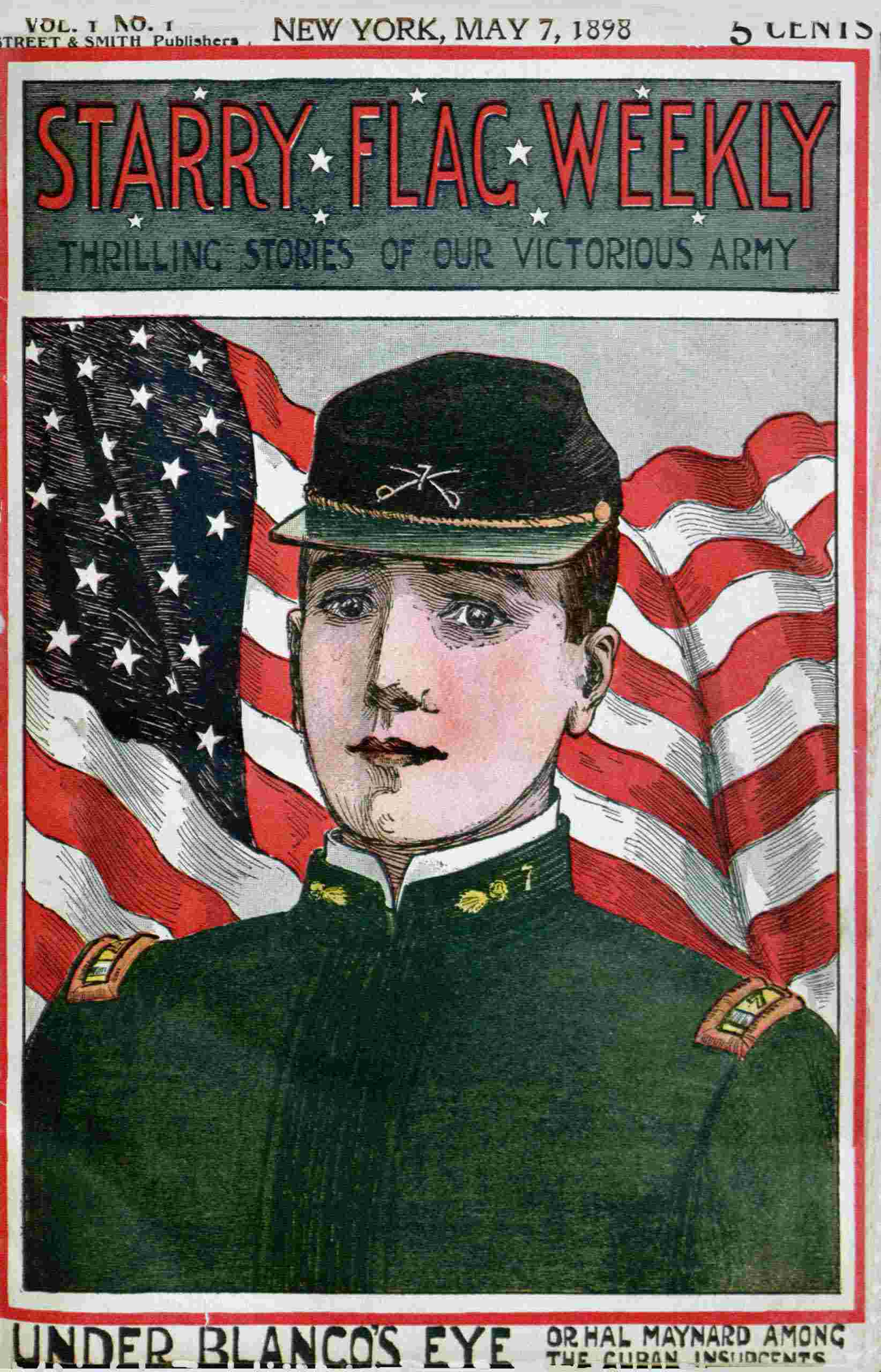
Cuba is the scene of splendid deeds! The struggle of her people for the Heaven-born boon of independence has commanded the whole world’s admiration, just as the Starry Flag Weekly’s series of Cuban war stories will win the hearty applause of all American readers. Hal Maynard and Juan Ramirez played manly, dashing parts in that hot-blooded struggle. What was perhaps their greatest exploit of all will be thrillingly told by Douglas Wells in “Gomez’s Yankee Scout; or, The Blow that Told for Cuba,” which will be published complete in next week’s Starry Flag Weekly, No. 2. This series will embrace by far the best Cuban war stories that will be Published!
IMPORTANT ANNOUNCEMENT.
It is the unchanging object of the publishers of the STARRY FLAG WEEKLY to have the best stories of adventure that can be procured, regardless of expense or trouble. Following this policy, the publishers decided some weeks ago to send Mr. Douglas Wells to Cuba. Mr. Wells, being an old campaigner, is accustomed to moving on short notice. Within two hours of the receipt of his orders he was speeding southward “under light equipment.”
Mr. Wells has spent many years of his eventful life in the armed camps of the world. He has spent many more years of his life in describing what he has seen, in works ranging all the way from history to romance. His long and varied experience, powers of observation, and knowledge of human nature have all greatly aided him in knowing just what subjects to depict, therefore, on reaching Havana he lost no time in getting to work. In the face of many difficulties he succeeded in obtaining permission to proceed into the interior, and he was soon among the insurgents. Then followed days of hard, rough riding, scant sleep and poor and little food. He was received by General Gomez, of the Cuban Army, and, after witnessing much of the Cuban drilling and some of the fighting made his way from the island to Key West.
Should war take place between the United States and Spain all his stories will be written from the front. Readers of the STARRY FLAG WEEKLY will have the most accurate and truthful pictures of the war, and those who are familiar with this author’s thrilling style will understand that, while there may be other Cuban stories published, none will be equal to those which will appear in the STARRY FLAG WEEKLY.
Hal Maynard will be the hero, a bright, typical, dashing American boy. As Napoleon once said that every soldier of France carried in his knapsack a marshal’s baton, so every American boy has implanted in him the seeds of heroism, awaiting only the sunshine of opportunity for development.
Thus Hal Maynard will be the representative of all American boys, and our readers, in following his adventures, will see done exactly what they would do themselves were they in the hero’s place.
Young Americans will do well to keep their eyes on the STARRY FLAG WEEKLY. It will be in these columns they will find the best and most graphic stories of the war—stories that will be written by an author who enjoys the somewhat rare distinction of knowing what he is writing about. Mr. Wells will not quit the front so long as the fighting goes on. Who can describe so well as he the march of great events this summer?