
CHAPTER XIII
OLD COMRADES IN ARMS
The town and harbor of Chemulpo are in reality the seaport for Seoul, the capital of Korea, which is inland about fifty miles. The harbor proper is a small affair and large vessels usually lie in the roadstead outside. Along the shore are clustered a number of wooden houses, painted white, and back of these are a small hill and a larger settlement, divided into Chinese, Japanese, and English, French, and German quarters. In the latter are hotels of fairly good size, a bank, schools, and churches. The trade is largely in the hands of the Japanese and Chinese, and almost all of the shipping is Japanese.
The sights in the town interested Gilbert very much, especially such as were to be seen in the Korean quarter proper. Here were long string of stalls, piled high with various things on sale, and the streets were alive with people, for the Koreans believe in keeping “on the go” constantly.
The sailor, Nouye, knew of a good Japanese hotel, and conducted the young American hither, where he was given a fair-sized room, heated, for his benefit, with a small foot stove. Gilbert was also introduced to several people at the hotel, so that he might not feel altogether strange. Then the sailor left him and he was allowed to shift for himself.
The ex-lieutenant needed a rest after his adventures on the Yellow Sea, and he determined to take it easy for several days before deciding upon what to do next. He learned that there was no steamer in the harbor bound for Nagasaki or any other port in Japan, and there was no telling when there would be.
“I rather reckon the Columbia and those on board will have to take care of themselves,” he reasoned. “I wish I was with them, but I’ve got to take what comes.”
The young American remained at the Japanese hotel just for one day, and then moved to another resort, kept by an Englishman named David Penworth. Here accommodations were also good, and the ex-lieutenant had the satisfaction of hearing his native tongue spoken once more.
“Quite a few Americans have enlisted for this war,” said David Penworth. “I had some of them in here a couple of days ago.”
“On the Japanese side?” questioned Gilbert.
“To be sure. I don’t believe any of them have joined the Russians. They seem to take to the Japs—they are such sturdy chaps, don’t you know.”
“They are that. Are those Americans who enlisted around now?”
“Oh, no, they came in from the Japanese camp, some miles from here. But, for all I know, they may be down again.”
Gilbert soon learned that the Japanese were landing troops not only at Chemulpo but also at Chinampo, a small treaty port about a hundred and fifty miles further north, and at Haiju, another place located midway between those first named.
The weather that these troops had to face was, for a while, terrible. The snow was heavy, the wind high, and camp accommodations very insufficient. Each soldier had to carry nearly a hundred pounds of baggage, and with this they struggled along, making marches of twenty to twenty-five miles a day.
The objective point of the Japanese army at that time was Ping-Yang, a place of considerable importance on the Tai-tong River. As soon as a sufficient army force was on hand, the Japanese proceeded to fortify Ping-Yang, and then more troops were sent in until, by the middle of March, there were over 80,000 soldiers in that vicinity, all forming the First Army Corps, under General Kuroki, a commander well known for his skill and daring in the art of warfare.
Gilbert had hoped to meet some of his own countrymen at Chemulpo, but he was not prepared for the surprise in store for him. One day he was near the docks, watching the arrival of a regiment of Japanese soldiers, when he noticed a body of sharpshooters having at their head a first sergeant whose face looked strangely familiar.
“Dan Casey, or am I dreaming!” he cried, and ran forward to get a better look at the individual.
“Well, be the powers, if it ain’t Leftenant Pennington!” came in a rich Irish brogue. “An’ to think we’d be after matin’ in such an outlandish place as this.” And leaving his command Dan Casey, who, as my old readers know, had served on many a battlefield with Gilbert, rushed to the ex-lieutenant’s side, and grasped his hand warmly.
“Then it is really you, Casey? I was afraid I was mistaken.”
“Sure an’ it’s meself, leftenant. I’m a bould sodger b’y onct more, glory be to the Mikado’s flag, which, by that same token, but privately, ain’t half as handsome as Old Glory, is it now?”
“Where did you enlist? I’ve been wondering what became of you after we parted in the regular army.”
“Sure an’ I’ve been dhriftin’ around, along with Carl Stummer. First we wint to the Philippines, thin Korea, an’ thin to Japan, workin’ whin we had to an’ seein’ the soights whin our pockets were lined, which same was not often. Both of us were down to hard-pan whin this war broke out, an’ says I to Carl, says I, ‘Lit’s go to th’ front.’ ‘Done wid ye,’ says he, an’ the next day we puts our names to a paper two yards long an’ covered wid plasters.”
“But you are a first sergeant?”
“Sure!” Dan Casey put up his finger knowingly. “They thought I was a captain in Uncle Sam’s army an’ I lit them remain under that impression. Carl’s me second sergeant, so he is.”
At this point another individual, short and rather stocky, came up, also dressed in the uniform of a Japanese soldier. For a moment he stared in amazement at Gilbert, then rushed in and embraced the ex-lieutenant.
“Vell, py chimanatics!” he burst out. “Of dis ton’t peat der pand annahow! Lieutenant Bennington, or I vas plind! How in der vorld did you got here, told me dot. Vas you in der army too?”
“How are you, Stummer?” and Gilbert shook hands warmly with the former soldier of the U. S. regulars. “I declare, it seems like old times to see you and Casey together, and in army uniform. No, I am not in the army, but I may be, if I see many more of our old crowd joining. So you are a sergeant, and Casey too. Let me congratulate you.”
“Dank you, lieutenant. Yah, I vas an officer now. Casey, he gits me dot chob. Dan vos a great feller annahow. He makes dem dink he vos a major, or somedings like dot.”
“Oh, I was after lettin’ ’em do their own guessing,” put in Dan Casey. “But we really got in on our merits,” he added. “’Tis a company of sharpshooters we have, an’ Carl an’ I had to qualify for our positions.”
“And what score did you make?” questioned Gilbert, with a soldier’s keen interest in such matters.
“Oh, I was lucky. I got ninety-six points out of a possible hundred, an’ Carl got ninety-six points. The Japs thought both were great scores.”
“And they were,” answered Gilbert, for he himself was a good marksman, but had never done quite as well. “Where are you bound for?” he added, after a pause.
“We have orders to Ping-yang. After that I’m afther thinkin’ we’ll get orders to drive the Russians northward beyand the Yalu River—if we can do it.”
“Put ve ton’t vos do dot right avay,” came from Carl Stummer. “Ve got to vait for besser veather. Dis vos den-dimes vorse nor dot rainy season in Luzon, ven we sleep in vater a foot teep. Maype you remember dot, hey?”
“Yes, I remember,” said Gilbert, with a short laugh. “But we had some pretty interesting times, for all that, didn’t we?”
“Oxactly so.”
“I’m wishin’ fer thim same times this minit,” put in Dan Casey. “Sure an’ ye must enlist, leftenant. Say the wurrd, an’ I’ll do all in me power to git ye a commission.”
“No, I can’t do that—at least, not now;” and then Gilbert told the pair about his business affairs, and how anxious he was regarding the Columbia and those on board.
“So Ben Russell and his brother Larry are on board,” cried Dan Casey. “That’s as interestin’ as it is to mate you, so it is! Sure an’ I’d like to see ’em.”
“Maype da vos into dis fight, too,” said Carl Stummer. “Pen Russell vos a porn fighter, remember dot.”
“An’ Larry could go into the navy,” said Casey. “A fellow that fought wid Dewey could enlist on any Japanese warship.”
Unfortunately the sharpshooters had to move on, so Gilbert could not question the pair of old comrades in arms farther. But he made an appointment for that evening, and the three spent several hours together, talking over old times and speculating over the future. Both Casey and Stummer urged Gilbert to enlist, and at last the ex-lieutenant promised to think the matter over.
“An’ if ye do, be sure to git wid us,” said Dan Casey.
“Yah, do dot py all means,” added Carl Stummer, and Gilbert promised to keep the whole matter in mind.
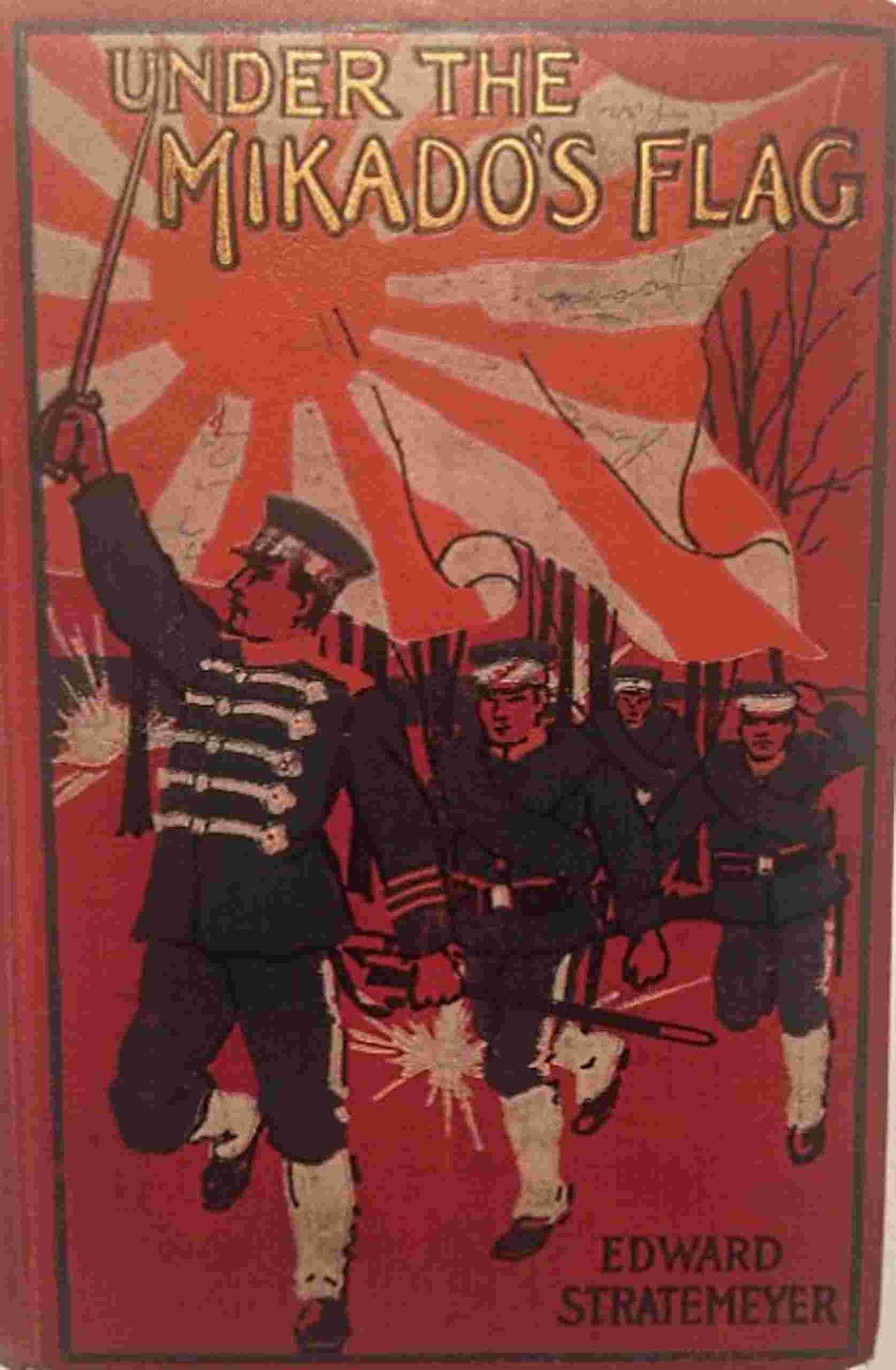
After Casey and Stummer had departed the young American thought over the matter for a good hour. He had spent many years of life in army service, but in the past this had been only under Old Glory. It would be a new experience to march under the Mikado’s flag. Yet a great many Americans were doing it.
“If I join the Japanese army, I’d be a regular soldier of fortune and no mistake,” he mused. “Well, I might do worse. After all, army service is largely a matter of business—when it isn’t the army of one’s own country. I don’t know but that I could fight just as hard for the Mikado as I have for Uncle Sam.” And there, for the time being, he dropped the matter. He would not have considered taking up arms against the Russians had he not been so badly treated at Port Arthur.
The very next day after the meeting just recorded a vessel arrived at Chemulpo carrying large quantities of army stores for the Japanese soldiers. The vessel was from Nagasaki, and Gilbert lost no time in visiting the ship and asking for the latest shipping news from that port.
“You may look over the papers,” said the purser, and handed him copies of the Mainichi, which means Daily, and of several sheets devoted largely to Japanese shipping interests.
“I’m sorry, but I haven’t got to reading Japanese yet,” said Gilbert, and was then handed a copy of the Japan Mail, and also a copy of the Japan Times, both published in English.
Sitting down, the young American looked the two sheets over with interest. At first he could find nothing of what he wanted, but at last caught a paragraph which instantly commanded his attention. The paragraph stated that the Columbia, Captain Ponsberry, had arrived at Nagasaki, with a mixed cargo consigned to various ports. She had expected to sail for ports in Korea and Manchuria, but owing to the war, the captain was awaiting further orders from the owners.
“I hope she stays at Nagasaki until I can get there,” said Gilbert to himself. “If she’ll do that, perhaps we can make something out of what’s on board. The Japanese are paying big prices for stores of all kinds just now. I wish I could sail for Nagasaki at once.”
The opportunity to sail for the Japanese seaport named came sooner than expected. That very afternoon a steamer came in from an upper port. She was bound for Nagasaki direct, and Gilbert had but little difficulty in procuring passage, although he had to pay just twice the regular fare. But in war times this was to be expected.
“And if a Russian warship sinks us, you must not complain,” said the captain of the steamer, after the bargain had been made.
“All right. I’ll take my medicine the same as the rest,” returned the young American.