
CHAPTER XXI
THE BATTLE OF THE YALU
For the instant after he went down, Gilbert was too bewildered to do anything to save himself. The Russian lieutenant was so close the young American had no chance to dodge or roll out of the way.
But when the young captain was attacked by the three Russian privates, Ben saw the movement and lost no time in hurrying to his chum’s assistance. He was just in time to meet the onslaught of the Russian lieutenant, and sword met sword in a clash which drew fire from both blades.
“Not so fast, my fine fellow!” cried Ben, who, as my old readers know, knew how to handle his blade perfectly. “Not so fast!” And watching his chance, he gave a turn that sent the Russian’s blade flying into the air. Then he lunged at his enemy, but the fellow was too quick for him, and leaping back, he lost no time in taking to his heels and disappearing among the trees.
“Good for you, Ben,” panted Gilbert, as he leaped up. “You stopped him just in the nick of time.”
“Glad I was able to do it,” was the laconic reply. “They thought they had you sure, didn’t they?”
The battle was now on the wane, and a little later the Russians were in full retreat. The Japanese thought at first to follow them up, but were too tired and hungry to do so. The Russians lost no time in reaching the Yalu, and that night, under cover of darkness, made their way by one of the fords to the other side.
Following this battle—which, indeed, was little more than a brisk skirmish,—came several other encounters in that vicinity, in which, however, our friends did not participate. Meanwhile the Japanese general lost no time in massing his forces along the Yalu, as previously mentioned, bringing up his batteries to the most commanding positions, and making all in readiness for a battle which both sides knew would be long and bloody.
To understand the great battle so close at hand, it is necessary for a moment to look at the geography of the locality. The Yalu is a broad and rather shallow stream, bounded in some places by hills and in others by low, marshy land. Opposite to the town of Wiju, is the Manchurian river Ai, above which is a high spur of land called Husan, or Tiger Hill. Between this spur and the Korean side of the Yalu is Kulido Island, and there is a ford to this island from each side of the river.
Some distance below where the Ai joins the Yalu the main river is cut into three channels by two islands, each about thirteen miles long. There are fords to both islands, but they are deep and dangerous, while the middle channel of the river can only be crossed by means of a bridge.
Following several skirmishes of slight importance, came a sharp attack by the Japanese on some Russian sharpshooters located on Kulido Island. This was at dawn on the 26th of April, and the Russians replied with vigor. But the Japanese fire proved too heavy for them, and presently they retreated to the mainland, being shelled by a battery located on a hill behind Wiju.
This was an opening the Japanese were looking for, and in a twinkling some boats were brought forth, and the troops either rowed or waded to the island. It may be mentioned here that among the troops to move to this new position were the sharpshooters to which Dan Casey and Carl Stummer belonged, and both distinguished themselves by what they did upon that occasion.
No sooner was the island in the possession of the Japanese than the Russians tried to retake it. But the fire of the Japanese battery was too fierce for them, and at last they were compelled to retreat to a shelter under Tiger Hill.
While this fighting was going on to the north of Wiju, another division of the Japanese army crossed the two islands further down, and made preparations to cross from the second island to the north bank of the Yalu. Strange as it may seem, the engagement at this point was a small one and the losses were trifling on both sides.
The next day was given over largely to bridge-building by the Japanese. The Russians watched them closely, and did what they could to stop the work, but without success. The batteries on both sides were kept at work, and the Japanese fire was so destructive that the enemy was forced to keep back. In the meantime a large body of the Japanese army was marched far to the north of Wiju, and the next day constructed two pontoon bridges across the Yalu, and succeeded in landing on the north bank. With this division went the command to which Gilbert and Ben were attached.
It had been thought all along that the Russians would make a strong resistance at Tiger Hill, but much to the astonishment of the Japanese when they arrived there they found it deserted. This was due to a misunderstanding of orders among the Russians, for the next day they took command of the hill, the Japanese being just then in no position to drive them away.
It was now that the Japanese showed their skill in generalship. Totally ignorant of the fact that a strong portion of the Japanese army was creeping up upon his left, the Russian commander at Tiger Hill began an engagement with the Japanese body on Kulido Island, directly in front of him. Slowly, but surely, the division from the north crept closer, coming over first one hill and then another. At last it came into sight unexpectedly, and that fact was announced throughout the Russian quarters.
“The advance must be stopped, and at once,” was the order given, and the heavy artillery broke forth into a roar to be heard for miles, while the shrapnel whistled through the air in all directions. The Japanese batteries, now able to locate the field-pieces of the enemy by the smoke, also broke forth, until the din was terrific. By those who took part in this battle, a hillside was described as a perfect volcano, from which belched forth gray-black smoke and grim death.
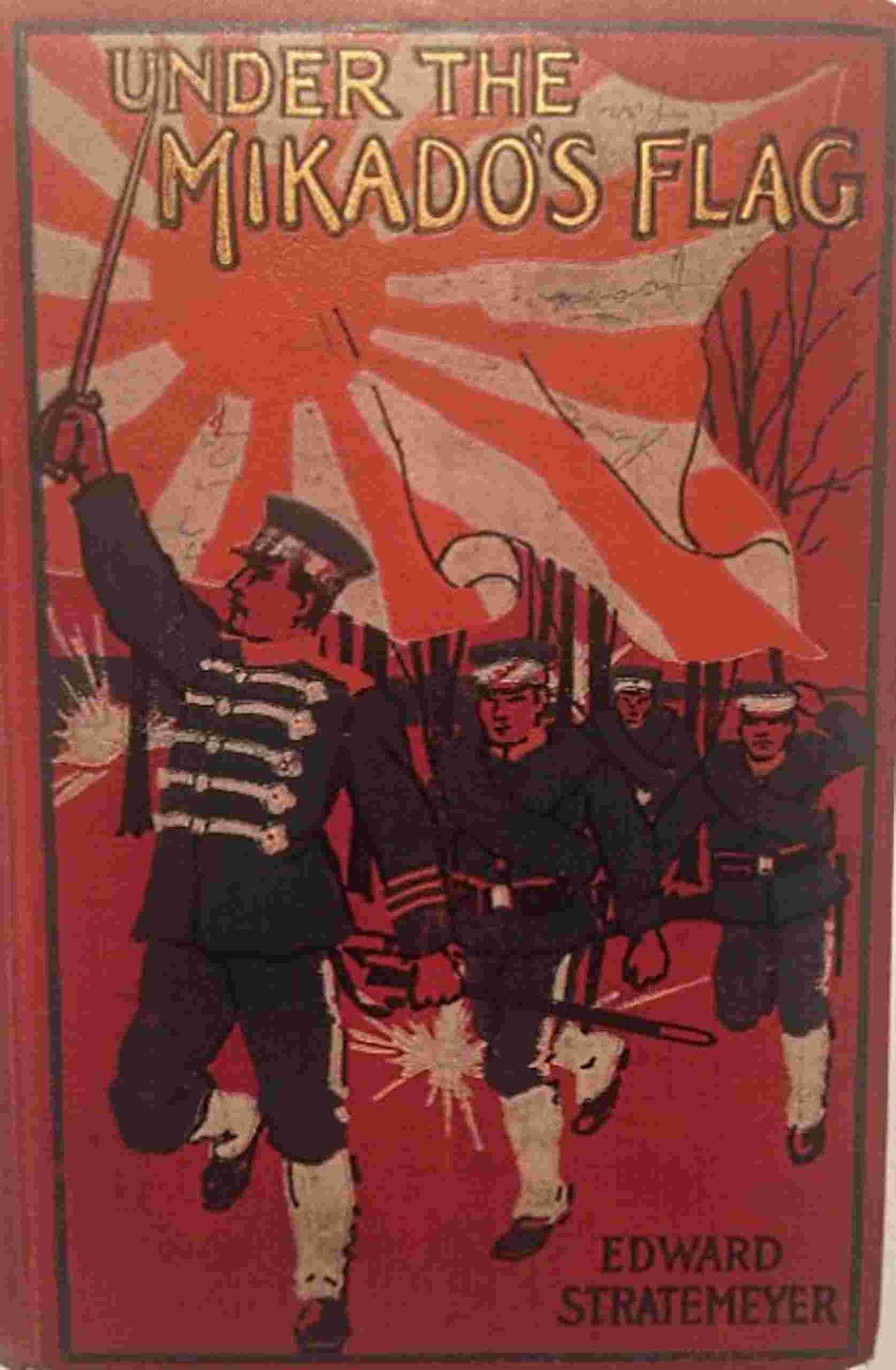
In this great struggle the red banners of the Mikado’s men were ever in the front—for Japanese armies invariably carry their flags where they should be carried, in the advance guard. This flag cheered the soldiers on to deeds of great valor, helping them to cross the river at the two islands and in other places in the face of a fire that was as searching now as it had been uncertain in the days previous. The slaughter on every side was fearful, but as soon as one line melted away another sprang forward to take its place.
Neither Gilbert nor Ben got into the fight until about eleven o’clock in the morning. They had crossed the pontoon bridge nearest to Wiju with Major Okopa’s command, and were marching along over the hills in the direction of Tiger Hill.
“The battle is on now for certain,” exclaimed Gilbert, as he listened to the thunder of artillery in the distance.
“I hope it is going in our favor,” answered Ben, who had chanced to come up. “My, just listen to that,” he went on, as the din became heavier than ever.
“Sounds as if both sides had every battery into play,” went on Gilbert.
Soon after this they were ordered to move forward on the double-quick. Away went the soldiers, each carrying his heavy baggage and his gun as if they weighed nothing at all.
The battalion had been discovered by a Russian battery, and soon came some shells which did considerable damage. They could not reply to this, but kept on, until a grove of trees gave them temporary relief. Their course was now almost directly for Tiger Hill.
The shock of battle to follow was probably the heaviest that the young Americans had ever experienced. At first they had the Russian batteries to overcome, and then they found themselves face to face with several Russian regiments well-known for their heroism and soldierly qualities. It was a fight “to the finish,” as Ben afterward expressed it, and every foot of the ground was contested.
“Phew! but this is fighting,” declared Gilbert, after they had been at it for hours. “Talk about getting into close quarters. If we are beaten, we’ll be caught like rats in a trap.”
“But we are not going to be beaten, Gilbert,” answered his chum. “Just listen to that.”
Close at hand a Japanese regiment was fighting desperately. The flags were to the front, and each soldier was yelling “Banzai!” at the top of his lungs. They had often shouted that word themselves, for Banzai is the Japanese for hurrah.
They were now going up Tiger Hill proper. On all sides the shells were dropping, and the hillside was thick with smoke and with the bodies of the dead and the wounded. The sight was enough to sicken them, but they did not dare to give it a second thought. They must do or die, that was all there was to it.
“Forward—for the honor of Japan!” was the Japanese cry. “Forward for the Mikado!” And forward they did go, up one rocky slope after another. And while this advance was being made, a Japanese flotilla of gunboats steamed up the Yalu as far as Antung, shelling that town and also several other Russian strongholds.
Pressed from in front and on both sides, the Russian commander at Tiger Hill knew not what to do, and was gradually forced to retreat, which he did by crossing the Ai River not far above where that stream flows into the Yalu. Here were some hills, and he lost no time in fortifying them as best he could. It is said that he wished to retreat still further, but his superiors would not allow him to do so.
The attack on Tiger Hill had occurred on Saturday, and that night it is safe to say nearly all of the soldiers on both sides were all but exhausted. Gilbert and Ben could scarcely stand, and the same was true of Major Okopa.
“I wonder if we’ll have to fight to-morrow,” said Ben, as they sat eating a very late supper.
“To be sure,” answered Gilbert. “Now we’ve got the Russians on the run it would be most unwise to let them rest.”
“It’s wonderful what our men can endure. Even the students seem to have iron constitutions.”
There was little sleep that night, and by dawn the call to arms was renewed. The command had been resting close to the top of Tiger Hill. Now it was ordered to take its place with the advance across the Ai River, which was to be forded in the face of the foe intrenched on the opposite shore.
The troops which had crossed by way of Kulido Island were close at hand, and just before the march to the river started Gilbert and Ben heard a call in a familiar voice, and beheld Dan Casey running towards them.
“Well, av all things,” cried the Irish sharpshooter, as he shook hands. “Sure an’ I didn’t expect to mate you in such a shpot as this!”
“How have you been, Casey?” questioned Gilbert.
“First-rate, barrin’ a scratch I got from a shell yesterday.” The Irishman’s eyes twinkled. “Sure an’ it was a regular Donnybrook fair, wasn’t it?”
“I should say it was—three Donnybrooks rolled into one,” laughed Ben. “But where is Stummer? Gilbert said he was with you.”
“Here he comes now,” was the reply, and a moment later the German sharpshooter came up and almost hugged Ben, and then shook hands with Gilbert.
“I dink me you vos not go py der var after all,” he said to Gilbert. “So you vos captains, hey? I vos glad to hear dot. Maype you ton’t vos fightin’ a leetle yesterday alretty? I told Tan it vos a hornet’s nest—chust like dot pattle of San Juan Hill py Cuby.”
“Were you touched, Carl?”
“Yah, but I ton’t know it bis der pattle vos ofer. Den I see plood running mine leg town, und I got me shot chust ofer der knee. But it vos noddings und I ton’t go to no doctor. Tan, he pound it up for me,” concluded Carl Stummer; and there the talk had to come to an end.