
CHAPTER XXXII
FACE TO FACE—CONCLUSION
The report that Liao-Yang was being abandoned by the Russians spread with lightning-like rapidity through the Japanese army, and many were the cries of Banzai which rent the air. Although wearied to the last degree many of the soldiers were for pressing forward, and clinching the victory gained, and the onward movement was begun just as quickly as necessary supplies could be brought to the front.
When Liao-Yang was entered by the Japanese it presented a truly terrible spectacle. The Russian portion of the town was in ruins, and a large part of the Chinese quarters had been sacked, the shops broken open, and contents strewn everywhere. Many buildings were burning, and a heavy smoke hung over all. The Japanese shell fire had caused heavy destruction at certain points, and many Chinese and Russian dead were found in the houses and on the streets.
General Kuroki was still of a mind to turn the Russian flank, if it could possibly be done, and for that purpose a large portion of his army struck northward, in columns almost parallel to the columns of the enemy. On several occasions the opposing columns came into touch with each other, and some lively skirmishes were the result.
“He’s going to try to hem in the Russians before they reach Mukden,” said Gilbert. “If he is able to do that, we may see worse fighting than we’ve seen yet.”
“It can’t be worse than it was in the plain before Liao-Yang,” replied Ben. “I never saw such a horrible sight in my life. It was enough to give one the nightmare.”
The command under Gilbert had been detached from General Kuroki’s army and was now placed on guard in the vicinity of Liao-Yang. Such a guard was absolutely necessary, for the purpose of maintaining order and to guard private property from the depredations of the Chunchuses, and ordinary plunderers.
Gilbert’s first visit to the town was paid two days after the worst of the fighting came to an end. He was accompanied by Ben and a small detachment of soldiers, who were to guard the property of certain foreigners who had asked for protection.
The great majority of the Russians had left Liao-Yang, but here and there one was discovered disguised as a Chinaman, or else claiming to be a German or some other foreigner. Those who had not been soldiers or spies, and those who behaved themselves, were not molested, but all others were promptly placed under arrest.
“The town must have been a hot place while the fighting was going on,” was Ben’s comment, as he and his chum surveyed the scene before them. “Just look how the shells ripped up that building yonder, and how they riddled the house on the corner.”
“You are right, Ben. And yet this can’t be a patch to the bombardment at Port Arthur. They have had to endure it for weeks and weeks. It must be simply awful.”
“Do you think Port Arthur will fall?”
“I shouldn’t wonder. Stoessel can’t hold out forever, no matter how brave he and his garrison are. Sooner or later their ammunition and food will run out.”
As the pair walked along one of the streets they passed a man in Chinese dress whose face looked strangely familiar to Gilbert. The man stared at Gilbert as if he had seen a ghost.
“That’s queer,” murmured the young captain, and stopped short.
“What’s up?” demanded Ben.
“That fellow—I’ve seen him before. I think—Ah, I have it! Wait a minute!”
Gilbert wheeled around and made after the man, and caught him by the shoulder.
“Wait a minute,” said he, in Russian. “Don’t you remember me?”
“Remember you?” stammered the man. “I—I——”
“I am Gilbert Pennington, of the Richmond Importing Company. You are Nicholas Vanskynov, the clerk who used to work for Ivan Snokoff.”
“Oh!” The clerk drew a long breath and grew pale. “Do not—do not expose me, sire!” he pleaded. “The Japanese—they will kill me!”
“What are you doing here?”
“I was working here, sire. After I left Port Arthur I got a position with the coal company whose mines are to the east of this town. On my word of honor, sire, I have had nothing to do with the war!”
“I believe you, Vanskynov. Now that the Japanese are in possession, what do you intend to do?”
“I know not. I have lost everything. My family is suffering, and dare not show themselves to the Japanese soldiers.”
“That is certainly ill luck.”
“You are, I see by your dress, a Japanese officer,” went on the clerk with a little more confidence. “Cannot you assist me? I shall be exceedingly grateful.”
“Perhaps I can—it depends upon how you’ve been acting. Have you taken any part in the fighting, or have you been a spy?”
“No! no! On my word of honor! I am not a fighting man!”
“Tell me, have you seen or heard anything of Ivan Snokoff since we parted at Port Arthur?”
“Have I seen him? He is here. Did you not know that?”
“Here!” cried Gilbert. “Now?”
“He was here during the fighting, and before. I have not seen him for three days.”
“Show me where he was stopping.”
“I will do that readily, sire. And you, you will help me,” pleaded the clerk. He was lean, hungry, hollow-eyed, and his clothing was in tatters.
“Yes, I’ll help you,” answered the young captain.
In a minute more they were on the way to the Russian section of the town, Ben going along. They had to pass a number of burnt buildings, and then came to a side street which the fire had not touched, but which had suffered much from Japanese shells and solid shots.
“What has Ivan Snokoff been doing here?” asked Gilbert, as they walked along.
“He has been supplying the Russian soldiers with things to eat and to drink at high prices. He forced them to buy from him through his confederate, Captain Barusky.”
“Where is the captain?”
“He has retreated with his command in the direction of Mukden.”
“You are sure Snokoff did not go with him?”
“Yes, I am sure. But he may have followed since.”
They were now coming to a well-built house at the end of the street. The front door was open, but as they approached it was suddenly slammed shut, and bolted from the inside.
“That looks suspicious!” cried Gilbert, and immediately drew his pistol, while Ben did the same.
“Hadn’t we better get help?” asked Ben. “If that rascal is in there with some of his friends, he may show fight.”
“Yes, get some of the guards we met at the upper corner, Ben.”
Going up to the door, Gilbert knocked loudly.
“Open in the name of the Mikado!” he cried, in Russian.
There was a stir within, but no one came to the door. Then Albert heard hasty footsteps retreating to the rear of the building.
“Watch this door and don’t let Snokoff escape,” he said to the clerk.
“I will do my best, sire,” was the trembling answer.
Running around the side of the building, the young captain was just in time to see the figure of a man, bundle in hand, leaping from a back window. The man was disguised as a Chinaman, and had his face stained.
“Stop!” cried the young American. “Stop, or I will fire!”
To this the man made no reply, but kept on running. Raising his pistol, Gilbert fired, and the man staggered and gave a cry of pain. The young captain had aimed for his leg and the bullet had gone true.
“Why didn’t you stop when I told you?” asked Gilbert as he came up. The man had sunk to the ground at the foot of the small garden attached to the building.
“I will have the law on you for this,” grumbled the man, in broken Chinese.
“You cannot deceive me, Ivan Snokoff,” returned Gilbert, in Russian. And reaching forward he pulled off the false queue the Russian was wearing and cast it on the ground.
“Ha! it’s Gilbert Pennington!” gasped the man. “And in the uniform of a Japanese officer. Why do you masquerade thus?”
“It is no masquerade. I am a Japanese officer, Snokoff, and, let me add, I had a perfect right to shoot you down when I did. You can be thankful that I did not aim for your heart instead of your leg.”
“An officer of the Japanese army!” groaned Ivan Snokoff, and all his courage deserted him. “I am lost!”
“You are a fine sneak and swindler, Snokoff. You played a fine trick on me at Port Arthur.”
“It—it was all a—a mistake!” whined the other. “All a mistake, I assure you, Mr. Pennington. I mean to pay you every ruble, yes, every one!”
“If that’s the case, you had better pay up right now,” and Gilbert glanced at the bundle Ivan Snokoff had been carrying. “Or shall I take possession of that?”
“No! no! Do not rob me of what little I possess! This war has cost me so much! I will pay, yes, every ruble!”
“Very well, see that you do,” answered the young captain sternly.
By this time Ben had returned with a squad of six Japanese soldiers. The house was searched, and then put in charge of a guard.
“I’m half of a mind to have you sent to prison,” said Gilbert to Snokoff, although he knew such a course would not be necessary.
“Do not, I beg of you,” pleaded the rascal. “I will pay; have I not said so?”
“Very well, do so, and we can sign the papers right here.”
Ben was called in, and also Nicholas Vanskynov. When Ivan Snokoff saw his former clerk he was furious.
“So it is you who have betrayed me!” he roared. He was sitting with his wounded leg bound up and resting on a bench. “Oh, that I might get at you!”
“You leave him alone,” said Gilbert. “If you do not, you will only get yourself into more trouble.”
The necessary papers were drawn up, and in the presence of Ben and the clerk Snokoff paid over to Gilbert all that was coming to the Richmond Importing Company—half in gold and half in Russian paper money, which the young captain knew was just as good.
“Tell me, does he owe you anything?” asked Gilbert of Nicholas Vanskynov, after this transaction was completed.
“He does, three rubles. And more, too, for he once promised to pay me more salary, but he never did so.”
“What would the increase of salary have amounted to?”
The clerk made a rapid calculation in his head.
“Not less than eighteen rubles.” His eyes glistened. “But I will take fifteen, if I can get them.”
“You villain! It is nothing more that I will pay!” roared Ivan Snokoff.
“Not so fast, Snokoff,” said Gilbert coolly. “You had better pay up and save trouble. Remember, he can report you quite as well as I can.”
At this the rascal stormed greatly. But he saw how helpless he was, and not caring to have more trouble, he finally paid his former clerk what was coming to him and ordered him to be gone. He was then left to himself, and the guard was cautioned to see to it that he did not escape.
“Well, that was certainly a piece of luck,” said Gilbert, after the affair was over, and he had placed the money in a safe place. “The folks at home will be glad to hear of it.”
“Snokoff will never forgive you, Gilbert,” answered Ben.
“Perhaps not. But I can’t help it—I only did what was right,” returned the young captain.
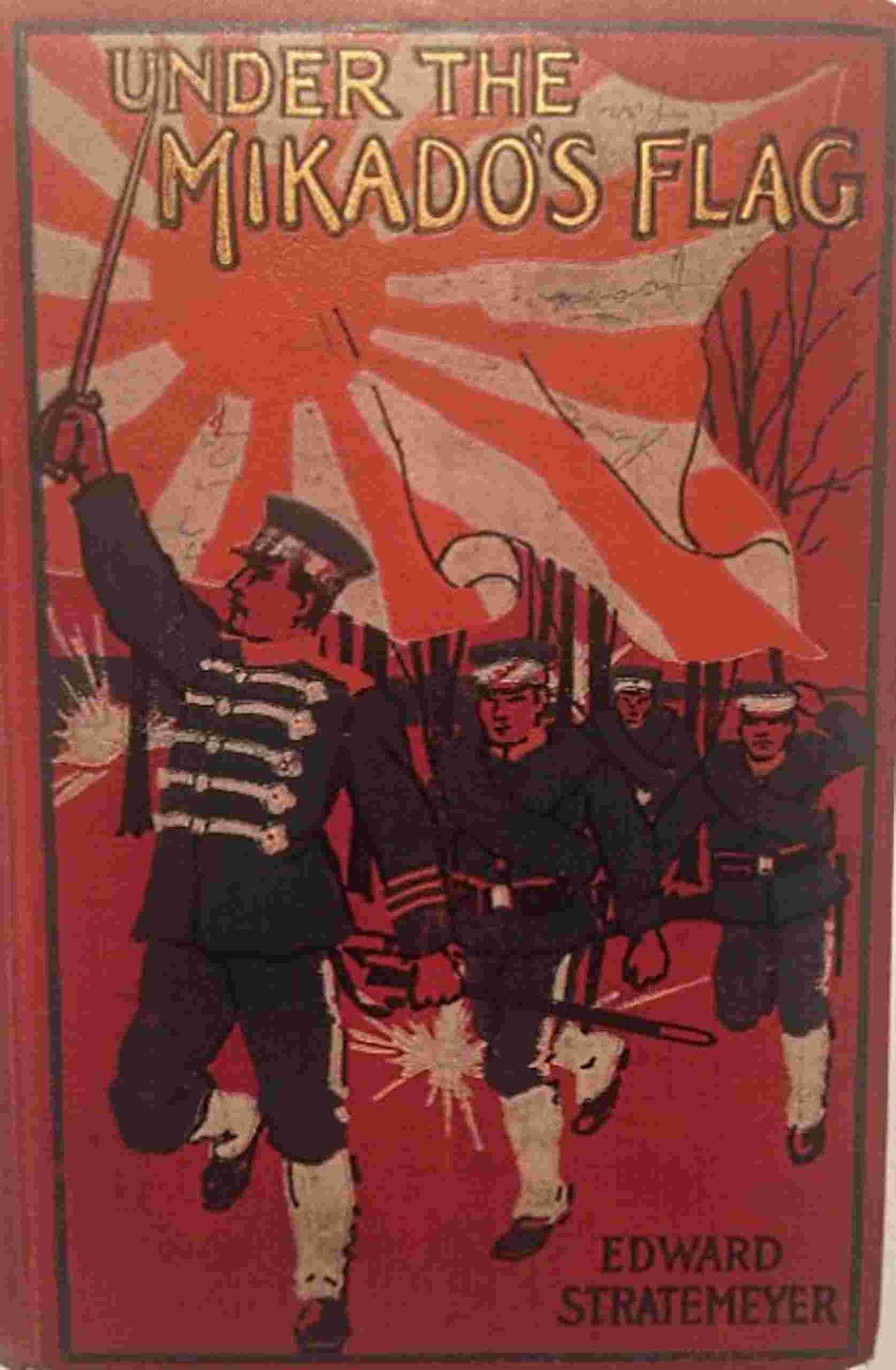
Here let me add a few words more, and then bring to a close this story of stirring adventures while fighting “Under the Mikado’s Flag.”
After the evacuation of Liao-Yang by the Russians there came to Gilbert and Ben a short period of well-earned rest, during which the two young officers attended to several small wounds which they had received, and did their best to fortify themselves for the fighting still to come.
During this period of inactivity Ben received a long letter from his brother Larry, in which the sailor boy said the Columbia had arrived in safety at Manila, and was then taking on her cargo for Nagasaki. The letter had been delayed in various ways, and was then many weeks old.
“Larry must have left Manila long ago,” said Gilbert, as he read the communication. “If the Columbia had a safe passage, she must have arrived at Nagasaki before this. But perhaps she fell in with some Russian warship. In that case she’d have a whole lot of trouble.” The Columbia did fall in with one of the ships of the enemy, and what befell Larry at that time and afterward will be told in another volume, to be entitled: “At the Siege of Port Arthur; Or, A Young American in the Japanese Navy.” In this tale we shall meet all our friends again, and also learn something more about Ivan Snokoff and his confederate, Captain Barusky.
“I understand the Russians are sinking Japanese transports wherever they can find them,” said Ben, after reading the letter.
“Well; it’s more than likely that the Japanese are doing the same to the Russian vessels,” returned Gilbert. “One thing is sure, as great as has been the fighting on land, the battles on the water are equally hot.”
“And Japan is winning both on the land and on the sea. Her navy must certainly be a good one.”
“Perhaps Larry will want to join the navy when he learns of all that is going on.”
“If so, I can’t blame him. He’s a natural born sailor boy, and something of a gunner to boot,” answered Ben, but without dreaming of what was in store for his brother.
For the time being the days passed quietly enough for Gilbert and Ben. There was little for the young officers to do; so here let us leave them, knowing that, no matter what the future held in store for them, they would never forget the days spent battling “Under the Mikado’s Flag.”
THE END