
The Project Gutenberg eBook of Unique Ghost Towns and Mountain Spots
Title: Unique Ghost Towns and Mountain Spots
Author: Caroline Bancroft
Contributor: Daniel K. Peterson
Release date: April 6, 2016 [eBook #51678]
Most recently updated: October 23, 2024
Language: English
Credits: Produced by Stephen Hutcheson, Dave Morgan and the Online
Distributed Proofreading Team at http://www.pgdp.net
Unique Ghost Towns and Mountain Spots
Copyright 1961 by Caroline Bancroft. Seventh edition, 1973.
All rights in this book are reserved. It may not be used for dramatic, radio,
television, motion or talking picture purposes without written authorization.
Johnson Publishing Co., Boulder, Colorado.
The Author
D.K.P. 1960
Caroline Bancroft is a third generation Coloradan who began writing her first history for The Denver Post in 1928.
Her long-standing interest in western history was inherited. Her pioneer grandfather, Dr. F. J. Bancroft, was a founder of the Colorado Historical Society and its first president.
His granddaughter has carried on the family tradition. She is the author of the interesting series of Bancroft Booklets, Silver Queen: The Fabulous Story of Baby Doe Tabor, Famous Aspen, Denver’s Lively Past, Historic Central City, The Brown Palace in Denver, Tabor’s Matchless Mine and Lusty Leadville, Augusta Tabor: Her Side of the Scandal, Glenwood’s Early Glamor, Colorado’s Lost Gold Mines and Buried Treasure, The Unsinkable Mrs. Brown and Colorful Colorado.
A Bachelor of Arts from Smith College, she later obtained a Master of Arts degree from the University of Denver, writing her thesis on Central City, Colorado. Her full-size Gulch of Gold is the definitive history of that well-known area, which includes Nevadaville, the scene of the accompanying photo. She is shown with Daniel K. Peterson who drew the maps and took most of the contemporary pictures for the new booklet on ghost towns.
STEPHEN L. R. McNICHOLS Governor of Colorado 1956-1962
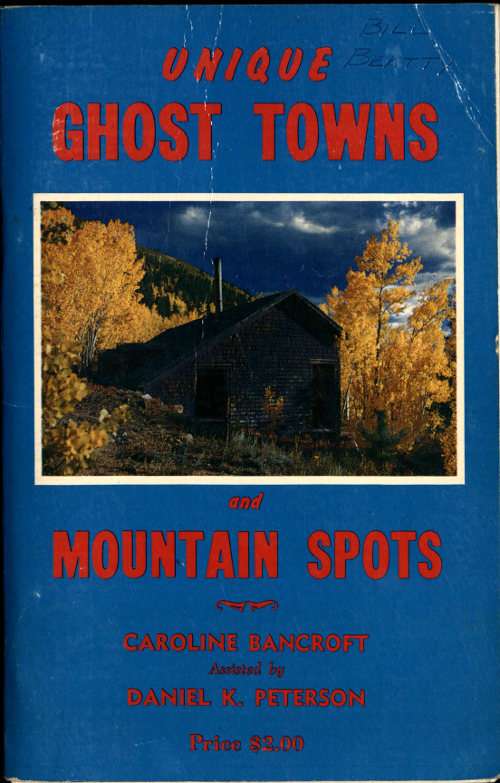
The Cover
The Dumont boarding house in North Empire, unique for its ground-level dormer windows, was built about 1872 for miners working on the Benton lode, owned by John M. Dumont. In 1897, with a date still on the wall, it was bought by a Mrs. Bishop who painted the building a purplish blue. She operated it as a boarding house until about 1906 when she took over the Peck House (Hotel Splendide) in Empire. Still later, in the 1930’s, Waldemar Nelson lived in the “Blue House” and used one section as a machine shop. A forge was still there in 1960. Photo by Dan Peterson.
UNIQUE
GHOST TOWNS
and
MOUNTAIN SPOTS
by
CAROLINE BANCROFT
Assisted
by
DANIEL K. PETERSON
(Cartographer and Photographer)
Illustrated
Johnson Publishing Company
Boulder, Colorado
1967
Personal to the reader
I love the high country of Colorado—and in a less effusive manner, so does Dan Peterson. Partly for your enjoyment and partly for our own, this booklet represents the crystallization of our mutual enthusiasms. We hope that it will serve as a useful guide for you and others who thrill to the heights and diverse grandeur of our Colorado Rockies.
But first, a word of warning: if after reading this booklet, you add one act of vandalism, or carelessly cast one burning cigarette to the winds, or messily leave a beer can in a crystal creek bed, the whole purpose of our publication has been defeated. We have written about ghost towns out of love of their dramatic past and a reverence for their present fragility. If you follow in our footsteps to these mountain spots, we entreat you to go in the same spirit.
When I said this booklet represented a “crystallization” of our mutual enthusiasms, I could not have spoken more truly. Dan is still “hurting,” as he phrases it, because Gladstone, his favorite ghost town, had to be left out due to limitations of space. In order to appease his hurt, I have agreed that he can sneak in its location on the Silverton map and a short paragraph of description in the text.
And what have I had to sacrifice? Too many pets, such as Beartown, reminder of the brave history of Stony and Hunchback Passes; Mineral Point and its lonely sentinel, the San Juan Chief shaft house still perched across a fork of Poughkeepsie Gulch and seen as one jeeps up to thrilling Engineer Pass, and Mayday, where I have never been but am intrigued by its romantic sound.
Our booklet does offer you forty-two “ghost towns” in photograph and story, plus passing mention on a map or in the text of a few others. These forty-two are reached from twenty-two attractive mountain towns where it is possible to obtain good accommodations. All but three of our final choices may be visited by ordinary car. For Lulu City, you will have to walk a three-mile trail or ride a horse; for Bachelor, you may take your car most of the way but will have to walk the last mile or jeep the whole distance, and for Carson, you will have to go by jeep or horse from Lake City. For the most part our forty-two towns are easy to see and in their separate ways unique.
Here, another word of warning: there are almost no ghost towns any more. In the true sense of the word they are gone. If you had been able to ride a horse or were willing to punish your Model T Ford, I could have taken you in the 1920’s to dozens of true ghost towns no farther away than along the Front Range. Even in the late 1940’s, when jeeps first came in, I could still have guided you to many true ghost towns. But no more.
What has happened? Tourists (a mixed blessing) and natives who have no regard for Colorado’s appealing past, have stolen from them, vandalized them, destroyed buildings, and carted whole towns away. Another killer in the form of fierce high-country winters has levelled them under tons of heavy white snow or pulled them apart with snatching, tearing wind. Whether desecrated by humans or eroded by nature, I am constantly reminded of Charles Kingsley’s lines, painted on the Tabor Grand Theatre curtain:
So fleet the works of men, back to the earth again,
Ancient and holy things fade like a dream.
In other cases the ghost towns have undergone a metamorphosis. Some settlements have changed into summer resorts because of the charm of their buildings or the picturesqueness of their settings. Sometimes their ghost town status was lost by a new industry moving in, such as the sawmill at Lenado; or a new motor road has been strategically built, such as the Peak-to-Peak Highway which redeemed Ward. These towns, although peopled only by ghosts for many years, once again throb with life today. Many of the summer-resort group are alive only in the warm months. When the aspens have lost their fluttering gold in the autumn, they return to ghost towns.
We have included some of each type. All were true ghost towns once, and all had ghostly reminders still extant in 1960. But if you, as you visit them, should fail to leave everything as you find it, there will soon be nothing left for anyone to see. A sad and forlorn example of what can happen in only a short time is the formerly beautiful Lee House at Capitol City. When I first saw it in 1955, the house was still a true mansion, and its atmosphere eerily evoked the great and pretentious dreams of its builder. But in 1960 despoiling tourists had changed it to a horrid ruin.
So go forth in the true spirit of adventure to see and to enjoy, and may this little book add to your enjoyment!
A plan for touring the whole state and a large folded-in map of Colorado serve as introduction to the special towns and separate tours that follow. On the large map, the towns suggested for starting points are shown as black dots and are numbered to correspond with the numbers of the individual tours. The ghost towns appear as red dots. On the smaller maps the starting points are shown as squares, and the ghost towns as solid circles. Dan has drawn them all with the double purpose of being accurate and helpfully clear.
But however clear the plan and maps, real enjoyment in visiting these sites can only be had if the viewer has adequate knowledge of the people who built these towns and the times they lived in. Before setting out on the trips recommended here, some general knowledge of the state’s history is a must. To this end no quicker method exists than a reading of Colorful Colorado, a good companion volume.
The photographs, employed throughout the present booklet as illustrations, carry credit lines which should be plain to all except where initials have been used. DKP stands for Daniel K. Peterson; CHS, for Colorado Historical Society, and DPL, for the Western History Collection of the Denver Public Library.
My own part in the production of this work needs no explanation. My first visit to a ghost town was in 1904 when, as a toddler, I was carried on horseback by my father to Alice (then a thriving little spot). Alice was my father’s headquarters for building a reservoir system from five high mountain lakes that emptied into a sixth. These lakes (one, Lake Caroline) lie some four to six miles beyond Alice.
Since that distant day I have never ceased to travel to Colorado’s mountain towns, and I frequently describe myself as a “hillbilly.” No matter where I have been, it has always been the mountains of faraway lands that have had the greatest drawing power for me—the Jotunheim range of Norway, the Highlands of Scotland, the Alps in France and Switzerland, the Apennines in Italy and the Himalayas in India.
Yes, I can say along with Keats:
Much have I travelled in the realms of gold,
And many goodly state and kingdoms seen....
* * *
Yet none speaks so well of romance untold
As our high ghostly towns, still and serene.
THE ALICE POST OFFICE STILL STANDS
George J. Bancroft, 1904; D.P.L.
⇐PLAN OF TOURS
| TOUR No. | STARTING POINT | GHOST TOWNS AND MOUNTAIN SPOTS | PAGE |
|---|---|---|---|
| 1. | CENTRAL CITY | Nevadaville, American City, Kingston | 8 |
| 2. | IDAHO SPRINGS | Alice, North Empire | 14 |
| 3. | GEORGETOWN | Waldorf, Sts. John | 20 |
| 4. | BOULDER | Caribou | 24 |
| 5. | ESTES PARK | Ward | 26 |
| 6. | GRAND LAKE | Lulu City | 28 |
| 7. | STEAMBOAT SPRINGS | Hahns Peak | 32 |
| 8. | GLENWOOD SPRINGS | Fulford, Crystal City | 34 |
| 9. | ASPEN | Lenado, Ashcroft | 40 |
| 10. | LEADVILLE | Independence, Stumptown | 44 |
| 11. | FAIRPLAY | Buckskin Joe, Como, Mudsill, Leavick | 48 |
| 12. | CRIPPLE CREEK | Altman, Bull Hill Station, Goldfield | 52 |
| 13. | CANON CITY | Rosita, Silver Cliff | 56 |
| 14. | SALIDA | Turret, Bonanza | 59 |
| 15. | BUENA VISTA | St. Elmo, Winfield | 63 |
| 16. | GUNNISON | Tin Cup, Gothic | 66 |
| 17. | LAKE CITY | Capitol City, Carson | 70 |
| 18. | CREEDE | Spar City, Bachelor | 75 |
| 19. | DEL NORTE | Summitville | 82 |
| 20. | SILVERTON | Eureka, Animas Forks | 84 |
| 21. | OURAY | Red Mountain, Ironton | 88 |
| 22. | TELLURIDE | Pandora | 92 |
From Central City
Nevadaville is unique for many reasons. It was part of the historic 1859 “Pikes Peak or Bust” gold rush. In 1861 the town was larger than Denver. In 1863 one of Nevadaville’s mines, the Pat Casey (later the Ophir), was sold by its illiterate Irish owner in New York to Wall Street speculators for a fancy sum which started a boom in Gilpin County mines. Stock shares of Nevadaville’s mines were thus the first of Colorado corporations to be quoted on the “big board.”
When John H. Gregory found the first lode gold of Colorado in Gregory Gulch on May 6, 1859, other prospectors immediately pushed up all the tributary gulches. By the latter part of May a number of good claims had been staked on Quartz Hill above Nevada Creek. This creek joins Spring Creek at Central City and together they join Eureka Creek to make the mile-long Gregory Creek. It, in turn, joins the North Fork of Clear Creek at Black Hawk. The closest source of water for the mines on Quartz Hill was Nevada Creek. A camp sprang up immediately, and was named Nevada City.
A great deal of confusion followed this naming. Some referred to it only as Nevada and some as Nevadaville. When the townspeople petitioned for a post office they were given Bald Mountain because of a similarity with Nevada City, California. Nevertheless, increasingly through the years, the residents continued to call it Nevadaville and few people today know of its other names.
The earliest good finds were the Illinois by John Gregory, the Burroughs by Benjamin Burroughs and his brother, and the Casey (or Ophir) by Pat Casey. The Burroughs and Pat Casey were among the founders of Nevadaville.
The town had a long and boisterous life. It was settled largely by Cornish at the western end and by Irish at the eastern. These two groups waged a prolonged and skull-cracking battle with each other until the 1890’s. Then they found it expedient to unite against an influx from the Tyrol of miners who threatened to undercut their wages.
The Cornish (Cousin Jacks) built two charming little churches, an Episcopalian and a Methodist. (Both are now gone.) The Irish drove or walked down to mass at St. Mary’s-of-the-Assumption in Central City, over a mile away. But however earnest their church attendance on Sunday morning, it never altered their beer drinking at Nevadaville’s thirteen saloons that afternoon nor the fights and murders that followed. Two of the latter, both Cousin Jacks killed by Irishmen, were notorious in the annals of Colorado law and were eventually carried to the Supreme Court.
I have told the town’s story at considerable length in Gulch of Gold to which the reader is referred for rollicking details. Nevadaville’s ghost status began in 1920 and worsened for twenty-five years. On the bleak scrubby side of Nevada Hill more and more buildings fell down or were torn down. By World War II only two permanent residents remained, and finally there were none.
D.K.P., 1960
NEVADAVILLE HAD THIRTEEN SALOONS
This view looks northeast across Nevada Creek to the main street, which continues at the right on down to Central City and Denver.
A. M. Thomas, 1900; D.P.L.
CORNISH COTTAGES COVERED THIS SLOPE
The population of Nevadaville was twelve hundred in 1900 when the upper photo was taken. The Union Bakery wagon was delivering bread and pastries; an ore wagon was heading up toward Alps Hill, and a number of residents, both on this side of Nevada Creek and the other, were interested in the photographer’s work. In 1960 no one was around to be curious; the lower bridge was gone, but the slopes were the same.
D.K.P., 1960
Nevadaville, similar to all gold camps in Colorado, had a renascence during the 1930’s when the price of gold rose from $20 an ounce to $35. During this period a number of its mines were re-opened including the Hubert, which was worked by Frankie Warren. Frankie was one of the delightful Cousin Jacks left from the old days and could tell dialect stories by the dozens. I spent a number of delightful evenings in Nevadaville listening to his reminiscences and was particularly amused by his ‘ant’ (haunt) stories. One of these was about the Bald Mountain cemetery (a charming spot west of the settlement and worth a side trip) where the parents of Estel Slater had installed his photo on his tombstone and covered it with glass. On moonlight nights a ghost moved in the cemetery. Frankie went up to investigate and discovered the reflected light. I, too, followed Frankie’s example and was startled by the effect—I hope they are still there for you to see. There is always the danger that they have been vandalized. But let us return to Nevadaville.
Of recent years hardy souls who did not mind coping with the meagre water supply have renovated the remaining houses. In 1960 parts of Nevadaville presented a spruce appearance. But the mines which were once rich and storied, contributing a large part of Gilpin County’s $106,000,000 production, are ruins. The ghostliness that they cast and the derelict Main Street were little affected by the neat cottages. It does not take much imagination on a still afternoon to hear a Cornish “tommy-knocker” or to see why Nevadaville rates first among the ghost towns....
Farther on toward the continental divide, past Apex and a sign erroneously marked Private Road, is American City. A mixture of occupied and deserted buildings, the town lies hidden on the wooded side of Colorado Mountain overlooking a glen. A number of the deserted cabins and pretty sites may be bought from the county for back taxes. But others are in fine repair and lovingly cared for. Be wary in American City not to cast yourself in the role of “trespasser.”
American City’s history is not long and dramatic like Nevadaville’s. But its story is unique for glamor, gayety and culture. After the crash of silver in 1893, desperate efforts were made to find as yet undiscovered gold, and new strikes were made in the Pine Creek Mining District of Gilpin County. By 1895 Apex had reached sufficient stature to be listed in the Colorado Business Directory, as the district’s principal town, having two hotels and a general merchandise store. By June 1896 the Denver Times was saying, “American City is very dressy.”
A year later the Denver Republican described the main stockholders of the American Company who were from Illinois and Iowa. It added that this company was in good financial condition, was running two shifts of miners and had opened a library in their office in American City which “now numbers 503 books and the miners appreciate the courtesy on the part of the company.”
D.K.P., 1960
AMERICAN CITY HUGS THE TREES
The mill (which was built by a master carpenter of the German shipyards) was in ruins, but the Hotel del Monte (second in the trees) stood.
On July 3, 1897, a newspaper called the Pine Cone began publication at Apex and carried frequent delightful items about American City. Captain E. M. Stedman, one of the principal stockholders, was also manager. On April 28, 1900, it reported that he was becoming an expert at “skeeing” since “he made the distance on Tuesday from his residence in American City to Apex, about a mile and a half, in five minutes.”
One of American City’s proudest possessions was its mill built by Gus Meyer in 1903. Meyer was a master craftsman from Germany and did contract work in Denver. He was the boss carpenter on the Barth Block. Because of his excellent work on the business building, William Barth gave him $100 in gold coin in addition to his contract money.
In the succeeding years up to around 1910 the Stedmans frequently entertained at house parties, using their own palatial cabin and overflowing into the cabins of other Eastern stockholders as well as the Hotel del Monte. My mother and father were present at a number of these affairs, and I can remember the fuss of getting all the luggage packed with a correct riding habit and a number of evening gowns for Mother to dress for dinner. It was indeed a glamorous place.
Then the gold petered out, and American City was abandoned. For years it was almost lost to view and to memory. Only the late wealthy Mrs. John Anthony Crook maintained a summer cabin there. In the 1930’s she was the lone resident. Finally a few others followed her lead until the town was partly saved....
Nugget, on the way to Kingston, had a few remnants in 1960. But uncared for, the fierce elements were wreaking havoc on the buildings as they also were at Kingston. The havoc was more serious at Kingston because of the beauty of the dormer-windowed boardinghouse close to the London mill and mine and because of the unusual latticed log cabin down on Secreto Creek at what is humorously called South Kingston.
In the late 1890’s and early 1900’s there were many residences along the ridge that runs between Pile Hill and Kingston Peak, and down the banks of Mosquito Creek. In 1960 some of these were still partially standing and many of their foundations were intact; but all were deteriorating fast. Kingston, like American City, was purely a mining, milling and residential town and depended on Apex for commerce, merchandise and a newspaper. But the details of its history are lost. Kingston is unique because of its mystery.
KINGSTON IS IN TWO SECTIONS
Shown are the London boardinghouse, mill and mine (far right). More miners lived down in Secreto Gulch to the left of this high ridge.
D.K.P., 1960
From Idaho Springs
Alice was rich in gold—particularly placer gold. But oddly and uniquely, no one found these placers until long after other Clear Creek placers had been worked out. Apparently no prospector was thorough enough in his search on upper Fall River and its little tributary, Silver Creek, to make a strike during the placer excitements of 1859 and the early 1860’s, although some silver was uncovered. When rich gold was finally found in 1881, the discovery was made by a party working west from Yankee along the road that ran from Central City, the county seat of Gilpin County, past the side of Yankee Hill, down Silver Creek and Fall River, and on to Georgetown, county seat of Clear Creek County.
Alice was described in Denver’s Rocky Mountain News August 24, 1881, as a colony of fifteen or twenty tents near Silver City, a camp slightly higher up Silver Creek. Colonel A. J. Cropsey of Nebraska was the superintendent of the Alice Mining Company, and he was banking sums of twelve and fifteen hundred dollars every two weeks in the First National Bank at Central City.
The summer and fall production proved so successful that the following February the capital stock of the company was increased from $1,000,000 to $2,000,000; a second ditch was built to bring water for hydraulic mining; log cabins and a mill were erected; the eleven-mile road to Idaho Springs was improved, and the company banked $2,500 or $3,000 in Idaho Springs every fortnight.
Hydraulic mining continued through the early 1880’s and proved consistently profitable so that Alice absorbed Silver City (if it had ever been anything more than a cluster of tents). As the placers were worked out, lode mining developed in a number of mines, especially in tunnels that led away from a pit torn out by hydraulic hoses. The population was around thirty-five until after 1903 when it rose to fifty or sixty. In 1908 a more modern mill was built, and production continued steadily until 1915 when the mill shut down. Soon the ghosts took over.
Four people lingered on, including the E. J. Harpers. He had been postmaster in 1904 (see the photo at the end of my introduction) and had conducted business from one end of their own cabin. She served meals at the other. On inspection trips to the Loch Lomond reservoir my father and I used to tie our horses outside this cabin and have a delicious lunch. In 1960 it was being used as a summer cottage but its exterior lines were identical with Father’s 1904 photo.
In 1934 Alice, like many other Colorado gold camps, experienced a renascence. (This was because of the price of gold rising from $20 to $35 an ounce.) The sturdy log cabins were re-roofed; the mill started, and the pit was turned into a real glory hole. Today Alice is unique because of its abandoned glory hole—the only summer resort-ghost town to boast of one within its town limits....
Returning to Clear Creek and driving farther up its course, is another tumbling tributary, a creek also coming in from the north. Originally this creek was called Lyon’s, but now Lion. It flows through the town of Empire about which the splendid historian, Ovando J. Hollister, said in 1866, “Of all the towns brought into existence by the famed Cherry Creek Sands, Empire bears away the palm for a pretty location and picturesque surroundings.” This statement is particularly true of North Empire, about a mile and a half up Lion Creek and its fork, North Empire Creek.
Bayard Taylor (the renowned nineteenth century lecturer and travel writer) and William N. Byers, founder and editor of the Rocky Mountain News, also visited the two towns that same year and were much impressed with their settings. Byers reported North Empire as “a hustling busy little hamlet right amid the mines. It has three or four mills.”
He also mentioned by name a number of prosperous mines, especially the Atlantic owned by Frank Peck who was later the founder of Lower Empire’s Peck House (now the Hotel Splendide). Byers was interested by an arastra in the gulch which was operated by water power and “was pointed out as a paying institution.”
Lower Empire was organized in the spring of 1860 by a band of prospectors who came up from Spanish Bar (then on the south side of Clear Creek close to its junction with Fall River). The first gold was discovered on Eureka Mountain, northwest of Empire. A find of rich placers and lodes soon followed on Silver Mountain, north of Empire. It was these mines that caused North Empire to spring up on the side of Silver and the flanking mountainside to the east, Covode.
E. S. Bastin, 1911; U.S.G.S.
Too late to alter: now proved to be Russell Gulch.
ALICE BOASTED OF ITS GLORY HOLE
In 1911 two mills, the Anchor and Princess Alice, and six mining companies were operating when this view was taken. It looks southwest along the road that runs past the Glory Hole and eventually to the Loch Lomond Reservoir system, built and owned by G. J. Bancroft in the early 1900’s. The 1960 view of the Glory Hole shows three roads at upper right: two up to Yankee and St. Mary’s Glacier, and one off to Idaho Springs.
D.K.P., 1960
George Wakely, circa 1868; D.P.L.
NORTH EMPIRE CLUNG CLOSE TO THE MINES
The town was built on the side of Covode Mountain nearly opposite the Silver Mountain mining properties and equidistant between the two boardinghouse relics, the Dumont and the Conqueror. The 1960 shot of the Copper Cone (or Gold Fissure) mine was taken from approximately the same location, but looking north rather than east. The various levels of streets and a few foundations may still be seen through the trees.
D.K.P., 1960
North Empire led a prosperous existence during the 1860’s and ’70’s but died out during the 1880’s. Then in 1890 John M. Dumont, who had made money at Mill City (now Dumont after him) and Freeland, bought the Benton lode (named for Thomas Benton, the mountain man). Dumont attempted a resurrection of the town. The collapse of silver in 1893 added momentum to his efforts, and North Empire enjoyed a lively life for over a decade.
Again it was left to the blue jays and mountain rats until the 1930’s when once more the mines and mills throbbed. When World War II drafted its miners, the mills shut down and the mine shafts filled with water. The town died forever—or until the price of gold again changes.
Nonetheless, the picturesqueness of North Empire’s setting, commented on by all, lives on. The view to the south over Empire and Clear Creek to the meadow made by Bard Creek, on over Union Pass to the valley where Georgetown lies hidden, and on up to Guanella Pass against the skyline, is unsurpassed for its soft charm. North Empire remains unique for its picturesqueness.
THE CONQUEROR’S MINERS LIVED WELL
The south wing of the Conqueror’s boardinghouse was built by W. S. Pryor in 1910. The original wing (at the right) dates from the 1870’s. Unfortunately, vandals have since burned down this picturesque relic.
D.K.P., 1960
From Georgetown
Waldorf is unique because, single-handed, it was caused and named by a mining magnate who built his own little railroad—the Argentine Central—to create the town.
Edward John Wilcox was another of the many colorful characters Colorado has produced. He was full of quirks and idiosyncrasies. A former Methodist minister, he decided he could serve the church better by making money and tithing than by staying on with any of his former parishes in Longmont, Denver or Pueblo. Success attended his decision, and by 1905 he was the owner of some sixty-five mines on Leavenworth Mountain, south of Georgetown. But the mines were high in the East Argentine district where it was difficult to transport machinery in and ore out.
So on August 1 (Colorado Day), 1905, Wilcox began building his railroad, starting over eight miles away at Silver Plume and planning to grade switchbacks over Pendleton Mountain, the western wing of Leavenworth. By Colorado Day of the next year, the railroad had reached nearly eight miles beyond Waldorf to a point almost at the top of Mount McClellan. A second ceremony was held which included driving a gold spike. (The first had been held on reaching Waldorf.) Immediately afterward trains began operating to haul freight and tourists. But not on Sunday. Wilcox would not degrade the Lord’s day!
A post office was opened in Waldorf at 11,666 feet in altitude claiming to be the highest in the United States, and Waldorf was prepared for a great future. It had already had a considerable past, if not under the name of Waldorf. The silver mines in both the West and East Argentine districts had been working since 1866 and been supporting two mills. One mill and a camp called Argentine (from the Latin word for silver, argentum) were fairly high in Leavenworth Gulch on the way to Argentine Pass. Their location was beside the stagecoach road from Georgetown to Montezuma. But now a large boardinghouse, several residences, a store and a depot clustered about the Waldorf and Vidler tunnels and their mills. Thus the new camp of Waldorf was born.
Everything went well at first for the town and railroad—even despite the ban on Sunday tourists. The little railroad made a great impression, and Wilcox was as proud as a racehorse stable owner as he added little Shay engines to his rolling stock. Early in 1907 a British syndicate offered $3,000,000 for his holdings around Waldorf including the railroad. Wilcox refused despite the enormous profit involved.
But 1907 turned out to be a bad year. A depression started gathering momentum in the East. During the last six months of the year the price of silver fell thirteen cents, and Waldorf ore was not worth hauling. By 1908 Wilcox was badly in debt and was forced to liquidate where he could. According to the railroad historians, Elmer O. Davis and Frank Hollenback, Wilcox sold his $300,000 railroad for $44,000. The new management took over in 1909 and made a bid for the tourist trade which naturally included trains on Sunday.
Still the railroad did not pay, and was sold again in 1912. Ironically, the buyer was William Rogers of Georgetown, the same Rogers who had suggested the idea of the railroad to Wilcox in the first place. Now he had his railroad all built and operating for only $19,500! Rogers founded a new company.
But the mines had never come back after the blow of ’07. The tourist trade was not adequate to support the railroad with no freight to haul other than coal for the power company’s maintenance station at Waldorf. The last Shay engines were sold in 1914, and gasoline engined cars replaced them. Even this drastic measure did not suffice. The income for the 1917 summer season was too lean for the company to continue. In 1920 permission was granted for abandonment, and the next year track was taken up.
Waldorf was truly dead. Since then, from time to time, assorted lessees have operated the Waldorf tunnel and the Santiago mine northwest of Waldorf on the side of Mount McClellan. While they were working, they took over some of the old buildings for a year or two as residences. In the 1950’s Waldorf had two bad fires which destroyed the last of the big buildings and the habitable dwellings. In desperation the man who was working the Santiago mine in 1958, erected a Quonset hut for his home.
It stands as a sad commentary on these high towns where water is so precious and the menace of fire, an ever-present reality. Most Colorado mining camps have experienced terrible fires more than once, and Waldorf is no exception.
L. C. McClure, 1905-11; D.P.L.
WALDORF WAS A RAILROAD MINING TOWN
The upper view was taken with a telescopic lens and shows the Vidler mill in the foreground, the track from Vidler tunnel and one of its ore cars to the right, a team of horses to the left, and at Waldorf proper, a railroad coach and a boxcar on a siding. In both photos the road around to the Santiago mine and its power line across the hill are prominent. The Argentine Pass horseback trail goes off to the left.
D.K.P., 1960
The hut’s shiny newness makes Waldorf unique for still another reason—our only ghost town with a Quonset hut!...
To reach Saints John, less than eight miles away as the crow flies, you have to take a long circuitous route. But it is a scenic ride, and the pastoral seclusion of Saints John should be worth the trip. The town lies between Glacier Mountain on the southeast and Bear Mountain on the northwest. It snuggles along the banks of Saints John Creek which runs into the Snake River at Montezuma. At the head of Saints John Creek is Bear Pass which leads over into the Swan River, a tributary of the Blue, and on to Breckenridge.
It was from that direction that discovery of Saints John was made. A prospector by the name of J. Coley came over Bear Pass from Breckenridge in 1863 and found silver ore on the crest of Glacier Mountain about a thousand feet up from the town. He smelted his find in a crude furnace with a flue built from a hollow log encased with rocks and clay obtained from the lode for mortar. The outlines are still there.
According to Verna Sharp, Montezuma historian, Coley took his ingots into a bar in Georgetown and showed them around. Promptly other miners came flocking in and made more finds on Glacier Mountain. They called their little settlement Coleyville until a group of Free Masons arrived in 1867. This group altered the name to Saints John, for John the Baptist and John the Evangelist, patron Saints of Masonry.
The camp already had a sober upright character and had welcomed a number of traveling preachers. Prominent among them was Father John L. Dyer, the Methodist minister who is remembered in Colorado for his fine book, The Snowshoe Itinerant, as well as for his good works. Father Dyer came by the way of Swan River in 1865 and staked some claims on Glacier Mountain. His route was chosen for the mail between Montezuma and Breckenridge which began tri-weekly service in 1869 and was carried by horseback via Saints John.
In 1872 some of the claims on Glacier Mountain were combined into one property by a company backed with Boston financing. To handle the ore, the Boston company built the best milling and smelting works their Eastern engineers could devise. Later they acquired all the mines on the north side of Glacier Mountain. Their next project was to erect a suitable company town in place of the ramshackle camp. Their plans called for a two-and-a-half story boardinghouse, a company store, an assay office, an ornately trimmed guest house, a mess hall, a foreman’s home, a superintendent’s home, and residences for the miners. (But oddly there was no school, and the children had to walk to Montezuma.) In 1878 the company town of Saints John was completed.