
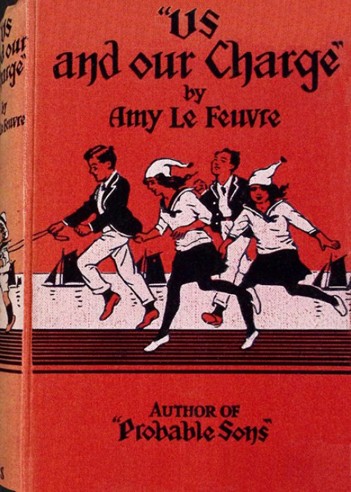
CHAPTER IV
A RESCUE
THEN Aylwin came tearing back.
"Here, you girls, got any sashes? We must make a rope; there's a fellow a good way down the cliff. He has stuck there, can't get up or down—we'll have to get him up."
Lynette and I got out of the cart hurriedly and Puff followed us. Slapper stopped quite contentedly and began to munch some coarse grass.
"We've no sashes," I said in despair. "What shall we do?"
"Tear up your frocks!"
"Oh, we can't, we really can't!" I cried. "Our brand-new dresses—you had better tear up something of yours!"
"What are frocks when a chap's life is at stake!" said Aylwin.
And then Denys came up.
"We must do something at once; a bit of the cliff crumbled away, and he is just hanging to a bush. Here, give us the reins. They look new and strong."
They were. We unbuckled them and the boys went back.
Lynette and I stole up as near the edge as we could, but we could see nothing and Denys waved us back. Then he carefully lowered one end of the reins.
"Tie it round you, and we'll haul you up!"
"It will break," said Aylwin, shaking his head.
Then Denys made us all stand one behind the other with a bit of the rein twisted round our hand, but we got hold of each other as well.
"Now," he shouted, "when I say 'Go,' we'll pull."
There was a moment's silence and I felt my heart thump.
"Supposing," I thought, "he pulls us all over, instead of us pulling him up?" And then I said out loud, for I was very excited:
"O God, make us very strong!"
Then Denys shouted—
"Go!"
And we pulled and pulled for all we were worth. The jerk at first was awful, and it seemed as if we were never going to haul in. But in another minute, a boy's head appeared above the cliff, and then he climbed up. He told us afterwards, that when he let go of his bush, he thought he was going to certain death, and then he found he could seize hold of ledges to help him up, and he found we were strong enough to pull him.
He was a very slight-looking boy about Denys's size, with merry eyes and short crisp brown curls. His coat was torn, and for a moment he turned white and giddy, then he laughed and said:
"I thought I was a goner!"
We were gasping for breath, and then he looked at us in astonishment.
"Have you descended from the skies?" he asked.
"No," said Denys; "don't you see our steed?"
And then we all cried out, for there was no sign of Slapper or the cart.
"Oh, what an old humbug!" said Aylwin. "He's sharp enough to give us the slip when he chooses!"
"It was having no reins, I guess!" said Denys. He looked rather worried. The road stretched away from us empty and bare; there was no sign of the cart anywhere.
"And he has gone away with my hat!" said Lynette, laughing.
The strange boy looked at her.
"Ah!" he said. "And sure I wish I had my own hat to offer you, but it's at the bottom of the cliff long ago. Where do you come from?"
We told him; he was frightfully interested, and then he told us about himself. He had come to live with an old aunt about fifteen miles from us, and he had a tutor, and his name was Patrick Douglas.
"Oirish I am," he said with a merry chuckle; "and I can tell you the Scotch are terrible sober sides. They say I'm making my aunt sit up. She'll be grey-headed, I fear, before her time! Yesterday they were for having me before the magistrate, and of all the conceited, starched-up blunderbusses, give me a Scot Bobby!"
"What did you do?" asked Aylwin with interest.
"Oh, I just gave a whisky-loving farmer a seat in some old stocks near by. He turned out to be our good Bobby's brother-in-law, so I was run in for assault. But it was a storm in a teacup, and I got off."
We were so interested in listening to the boy that we forgot our plight, until Denys reminded us of it.
"Which way has that beast gone? That's the question."
"It's Andy over again," Lynette said, "we do seem very unlucky with our animals."
Denys looked worried, and I was anxious too. The horse wasn't ours, but grandfather's, and if we went home without him we should never be allowed to drive him again.
And then Denys and Aylwin lay flat down on the road on their faces and studied the wheel marks. They're always clever at woodcraft, and very soon tracked the mark of our wheels in the dust.
But Slapper hadn't gone home; he had gone on, and we all agreed we must go on too.
"We're not going home without our steed, if we stay out all night," said Denys.
"Hurrah!" cried the strange boy. "Then my way is yours, and we'll tramp it together."
And so we did, and Pat, as he told us to call him, was so funny and so full of talk that we became the greatest friends with him.
We soon met two men in a cart. We stopped them, but they had not seen Slapper, and I began to get afraid that Puff would get tired and refuse to go on. It was quite three miles before we came to a little town or big village called Nellsolley, and then, to our great relief, we found that Slapper had been stopped as he was quietly trotting through. The man at the inn had got him in the yard. Denys came to me looking very hot and red.
"Of course he expects a tip, Grisel; it's awfully hard lines not to have a penny to give him!"
"I haven't got my purse," I said; "and even if I had, he wouldn't thank us for twopence halfpenny."
"Shall we borrow from Pat? I hear him jingling money in his pocket."
"Oh no!" I cried. "Father always made us promise never to borrow from anybody. And we might not be able to pay it back again!"
Denys shrugged his shoulders.
"This is an exception!" he said.
"Hold fast!" I whispered.
Denys scowled, but he walked away, and I heard him say very grandly to the landlord:
"I'm sure we're awfully obliged—and our grandfather, Colonel Noble, will be too—and you'll hear from him about it—as soon as we get back!"
The reins were very much twisted and stretched, and Pat, in his funny way, put them up to his lips and kissed them before the man fastened them on to Slapper again.
"There for ye!" he said. "And that's for saving my worthless life."
And then he shook hands with us all round and his shake was more like a wring; I almost cried with pain. He said a lot about his gratitude to us, and then he finished up by laughing.
"There's only one person in the wide world who's truly grateful to you, and that's myself, for nobody else would give you a 'thank you' for keeping me alive in the world at all, at all!"
We begged him to come and see us, and he said he had a little sailing-boat of his own, and he'd come along the very next day and take us all for a sail. I felt rather doubtful whether we would be allowed to go with him, but Denys seemed to think it would be all right.
And then we said good-bye and drove back home as fast as we could. We felt we had had quite an adventure, and certainly it was a thrilling moment when we were all pulling Pat up the cliff by the reins, and not knowing whether they would break in our hands!
We got home about five o'clock, and as we were tumbling out of the cart, Denys called to me:
"Here, Grisel, I want you."
"What is it?" I said.
Aylwin and Lynette were racing each other up the backstairs, and Puff following, so I stood still and waited.
Denys looked very grave.
"I think you'd better come with me. It isn't that I'm afraid of going alone, but we're the two eldest, and if I should get a bit hot, you can put the butter on, and cool the old chap down."
"You mean grandfather?" I asked.
"Yes, I must tell him, for he'll have to send the landlord of the inn something. It may open his eyes as to the emptiness of our pockets! And you heard that upstart groom ask what we had been doing to the reins!"
"Oh, all right. I'll come with you, only let us get it over quick!"
I felt rather frightened, for we all consider that we don't know grandfather yet.
So we went through the baize door into the front hall, and asked Jenkins the butler to take us to grandfather. He shook his old head at first.
"The Colonel don't wish to be disturbed."
But Denys said grandly:
"Please do as you are told. Tell him we have particular business to talk over."
I like old Jenkins, so I added:
"Do get him to see us, Jenkins. I know you'll manage it. And we won't hurt him!"
He walked off to the library and then he came back.
"The Colonel will see you."
So we went in. Grandfather was sitting in his arm-chair reading a paper, and I was rather glad that Aunt Isobel was not with him.
"Good afternoon, grandfather," Denys said cheerfully. "Hope you don't mind us coming to see you, but we've been out for a drive, and found a fellow hanging on by his eyelids over a cliff, so we had to haul him up and took the reins to do it, and old Slapper trotted on without us. We found him again. A chap called Pittock, who keeps the inn at Nellsolley, had taken him in for us. He was awfully civil and obliging, but I hadn't a penny in my pocket, so I told him I'd tell you about it."
He paused, for grandfather has a way of fixing you with his eye that rather dries one up.
He didn't say anything at first, and then he spoke very slowly:
"It strikes me you may prove rather expensive young people. Why am I to be told about him?"
Denys got a little red, and then I tried to help him.
"You see, grandfather, we ought to have given him a tip. You would if you had been there, wouldn't you? It was very awkward, so we thought perhaps you could very kindly give us a shilling for him. Not more than that—and if you like only to give ninepence halfpenny, it will be enough, for I have twopence halfpenny of my own."
He looked at me, and then for the first time I saw a twinkle in his eyes, and now I shall never be afraid of him again. I always know, when people have twinkly eyes, that they have kindness inside.
"I should like a few more details, please," he said, and so we told him every bit of our drive.
"Pat Douglas!" he said. "Well, you've wasted no time in scraping up acquaintance with a thorough bad lot! It's a pity you hauled him up. My new reins were worth more than he was."
"Yes, that's what he seemed to feel," I said rather sadly; "he told us nobody would thank us for saving him. I felt so sorry for him, grandfather! And he's such a nice merry boy!"
"A scamp! A worthless scamp! He will drown himself before long in that cockleshell of his. Mind you, I forbid any of you to go out in his sailing-boat!"
Denys and I looked at each other.
"He's coming round to-morrow to take us for a sail!" I said.
"Bless my soul! You don't let the grass grow under your feet! Send him packing when he comes."
"Couldn't we go if we're very, very careful?" I pleaded.
And then he thundered out, "No!" and told us to leave him.
But Denys stood still.
"And what about the chap Pittock?"
Then grandfather put his hand in his pocket and drew out a two-shilling piece. Denys took it and thanked him, and then we went away.
"He isn't half bad," I said.
Denys looked gloomy.
"It's rot not to let us sail, but we'll get the man to come out in the boat, and race him."
We cheered up at that thought, and ran upstairs to tea.
We got Peggy to tell us about Pat when she came in. She knows about everybody and everything for miles round. She told us a Mr. Douglas had married a wild Irish girl, and lived in France after his marriage. When his father died, he came home and lived on his property, but his wife wasn't much liked. She shocked people by things she said and did, and hunted morning, noon, and night. Pat was only three years old when she was thrown from her horse in the hunting-field and killed on the spot. Then Mr. Douglas asked his sister to come and live with him, and he died when Pat was eight. Then his mother's people in Ireland took him, and when his grandfather and grandmother died over there, he came back to his aunt, and has lived with her ever since.
"He's a terrible laddie!" Peggy said. "He's in scrapes most days. He is going to the school where you young gentlemen will be going, for his tutor can't manage him. He seems to have nine lives, like a cat."
"Poor Pat!" I said. "He must feel very sad sometimes when he thinks of all of his relations dying and leaving him. What is his aunt like?"
"Miss Douglas? Oh, she's Miss Douglas, but she's rare fond of the laddie, they say. She and your mother were fast friends, and she'll be over here to see ye before long if I'm not mistaken."
"Is she as stiff and cold as Aunt Isobel?"
"Hush now, for shame on ye! The mistress has a sad heart. None but a lone widder with ne'er a son or daughter to cheer her old age can tell the black days that are waitin' for her!"
"Well, we're ready to cheer her up any day she likes," said Lynette, "but she never comes near us."
I began to think about Aunt Isobel. I wonder if she is really lonely and unhappy. It is so difficult to understand grown-up people. So many of them are grave and quiet, and they never enjoy the things we do. But I wish she would talk to us a little more.
Puff is getting rather troublesome here. He's always trying to get out into the other part of the house through the baize door. We rather enjoy having a part of the house to ourselves, but he seems to think all kinds of things are happening the other side of the door. After tea this evening, I suddenly missed him. The boys and Lynette were trying to do some conjuring tricks out of "Peter Parley's Tales," and I was so deep in a book that I thought Puff was watching them. When I missed him, I went along the passage, and found, as I feared, that the baize door was open. There is a gallery at the top of the big staircase and I looked over and there I saw Puff stumping down the stairs. I was just going to call out to him when I saw grandfather coming very slowly across the hall, and then I was horrified at hearing Puff's shrill little voice:
"Hullo, old gempleum!"
"What are you doing here?" grandfather said gruffly.
Puff put his head on one side and smiled in his sweetest manner.
"I'm—er—coming down to say how d'ye do to you."
He stumped on down, and grandfather just stared at him.
Then Puff went straight up to him and took hold of his coat-sleeve coaxingly.
"They're all so stoopid upstairs, pretending to make eggs lay theirselves in a hat, as if the little chickens would think o' doing such a thing, and I just come away, and if you like me to come into your room, I'll help you smoke a pipe. Our gardener at home let me try lots o' times. And p'raps you've a long white pipe. They smokes bubbles. I can do that best."
He was trotting along by grandfather's side and never stopped talking. They both went into the library, and Puff slammed the door with all his strength.
I thought I had better not interfere. Puff is never shy with anybody, but I never thought he would be friends so quickly with grandfather. I went back to the schoolroom and told the others, but they were too busy with their tricks to care.
"We shall hear a howl soon," said Denys, "and he'll be sent back to us in disgrace."
But that did not happen. Puff stayed away an hour, and came upstairs with shining eyes and red-hot cheeks.
"I'm going to call him Gruffy. He said I might, and I've been sealing-waxing thousands of embelopes, and he gave me his ring, and I tolded him all about myself, and stood on my head for hours!"
"I wish you'd learn to speak true, Puff," I said.
Puff was too excited to listen to me.
"And Gruffy says I can ride and hunt the fox. He doesn't come out in the summer, but next winter I can. And I sawed pictures of hunting gempleums, and Aunt Isobel give me some grapes."
Puff seemed to have got on, as he always does with strangers, and then he got very wild. Denys told him he was suffering from "a swelled head," and we were quite glad when he went to bed.
Now I must tell about to-day, but I shall have to take another chapter, for something awful has happened, and I shall have to begin from the very beginning.
CHAPTER V
MISSING
THIS morning was lovely and hot, and directly after breakfast we went down to the sea. I can't think how people can possibly stay in the house when the sea is close to them outside. I think to live all the year by the seaside is ripping! And that's why we're so lucky to be here. Of course the boys had got hold of Davey the under-gardener, but he wouldn't have the boat out till eleven o'clock—he said he must wait for the turn of the tide. And they were so busy looking out for Pat in his sailing-boat that they didn't half enjoy themselves.
Lynette and I took off our shoes and stockings and paddled. The water seemed very cold at first, but we soon got accustomed to it, and Puff was perfectly happy messing about with sand and seaweed.
When Davey came down to the boat-house and took out the boat, we all got very excited, but the boys couldn't understand why Pat had not turned up. We all got into the boat, and Davey got two pairs of oars—he took one pair himself and Denys and Aylwin took the other between them. It was lovely flying along over the water. We watched the seagulls flying backwards and forwards from the cliffs, and saw in the distance small fishing-smacks, but we couldn't see a sign of Pat in his boat.
"He is a daring laddie," Davey said; "he'll take nobody with him, and a sailin'-boat ought to have two at least to man it. 'Tis a wonder he haven't gone to the bottom long before this."
"Perhaps something prevented him from coming out this morning," I said. "Let us forget him, Denys, and enjoy ourselves."
And then we saw land appear not so very far out at sea, and we asked what it was.
"'Tis the islands. There be four on 'em—"
"Oh how ripping!" Aylwin cried. "We'll go over and explore them. Are they big? Does any one live on them?"
"No, no, they're too small. Some goes over for seagull's-eggs, and there be some rare rock plants on one o' them. But there be too strong a current this time o' year to go near them. 'Tis dangerous at all times for small boats unless the tide be out."
So we rowed along past them, and then, when we rounded a corner of the cliffs, we all cried out at once, for there was Pat's sailing-boat. At least we made up our minds it must be, for it was a very small boat with a very big white sail which was flapping to and fro in rather a crazy fashion.
We shouted, for Davey told us our guess was right, but no Pat answered us. And then as we rowed on, we began to feel as if there was something wrong, for the boat seemed drifting about by itself, and there was no sign of anybody in it. It seemed a long time before we reached it. At first Davey was not going near it, but we made him, and though he pretended at first that Pat was most likely asleep in it, I could see he got more anxious as we came nearer.
We rowed up quite close to it, but there was no sign of any one in it. Davey told us to stay quite still where we were, and then he clambered on board. He shook his head as he took up a great-coat. "He's been here, sure enough, but where he be now is past me!"
WE BEGAN TO FEEL THERE WAS SOMETHING WRONG.
Then we watched him take down the sail, and then he and Denys between them managed to fasten the boat behind ours, and we towed her along. We shouted Pat's name over and over again, for we thought he might have landed on the beach, and his boat sailed off without him.
Davey said he must take us home, and then he would inquire at Miss Douglas's whether Pat had returned home. We didn't like this idea at all, for we wanted to help to look for him, but Davey wouldn't listen to us. And so we came back, and the boys helped Davey to pull up both boats on the beach and tie them outside the boat-house.
And then Denys and Aylwin told Davey that they intended to go over with him to Pat's aunt, and in the end they got Slapper and drove off. But Davey went on his cycle, and of course got there first.
Lynette and I went into the house and told Aunt Isobel about it. But she did not seem at all alarmed, said that Pat was always disappearing and turning up again. Then we had our dinner with Puff in the schoolroom, but the boys did not come back, and we hardly knew what to do with ourselves in the afternoon.
At last, Lynette took Puff across the field to see the farm that belongs to grandfather, and I went down to my favourite little garden. I had got hold of an old-fashioned story-book with mother's name in it, and I wanted to read it quite by myself, away from everybody, and think of her.
I opened the gate along the little winding path until I got to "Rosebud's" grave, and then I stopped quite taken aback, for on the old seat close by sat Aunt Isobel, reading a book!
She looked up when she heard me coming along, and I felt my cheeks getting hot.
"I—I was coming to sit here," I stammered. "I didn't know you ever came here."
It sounded rude, but I hardly knew what to say.
And then she gave me a tiny smile.
"Is there not room for both of us?" she said. "Come and sit down by me. Your mother and I used to sit here together when we were girls. You are very like her, Grisel."
"Oh, Aunt Isobel!" I exclaimed. "Mother was beautiful. I wish, I wish I could think I was like her!"
"She was not very beautiful when she was your age, but your face is the same shape, and so are your eyes and smile."
Aunt Isobel was looking at me very steadily, and I felt almost shy. I sat down, and then I suddenly thought I might ask her about the little grave. So I did, and she told me that it was a favourite doll of mother's, and she was nearly heart-broken when the puppies destroyed it, and would never have another doll afterwards. She was ten years old when it happened, and she used to come down and plant flowers on the grave, and this was always her favourite part of the garden.
And then—I don't know how it was, but I found myself talking quite freely to Aunt Isobel about everything. She seemed more sad than stern to me. And she asked me a lot of questions about us all. I said to her:
"I feel so old now that father has gone away from us, and I am afraid of not doing what he wanted. May I tell you his last words to me? Perhaps you could explain them. We have tried to understand them. The Bible helped us. He said to me—I shall never, 'never' forget his earnest tone!—
"'Grisel—remember—tell the boys—I charge you! Hold fast, Hold fast.'
"You see it is our charge, and we want to do it. We think he meant we must hold fast to all that he had taught us. He was so very good himself, and of course he wants us to be, but I do think it's more difficult for us than grown-ups, don't you? And though we do remember sometimes, we generally forget."
"What did your father teach you?"
Aunt Isobel asked this as if she were thinking of something else while she spoke, and I hardly knew what to say.
"He taught us how to love God first, and put God first, and be faithful and true. He used to say,—
"'Never forget that your souls and bodies belong to the One Who died to save you—' And he told us: 'So many live on the enemy's side, and forget Whose they are, and Whom they ought to serve.'
"I wish I could remember it all better, but I mean to hold fast to it if I can."
"Life is hard on one's memories!" said Aunt Isobel.
I did not quite understand what she meant, but she looked so sad that I seized hold of her hand.
"Oh, Aunt Isobel, do let us love you! We will try not to vex you. And please tell us when you don't like what we're doing!"
She stooped and kissed me.
"Good little Grisel!" she said.
And then she walked away, and I did not like to follow her.
After a little, I went into the house.
And Lynette and Puff came in at tea-time, but the boys were very late. And when they did come, they told us that it was quite awful about Pat; for everybody now thought he was drowned. Lots of men had gone out in boats, and hunted up and down everywhere, but there was no sign of him. And his aunt was in an awful state, and the police, and fishermen, and coast-guardsmen were still out.
"He's gone, there's no doubt of it," said Denys gloomily; "a fellow would never let his boat drift in that fashion, if he could have helped it."
"How dreadful!" cried Lynette. "And while we were laughing and capering over the rocks this morning, he was round the corner shrieking for help, and battling with the waves, and sinking like a stone without a soul—not even a dog—to save him!"
The boys generally laugh when Lynette gets the "heroics" as we call it, but they didn't laugh this time, and I felt all the tears crowd into my eyes. I couldn't believe it. Pat seemed too much alive to be able to die so quickly!
"Does grandfather know?" I asked.
"Yes, we told him. He was walking up and down outside the house when we came back."
"And what did he say?"
"He fixed us with stony eyes," said Aylwin, "and then jerked out:
"'And if you had had your wish, you would have been all at the bottom of the sea with him.'
"So we begged to differ from him there. We said we would most likely have saved his life, for there was nothing wrong with his boat. And the old chap marched away muttering to himself. I expect he would have been jolly glad to get rid of the whole lot of us so cheap. You see, he wouldn't even have had the expense of our funerals!"
"Oh, don't, Aylwin!" I shuddered, for our father's funeral was still in my mind. It seemed so dreadful to talk of it so lightly.
We had a miserable evening; and we all went early to bed.
I couldn't get to sleep for a long while, and then at last I did. But in the middle of the night, or it seemed so to me, I heard a sharp knock at our door. I started up, and before I could have time to be frightened, I heard Denys's voice:
"Grizzy, are you awake?"
"Yes, what's the matter? Is Puff ill?"
"Puff! He's snoring like a grampus. Aylwin and I are going out, so you'll know where we are. There's a light out at sea, and I believe it's Pat."
"Oh, Denys, how can it be? Show it to me."
I was at the window in a moment, and I saw at once a waving, flaring light.
"It isn't a boat," said Denys, in a grave voice, "because the light isn't a lantern or anything of that sort; it's more like a bonfire, and it's on one of the islands!"
"Oh, Denys, of course! Why didn't we think of the islands!"
"We did. Davey and another man went off and landed late in the afternoon, but they could see no signs of him. I made certain he was on them, and told them so, for it seems the old cook had packed him a big basket of provisions, and it couldn't be found on his boat."
"Of course he must have landed them. Oh how lovely to think he may be alive! Denys, dear, do, do let me come with you; it would be such an adventure!"
"Stuff! Of course you can't come. Girls would only be in the way. We're going down to Davey's cottage."
"But it's in the middle of the night!"
"It's hardly eleven o'clock yet."
I gasped!
"Oh do, 'do' let me come."
Denys rushed away. I knew it was no good trying to follow him. It's always the way. Boys get all the fun, and girls have to stick in the corner, and do nothing.
But I was so excited that I woke Lynette up. She locks herself up, we always say with the key inside, when she goes to sleep, for we never can wake her for ages and ages. And she's dangerous to wake, for she hits out, and is awfully cross for a long time. She began now, when I shook her, to call out in her sleep.
"I tell you I didn't do it! Why, the sea is boiling! Let's put the kettle on! And Pat is inside; I told you he was!"
Lynette always talks most dreadful nonsense when she's half asleep. Then she said crossly:
"Leave me alone. I shan't get up. It's much too early."
And then she hit me, and sat up straight in bed, and blinked like an owl.
"What's the matter? Are you ill?"
We always think anybody's ill, if we wake in the middle of the night.
Then I told her, and she got quite as excited as I was. And we put on our dressing-gowns, and watched and watched at the window, till we were sick and tired of watching. And at last, the light went out. It was too far off to see if a boat was getting near it, but a thick mist came over the sea and blotted everything out, and then we began to feel anxious about the boys. But we knew Davey was a very good seaman—for he used to be in the Navy—and I felt sure he would take care of the boys.
And at last we both got so sleepy that we crept into bed again, only just before we did, we knelt down and asked God to make Pat alive and not dead, and to keep the boys safe. I thought we had better do that, as God was the only One Who could save if there was danger, and then we both fell asleep till broad daylight.
I have been writing this all in bits just as I have time. This morning, when we woke, the sun was streaming in at the window, as if it didn't care a bit about Pat and the boys. I rushed into the boys' room at once. I hoped to find them in bed, and ready to tell us about Pat, but their beds were empty, and Puff was still asleep.
When Peggy came to call us, we told her all about it, and asked her if Davey was missing too.
"Why no," she said, looking very anxious, "Davey is cutting the grass in the back yard, and he hasn't been out at night—that I know for a fact. Dearie me, what feckless wicked laddies! They have just gone out by themselves!"
This seemed dreadful news; and then we heard that grandfather's boat was missing. And when we were dressed, we ran downstairs and told Davey all about it. And he was very much put out, and quite positive that Pat was not on one of the islands.
"'Twas most likely the coastguards' lights ye saw," he said. "And now there be two more to be searched for, and the Kornel will be in a pretty stew!"
Lynette and I tore down to the beach. It was very low tide, and we ran along for a long way until we came opposite the islands. And the sun was so hot and shining, and the sea so smooth and blue, that we said to each other that we were quite certain that nothing dreadful had happened.
But we could see no signs of any boys or of the boat, and Davey came along dragging a big boat after him.
I pointed out to him just where we had seen the bonfire, but he didn't seem as if he believed us.
"I'll be just rowing across to see once agen if the laddie be there."
Then we besought him to take us with him. Lynette coaxed, and I entreated with all my soul, and at last he said we might come with him. We forgot all about our breakfast, and if it had not been for the thought of the boys, and wondering where they were, we should have enjoyed ourselves most awfully. Davey let us take one of the oars, and we pulled rather awkwardly at first, but much better farther on. And then we began shouting and cooee-ing as we got near to the island, and I shall never forget the relief it was when, in a little cove close to the island, we caught sight of grandfather's boat.
"There you see! The boys are here!" cried Lynette triumphantly.
"Yes they be," said Davey crossly, "and I'll gie them a bit o' my mind, to go carryin' off the Kornel's boat, and leading me such a dance for nothin'!"
"I wonder if they have found Pat," said Lynette.
I was afraid they had not, for there was no sign of them, and we thought they must be hunting for him on the other side. There was no beach where the boat was—Davey said it was high tide, and our hearts sank when we saw there was no possibility of landing. There was a straight high cliff right up above the boat, but it was tied to an iron staple in the cliff that must have been put there to be used. Then we called again and again, but the waves were making such a noise as they dashed against the rocks that it quite drowned our voices.
"Is there nowhere to land?" I asked Davey.
And he shook his head.
"We'll go round to the caves," he said.
And then we rowed round the island for a good way, and then suddenly, as we were calling, we heard an answering shout. For a moment we stared about, but could see nobody, and then I caught sight of Denys's head just peeping out of a hole in the cliff. He looked so funny that I could hardly help laughing. We rowed right up underneath him and Davey told us he was in the caves, which slope upwards—and the sea was washing in at the bottom of them.
"I've spent a night there," said Davey. "You're quite safe if you climb high enough."
"Are you all safe?" I cried out to Denys.
And Lynette cried: "Is Pat with you?"
Denys's head suddenly disappeared, and we waited breathlessly to see it again.
CHAPTER VI
A LONG SUNDAY
THE next head that appeared was Aylwin's, with a broad grin upon his face. I knew instantly that they must have found Pat.
"Pat is with you?" I cried, and Aylwin's head nodded. The voice of the sea quite drowned our voices.
Davey gave a kind of chuckle. "Might have known it, so we might; he'll always turn up again, will that limb of a boy!"
"But why didn't you find him?" Lynette asked a little indignantly.
Davey shook his head.
Then we heard Aylwin shouting: "We're in here till the tide turns, unless you can fling us a rope!"
Now I knew how daring the boys are. I knew if we did, they would squeeze themselves through that hole, and we would see them dangling in mid-air by the rope, so I told Davey not to say he had got one at the bottom of his boat.
"The tide is going out," said Davey, "but it will take a couple of hours yet for them to be able to get out of that cave."
Then Pat's head appeared at the hole. "How's yourselves?" he shouted.
"How are you?" Lynette cried back.
"Hurt my leg! Had to lie low. Go home to your breakfasts. We have the boat and will come as soon as ever we can!"
But we waited till Denys's head popped out again, and when he shouted the same thing we thought we had better go back. Davey said Pat's aunt must be told that he was safe, so we rowed back, and I felt as if a great heavy lump had been lifted off my chest. It was so glorious to have them all alive and jolly!
We weren't scolded for going out so early when they heard the good news. Even Peggy beamed with delight. Davey rode off to tell Miss Douglas and all the village people, and Aunt Isobel came into the schoolroom to hear all about it, while we had our breakfast.
We went down to the beach directly afterwards, and Puff said:
"I do think God might hurry up the sea, and tell it to move quicker."
It seemed really very slow at going out. But gradually the rocks began to show themselves, and then the seaweed, and then, after a very long time, we saw a little boat in the distance, and it came nearer and nearer. And at last, the boys came in sight. And we danced and shouted like savages, and took off our shoes and stockings, and waded into the sea to meet them.
Pat was as funny as ever, but he looked very white, and had a bandage round his ankle. Denys carried him on his back right up the beach, for he couldn't walk, and then Aylwin took a turn, and as we went up to the house, we heard all about it. Pat had planned a lovely picnic on the island. He landed there on the way to us to leave his big basket of provisions and to get the cave ready for us. He said, one day, there was a horrid dead fish in it which made an awful smell, and he didn't want anything of that sort to be there when we came. He was a little longer than he meant to be, and then, to his horror, he saw that his boat had slipped her anchor and was drifting away. He was in a hurry to get to a high part of the cave to shout for help, when he had an awful tumble and cut a great gash in his leg. It wouldn't stop bleeding, and it made him sick, and he thinks he must have fainted.
When he came to himself, he was afraid of moving lest the bleeding should burst out again, and he was also in too much pain to move. He saw the tide was coming in, and knew he was caught and would have to stop there, so he dragged himself slowly to the high and dry part of the cave, and there he lay down and ate a good meal and then went to sleep, he said, for hours. I suppose that was when the men were hunting for him, but they stupidly never looked in the cave. Pat says the villagers think it is haunted, and will never go right in.
When he woke up, he tore some strips off his shirt and bound up his leg very tight, and then he could hop about. And when it came on to be dark, he thought what a fool he was not to make a fire. So he made it at last, and that was how Denys and Aylwin saw it, and they got over to him all right, for it was low tide. But when they tried to bring him down to the boat, his leg burst out bleeding afresh, and by the time they had bound it up, and he began to feel fit to hop down to the beach, they found the horrid tide had turned, and was washing into the cave. So they had to wait till the morning, and then they saw us coming. It all sounded so natural that I thought how stupid we were not to find Pat before.
When we got to the house, Aunt Isobel came running out, and Miss Douglas, who had just arrived. She had ridden over. It seemed funny to me to see a grey-haired lady on a horse, but everybody seems to ride here.
Pat waved his hand airily to them.
"Sorry am I to have turned up again to plague you," he said.
But Miss Douglas looked as if she wanted to hug him.
"Oh Pat, you'll be my death one day," she said. "I had quite made up my mind that you were lying fathoms deep below the sea."
When Aunt Isobel saw how hurt Pat's leg was, she had him carried by Davey into one of the empty spare rooms, and then the doctor came and sewed up his leg, for he had a great gash in it. We thought it was awful to actually sew up his flesh with needle and cotton. I had never heard of such a thing before. And then we were told that, as he had to keep quiet and not move his leg, he was going to stay with us for a few days, and of course we voted it great fun. Miss Douglas fussed in and out of his room all the day, but she went away before it got dark.
In the evening, Pat came into the schoolroom and lay on the couch there. We had a big fire, and we all sat round it and told ghost stories; and Pat's "yarns," as the boys called them, were simply ripping!
"It's queer," he said, just before we went to bed, "that you should have come to my rescue two days running. I hope you'll get into difficulties next, and sure I'll get you out of them! So as to be quits!"
"I suppose it's being by the sea that brings so many dangers," I said.
"No," he said with his merry laugh, "it's just meself, born to be the plague of my belongings! If anybody can get into a scrape, it's I that do it."
"It's very interesting and exciting," said Lynette. "I do hope you'll go on doing it. We do love adventures."
And when we came up to bed Lynette said to me:
"Isn't Pat a darling, Grisel? I'm so glad we know him."
"Yes," I said, "he's so merry that I can't help liking him, but Lynette, he uses such words—almost swearing—I can't bear to hear him do it!"
"You mean when he says 'Oh Lord!' and 'May the devil take me.' He doesn't mean anything by it, he only rattles the words off in his stories—"
"Puff will be copying him," I said. "He always copies big boys."
"Then we must give Puff a whacking if he does, and stop it," said Lynette.
Nothing ever troubles Lynette.
*****
To-day is Sunday. It hasn't been at all a nice day. To begin with, it has been a regular wet day. Aunt Isobel said we couldn't any of us go to church, and that seemed to turn it into a week-day. She told us we must stay quietly in the schoolroom, and that of course brought difficulties at once. First we were all quiet. I got Puff into a corner, and began to read him some of "The Pilgrim's Progress," and the boys and Lynette got some books from the book-case.
But about eleven o'clock Pat hobbled in and took possession of the sofa, and then there was no more quiet. Puff first began to humbug about the room and throw cushions, and then Pat said he would show us some conjuring tricks, and they were so interesting that I forgot it was Sunday, and enjoyed them as much as the others. Then he brought out of his pocket a rather dirty pack of cards, and said we must have a game. I said at once we never played cards, but the boys looked uncomfortable. Pat laughed. He has a very wheedling way with him, and when I added hastily:
"It's Sunday," he laughed all the more.
"You're not one of these sour-faced Scotchies, Grisel," he said. "What's a poor invalid to do if you can't amuse him? Doesn't it say in the Bible you must give a leg up to any poor ass who's down in his luck? But girls are all the same. Now you shut those grey eyes of yours, and go on reading your Sabbath book. And we'll have our quiet game without interfering with you."
Then I turned and looked at the boys.
"Hold fast!" I said, and then I ran out of the room.
I felt miserable when I got to my bedroom. I'm a regular out-and-out coward. I couldn't stay in the room to be laughed at, and so I came away, and I left them, and knew that perhaps they would all be breaking Sunday, and playing cards. I looked out of the window, and began to wish we had never come here. There seemed nobody to help us do right, and it was so easy to do wrong. And then I remembered that God was with us just the same, so I knelt down and asked Him to make the boys hold fast, and remember father's teaching. And I felt a little better when I got up from my knees, and a little braver too.
So presently I crept back to the schoolroom. There was the most awful noise going on, but they weren't playing cards, they were acting stories out of the Bible and making Pat guess what they were. I found Lynette rolling and shrieking on the floor, and Puff and Aylwin were gambolling about her on all fours, and Denys was standing on the mantelpiece looking on.
I heard in a minute or two that Lynette and Denys had both stood on the mantelpiece, and that she was Jezebel. And Puff had come by riding on Aylwin and said, "Throw her down," and that Denys had pushed her down, and then Aylwin and Puff pretended to be the dogs devouring her, and Lynette showed me afterwards huge bruises on her elbows and knees where she fell. Pat was in fits of laughter. And I didn't know what to say or do.
"We've been so good," he said to me; "we've postponed our game of 'Nap' till to-morrow."
He pulled hold of me and made me sit on a chair close to him.
"I really don't know whether this is any better," I said in despair. "We've never spent a Sunday like this before."
Lynette got up, rubbing her elbows dolefully.
"We've never been kept in from church," said Denys, a little defiantly. "Aunt Isobel treats us as if we're china under glass!"
I gave a big sigh, and Pat mimicked me at once.
"Old mother Grisel!" he said. "Do you always try to be good? Or do you only keep it for Sundays?"
I looked at him. Somehow, though his voice and words are teasing, I never feel afraid of Pat. I think it is his bright soft blue eyes.
"Oh, Pat!" I said. "If you had just lost your father whom you adored, wouldn't you try to do what he would wish?"
"He won't know anything," said Pat reflectively.
"Oh, I hope he doesn't know what we're doing to-day," I said, feeling a great lump rising in my throat. "It would break his heart if he knew you were going to make the boys play cards and gamble. I heard you talking of halfpenny points!"
Pat laughed.
"Don't you worry, little mother. Your boys can look after themselves. Why did you call out 'Hold fast' when you ran away?"
"It was father's charge to me," I said firmly. "He told me before he died to tell the boys to hold fast, and I shall always say it to them when they forget. I say it to myself every morning. I forget quite as much as they do."
"Hold fast to what?"
"We looked it up in the Bible. Father didn't finish his sentence, but I'm sure he meant to what he taught us, and to what God says we're to do in the Bible."
"Oh, sakes alive! Sure, if we're to do all the Bible tells us, we'd better quit the earth straight away."
"Why?" I asked.
"Because nobody could live on Bible lines. Now doesn't it tell you to give to every one who wants to borrow? We have some awful wandering beggars over here. Supposing if everybody gave them everything they asked for, why, like cormorants, they'd swallow our all!"
"You need not pick out the unlikely kinds of things to do," I said.
Then Denys came over to us. He was smoothing down the back of his head with his hand—a little trick of his when he's not quite sure of himself.
"Well, Grizzy," he said, "how are we going to get through this wet Sunday? I'll never stand another like this—never!"
"I think, if you were to read the lessons to us, Denys, and a collect or two, it would be a kind of church at home, and we could sing the chants and a hymn or two."
I was rather nervous as I spoke, because of Pat, but, to my relief, he said:
"It'll be a thundering good idea, and then all the wrinkles will go, little mother, won't they?"
In a moment, they all took it up. Lynette and Aylwin made a kind of reading-desk and some pews, and the only thing Denys would not do was to put on the nightdress Lynette brought him for a surplice.
"I'm not a parson," he said, "and I won't ape one."
We all settled down; even Puff got grave and quiet, and Pat lay quite still till we began to sing, and then he joined in with such a lovely voice that I almost held my breath to listen to him.
And then we sang ever so many hymns one after another, and when our church was over, it was dinner-time. I felt quite happy again, and I know Denys was too, he pulled hold of me in the passage as he was going to his room to wash his hands.
"Grisel, we nearly let go this morning, didn't we?"
I nodded.
"And next time," he added quickly, "I hope I shall be the one to call out 'Hold fast.'"
We didn't say any more.
The afternoon was quite fine, and we all went for a long walk along the cliffs, for the tide was in. Aunt Isobel sat with Pat to cheer him up, she said. But I think he cheered her up, for he talked and she listened, and there's nobody that can talk like Pat. He simply makes you die with laughing every minute.
It seems that in this part of Scotland the church that Aunt Isobel goes to is only held once a day, in the morning. And nobody thinks of going anywhere else. As it was fine, several visitors came to see Aunt Isobel, and some who arrived in a motor stayed to dinner. They sounded very jolly downstairs, and Lynette was very cross at Peggy telling us we were to stay quietly in the schoolroom, as there was company.
"We might as well be in jail," she said.
"Oh," I said, "I'm thankful we can be here by ourselves."
After tea, we got round the fire, and then somehow we began to tell Pat about our Empire League. He was awfully interested.
"I'm half inclined to be a soldier myself," he said, "but I'm all for old Oireland. I don't know that I have a passion for England."
"Oh, but you must," I cried. "We are all bound up together. You're a loyal Irishman, aren't you?"
Pat half winked his eye at me.
"I don't mean to know or like any men, when I grow up," I said stoutly, "who aren't loyal subjects to their King and country."
"And," burst out Lynette, "Grisel and I have quite made up our minds not to marry anybody but soldiers."
"How many for each of you?" said Aylwin, with his funny chuckle.
"Sure," said Pat, "with that shining prospect before me of weddin' either of you, or both, I'll enlist as a drummer-boy right away!"
"Don't joke," I said. "Aren't you fond of and proud of our British Empire, Pat?"
"I'll be so, if you'll teach me," he said, folding his hands and casting his eyes up to the ceiling till we could only see the whites of them.
And then I gave up talking, for I saw he wouldn't be serious, but I hoped he would listen another day.
And now I've been writing in this diary, and we're just off to bed. This has been a dreadfully long Sunday; I do hope we shall never stay home from church again.
Oh dear, oh dear! I did hope we had got through the day all right. But there's the most awful row going on, and we're all in it, and it has all happened in the last half-hour, and Aunt Isobel is furious. But I must write about it to-morrow.
CHAPTER VII
PAT LEAVES US
IF only we could stop and think sometimes! We do all our worst scrapes all in a minute, and this is what happened last night, and of course, being Sunday, it made it a hundred times worse.
Puff was the one who began it. When I told him to come to bed, he ran away. He's often like that, and you can't reason with him. He rushed along the passage and got through the baize door, and of course I went after him.
The big hall downstairs was lighted up, and there were two gentlemen talking and smoking outside the drawing-room door. They went into the smoking-room after a few minutes, and I leant over the railing that goes round the gallery and looked down at the oil-pictures on the walls. They always interested me, for they were portraits of our mother's ancestors.
Suddenly I heard Lynette's giggle, and I turned round to find her and the boys, and Pat, all out on the landing. Pat was supporting himself with two sticks. Then Pat pointed to the broad balustrade on the top of the banister.
"I had a splendid slide down there once," he said.
In one second Aylwin was astride, Denys followed, Lynette, and then Puff, and—I can't explain it—the thought of Sunday went quite away—and I swung myself up. It did flash across me that I could keep Puff from going over, but it was all in a minute, and the feeling of sliding down quicker and quicker was just lovely. It was all over in two minutes, but Aylwin didn't jump clear at the bottom. We all fell in a confused heap on the floor, Puff gave a yell, and in falling, Lynette grabbed hold of Jenkins's legs. He was unfortunately passing close to the bottom of the stairs with a tray of glasses. He came to the ground with a crash, and the glasses too.
And the drawing-room door suddenly opened, and when we picked ourselves up, there was grandfather, and Aunt Isobel, and several ladies and gentlemen.
I felt as if I would like the earth to have swallowed us up, and grandfather was furious. He swore, and I have never heard such swearing before.
We said we were very sorry, and crept upstairs.
But Aunt Isobel came after us, and she scolded me and Denys most dreadfully. Of course we were the eldest ones, and were much too big to do it, and we couldn't excuse ourselves.
And when I at last went to bed, I felt perfectly miserable. Lynette would keep laughing and chuckling at the remembrance of Jenkins going down. He forgot his proper voice and shouted dreadful words, which was swearing, I suppose, but grandfather said something much worse. And Jenkins has a great big bruise on the bald part of his head this morning, and Peggy told us that the cut-glass which was broken was worth twenty pounds. Aunt Isobel said she would telegraph to the governess to come and take charge of us at once. She said to me:
"I did think, Grisel, that you were a good little girl from your talk. Remember, it is actions, not words, that speak loudest. I am bitterly disappointed in you."
And I am thoroughly ashamed of myself. How could I! Oh how could I!
Pat was the only one who kept out of disgrace, but he was really the one who put it into our heads to do it.
He came over to me this morning while I was waiting for breakfast. I was standing by the window and wishing for father again, and feeling deadly miserable.
Pat clapped his hand down on my shoulder.
"Cheer up, Madam Dumps!"
"How can I, Pat?" I said, choking down a lump in my throat. "When I think of what we did on Sunday, and Aunt Isobel's face of horror and disgust, I just feel I can never be happy again! And father told us to hold fast; why, I'm letting everything go as quickly as I can!"
"I should say it was a case of holding fast last night! Why, I heard you say it to Puff as you started on your downward career!"
I checked my inclination to laugh. Pat's face is like the sun; he always seems to warm you up, and I began to feel better.
"Well," I said with a big sigh, "it was a black day yesterday, but we've a fresh one in front of us, and I'm going to try to be an angel of goodness to-day."
"Sure! So am I," said Pat fervently.
And then he tucked my arm in his, and when the others trooped in to breakfast, we were standing up very straight and stiff together with two of the large breakfast-plates fastened behind our heads and Pat said:
"Behold St. Patrick and St. Grisel waiting to give the sinners their blessing."
Then we nearly had a regular shindy, for they all got hold of the plates and began to shy them at us. So I took mine off very quickly, and made them be quiet; at least I begged Denys to keep order, and he did.
"Do let us all try to keep out of scrapes to-day," I said.
But after breakfast, Pat began getting out his cards again, and I felt in despair. It was a lovely morning, and it seemed too awful for the boys to be staying in and trying to gamble. I almost wished that Pat would go home, and then I seized hold of Denys and got him out of the room.
"Oh, Denys," I said, "aren't you going to 'hold fast'? I shall never be able to make you, and it will be dreadful if Aylwin gets to play for money. Father hated card-playing; you know he did."
Denys looked uncomfortable.
"We won't play for money," he said; "it's awfully dull for Pat not being able to get out."
"But he can. We can have the trap and drive him, and you know he won't play unless there's money in it."
"Well, I'll see if he'll come out for a drive."
"And if he won't, do hold fast, Denys!"
Denys straightened himself.
"All right. Don't you worry."
He went back to the schoolroom, but I don't know what happened, for Peggy came up to say that I was to go downstairs to Aunt Isobel.
I found her in her own nice sitting-room. She looked very grave when she saw me.
"I hope you're ashamed of that shocking exhibition last night, Grisel. Are you two big girls accustomed to behave like tomboys?"
"We're awfully ashamed and sorry," I said. "I can't tell you now what made me do it. Lynette is always a mad-cap. It only takes me like that very very seldom. I suppose it was being shut up all day, and trying so hard to do what was right for such a long time when it was all so difficult. Then suddenly I forgot everything and let myself go. I suppose it's something like elastic being stretched out too long, and then it goes snap. I felt stretched out all day yesterday."
There was silence. Then, after a moment, Aunt Isobel said:
"Your governess will be here to-morrow. Until she comes, I wish you and your sister to be in this room with me. The boys are to remain in the schoolroom upstairs. I wish you to be kept quite apart for to-day. Go upstairs again now and fetch your sister down. I have some needlework here that you can help me with. I am making some flannel petticoats for our old alms-cottage women."
I felt quite desperate.
"If I leave the boys, they may do 'anything,'" I said; "and Puff will get awfully out of hand. It's Pat, I think, you had better send him home if you want the boys to be good."
"You can't blame Pat for your behaviour last night; he was not with you."
I was silent. What could I say? And felt very mean in blaming Pat.
"As it happens," Aunt Isobel said, "Pat is going home this afternoon. His aunt is coming over for him."
I went upstairs very slowly. The boys weren't playing cards; they were talking eagerly. Puff was trying to climb out of the window, and Lynette was busy painting a most hideous paper mask; she's very good at them, and is always making them for Puff.
I told them what Aunt Isobel wished, and Lynette was very angry.
"I won't come, Grizzy; you can go back and tell her I won't. I'm a pattern of perfection to-day. I shouldn't think of doing anything so vulgar as sliding down the banisters. Tell her my hair is tidy, my hands and nails as clean as hers. I am not even crossing my legs, or tipping my chair back. And nothing will induce me to leave the boys."
"You must come at once," I repeated. And then I hauled in Puff from the window-ledge, and fastened the window. "Denys, you must look after Puff, and don't let him get into mischief."
"You go down, both of you," said Pat, "and we'll find a way of fetching you up. I give you my word, you'll both be up in half an hour!"
Lynette wanted a good deal of coaxing even then, but she followed me down at last. And Aunt Isobel gave us two flannel petticoats to make, and we sat on two chairs and wondered what was going on upstairs.
Aunt Isobel went to her writing-desk and began to write some letters. Presently we heard a little bustle and noise outside, and then Jenkins came in.
"If you please, mem, Peggy wishes Miss Grisel to come upstairs quick, for the little master have cut his thumb frightful and won't let nobody touch it but her!"
I sprang up.
"Oh, it's Puff, aunt; I must go."
I darted out of the door and upstairs. Lynette tried to follow me, but was called back.
I dashed into the schoolroom. Peggy came along with a basin of water.
"He won't let me get near him, the naughty laddie!" she said.
And then I saw Puff lying back in a chair with the boys round him, and yelling for all he was worth, and his handkerchief seemed covered with blood.
Aylwin took the basin hastily out of Peggy's hands, and almost pushed her out of the room.
"We'll manage now, thanks." He locked the door after her.
I knelt down by Puff.
"You poor little man, how did it happen?" I asked.
Puff had his eyes tightly shut and his mouth wide open. When he heard my voice, he jumped up, and he and the boys burst into a roar of laughter.
I found his white handkerchief was-smeared with red paint, and that his thumb was not cut at all.
I felt quite bewildered.
"Now we have to get hold of Lynette," said Denys. "Why didn't she come with you?"
"Oh, boys," I said, "you must have told Peggy an awful whopper! It isn't right! And I must go back at once."
"No, you won't," said Pat, taking the key from Aylwin and pocketing it. "You'll stay here. Now, then, I'll do the rest."
He limped out of the room and down the stairs, locking the door on the outside, and taking the key with him.
I heard from Lynette, afterwards, that he appeared with a very scared face:
"Grisel says she has some sticking-plaster locked up in a drawer, and you have the key. Come on, quick!"
"And when you have given her the key come downstairs again," said Aunt Isobel very shortly.
Upstairs flew Lynette, and when she, in her turn, was locked inside by wicked Pat, she enjoyed the joke. But I couldn't laugh, though I hate the boys thinking me a prig.
"Didn't I tell you I'd fetch you up again?" said Pat triumphantly.
"Oh, you can do anything if you tell lies," I said.
Pat got very red in the face.
"Do you call meself a liar?" he said, and his eyes blazed.
But I stood my ground, for I was angry with Pat, and I was afraid he would be teaching Puff to be deceitful.
"You can't say you didn't tell a lie, for you told two, and it spoils fun to get it like that. Now, Lynette, come on down. And if you boys send down a message to say that the schoolroom is on fire, I shan't budge from my seat. Where's the key, Pat? If you don't unlock that door, I'll ring the bell."
"Grizzy is in a stew," said Aylwin, chuckling.
Pat looked at me defiantly.
"If you were a boy, I'd have you out, and give you a thorough good licking, sure I would, by—"
I put my hand on his arm.
"Now, Pat, forgive me; where's the key?"
He flung it on the floor.
I picked it up and Lynette followed me downstairs without a word.
"How did he cut himself?" Aunt Isobel asked.
And I answered straight out: "It was a joke of the boys to get us upstairs again."
Aunt Isobel looked at me sharply, then went on with her writing, and did not say another word.
Lynette and I were allowed to go upstairs to our schoolroom dinner. And the whole time we were eating it, the boys were arguing about a lie, what it was, and what it wasn't. Pat says a practical joke isn't a lie; he says to deny something you've done wrong is the only lie he knows of. Aylwin says a lie that makes a person suffer who ought not to is the worst lie of all.
Denys said a lie of any sort is not possible to a gentleman, but a joke like Pat's is more fun than earnest.
"I know a boy at school who tells the most awful yarns," Denys said, "but we don't call them lies, because we know what he is."
"Yes, but when there's something awfully important going on, you wouldn't trust his word," I said. "And I should like to feel I could trust Pat's."
"If you can't trust me, slay me!" said Pat, jumping from his seat and handing me a big knife. Then he unbuttoned his waistcoat and pretended to expose his heart.
"Here, strike, cruel maiden! Rather the cut of cold steel, than the cut of such words and looks!"
I laughed as I threw down the knife.
"Oh, Pat, you're such a nice boy that you really mustn't tell crams even in fun!"
And then none of us said any more.
Lynette and I went out for a drive with Aunt Isobel after our dinner. And when we came back, Miss Douglas had just arrived in a big old-fashioned carriage, and Pat was saying good-bye to everybody, for his aunt wouldn't stop to tea. And just before he went, he got me into a corner of the hall, and said:
"You're a game little creature, Grisel. And if you'll take me in hand, and give me a grand licking with your tongue on occasions, sure I'll make a grand man by and by!"