
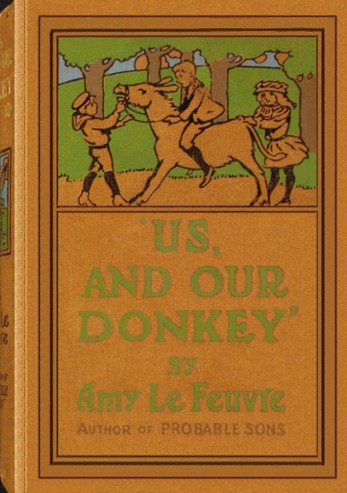
HE WENT OVER HIS HEAD INTO A BED OF STINGING NETTLES.
And so he did, and Aylwin put his head in at our bedroom door to tell us that father had bought the cart as well. We were to give him as much money as we had earned, and he would add the rest. Mrs. Rowe came down to four pounds, and that was what father paid her.
Lynette and I were awfully disappointed not to see the donkey put into the stable. We found out in the morning that Baldwin turned him into our field next the kitchen-garden. Baldwin said he knew all about donkeys and their ways.
We got up very early to go out and see him, and Lynette took him a carrot. He came up to us at once and took it, but when we tried to get on his back, he galloped off.
After breakfast father and Aunt Caroline came out to look at him. The boys had gone off to school. Father said they could paint up the little cart quite well, and he would get the harness done up for us. And Aunt Caroline said that a donkey-cart would be very useful in many ways. We were all delighted about it. After our lessons were over, Lynette and I went to the stable and took down all the harness, and made Baldwin explain how it was put on. And then we got into the cart and found out that it would hold the five of us quite well if we squeezed up. And then we went out to the field and tried to catch Andy.
I don't think we could have been happier if we had had a beautiful carriage and a pair of horses given to us. Puff was most excited. He got rather cross when he found he couldn't get near Andy, but at last we got him in a corner and put Puff on his back. Then we walked slowly round the field. Lynette was holding Andy by his tail in case he ran away, and I was holding Puff on. The boys came home and found us in the field. They got a halter, and then we each had a ride on him in turns, and at last, as Andy was quite tired, and lay down on the ground, we left him and went into the house, and Aylwin whispered to me:
"We're off to the gipsies' supper to-night!"
CHAPTER IX
THE GIPSIES' SUPPER
IT is so dreadful when in the bottom of your heart you want to be good, to find yourself wanting most frightfully to do what you know isn't good. All the delicious things seem to be wrong. And I think this gipsies' supper seemed the most delicious thing I had ever heard of. After tea, I walked round and round the path in the garden and thought about it. I knew perfectly well we shouldn't be allowed to go—certainly we girls should not. But we were always in the garden till bedtime, so it would be quite easy to slip away without being seen, and the walk there in the dusk would be jolly, and the supper, with the fire, and the gipsies all sitting round, would be simply entrancing, and then the walk back afterwards by moonlight would be so unusual. I simply ached and longed to do it.
And then I thought to myself that of course if I meant to be a faithful servant, I couldn't go to anything that my Master wouldn't like me to, and so I must ask Him about it first. And I hope it isn't priggish to write it down, but I went into the shrubbery close to the church, where no one could see me, and told Jesus Christ all about it, and asked Him to make me stop at home if it was wrong to go. And when I got up I felt quite, quite sure I mustn't go, and I knew I must try and prevent Lynette from going too. So then I went to find her. I'm afraid I felt very disappointed; particularly when I saw the boys stealing down the drive.
I ran after them.
"Are you going?" I said.
"Yes; you had better be quick if you're coming," said Denys.
"I'm not coming," I said; "where's Lynette?"
"Trying to be as good as yourself!" said Aylwin in a mocking voice.
The tears would come into my eyes.
"Oh, I wish, I wish I could come!" I said.
And then I ran into the house, for it just struck me I was like Balaam, who wanted to go when God didn't want him to. But I was glad the boys were going off by themselves without Lynette.
I went all over the house calling to her, but I couldn't find her anywhere. Then I thought she might have gone to wish Andy good-night, so I went down to the field, and all over the garden, and asked Baldwin and Emma and cook if they had seen her, but none of them had. And then Aunt Caroline told me it was bedtime, and asked me where Lynette was. I told her I could not find her, but she didn't seem to take it in. She told me not to wait, but to go to bed myself, and Lynette must follow. So I said good-night to father, who was in the study, and then I went upstairs, and I felt lonely and miserable, and began to wish again I had gone with the boys. And then I wondered if Lynette had gone with them after all. I remembered what she said, that she meant to go, however much she might be punished afterwards. I was in bed, rather worrying over it, when Aunt Caroline came in.
"Where is Lynette, Grisel? Emma says she can't be found, and the boys too—where are they?"
I was silent, for it isn't "good form" to tell tales. We never do.
Aunt Caroline would make me speak. She said she would fetch father up if I didn't, so then I said:
"I know where the boys are, Aunt Caroline, but I'd rather not say. And I don't know if Lynette is with them or not."
"But you must say where they have gone, Grisel; it is very naughty of them to go off like this."
"They won't come to any harm," I said, "but they'll be in rather late."
"I shall speak to your father about it at once."
Aunt Caroline knew we would never tell tales of each other, and I was sorry for her, because she looked so anxious.
No one came near me for some time, and then father did, and when I heard his step, I was tempted to hide my head under the clothes and pretend to be asleep. But I didn't, for he put his hand on my head. And when he does that, it's like a kiss, and I feel I can tell him anything.
"Well, little woman, has Lynette not turned up yet? What pickles you are! Your poor aunt is quite upset."
"I'm so sorry, father, but Lynette never told me she was going, and I never saw her go."
"You know where the boys are?"
"Yes, father."
He was silent a minute, then he said:
"I am afraid you must tell me. I can't have one of my little daughters out of the house at this time of the night without knowing where she is."
So then I told him—I had to; and he heaved a sigh.
"It's very wrong of them, and they must know it. I am disappointed in Denys!"
"Oh, father," I said, squeezing his hand, "if only you were a boy again, I'm sure you'd like to do it yourself. Fancy! They may be sitting round a camp fire, eating rabbit stew, and hearing gipsy songs being sung! Why is it wrong to do it? I wish it wasn't!"
Father smiled.
"Well, Grisel, it might not do the boys much harm, but gipsies are not fit company for my little girls, and Denys ought to have known better. Why, Lynette is a baby!"
He walked towards the door, then he gave a little nod at me.
"Good child!" he said, and then he left the room.
I heard the hall door shut immediately after, so I knew that he had gone to meet them coming back. I tried to keep awake, but I couldn't, and I never woke till the next morning.
I looked over towards Lynette's bed, and found she was there right enough, and when she woke up she was very sleepy and cross.
"Do tell me all about it," I said. "Did you go with the boys?"
"Of course I did, you stupid! I told you I would go. I ran out before they did, in case you might try to stop me, and I waited on Mrs. Ribbon's doorstep till they came by, and then I joined them."
Lynette stopped, then she added mischievously:
"Denys wanted to send me back, so I told him I wasn't one of his Sunday scholars, and he didn't like that at all. He said he would punch my head for cheek, if I didn't look-out."
"Do tell me about the supper," I said eagerly.
"There was none," said Lynette crossly. "It was all for nothing, and my legs ached with tiredness. When we got there, it was all dark, and the van and the tent were gone, and there wasn't a single person there. But there was a piece of paper nailed to a tree, and in awful bad letters it was written:
"'THE GIPSIES' SUPPER
First catch your hare, then cook it.'
"Denys said it was quite a clever joke for gipsies, but he and Aylwin were awfully angry, and so was I."
"It was just a sell, then!" I said.
And I tried not to feel glad. I'm not properly good at all. I wish I was. I felt much gladder now that I hadn't gone, for I didn't miss anything. And I ought to have been just as glad if they really had had a ripping good supper.
"It's too bad," grumbled Lynette; "we're all going to be punished for nothing at all, for we never had the supper."
The boys were very quiet at breakfast. I knew father must have given them a good scolding, and neither they nor Lynette were to go out into the garden after tea. They had to stay up in the schoolroom. Father doesn't often punish, and it's more the disgrace than the punishment itself that we mind. Though after tea is our favourite time in the day, because lessons are over, and we meant to ride the donkey in turns round and round the field to get him accustomed to us. Just before the boys went off to school, Denys said to me in the hall:
"I don't wonder grown-up people are always saying the world is getting worse, and everybody is quite different from what they used to be, I know jolly well the gipsies are!"
And that was all he ever said about the gipsies' supper-party.
For the next few days we were all very busy getting the donkey-cart ready. Father let the boys have some paint. Mrs. Ribbon got it for them; they chose the brightest green they could get. We wanted scarlet, but it seems red paint is the most expensive, and we had to have the cheapest. Denys and Aylwin are very good painters; they've done a lot of things before, and they don't make themselves in a mess. I do; and when they let me paint the shafts, I just covered my hands all over, and my dress too; the brushes got so full of paint, that the paint ran down the handle and covered me with it. I suppose I try to be too quick. However, Lynette and I cleaned the brass parts of the harness, and we got a brush and groomed Andy. We caught him and brought him into the stable. He seemed to like it, and I'm sure we did. And all the time Denys was trying to settle how we could buy a saddle.
"Of course we must have one," he said. "We can't always go about in the cart. I shall have to go on fishing for a bit, and you'll have to fish too, Aylwin, and Lynette can go on toffeeing."
"And I'll go on selling vegetables and flowers," I cried. "We can all go on doing it till we get enough."
"And Puff can go on praying," said Aylwin.
"You're not to be irreverent!" I said.
"I'm not," said Aylwin. "I really do think his prayers were answered, because granny must have been made to send the money. She never has done such a thing before."
"Cook is always saying, 'God helps those who help themselves,'" I said.
"Yes," said Denys, "and I'd rather earn the money than have it arrive in a letter."
So we set to work again, but we found time to have some rides on Andy, though we had to ride bareback.
The next thing that happened was our school-treat. We always love school-treats, but when we lived in a town we used to go out in wagonettes to the country. Here they're held in fields or gardens close by.
Lady Laura always has the children in her park, and they march from our village with flags, and the next village joins us, and so it is a very big thing indeed.
The day before the treat Denys came back from school with a black eye and a cut just above it. He told me at once he had been fighting "the Sausage." That's the boy with thick legs, who's so nasty.
Father asked Denys at once about it, and Denys said:
"I kept my hands off him too long, father. He got to think he could say anything. He said the convicts in prison were nearly all parsons' sons, because their fathers were all snivelling hypocrites. I told him to take it back, and he looked me full in the face and said:
"'Your snivelling dad may lay down the law in the pulpit, but his bounder of a boy won't dictate to me, I can jolly well tell you!'"
"And then I went for him, and he actually ran away, and picked up a stone and flung it at me. I wouldn't have minded having a fist in my eye—but a stone! We all howled and yelled at him, and he tried to take refuge in old Gray's study, but we had him out of that, and we made him stand up, and I gave him a jolly good licking. And it was a good thing I did it and not some of the others, for I knew when to stop, and if young Gray had got at him I believe he would have half killed him!"
"Yes," Aylwin chimed in, "and he went blabbing to old Gray, and he told him he jolly well deserved what he had got."
Father did not say much. He seems to understand boys, but just before we went to bed, Denys came to me, when no one was near, and he said:
"Look here, Grizzy, I'll hand you over the infants' class to teach. I can't keep it up. I can't tell them not to fight when I do it myself. I separated two boys in the village yesterday. It was a mistake my trying to do it, but I wanted to carry out the 'go' we heard about. And then there was that scrape, taking Lynette out at night. I can't keep it up, it's no good."
"All right," I said, "but I'm afraid I won't be much better. Must you never do one wrong thing if you teach a class?"
"I won't be a hypocrite," Denys said, and then he ran off.
When father heard of the class being handed over to me, he shook his head at Denys. "My boy, do you know why you failed?" he said. "You put the cart before the horse: you began to 'go' before you had 'come.'"
Denys got very red and didn't say anything for a minute, and then he said:
"How do you mean?"
"You were like a civilian insisting upon marching out to battle with soldiers, and considering himself a soldier, when he had never enlisted and couldn't draw soldier's rations, or uniform, or arms."
Denys said no more, but I saw he was thinking hard. And I began to think over it too, and I think I see what father meant. He often tells us that though he gave us to God in our baptism to be His soldiers and servants, the time must come when we must do it ourselves. And he says we need not wait till our confirmation to do it. And I am wondering if I have got my uniform and arms to fight. After all, if I have given myself to be Christ's soldier and servant, He will look after me, and give me all I want.
Denys didn't much like the idea of going to the school-treat with his black eye, and father told him he must please himself about it.
"If you stay at home," he said, "you might like to drive your donkey over to Morton Relton. It's five miles from here, and I want a message taken to a farmer there."
So Denys quite cheered up, and said he would do it. The school-treat was on Saturday, so of course we all had a holiday.
All of us except Denys started with the school-children at two o'clock. Even Puff trudged along, though it was a long walk for him. We joined the other school-children at Cross Glen village, and then we all walked up through the big gates to the Hall.
Clarice and Beatrice were waiting on the steps. They were awfully excited when they saw us. Beatrice was much better, and was able to limp about on crutches. We stayed with them a little whilst the school-children went on. There were all kinds of games in the park, and races, and a Punch and Judy, and then came tea. One thing surprised us at tea—all the plum cake was buttered; the children won't eat any cake unless it is buttered. I think it is only a custom in our part of the country. It seemed very funny to us, and I thought everybody must be very rich in Lincolnshire; we could never afford to have it, I know. I wish we could. Aunt Caroline told me to see that Puff didn't eat too much of it, because he is rather greedy.
We told Beatrice and Clarice all about our donkey and cart and how we got it, and then we planned that they should come over to our village in their pony-carriage. It's the one thing they are allowed to do alone. And then we'll bring out our donkey-cart, and we'll have a race with them. I believe Andy will go quite as fast as their pony, though Lynette said the pony tore like the wind when it ran away with her.
There were a lot of grown-up people at the school-treat. We kept away from them as much as we could, because it's very dull when you have to talk to them; they are never very interesting, and they always think if they know father, they ought to know us. But presently a lady came up to me when I was playing at "nuts and may," and I saw she was Mrs. Rogers.
And in a few minutes she took me off to see her husband, who was sitting under a tree with several other grown-up people. We had been so busy that Lynette had quite forgotten to write the letter she promised, and Captain Rogers wanted to hear if we had got a donkey.
"We heard old Nell had misbehaved herself, but I didn't wonder at that," said Captain Rogers.
So I told him everything, and how our cart was painted and the harness done up, and we were still trying to earn enough money to buy a saddle. Then he asked how we were doing it, and when he heard of the boys' fishing, he told me to tell them that he was awfully fond of fresh-water fish and would like some for breakfast every morning if they could bring some. So then I went and fetched Aylwin and told him I had got him a customer. Aylwin didn't like coming at first, but when he knew Captain Rogers was a man, he didn't mind. And in a minute he was talking as hard as ever he could to him. Captain Rogers is such an easy man to talk to. He told us he had got his steed and was going to crawl about the lanes in a bath-chair, but he said it as if he liked it, and Aylwin told him he could have great fun if he was game for it.
"A bath-chair and fun don't seem to fit," said Captain Rogers gravely.
"You could race in it," suggested Aylwin.
"Yes," I put in, "we're going to have a chariot race next week. I'm going to get Denys to mark out the course. Beatrice and Clarice are coming in their carriage, and if you could come in your bath-chair there will be three of us."
"It sounds ripping, only must we drive three abreast? For the lanes aren't over wide."
"I had thought of a big field," I said; "round and round, you know, like the Romans used to drive in the ampi—something."
"Have you got any laurel crowns?"
"Yes," I said excitedly, "we have lots of laurel in the shrubbery, and we'll make them."
"Oh, Charlie, what nonsense you talk!" said Mrs. Rogers, with a laugh, but her eyes looked quite sad.
My face fell, for I thought it might be all chaff. So I begged her to help us have the race.
She said to me, "The doctors won't let my husband go out of a foot's pace, dear; he must not be shaken."
"Never mind," said Captain Rogers cheerfully; "I'll be umpire, and give the crowns away."
"And we could have a tortoise race," said Aylwin, "and that could be an easy crawl; last in, best man."
"I think you'll all have to come over to our big field close to the farm. Mr. Donnyball has cut his hay and isn't ploughing it up for a bit."
"That will be lovely," I said. "If you could fix a day, I would tell Beatrice and Clarice about it. Saturday is our best day, because it is a holiday."
"Next Saturday then, sharp at two o'clock, and we'll have tea down by the river, which runs at the bottom of the field."
"There's the choir practice," whispered Aylwin to me; "we're always missing it. I do wish Aunt Caroline would change the day. It's our only holiday."
I felt rather impatient that he had reminded me of it. Father had been talking to us about it. He said children nowadays thought of nothing but amusement, and exercised no self-denial. And if they took up a thing, they never stuck to it if it interfered with their pleasure. I knew he meant the choir practice, as we had been rather irregular lately, but I was simply longing to have the race, and it seemed such a pity to put it off.
"When do your summer holidays begin?" asked Captain Rogers, seeing our hesitation.
"The last of this month," I said; "at least the boys' do. I believe Aunt Caroline is going to keep Lynette and me at lessons longer. She says we have lost such a lot of our time because of our move."
"Well, let us put off the race till the 1st of August," suggested Captain Rogers. "That will be a Thursday, and you can be practising for it beforehand."
"Yes," I said, cheering up, "we will. Andy must beat Clarice's pony; we'll make him."
"And where's the lady of the hair?" asked Captain Rogers.
I knew he meant Lynette, so I called her, and then I went back to the games, and Lynette stayed and talked.
I found out Clarice and Beatrice, and told them about it, and they were awfully delighted. They said their mother had known Mrs. Rogers when she was a little girl, and had recommended her to bring her husband to the farm, so she would be sure to let them come.
Soon after, we came home, and we told Denys about it. He said he must be charioteer, for girls couldn't drive, but I said Clarice was going to drive their pony, so I should drive Andy. We almost got into a quarrel over it, until Aylwin said that he should offer to be their charioteer, and then it would make us quits.
And then Lynette and I suddenly thought we would cover our cart with flowers and make it lovely. So we were all friends again, and longed for the 1st of August to be here.
CHAPTER X
THE CHARIOT RACE
I WAS rather frightened of teaching Denys's class, but I asked Aunt Caroline what to do, and she told me, and I got my Bible and read over the story of Samuel till I knew it by heart. And the next morning I walked into the schoolroom with Aunt C., quite happy, for I felt as if I was really "going" at last. (I must call Aunt Caroline "Aunt C." like the boys, because it will take a shorter time to write.) I had my class in the corner of the room away from Aunt C. There were four little boys and three little girls, and none of them were older than six. They smelt of soap and pomatum, and had very shiny faces and hair.
One of the boys, Freddie Galt, couldn't or wouldn't sit still, and the three little girls were watching what he was doing the whole time instead of attending to me. Freddy first pretended to catch a fly in his hands, and then he offered it in turn to every one. And when they held out their hands for it, he opened his and slapped them hard. I couldn't keep him still, and at last I said to him very sternly, "Freddy, if you can't keep still, I shall take you on my lap like a big baby, and hold you there."
He stared at me in fright. If I had said I would whip him, I don't believe he would have been half so frightened. And he stopped fidgeting and was as good as gold all the rest of the time.
I told them the story of Samuel, and then I told them that God wants all of us to be His servants and do what He tells us. Another boy, Bertie, said at once:
"I never hears God a-callin' me in bed."
"No," I said, "but when you're going to do something naughty, He speaks to you in your heart and tells you not to do it."
They seemed to understand this, and then one of them said thoughtfully:
"God can't slap us. He be too far away."
I told them how close He was, and how He loves us, and how we must try to be good to please Him, not from fear of being punished.
But I don't know if they understood. They seemed to think the only reason they must be good was not to be slapped or punished. And then the smallest of the little girls said, nodding her head at me:
"I loves Jesus always, I does. When I'm good girl, I loves Him, and when I'm naughty girl, I does."
"You can't love Him if you grieve Him," I said. "Jesus is grieved when you're naughty."
"I loves Him just the same," she repeated.
And I felt it was no good telling her she oughtn't to love Him, so I took no notice. But I was rather glad when the class was over. I felt so hot and tired, and I told father after church I thought it was very difficult to teach little children. He asked me what I had said to them. And I told him, and he said:
"Keep to the Bible, Grisel; the seed sown comes up after many days. Tell the little ones of their loving Saviour Who died for them, and Who lives quite close to them now, and is willing to help them every hour of the day. If your heart is full of Him, child, it will be easy to talk to others about Him."
"But," I said, "my heart is so full of such lots of other things, father. I can't help it. I'm not properly good at all."
"Do you love your Saviour?"
"Oh, I hope I do, I think I do, but I'm always doing what I oughtn't to do."
"Don't be always looking at yourself, but look up at Him, and try to do all things faithfully for Him."
He said no more. Father never says very much to us, but he always seems just to say the thing you want. And if I try to be faithful all day long, I expect that will keep me straight.
We had a discussion with the boys about being faithful. It was rather a funny place to have it—in our donkey-cart. We went out after tea yesterday evening for a drive. Denys drove, and Puff sat up on the front seat with him, Lynette and Aylwin and I crammed in behind. It was lovely. We drove right through the village, and everybody came to their doors to look at us.
And then when we were out of sight of houses, we talked. It began with Andy.
"I wonder if he knows us by this time," Lynette said.
"He'd be an ass if he didn't," said Aylwin quickly.
And then we all laughed at him.
"He is an ass," I said—"that's just the reason: if he was a dog, he would be much cleverer."
"All dogs aren't clever," said Denys.
"But they're faithful," I said. "You always hear of faithful dogs, never of faithful donkeys."
"What is it to be faithful?" said Lynette—"Full of faith?"
"No," said Denys, "a dog has no faith at all."
"I think," I said slowly, for I was thinking it out, "to be faithful is to be always the same and never change. If you love a person once, you love him always. If you do a thing once, you do it always."
"A faithful knight," said Denys, "is a man who never fails his lady. She can be sure of him."
"What is a faithful servant?" Lynette asked.
"One who doesn't shirk his work," said Denys.
"I think you can't be faithful unless you love," I said.
"Yes, that's the tip," said Aylwin; "if a dog doesn't love his master, he can't be faithful, nor can a knight be faithful if he doesn't love his lady, nor a servant, nor a friend. They must go together."
"'Semper fidelis,'" I murmured.
"Don't you pretend you can quote Latin, Grizzy; you only got that off the old chap's tomb in church."
"Yes, I did. What a lot faithful means! You must love, and be thorough, and certain, and always the same, and never fail your master. It's rather difficult to do all that."
"If you really love a person, you would do it naturally without thinking about it; a dog does," said Denys.
"I suppose you would," I said, and then I began to wonder how big a love I had for my Master.
But Puff suddenly turned the conversation by saying:
"I'm going to have a effelun net' birfday, and he'll be my very own. I shan't have only a bit of him, like this ole donkey."
"What bit of the donkey have you got?" Lynette asked.
"He has one-fifth of it," said Denys. "Go on, you Puff-Bag, tell us about your 'effelun.' Who will give it to you?"
"God," said Puff, nodding his head most earnestly. "It'll be mine very own, and I shall wide on him, and he'll be bigger than our house."
At this moment we passed an old woman carrying a bundle of sticks over her back.
"Hi!" Denys called out to her. "Are you going far? Would you like us to take your load for you?"
She said Yes, and then called down blessings on our head. She pointed out her cottage higher up the road; she had been gathering the sticks in the wood and seemed to find them pretty heavy. Denys told her we would leave them on her doorstep, so we rattled on.
"When I went to Morton Relton the other day, while you were at the school-treat," said Denys, "I offered every one that I passed a lift in the cart, and when I drove into the village, I had two old women and a boy."
"What fun!" I said. "That's like the knights did in the olden times. They rode out in search of adventures, and always took up weeping girls behind them, and rode them home in safety."
"We'll do the same," said Aylwin enthusiastically; "we'll drive on and rescue somebody from somebody."
"But there will be no room for any more in our cart," I said. "We're crammed already."
"You'll have to get out and walk then," said Denys. "If we could meet a broken-down carriage or motor, with a lady wringing her hands, that would be the style!"
But we didn't meet any one, and we drove home without any adventures. It set me thinking. It was very nice to drive about in a donkey-cart, but that wasn't doing much good. At last I said, just as we were coming past the signpost where we put up notices:
"Look here! I think when our holidays begin we ought to take it in turns to have the donkey. I can drive the cart as well as you, Denys, and I should like to do some business of my own sometimes. I think I ought to have one day in the week at least."
"Well, there are six days in the week, not counting Sunday. We four could have it in turns, and there would be two days over for father or Aunt C. and Puff." Denys said this. He is always very just.
"Yes," said Aylwin, "and we'll begin the week according to age. Denys, you can have it every Monday, I'll take it on Tuesday, Grizzy can have it on Wednesday, and Lynette on Thursday."
We all thought this a splendid plan.
"And sometimes," Denys said, "we can change days with each other to oblige."
I had a plan in my head which I wouldn't tell the boys, but I'm going to write it down now. I have made out a notice, and I am going to paste it on the signpost, and it's this:
"Anybody wanting parcels or themselves carried anywhere must apply to
Grisel Marjoribanks, The Rectory, on Wednesday morning early. Free of
Charge."
Everybody in the village loves our signpost; they always look up to see if there is any notice on it, and I knew they would read mine. I told Lynette about it this afternoon.
"It will be rather like a carrier," she said. "Won't it be a bother if you want to go off and enjoy yourself somewhere?"
"No," I said; "I think I shall like doing it. You know father always says his time, and as much as possible his goods, are at his parishioners' service. So Andy is going to be at their service every Wednesday. It is going to be a proper Rectory donkey! And I shall have the fun of driving him."
"I shall have to think of what I shall do with Andy on my day out," said Lynette.
And I feel that she'll get into the most awful scrapes with him if she can.
*****
We thought the holidays were never coming, and father said the boys oughtn't to have any holidays at all, because they had had so many already. At last they came. Denys had been tearing along the road with Andy as often as he could to try and get him in training for the 1st of August. Aylwin said he ought to be dieted, to get his weight down. He said race-horses were. Andy is getting rather fat; he eats so much grass. He eats all day long without stopping, except when he is out with us. But we didn't know what to give him. Oats cost a lot of money. Lynette suggested strong beef-tea in a bucket, but beef-tea costs money, and so does everything that makes you strong. Andy is a very good donkey to go, and he has no tricks except that he sometimes stops still in the road for a minute or two, and then he starts off again. I say he does it for a rest, and to gather fresh strength. Denys says he does it to think. Aylwin says he does it to show us he has a will of his own, and he intends to use it sometimes.
Lynette and I were very busy making laurel crowns, and getting flowers to trim up our cart. The day before the 1st, we worked all day long at it.
We made some lovely rosettes of scarlet geraniums to put on Andy's blinkers, and we had ferns and ox-eyed daisies all over the cart outside, and we twined daisy chains round and round the shafts. Baldwin wouldn't let us pick the best flowers, but we covered the whip-handle with snap-dragons and sweet peas when he wasn't looking. And the boys were awfully pleased with it. You see, I have helped at so many church decorations that I know how to fix the flowers. Aunt C. let us have dinner at half-past twelve. We all dressed in our best things, and Lynette and I coaxed some roses out of Baldwin and put a wreath round our hats.
Everybody came to see us off, and the village people were awfully pleased with us. I heard one woman say to the other:
"Us do have grand toimes now. Us never knows what they be up to nex'. 'Tis always somethin' fresh they thinks of!"
We couldn't help giving a wild cheer as we drove through the village, and Andy trotted off with his head up as pleased and proud as Punch. We got to the field first. It was a nice flat one, and in one corner of it under a tree Captain Rogers sat in his bath-chair. When he and Mrs. Rogers saw us arrive, they could hardly believe it was us, for we looked so grand.
Beatrice and Clarice arrived five minutes later, and then the first difficulty happened. They wouldn't think of Aylwin being their charioteer; they said they would drive themselves, as that would be half the fun. Aylwin was awfully disappointed, and then Captain Rogers thought of a splendid thing. He got out of his bath-chair and made Mrs. Rogers help him into another one, and then he told Aylwin that if he went to the farm, he could have his little pony that drew him out, and harness him in his chair, and drive him. We simply screamed with delight, as that made three chariots. And then to be quite fair, we settled that Denys and I should drive in our cart, and Aylwin and Lynette in Captain Rogers's chair—there was just room for both of them—and we told Puff that he must wait at the winning-post. Then he began to roar and cry, and said he got the donkey and he was going to ride.
Denys said he would make us much heavier than the others, so that we couldn't go so fast, but Puff wouldn't listen, he just roared on. So then I said I would let him go with Denys instead of me, because it did seem rather hard that he shouldn't. Denys was awfully pleased, because he said he would be much lighter weight than I was. Mrs. Rogers asked me if I didn't mind, and I said No, not much, for I should be able to stand at the winning-post and see them come in.
"I don't mind enough to roar and cry because I'm not in it," I said, as I wiped Puff's tears away with my handkerchief.
He was beaming all over, and got into the cart and sat up like a little king.
Beatrice told me she thought our cart was simply lovely.
"I wish Clarice and I could think of the things you do," she said, with a little sigh. "We feel so dull when we're not with you."
I looked at their pretty little jingle with its blue cushions, and their silver harness, and their sweet pony, and shook my head. "Ah, but we have to hide up our ugliness," I said. "You haven't."
And then she quite cheered up, and said she supposed that was it.
Well, Captain Rogers had marked out the course—at least he had made a farm boy do it with a heap of stones here and there. And then they all got into line, and Captain Rogers had a real pistol which he let off. It was awfully exciting. They were to go twice round the field, and as I was watching, I really thought it was much more fun being out of it than in it.
First I thought Beatrice and Clarice were going to win—they were well ahead. Then Denys gradually caught them up, and when Andy actually passed them, I yelled with delight. Then to my astonishment, in the second round the bath-chair, which had been a long way behind, now got faster and faster, and at last passed Denys, but he slashed and shouted at Andy so hard that he bucked up and tore along and got first again, and I thought he was going to win, when just before he came up to the winning-post, he stopped dead short and nothing would make him move. Denys shouted and whipped, but he only shook his ears and stood perfectly still. It was quite too bad. I nearly cried.
Then up came Aylwin and Lynette, and then Clarice's pony put on a spurt and came in exactly at the same time as they did; the boys called it neck-to-neck. They both won the race, and directly Andy heard us cheer them, he started off and dashed in after them, but of course he was just too late. We were all perfectly disgusted with him except Aylwin and Lynette, and they were delighted to have won. They seemed to forget that it was our donkey who had lost, and all from sheer wicked obstinacy.
Mrs. Rogers did not know who to give the laurel crown to, so Captain Rogers said the bath-chair and the jingle must have another try, and he set them only a short distance to run. The bath-chair won easily. And Lynette got the laurel crown. She was enchanted with it, and wouldn't take it off. She wore it instead of her hat, and said it was much cooler.
Then after we had all talked a lot about the race, we went down to the river, and Captain Rogers was wheeled along in his chair. We had the most lovely tea, because we boiled the kettle ourselves, and made a fire; it was almost as good as being gipsies.
And then we played games afterwards; and though Beatrice couldn't run about, because of her foot, we managed to have great fun with sitting-still games. We were quite sorry to have to go home, but we all drove in our cart by the side of Beatrice and Clarice, and they said they thought Andy looked quite as handsome as Queenie, their pony, did. They were rather disappointed that they hadn't won, but of course we couldn't all win, and somebody had to be disappointed. Denys was disappointed too. And I was. For the aggravating part was that Andy only lost the race on account of his bad temper. Captain Rogers said it was just because of his donkey's nature.
CHAPTER XI
ANDY AND ME
THIS is our week for taking it in turns to drive Andy. We have decided that we needn't always go out alone on our day, but we can invite the others to come with us if we like, only we must drive.
I put up my notice on the signpost on Monday. I did it before breakfast. The boys didn't know anything about it till the afternoon, and then they saw some people gazing up at it, and they came home and laughed at me.
"Are you going to carry the people or the parcels on your back, old Gristle? Both, I suppose. I'm sure they think you are, for there's no mention of Andy."
"That's my look-out," I said. "If they have any wits, they can guess."
I didn't mind them laughing at me a bit, for I was quite excited at the thought of being a carrier.
Father read my notice too—I didn't think he would see it—and he said to me:
"That is right, Grisel; you take after your mother. I want you all to share your pleasures with those who are less fortunate than you are."
Denys spent the whole of his day out with Aylwin and the donkey. They seem to have gone all over the country. They took their lunch with them and didn't come back till late.
Aylwin seemed to have had so much of it that he wasn't keen to take the donkey out himself the next day. But in the afternoon he drove off with Lynette, and I saw from their faces that they were up to something. Poor Andy must have had a dreadful time. It was a windy day, and Aylwin got hold of two big kites that he and Denys had made last winter. He and Lynette unrolled them and let them fly, and then tied the end of their cords to each side of the cart. They went down the village with the kites flying in splendid style, but directly they turned the corner, the kites pulled one way and Andy another.
Lynette told me she hoped the kites were going to pull them up in the air. Andy did his best to pull against them, and then he stopped short and wouldn't move at all. And for half an hour they tried to get him on, and then Aylwin turned him round, and he tore off home like lightning. And one kite broke its string and got clean away, and the other caught in a tree and stayed there, and Aylwin had to climb up and get it. They came home quite early in the afternoon. Denis asked Aylwin why he was such a fool. He said he thought the kites would act like a sail, and take Andy along in double-quick time.
Aylwin is very cross with Andy.
"I begin to think he isn't much fun!" he said.
"Well," I said to him, "I thought you would ride him more. You and Denys said you would like a donkey to take you to school, but you have never used him once."
Aylwin grinned at me.
"Do you know why? That was the beginning of old Denys's fight with 'the Sausage.' 'The Sausage' heard we had a donkey, and he danced round us and sang:
"'Pass! Parson, pass!
Riding on an ass!
Teach your boys to bray!
'Tis the Parson's way!'
"So Denys walked up to him, and then he said a lot more, and then he got a licking—and I would have done it if Denys hadn't!"
"I wish you had!" I said. "Denys had to give up his class because of it!"
"Oh, he wouldn't have kept that up long!" said Aylwin. "It's all very well for girls, that kind of thing!"
I faced round on him.
"It wasn't girls that Jesus Christ told to go and tell others about Him—it was men. You're always wanting to do what men do!"
"Don't be a preaching prig!"
"I hate it when you speak as if it isn't manly to be good," I went on with red cheeks. "That's how 'the Sausage' might talk, not the boys of a gentleman like father!"
Aylwin put his hands to his ears and ran away from me. There's one thing, he doesn't mean what he says. Now I know why the boys won't ride on Andy to school, they think they'll get laughed at. I believe boys are much more frightened of a laugh than girls are.
Lynette's day with the donkey did not end very well. She didn't take it out till the afternoon, because we were busy picking some plums for jam and helping Aunt C. to stir it in the kitchen. She always likes to make the jam herself. We were very interested in helping her first, and then we got tired. And Lynette was cross because she couldn't take Andy out before dinner.
"I'm going to drive Puff," she said. "I've promised him, he shall come."
"Shall I come too?" I asked.
"No, thank you; you'd be trying to manage me. Oh, do let us leave this old jam. Why doesn't cook do it? Now father has called Aunt C.; she won't be back for ever so long."
"You needn't wait—I'll go on stirring it," I said. "Cook is busy clearing her larders out this morning."
"But it's too late to take Andy out now—it is a shame!"
She ran out of the kitchen. When Aunt C. came back, it was just dinner-time.
"I hope there won't be any more jam to make," I said. "I do hate doing it; it's so hot!"
"It's very good for children to do what they don't like sometimes," said Aunt C. rather sternly. "Life isn't given you, Grisel, to live entirely for yourself!"
I felt rather ashamed of myself, because we have a good deal of holiday-time, and just this first week or two of the boys' holidays, Lynette and I are doing no lessons.
"I don't like making jam in a hot kitchen any better than you do, Grisel," Aunt C. went on, "but I do it because it has to be done."
"I thought grown-up people liked everything," I said. "They needn't do it if they don't. There's no one to make them."
"The sense of right principle makes them," said Aunt C. "When you grow up you'll find your whole life sometimes consists in doing things that you don't like, but which you must do."
This was quite a new idea to me. I thought grown-ups never did anything they did not like. I dare say Aunt C. doesn't like looking after us. Perhaps she would rather be at home. It makes me feel I ought to help her do things more. I'm always running off to play with the boys whenever I can. I expect it would be one of the "do's" if I helped her more. I really will try.
I was busy all the afternoon playing cricket with the boys. About four o'clock Lynette appeared. Her hair was flying, and she was looking most excited.
She called out to Denys:
"Do come; Andy is a perfect brute, and I expect Puff will be drowned."
So we all raced across the grass to her, and she explained breathlessly:
"I wanted to cross the river with him—just by the ford, you stupids, don't look so scared! I got him in, and then instead of going straight across, he went crooked, and the cart got wedged against a stone, and he wouldn't move; and at last, after trying for hours, I climbed out and waded through the water. I took off my shoes and stockings, and told Puff to sit quite still till I came back. And you must come at once, and help me get him out!"
"You've left Puff in the donkey-cart in the middle of the river!" I exclaimed in horror.
We were tearing out of the Rectory and down the road as we talked.
"Why on earth didn't you get the first man or boy that you met to help you?" said Denys.
"I didn't meet any one," said Lynette; "I was afraid of them telling father, that's why I came straight to you."
"If Puff is drowned, father will have to be told," Denys said shortly.
And then Lynette began to cry.
Happily it wasn't very far out of the village, but how Lynette could have thought of going through the river, I don't know! I shouldn't have liked to do it, and Denys said a carter was drowned in this very place last winter, when the river was high; some one told him so.
When we got down to the river there wasn't a sign of Puff or the donkey. Lynette burst out crying afresh.
"They're all drowned," she sobbed, "and I shall be hung for drowning them!"
We crossed the river by a plank bridge a little higher up, and then Denys said he believed that Andy must have gone through all right, and trotted on somewhere. So he and Aylwin lay flat on their chests and examined the grass close to the bank, like detectives or Red Indians do.