
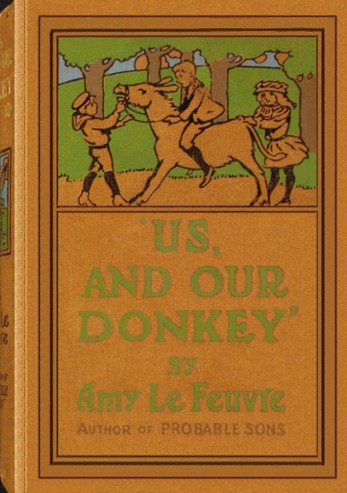
The Project Gutenberg eBook of "Us, and our donkey"
Title: "Us, and our donkey"
Author: Amy Le Feuvre
Illustrator: William H. C. Groome
Release date: July 19, 2025 [eBook #76530]
Language: English
Original publication: London: The Religious Tract Society, 1909
Transcriber's note: Unusual and inconsistent spelling is as printed.
"US, AND OUR DONKEY"
BY
AMY LE FEUVRE
Author of
"Me and Nobbles," "Probable Sons," "Teddy's Button," etc.
Semper fidelis, semper paratus
WITH ILLUSTRATIONS BY
W. H. C. GROOME
SECOND IMPRESSION
London
THE RELIGIOUS TRACT SOCIETY
4 Bouverie Street and 65 St. Paul's Churchyard
————————
Bulbs and Blossoms. A Little Maid.
The Carved Cupboard. Odd.
Eric's Good News. Odd made Even.
Heather's Mistress. Probable Sons.
His Little Daughter. Teddy's Button.
Miss Lavender's Boy. "Me and Nobbles."
On the Edge of a Moor. A Bit of Rough Road.
A Puzzling Pair. Dwell Deep.
A Thoughtless Seven. His Birthday.
Bunny's Friends. A Little Listener.
Jill's Red Bag. The Making of a Woman.
Legend Led. The Mender.
——————————
THE RELIGIOUS TRACT SOCIETY 4 Bouverie Street London, E. C.
CONTENTS
CHAP.
"US, AND OUR DONKEY"
CHAPTER I
OUR MOVE
OF course the boys say I shan't keep it up, but I say I shall. You see, there's such a lot to tell about, for we have come into a fresh village, and everything is strange and new. Denys says every one who writes is a prig, and Aylwin says I shall only write about myself, but I shan't do that, I know, for I think the others are much more interesting than I am. And I don't mean to write all our sayings and doings. There are a good many other people besides ourselves about here, and they will be very interesting, I'm sure. Of course, I may not write as I ought, always. I make good resolutions very often, but the difficulty is to keep them. And, of course, I must describe ourselves a little. I always like to hear what the children are like in books.
So I will begin this chapter by saying that our father's name is John Henry Marjoribanks, and he is a clergyman. Mother died just a year ago. I don't like writing about it, but I think I must. It was such a horrible, awful time. We were very poor, for father was only a curate then, and mother could not afford a thick winter jacket. She cut down hers for me—I hate the very sight of it now—and then she went out one bitterly cold night to see a sick woman, and she came back shivering. And then she got—I really can't spell it, but I know it begins with a 'p' which you don't pronounce. It means inflammation of the lungs—and we had to have a nurse, which cost a lot of money. And none of us were allowed to see her until the last day, when she asked for us, to wish us good-bye. I won't write any more; it makes me cry; we did love mother so. But she told me to try to take her place, for I was the eldest daughter. And I feel I never, never shall, for I'm so forgetful, and can't sit still, and hate needlework. And I laugh at the most solemn kind of things; anybody can make me laugh, and they know it.
Poor father got graver and graver, and Mrs. Glass, our rector's wife, was horrid; she kept interfering so. We always hated her little girls. They were prigs (I think I would rather be a convict than a prig!), and they were always so superior to us.
"Your father has to do what our father tells him," they said one day when we were fighting with them. "And if he doesn't, he'll be sent away."
They seemed to think father was a kind of servant. So we told them what we thought of them, and after that we didn't speak to each other for five whole days. And then the glorious news came at breakfast by the post. Father was going to be the Rector of Warlington, and that meant a church of his own, and a house of his own, and a move. A move is the most splendid thing, we all think. We have had two before, and we would like one every year. This one wasn't quite so nice as usual, because mother wasn't at it. And Aunt Caroline came to see to it. We love the way the house gets more and more untidy, and the last day, when we have to eat our meals off boxes, and everything is in the most hopeless muddle, and the rooms get emptier and emptier, and no one has time to look after us—it is simply ripping!
But I can't stop to describe this move of ours, because it is all over, and I want to hurry on to where we are now. Aunt Caroline came to settle us in, and she's with us now. She's father's sister, and very kind, but a little fussy, we think. She says she feels she never ought to have her needle out of her hand, because we tear our clothes so. We had to come a very long way by train, because we had been living near London, and our new home is in Lincolnshire. We got so tired that we were all asleep when we arrived. Perhaps I had better describe ourselves before I describe the house, and then I shall be able to begin my story quite properly.
Denys is the eldest—he is thirteen; Aylwin is twelve. They always do everything together. Denys is the managing one, and Aylwin generally agrees with him, after he has argued the thing thoroughly out. Everybody thinks they're very nice-looking. I think they are, but when people say to father, "What dear boys! Such thorough little gentlemen," he shakes his head. "They're gentlemen, I hope, but desperate pickles!"
Then I come next. I'm the ugly one of the family. I have reddish hair, and a white face, and greenish-brown eyes. I think I'm quite fair in saying my hair is reddish, because it could be redder. I've seen some a real red, and mine isn't that. The boys say red-haired people are always ugly, and spit-cats. I do flare up, I know, but I try not to. I won't say any more about myself, except that I mean to write books one day, and that's why I'm beginning now to get my hand in. My name is Grisel. Isn't it a dreadful name? It was given me by an old great-aunt, who was my godmother. The boys, of course, call me Gristle and Grizzy. "You couldn't possibly be a beauty with a name like that," said Denys one day to me, when I told him I wished I was like Lynette. "No," I said, "but if I shut my eyes, Grisel sounds like a grim, grey-haired old woman with a beard under her chin, and I suppose I shall grow up like that." "I dare say you will," he said, "but you needn't be grim unless you like. You aren't grim now." So that is one thing I'm thankful for—that I'm not grim!
I find I am writing an awful lot about myself, so I will hurry on. Lynette is nine years old, and very pretty, and a regular mad-cap. She has long fair hair that comes right down to her waist in curly waves, and very big blue eyes, and she is never still a minute unless she is concocting mischief. Then Puff is the last one of us, and he used to be the baby. His real name is George, but we call him Puff because he talks so fast that he puffs like a steam-engine between his words, and he thinks an awful lot of himself, and struts about like a bantam-cock. He is only six, and he is always in pinafores, which he hates, and tries to get rid of whenever he can. We tie them in tight knots behind him. He tried dirtying them as fast as he could at one time, but if he has to have more than one pinafore a day, he has to go without sugar at tea-time, and he can't bear that. He has very curly hair, and a chubby rosy face, and he stamps when he walks, so he wears a lot of shoes out.
Now I will try to describe our house, as it is a delicious one. It is at the corner of a very pretty village with thatched cottages, and it is close to the church. Our big gate is almost side by side with the church gate, but when we go into church, we go down a little narrow path between thick shrubberies, and then we come to a narrow little iron gate which leads into the churchyard exactly opposite the door. Our big gate leads up a broad drive to our hall door, which is built in the side of our house; the stables are this side, and there are a coach-house and harness-room and loft, and two stalls for horses. We haven't a carriage or horse, but they're lovely places to play in.
The front of the house looks over a lovely big lawn; there's a summer-house and a lot of trees one end, and two big elms the other end, and at the bottom of it is a straight gravel path, and on the other side is a huge strawberry-bed. The strawberries divide the flower-garden from the kitchen-garden, which slopes down to a field. There are two fields after this one, and then comes the railway line. Our house is rather on a hill, so the fields slant down, which is a good thing when you're running to catch a train. Then there's a bit of garden that runs up the other side of the house, and that is full of flower-beds, and there's a small greenhouse, and father's study window looks out upon it. At the back of the stables is the yard, with the outhouses and the fowls' run; and then there is a wild bit of grass under a small plantation, and a high wall dividing our garden from the road. I am not good at descriptions, but I hope I've said enough about it outside.
Inside, we have the dining-room and drawing-room and father's study. Then there are a baize door and a long passage leading past the kitchens to the yard. Upstairs, we have our schoolroom over the dining-room; then there are father's bedroom, and Aunt Caroline's, and the spare room; and then there are another baize door and a long passage with our bedrooms and the servants'. Aylwin and Denys sleep together in one room, and Lynette and I in another. Puff sleeps with Aunt Caroline. What we like are the broad low stairs, and the long passages. And there's a lovely country smell about the house. I can't describe it. We've always lived in towns before, but if I shut my eyes, I can tell where I am because of the smell. It's something like burnt wood and hot loaves and lavender all mixed up together, and it made me sniff all over the house when I first got here.
The first few weeks after we came were lovely. We helped Aunt Caroline to arrange the furniture, and father went into Lemworth, our nearest town, twelve miles off, and bought some new carpets and a lot of new furniture. We clapped our hands when we saw it, but father said, "Oh, children, how mother would have enjoyed this!" And then he went into his study and shut the door, and we hushed at once, till we forgot again.
You see, we have run rather wild, but it's all so new to us, and we've never had a proper garden before, and we can hardly believe that everything in it belongs to us. We came here the beginning of June, and we haven't finished eating the strawberries yet, and it will be July to-morrow. Yesterday was the first wet day that we've had, so we all got together in the schoolroom and talked. We always find a lot to talk about, and we began about the lessons. Denys and Aylwin are to walk three miles every day to the clergyman of the next parish, who teaches his own boys and a few others. They will have their dinner there, and not come back till tea-time. Lynette and I shall do lessons with Aunt Caroline. I don't think she will be very strict, but I don't know. She and Aunt Mildred are going to take it in turns to come and keep house for father. They live near London with grannie. We like Aunt Mildred because she plays games with us and tells us stories, and she is quite a young grown-up, but her turn won't come till next autumn, and that seems years away.
"I think six miles every day will be awful rot!" said Denys, swinging his legs upon the table, and looking rather cross. "We ought to have bikes, then we should do it easy!"
"We'll never have them," said Aylwin, "as long as we're a poor parson's sons. When I grow up, I shall make a fortune before I marry, and give every one of my sons a bike on their sixth birthday."
"How will you make it?" scoffed Denys. "Not by working, I know!"
"I shall just find," said Aylwin. "Gold, or diamonds, or oil. I don't care what, but that's how you make your money."
"The gold and diamonds don't come spouting out of the earth as you walk by," said Denys.
"Oh, no, but I shall come across them unexpectedly."
"I wish we could keep a little pony-cart," I said. "I saw one driving through the village yesterday; it was such a darling little pony, and it was tearing along, and a little girl was driving it. I don't know who she is, but I mean to know her. She was dressed in a blue cotton frock and a white straw hat, and she looked rather hot and grubby—that's why I liked her. She wasn't a bit stuck up."
"Ponies cost a lot," said Aylwin. "An old ass wouldn't be bad. If we could make him go, he would take us to school in no time."
"Yes," I said, with a yell of delight, "and I should come with you every morning to drive him back again, because we should want to use him in the daytime. I should come every day to fetch and carry you."
Denys threw the book he was reading at my head. I caught it, and returned it with a better aim. Then we had a regular shindy, and every one joined in. And Aunt Caroline put her head in at the door to tell us to stop. But we began to think about the donkey, and then we determined to save up money to buy one ourselves. We don't often have money given us, but on birthdays we do, and we solemnly promised each other that we wouldn't spend a penny on sweets till the donkey was got.
"We'll be able to ride him in turns, even if we can't afford a cart," said Aylwin.
And then Puff began to speak.
"I'll save all I've ever had, and I'll get a wocking-horse, that'll be muchest better than a old donkey."
"Could you go six miles along the road on a rocking-horse, you booby?" said Denys.
Puff began to agitate himself.
"A old donkey doesn't know how to wock, he only goes straight. I likes wocking, and I don't care nuffin about going along stupid old roads, and I shan't give my pennies at all, at all, and I—"
"Shut up, you little duffer, or we'll hang you by the neck over the banisters. Now, how much tin have we altogether? I'll be treasurer; hand out, sharp."
Before Denys had finished speaking, Lynette and I had rushed to our room to get our purses—Lynette had fivepence-half-penny, I had three shillings.
We gave this amount to Denys, who dropped every bit of it into a money-box of his. He then took from his pocket two shillings and a penny, and Aylwin confessed with sorrow that he was without a penny. Then Puff was forced to part with two treasured farthings, which he did with a burst of tears, and when we counted up we found we had five shillings and seven-pence. It seemed a good deal to us, but very little for a donkey.
"We shall have to earn some money," I suggested.
"That isn't a bad tip, and I've thought how I can do it," said Denys.
"So have I," I said hastily, "but I shan't tell you, and I'll do it next week; it will be awfully jolly."
Lynette was busy hopping round the room on one leg. She stopped for a minute. "I wish we could beg," she said.
"There are no policemen to stop us in the country."
"As if our class could beg!"
Denys was very fond of talking about "our class." I asked him once what class we were, and he said we were second. He said the first-class were the lords and ladies, but I reminded him that mother's grandmother was called Lady Louisa, so we ought to belong to the first-class. He said we must be a cross breed. I don't know what that means, and I don't care.
"P'r'aps father will buy us a donkey if we ask him," said Lynette; "he's much richer now. I'll tell him about it."
She flew out of the room. Father is very fond of Lynette; he never scolds her if she goes into his study any time. We waited, wondering.
And then she came back again with a long face. "He says the move has taken so much money that he can hardly pay all the bills that are coming in."
THEN PUFF WAS FORCED TO PART WITH THE
TWO TREASURED FARTHINGS.
"It will be much greater fun buying the donkey ourselves," said Denys.
"I've thought of a ripping plan for earning money," cried Aylwin.
"Now we've three plans," said Denys, "and we'll do them without telling each other, and this day month we'll call a meeting and produce our money. Lynette, you'll have to think of a way to get money."
She nodded her head with a laugh. "Yes, I've got a way, and I shan't tell any one."
So we gave some cheers then, and had a steeple-chase round the room, until Aunt Caroline put her head in and told us to stop.
When Puff was going to bed that night, he asked father if God had any money. Puff is always asking ridiculous questions, and father always answers him quite gravely; he never laughs at him.
"God is very rich, isn't He, father?"
"All things in heaven and earth belong to Him," father answered.
Puff trotted off to bed quite happy, but he put his head inside the door before he went.
"I've got a vewy good plan," he said.
And we all laughed, because we guessed what it was.
CHAPTER II
THE KNIGHT'S MOTTO
WE have two weeks' holidays before we begin lessons, and then we shall only have a few weeks of them, and it will be holidays again—the proper summer holidays, for they begin at the end of July.
I am longing to start my plan for earning money, so I thought I wouldn't wait any longer, and I've begun to-day. I don't think I'll tell about it just yet, but I've got father's leave for a little part of it, and I've told him not to tell the others. Lynette never can keep a secret; she wanted to tell me what she meant to do this morning while she was in bed, but I wouldn't let her do it, and I stopped my ears up with my fingers, so she saw it was no good. I'm perfectly certain we shan't keep it secret long; we never can, for some one is sure to tell, or find out. If it was one secret, it would be different, but five secrets couldn't possibly be kept. And I know I shall just long to tell some one mine, for I think it's rather clever—for me.
To-day is Saturday. Aunt Caroline has a practice for church every Saturday afternoon, and we all go to it. It is a dear old church, and I like to think that it belongs to us. Aunt Caroline plays the harmonium—there is no organ, and we have a funny choir; Denys calls it a scratch pack. There is one old man who used to be the clerk, and say the responses when no one else did. He has the most awful wheezy voice, and he is always a good line behind everybody else. He has to clear his throat so often that it takes up the time. His name is Nathan Porter. Denys said to him last Saturday: "Look here, don't you bother to sing so loud; we'll do it for you. I should think you're jolly well tired of sitting in the choir. Why don't you retire, and sit in the middle of the church, and put a cushion behind your back?" He was quite offended, and tapped his stick on the aisle very solemnly: "Look 'ee here, laddy, I be a fixture in these parts; ye passon folk pass away like the grass that withereth. I hath seed four passons in my time, and they all comes and turns us topsy-turvy first year of office, but not one on them turns me out of me seat, what I hath had these forty year or so. I hath singed in this 'ere 'oly sanctury since I were a lad, and sing I will, till I goes up to the sanctury above, and does my singin' there!" Denys felt awfully small, and said nothing at all after that. Then there's a lame young woman who does dressmaking, and the schoolmistress, and four school-children, and Denys and Aylwin and I make up the rest.
I like the choir practices, but the boys rather grumble sometimes. They had been playing cricket in the lower field early this afternoon. I was fielding for them, as Lynette was busy with her secret, and we all came in dreadfully hot, and had a rush to wash our hands and tidy ourselves by four o'clock. The church seemed very cool and still after the hot field outside, and somehow I always feel good when I'm inside it. There is only one painted window in the church, the rest are clear glass, and you can see the green trees waving outside, and the blue sky, while you are singing. It makes me go into dreams, and sometimes as I look-out, I forget where I am, and then the boys nudge me and whisper, "Wake up, Grizzy; look-out for a whopper of a wasp!" They know how I hate wasps, and I almost scream out loud, and then I find they're only humbugging. It is very difficult to be always good when you're with boys; they sometimes make you laugh, and sometimes make you lose your temper. And I have such a longing to be good when I'm in church, or when it's a beautiful day and everything is quiet and still, and especially when I look up into the sky at sunset, and see all the golden flames and pearly blue streaks and crimson clouds. It sends a little shiver over me, and I just whisper to myself, "O God, make me good, make me good!"
Denys and Aylwin have lovely voices; they ring out through the church like—well, I was going to say like a bell, but they're sweeter than that, they're like finger glasses when you wet your fingers and rub the edge of them! Father says I haven't a bad voice, but it's nothing by the side of the boys'. Mother used to sing beautifully—but I don't talk about her—it makes me cry—and then I hate the boys seeing me. I often wonder why it should be such a shameful thing to cry; I suppose it is because it is babyish. Denys is awfully hard on any of us who cries, even if we hurt ourselves awfully. He says the finest people in the world are the North American Indians, and they would smile all the time they were being scalped. But I can cry at the least thing; the tears simply pour out of me, and I can't keep them back. Even the boys' voices at the choir practice make me feel weepy. I wish I was a North American Indian!
When the practice was over this afternoon, I stayed behind in the church with Aunt Caroline to tidy up the choir-books, and father came in. He looked about him with a pleased smile, then walked over to an old tomb in the chancel, and called me to his side. There was a figure of a knight carved in stone—we think it is such a pity that his nose is broken, as it spoils his face, but father pointed out some words that were written on the shield at his feet. "Grisel, those are the words I should like placed upon my grave as an epitaph—that is, if I lived worthy of them. Read them to me, child." So I read them, though I did not understand them: "'Semper fidelis! Semper paratus!'"
"Always faithful, always ready!" said father. "Not sometimes, Grisel. How few of us can put the 'semper' before our virtues!"
I don't always understand father, but I said nothing, until the sun shone through the coloured glass window, and sent patches of red and blue all over the knight. Then I smiled. "Oh, father, isn't it a lovely little church? And aren't you glad it all belongs to you? It's our very own, isn't it? It's so lovely to think of it."
He shook his head at me.
"It is not my church, Grisel; it is my Master's."
"Yes, I know that," I said soberly.
"Only a steward," said father in a low tone, more as if he were talking to himself than to me. "Moreover, it is required in stewards that a man be found faithful, 'semper fidelis!'"
Aunt Caroline came up to us.
"It is tea-time, Grisel: run along indoors."
I went, feeling rather sorry to leave the cool church. I wish we could have all our meals out-of-doors. Tea in the summer is so hot. I went into the dining-room. The venetian blinds were down; there was a hot steamy smell from the urn which had just been brought in. Aylwin was chasing the flies away from our plates of bread-and-butter, Denys was trying to make Puff walk on his head, and Lynette was nowhere to be seen. I was just going to hunt her up, when she burst into the room. Her hair was flying, her face was red and hot and sticky, her pinafore was sticky too.
She danced round the room, singing at the top of her voice, "I've done it—hurrah! hurrah!" And then she suddenly stood still, and held out a sixpence.
"My first earnings!" she cried. "I've beat you all!"
I approached her cautiously, then said, "I know what you've been doing, I can smell you!"
"You're not to say! Catch, Mr. Treasurer; I'm going to wash!"
She darted out of the room. Puff looked solemnly at me.
"Her 's been making toffee in the kitching!"
The boys began to laugh.
"Easy enough to guess her old secret, but who's given her sixpence for it, I'd like to know?"
"Perhaps father or Aunt Caroline," I said, "but we mustn't try to find out till she tells us. It wouldn't be 'good form.'"
"Good form" is really Denys's word; he's always saying it.
"It isn't 'good form' to be a prig!" he said.
"I know that as well as you!"
"Then don't you be it, Grizzy!"
Aunt Caroline came in, and we stopped; we're so easily in the middle of a fight before we know where we are, but I hate being called Grizzy, and I'm not a prig!
She sat down and poured out tea for us. And then Lynette came in, looking sleek and shiny with the washing she had given herself.
"Dear me, child, how hot you are!" Aunt Caroline said.
And Lynette's face did look like a boiled lobster still.
"I've been working so hard!" she said. "I wouldn't be a cook for a thousand pounds!"
Father came in then; he always sits down and has a cup of tea with us, but he doesn't have his proper meal till eight o'clock. He and Aunt Caroline have that together; it's the only meal we don't have with them.
None of us were very hungry for tea; it was so hot, and there was only bread-and-butter—no cake, and no jam, and no strawberries. Of course we don't have those kind of things every night.
Then the boys went out into the garden, and I had to help Aunt Caroline put out all our best clothes for Sunday, and put buttons on the boys' shirts, and do a lot of mending. She makes even Lynette help on Saturday evening. We only keep two servants, cook and Emma, so they can't do our mending. Emma gives Puff his evening bath, and he leads her rather a dance over it, as his head is washed on Saturday, and he turns head over heels in the water and makes an awful noise and mess.
Lynette is awfully proud over her sixpence. I can't earn any till next Tuesday, but I'm going to have great fun then. And now I must stop writing, for I'm to go to bed. Lynette has just come up to me and said:
"Grisel, do guess how I got that sixpence; I'm dying to tell you."
"It's to be a secret," I said.
"Yes, but you can keep secrets, can't you?"
"I know you sold your toffee to some one," I said, "but I don't know who bought it. Emma did, perhaps; I know she is fond of sweets."
"Emma! As if I would take sixpence from her! A very important person gave it to me, nobody in this house."
That made me curious, but I wouldn't let her see I was.
"Father wouldn't let you sell toffee to strangers," I said.
"This isn't a stranger." Then she whispered into my ear: "Mrs. Ribbon. Don't you tell the boys!"
I gasped. Mrs. Ribbon is a great friend of ours, though we have not known her very long. She keeps the village shop. She is very fat and very good-natured. She has a grown-up son who is great friends with Emma. He has painted outside the shop door a little piece of poetry. We think it is splendid:
"If once you come, you come again,
You never come to us in vain."
And Mrs. Ribbon really has everything that everybody wants in her shop. She told us she had everything when first we came, and we didn't believe her. Aylwin went in and asked her for a Brazil stamp—he collects stamps. She said she would have them in a week, for they were on order. We didn't believe her, but on Tuesday, which is market day at Lemworth, she sent her son Tom to a very good stationer's there, where they keep packets of foreign stamps, and he brought back not only a Brazil one, but some others that Aylwin had been trying to get for a long time. Then Denys went to her, and said he wanted to buy a white mouse. She went straight out to the back-yard, and brought one for him to see. I said that she caught a common mouse and painted it white, but he said No, it was a real one, only she wanted more money than he could give for it. We found out afterwards that Tom keeps quite a happy family in the back-yard—pigeons, and guinea-pigs, and mice, and canaries, and a lovely black bull-dog.
There's such a nice mixed smell in Mrs. Ribbon's shop. We sometimes try to describe it to each other. Denys says it's a kind of soapy, oniony, treacley, hot-cakey, coffee sort of smell. I say it's a matchy, bacony, appley, cheesey sort of smell. And Aylwin says it's a sugary, cabbagy, tallowy, leathery kind of smell. I really think it's all those things put together, with a lot more added to them. She is always sitting there smiling, and we love to watch her selling. First it is some peppermints, then a piece of pickled pork, then six yards of calico, then a saucepan, cups and saucers, a pony's halter, bootlaces, some ink, some patent medicine, some turnips, or biscuits—I can't possibly write them all down, but she always knows where everything is, and never loses her head.
I told her one day that keeping shop must be a most exciting thing to do, as you never knew what you would be asked for! And she said, "Bless your heart, missy, I knows their wants better 'n they do theirsel's!" Which shows she is a most clever woman.
"Did Mrs. Ribbon buy your toffee?" I asked Lynette.
"Yes, I took it over and showed it to her, and asked her if she didn't think it good, and I told her I wanted to earn some money. And she said it was lovely, and if it sold well, she'd buy some more from me next Wednesday."
I felt a little jealous. We have always made toffee since we were quite small, so it's very easy. I taught Lynette how to do it first. Of course it was clever of her to think of it, but it's no trouble for her to take it over to Mrs. Ribbon to sell. And when I think of what I have got to do . . . but I mustn't say, in case the boys see this book.
"I don't know if Aunt Caroline will like you using all the butter and sugar up!" I said a little crossly.
"Oh, cook will make that right; she says she will. I'm to give her one penny out of every sixpence I make, and she'll keep it to get more butter if she wants it!"
"I'm sure she won't let you mess in her kitchen every day," I said.
"I shan't do it every day. Cook will let me do it as often as I like; she said she would."
I knew that was true, for Lynette always gets her way with every one, she coaxes so. I don't know why I felt cross, but I did, and then I was cross with myself for feeling cross, and that made me crosser still. Lynette was so awfully pleased with herself that she couldn't keep still.
"None of you have begun to do anything yet," she said; "I'm at the top of you all."
"Go on to bed," I said; "you fuss and bother so that I can't write a bit!"
So she has run out of the room calling me "crosspatch," and I shall have to go to bed too, and say I'm sorry before we go to sleep, because we always do that in case we don't wake up alive in the morning.
We heard a dreadful story once of a boy who wouldn't forgive his sister before she went to sleep, and she never woke up; she died in her bed of heart disease. I am rather glad it is Sunday to-morrow, because none of us can think of earning any money, so we can't get in front of each other. I never do like people getting in front of me; we all like to be the front one ourselves.
CHAPTER III
MY SECRET
I HAVEN'T written in this book for over a week, so I shall be very busy now doing it. I think I'll tell about Sunday first. We all have a boiled egg on Sunday morning for breakfast; that's the first nice thing that happens, if we don't count our clothes. I'm afraid Lynette and I rather like our best white dresses. We are only just out of our mourning, and it is nice to be in white instead of black. Our hats are white straw with white ribbon; father always likes our things to be very plain. I think Lynette looks rather like an angel on Sunday; if she had wings, she would be exactly like one. And I do think it's very nice to know you're dressed better than on any other day in the week; it makes you feel good.
We had to be rather quick over breakfast, because Aunt Caroline had to go off to Sunday school. She comes back in time to go to church with us. It was another very hot day, and the sun streamed in through the church windows and made us hotter still. It kept coming into my eyes—I was very uncomfortable—and then it settled on a farmer's bald head. He didn't like it at all; he kept flicking his head with his handkerchief as if he were beating off flies. And then he spread his handkerchief over his head, and he looked so funny that I struggled and struggled to keep from laughing, and in the end I exploded, and made such a noise that father stopped reading the lesson and looked at me. I was ready to cry then, I felt it was such a disgrace. And I honestly had tried not to laugh, but it would come in spite of me. I felt miserable till father got up to preach, and then I listened. I always like father's sermons; he never says long words, and he always tells us something new out of the Bible.
He began telling the story of the centurion, and he took for his text the verse: "I say unto one, Go, and he goeth; and to another, Come, and he cometh; and to my servant, Do this, and he doeth it." Father said this was the picture of a faithful servant. And then he told us that Jesus Christ said those three words to us, only father changed the order of them, He said it was Come, Go, Do.
And he said that was our Christian life. We must "come" first before we could "go," and then we must "do." We must "come" and give ourselves up to Jesus as His soldiers and servants, and get Him to forgive us our sins, and make us His own. And we must "go," and tell others—to our friends first, and then to those who don't know about Jesus. We must "go" straight into the world from our knees; some had to go far away—from England and home. Father talked about missionaries a good deal, and he said there were others who could "do" in their own homes, just doing what Jesus told them all day long. I could understand every word of it, and even the boys listened, because father called it a sermon preached by a soldier, and they like anything about soldiers.
I began to think a lot before I came out of church; the boys asked if I was worrying over my secret, but I told them I wasn't. After dinner we all went out on the lawn, and learnt our collects and bits of the catechism. Aunt Caroline went off to Sunday school again, but father came out and sat in an easy-chair under the elms and talked to us about our collects. We said them to him. Then the boys went off and so did Lynette, but I stayed, for I hoped father would say something about his sermon. He did presently; he put out his hand and laid it on my shoulder. I was sitting upon the grass close to him.
"Did you listen to my sermon, Grisel?"
"Yes, father."
"And which command of those three have you obeyed? Are you going to be one of Christ's faithful servants?"
"I think I have 'come,'" I said shyly.
Father did not say anything.
"But I don't quite understand the 'going,'" I said. "I couldn't go into all the world and preach the Gospel!"
"I heard your aunt ask you if you couldn't help her by teaching the infants' class at Sunday school; I think you could 'go' to that."
"Oh, father!" I said, looking at him with startled eyes. "I'm not old enough. The boys would say I was more of a prig than ever, if I did it; they're always calling me a prig now!"
"The question is whether Christ's commands or the boys have most weight with you."
I hung my head, then faltered out:
"A prig is such 'bad form.'"
Father laughed aloud.
I added hastily: "I do hate a prig so myself, father, and teaching in Sunday school would be very priggy."
"Very well," said father; "I will say no more."
I didn't feel comfortable. Puff came up at this minute and launched himself on father's knees, so I left them, and went up to the schoolroom and got a story-book out of the Sunday bookshelf. I sat down and read till tea-time, for I didn't want to think. I really cannot teach a class. I shouldn't know what to say, and the infants stare so, and I know Denys would laugh at me.
We went to evening church after tea, but I'm afraid I tried not to listen to the sermon.
And when we were singing the evening hymn—
Sweet Saviour, bless us ere we go,
Thy Word into our minds instil,
And make our lukewarm hearts to glow
With lowly love and fervent will—
I felt the tears come into my eyes, because I knew I had a lukewarm heart.
I was rather glad when Monday came, because I was very busy making preparations for Tuesday. Aylwin asked father at breakfast if he could go into the hayfields for the whole day with Mr. Cummins—he's the farmer who has father's glebe farm. And father said he might, if Mr. Cummins liked to have him.
I envied Aylwin, because I simply adore hayfields. "You're going to have a nice lazy day," I said to him, "when you ought to be carrying out your plan!"
"Shut up, old Grizzly!" he said. And then he ran off laughing.
Denys looked after him for a minute as if he would like to have gone too.
"I'm going to be ferociously busy," he said. "My plan is ripe for carrying out to-day."
"Mine will be ripe to-morrow," I said.
And then I went out into the garden to talk to old Baldwin. He is our gardener. We have never had a gardener in our lives before, but then we have had no garden. He's a very nice old man, but he won't take orders from anybody, not even father.
"The garden be my job," he said to him one day, "and sermons be your'n, and 'tis no manner of use of mixin' 'em up together. Might as well mix onion seed and lavender. You be trained to preach, I be trained to garding, and we both knows our own bizness best."
He is always ready to talk to us, and I'm afraid I've told him a part of my plan. He and father have both heard a bit of it, but then they had to, or I couldn't have done it.
I was busy till dinner-time, and then Aunt Caroline said to me:
"Grisel, I want you to take some soup to an old woman who lives half a mile out of the village. You can take Puff with you; a walk will do him good."
"Oh, Aunt Caroline!" I said. "Need I go this afternoon? I wanted to do something in the garden so much."
"I notice that whenever I ask you to do anything, Grisel, you always want to do something else. It isn't a great hardship to go half a mile with some soup to a sick woman. I can't go myself, for I am returning a call with your father."
I made a wry face, and then I thought this might be one of the "go's" father talked about. Anyway, it was better than teaching a Sunday class, so I tried to look pleasant, and got Puff ready and started with him. Lynette came out to the gate with us, and took advantage of opening it to have a good swing on it.
"Hurrah!" she cried. "I'm going to make some more toffee. I shall beat you all hollow, you are such slow-coaches!"
She was so excited that she swung herself a little too violently, and the next minute she was flying off the gate upon the ground.
"Pride will have a fall!" I called after her, as she picked herself up and rubbed her grazed elbows, and then I hurried on with Puff.
He was, of course, full of talk, as he always is.
"I shall wide the donkey nex' week," he said, "and I shall have first turn 'cause it's me that gotted it!"
"When is it coming, then?" I asked him.
He looked thoughtful for a minute, then said:
"I said it must be a vewy clean one, newly washed, not like the donkeys when we went to the seaside, and it must have blue eyes, and teaf that doesn't bite. I expect it about four days after to-morrer."
I laughed.
He looked so earnest as he trotted along, and then he panted out:
"It'll be the bestest donkey in the world, 'cause I've asked the richest Person in the world to get it, and if He gived a million pounds for it, He wouldn't mind a bit, 'cause He is so rich."
"I don't think you should speak of God like that Puff—it isn't reverent."
"I didn't say who it was, you horrid fing; you've guessed my secret, and it's a shame."
Puff looked ready to cry, and came to a standstill in the middle of the road. I took hold of his hand and hurried him on.
"Never mind! I won't tell any one, I promise you."
And then I began to tell him a story to take his mind off.
It was a long hot walk to Mrs. Tapson's. I'm sure it was more like a mile than half a mile, but we got there at last. It was a dear little cottage in a garden by itself off the road. The door was partly open, so I went in, and a man who was making up the fire turned round when he saw me.
"Soup for mother?" he said, smiling, when I told him why I came. "I be right down grateful for it, that I be. She be upstairs in bed with cruel rheumatics, and I be tending on her like a baby. To-morrer be my day to Lemworth, and I leaves the village sharp at eight and don't come back till seven at night, and I were just trying to cook a bit o' bacon pie to last her, but the soup be grand."
He had taken the jug from me, and was looking in it.
"There be plenty o' this for a drop to-day as well as to-morrer," he said. "Well, I thank 'ee kindly, missy. Go on up and see mother, will 'ee? She dearly likes a bit o' company."
So I climbed the little narrow stair, and Puff came thumping after me. I am rather afraid of sick persons generally, but I liked this old woman. She had a clean frilled night-cap, and a wonderful patchwork quilt, and her face was quite bright when she saw us. She said she had heard about us, and was I the little lady with the lovely hair? I laughed as I shook back my red mane, and told her that was Lynette. And then Puff began to talk to her, and of course he told her about the donkey—he was full of it.
"Puff doesn't quite understand about prayer," I said, explaining. "He thinks he is bound to get everything he asks God for. He asks to have his toys mended, and I generally have to be the mender, because he goes on expecting miracles so."
"Ah, dearie," said Mrs. Tapson, "the Lord does love to hear the baby chatter, I'll be bound, same as I used to listen to my Bob's, though well I knew I couldn't and wouldn't give him half he asked for. But pray away, sonny, pray away; 'tis the habit of prayer will make you a strong soul, if so be you sticks to it, and you be an example to us older folk, for sure you be."
Puff didn't understand her. He grew restless and stumped downstairs, and I got up to go, and then I found out that Bob Tapson, her son, was the carrier. And then I told her my secret; I felt I simply must tell somebody, and I told it all, every bit of it. She was quite interested, and told me her son would look-out for me and keep a seat for me in the cart.
There! I am letting the cat out of the bag, so I think I had better tell my whole plan. Father said I could have any vegetables and flowers that Baldwin could spare me, because we have such a lot of them. And I had been busy picking flowers and arranging them in nosegays, and tying up lettuces that were weeded out, and onions, and cabbages, and a lot of odd things, and I had found an old hamper in the stable, and Baldwin helped me to pack it, and my idea was to go to Lemworth Market in the carrier's cart and sell my vegetables and flowers myself, like lots of our village women and children do. Of course you can go to Lemworth by train, but it is a very long way round, and you have to change trains, and the carrier is cheaper. When I heard that I should have to be off at eight o'clock and not come back till seven at night I wondered how I should do it, as I should be missed, and perhaps Aunt Caroline might make a fuss and try to prevent me if she knew.
I walked home with Puff, feeling rather worried. I should have to go without my breakfast, that was certain, because we don't have breakfast till eight o'clock. I could easily get off so early, because no one would see me—but would they think something had happened to me? And then I thought I would leave a note for father and explain, and ask him not to tell. So I cheered up, and directly we got in I rushed off to the garden and went on packing my hamper. When we came to tea, Aunt Caroline told us that father had been sent for to take a funeral in the next parish, for the clergyman was away.
"And he is going to sleep the night there," she said. "He won't be back till to-morrow afternoon, for there is a wedding in the morning he must take as well."
So my note to him was no good. I felt rather puzzled, and then I thought of what I could say to Aunt Caroline. So I wrote this note before I went to bed:
"DEAR AUNT CAROLINE,—If I am missing all day, this is to tell you
that I am not drowned, but quite well. And I shall come back at seven
o'clock, and it is because I am carrying out my plan, which is a secret.
"Your loving niece,
"GRISEL.
"P.S.—It isn't mischief, but good business."
Aunt Caroline said before we went to bed that she had hardly seen any of us all day, and that she hoped we hadn't been getting into mischief. Aylwin looked as scarlet as a poppy, and said he was dead tired, and Denys looked rather crestfallen.
"I've worked hard enough to earn ten shillings," he said, "and I mean to make that before very long, I can tell you."
"I don't like all this talk about money, children," said Aunt Caroline. "You seem to think of nothing else. It is so mercenary and unchildish."
"But it's to get a donkey," we all shouted.
Aunt Caroline didn't say any more.
CHAPTER IV
MARKET DAY
I WOKE up at four o'clock the next morning.
I had been dreaming all night that I was trying to catch trains, and just missing them, and trying to hide from Aunt Caroline. I was so glad when it got light at last and I could get up. I was very excited, for it was a regular adventure, and we do love adventures. I had thought out everything. I did not want people to know who I was, so I put on a very old cotton frock and my pinafore over that—the one I wear in the garden—and then I plaited my hair in a tight pig-tail and stuffed it into a cotton sun-bonnet, and drew that well over my face. Aunt Caroline bought these cotton sunbonnets at Mrs. Ribbon's—she said they were just the thing for Lynette and me to wear in the garden, but we never go out in the village with them, because we don't like to look like the village children.
I didn't wear gloves, and I had to dress very quietly so as not to wake Lynette, but I was ready at last, and then I put my note on the dressing-table for Lynette to see and take to Aunt Caroline. I stole on tiptoe down the stairs, for it was very early, and I did not want the servants to see me, and then I opened the hall door as gently as I could and let myself out of the house. Baldwin had carried the hamper to the stable the night before, and the only difficulty was in getting it down to the gate. It was very heavy, but I did it at last. I had to drag it along the drive most of the way, and I kept looking up at the house to see if any one was peeping at me. I left it outside the gate, for the carrier's cart always passed along the road at the corner, and then I walked as quickly as I could to Mrs. Tapson's cottage. Bob Tapson had told me if I came there early, I could get a comfortable seat by him, before the village people got in. I found him harnessing his horse. He looked quite surprised when he saw me, but he didn't recognise me in my sun-bonnet.
"I don't want the village people to know what I am doing," I said. "You won't tell them, will you? And I've left my hamper just outside our gate. I thought you would fetch it, and lift it in by me."
"That I will, missy," he said heartily. "You be a early bird. Have you had some breakfast?"
I took out of my pocket two thick slices of bread-and-butter which I had coaxed cook to give me the night before. She thought I was extra hungry and wanted something to eat before I went to bed. He smiled and went indoors, and then brought me out a lovely cup of tea. He had just been having some himself. Then he went up to say good-bye to his old mother, and asked me if I would like to see her. So I went up, and she took hold of my hand and smiled at me.
"You be a brave little lass to go," she said, "and I tell 'ee who will help 'ee there. You ask for Mary Dutton; she be my own sister what lives two mile out of Lemworth, and she'll let 'ee stand by her stall and see to 'ee. Bob will take your goods right in to her."
"I've never been to a country market before," I confessed to her; "I shall be so glad if she will help me."
And then I went down and climbed up into the big covered waggon which was standing in the yard. I could not help feeling glad that Aunt Caroline had told me to take the soup to Mrs. Tapson, for she was making it all so easy for me, and it seemed so strange that her son should be the carrier. Bob was very good; he put a footstool in the corner of the waggon just behind him, and I was quite comfortable. Then we started; it was delicious to be really off, but I thought we were never going to get through the village. Only three women got in, but nearly every one sent parcels or messages. Bob brought my hamper in, and then one of the women looked at me.
"Whose be that little lass?" she asked.
I didn't turn my head, and Bob said rather crossly, "She have come wi' me."
And she said no more, for she was so busy talking to the other women that she quite forgot me.
I sat still and loved my ride, only we went so slowly that it seemed like years and years, and my legs got rather cramped. I was tired too, for I had been awake so early, and I actually found myself nodding before we came to Lemworth. It seemed quite a big town, and I was almost frightened when we got to the market; there were such a lot of people, and everybody pushed so.
I let them all get out first. We were quite full up, because so many people had got in on the way. And then Bob shouldered my hamper and told me to follow him. It was a lovely market; there were rows of chickens, and ducks, and fruit, and flowers, and butter, and eggs, and everybody was laughing and talking at the top of their voices. There were such funny old country-women and men; children were crowding round the sweet-stalls, and farther down there was the little market. It was like the pictures I have seen of fairs, only there were no "Punch and Judys" or peep-shows.
Bob took me right along to the corner stall, where a dear old woman sat. She was very like Mrs. Tapson, only she had a fatter face. He told her who I was, and she laughed and begged me to tell her all about it. So I did, and then she unpacked my hamper, and made room for me to put my things on the corner of her stall. I began to enjoy myself very much, and I longed that the boys could see me. And my bunches of flowers were prettier than any I saw, because I had arranged them very carefully.
But for a long time no one bought anything, and I began to feel very nervous. I never shall forget the first person who took hold of my flowers and asked me how much they were a bunch. I said twopence—Mrs. Dutton had told me to ask that—and she took six bunches from me. I could have got up and danced round the market, I was so delighted. And soon after that two ladies came along with baskets. They stopped and said "Good-morning" to Mrs. Dutton and asked her if she had any lettuces. She said she hadn't, but told them I had some nice ones. They looked at mine and bought four, and they bought a bunch of parsley from me, and three beetroots, and they gave me ninepence, and one of them turned to the other and said:
"Is she not a little picture in her neat dress? If only the poor would always dress their children as sensibly as her mother dresses her, we should not have such extravagance amongst the lower classes. She is quite an example to her class!"
And I nearly laughed aloud when I heard them. Later on I sold four cabbages, and three bunches of sweet peas, and some carrots. By the end of the afternoon I had sold all I brought except two cabbages and a vegetable marrow, and Mrs. Dutton bought those from me—she keeps a little, greengrocer's shop, and said they would come in handy. I forgot to say that at one o'clock I went with Mrs. Dutton into a large room joining the market where they sold cups of tea and buns and meat pies. I felt very hungry, but I didn't want to spend much of my money which I had earned, so I got a penny cup of tea and a penny bun, and Mrs. Dutton gave me one of her big apples.
Bob Tapson came along to tell me that his cart would start at four, and long before that the women were packing their baskets up and leaving. I counted up my money and found I had actually four shillings and a penny! I was so proud and pleased. And Mrs. Dutton seemed pleased too. I felt I should like to sit in the market and sell every day. Everybody seemed so good-natured and kind to each other. And the jokes they made when they gave each other change, and the stories they told of their own and their neighbours' complaints, would have made the boys roar. They generally began each sentence with "Well, there, my dear," and "You don't say so!"
I was quite sorry to leave the market, but I climbed up into the cart and got my own seat again. It seemed quite an endless way coming back. There was an old man who smelt very strongly of beer and who kept laughing at nothing at all, and some girls who were screaming with silly jokes, and trying to make Bob Tapson look at them. I felt dreadfully tired, and then I got the fidgets and couldn't get comfortable, and then at last I went fast asleep and never woke up till Bob put me down at the Rectory gate.
"Well, missy, have you had a good time?"
"Yes," I said, trying to wake up; "how much is it I have to pay you?"
"Oh, nothing at all—you didn't take no room. And mind you come and tell mother all about your day. She'll be proper interested to hear about it."
I shook hands with him and thanked him very much, and then I carried my empty hamper back to the stable, and opened the hall door and went quietly in. I was rather afraid of Aunt Caroline.
Lynette came running downstairs.
"Oh, you wicked girl! You'll catch it; father has come home, and he is awfully angry with you; and what have you been doing? We've been guessing all day—and do you know, I've found out what Denys is doing. Wouldn't you like to know?"
"I'm tired," I said; "can I have some tea? Where is Aunt Caroline?"
"They're all in the garden, watering the flowers. Grisel dear, darling, dearest, do tell me what you've been doing."
But I wouldn't tell her then. I was feeling rather uncomfortable, so I thought I'd better go to father straight and tell him. I ran out into the garden. Aunt Caroline came towards me at once.
"Grisel, this is very naughty of you. Where have you been? And what have you been doing all day? You ought to know better than to absent yourself without leave in such a manner."
"I want to tell father; it's a secret," I said.
Aunt Caroline was always very good when we said we wanted to go to father. She called father, who was filling the water-can from the garden tap, and then she walked away and left us. Denys says it's very "good form" when she does that.
Father put on his spectacles and looked at me.
"You have made your aunt very anxious to-day, Grisel; I am not pleased with you."
"Please listen, father. It's about the vegetables and flowers you said I could have. I've been selling them to help to buy our donkey."
And then I told him as fast as I could just what I had been doing. And once he laughed, and then I knew I shouldn't get a big scolding. But I got a little one, and he said I must not think of doing such a thing again, which made me miserable.
"No, Grisel. I don't like my little daughter to be alone amongst a lot of rough people, however kind-hearted they may be. It is not suitable. Your mother would not have allowed it, I am sure. And you ought to have asked permission first. I am afraid you must have known you would not get it. Speak up and tell the truth."
My cheeks got scarlet.
"I did think—at least, I was afraid you might not let me," I said, "but I wasn't disobedient, for I didn't know it for certain!"
"That is where you did wrong, and you know it. Don't do such a thing again. And now go in and have something to eat."
"And I may keep the money?" I asked.
"Yes; I have no objection this time, but you must find another way of disposing of the vegetables than of selling them yourself in the market."
So I went into the dining-room, and Aunt Caroline had been getting my tea ready. She didn't say much, but before I had finished eating, the boys and Lynette burst in.
"Now, you sinner, own up! What have you been doing with yourself?"
"'Good business' indeed! We saw your letter; it was an awfully cheeky one!"
"And Aunt Caroline was in a jolly wax, I can tell you."
I quietly produced my purse, and poured out my silver and copper upon the table.
"There!" I said. "Can any of you beat that?"
"Four shillings!" exclaimed Denys, grabbing it like any old miser. "Ah, well, it isn't bad for a girl! Tell us how you did it."
"That's my secret!" I said.
It was my triumphant moment. But I knew I could not keep it much longer. I did so want to tell them all about it.
"Well!" said Lynette. "I know what Denys has been doing these last two days. Ask him how much he has got, Grisel!"
Denys grinned and held out his hand.
"I've had an adventure to-day," he said. It was a half-crown he held out.
I got up from my tea and danced round the table. "We shall soon be rolling and rolling in money," I cried.
"Wallowing!" put in Aylwin. "But I haven't begun to roll yet. You'll have to wait till the end of this week for my little million!"
Then we all pursued each other round the table, and Denys sang—
When the money comes rolling in, boys,
And our silver turns to gold,
We'll then buy a noble steed, boys,
And ride like the knights of old.
Denys can always spout poetry whenever he likes. We were so delighted that we sang it at the top of our voices and danced faster and faster, till we got into a regular war-dance, and then at last tumbled down on the top of each other in a regular heap of arms and legs. And then we got up, rather out of breath, and I shouted:
"'Pax!' If you tell your adventure, Denys, I'll tell mine."
"Ladies first!" he said, with a grin.
So I began in a great hurry, for I thought it would astonish them, and it did.
At first Denys and Aylwin wished they had done it themselves—I know they did, though they wouldn't say so. And then Denys put on his soberest face and said:
"I don't think you and Lynette are playing the game fair. Anybody can make money out of father's things! Why, I could go into his study and take some of his books and sell them!"
"Oh!" I gasped. "That would be sac—sacrilege!"
"The flowers and vegetables aren't yours to sell," said Denys, "nor more is Lynette's butter and sugar she uses for her toffee."
"Oh, but," we both cried, "father has given leave."
"And I pay for mine," said Lynette; "and it's a lot harder work in the stuffy hot kitchen than sitting in a market and selling, and not half the fun!"
"Father gave me leave," I repeated, "so it's quite, quite fair."
"Well, but we've all a right to sell the flowers and stuff," said Aylwin.
"No," I said firmly, "only those who thought of doing it. It was my plan."
"Well, if you thought of doing it yesterday, I shall think of doing it to-morrow; why shouldn't I? And I've been working much harder than any of you, and I'm going on all this week."
"But I can't go on," I said dolefully; "I'm not to do it again, father says."
"Like to hear my adventure?" asked Denys.
"He's dying to tell about himself," said Lynette mischievously.
We were all attention, but Denys would not begin at once. He hummed and hawed, and then, just as he was settling down to tell us, in came Aunt Caroline and packed us off to bed.
"It will keep till to-morrow," said Denys.
And I was almost glad, for I was so sleepy and tired that I fell asleep directly my head touched the pillow.