
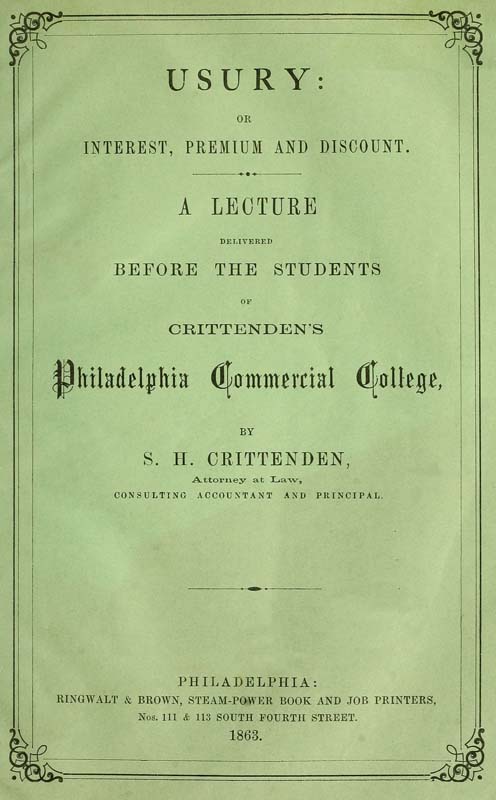
About This Book
The lecture defines and differentiates interest, discount, and premium, treating their distinct meanings and how each is recorded in bookkeeping. It separates three common uses of discount — bank discount on early payment, trade cash deductions, and exchange adjustments for foreign remittances — and explains how true discount is computed by proportion or rule of three. It examines premium as an added charge or bounty, and analyzes usury as the rent of capital, showing why legal caps on rates arose and how customary practices can create effective higher rates. Historical attitudes toward lending and capital accumulation and practical ledger examples illustrate the economic and legal implications.
About the Author

You May Also Like
6 picks
 A Brief History of Panics and Their Periodical Occurrence in the United States
by Clément Juglar
A Brief History of Panics and Their Periodical Occurrence in the United States
by Clément Juglar
 A Contribution to the Critique of Political Economy
by Karl Marx
A Contribution to the Critique of Political Economy
by Karl Marx
 A Critical Examination of Socialism
by W. H. Mallock
A Critical Examination of Socialism
by W. H. Mallock
 A Discourse on Trade, and Other Matters Relative to it
by John Cary
A Discourse on Trade, and Other Matters Relative to it
by John Cary
 A dissolução do regimen capitalista
by Teixeira Bastos
A dissolução do regimen capitalista
by Teixeira Bastos
 A History of Banks for Savings in Great Britain and Ireland
by William Lewins
A History of Banks for Savings in Great Britain and Ireland
by William Lewins