
The Project Gutenberg eBook of Verses popular and humorous
Title: Verses popular and humorous
Author: Henry Lawson
Release date: May 14, 2016 [eBook #52066]
Most recently updated: October 23, 2024
Language: English
Credits: Produced by MWS, Bryan Ness, Chuck Greif and the Online
Distributed Proofreading Team at http://www.pgdp.net (This
file was produced from images generously made available
by The Internet Archive/American Libraries.)
POPULAR AND HUMOROUS VERSES
VERSES
POPULAR AND HUMOROUS
BY
HENRY LAWSON
Author of “When the World was Wide and Other Verses,”
“While the Billy Boils,” and “On the Track and
Over the Sliprails”
“A hundred miles shall see to-night the lights of Cobb and Co.!”
Sydney
ANGUS AND ROBERTSON
London: The Australian Book Company
38 West Smithfield, E.C.
1900
Sydney:
Websdale, Shoosmith and Co., Printers,
117 Clarence Street.
PREFACE
My acknowledgments of the courtesy of the editors and proprietors of the newspapers in which most of these verses were first published are due and are gratefully discharged on the eve of my departure for England. Chief among them is the Sydney Bulletin; others are the Sydney Town and Country Journal, Freeman’s Journal, and Truth, and the New Zealand Mail.
A few new pieces are included in the collection.
H. L.
Sydney, March 17th, 1900.
CONTENTS
| PAGE | |
| THE PORTS OF THE OPEN SEA | |
|---|---|
| Down here where the ships loom large in | 1 |
| THE THREE KINGS | |
| The East is dead and the West is done, and again our course lies thus:— | 5 |
| THE OUTSIDE TRACK | |
| There were ten of us there on the moonlit quay, | 8 |
| SYDNEY-SIDE | |
| Where’s the steward?—Bar-room steward? Berth? Oh, any berth will do— | 10 |
| THE ROVERS | |
| Some born of homely parents | 13 |
| FOREIGN LANDS | |
| You may roam the wide seas over, follow, meet, and cross the sun, | 18 |
| MARY LEMAINE | |
| Jim Duff was a ‘native,’ as wild as could be; | 22 |
| THE SHAKEDOWN ON THE FLOOR | |
| Set me back for twenty summers— | 25 |
| REEDY RIVER | |
| Ten miles down Reedy River | 28 |
| OLD STONE CHIMNEY | |
| The rising moon on the peaks was blending | 31 |
| SONG OF THE OLD BULLOCK-DRIVER | |
| Far Back in the days when the blacks used to ramble | 35 |
| THE LIGHTS OF COBB AND CO. | |
| Fire lighted, on the table a meal for sleepy men, | 39 |
| HOW THE LAND WAS WON | |
| The future was dark and the past was dead | 45 |
| THE BOSS OVER THE BOARD | |
| When he’s over a rough and unpopular shed, | 48 |
| WHEN THE LADIES COME TO THE SHEARING SHED | |
| ‘The ladies are coming,’ the super says | 52 |
| THE BALLAD OF THE ROUSEABOUT | |
| A rouseabout of rouseabouts, from any land—or none— | 55 |
| YEARS AFTER THE WAR IN AUSTRALIA | |
| The big rough boys from the runs out back were first where the balls flew free, | 60 |
| THE OLD JIMMY WOODSER | |
| The old Jimmy Woodser comes into the bar, | 67 |
| THE CHRIST OF THE ‘NEVER’ | |
| With eyes that seem shrunken to pierce | 69 |
| THE CATTLE-DOG’S DEATH | |
| The plains lay bare on the homeward route, | 71 |
| THE SONG OF THE DARLING RIVER | |
| The skies are brass and the plains are bare, | 73 |
| RAIN IN THE MOUNTAINS | |
| The valley’s full of misty cloud, | 75 |
| A MAY NIGHT ON THE MOUNTAINS | |
| ’Tis a wonderful time when these hours begin, | 76 |
| THE NEW CHUM JACKAROO | |
| Let bushmen think as bushmen will, | 78 |
| THE DONS OF SPAIN | |
| The Eagle screams at the beck of trade, so Spain, as the world goes round, | 81 |
| THE BURSTING OF THE BOOM | |
| The shipping office clerks are ‘short,’ the manager is gruff— | 84 |
| ANTONY VILLA | |
| Over there, above the jetty, stands the mansion of the Vardens, | 90 |
| SECOND CLASS WAIT HERE | |
| On suburban railway stations—you may see them as you pass— | 96 |
| THE SHIPS THAT WON’T GO DOWN | |
| We hear a great commotion | 99 |
| THE MEN WE MIGHT HAVE BEEN | |
| When God’s wrath-cloud is o’er me | 101 |
| THE WAY OF THE WORLD | |
| When fairer faces turn from me, | 103 |
| THE BATTLING DAYS | |
| So, sit you down in a straight-backed chair, with your pipe and your wife content, | 105 |
| WRITTEN AFTERWARDS | |
| So the days of my tramping are over, | 108 |
| THE UNCULTURED RHYMER TO HIS CULTURED CRITICS | |
| Fight through ignorance, want, and care— | 111 |
| THE WRITER’S DREAM | |
| A writer wrote of the hearts of men, and he followed their tracks afar; | 113 |
| THE JOLLY DEAD MARCH | |
| If I ever be worthy or famous— | 121 |
| MY LITERARY FRIEND | |
| Once I wrote a little poem which I thought was very fine, | 125 |
| MARY CALLED HIM ‘MISTER’ | |
| They’d parted but a year before—she never thought he’d come, | 127 |
| REJECTED | |
| She says she’s very sorry, as she sees you to the gate; | 130 |
| O’HARA, J.P. | |
| James Patrick O’Hara, the Justice of Peace, | 134 |
| BILL AND JIM FALL OUT | |
| Bill and Jim are mates no longer—they would scorn the name of mate— | 138 |
| THE PAROO | |
| It was a week from Christmas-time, | 142 |
| THE GREEN-HAND ROUSEABOUT | |
| Call this hot? I beg your pardon. Hot!—you don’t know what it means. | 146 |
| THE MAN FROM WATERLOO | |
| It was the Man from Waterloo, | 151 |
| SAINT PETER | |
| Now, I think there is a likeness | 155 |
| THE STRANGER’S FRIEND | |
| The strangest things, and the maddest things, that a man can do or say, | 158 |
| THE GOD-FORGOTTEN ELECTION | |
| Pat M‘Durmer brought the tidings to the town of God-Forgotten: | 162 |
| THE BOSS’S BOOTS | |
| The shearers squint along the pens, they squint along the ‘shoots;’ | 168 |
| THE CAPTAIN OF THE PUSH | |
| As the night was falling slowly down on city, town and bush, | 174 |
| BILLY’S ‘SQUARE AFFAIR’ | |
| Long Bill, the captain of the push, was tired of his estate, | 181 |
| A DERRY ON A COVE | |
| ’Twas in the felon’s dock he stood, his eyes were black and blue; | 185 |
| RISE YE! RISE YE! | |
| Rise ye! rise ye! noble toilers! claim your rights with fire and steel! | 187 |
| THE BALLAD OF MABEL CLARE | |
| Ye children of the Land of Gold, | 190 |
| CONSTABLE M‘CARTHY’S INVESTIGATIONS | |
| Most unpleasantly adjacent to the haunts of lower orders | 196 |
| AT THE TUG-OF-WAR | |
| ’Twas in a tug-of-war where I—the guvnor’s hope and pride— | 205 |
| HERE’S LUCK! | |
| Old Time is tramping close to-day—you hear his bluchers fall, | 208 |
| THE MEN WHO COME BEHIND | |
| There’s a class of men (and women) who are always on their guard— | 211 |
| THE DAYS WHEN WE WENT SWIMMING | |
| The breezes waved the silver grass, | 214 |
| THE OLD BARK SCHOOL | |
| It was built of bark and poles, and the floor was full of holes | 216 |
| TROUBLE ON THE SELECTION | |
| You lazy boy, you’re here at last, | 220 |
| THE PROFESSIONAL WANDERER | |
| When you’ve knocked about the country—been away from home for years; | 222 |
| A LITTLE MISTAKE | |
| ’Tis a yarn I heard of a new-chum ‘trap’ | 225 |
| A STUDY IN THE “NOOD” | |
| He was bare—we don’t want to be rude— | 228 |
| A WORD TO TEXAS JACK | |
| Texas Jack, you are amusin’. By Lord Harry, how I laughed | 231 |
| THE GROG-AN’-GRUMBLE STEEPLECHASE | |
| ’Twixt the coastline and the border lay the town of Grog-an’-Grumble | 237 |
| BUT WHAT’S THE USE | |
| But what’s the use of writing ‘bush’— | 242 |
VIGNETTES BY FRANK P. MAHONY
| Portrait of the Author | facing title page |
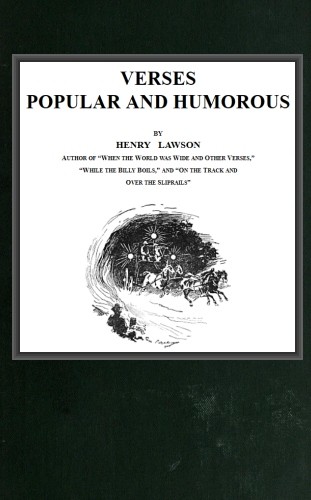
| The Lights of Cobb and Co. | title page |
| My Literary Friend | page xvi. |
And I showed the printer’s copy to a critic friend of mine,
First he praised the thing a little....”
page 125.
THE PORTS OF THE OPEN SEA
The gloom when the sea-storms veer,
Down here on the south-west margin
Of the western hemisphere,
Where the might of a world-wide ocean
Round the youngest land rolls free—
Storm-bound from the world’s commotion,
Lie the Ports of the Open Sea.
To the kerb of the spray-swept street,
By the sweep of the black sand beaches
From the main-road travellers’ feet,
By the heights like a work Titanic,
Begun ere the gods’ work ceased,
By a bluff-lined coast volcanic
Lie the Ports of the wild South-east.
By the scarped and terraced hills—
Far away from the swift life-changes,
From the wear of the strife that kills—
Where the land in the Spring seems younger
Than a land of the Earth might be—
Oh! the hearts of the rovers hunger
For the Ports of the Open Sea.
For a sign of the South Sea wrath—
Let the face of the South-east darken,
And they turn to the ocean path.
Ay, the sea-boats dare not linger,
Whatever the cargo be;
When the South-east lifts a finger
By the Ports of the Open Sea.
North where the Three Kings wait,
South-east the tempest daring—
Flight through the storm-tossed strait;
Yonder a white-winged roamer
Struck where the rollers roar—
Where the great green froth-flaked comber
Breaks down on a black-ribbed shore.
To the sailor in the shrouds,
Where the low clouds loom like headlands,
And the black bluffs blur like clouds.
When the breakers rage to windward
And the lights are masked a-lee,
And the sunken rocks run inward
To a Port of the Open Sea.
The sweep of the three-days’ gale—
When, far through the flax and heather,
The spindrift drives like hail.
Glory to man’s creations
That drive where the gale grows gruff,
When the homes of the sea-coast stations
Flash white from the dark’ning bluff!
The wrath of the Maori sprite,
And the brown folk flee their houses
And crouch in the flax by night,
And wait as they long have waited—
In fear as the brown folk be—
The wave of destruction fated
For the Ports of the Open Sea.
. . . . . . . . . .
Grey cloud to the mountain bases,
Wild boughs that rush and sweep;
On the rounded hills the tussocks
Like flocks of flying sheep;
A lonely storm-bird soaring
O’er tussock, fern and tree;
And the boulder beaches roaring
The Hymn of the Open Sea.
THE THREE KINGS[A]
[A] Three sea-girt pinnacles off North Cape, New Zealand.
South-east by Fate and the Rising Sun where the Three Kings wait for us.
When our hearts are young and the world is wide, and the heights seem grand to climb—
We are off and away to the Sydney-side; but the Three Kings bide their time.
‘Ah, the smothering curse of the East is wool, and the curse of the West is gold.
‘I went to the West in the golden boom, with Hope and a life-long mate,
‘They sleep in the sand by the Boulder Soak, and long may the Three Kings wait.’
‘Let the young fool learn when he can’t be taught: I’ve learnt what’s good for me.’
And he gazed ahead on the sea-line dim—grown dim in his softened eyes—
With a pain in his heart that was good for him—as he saw the Three Kings rise.
But it seems to her like a life-time dead since she fled with him ‘saloon.’
There is refuge still in the old folks’ arms for the child that loved too well;
They will hide her shame on the Southern farm—and the Three Kings will not tell.
That led me on to the deadly strife where the Southern London lies;
But I dream in peace of a home for me, by a glorious southern sound,
As the sunset fades from a moonlit sea, and the Three Kings show us round.
And away in the world there is fame and gold—and the Three Kings watch us go.
Our heads seem wise and the world seems wide, and its heights are ours to climb,
So it’s off and away in our youthful pride—but the Three Kings bide our time.
THE OUTSIDE TRACK
And one on the for’ard hatch;
No straighter mate to his mates than he
Had ever said: ‘Len’s a match!’
’Twill be long, old man, ere our glasses clink,
’Twill be long ere we grip your hand!—
And we dragged him ashore for a final drink
Till the whole wide world seemed grand.
They marry and vanish and die;
But their spirit shall live on the Outside Track
As long as the years go by.
That rolled from the waters green;
And over the railing we grasped his fist
As the dark tide came between.
And our mate, times out of mind;
We cheered the land he was going to
And the land he had left behind.
But my heart seemed out of joint;
I well remember the hush that fell
When the steamer had passed the point
We drifted home through the public bars,
We were ten times less by one
Who sailed out under the morning stars,
And under the rising sun.
They have sailed from the wharf since then;
I have said good-bye to the last I knew,
The last of the careless men.
And I can’t but think that the times we had
Were the best times after all,
As I turn aside with a lonely glass
And drink to the bar-room wall.
Then a last good-bye to the bush;
For my heart’s away on the Outside Track,
On the track of the steerage push.
SYDNEY-SIDE
I have left a three-pound billet just to come along with you.
Brighter shines the Star of Rovers on a world that’s growing wide,
But I think I’d give a kingdom for a glimpse of Sydney-Side.
Homes of Coogee, homes of Bondi, and the lighthouse on South Head;
For in loneliness and hardship—and with just a touch of pride—
Has my heart been taught to whisper, ‘You belong to Sydney-Side.’
But I thought I saw the ferries streaming out across the bays—
And as fresh and fair in fancy did the picture rise again
As the sunrise flushed the city from Woollahra to Balmain.
And the coastal schooners working by the loom of Bradley’s Head;
And the whistles and the sirens that re-echo far and wide—
All the life and light and beauty that belong to Sydney-Side.
But the city set in jewels rose before me from ‘The Shore.’
Round the sea-world shine the beacons of a thousand ports o’ call,
But the harbour-lights of Sydney are the grandest of them all!
Where the Rover’s Star gleams redly in the desert by the ‘soak’—
But says one mate to the other, ‘Brace your lip and do not fret,
We will laugh on trains and ’buses—Sydney’s in the same place yet.’
Where the local spirit hungers for each ‘saxpence’ that we earn—
We can stand it for a season, for our world is growing wide,
And they all are friends and strangers who belong to Sydney-Side.
It is we that send the backward province fifty years ahead;
We it is that ‘trim’ Australia—making narrow country wide—
Yet we’re always T’other-siders till we sail for Sydney-side.