
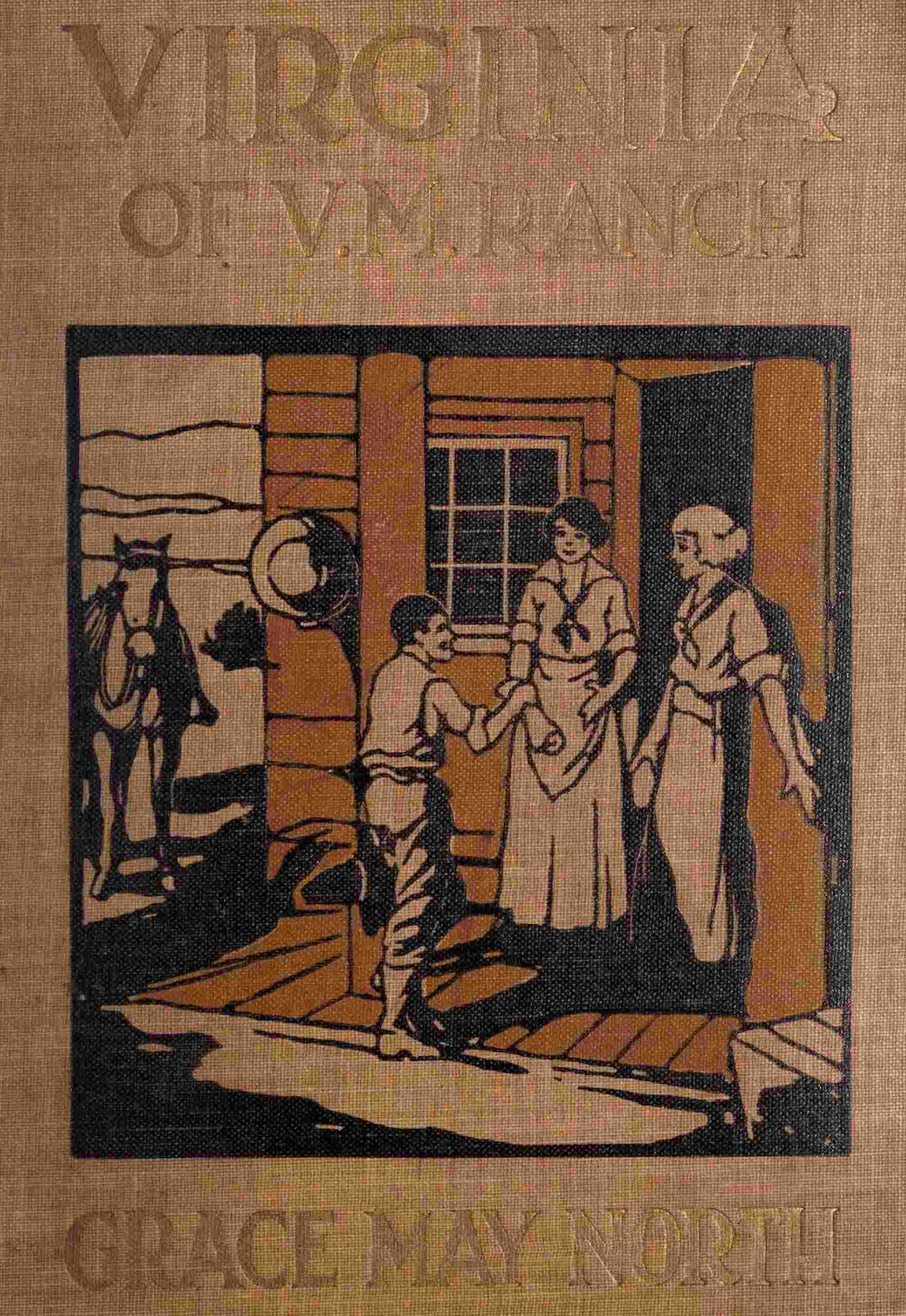
Virginia’s heart leaped with joy, for after all she would not have to give up the horse she so loved, the one her dear father had given her for her very, very own.
“Star is far more gentle,” she said, as she and Cy assisted Margaret to her feet, then remembering her manners, she added, “Margaret, permit me to introduce Slick Cy. He is one of Mr. Slater’s cow-boys.”
Impulsively Margaret held out her hand as she said graciously, “Thank you, Mr. Slick Cy, for coming to my rescue.”
The young giant of a cow-boy, being unused to girls, was very shy and he shifted from one foot to another as he said, “Miss Margaret, ah reckon as you’d better ride home with me on my horse.”
“Yes, do, Megsy,” Virginia urged. “It won’t be safe for you to even ride Star until you have had a few lessons.”
Margaret smiled at her friend as she remarked: “Now I have an adventure about which I can tell Babs in my very next letter.”
CHAPTER XIII—THE DESERT HUT.
It was the nineteenth of December and the morning was bright and sparkling. Margaret Selover stood on the wide veranda of the ranch house, her eyes glowing with appreciation as she gazed across the shimmering white desert and toward the mountains over which hung a blaze of blue and gold.
“Ho, Virginia,” she called to the girl, who, hatless, came up from the chicken yard, where she had been to scatter a breakfast to her feathered pets, “it is hard for me to realize that it is nearly Christmas and not a snow flake to be seen.”
“When we go up in the mountains after our Christmas tree, you will see plenty of snow,” Virginia assured her. “Slim tells me that when he rode over the Seven Peak range yesterday, it was snowing and blowing a regular blizzard.”
“Oh, Virg, how nice! Are we going to have a truly Christmas tree? I haven’t had one since mother and dad and I were all together.”
The other girl nodded. “Yes, indeed. We have a big tree every Christmas for our own family and for the Slaters. One year we have it here and the next to the Bar S Ranch. That makes quite a party, for they have four cow-boys and we have two.” Then after a thoughtful moment, Virginia added, “How I do wish that some kiddies lived nearby. It would be heaps more fun to have children to skip around a Christmas tree wouldn’t it, but there isn’t a chick or child for ten miles around.”
At that moment Malcolm appeared. “Sis,” he said, “I have an important letter to send. Would you and Margaret be willing to ride over to the junction and mail it for me? I had planned going myself, but Mr. Slater just phoned that he saw several of our prize yearlings headed for the Mexican border, and so Rusty and I are going at once to search for them and turn them back, for, if they cross the line, we will never see them again. If we aren’t home tonight, don’t worry, girls, for we will camp down that way until we find them all.”
“Goodbye and good luck!” Margaret and Virginia called, as arm in arm they stood watching the good looking boy as he swung into his saddle and galloped away. Near the corral he was joined by Rusty Pete and the two boys turned and waved their wide sombreros while Malcolm’s horse reared and then plunged ahead, to the delight of the eastern girl. “How I do hope Babs will see Malcolm ride some day,” she said as they turned into the house.
Several weeks had passed since Margaret had attempted to ride Comrade, and Malcolm had taken every opportunity that presented since then to teach his ward to ride, and at last both gracefully and fearlessly she rode every day with Virginia.
Half an hour after Malcolm had departed, the two girls in their khaki riding habits (Margaret with a red handkerchief knotted about her neck and Virginia with a blue) started riding along the trail which led over the mesa, down into the dry creek and over toward the mountains. They were about a quarter of a mile away from the Seven Peak range when Virginia suddenly drew rein and gazed intently ahead. Margaret looked wonderingly in the same direction but saw nothing unusual.
“What is it, Virginia?” the eastern girl asked anxiously as she drew rein by the side of her friend and gazed across the shimmering desert.
“Has something startled you? What do you see?”
Margaret knew that Virginia’s desert trained eyes could perceive things that were invisible to her. “It may be nothing at all to be startled about,” Virginia replied, “but I overheard two cow-boys talking yesterday. One of them had just ridden in from Douglas and he said that an outlaw from Texas is hiding in the mountains. I did not mention this to brother, for, had I done so, he would not permit me to ride far from the house, and I am very sure that we can protect ourselves. However, I do not wish to run into trouble needlessly.”
“But what did you see that made you think this outlaw might be near?” Margaret inquired.
Virginia turned toward her. “You, too, must train your eyes,” she said. “Now look intently just to the left of the giant cactus, and close to the foot of the mountains; then tell me what you see.”
Margaret shaded her eyes and gazed for a long time before she spoke. “I think that I can see an old adobe hut,” she said softly. Then she asked, “Is that what you wished me to see?”
Virginia nodded. “Yes, but what do you notice about it?”
“There might be smoke coming from the chimney,” Margaret replied, “but it is so faint that at first I did not notice it.”
“When I tell you that the old crumbling adobe has been vacant for many years and that it is absolutely unsafe as a habitation for human beings of any kind, you will understand why I was so puzzled to see signs of an occupant. The last family to live there was a mountain lioness and her young, but I am sure that some human being must be there now, for a lion could not start a fire.”
Virginia, fearing that she might have frightened the eastern girl, said this merrily as she whirled her horse’s head away from the mountains.
“We will take the sand hill trail,” she announced. “It is a mile farther to the junction, but perhaps we would be unwise to ride alone too close to the old adobe.”
“You really think that the outlaw might be hiding there?” Margaret asked anxiously.
Virginia nodded. “It is a very lonely spot,” she said, “and so it is quite possible.”
“What is an outlaw?” the eastern girl inquired as they rode side by side toward the sand-hills.
“An outlaw is a man who has done something displeasing to his fellow citizens. He is driven from his home state and it would not be safe for him to return. Sometimes an outlaw is innocent of the charges against him and is just a victim of unfortunate circumstances, but one never knows, of course.”
Virginia, as she spoke, glanced back toward the old adobe which was hardly visible from that distance; then, to Margaret’s surprise, she drew rein, whirled about and once more gazed intently in that direction.
“Virg, what do you see now?” Margaret inquired, for she herself could see nothing.
For answer Virginia beckoned the eastern girl to follow, and then, urging Comrade to top speed, she again galloped toward the mountains and the old adobe hut.
Much puzzled, Margaret followed on Star.
What had Virginia seen, she wondered.
CHAPTER XIV—THE HUT OCCUPIED.
Virginia did not pause in her mad gallop over the hard, sandy trail toward the mountains until they were near enough for Margaret’s untrained eyes to see clearly the old adobe. Then, turning in her saddle, the western girl asked: “What do you see now?”
“Something white waving on the roof,” the eastern girl replied.
“Yes, and the something is being waved by a small boy, and so the occupant is not an outlaw as we feared at first. I believe that the little fellow is trying to call for help.” Then gazing intently at her comrade, Virginia said: “Margaret, I will ride on alone, and you remain here. It may be a trap laid for us, but still it may be someone in trouble. I cannot pass without knowing which it is.”
“But, Virginia,” the Eastern girl pleaded, “I wouldn’t want to remain here and let you go alone into possible danger.”
“Margaret,” the other said earnestly, “you would be a far greater help to me if you would wait here. If it is a trap, and if I do not quickly reappear, gallop as fast as you can back to the ranch and bring Slim to my rescue, but if all is well I will wave to you and then you may come to the hut in safety.”
Margaret felt that Virginia was planning this to protect her, and her heart was filled with conflicting emotions as she sat on Star watching as the western girl rode alone toward the crumbling adobe hut. The boy was no longer on the roof, nor was there smoke coming from the chimney. A vulture, sweeping in great circles overhead, was the only sign of life.
Margaret fairly held her breath when she saw Virginia dismount and enter the open door. Would she come out again? What would she find in there? Margaret shuddered at these thoughts.
One minute passed, then two, and Virginia did not appear. Ought Margaret to race to the ranch for help? Another minute, which seemed an hour long to the waiting girl, and then, to her great relief, Virginia appeared in the open door and beckoned to her. By her side was the small boy who had been on the roof.
As Margaret rode up, Virginia hastened out to meet her and there were tears in the eyes that were lifted to her friend.
“What is it, Virginia? Is someone in trouble?” Margaret asked anxiously.
“Yes, dear, in great trouble,” was the reply. “A little mother is lying in there, unconscious, and the three babies, the oldest but nine, are almost starved. Oh, how thankful I am that we did not pass them by.” Then, brushing away her tears, she added: “Margaret, dear, please ride home as fast as you can and ask Slim to come at once with the car. I will take this little family back to the ranch.”
Margaret did as she was told, and was soon riding as she had never ridden before. Suddenly she saw a horseman appear on the sand hill trail. He was riding slowly when she first noticed him, but upon seeing her, he urged his horse to a gallop. Margaret was terrorized! What if it should be that dreaded outlaw? She tried to urge Star to greater speed, but although she did not turn, she could tell that the horseman was overtaking her.
A few moments later, when the galloping tread of the pursuing horse was close behind her, the eastern girl, drew rein and whirled about that she might know the worst or the best, and it sure was the latter for the supposed “outlaw” was no other than Slick Cy, the kindly cow-boy from the Slater Ranch.
“Miss Margaret,” he exclaimed as he rode alongside, “yo’ all look scared like. Didn’t yo’ all know who ah was?”
She tried to urge Star to greater speed for the horseman was overtaking her.
“No, I didn’t ever think that it might be you, Cy, but Oh, how glad I am that you have come, for something terrible has happened.” And then the girl hurriedly told of the sick woman and the nearly starved children whom Virginia had found in the crumbling old adobe.
“They all must be strangers hereabouts,” the cow-boy said, then he added: “It’s well I met up with yo’, Miss Margaret, for Slim is riding north to the Dartly Ranch. Ah passed him this hour back.”
“Oh, what shall we do, then?” Margaret dolefully exclaimed. “Virginia told me to send Slim to her at once with the car. How I wish now that I had learned to drive, but all I can do is start a car and stop it.”
“Wall,” said the cow-boy hopefully, “if yo’ all can start it, like as not ah can steer it, and then Miss Virginia can be drivin’ it back.”
Five minutes later they were down by the corral and the big automobile was taken from its shelter. Then, with many misgivings, Margaret told Slick Cy what to do and they started so suddenly that the girl feared that they would plunge down into the dry creek before the machine could be controlled, but, although Slick Cy knew much more about the management of wild horses, by following Margaret’s directions, he was soon driving slowly and the danger of a wreck was passed, for the present, at least.
Virginia saw them coming and hurried out to meet them. “Why, Slick Cy,” she exclaimed, when the car stopped, “I didn’t know that you could drive.”
The cow-boy drew out a big, red bandana and wiped his flushed face.
“He did splendidly,” Margaret put in before the cow-boy could reply. “I am so thankful he happened along, for Slim has ridden over to the Dartley Ranch.”
They were walking toward the old adobe as they talked and when they entered the dark, damp room Margaret glanced at the hard board bench and saw a frail little woman lying there so white and still that the girl feared she had died while she had been gone. Nearby stood a hollow-eyed boy of 9, and, on the floor, clinging to each other were two small girls of about 3 and 5.
The younger one was crying softly, but the older girl looked as though she had suffered and starved so much that she could cry no more.
Slick Cy took off his hat. “How came the pore things here, Miss Virginia?” he asked.
“The little lad has told me the whole sad story,” that girl replied, “and I will tell it to you when the brave little mother is cared for. Cy, can you carry her to the car?”
For answer the young giant of a cow-boy stooped and lifted the frail woman, who moaned but did not open her eyes.
Soon they were all in the car, which Virginia drove slowly and skillfully toward the V. M. Ranch.
CHAPTER XV—THE STRANDED FAMILY.
Back of the big, rambling V. M. ranch house there was a comfortable small adobe which had been occupied at one time by the foreman and family, but now that Malcolm was his own foreman, the house was vacant, and it was into this that Virginia bade Cy carry the little woman.
Then Virginia held out her hand as she said sincerely: “Thank you Cy, for having helped us again. Isn’t it strange that twice, when we have needed someone, you have just happened to pass by.”
The cow-boy flushed as he replied, shuffling from one foot to the other. “Yo’ all have done mo’ for me than ah can be doin’ fo’ you-all. Ah’m glad ah meet up wi’-you-all.” Then he turned and bolted. No other word would adequately describe his manner of disappearance.
“That boy is a diamond in the rough, isn’t he?” Margaret said as she stood in the open-door and watched the tall lank cow-boy swing into his saddle and ride away toward the Slater Ranch.
Virginia, having for years helped care for an invalid mother, soon had the little woman roused from her stupor and taking warm broth for nourishment. Margaret, in the meantime, fed the three solemn eyed children who ate ravenously, like little wild creatures that were nearly starved.
At last when the mother had fallen into a more natural sleep and the three children had been tucked into one large bed, the two girls seated themselves near the kitchen stove in which Virg had made a fire and Megsy said: “Now may I hear what happened to bring this little brood to the desert?”
“It is not a long story,” Virginia began, “nor an unusual one. The father of the small family is a prospector who, until recently, was working in a copper mine near Bisbee. They had a good home and plenty to eat, little Pat said, until the strike came and then their money had to be taken from the savings bank where the mother had been so glad each month to place it and had been used for absolute necessities until, at last, it was nearly gone.
“Then, one day, the father, who had tried in vain to get work of any kind, came home much excited because he had heard that the mountains of the Seven Peak Range were supposed to be rich and as yet they had been unmined. He wanted to start out that very day. His wife, Mrs. Mahoy, begged him not to go, but Margaret, when a miner thinks that he has heard of a possible location that might be rich, his gambling spirit seems to be stronger than all else, and so just one month ago today Mr. Mahoy left Bisbee and came, as his wife supposed, to Seven Peak Range.
“She had not heard from him since, and so she started out in search of him, spending the few remaining dollars for food. Carrying the baby and leading the two older children, the brave little woman walked for days across the desert.
“Pat said that she ate almost nothing herself, so eager was she to make the food last for her little ones, but for two days even they had not eaten. Last night they reached the old adobe hut and there the mother, faint from hunger and the long walk, crept in and fell unconscious.
“You know the rest; how the brave little fellow tried to think of some way that he might call help and how, just by chance, we saw and responded.” Margaret, by the window, looked out across the desert. Night had settled down and the stars were shining brilliantly.
“One week from tonight it will be Christmas eve,” she said softly, “How I wish we might find the poor father and restore him to his family. What happiness it would bring, for no other Christmas gift would be more welcome to the little mother and her three babies.”
“Such things only happen in story books, not in real life, Megsy dear,” Virginia said, quietly.
“And yet truth is stranger than fiction.” Margaret replied as she prepared the bed that she and Virginia were to occupy in the little house that they might be near the sick mother.
And Margaret was right. Truth is stranger than fiction.
CHAPTER XVI—CAUGHT IN A BLIZZARD.
Three days had passed and the little mother had responded to the loving care of the two girls. Nourishing food taken each hour had revived her and slowly she was regaining her strength. She was able to walk about the little house and care for her babies. Virginia assured her that she need worry about nothing; that she and her children would be well cared for as long as she wished to remain there.
The frail woman took the girl’s hand and with tears in her eyes she said: “You are one of God’s angels sent to save my babies and now may He guide my husband back to me.”
“He will! I know He will, Mrs. Mahoy,” Virginia said earnestly. Then hearing the telephone ringing in the big ranch house, she ran to answer it. Margaret had also heard the summons and the two girls met on the veranda. Together they raced to the living-room, but it was Virginia who first reached the phone. “Oh, Brother Malcolm,” she exclaimed, “Where have you been all these three days? I feared that you had been dragged over the border by Mexican bandits. Have you found all of the straying cattle?”
Then after listening with shining eyes for a moment, Virginia exclaimed: “Oh, goodie. We’ll come at once. I have a very exciting something to tell you, but it will keep till we get there. Good-bye, Buddie.”
“Guess what Malcolm wants us to do?” she then exclaimed as she looked beamingly up at Margaret.
“Well, dear, I judge that he wants us to ride somewhere and meet him for some reason which seems pleasing to his sister.”
Virginia laughed. “You ought to know what we are to do if you will put on your thinking cap. Do you remember what I said brother and I do every year just before Christmas?”
Margaret looked blank and shook her head. “Why, we were talking about it only last week when you said you wished that you could see snow and—”
“Oho! I know now. We are to meet Malcolm somewhere and go up into the mountains after a Christmas tree.” Then she added blithely: “Virginia, do you remember that on that very same day you wished that we might have a child to dance around the Christmas tree and now we have three children, and so it will be heaps more fun, won’t it?”
As the girls chattered, they entered their bedrooms to exchange their house dresses for their khaki riding habits.
“There’s little Pat on the cow-pony that you told him he might ride,” Margaret said, looking out of the window.
“I will ask him if he would like to go with us,” Virginia remarked. The little lad was delighted to accompany the two girls, and half an hour later the three were riding along the desert trail toward the Slater Ranch, where they were to meet Malcolm.
“I just love Christmas, don’t you, Virg?” Margaret exclaimed, when, the deep dry creek having been crossed, the girls were cantering along on the hard sand side by side. “It’s such fun to get packages by mail and then put them away to keep until Christmas. Of course I know just where they are, and every now and then I peek at them and try to guess from the shape what is in them, but I am strong-minded about it. I never do really open them until Christmas morning, do you?”
Virginia laughed. “I’ll have to confess that last year I opened a long, mysterious box the moment it arrived. I was so eager to see if it was the something that I wanted most, and it was.”
“What was it?” the other asked with interest.
“A set of grey fox furs,” Virginia replied. “Brother shot the fox in the early winter and I had said what an adorable set of furs could be made from the skin. Well, I noticed that it disappeared from Buddie’s room, but I wasn’t real sure what had become of it until that box arrived from the town furrier.”
Suddenly the girls noticed that the little Irish boy riding near was listening with wide-eyed interest.
“Well, Little Pat,” Margaret said gaily, “a penny for your thoughts.”
“But Miss Virginia,” was the reply, “Christmas presents don’t come on the train. Weren’t you after knowin’ that it’s the good St. Nick as brings them?”
“Of course, dearie,” Virginia hastened to say, “I know it is the good St. Nick who brings presents to children, but we grown folks sometimes give gifts to each other. Ho! look ahead! Megsy,” she added. “There’s Brother Malcolm waiting for us at the Big Boulder, and good! Slick Cy is with him.”
The latter cow-boy had told Malcolm all about the poor family that Virginia had rescued, and he was eager to assure his sister that she had done just as he would have wished her to do had he been there.
After the merry greetings had been exchanged, Virginia exclaimed “Where are we to go for a Christmas tree, Slick Cy?”
“Ah saw a beauty tree last week, high on Second Peak trail,” that cow-boy drawled. Then he looked anxiously at the sky. “Looks sort of to me like thar might be a blizzard. If so, ’twouldn’t be safe nohow fo’ you gurls to ride up that trail.”
“Oh, please, let us go,” Margaret begged. “I’m wild to see a pine tree growing up in the mountains. I don’t believe a storm is coming, do you, Malcolm?”
That boy looked toward the north where threatening clouds were rapidly gathering.
“I’m afraid Slick Cy is right,” he said. “Perhaps we ought to give up the idea of getting the tree today.”
“But, brother, there is only one day more before Christmas and we need that to trim the tree and get ready for the party,” Virginia protested.
“Well, like as not it may blow over,” Slick Cy said, really against his better judgment. “If we are a-goin’, we’d better get started.”
And so with the Slater cow-boy in the lead and Malcolm in the rear, the little procession started up the steep trail. But they had not gone far when Slick Cy whirled in his saddle and held up a warning hand. Malcolm had also heard the low ominous sound which seemed to be gathering in volume as though whatever caused it, with each second, was drawing nearer.
“What is it?” the eastern girl inquired, looking from one startled face to another.
“It’s the blizzard I dreaded,” Malcolm replied. “Cy, what shall we do? Just ahead of us the trail is exposed. How I do wish that we had insisted upon the girls returning.”
“Oh, brother,” Virginia exclaimed “we will return at once if you think best.”
“It’s too late now,” the lad replied. “Quick, jump from your horses and follow me. There is a small cave near here and in it you will be protected from the storm.”
A moment later the two girls and small boy were huddled in the cave, and none too soon, for a blinding hurricane of snow and hail surged past. The two cow-boys had succeeded in leading the ponies into a shelter of brush and rock. Luckily the storm was of short duration and it was followed by a gleaming blue sky. But Malcolm would not permit the girls to ride higher up a trail which he knew might be dangerous at that time of the year, and so, reluctantly, they agreed to return to V. M. Ranch after having received the promise from the cow-boys that they would surely bring a tree by nightfall that the girls would have time to trim it and have it in readiness for the joyful Christmas day.
Little Pat was very proud indeed when Malcolm placed a hand on his shoulder and said in his kind, comrady manner: “Laddie, you will take good care of the young ladies won’t you?”
“Shure, sir, I’ll be doin’ me best,” the Irish boy declared, and the girls laughed to themselves as they rode down the trail, for often the little fellow looked back anxiously to be sure that all was well with them.
“I’m disappointed not to see our Christmas tree growing in its mountain home,” Margaret said when they were cantering across the level desert trail toward V. M., “but I was so frightened when the storm surged by that I would not care to be caught in another.”
“Such storms high on the mountains are very frequent at this time of the year,” Virginia told her friend, then she added: “How I do hope the boys will be able to find the big tree that Cy saw last week.”
Even as Virg spoke, high up in the mountains, the two boys had found something, but it was not a Christmas tree.
CHAPTER XVII—CHRISTMAS EVE.
It was Christmas Eve. Slick Cy and Malcolm had returned toward nightfall with a fine tree, to the delight of the girls, who had it erected in the big living-room, where they spent a merry hour covering its branches with shining ornaments.
Virginia and Margaret were happily excited. “Virg,” Megsy exclaimed, “don’t you think that Malcolm and Slick Cy act as though they have a secret that they don’t wish us to know?”
“Yes, I have noticed it,” Virginia said as she stood on a chair to place a tiny doll on the top-most bough. “What do you suppose it can be?”
“Perhaps they have a present for us,” Margaret replied. Then she added: “I keep thinking of poor Babs and wishing that she was with us.”
“Why poor? I thought you said that Babs has a good income.” Virginia held a toy horse as she glanced inquiringly at her friend.
“Babs is always so sad at the holiday time,” Margaret explained. “She tries to seem cheerful but there is such a lonely, wistful expression in her eyes and then once she told me that Christmas had never been a happy season for her since her brother Peyton left home.”
“I, too, say ‘poor Babs,’” Virginia said earnestly. “I do indeed wish that she were here. Now, dear, if you will give me that taper I will light the candles.”
Margaret did this and then stepped back. “How pretty the tree looks with all those sparkling ornaments,” she said.
“Doesn’t it?” Virginia had joined her friend. Then as she blew out the light of the taper she added: “One of the boys is to play Santa Claus—I don’t know which one—but brother told me to have Mrs. Mahoy and the kiddies over here promptly at seven o’clock. Since it is ten minutes to that hour I’ll skip over to their house and call them.”
A moment later the three shining-eyed Irish children burst into the room and the older girls could not have found little ones more willing to skip and dance about their tree, for how those small Mahoys did squeal and clap their hands and hop for joy!
“See ’ittle dollies way up top!” Baby Cola lisped as she tried to drag her pale, sad-eyed mother over toward the tree. The older girls looked at the little woman and their hearts ached for her, for well they knew that there could be no real happiness for her unless she could find her lost husband.
“Everybody be seated, quick!” Margaret called as the clock struck 7. “Santa will be coming now.”
Such a scramble as there was for chairs, and then, “Oh! Oh! See Santa!” Baby Cola and 5-year-old Dora cried in excited chorus. The dining-room had opened to admit someone dressed to represent the good old saint. Margaret and Virginia stared for a moment, uncomprehending, for this apparition was not of the build of either Slick Cy or Malcolm, both of whom were broad-shouldered young giants. The Santa Claus, however, evidently had been told what to do, for, after making a fine bow he straightway reached to the highest branch, and taking down the dollies, he called: “For Baby Cola.”
Right at that moment something surprising happened. A glad light brightened the face of the little woman, and, springing up, she ran with outstretched arms toward the supposed Santa Claus, who caught her in an embrace that told the tenderness of his love for her.
“It’s me Pat!”, the little woman sobbed. “Me Pat that I’ve wanted so.” Snatching off his disguise the happy Irishman gathered his little ones in his arms. A moment later Malcolm and Slick Cy appeared, and going to the amazed girls, the former said:
“Our Santa Claus is not much better at play-actin’ than is dear old Uncle Tex.”
“Of course not,” Virginia exclaimed, with tears in her eyes. “He couldn’t disguise his voice so that his loving little wife wouldn’t recognize it, but how did he come here? Where did you find him?”
The boys then told how they had found the prospector living alone in a cabin high on Second Peak, close to the Christmas tree.
“And think of it, sister,” Malcolm exclaimed excitedly. “He has truly found a paying mine, and if you and I will grubstake him, he’ll let us go shares and there’s no telling but that we may all be rich some day.”
It was a long time before the excitement had subsided so that they could proceed with the merry program as it had been planned, and never before had that old roof covered so many happy hearts.
CHAPTER XVIII—THE MYSTERIOUS CHRISTMAS BOX.
The week following Christmas was filled with many events on the V. M. Ranch.
Malcolm, who was greatly interested in the finding of the mine on Second Peak conferred for several hours with his sister, and finally decided that together they would grubstake Pat Mahoy in the venture.
The next day the three men rode away, leaving the girls to wait anxiously Malcolm’s decision when he himself had examined the prospective mine.
Mrs. Mahoy and her small brood were to remain in the adobe house indefinitely if they wished. The little woman was no longer sad, and the three children added much to the joyfulness of the Christmas season.
“Oh, Virginia!” Margaret exclaimed when they turned into the ranch house after having waved farewell to Malcolm, Slick Cy and Mr. Mahoy. “I am so eager to receive our Christmas mail, but no one has been to town in ever so long. I just know that there will be a box for me from Babs. We have exchanged presents every year and I am sure that she has sent me something. How are we going to get the mail?”
“I wouldn’t be a bit surprised if Slim rode in today or tomorrow,” Virginia said. “You know he has been for a week at a round-up just beyond the Junction. If he does come, he will stop for the mail.”
Half an hour later when Margaret went to the veranda to shake a duster, she called excitedly:
“Virg, come quick. Look way up on the mesa trail. Is that a horseman I see or is it the giant cactus?”
Virginia appeared with the field glasses and after gazing through them for a moment, she exclaimed: “It surely is a horseman but he can’t be our Slim for he is much too stout.”
But when the horseman drew near, they saw that it really was their cow-boy. Virginia ran out to greet him as she laughingly called, “Slim, it is no wonder that we didn’t recognize you. Why you bulge like a Santa Claus with all of those packages. Megsy, do see that big box tied on back. Who is it for, Slim?”
The young cow-boy looked as pleased as the jolly old saint himself as he replied, “I cal’late its fo’ the two of yo’, Miss Virginie. Sort o’ pears to me like both yo’ names is writ on it.”
He had dismounted as he talked, and, at Virginia’s suggestion, had carried the box into the living-room and placed it on the big table which Megsy had hastily cleared. The girls then filled his pockets with goodies, for Slim had been obliged to be away from V. M. for Christmas. “That’s our thank you for bringing us so many presents,” Virginia told him.
Then, when the cow-boy had departed for the bunk house, the girls turned their attention to the big mysterious looking box.
“What can be in it?” Margaret wondered. “Wait till I get a hammer and chisel and we will soon find out.” Virg skipped to the tool house but soon returned.
“Of course I am sure it is from Babs,” Margaret said as she watched with interest as her friend pried off the cover.
“I think so too,” Virg affirmed. “But why my name is also on the wrapping I cannot imagine.”
“I suppose that Babs put a present in for you, too,” Margaret declared. “I have written so much about you to my beloved roommate that she feels well acquainted with you, and then, moreover, she was so pleased because you invited her to visit on the V. M. Ranch next summer.”
Beneath the cover there lay a dozen Christmasy looking packages of all shapes and sizes. On each one was a sprig of holly and mistletoe and a tag. On some of these Virginia’s name was written and on the others Margaret’s.
Megsy clapped her hands in little girl fashion as she exclaimed merrily, “Oh, aren’t we having fun? I only wish that Babs might see the pleasure her surprise box is giving up. Now you choose one of the packages and open it and then I’ll do the same. That will make the surprise last longer.”
So Virginia chose a queer-shaped package and began to untie the narrow red ribbon, but she found whatever it was it had many wrappings. On one of these was written, “Pause and guess what I may be. I begin with a letter P.”
“If that isn’t just like Babs!” Margaret exclaimed. “Do you suppose it is a penwiper?”
“No,” Virginia said as she continued to unwrap the gift. “It feels like cardboard. Oho! Just look! It’s the dearest photograph of Babs herself.”
“It’s a new one taken in her first party dress,” Margaret exclaimed admiringly as the two heads bent over the picture of a merry-eyed girl with bobbed curls. “It’s the sweetest dress. She had it made just before I left. It’s pink and all fluffy ruffles. I’ll just be green with jealousy if Babs hasn’t sent me one, too.”
“I’m sure that you will find one,” Virginia declared as they both peered into the surprise box wondering which of the unopened packages contained the wished-for photograph.
“Well, let’s open them as they come,” Megsy said at last. “Babs has purposely wrapped them in queer shapes.”
It took the girls a long happy hour to untie the gifts. There were two pretty handkerchiefs, two books, “Just Patty” and “When Patty Went to College.” Two line-a-day diaries and two boxes of chocolate fudge so full of nut meats that they bulged.
“It’s the kind Babs makes every Saturday night at boarding school,” Margaret said, then she added: “Oh good! Here are two letters from my darling room-mate, one for you and one for me. Now we will know all the jolly news items about Vine Haven.”
“You read your letter first,” Virginia said as she piled the soft pillows back of them on the window seat and settled down for comfortable enjoyment of a visit with the far-away Babs.
“All right,” Margaret agreed as she tore open the pale blue envelope out of which wafted to them a faint scent of violets.
Then she began to read:
Vine Haven Seminary:
Dearest Megsy: Christmas without you isn’t nearly as festive as it used to be. The girls all came to our room just as they did last year to plan our mid-winter party, and though it wasn’t very complimentary to me I heartily agreed with Belle Terry when she said that our room seemed like an empty cage, out of which the song bird had flown. When the girls had gone, Megsy, I just threw myself down on your bed (no one has slept in it since you left) and I started to cry my eyes out, when I happened to remember what old Mrs. Tompkins, down at the candy shop, said once, “The best way to get over the miseries is to try to make somebody happy.” So I sprang right up and tried to think what I could do to add a mite of merriness to Christmas for you and Virginia. I decided to send you a jolly surprise box. I worked at it until long after midnight, but please don’t tell Miss Pickle, for of course I put the light out at 9 o’clock and waited until I was sure that she was asleep before I lighted it again.
There isn’t a single gift in the box that has any value, but I am just sure that you two girls will enjoy opening the packages.
I’m so excited about something and what that something is I will tell in my letter to Virginia.
Oh, Megsy, darling room-mate, no words of mine can tell how I’m a yearning to see you. Merry Christmas and happy New Year from Babs.
“Oh, Virginia, quick, open your letter and read the exciting news that Babs has to tell. I know what I do hope it is,” Margaret exclaimed eagerly.
Virg had already opened her letter and so she began at once to read:
Dear Virginia: Please let me call you that. I am so glad that you sent me a kodak picture of you on horseback. I just adore it! I had it enlarged so that I could see you better, and now in a pretty frame it hangs in my room over my writing desk, and every time one of the girls come in she immediately asks, “Oh Babs, who is that stunning cowgirl?” And when I tell them who you are and that you have invited me to visit at your ranch home, they all just look green with envy. Of course I don’t know yet that I may accept, but I have written dad about it twice, and I held my breath when a return letter came from him, but, for some reason, he didn’t mention the subject. However, I can’t give up hope that he will let me go. Oh, you’ll have to excuse me a minute, Martha just came to my door and said I am wanted in the library.
Half an hour later. It was dad at the long distance telephone. He said he had expected to run down to Vine Haven to wish me a Merry Christmas, but business prevented, so he had called up instead to give me a Christmas surprise, and girls, what do you think it was? I’m so happy and excited I can hardly keep my pen from dancing. Dad says I may come next summer, as he will have to go west on a business trip and can escort me as far as Arizona.
“Whoopla!” Margaret shouted as she tossed a pillow into the air. “Oh, I’m so glad, so glad!”
“I am glad, too,” Virginia said, and then the two girls snuggled close and planned the many delightful things that they would do when Babs came. When at last, the chiming of the clock announced that it was noon, they sprang up and a small folded paper fell to the floor. Virginia picked it up. “Here is a postscript to your letter, Megsy, that you didn’t read,” she said, “What can be in it?”
“Oh, I do hope Babs isn’t saying that she can’t come after all,” Margaret declared as she opened the note. She glanced at its message, then read aloud:
“Dearest Megsy: I am writing this on a separate piece of paper, for you may not have told Virginia about my lost brother. It is all right, dear, if you have, for I know that she is like a sister to you and will be to me when we become acquainted.
“Having my dear brother Peyton away this Christmas has made me even more lonely for you, for you two are the ones in all the world for whom I most care. Of course I do love my father, but he seems always to be mentally preoccupied somehow. I am never real sure but that he may be troubled with my chatter. Sometimes I wonder if his abstraction means that he is thinking of his business, or, if he, too, may be grieving about his lost son, for, though Peyton may be wayward (I never knew what he did to anger father), I do know that he was one of the most lovable of boys and that he would do just anything for a person for whom he really cared. You cannot think how tender and kind he was to our dear mother during her long last illness. Whatever my brother did to displease our father, I know that it was nothing really wrong. It was the day before last New Years that they had words. For the very first time, I believe, Peyton defied our father, declaring that he was old enough to decide some things for himself.
“The next morning, dad and I waited breakfast for my brother, but, when he did not join us, father sent me to call him. When I reached his room, I saw at once that his bed had not been slept in and that all of his clothes were gone. I shall never forget the desolate feeling that was in my heart when I saw that dark empty closet and knew that my dear brother had run away. When I went back, I was afraid to tell father, but of course I had to. His anger was terrible.
“‘Barbara,’ he said sternly, ‘your brother is dead to us from this day forever more. Do not again mention his name in my presence.’
“I never have, but Megsy, my brother is not dead to me, and if only I could learn his whereabouts, I would make any sacrifice.
“Now this is what I wanted to tell you. I always suspected that he ran away to sea, for he began wanting to be a sailor when he was a very little boy. Yesterday I received a picture postcard from China. There was no message on it and the address was blurred, but it might have been his handwriting. Oh, Megsy, I would be the happiest girl in the world if I could be sure that Peyton sent it, for, at least, it would mean that he is well. I wanted to tell someone, and you are the only friend to whom I ever mention my brother’s name. What do you think about it? Your, Bab.”
“Poor girl,” Virginia said, “I, too, have a dear brother and so I know just how lonely and sad Babs is. We must try to cheer her up, Megsy, when she visits us.”
CHAPTER XIX—THE SECRET CODE.
The next morning the two girls were up with the sun. “I feel as though something unusual is going to happen today,” Virginia said as she poured the coffee and smiled over at Margaret.
“So do I,” that maiden replied as she turned the toast when it was just the right crispy brown. “I keep thinking and thinking of poor Babs. Here it is only the first of January and she can’t come to visit us until the middle of June.”
“You will be surprised, Megsy, how quickly the time will pass,” Virginia declared and then they talked of Peyton, wondering what had become of him.
“If he is a happy-go-lucky, tender-hearted, easily led sort of a boy,” Virg said, “I am afraid that, being angered by his father, he may do many things that he might regret, perhaps when it is too late.”
“It is the not really knowing that makes it so hard for Babs,” Margaret said. “If she knew even the worst, she could face it more bravely.”
There was a sudden exclamation from the western girl who had chanced to glance out of the wide window and over the sandy stretch of desert that was glistening in the early sunshine.
“A horse and rider are coming at top speed,” she said. “How I do hope that Malcolm is returning.”
The girls went out on the veranda and stood arm in arm awaiting the coming of, they knew not whom. As the rider neared, Virginia, looking through her glasses exclaimed: “Oh, it is only Pasqual, a small Mexican boy whose father is one of the Slater Range riders. Perhaps he is on his way to the Junction. If so, he will turn at Dry Creek and ride up the mesa trail.”
They watched a moment in silence and then Virginia remarked: “He didn’t turn and so he must be coming here. How I hope that he has a message from Malcolm. Brother has been away for three days now and I haven’t heard a word. I cannot help feeling troubled if I do not hear at least that often. So many dangers lurk on a desert, and now, added to them, is that outlaw who is supposed to be hiding in our mountains.”
The girls went out on the veranda as the small boy approached. He removed his gayly adorned peaked hat and took from it a letter, which he handed to Virginia. That girl had a box of Christmas candy which she had caught up from the table as she passed and this she gave the dark eyed little boy whose white teeth gleamed as he smiled his pleasure.
Then thanking Virginia in his own musical language, his pony galloped away. Virginia glanced at the folded paper. “Why, this isn’t Malcolm’s handwriting after all,” she exclaimed in dismay. “Oh Megsy, I do hope that nothing has happened to my darling brother.”
They went indoors, but Virginia’s anxiety was quickly changed to mirth, and her merry laughter rang out.
“Virg, what is it that amuses you?” Megsy asked, truly puzzled. “I thought a moment ago that you were troubled.”
Without answering, Virginia led her friend toward a big desk in a sunny corner and sat down in the swinging chair that had been her father’s. “Sit near me,” she then said. “I have a task ahead of me.” Then, seeing that Margaret looked even more mystified than before, she added, by way of explanation: “Years ago, Buddie and I made up a code. We didn’t have any other children to play with and so we read many books of thrilling adventure. In one of them we found the inspiration for our code and we used to write letters to each other, pretending to tell secrets of a very serious nature. Honestly, Megsy, I have spent hours trying to decipher some message that Malcolm had sent me, to find, of course, that it was all make believe. We each had a key to the code, and evidently Malcolm still has his, but I am not real sure where mine is, but I think it is somewhere in this old desk. Of course I know that the message he has sent today is of a serious nature, and I simply must find the key to the code and decipher it as soon as possible.”
While Virginia talked she opened one drawer in the old desk after another, removed papers yellowing with age and felt in the far corners, but the key to the code was not found.
“What do you suppose can be in that message?” Margaret queried.
“I believe it has something to do with his mining enterprise,” Virg said, then continued: “The facts, so far, are that this Irish prospector, Pat Mahoy, found what he believed to be paying ore on Second peak and said that if brother and I would grubstake him, we three would be partners. Malcolm decided to return with Mr. Mahoy and look at the property, and as you know, he has been gone three days. Now I conclude that my brother believes the mine to be a great find and wishes to tell me so in a way that no one else can read. Perhaps he wants me to do something that may be very important and that must be kept a secret, hence he has used the code of our childhood.” Then, rising, she left the desk as she said: “I have searched there thoroughly but not a sign of the key did I find.”
“Isn’t there a secret drawer to the old desk?” Margaret asked, hopefully. If there was one thing more than another that Margaret liked, it was mystery, and the idea of a secret drawer or a panel that slid back, had always delighted her. Virginia laughingly shook her head. “Nary a secret drawer,” she declared.
Just then the chimes of the old clock tolled the hour of 10.
“Dear me; here it is mid-morning and we are no nearer deciphering this message than we were when it arrived,” Virginia declared, dolefully.
“Hark! Somebody is coming,” Margaret exclaimed. “Who do you suppose it can be?”
She opened the door as she spoke. The cow-boy Slim stood on the porch, sombrero in hand. “Miss Virginia,” he said in his shy manner, “did Malcolm leave word what he wanted me to do when I returned from the Junction?”
“No he didn’t, Slim,” Virginia said. “I think you would better use your own judgment. You know my brother always wishes you to do that when he is not at home. Just now he is away, and I do not know when he will return. Is everything all right here at the ranch?”
“Yes, Miss Virginia, and if it’s what you think Malcolm would be wishin’ me to do I’ll join Rusty up the north way, and help him drive in the yearlings. Dick Dartly told me as there’d be a stampede up that way and that Rusty is havin’ a hard time roundin’ up the scattered yearlings. He’d be glad of my help if you think as it would be right for me to go.”
“I’m sure it’s all right, Slim. Goodbye and good luck.” The two girls waved to the departing cow-boy and then turned back into the big, cheerful living-room as the clock chimed the quarter hour.
“Oh, dear, how time flies!” Virginia declared. Then she pressed both hands upon her forehead saying that she was going to think and think until she could recall where she had put the key to the code.
“And while you are thinking, I will make my bed.” Margaret said as she skipped to the adjoining room, into which the sun was flooding. She began to hum a little tune, but, in the middle of it she stopped suddenly, for she had heard a squeal of delight.
“What is it?” she asked peering out of the door.
“Inspiration!” Virginia laughingly responded. “Come along with me. I do believe I recall where I put the key to the code when I supposed Buddie and I were through with it forever. Are you a climber?”
“I don’t know. What will I have to climb?” asked the mystified Margaret. “I did climb a tree once and a ladder also. Which do you wish me to ascend now?”
Virginia was leading the way to the kitchen which was deserted at that hour. There she opened a door into a long, dark storeroom at one end of which was a straight up and down ladder made by the nailing of boards across uncovered uprights. Margaret looked up and saw a trap door in the ceiling. “Does that lead to your attic?” she inquired. Virginia was half way up the ladder, and, looking over her shoulder, she replied merrily. “Follow me and you shall see.”
CHAPTER XX—THE MESSAGE DECIPHERED.
It was indeed an old fashioned attic into which the two girls emerged. It was high in the middle and the sloping roof formed the sides.
“Where is your inspiration leading you?” Margaret inquired as she bent to follow Virginia into a dark cobwebby corner.
“It’s my old play trunk,” the western girl replied, “where I put all of my old castaway toys as I outgrew them, and so, what is more natural than that I should also have placed there the key to the code when I had outgrown it.” As she spoke Virginia was dragging a small dust-covered trunk, over near the window, which was the only opening through which light was coming.
The cover was lifted, revealing all sorts of play-things, dolls, books and mechanical toys.
“Oh, good!” Virginia exclaimed, joyfully. “Even if we don’t find the key to the code in here, how glad I am that I happened to remember this old trunk. What pleasure it will give to the Mahoy children. I will have someone carry it down and let them play with these things to their hearts’ content.” As she spoke she took from the trunk first one toy and then another. She did this eagerly, for time was flying and she well knew that she must find the code, but she seemed doomed to disappointment, for everything had been taken from the trunk and not a scrap of paper had been revealed. “How provoking!” she declared as she arose.
Margaret had picked up a queer old doll dressed in the costume of an early pioneer, when, from the folds of its print gingham dress, a yellow paper fluttered to the floor. With a cry of joy, Virginia pounced upon it. “Oh! Oh!” she exclaimed, “that dear old doll, Patience Putney has been keeping it for me all this time. Now we will begin to decipher my brother’s message. Goodness, I do hope it isn’t too late. Give me the doll, Megsy, I’ll take her downstairs and enthrone her in a place of honor to reward her for her faithful vigilance through all these years.”
Down the ladder the girls scrambled and into the living-room they hurried. Then on the desk the message from Malcolm was spread and also the key to the code.
Both heads bent over the latter as Virginia said eagerly: “First of all look for a Q with two tails and see what it means. Malcolm has written that all alone at the top so I think we would better decipher it first.”
“Here it is,” Margaret said, pouncing her finger on the character in question. “It means ‘Very important. Great haste required.’”
“Oh, Megsy,” moaned Virginia, and just then the clock chimed twelve. “It is three hours since we first received the message.
“Now look for a T with a cross on the bottom as well as on the top.” Virginia began as they both searched the key, then she added, “Here it is! I’m beginning to recall now how I used the key in earlier days. I believe I will take it by myself, Megsy. I think that I will soon be able to decipher the message.”
“All right and while you are doing it I will make your bed. Perhaps if I leave you all alone, you will make better headway,” the other girl said, suiting her actions to the words.
Fifteen minutes passed before Virginia sprang up and hurried to her friend’s open door. Margaret sat by the sun-flooded window sewing. She glanced up eagerly. “What is it, Virg? You look troubled.”
Virginia sank on the bed truly the picture of despair. “Oh, Megsy, what shall I do?” she said, “but first I’ll read you the message. ‘Dear sister. I find the ore to be of excellent quality; the best I do believe that has been found in these parts for many years. Pat Mahoy and I must go at once to Douglas and record the location papers. Send one of the cow-boys to stay in the hut on Second Peak until we return. Tell him that he is to report to me if he sees anyone lurking about the property.
“‘Hastily, Malcolm.’”
Virginia looked up woefully. “If only I had been able to read the message before I told Slim to join Rusty in the north! That is fully two hours ago and by this time he is far out of reach. However, he might have gone by the way of the Dartly Ranch, and, if he did, I am sure that Mrs. Dartly would have insisted upon his remaining there for the noon meal. I’ll call up and inquire.”
Skipping to the telephone in the living-room, Virginia was soon talking with her nearest neighbor four miles away. “Slim isn’t here now,” that good woman replied. “He did stop some time ago and I asked him to stay to lunch but he said he had some business to talk over with old Mr. Dodd up at Double Cross Ranch and that he would get some frijoles there. If it’s very important Virginia, I could send my boy over to the Dodds, but it would be several hours before he could make the round trip. It’s a pity now that they haven’t a ’phone.”
“No, indeed, don’t send Jack. I’ll just have to manage some way without Slim. Thank you, Mrs. Dartly.”
Margaret was standing near, eagerly waiting for Virginia to finish the telephone conversation.
The western girl rose with a determined expression in her eyes as she said: “Megsy, there is only one thing left to do, and I’m going to do it.”
“What is it?” the eastern girl asked.
“It is that I must go myself and stay in the log cabin on Second Peak until my brother returns from recording the location papers in Douglas. He will have started already, believing that I will at once obey his instructions and send one of the cow-boys to watch the property, and since it is as much to my interest as his to have it protected, I must go.”
Margaret’s eyes were wide with amazement. “Why, Virginia,” she exclaimed, “do you mean that you, a mere girl, would go and stay alone all night in an old log hut on that desolate mountain?”
Virginia nodded. “Well, then, I’m going with you.” Margaret’s tone sounded as determined as her friend’s.
“But I couldn’t allow you to go, dear,” Virginia protested. “You aren’t used to the loneliness of the mountains as I am. I love it. Then night noises do not frighten me in the least and there is very seldom a wild animal prowling about that is not more afraid of me than I am of it.”
“If you go, I’m going also,” Margaret repeated with emphasis, then putting her arms about her friend, she declared gaily: “It will be something exciting about which to write to dear old Babs.” Then she added with sweet seriousness. “I’d be heaps more worried and unhappy all alone here on the ranch, not knowing what might be happening to you than I would be were I with you. If you are to be eaten by a grizzly, then I wish to be devoured also.”
Virginia laughed as she began to don her khaki riding habit. “What if the fierce outlaw that is supposed to be hiding somewhere in the Seven Peak Range should happen to visit the hut in the night?” she asked merrily. Not that she had any faith in the existence of the rumored outlaw, but she wished to persuade Margaret to remain at home.
“Let him come if he wishes,” the eastern girl said. “If you aren’t skeered of him, neither am I.” This sounded very brave, but in her heart Margaret was hoping that they would meet neither a bear nor an outlaw.
CHAPTER XXI—TWO COURAGEOUS GIRLS.
Half an hour later the two girls were in the saddle, cantering toward the distant mountains.
“Isn’t it good to be alive on a day like this?” Margaret exclaimed as she gazed over the wide desert that was gleaming white in the early afternoon sun. “Somehow, when everything is sparkling and seeming to rejoice, I just can’t be skeered of a bear or even an outlaw that may be lurking on Second Peak.”
“I love the desert,” Virginia declared, “but then, I have always lived here. I do believe that I will feel smothered and as shut in as a bird in a cage if you and I go east to boarding school next winter.”
The two girls were riding side by side. A mile ahead of them the Seven Peak Range loomed rugged and uninviting.
“Yes, I suppose that boarding school will seem strange to you,” Margaret continued the conversation, “and probably the chatter of so many girls will make you dizzy just at first. It did me, for although I had never lived in as silent a place as this, I had been an only child, unused to the merriment of many girls, but one soon becomes accustomed to it.” Then suddenly she turned toward her friend with eyes that glowed. “Oh, Virg,” she exclaimed, “before we do go, I will write to Mrs. Martin, she’s the principal and such a dear, and ask her if we may reserve the big, sunny corner room that overlooks the orchard. There are three single beds in it and so you and Babs and I can be roommates.”
Virginia laughed. “Megsy,” she said, “we are letting our imaginations run riot. We are like the old woman who counted her chickens before they were hatched. Here we are spending the money that we hope the mine will bring to us when, as yet, the location papers have not been recorded.”
“But they will be, won’t they?” Margaret asked, turning questioning eyes toward the speaker. “Surely in a short 24 hours no one else will discover the place when it has been there for centuries undisturbed.”
“Stranger things have happened,” Virginia said, “but here’s where we go single file, Megsy. The trail is very steep in places. Don’t try to direct Star. Let him climb as he wishes and he will carry you to the old hut in safety.”
“How dark it is in the canyon,” Margaret said as she looked ahead with a shudder. “No one would dream that the sun is shining so brightly out on the desert.”
“You’ll get used to the dimness in a minute and then you will see many interesting things,” her friend assured her. Megsy did not reply but she sincerely hoped that the interesting things would not be a bear nor the rumored outlaw.
Virginia had been right. As soon as their eyes became accustomed to the dimness of the canyon after the glaring sunlight on the desert, Margaret did see many things that interested her. This was not the trail they had ascended on the day of the storm.
“It is a shorter way,” Virginia had said. “I am so eager to reach the old hut at least an hour before sunset that we may make ourselves comfortable before the night settles down.”
The trail in some places seemed perilously steep to the eastern girl and how glad she was that Virginia was riding ahead, for, she did not wish her friend to know how truly terrorized she was, and there were times when she even closed her eyes tight and clung to the pony. Luckily her trust was not misplaced, for Star, being accustomed to mountain trails ascended slowly and without stumbling until the wider upper trail was reached. There, Margaret once again breathed freely. Then to her surprise Virginia swung around in her saddle and called merrily, “Bravo, Megsy! You took that climb like a true Westerner. Honestly I expected any moment to hear you protest that you simply couldn’t make it.”
Margaret was half tempted to explain that she had closed her eyes tight that she might not see the sheer descent below her, but she decided not to tell at present. She was pleased with Virginia’s praise and hoped that in time she would be courageous enough to deserve it.
“Just another turn or two and then we will see the hut among the pines,” Virg called over her shoulder when suddenly Margaret whispered, “Hark! Did you hear a noise?”
They drew rein and listened intently, but heard and saw nothing. However, when they started on again, a lithe, cat-like creature leaped from near jutting rocks, darted ahead of them up the trail and then disappeared.
Margaret was terrorized. She had seen Virginia reach for her small gun, and then, as though seemingly on second thought, replace it allowing the creature to escape.
“What was it, Virg, and why didn’t you shoot it?” she inquired.
“It was only a small lion,” the western girl replied, “and it was more afraid of us than we were of it.” Margaret doubted this statement, but said nothing.
Then Virginia added. “My brother Malcolm does wish me to shoot them whenever I see them because they prey upon our young calves, but I didn’t this time because I do not wish anyone who might be near to know of our presence.”
This was not very reassuring to the eastern girl, for it suggested that Virginia believed that someone might be lurking near whose closer acquaintance they would not wish to make. This was truer than either of the girls dreamed.