
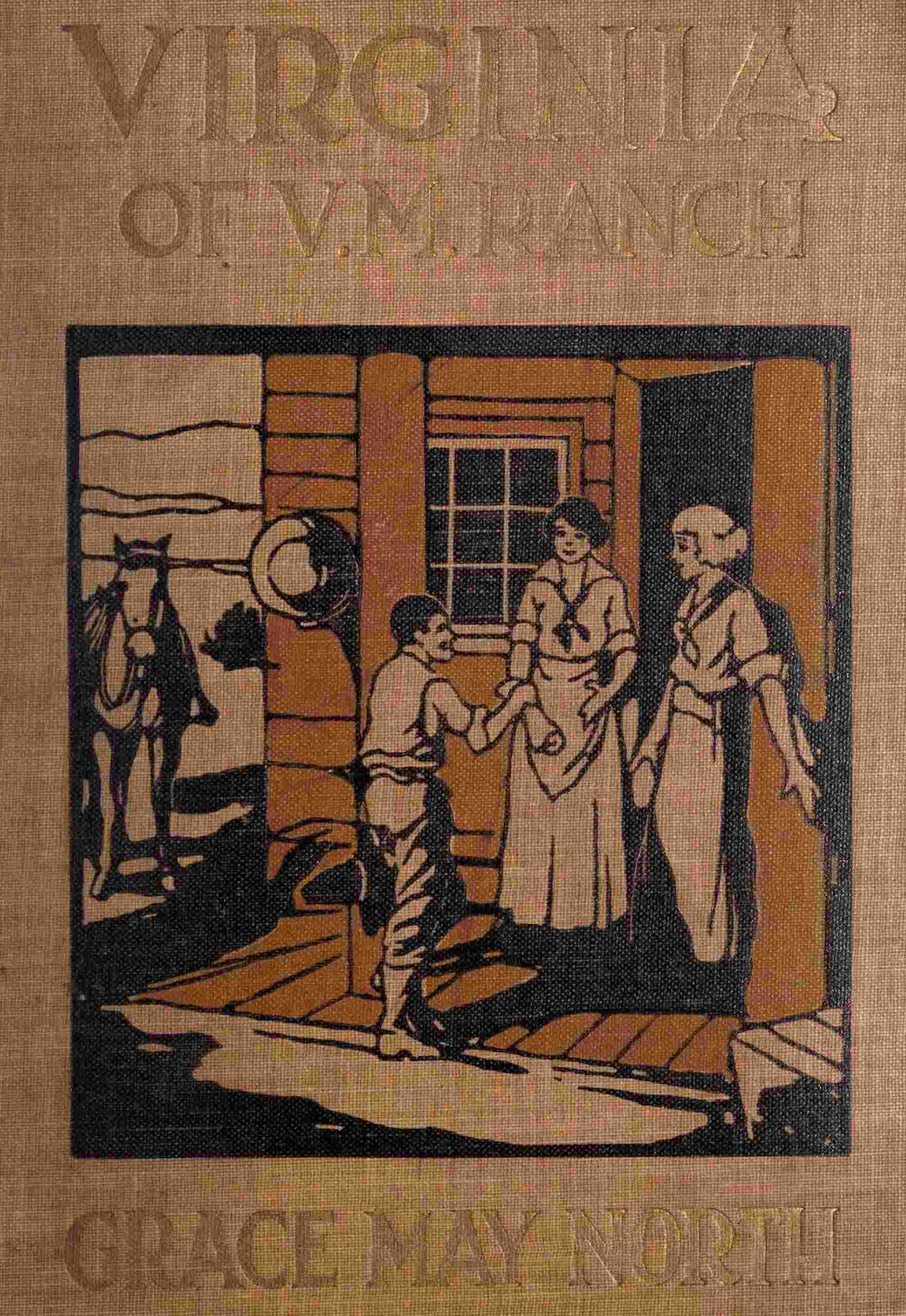
When the two riders appeared a pack of wolf-dogs made a mad rush at the stranger.
Suddenly his horse snorted and stopped. Tom wondered what it had heard for surely there was nothing to see, but he was not long puzzled, for a second later a lean, shaggy pony, ridden by a small Indian boy, emerged from what seemed to be solid rock. Tom urged his horse forward and hailed the little fellow who, after looking at the stranger with startled eyes, seemed about to return by the way he had come. Then it was Tom remembered something. He had been told to say to the first Indian he met, “Virginia Davis sent me,” which sentence, he had been assured would prove an open sesame that would win for him admittance and welcome.
Nor had he been misinformed, for, when the small Indian boy who was about to disappear, heard the name which Tom called, he smiled, showing two rows of gleaming white teeth, and then, silently beckoning he led the way through a crevice, so narrow that Tom no longer wondered that it had escaped his observation.
It gradually widened, however, into a canyon which at last opened into a huge bowl-shaped valley where the grass was green and where clumps of scarlet flowers were blossoming.
Scattering about were a dozen or more low adobe huts and in the midst of them in a large corral were many wiry Indian ponies.
When the two riders appeared a pack of wolf-dogs made a mad rush at the stranger, barking furiously. However at a word of command from the small Indian boy, they slunk away, to Tom’s secret relief. The lad had evidently assured them that the intruder was a friend and not a foe.
The Indian boy knew little English, but he led Tom to the most imposing of the adobe huts. There he paused and uttered a cry like that of some wild bird.
Tom gazed curiously at the open door which was festooned with dried red peppers. He wondered who would appear. He hoped and believed that it would be Winona, the Indian maiden, who was Virginia’s friend, but instead a shriveled old Indian woman wrapped in a bright-colored blanket shuffled to the door and evidently asked the lad what he wished at the home of the chief.
Tom understood only one word in the lad’s reply and that was “Winona.” For answer the old woman silently pointed toward the nearest cliff. Tom, looking in that direction, saw a graceful Indian girl approaching and on her head she was balancing a very large red pottery jar which was almost brimming full of sparkling water from a mountain spring.
Whirling his pony, the little Indian had galloped toward the dusky maiden, who paused to listen to what he had to say with an eager interest.
Then, placing her water jar upon a large, flat rock, she approached the newcomer who had dismounted, having first assured himself that the pack of wolf-like dogs was not in evidence.
To his surprise the Indian maiden spoke in the English language and, without the least embarrassment held out her slim, dark hand as she said, “Welcome, Virginia’s friend. You have traveled far and are hungry. I am Winona and I will give you breakfast.”
Tom thanked her and, as she was about to lift the jar again to her head, he said with his frank, friendly smile, “I ought to offer to carry that, but I fear I could not manage it as skillfully as you do. Since it is without handles, it must be a difficult feat.”
Winona smiled up at him as they walked side by side; the Indian lad, whose name was Red Feather, having taken Tom’s horse to the corral.
“Perhaps,” she replied, “but we learn early and do not forget. Look yonder.”
Tom’s glance followed that of Winona and he saw a group of little Indian girls, the oldest not more than 10. They were coming from a mountain spring and each was balancing a water jar upon her head. The small girls gathered about gazing half shyly and half curiously at the newcomer, until Winona spoke a few words in a tone of gentle rebuke, then the little, wild, coyote-like creatures scattered and soon disappeared in different mud huts.
“What did you say to them, Winona?” Tom asked curiously.
The Indian girl’s smile was almost merry. “That it isn’t manners to stare at company,” was the reply. “For seven winters, as Virginia told you, I learned the white man’s way, and now I have a little class and teach what I learned. Here we are at my home. My father awaits to welcome you.”
Tom saw an old Indian squatted upon the mud porch, and about his jet-black hair was a band into which had been woven with garnet beads the emblem of the tribe.
“My father, Chief Grey Hawk, this is Tom, friend of Virginia.” The bronzed, wrinkled face had a kindly expression as the old man replied in his own tongue, offering hospitality.
“Sit and rest and I will bring refreshment,” Winona said as she went within, soon to return with steaming coffee and a hard cake made from Indian meal.
The chief having retired, Winona sat beside Tom on the adobe porch and asked many questions about Virginia.
An hour later Tom bade the Indian girl farewell, and with little Red Feather as guide, he again rode toward the north. As he looked ahead at the rugged, uninviting mountains, in his heart there was an impulse to whirl his horse about and gallop back to the V. M. Ranch, whatever the consequences, but instead he followed the lad who led the way across an ever rising sandy waste where there was no sign of a trail. Had there been one the frequent whirlwinds would have hidden it with sand.
Tom wondered if the Indian boy had the same unerring instinct that a bird seems to have in its flight. Once only did the small guide pause and listen. Tom, too, drew rein, but heard nothing, although it was evident that the Indian lad did. He was intently watching a sandhill nearby, around which, in another moment, there appeared a bunch of wild, shaggy ponies, but, upon seeing Tom and Red Feather, with a shrill whistle-like neighing, they whirled about and galloped in the other direction and were soon hidden in a cloud of sand.
The Indian lad looked back and his white teeth gleamed as he said, “Much pony-wild.”
That was his first attempt at speaking the English language and would have surprised Tom greatly had he not recalled that Red Feather was probably a pupil in Winona’s little class, and so, riding closer, he asked, “Is it far yet we go? Long way?”
The lad shook his head. He had understood. “One up, one down,” was his curious reply. Tom decided that the little fellow meant that they would cross one more range of mountains and then descend into a valley, nor was he wrong, for they were soon climbing a clearly defined mountain trail and at last reached a high point from which Tom could see, far below them, a wide, fertile valley.
Red Feather drew rein and pointed. “Sheep,” he said. “I go back.” Not waiting for Tom to express his gratitude, and without a formal farewell, the Indian lad returned by the way he had come.
Tom, believing that the sheep ranch he sought lay in the valley below, started the descent.
As he neared the group of low, white-washed buildings, Tom felt in his heart a strange loneliness and a sense of homesickness for the V. M. Ranch.
After years of wandering, the few days he had spent there had meant so much to him, but it had been Virginia’s wish that he seek refuge on this sheep ranch, and so he rode on, wondering what manner of welcome he would receive.
Mr. Wilson and his 18-year-old son, Harry, were mounted and apparently about to ride away from the big white-washed ranch house when they perceived the newcomer and drew rein to await him. They wondered who the visitor might be, as few riders passed that way, the sheep ranch being isolated and difficult of access.
When the lad was within hailing distance, Mr. Wilson, in his bluff, hearty manner, called:
“Welcome, stranger!”
Tom responded to the greeting and said:
“Mr. Wilson, I am from the V. M. Ranch. An old cattleman, whom they call ‘Uncle Tex,’ brought word that you were in need of help and I have come to apply for a position.”
“Good! We do indeed need help,” was the hearty response. “Have you any knowledge of sheep?”
“None whatever,” was the frank reply, “and before I accept a position with you, I would like to tell you just who I am.”
“That is not at all necessary,” Mr. Wilson replied, heartily. “Your honest face and manner are all the recommendations that you need. Your past, my boy, is past. Your present will be what you make it now.” Then he added, “This is my son, Harry. What shall we call you?”
“Tom,” was the simple reply.
“Tom,” Mr. Wilson repeated, “you have come at a very opportune time. Harry and I were just setting out for the Red Canyon camp. Our herder there, Juan, reports that many sheep are being killed in his flock, but that alone he cannot watch them at all hours. Of course he must have sleep, and although I am really needed on the home ranch, I am so short of help that I was about to accompany Harry. Will you go in my place?”
“Gladly, sir,” Tom replied.
“Then first come within and have refreshments and meet the Little Mother who makes home for us.”
Mrs. Wilson welcomed the lad with the same kindliness that her husband extended to him and led him at once to the big, comfortable kitchen where he was soon given a bountiful dinner, which he greatly appreciated.
An hour later, with Harry and on a fresh mount, Tom started again toward the north. The boys liked each other at once. Tom was soon asking many questions about sheep ranching, which the other lad seemed glad to answer.
Then, for a time, they rode on silently. Tom was thinking how pleased Virginia would be if she could know of the kindly welcome he had received. How he wished that he could write to her.
“Can one send a letter from here to the V. M. Ranch?” he inquired.
“Yes,” Harry replied; “about once a month we send our mail to Red River Junction, which is thirty miles away. Little Francisco will go to town in about a week.”
CHAPTER XXXII—A FIERCE WARRIOR.
A week had passed and it had been an anxious one for Virginia and Margaret as they had no way of knowing whether or not Tom had managed to escape the posse that had been searching for him. True, they had one day ridden to the Junction and there they had learned from Mrs. Wells, the station master’s wife, that the posse had returned to Texas, but whether they had captured the young outlaw or not the good woman could not tell.
One glorious day Margaret asked Virginia if she would like to go for a ride but the western girl wished to remain at home and suggested that Megsy go for a short canter by herself.
“You will be perfectly safe, dear,” Virginia assured her. “Suppose you follow the trail over the mesa and toward the sand hills, then circle around them and come home again. That ride will make you good and hungry for the delicious something that I am going to bake. Our miners are to return tomorrow, and since Uncle Tex does not know how to make pies, Mrs. Mahoy offered to teach me this morning.”
Half an hour later Margaret cantered away, feeling very brave indeed, as this was the first time she had started out on a desert trail all alone and unprotected. When she reached the mesa, she drew rein and looked about. Not a horseman was to be seen, only the gleaming white sand with here and there a mesquite brush, or a clump of wiry grass or a spot of flaming color where some hardy plant was blossoming.
Toward the north lay the desolate sandhills on which tall stalks of yucca stood like silent sentinels. Margaret decided to do as Virginia had suggested, gallop around the small group of hills and then, home again. How she did wish that Babs was with her, for well she knew that her eastern schoolmate would enjoy a canter on so glorious a morning. It wouldn’t be long though before Babs would be coming. “Today is the first of March,” Margaret was thinking. “April and May will soon pass and then it will be June and Barbara will come.”
Margaret was nearing the first of the three isolated sand hills when she felt her saddle slipping. She dismounted to tighten the girth when suddenly she lifted her head and listened intently.
What had she heard? Perhaps nothing really, for well she knew that being timid, she was very imaginative. She fastened the girth securely and had one foot in a stirrup about to remount when again she heard the sound, and this time it was much nearer than before. Leaping to her saddle, she was about to gallop away when she saw a band of horsemen coming around the nearest sand hill. Terrorized she whirled her pony’s head toward the south and urged Star to his top speed.
She knew by the racing hoofbeats back of her that she was being pursued. Could she reach the V. M. Ranch before she was overtaken?
Virginia was proudly surveying the row of pies, which, with the help of Mrs. Mahoy, she had just made, when she heard the front door burst open and slam shut. Then, almost before she could turn around, a terrorized girl rushed into the kitchen, and seizing Virginia, clung to her wildly as she said, “Oh, Virg, I was almost captured by Indians. They came around the sand hills. The minute I saw them I galloped for home, but two of them pursued me. Do you suppose they are coming to raid the ranch as you said they used to do when your father was a boy?”
“No, no, Megsy, of course not,” Virginia replied. “Tell me what did your Indian pursuers look like.”
“One of them was a big fierce warrior, and—”
Just then there was a rap at the front door. “Oh! Oh! There they are now! Virg, you aren’t going to let them in?”
“Megsy, my dear, the only Indians living near here are the friendly Papagoes. Please do not hold me so tight.” The western girl had to fairly drag herself away from Margaret.
When the door was opened there on the porch stood the Indian maiden, Winona, and by her side was little Red Feather.
Virginia was delighted and embraced her Indian friend just as she would have welcomed a white girl whom she loved and had not seen for a long time.
“Margaret,” she called, “come and meet my dear friend Winona, of whom I have so often spoken.”
Margaret approached, feeling rather overcome by the sudden change of emotions. She held out her hand to the Indian girl and said sincerely that she was indeed glad to meet Virginia’s friend. Then she smiled at the little fellow whom she had called a “fierce warrior.” About his straight black hair there was a band of green, in which, perched at a jaunty angle, was a bright red feather. The Indian boy’s white teeth gleamed as he said admiringly:
“Fast pony! Go zip!”
Luckily neither of the Papago visitors had suspected that Margaret had been frightened by their sudden appearance at the sand hills.
“Can’t you stay awhile, Winona?” Virginia asked.
“Not this time. Some other, perhaps. My father, Chief Grey Hawk, awaits me. We have buying to do in town, but I wanted to tell you the nice young man, your friend, he came and went again soon to the north. Red Feather showed him the way. He reached there safely.”
Virginia’s eyes glowed, and again taking the Indian girl’s hand, she exclaimed, “Oh, Winona, I am so glad that you stopped to tell me. We were eager to know if Tom really found your village. It is so hidden that the entrance is hard to find.”
When the farewells had been said and the two visitors had ridden away, Margaret went to the old writing desk, declaring that she was going to pen Babs a letter that would make the boarding school life seem dull and monotonous. Scarcely was the epistle finished and sealed, when Lucky called to say that he was riding to the Junction and would take the mail.
“Be sure to bring us back some letters,” Virginia called merrily as the cow-boy, waving his sombrero, rode away.
CHAPTER XXXIII—A SAND STORM.
“March winds surely are blowing,” Margaret sang out, as she and Virginia were hurled along at a merry pace from the “hen corral,” the small fenced-in enclosure whither the girls had been to gather eggs.
When they reached the shelter of the kitchen, Virginia declared, “It’s great fun to race with the wind back of one, but I wouldn’t care to go far across the desert facing this gale. I suppose that it will blow now for days and days. It usually does in March. Sometimes it hurls the sand against our windows in terrific gusts and woe to the horseman who is caught out in a such a storm.”
“What happens? Is he buried alive?” Margaret asked.
“No, not often that. Sometimes he turns and rides with the wind until it has abated. Let’s get the darning basket, shall we? This is such a cozy time to sit by the fire and mend. I always enjoy it most when there is a storm outside, don’t you?”
Fifteen minutes later the two girls were comfortably curled up in easy chairs in front of the wide grate on which a mesquite root was cheerfully burning. Margaret, dropping her darning into her lap sat watching the flames.
“A penny for your thoughts,” Virginia teased. Margaret looked up with a little laugh. “Virg,” she said, “my thoughts had gone way back to the first chapter. I was thinking how I had rebelled when you wrote that I would have to leave boarding school and come out here to live on the desert. I was so sure that I was leaving happiness behind me and that I would be miserable ever after, but instead—” she paused.
“Have you been unhappy, dear, and are you hiding it in your heart?” Virginia asked anxiously.
“Unhappy?” Margaret lifted such a glowing face that Virginia felt that her question was answered before the next words were uttered. “I have never been so happy before in all my life. This is the first real home that I ever had. Mother died when I was so very young, and then father placed me in boarding school, and then he died. Of course I was happy at Vine Haven and Babs was like a dear sister, but Oh, Virginia, there’s nothing like a comfortable, love-filled house for a home, is there? Of course I still love Babs, and now I have you, and Malcolm for a brother.”
Margaret had returned her attention to the sock she was darning which chanced to belong to the lad she had just mentioned, and she smiled as she continued, “How nice Malcolm is. But isn’t he much more serious than most boys of eighteen? Is it because he has had so much responsibility since your father died?”
“Perhaps, and also because he is of a serious nature,” Virginia replied, as she threaded a needle. “And yet there is lots of fun in Buddy. You haven’t had an opportunity to become acquainted with him. He has been so occupied since you came. If he does return to V. M. Ranch tomorrow I do hope he plans staying at home for a while. He has been away now for two weeks.”
“Whew-oo!” Margaret said with a shudder. “Virg, did you hear that gust of wind? It’s blowing the sand, and how dark it is getting!”
Virginia glanced anxiously at the window. “I do hope Lucky will reach here before nightfall,” she said. “However, he may remain all night at the Junction. That would be the wise thing to do.”
“Hark!” Margaret exclaimed listening intently, “I’m sure I heard someone calling just then. Did you?”
They both listened but heard only the rush of the wind and sand.
However, a moment later, there came a rapping on the back door and both girls dropping their darning, hurried to see who the newcomer might be.
As they had really expected, it was the cow-boy who had ridden to the Junction for the mail.
“Lucky!” Virginia remonstrated, “you are covered with sand and your face is almost bleeding. Why did you come out tonight? The mail was not so important.”
“No, Miss Virginia, ’twant the mail that fetched me but the stock. Slim ain’t here and I hadn’t tol’ Uncle Tex about the little sick heifer as I’ve got down in the hospital. I knew it would be dead by morning if I didn’t come home to tend to it.” As the long, lank cow-boy talked, he was taking the mail from the pouch and placing it on the kitchen table. At first he seemed puzzled, and then troubled about something. He turned the mailbag upside down and shook it.
“What’s the matter, Lucky? Have you lost something?” Virg inquired.
“I’m afeared I have, Miss Virginia,” the cow-boy replied. “I know as how I had five letters for V. M. Ranch, but now I don’t count but four. One of ’em must have blowed away. I’m powerful sorry, Miss Virginia. It was a longish one and it was from Red Riverton, I just don’t see where that letter can be.”
The poor cow-boy was so distressed that Virginia assured him that the missive was of no great importance and that probably it would be found in the morning.
Then, returning to the living-room the girls drew their chairs close to the center table where Virginia had lighted the lamp with its cheerful crimson shade.
“Where did Lucky say the lost letter was from?” Margaret asked as she slipped a gourd into the toe of one of Malcolm’s socks. “I had never heard of the place before.”
“Oh, I imagine it is a letter from some neighboring rancher to my brother,” Virginia remarked as she took up her darning. “Red Riverton is in the northern part of the state, and—”
“Virg!” Margaret interrupted, “do you suppose that letter was from our Tom? Or rather I should say, your Tom, as he never seems conscious of my existence.”
Virginia’s eyes glowed and springing up she exclaimed, “I do believe that you may be right. I’ll ask Uncle Tex the name of the nearest postoffice to the Wilson Sheep Ranch.” Into the kitchen she skipped returning with a woe-begone expression. “You are right, and, Oh Megsy, isn’t it dreadful? We have lost the very first letter that Tom ever wrote to us, for of course it must be blown far away. Just listen to that wind. It is traveling sixty miles an hour or more and by this time the letter will be far over the Mexican border. I am just sure we never will find it.”
“It might have been caught on a thorny cactus,” Margaret said, but neither of the girls had any real hope of finding the missive in which they were so interested.
During the night the wind subsided and the next day dawned gloriously still and sunny. The cow-boy, Lucky, arose before daybreak and rode up to the mesa, searching everywhere for the lost letter until the bell on the back porch of the ranch house called him to breakfast.
When he entered the kitchen, he looked so troubled that Virginia said with her friendly smile, “Don’t you worry about that letter. If it doesn’t turn up, I know who sent it, and I will write and explain that it was blown away in a sand storm.”
After breakfast the two girls tramped over every bit of sand between the ranch house and the corrals; then they mounted their ponies and rode over the trail toward the Junction, but not a gleam of white did they see.
“How the sand has changed!” Margaret exclaimed. “It is lying in billow-like waves. It isn’t smooth, the way it was yesterday.”
“That is how the three little sand hills were formed, I suppose,” Virginia remarked. “Something must have been there, a giant cactus, perhaps around which the sand first gathered, and then, being held, other storms added to it until the mounds became quite sizable sand hills standing all alone on the desert, but these little waves have nothing to hold them and they will soon smooth out again.”
At noon they gave up the search and returned for lunch. As they entered the house, Margaret suddenly exclaimed, “Why, Virginia, how could that letter have blown away? Lucky took the mail out of the pouch right here in the kitchen and before that the flap was buckled down.”
“That’s so,” Virginia replied, “and yet he remembers having had it and I have looked in the pouch several times.” Then, chancing to glance out of the window, she laughingly added, “You’d better hide, Margaret, for here comes your fierce warrior and he may be after your curly scalp.”
Megsy took the teasing good naturedly and both girls went out on the veranda to see what message little Red Feather had for them.
Far on the mesa they saw a gray line of horsemen whom they knew were the Papagoes returning to their mountain encircled home. Probably Winona had sent the Indian boy down to the V. M.
As the little fellow rode up, he reached under his red saddle blanket and drew forth a long white envelope. This he handed to Virginia with a slip of brown wrapping paper on which Winona had written:
“Dear White Lily:
“Mrs. Wells sent this. Your cow-boy dropped it at the station. Your friend, Winona.”
“Oh thank you, Red Feather!” Virginia exclaimed, when she had read the message. “Tell Winona to come soon again and pay us a real visit.”
The little Indian lad showed his white teeth in a wide smile but whether he understood or not the girls could not tell.
When he was gone, Virginia dragged Margaret into the living-room and whirled her about merrily. Then they sank down on the window seat and Virginia tore open the long white envelope.
CHAPTER XXXIV—TWO LETTERS FROM TOM.
“A letter from an outlaw,” Margaret laughingly exclaimed as the two girls curled up on the window seat, one to read and the other to listen to their very first letter from Tom.
“Virginia, isn’t this the strangest thing you ever heard of?” Margaret added. “What would my primly and properly brought up friends in Vine Haven Seminary think if they knew that we were corresponding with a young man labeled an outlaw whose last name we do not even know?”
Virginia laughed. “I suppose your Miss Pickle would be frigid with horror, but luckily she knows nothing of your present misdemeanors and cannot make you go without dessert for a week for breaking a rule. Now for the letter:
“Dear Virginia and Margaret:
“Greetings from a sheep ranch. Virginia, when I was outlawed from your home, I felt that I was leaving the sunshine of the world behind me and I didn’t much care what happened, but you will be glad to know that my destination proved to be a real home where I was kindly welcomed by a motherly woman, her big hearted, splendid husband and their son, Harry, who is just my age. I offered at once to tell them who I really am, but they would not permit me to do so. Luckily for me, Mr. Wilson was in great need of help and within an hour after my arrival, his son Harry and I started to ride to the Red Canyon Camp where the sheep herder, Juan, was alone with several hundred ewes.
“A very small Mexican boy with a very big name, it being Francisco Quintano Mendoza, is ranch rider. It is his duty to visit each of the four outlying camps, which he does on his brisk little burro, finding out the needs of each herder and then he returns to the main ranch house. It takes him a week to make the round trip. He had ridden in that morning with a message from Juan of Red Canon Camp. The flock was being nightly attacked by wild animals, and, try as he might, the herder had been unable to capture the invader.
“‘Of course even a sheep herder must sleep part of the time,’ Harry declared as we rode through a valley that was covered with dry grama grass. Close to the mountains we came to the herder’s hut, which consisted of one earth-roofed adobe room, a stove, two bunks, a rude table and bench were the only furnishings, while strings of dry red peppers were the decorations. Juan was farther up the valley with the flock, but toward sundown, he came driving the sheep into the sheltered corral. Harry at once saw that something was wrong with the herder. The faithful shepherd had broken his arm and was enduring much pain, but he would not leave his flock until someone came to care for it. Harry skilfully bandaged the broken arm and then bade Juan ride at once to a physician in Red Riverton. He is to leave now as soon as he has his supper, which Harry is preparing; so I must end this letter that I may send it by Juan.
“Harry and I are going to take turns watching the flock. How I do hope that I will be able to catch the wolf or mountain lion that is killing the sheep. I would like to prove my gratitude to Mr. Wilson by some helpful deed.
“Virginia, how may I show my gratitude to you? Will you let me know? Your outlaw, Tom.”
“What an interesting letter!” Virginia exclaimed; “I am so glad that the Wilsons are being so kind to him.”
Several days later the girls were surprised to receive another letter from Tom. They were riding on the mesa trail when Slim came from town with the mail. There were several letters for each of them and so eager were they to read them that they dismounted and bidding their ponies return to the home ranch, the girls sat on the sun-warmed sand and looked over the mail.
“A letter from Babs!” Margaret exclaimed happily.
“And another from Tom, so soon!” Virginia said. “Which shall we read first?”
“Tom’s, of course,” Margaret replied, “Babs won’t mind waiting.” So Virg began to read aloud.
“Dear Virginia and Margaret: I have had such an exciting adventure and I want to tell you about it. Last night Harry permitted me to watch the flock, as he had done the night before, but without discovering the invader. In fact, when he came to the cabin to breakfast, he told me that nothing had happened to disturb the sheep, and yet, an hour later, when he drove the flock to the valley pasture we found that two of the best ewes had been killed on the far north side, so it was there that I determined to hide and watch. That part is nearest the Red Canyon which is a narrow gorge of red rock leading into the mountains.
“I crouched in the shelter of an overhanging ledge behind a scrub pine and waited. The hours dragged by but nothing happened. It must have been about midnight when I thought that I heard soft, stealthy footfalls as though made by padded feet. Too, the sheep nearest me became fidgety and stood up facing the canyon. The wind evidently had brought a scent to them that they feared.
“I arose, and leaning on one knee with my gun ready to fire, I watched the opening of the canyon intently, expecting to see a dark figure appear, or, cat-like eyes gleaming in the dark, but nothing happened. Suddenly something impelled me to look up, and it was well that I did, or I would not be writing this letter to you, for there on the jutting ledge, was a lion crouched to spring, not at the sheep, but at me. I whirled to shoot, but in that moment the creature leaped. By turning, however, I had changed my position and the lion leaped beyond me.
“Instantly it was upon me, however, but I had time to lift my gun, and it leaped against the muzzle. ‘What if the gun should fail me?’ I thought, but it didn’t, and the lion fell over.
“I sat down again to wait for dawn, feeling none too secure, and glancing often at the ledge over my head for where there is one mountain lion, there might be another, but nothing happened, and when day dawned, Harry rode over and found me sitting beside the largest dead lion, he said, that he had ever seen. The creature had torn the right sleeve almost out of my coat and my arm was scratched but the sheep were all there.
“I tell you, Virginia, it makes a chap feel that he is not entirely useless in this world when he can do something that really helps.
“We are back at the home ranch now; another herder, Josef Lopez, having ridden in from Red Riverton to take Juan’s place for two weeks. Little Francisco Quintano Mendoza is about to ride into town with the mail, so I will say good-bye now. How I do hope, when he returns, that he will have a letter for me from you. Greetings from your outlaw, Tom.”
Virg paused and gazed intently at the signature.
Margaret inquired:
“What do you see, Virg? Hieroglyphics that you find hard to decipher?”
“Well, it is something puzzling,” the western girl declared. “I believe that Tom first signed another name to this letter, and then, remembering that his real name was to be kept a secret, known only to himself, he has carefully erased it, but even so there is a faint lining of letters perceptible. How I do wish that we could make them out, although, perhaps we ought not to pry into Tom’s secret if he does not wish to share it with us.”
“May I look at the signature?” Megsy asked. Virginia gave her the letter, and Margaret taking the sheet of paper held it up to the sun.
After gazing at it intently for several seconds, she uttered a squeal of excited delight. “Virginia,” she announced, “I am just sure that I can make out the capital letter beginning the last name. See! It’s a W, isn’t it? There can be no mistake as to that.”
Virginia also looked and although none of the others could be recognized, she too, was convinced that the last name began the letter her friend had mentioned.
Suddenly Margaret turned toward her, with eyes that glowed.
“Virginia Davis,” she exclaimed excitedly, “has it ever entered your thought even remotely that our Tom might be Peyton Wente, the lost brother of Babs?”
“Why no, dear. It never had,” Virginia replied. “Do you suppose that it might be possible? And yet, if it were true, we wouldn’t want to tell Babs that the brother whom she so adores is a fugitive from justice.”
“No, we wouldn’t,” Margaret reluctantly admitted. Then, after a thoughtful moment, she added, “but I would like to know for our own sake, wouldn’t you, Virg?”
“Yes, I would,” the western girl agreed. “The more I know of Tom the more I am convinced that he belongs to a refined family, and I also believe there is a mistake about the mysterious something for which he is an outlaw from Texas.”
“I know what let’s do,” Margaret exclaimed brightly, “let’s ask Babs to send a photograph of her brother, telling her merely that many lads drift West, lured by the fascination of life on the desert, and that if her brother should happen to be among them, we would want to be able to recognize him.”
“That will be a good plan,” Virginia agreed. “Now, suppose you read the letter from Babs. I hope it isn’t feeling offended because it has been kept waiting.”
CHAPTER XXXV—NEWS FROM SCHOOL.
Virginia settled comfortably on the warm sand still holding the letter from Tom while Margaret eagerly opened the plump epistle from her best friend in the far away East.
“I just love to get these chatty letters from Babs,” she prefaced and then read:
“Dearest Cowgirls:
“Megsy, you remember how prim and proper Miss Pickle was when you were here at school and how ‘skeered’ of her we girls always were. Well, some mysterious power is surely working a transformation. I told you about the Surprise Valentine party she gave for us and how we entertained young Prof. Pixley and thirteen of the boys from the Drexel Military Academy. Well, ever since that night Miss Piqulin has been kindlier in her manner; she hasn’t done her hair up quite so tight and she even attempted a joke in algebra class. We girls hardly dared laugh, however, but yesterday something happened to convince us that Miss Piqulin can be called the sour Miss Pickle no longer.
“It was her birthday and it was also mine. It being Saturday Miss Piqulin decided to celebrate and she invited her algebra class to spend the day in the city with her. Weren’t we excited though? You know our club, ‘The Lucky Thirteen,’ (we asked Jennie Clark to join when you left school that we might keep the same number), are all in that class. We decked up in our very best and looked pretty nice, so we thought, when we gathered in the lower corridor to await the coming of the school bus. Betsy Closson was the last down and she seemed excited about something. ‘Girls,’ she said, ‘watch Miss Martin’s office door.
“‘A strange young lady just went in there and she had on the prettiest spring suit. It’s the very latest style. I wonder who—’ Betsy said no more for the office door was opening. The strange young lady appeared with her back toward us, but suddenly she turned, and if it wasn’t our very own Miss Pickle. She had on the prettiest grey suit and a grey tulle hat trimmed with crushed pink roses.
“I’m afraid we stared our astonishment, but luckily the bus arrived just then and so we went out and climbed in. Miss Piqulin was with Patrick on the front seat but she smiled at us over her shoulder. We sat there in two rows as solemn as though we were at a funeral.
“‘Girls,’ Miss Pickle said, ‘have a happy time; laugh and chatter all you want to.’
“Megsy, did you ever suppose the day would dawn when Miss Pickle would say that? Well, anyway, she did, so we started to sing a school song when suddenly Betsy Closson held up one hand and said, ‘Hark! Don’t you hear bugles?’
“‘Look! Look!’” Jenny Clark was pointing back at the bend in the road. ‘There comes a carryall and it’s filled with boys from the Drexel Military Academy. Don’t they look nice in their dress uniforms?’
“‘That jolly young Professor Pixley is with them,’ Flora Wells added. Miss Piqulin heard this and her cheeks became as pink as the roses on her hat. The mystery was solved. Miss Pickle is in love!
“Well, to make a long story short, the carryall dashed up and both vehicles stopped while greetings were exchanged. When Prof. Pixley heard that we were to spend the day in town, he asked us to join them at a theater party at two in the afternoon. Weren’t we girls excited and delighted, and what a fine time we did have! I sat next to such a nice boy and Virg, how pleased I was when he said that his home is in Arizona. His name is Benjamin Wilson. Have you ever heard of him?
“That was a whole lot of excitement for boarding school girls all in one day, wasn’t it Megsy? Nor was that all, for when I reached my room that night, I found a birthday box from China. In it was a pale blue silk kimono embroidered with pink cherry blossoms and slippers to match. It was from my dear brother Peyton. He has never missed giving me something on my birthday. Now that I know where he is, I am so happy and content.
“Farewell for now. Your Babs.”
“Then after all our Tom isn’t Peyton Wente,” Margaret said as they started walking toward the V. M. Ranch.
“I’m disappointed,” Megsy continued. “I did hope your outlaw would turn out to be—well—somebody just ever so nice and of course even if he did run away from a very stern father, Peyton Wente must be nice, else how could he be my adorable Barbara’s brother?”
“That argument can’t be disputed.” Virginia said, then leaping to her feet she added: “Let’s go home, dear, I’m hungry as a lean coyote! How I do hope that Uncle Tex will have a fine dinner waiting for us.”
Upon reaching the ranch house the girls went at once to their rooms to prepare for the midday meal, but when the Chinese gongs rang, they sallied forth arm in arm and were confronted by a young giant of a lad.
“Malcolm Davis, are you home at last?” Virginia fairly flew at her dearly loved brother, and was caught in his arms. Then turning, the smiling young man, held out his right hand to Margaret.
“I feel as though I ought to be introduced to my ward all over again,” he said with his pleasant smile. “I have been away at the mines for so long that I have hardly had time to become acquainted with her. Has she been a dutiful ward?”
Virginia smiled at her friend as she replied, “Oh, Malcolm, you can’t know what a comfort Margaret is to me. We two girls do have the nicest times together.”
Then, when they were seated about the table, Slim having been detained at the corral and Lucky still being out on the range, Malcolm remarked, “Slim tells me that Tom is not here now. Did you have cause to dismiss him from our service, sister?”
“No, indeed, Buddie,” was the earnest reply. “Tom proved to be as trustworthy as you believed that he would, but, for some reason, he seems to be a fugitive from justice as he told you. We advised him to go farther north, but he would not leave the V. M. until we girls were well protected. That very night Uncle Tex returned telling us that Mr. Wilson up Red Riverton way needed help on his sheep ranch and so we urged Tom to go. We have had two splendid letters from him. He seems to be enjoying his work up there and he likes the Wilson family just ever so much. Do you know them, Buddie?”
“Yes, indeed I do. I often stayed all night with the Wilsons when I was one of dad’s range riders, and when I had gone that far north in search of strayed cattle. Of course the cowmen and the sheep ranchers are supposed to be bitter enemies, but my theory is that there is room enough in our big state for all of us to live and let live. The Wilsons are the nicest kind of a family, Virg. Mrs. Wilson is a dear, mothering sort who reminds me of a hen with wide, warm wings that can always take one more chick in out of the cold. Dad thought very highly of Mr. Wilson, and then, there are two sons. One of them, Harry, is about my age and there is a younger chap. I think he is nearly sixteen. He was fonder of books than Hal and so they sent him East to school. I can’t recall his name.”
“Was it Benjamin?” Virginia asked.
“Yes, that’s it. Benjy, his mother called him. I haven’t ridden that far north for two years at least. However, I hope that I will get up that way some day. I like to keep in touch with such kindly neighbors.”
Malcolm then told the girls about the progress made at the mine.
“I am very much encouraged with the output,” he told Virginia, “but I am a rancher, not a miner, and so I asked Pat Mahoy to send for his former associates in Bisbee to assist him. I can trust Pat to look after our interests as he will his own. I will stay at home for a time and get acquainted with my ward and my sister.”
“Oh brother, I am so glad, and some day will you take us for a long, long ride? I am eager to have Margaret see more of our wonderful desert.”
“That’s a splendid suggestion,” Malcolm said with enthusiasm. “We might even ride as far north as the Wilson Ranch.”
Although Virginia’s reply expressed her pleasure, it did not reveal to her brother how very much she did hope that plan would soon be carried out.
CHAPTER XXXVI—CAUGHT IN A TORRENT.
A month had passed. The wild March winds had blown itself out. The spring rains had filled the usually dry creek with a rushing, raging torrent which could be forded by neither man nor beast. Then, when at last the sun shone out, the desert glistened, while here and there a clump of bright flowers gleamed. The sand had been washed from cactus and mesquite and there were fresh leaves on the cottonwood trees. Birds sang, and also there was a rejoicing in the hearts of the two girls who had been so long held prisoners by the inclement weather.
“Think of it!” Margaret said as she swept the veranda the first clear morning after the rains. “It is three weeks since any one has been for the mail. Do you suppose that it would be safe for us to cross the creek today and ride to the Junction?”
“Oh, I’m sure that it would,” Virginia replied. “There isn’t a cloud anywhere to be seen and isn’t the sky the shiniest, gleamingest blue?”
Half an hour later, when their morning tasks were finished, Virg hailed her brother, who was on his way to the valley pasture to see what damage had been done to the mile square fence. “Buddy,” she called, “is it safe for Margaret and me to ride to the Junction for the mail? There must be just stacks of it there waiting for us?”
The lad scanned the horizon and replied in the affirmative.
The two ponies, Star and Comrade had been in the corral so long that they were high spirited and galloped across the hard, desert trail as though racing with each other.
Having reached the rocky creek bottom, where only a little water was trickling along, Virginia turned her pony toward the opposite bank where she expected to find the trail which they had always ascended but it had been washed away leaving a steep perpendicular cliff, up which they could not ride.
“What shall we do?” Margaret asked. “Is there no other way to reach the Junction?”
“Yes, there is another trail farther up the creek, but, to reach it we will have to ride between these high banks for about a mile. At this time of the year it is rather a risky thing to do, for if there should be a cloudburst in the mountains, we would find ourselves in a raging torrent, but since brother assured us that it is not going to rain, suppose we take the chance.”
Margaret agreed and silently they rode along the creek bottom. On either side of them the banks rose sheer and high. Virginia felt strangely troubled. She almost wished they had not taken the chance. They were within sight of the low banks, when Virginia suddenly drew rein and listened intently. Somewhere, up in the mountains ahead of them, she heard a sullen, roaring noise. What could it be? There was no wind and the sky was clear. Intuitively, however, the western girl knew that something was wrong.
“Megsy,” she called, “ride as fast as you can.” The creek bottom was covered with stones of all sizes and the eastern girl, frightened by Virginia’s command, urged her horse to greater speed. The dull roaring in the mountains grew louder and louder. Then, there was a report like a crash of thunder.
Virginia was only two lengths from the low bank when a rush of water hurled past them. It had risen to the stirrups when Comrade with a frightened snort, started to climb the low bank. Virginia looked back, and to her dismay she saw that Star had reared and that Margaret was about to be thrown into the swirling ever-deepening torrent. Seizing Margaret’s bridle, she called: “Let go of the rein, Megsy, and cling to Star’s neck. It’s your only chance.”
She again scrambled up the low bank with Star in tow and not a minute too soon, for following the last booming noise in the mountains, a mad rushing torrent was hurled down the creek, overflowing the low bank.
“That was a narrow escape,” Virginia had just said when Mr. and Mrs. Wells and their young son, Davie, rushed out of the station house to see what had happened.
“It’s the new Pine Canyon reservoir that’s burst!” the excited man exclaimed, then he added, “Miss Virginia, you gals wasn’t a ridin’ along the creek bottom, was ye?” When Virg replied in the affirmative, he ejaculated, “Wall, I’ll be jigger-switched. You sure had a narrow call, but if its mail as yer after there’s a stack of it for ye.”
Kind Mrs. Wells led the way indoors and gave each of the girls a cup of steaming coffee. As soon as the flood had passed, Malcolm and Slim, with anxious faces, appeared, and how relieved they were to find that the girls were safe. The cow-boy shouldered the bulging mail bag and they returned home by another trail.
Uncle Tex opened the ranch house door to admit them, and Virg felt his hand tremble in her clasp.
“Miss Virginia, dearie,” he said in a quivering voice, “don’t yo’ be doin’ reckless things any more. If yo’r wantin’ the mail, send yo’ old Uncle Tex. He’d ruther be swept away in a torrent than be livin’ without ye.”
The old man was almost overcome with emotion and the girl whom he had trotted on his knee as a baby, kissed him tenderly on his wrinkled leathery cheek. “Dear Uncle Tex,” she said. “I’m sorry we worried you all so much. We won’t take chances again. Honest Injun;” and then in a higher tone, she added, “We’re powerful hungry. Have you something nice for us?”
“That I have Miss Virginia dearie, an’ ah’ll open up a can of the preserved strawberries yo’ all like so much.”
The young people did justice to the good meal, and, when the last delicious strawberry had been eaten Virginia sprang up, quite her old self again as she said, “Now brother Malcolm, let’s open the mail bag.”
They went into the living-room and the young giant of a lad unbuckled the cover of the pouch and shook the letters and papers out on the library table. Margaret pounced upon one addressed in Bab’s familiar scrawl. Although Virginia received several letters from girl friends who were away at school, there was not a line from Tom. She was surprised to realize how truly disappointed she was, and, not feeling in a mood to read chattery letters from girl friends just then, she picked up one of the papers, and, sitting on the sunny window seat she idly glanced it over. Margaret was about to read the letter from Babs, when an excited exclamation from her friend sent her hurrying to her side as she inquired. “What is it, Virg? What have you found in the paper?”
For answer the western girl sprang up and seizing the astonished Margaret, she whirled her about as she exclaimed gaily. “I knew it. I knew it all the time.”
“Knew what?” asked the mystified Megsy. For answer Virginia drew her friend down on the window seat and then read aloud an astonishing bit of news.