
PREFACE.
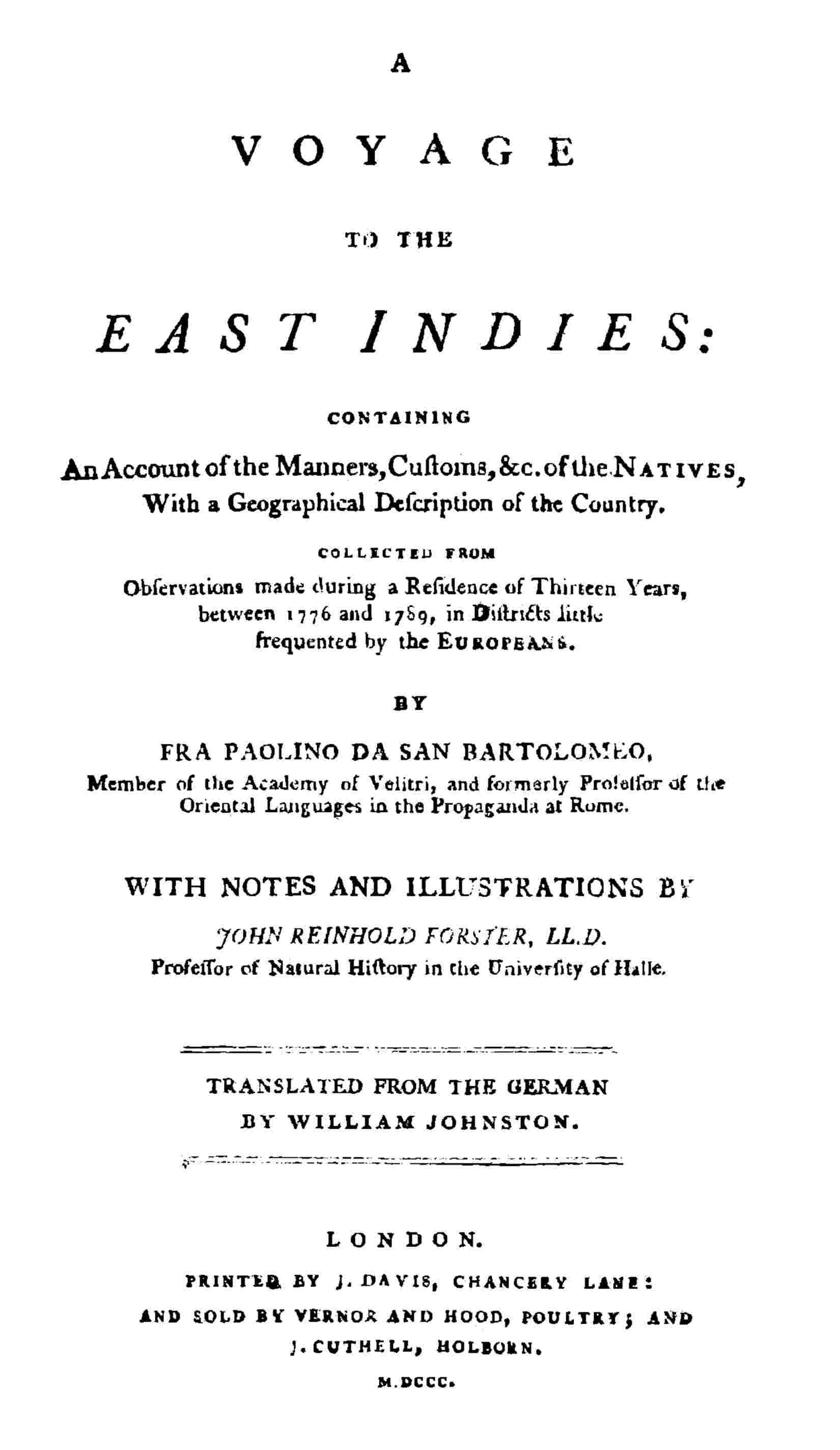
The original of this work appeared at Rome in the year 1796[1]. A German edition was published, in 1798, at Berlin, by the well-known Dr. John Reinhold Forster, with copious Notes; and from the latter the English Edition now offered to the Public has been translated. The Notes, a very few excepted, the Translator has retained, and it is hoped they will be found useful to illustrate various parts of the Text.
The author, Fra Paolino da San Bartolomeo, a barefooted Carmelite, resided thirteen years in India, and therefore may be supposed to have been well acquainted with the subject on which he treats. He was born at Hof, in the Austrian dominions, in 1748; and, before he embraced the monastic life, was known by the name of John Philip Wesdin. He was seven years Professor of the Oriental Languages in the Propaganda at Rome, and since his return from India has published several works relating to that country.
In regard to the present work, Dr. Forster, in his Preface to the German Edition, says:
“It is the more valuable, as the author understood the Tamulic or common Malabar language; and, what is of more importance, was so well acquainted with the Samscred, (a language exceedingly difficult,) as to be able to write a Grammar of it, which was published at Rome in 1790[2]. It appears from some of his quotations, that he understood also the English and French.
“His knowledge of the Indian languages has enabled him to rectify our orthography, in regard to the names of countries, cities, mountains, and rivers. The first European travellers who visited India were, for the most part, merchants, soldiers, or sailors; very few of whom were men of learning, or had enjoyed the advantage of a liberal education. These people wrote down the names of places merely as they struck their ear, and for that reason different names have been given to the same place in books of travels, maps, and military journals. To this may be added, that the authors were sometimes Dutch, sometimes French, and sometimes English; consequently each followed a different orthography, which has rendered the confusion still greater. The author of the present work thought it of importance to correct these errors; a task for which he seems to have been well qualified by his knowledge of the Indian dialects. Thus, for example, he changes the common, but improper, appellation Coromandel into Ciòlamandala, Pondichery into Puduceri, &c.; but the Reader ought to remember, that, as the author wrote in Italian, his c before e and i must be pronounced tch, &c.
“As the changed orthography of the names of countries, cities, and rivers, rendered a Geographical Index in some measure necessary, one has been added at the end of the work.—Readers acquainted with the tedious labour required to form such a nomenclature, and who may have occasion to use it, will, no doubt, thank the Translator for his trouble.”