
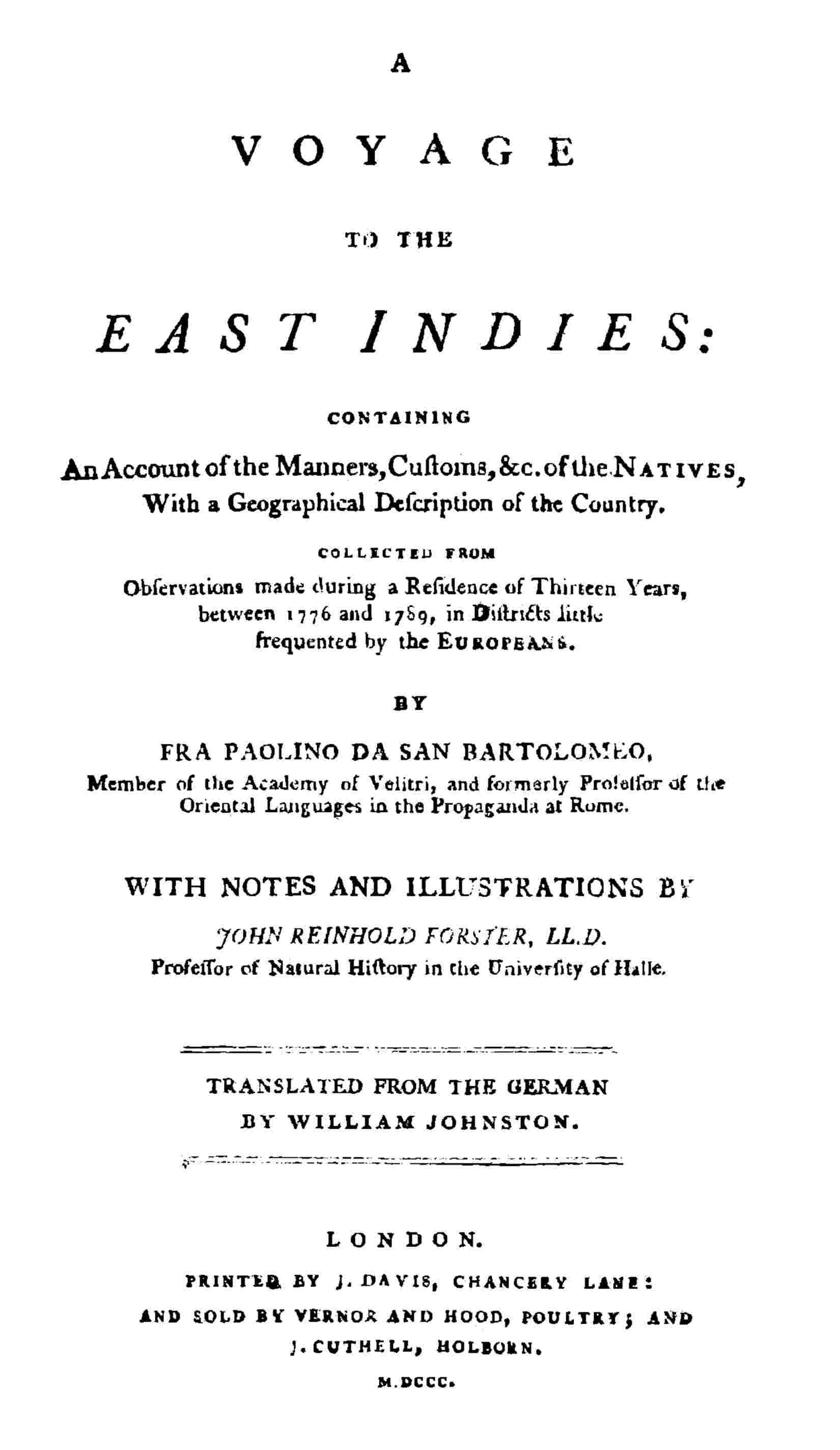
A
VOYAGE
TO THE
EAST INDIES.
BOOK I.
CHAPTER I.
Arrival at Puduceri (Pondichery)—Coast of Coromandel—Going on shore—Capuchins—Jesuits—Description of the City—Its trade—Fortifications—White ants—Bitter drops—Error of the heathens in regard to Christianity.
THE ship l’Aimable Nannette, commanded by Captain Berteaud, in which I sailed from l’Orient, arrived in the road of Puduceri[3] on the 25th of July 1776, after a tedious passage of six months and as many days. Our patience was, therefore, almost exhausted; and we longed not a little to set our feet once more upon dry ground. We directed our anxious looks towards the shore over the blue waves, and flattered ourselves with the hopes of reaching it that evening[4]: but, as the duration of the twilight is exceedingly short in India, night suddenly overtook us, disappointed the accomplishment of our wishes, and spread her dusky veil over both sea and land. At sun-rise next morning we saluted the citadel of Puduceri with eleven guns; a compliment which the garrison returned with nine, and at the same time hoisted the French flag.
The coast of Ciòmandala[5], which the Europeans very improperly call Coromandel, has at a distance the appearance of a green theatre. The sea-shore is covered with white sand; and a multitude of beautiful shells are here and there to be seen. The country is intersected by a great many rivers and streams, which flowing down from the high ridge of mountains on the west, called the Gauts, pursue their course towards the east, and discharge themselves into the sea; some with impetuosity and noise, others with gentleness and silence. In the months of October and November, when the rainy season commences, these streams are swelled up in an extraordinary degree, and sweep from the mountains a multitude of serpents, which, to the no small terror of the unexperienced traveller, they carry a great way out with them into the sea. This, in all probability, has given rise to the fabulous tales of sea monsters, which some pretend to have seen in the Indian ocean. The land here is covered, to a considerable distance, with trees of all kinds, and particularly that called by the Europeans the real Indian palm or the coco-nut tree. The Indians give it the name of tenga, and make much use of it for planting neat gardens, with which not only the coast of Malabar, but a great part of that of Ciòlamandala also is, in a manner, overspread. Various hamlets and villages are interspersed between these gardens, and the whole surrounding country delights the eye with never-fading verdure.
During my travels through India I found the climate every where mild and healthful; and in no place did I hear complaints of bad weather. The Indians generally sleep with their doors and windows open, except when there is any appearance of the Caracatta, which is a certain kind of wind that blows from the quarter of the Gauts. This chain of mountains begins at Cape Comari[6], in the eighth, degree of north latitude, and extends thence towards the north; so that it almost intersects India in the middle. The eastern part is called Ciòlamandala, that is, the land of millet[7]; the western Malayala, or the land of mountains. The latter is called by the Arabians and Europeans Malabar, or the Malabar coast. The Gauts, the highest ridge of mountains in this country, occasion that difference in the weather, and that remarkable change of seasons which take place on both these coasts. This is one of the most singular phenomena of nature ever yet observed. On the coast of Ciòlamandala the summer begins in June; but on the coast of Malabar it does not commence till October. During the latter month it is winter on the coast of Ciòlamandala, whereas on the coast of Malabar it begins so early as the 15th of June. The one season therefore always commences on the east coast at the time when it ends on the western. When winter prevails on the coast of Malabar; when the mountains and valleys are shaken by tremendous claps of thunder, and awful lightning traverses the heavens in every direction, the sky is pure and serene on the coast of Ciòlamandala: ships pursue their peaceful course; the inhabitants get in their rice harvest, and carry on trade with the various foreigners who in abundance frequent their shores. But when the wet season commences; when these districts are exposed, for three whole months, to storms and continual rains, hurricanes and inundations, the coast of Malabar opens its ports to the navigator; secures to its inhabitants the advantages of trade, labour and enjoyment; and from the end of October to the end of June presents a favourable sky, the serene aspect of which is never deformed by a single cloud. This regulation of nature appeared to Strabo, the geographer, altogether incredible; and he, therefore, abused those travellers who, on their return from India, asserted that in the course of the year, in that country, there were two summers and two winters. In this manner must the writers of travels often suffer by the ignorance of their readers[8]. “When I called in the aid of commentators to illustrate such passages,” says Chardin, “I every where observed the most palpable errors; for these people grope in the dark, and endeavour to explain every thing by conjecture.”
On the 26th of June I left the ship about noon, and, in company with M. Berteaud the captain, went on board a small Indian vessel of that kind called by the inhabitants shilinga. As it is exceedingly dangerous and difficult to land at Puduceri and Madraspatnam, these shilingas are built with a high deck, to prevent the waves of the sea from entering them. This mode of construction is, however, attended with one inconvenience, which is, that the waves beat with more impetuosity against the sides; raise the shilinga sometimes towards the heavens; again precipitate it into a yawning gulph, and, at length, drive it on shore with the utmost violence[9]. In such cases the vessel would be entirely dashed to pieces, if the Mucoas, or fishermen, who direct it, did not throw themselves into the sea, force it back by exerting their whole strength, and in this manner lessen the impetuosity of the surf. I was greatly alarmed before I reached the shore; and was so completely drenched by the waves, that the water ran down my back.
When I approached the city, I was exactly in the same state as if I had entered a furnace; for the sun had rendered the sand, with which the shore is covered, almost red hot. The reflection of his rays caused an insufferable smarting in my eyes, and my feet seemed as if on fire. I was met on the road by some Indian Christians, who conducted me to the convent of the Capuchins, in the southern extremity of the city. These good fathers were then employed in building: for the English, in the year 1764, had bombarded Puduceri from their ships lying in the road; and the poor Capuchins, as well as others, felt the effects of their vengeance, their church and convent being converted into a heap of ruins. The English, perhaps, were not acquainted with the maxims of the Pagan Indians, who consider it as an unpardonable crime to destroy the temple and house of God; for they say, Covil kettium tannir pandel kettium nashikarudàae; which may be thus translated: “It is never lawful to destroy a temple, and the halls in which travellers have lodged.” For want of room the Capuchins were not able to admit me into their convent, and therefore I repaired to the French missionaries, belonging to the so called Missions étrangères, who resided in the pagan quarter of the city. Here I found the procurators of this establishment, Messrs. Jallabert and Mouthon, by whom I was received with every mark of kindness and attention. After dinner I took a walk to the Jesuits’ college, where I saw Father Julius Cæsar Polenza, a learned Neapolitan, who was celebrated on account of his political talents, but still more on account of his knowledge of the Tamulic language; also Father le Fabre, Father Anzaldi; and fifteen other missionaries who had not long before assembled there, for the first time, from Tanjaur and Madura.
The governor of Puduceri, at that time, was M. Law de Lauriston, a man of very moderate principles, who perfectly understood the art of living in a state of peace and friendship, both with the English at Madraspatnam, and the Pagan Indians his neighbours. Few of those who preceded him in the government of Puduceri possessed the same virtue. On the contrary, most of them made it their chief study to endeavour to extend their dominion. This man’s prudence and moderation were not, therefore, approved by some of his hot-headed countrymen; and Sonnerat[10] inveighs bitterly against the friendly reception which Lord Pigot the governor of Madraspatnam experienced when he passed through Puduceri. Cum vitia prosunt, peccat qui recte agit—When vice thrives, those who act right become criminal.—The moderation of M. Law de Lauriston could not then fail to give offence to illiberal minds, subject to the impulse of their passions.
Puduceri, in my time, was a large and very beautiful city. The governor resided in an elegant palace. It was not uncommon to see a hundred covers on this gentleman’s table; and I once had the honour, together with M. Jallabert, of being invited to one of his entertainments. The city, towards the north and south, is defended by excellent fortifications, constructed in the year 1769, under the direction of M. Bourcet, who also formed the plan of them. In the southern part, some of the houses, inhabited by the Europeans, are exceedingly large and beautiful, and are ornamented with projecting galleries, balustrades, columns and porticoes. The European quarter is entirely separated from that of the Mahomedans and Pagan Indians. The latter live altogether in the western part. When a certain quarter is in this manner assigned to the Indians for their residence, one of their countrymen is always placed over them as a superintendant, who is obliged to preserve peace and good order among them, and to take care that they do not transgress the laws. At Cottate, Padmanaburam, Tiruvandapuram, Cayancollam, and other towns on the Malabar coast, the same establishment is made, that no strife or contention may arise among the various tribes, castes, and religious sects, on account of the difference of their manners and customs. Every one here is allowed to live in his own manner, and to enjoy his own belief; as it is not possible that so many classes and so many thousands of people should ever unite in one common system of religion[11].
The gate of the city towards the west was guarded by the so called sipoys (seapoys) or Indian soldiers, who consist of people of every caste, and of all religions. They were exercised according to the French manner. Hayder Aly Khan, that celebrated and formidable warrior, who reduced under his dominion Maissur, Carnate, Concao, Canara and Calicut, was originally a seapoy who did duty at this gate of Puduceri[12]. In that city he became first acquainted with the French tactics, which he afterwards employed not only against the Indian kings and princes, but against the Europeans; and it is not improbable that another Indian hero may arise in the course of time, and, in like manner, make use of the military discipline of the English, which that nation still teach to the native Indians. As the English and French in India are in a continual state of enmity, some enterprising Indian generally steps in between them, and attacks either the one or the other of the contending parties. Such was the conduct of Hayder Aly Khan’s son, Tippoo Sultan Bahader, who overran a considerable district in the southern part of India, and defeated the British troops in several engagements.
Puduceri was given up to the French, on the 15th of July 1630, by Rama Rajah a son of Sevagi king of the Marattas. This prince was sovereign of the province of Gingi, and possessed a fortress of the same name, which was situated among the mountains on the south of Puduceri. Rama Rajah had wrested this province, to which Puduceri belonged, from its original and lawful owner; and he resigned the city to the French on condition of their paying two per cent. on all the goods which should be there exported or imported. When Captain Ricaut established the French East India Company in 1642, he entered into partnership with twenty-four other merchants; and the only object of this society, as they then pretended, was to carry on trade in India. These merchants, however, shewed only too soon that their views were directed to things totally different. By little and little they began to extend their boundaries; endeavoured to get into their hands new possessions; from being merchants became warriors, and at last ventured to refuse the two per cent. which they had solemnly contracted to pay. This was done, in particular, after the year 1695, in which the Moguls took the fortress of Gingi[13]. There is just reason then to be surprised at the singular conduct of the Abbè Raynal, who throws out the bitterest reproaches against the Portuguese, as the first conquerors of India; and yet passes over, in perfect silence, what might be said of the violent proceedings of the other European nations, who certainly trod in the footsteps of the Portuguese. M. Dupleix, who was then governor of Puduceri, caused the Mogul to create him a nabob, that is an Indian chief or prince; and after that period the before-mentioned engagement and duty were, in the course of a few years, buried in oblivion. The haughtiness of the French still increased; the utmost degree of jealousy prevailed between them and the English; and a war was the consequence, in which the French soon lost their trade and their Indian possessions, which they afterwards recovered, and lost and recovered in turns. The Dutch East India Company, more attentive to its interest, and less inclined to war, possessed also several considerable settlements in India; but it excited much less jealousy, because it observed a peaceable conduct, and by these means acquired greater riches. In the year 1693, the Dutch took Puduceri, but restored it at the peace of Ryswick. In the year 1748 it was besieged by the English; and in 1761 it was taken by them, but given up at the peace of 1763. They made themselves masters of it a second time in 1778, when De Bellecombe was governor, but abandoned it afterwards in 1783. On the commencement of the French revolution it came under the dominion of the nabob Mohamed Aly prince of Arcate, a faithful adherent of the English; and ever since it has remained in his hands, or rather in the hands of the English. To such a state have the affairs of the French in India been reduced by their pride, their ambition and their rage for war! What benefits or advantages could France expect, as an indemnification for the monstrous sums which it was obliged to expend on this Indian colony, during its varied and ever changing fate? When in its most flourishing condition, it was said to contain, including the district belonging to it, about 20,000 inhabitants. Of these from four to five thousand, at least, were employed in collecting cotton; and in carding, spinning, weaving and printing it. By means of this industry the trade might have been so far improved that it would not only have sufficiently indemnified the Company for their expence, but have procured them the greatest advantages. On my arrival at Puduceri, five French ships were lying in the road, and the Aimable Nannette made the sixth. Some days after four others came to anchor. Three of these vessels were more than sufficient to supply the colony with every necessary; for three or four French merchants only resided in it. These ships were laden with wine, iron, cannon, fire-arms and French cloth. Now the Indians drink no wine, and their clothing consists of white cotton stuffs manufactured in their own country. How then did the French dispose of their commodities? They sold their wine, cloth, cannon, fire-arms, and, in a word, their whole cargoes to the English at Madraspatnam and Bengal, who employed these very cannon and arms against the French troops. On the other hand, the greater part of the money which the French received for these goods remained in India, as they purchased with it muslin, cotton stuffs, ginghams, sugar, pepper, cinnamon, cardamums, handkerchiefs, pearls, precious stones, and male and female slaves. Whether such a trade could be beneficial to France, I shall leave the reader to determine[14].
The garrison of Puduceri consisted of 4000 men. The city is situated on a sandy plain, not far from the shore, which produces nothing but palm trees, millet, and a few herbs; though the surrounding district produces cotton, with a little rice and capers. Neither Puduceri nor Madras atnam can be compared with the cities on the Malabar coast, in regard to abundance in provisions. On the coast of Ciòlamandala, which forms the eastern part of this peninsula, the heat is more intense, and the soil much sandier than any where else; and fewer rivers are found here, because it is too far distant from that ridge of mountains called the Gauts. To these circumstances it is to be ascribed that it produces very little cotton, and much less rice; that a greater trade is carried on here, while agriculture is neglected; and, in short, that its inhabitants are much more active and ingenious, handsomer, blacker, and more superstitious than on the coast of Malabar. The kingdom of Tanjaur forms, however, an exception; for this district is watered by several rivers that flow through it, and supplies with rice the whole coast of Ciòlamandala. The English, therefore, never ceased quarrelling with the Indian princes till they had reduced this kingdom under their subjection, as I shall soon relate in a more particular manner.
I remained at Puduceri till the 8th of September. During that time, which I employed in making myself acquainted with the geography of the country, the manufactures and manners of the Indians, I met with two incidents, which to me were new, and on that account excited more my astonishment. I had put all my effects into a chest which stood in my apartment, and being one day desirous of taking out a book in order to amuse myself with reading, as soon as I opened the chest I discovered in it an innumerable multitude of those white insects which the Tamulians, that is the inhabitants of the coast of Ciòlamandala, call Carea, and those of Malabar Cedel. They are the white ants which have been already described by naturalists, but which I never before had an opportunity of seeing[15]. When I examined the different articles in the chest, I unfortunately observed that these little animals had perforated my shirts in a thousand places; gnawed to pieces my books, and among others had already half destroyed a copy of Father Gazzaniga’s Theology; my girdle, my amice, and my shoes fell to pieces as soon as I touched them. The ants were moving in columns each behind the other, and each carried away in its mouth a fragment of my effects, As I expressed my astonishment by a loud shout, M. Jallabert ran into the room, and, seeing the swarms of these insects, repeatedly exclaimed, Carea! Carea! He then ordered my chest to be placed in the sun, and as soon as these careas found themselves exposed to his rays, they all speedily left it. My effects, however, were more than half destroyed; but it was very fortunate for me, on this occasion, that cotton goods are sold exceedingly cheap at Puduceri. One of the finest shirts, ready made, costs no more than five Roman paoli, or a rupee[16], according to the course of exchange in that settlement. I therefore clothed myself anew from head to foot, and with articles made of cotton.
One evening, a few days after, I had entered into a conversation with M. Jallabert on the religious ceremonies of the Heathens, and the properest means of converting them to the Christian faith; while his two servants had thrown themselves down on mats, spread out in the fore hall, in order to sleep. All of a sudden one of them began to scream out dreadfully; to beat his forehead; to stamp on the floor, and to roar and writhe his body like a madman. On asking him what was the matter, he pointed to one of his ears. We found on examination that a centipede had got into it; and the animal not being able to find its way out, kept pushing itself forwards, and gnawed the interior part of the ear. M. Jallabert immediately made the poor fellow lie down, and poured into his ear a spoonful of bitter drops (droga amara). The insect was dead in a moment; the patient’s pain and terror ceased, and, as soon as a little water was poured into his other ear, the centipede dropped out. These bitter drops are prepared in the following manner. You take mastic, resin or colophonium, myrrh, aloes, male incense, and calamba root, and pound them very fine when the weather is dry, that is to say when the north wind blows, which, in other parts of the world, supplies the place of what is here called the Caracatta. If you wish, therefore, to make a quantity of this medicine equal to 24 pints, you must take 24 ounces of resin or colophonium, 12 ounces of incense, 4 ounces of mastic, 4 ounces of aloes, 4 ounces of myrrh, and a like quantity of calamba root. Put all these ingredients into a jar filled with strong brandy, and keep it for a month in the sun during dry weather. If the brandy is sufficiently impregnated, it assumes a red colour, and the mass is deposited at the bottom. You then draw off the brandy very slowly, and bottle it up for use. One or two spoonfuls is the usual dose administered to sick persons. This medicine is of excellent service in cases of indigestion, colic, cramp in the stomach, and of difficult parturition; also for wounds and ulcers; against worms, and in scorbutic and other diseases which arise from corrupted juices. It is the best and most effectual remedy used by the missionaries during their travels. It is prepared in the apothecary’s shop of the ex-jesuits at Puduceri; at Verapoli by the barefooted Carmelites; and at Surat by the Capuchins. I myself cured with these drops a young man who was almost totally deaf. After pouring two spoonfuls of them into his ear, a cylindric piece of a hard yellow substance came from it, and the patient immediately recovered the perfect use of his hearing.
As I resided in the Pagan quarter of the city, I was visited by several young Indians; some of whom were heathens, and others professors of Christianity. Some of them spoke exceedingly good French; but others, who had received instruction from the Jesuits, spoke Latin. From this I concluded that the Indians are by nature well qualified for study; and that the Indian dialect facilitates, in an eminent degree, their acquiring the European languages. Those who were still heathens, boasted much of their theology; and extolled above all measure their learned language, which they call the Samscred. This confirmed me so much the more in the resolution I had formed of learning it, let it cost me whatever labour it might. I observed, however, at the same time, that these young people, either from ignorance or perversity, frequently confounded the doctrine and principles of Christianity with the doctrine and principles of Paganism. Thus, for example, they said that their female divinity Lakshmi was our Virgin Mary, and that Brahma, Vishnu, and Shiva, represented our Trinity; that we paid to images as much adoration as they did; and that our solemn processions were in nothing different from theirs[17]. I shall hereafter convince the reader of the falsity of this assertion, and shew how highly important it is that the missionaries should make themselves well acquainted with the religious doctrines of the Indians, in order to open the eyes of these people, so worthy of pity, and to convert them to the Christian faith[18]. They deceive not only themselves, but others; for, as they endeavour to lay to the charge of the Christian religion their own absurd tenets, they do not think it necessary to embrace it; and as they assert that there is no difference between their belief and ours, they mislead other Christians, who then imagine that the religion of the Pagan Indians is nothing else than Manicheism, or corrupted Christianity; and this error arises, like the former, from perverted principles and fables.
As the Pagans, Mahometans, and Christians in India all wear white cotton dresses, and made almost in the same manner, you must look very closely at their forehead, or breast, if you wish to distinguish an Idolater from a Christian. The former have on the forehead certain marks which they consider as sacred, and by which you may know to what sect they belong, and what deity they worship. In the second book I shall explain all these marks[19].