
CHAPTER XI.
SHADY LANES.—RURAL SKETCHES.—HEREFORDSHIRE AND MONMOUTHSHIRE SCENERY.—POINTS OF DIFFERENCE IN ENGLISH AND AMERICAN LANDSCAPES.—VISIT TO A FARM-HOUSE.—THE MISTRESS.—THE FARM-HOUSE GARDEN.—A STOUT OLD ENGLISH FARMER.—THE STABLES AND STOCK.—TURNIP CULTURE.—SHEEP.—WHEAT.—HAY.—RENTS.—PRICES.—A PARTING.—CIDER.
We soon turned off the main road, and pursued our way for several miles by narrow, deep, shady lanes, our conductor giving us much information about the agriculture of the district and the habits and character of the people, ever and anon, also, finding occasion from some incident or spectacle that engaged our attention, for instructive and godly discourse, in such a way as I have endeavoured to show his habit in the last chapter; not tediously, and to the interruption of other thoughts and conversation, but naturally and cheerfully.
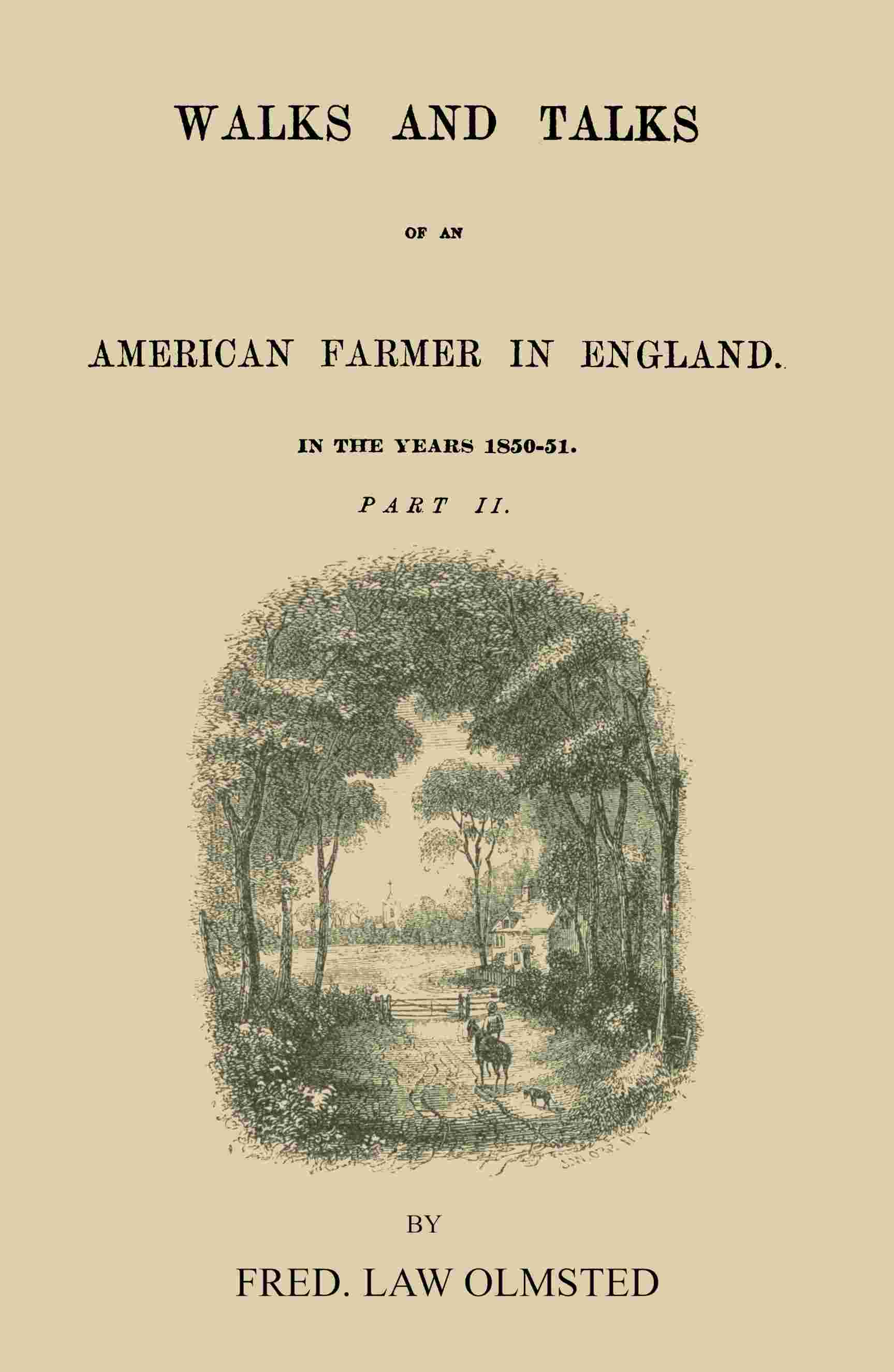
It was a rarely clear, bright, sunshiny afternoon, and while on the broad highway we found, for the first time in England, the temperature of the air more than comfortably warm. The more agreeable were the lanes;—narrow, deep, and shady, as I said, often not wider than the cart-track, and so deep, that the grassy banks on each side were higher than our heads; our friend could not explain how or why they were made so, but probably it was by the rain washing through them for centuries. On the banks, too, were thickly scattered the flowers of heart’s-ease, forget-me-not, and wild strawberries; above, and out of them, grew the hawthorn hedges in thick but wild and wilsome verdure, and pushing out of this, and stretching over us, often the branches mingling over our heads and shutting out the bright blue sky clear beyond the next turn, so we seemed walking in a bower, thick old apple and pear trees with pliant twigs of hazel-wood, and occasionally the strong arms of great bending elms. Now and then a break in the hedge-row, and, a little back, a low, thick-thatched cottage with many bends in the ridge-pole, and little windows, and thick walls; a cat asleep in the door, and pigs and chickens before it, and, lying on the ground, in the dust of the lane, playing with a puppy, two or three flaxen-haired, blue-eyed children; a little further, a drowsy old she-ass standing in the shade, and a mouse-coloured foal, as little as a lamb, but with a great head and large, plaintive dark eyes, and a most confiding, meek, and touching expression of infantile, embryo intellect.
Now and then, too, the hedge gives way to the wall of a paddock or stack-yard, and beyond it are a number of old and often dilapidated hovels, sheds, and stables, clustering without any appearance of arrangement about a low farm-house with big chimneys, wide windows, and a little porch half hidden under roses, jessamine, and honeysuckle.
And sometimes at these a big dog would bay at us, and, a woman coming to the door, our friend would turn up and ask, “How is the master and the little ones?” and in return be asked, “How is good mistress and young master?” And then we would be presented as strangers, that had come over the sea to view this goodly land, and would be asked, in pitying tones, about famine, and fever, and potatoes, the farm-wife, although she had an exceedingly sweet speech, apparently confusing New York with Connaught or Munster.
Again, broad fields, and stout horses, and busy labourers, and straight plough-furrows, or the bright metallic green of luxuriant young wheat and barley in broad glades of glancing light; and a stout old man, who waddles towards us with a warm greeting, also wiping the sweat from his brow, and mounting “a goodish bit of stuff, though she has seen twenty winters,” rides for a little way along with us, breathing hard and speaking huskily; grumbling, grumbling at every opening in the conversation at Free Trade and high rents, but answering all our questions about his draining, and boneing, and drilling, and dibbling, and very frankly acknowledging how much he has been able to increase his crops with new-fashioned ways and new-fangled implements.
Then leaving the lane, we take a foot-path, which, crossing the hedges by stiles, leads through old orchards, in all of which horses and cattle are pasturing; and there are beautiful swells of the ground, and sometimes deep swales of richer green, with rushes and willows growing at the bottom. Reaching a steeper hill-side, we enter a large plantation of young forest trees, and soon pass all at once into an older growth of larger and more thinly standing wood; and near the top of this, find a clearing, where men are making faggots of the brushwood, and stripping bark from the larger sticks, and some little boys and girls are picking up chips and putting them into sacks.
We reach another lane and cultivated fields again, and, being on elevated ground, at the knarly feet of a glorious, breezy, gray, old beech-tree, lay ourselves down, and, looking back upon the extensive landscape, tell our friend in what it differs from American scenery.
The great beauty and peculiarity of the English landscape is to be found in the frequent long, graceful lines of deep green hedges and hedge-row timber, crossing hill, valley, and plain, in every direction; and in the occasional large trees, dotting the broad fields, either singly or in small groups, left to their natural open growth, (for ship-timber, and, while they stand, for castle shades,) therefore branching low and spreading wide, and more beautiful, much more beautiful, than we often allow our trees to make themselves. The less frequent brilliancy of broad streams or ponds of water, also distinguishes the prospect from those we are accustomed to, though there are often small brooks or pools, and much marshy land, and England may be called a well-watered country. In the foreground you will notice the quaint buildings, generally pleasing objects in themselves, often supporting what is most agreeable of all, and that you can never fail to admire, never see any thing ugly or homely under, a curtain of ivy or other creepers; the ditches and the banks by their side, on which the hedges are planted; the clean and careful cultivation, and general tidiness of the agriculture; and the deep, narrow, crooked, gulche-like lane, or the smooth, clean, matchless, broad highway. Where trees are set in masses for ornament, the Norway spruce and the red beech generally give a dark, ponderous tone, which we seldom see in America; and in a hilly and unfertile country there are usually extensive patches of the larch, having a brown hue. The English elm is the most common tree in small parks or about country-houses. It appears, at a little distance, more like our hickory, when the latter grows upon a rich soil, and is not cramped, as sometimes in our river intervals, than any other American tree.
There seems to me to be a certain peculiarity in English foliage, which I can but little more than allude to, not having the skill to describe. You seem to see each particular leaf, (instead of a confused leafiness,) more than in our trees; or it is as if the face of each leaf was parallel, and more equally lighted than in our foliage. It is perhaps only owing to a greater density, and better filling up, and more even growth of the outer twigs of the trees, than is common in our drier climate. I think that our maple woods have more resemblance to it than others.
There is usually a much milder light over an English landscape than an American, and the distances and shady parts are more indistinct. It is rare that there is not a haziness, slightly like that of our Indian summer, in the atmosphere, and the colours of every thing, except of the foliage, are less brilliant and vivacious than we are accustomed to. The sublime or the picturesque in nature is much more rare in England, except on the sea-coast, than in America; but there is every where a great deal of quiet, peaceful, graceful beauty, which the works of man have generally added to, and which I remember but little at home that will compare with. This Herefordshire reminds me of the valley of Connecticut, between Middletown and Springfield. The valley of the Mohawk and the upper part of the Hudson, is also in some parts English-like.
Descending into a broad, low tract of dale-land, we came at length to the farm occupied by a relative of our guide, which we were going to visit. A branch of the lane in which we had been for some time walking, ran through the farm, and terminated at the farm-house. It was more picturesque and inconvenient, deeper, narrower, and muddier, than any we had before been through. It was explained to us that it was a “parish road”—although leading to but one house—and, therefore, the farmer was not responsible for its bad repair.[14] Great trees grew up at its side, and these the farmer was not allowed to fell or trim—the landlord estimating the value of their increase as timber or for fuel, or their advantage as a nursery of game, higher than the injury they caused to the crops in the adjoining fields. Near the house the road or lane widened, and one side was lined by a thick symmetrical yew-hedge, separating it from a garden; on the other side, however, the trees and high bank still continued, and two stout horses were straining every muscle to draw a cart-load of crushed bones through the mire, which reached close up to the gable-end of the house. Opposite the house was a cider-mill, cart-sheds, and some stacks: behind it, a large court, surrounded by stables, sties, dairy-house, malt-house, granary, &c. Into this enclosure we passed by a great gate: a considerable part of it was occupied by a large heap of manure and a pool of green stagnant liquid. The buildings were mostly old, some of them a good deal decayed, with cracks in the brick-work, timber bending and sustained by props and other patch-work, which spake better for the tenant than his landlord.
[14] In the proceedings of a Parliamentary Commission of the last century, the following questions and answers are recorded:
Q. What sort of roads have you in Monmouthshire?
A. None at all.
Q. How do you travel then?
A. In ditches.—Survey of Monmouth.
By a wide open door, directly from this filthy yard, we passed without ceremony into the kitchen—a large, long room with stone floor, black beams across the low ceiling, from which hung sides and hams of pork, a high settle, as usual, but not the ordinary kitchen display of bright metal and crockery. Old and well worn, every thing, but neat and nice as brand-new. On a table was a huge loaf with a large piece of cold fat bacon and a slice of cheese, and directly a maid came up from the cellar and added to these viands a pint of foaming beer—dinner or supper for the carter just returning from the town, whither he had gone early in the morning with a load of wool, and had now brought back bone-manure.
We are seated in a little parlour, and the “wench” (a buxom serving-maid) goes to call the mistress. The parlour is a small room neatly furnished, but not as expensively as it would be in most substantial farmers’ houses with us; painted deal chairs, a painted-calico-covered lounge, the floor carpeted, and the walls papered; an oak writing-desk, a table, and a sewing-stand; no newspapers or books, but a family-bible on the mantel and an almanac on the desk; a door and a window open from it upon the flower-garden.
In a few minutes the mistress enters, and, after kindly receiving us, rings a bell, and, when the maid comes, gives her a key and tells her to bring cider. After short refreshment, she takes us into the garden. A pleasant garden, with some very large and fine pansies, some roses, and great promise of more. It is extremely neat, clean, and finely kept, and it is the pride of the mistress that she takes the entire care of it herself; as we walk, she has her scissors in her hand, and cuts flowers, and when we are seated in a curious little arbour of clipped yew, where she had left her “work” when she came in to see us, she arranges little nosegays and presents them to us.
The house is small in size; the walls are of plain red brick; the roof of slate, neither very steep-pitched nor flat; the chimneys and windows of the usual simple American country-house form and size. There is no porch, veranda, gable, or dormer, upon the garden side, yet the house has a very pleasing and tasteful aspect, and does not at all disfigure the lovely landscape of distant woody hills, against which we see it. Five shillings’ worth of materials from a nursery, half-a-day’s labour of a man, and some recreative work of our fair and healthy hostess’ own hands, have done it vastly better than a carpenter or mason could at a thousand times the cost. Three large evergreen trees have grown near the end of the house, so that, instead of the plain, straight, ugly red corner, you see a beautiful, irregular, natural, tufty tower of verdure; myrtle and jessamine clamber gracefully upon a slight trellis of laths over the door; roses are trained up about one of the lower windows, honeysuckle about another, while all the others, above and below, are deeply draped and festooned with the ivy, which, starting from a few slips thrust one day into the soil by the mistress, near the corner opposite the evergreens, has already covered two-thirds of the bare brick wall on this side, found its way over the top of the tall yew-hedge, round the corner, climbed the gable-end, and is now creeping along the ridge-pole and up the kitchen chimney—which, before speaking only of boiled bacon and potatoes, now suggests happy holly-hangings of the fireside and grateful harvest’s home, hides all the formal lines and angles, breaks all the stiff rules of art, dances lightly over the grave precision of human handiwork, softens, shades, and shelters all under a gorgeous vesture of Heaven’s own weaving.
Soon, while we are sitting in this leafy boudoir, comes the master, as good a specimen of the stout, hearty, old English farmer as we shall find, and we go—the lady and all—to look at the horses, cows, and pigs. The stables are mostly small, inconveniently separated, and badly fitted up, and there is but little in them to boast of in the way of cattle; but there is one new building, incongruously neat among the rest, and in this there are some roomy stalls, with iron mangers, sliding neck-chains, and asphalte floor with grates and drain. Here was the best stock of the farm: among the rest, a fine, fat Hereford cow, which had just been sold to the butcher for $60, and a handsome heifer of the same blood, heavy with calf, which had been lately bought for $15, the farmer chuckling as he passes his hand over her square rump, as if it had been a shrewd purchase. He valued his best dairy cow at $45.
We then go to the cider-mill and the sheds to look at some implements; next to the ground, at some distance, where the labourers are all at work ridging for turnips, (Swedes, or Ruta-baga.) The larger part of the field is already planted, and in some other fields the young plants are coming up. The crop of the farm this year is to be grown on one hundred acres, the whole area of the farm being less than three hundred.
The soil of this field is a fine, light, pliable loam. It has been the year previous in wheat; the stubble was turned under soon after harvest with a skim-coulter-plough, an instrument that pairs off the surface before the mould-board of the plough and throws it first to the bottom of the furrow: the operation may be described as a superficial trench-ploughing; cross-ploughed and scarified again the same season with one of the instruments described at page 182, Vol. I. In the spring, ploughed again, (eight inches deep,) harrowed fine and smooth, thrown into ridges with double mould-board plough, rolled, and finally drilled with a two-horse machine that deposits and covers manure and seed together. The manure is ground bones, costing in Hereford 60½ cents a bushel, mixed with sifted coal-ashes. The expense of this application is about $12 an acre, but it must be remembered that the ground is already in high condition. The drills are thirty inches apart. The crop is principally used to fatten sheep, of which 500 are kept on the farm; the breed, Cotswold and Leicester.
We next went to a paddock in which were six Cotswold “tups,” (bucks,) as handsome sheep (of their kind) as I ever saw. One of them I caught and measured: girth behind the shoulders, exactly five feet; length from muzzle to tail, four feet and eleven inches.
Then to the wheat, of which there was also about one hundred acres, part after turnips and part after potatoes: the former, which had been boned, looked the best. A part of the land had been prepared by a presser, (a kind of roller used to give solidity to light soils,) and this was decidedly superior to the remainder. Most of the wheat was put in with drilling machines, of which there were two used, one sowing at greater intervals than the other. Some of the wheat upon the pressed land, after turnips, was the finest we have seen. The farmer expected it to yield forty bushels of seventy pounds each, but would consider an average of thirty, from the hundred acres, a very good crop. He said the average crop of the county was thought to be but eighteen and a half bushels.
Walked through some pastures and a grass-field, and examined the hay in stacks; mostly rye-grass. The hay-fields yielded one to two and a quarter tons an acre, the average being under two tons. It took about four days to cure it after cutting, and the whole cost of hay-making was about four dollars an acre. Hay from the stack, of the best quality, would sell at this time in the city of Hereford for twelve dollars a-ton.
The rent of this farm was seven dollars and a half an acre; tithes, one dollar and a quarter an acre; road-rates, seventy cents an acre; all paid by the farmer, together with poor-rates and other burdens.
A good pair of sound, well-broken, but rather light, cart-horses, cost here $185; horse-cart, $60; harness and gear for each horse, $12. A smith will keep a horse shod for $5 a year. Insurance of horses in the Royal Farmers’ Company, 2½ per cent. of value per annum.
After taking tea at the farm-house, our kind guide, Brother ——, made ready to depart by stuffing some tracts, publications of the Brethren, mostly of a meditative character, into our packs; we might learn more of their ideas from them, he said, and if they did not interest us, or after we had read them, it might do some one else good to leave them at the inns where we stopped, or in the public conveyances. He begged us if we got into any trouble or needed any assistance for any purpose while in England, to let him know; and so we parted. We had never heard of this man, nor he of us, till twenty-four hours before. He had then merely received word that three American Christians—wayfarers—would be passing through his town that night, and so he came out into the highway seeking for us, found us, and had so entertained us as I have shown. He would now walk several miles alone and return home by the night-coach.
The farmer now had his favourite greyhound let out for us to see, and after another short stroll, finding that we were bent upon leaving him that night, insisted on our coming to the garden again and tasting some choice cider made from the Hagloe crab—the pure juice he assured us it was—a good wholesome English drink: a baby might fill its belly with it and feel none the worse. So sitting on the door-steps, the lady and the dog with us, we remained yet a long time, the farmer talking first of sporting matters, and then getting into the everlasting topics of Free Trade, and exorbitant rents, taxes, and tithes.