
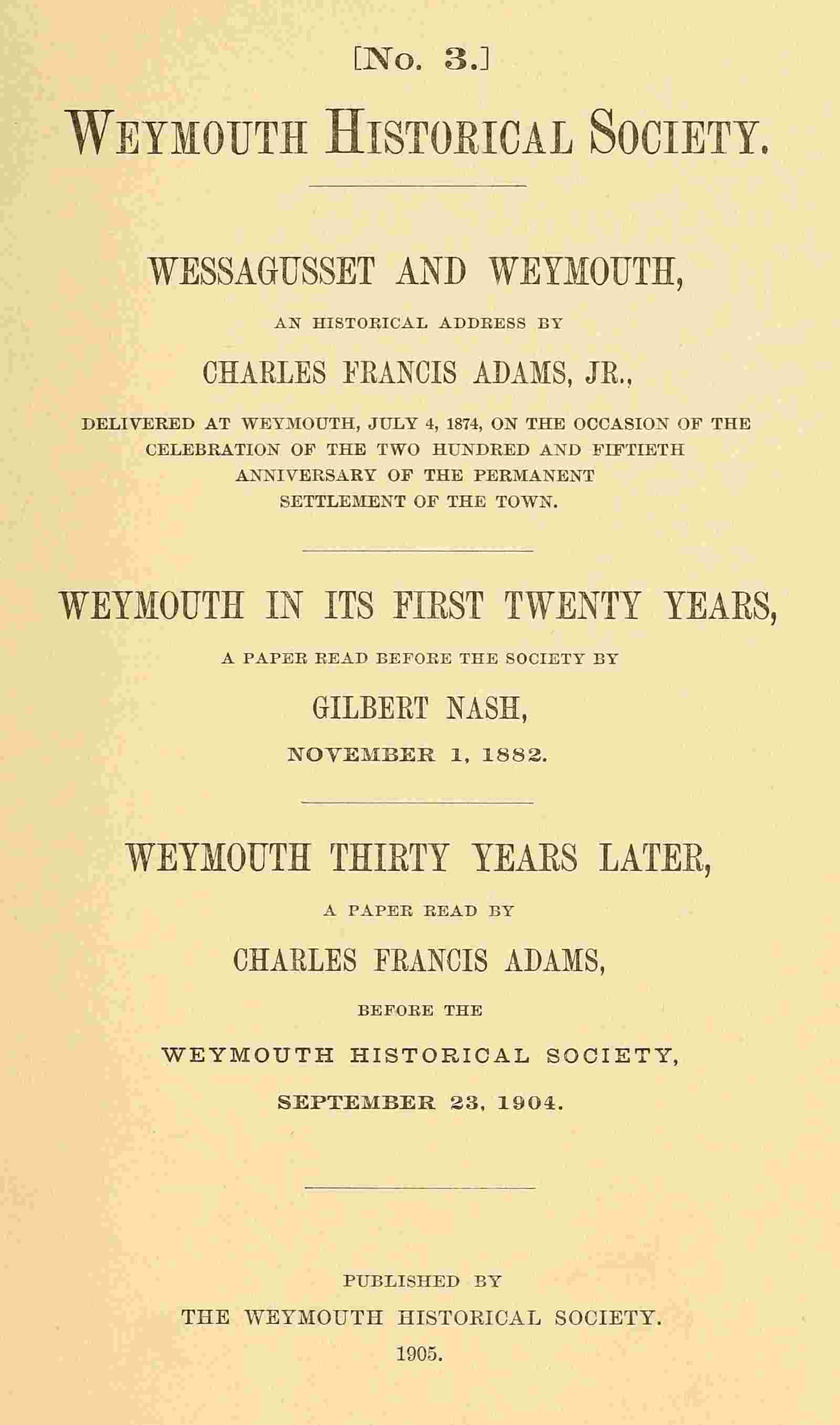
HISTORICAL ADDRESS
BY
CHARLES FRANCIS ADAMS, Jr.,
JULY 4, 1874.
Full in sight of the spot where we are now gathered,—almost at the foot of King-Oak Hill,—stands that portion of the ancient town of Weymouth, known from time immemorial as the village of Old Spain. When or why it was first so called is wholly unknown,—scarcely a tradition even remains to suggest to us an origin of the name. None the less Old Spain well deserved a portion at least of that familiar title, for, next to the town of Plymouth, it is the oldest settlement in Massachusetts. And when we speak of the oldest settlements in Massachusetts, we speak of communities which may fairly lay claim to a very respectable degree of antiquity; not of the greatest, it is true, for all antiquity is relative, and that of America scarcely deserves the name by the side of what England has to show; but what is the antiquity of England compared with that of Rome?—and Rome, again, seems young and crude when we speak of Greece; while even those who fought upon the ringing plains of windy Troy are but as prattling children in presence of the hoary age of the Pharaohs. The settlement of Old Spain and of Weymouth is, therefore, ancient only as things American are ancient; but still two hundred and fifty years of time carry us back to events and men which seem sufficiently remote. When the first European made his home in Old Spain,—when the earliest rude hut was framed on yonder north shore of Phillips Creek,—the modern world in which we live was just assuming shape. Few now realize how little of that which makes up the vast accumulated store of human possessions which we have inherited from our fathers—which to us is as the air we breathe,—had then existence. The Reformation was then young,—Luther and Calvin and Erasmus were men of yesterday; the life-and-death struggle with Catholicism still tortured eastern Europe. The thirty years’ war in Germany was just commenced, and the youthful Gustavus Adolphus had yet to win his spurs. The blood of St. Bartholomew was but half a century old, and the murder of Henry IV. was as near to the men of 1622 as is that of Abraham Lincoln to us. The great Cardinal-Duke was then organizing modern France; Charles I. had not yet ascended the English throne; Hampden was a young country gentleman, and Oliver Cromwell an unpretending English squire. While men still believed that the sun moved round the earth, Galileo and Kepler were gradually ascertaining those laws which guide the planets in their paths; Bacon was meditating his philosophy; Don Quixote was a newly published work, with a local reputation; and Milton, not yet a Cambridge pensioner, was making his first essays at verse. Shakespeare had died but six years before, and, indeed, the first edition of his plays did not appear until the very year in which Weymouth was settled. Thus, in 1622, our world of literature, of science, almost of history, was yet to be created. Hardly a single volume of our current English literature was then in existence, and people might well con their Bibles, for, in the English tongue, there was little else to read.
Meanwhile the North American continent was an unbroken wilderness, with here and there, few and far between, from the St. Lawrence to the Gulf, scattered specks of struggling civilization, hundreds of leagues apart, dotting the skirts of the green, primeval forest. It was at not the least famous of these scattered specks,—at the neighboring town of Plymouth,—that the history of Weymouth opened on a day towards the latter part of the month of May, in the year 1622. The little colony had then been established in its new home some seventeen months. They had just struggled through their second winter, and now, sadly reduced in number, with supplies wholly exhausted, and sorely distressed in spirit, the Pilgrims were anxiously looking for the arrival of some ship from England. The Mayflower had left them, starting on her homeward voyage a year before, and once only during their weary sojourn, in the month of the previous November, had these homesick wanderers on the sandy Plymouth shores been cheered by any tidings from the living world. On this particular day, however, the whole settlement was alive with excitement. There had been great trouble with the neighboring Indians, and the magistrates were on the point of delivering one of them up to the emissaries of his sachem to be put to death, when suddenly a boat was seen to cross the mouth of the bay and disappear behind the next headland.[1] There had been rumors of trouble between the English and the French, and the first idea of the settlers was that some connection existed between the sachem’s emissaries and those on board the boat. The delivery of the prisoner was consequently deferred. At the same time, a shot was fired as a signal, in response to which the boat changed her course, and came into the bay. When at last it touched the shore it was found to contain ten persons, who announced themselves as being in the service of one Mr. Thomas Weston, a London merchant, well known to the elders of Plymouth. They were cordially welcomed with a salute of three volleys of musketry, and thus finished a somewhat dangerous voyage.[2] It appeared they had been dispatched from England some months before, on board a vessel named the Sparrow, which belonged to Mr. Weston, and was bound to the fishing grounds off the coast of Maine: they were, in fact, the forerunners of a larger party which Weston was organizing in London, with the design of establishing a trading settlement somewhere on the shores of Massachusetts Bay. They brought with them letters to the Plymouth magistrates, but they were wholly unprovided with either food or outfit. The Sparrow was one of the fishing fleet which yearly visited those waters, and apparently Weston’s plan had been for these people to leave her near the Damariscove Islands, and thence to find their way by sea to Plymouth, examining the coast as they went along with a view to settlement. There was something curiously reckless in the methods of those old explorers. Weston himself afterwards sought to reach Plymouth in the same way, and encountered many strange adventures by sea and land before he got there. In the present case his messengers do not appear either to have been seafaring men, or especially selected for the work they had to do. It was not until they were actually leaving the Sparrow for their voyage of one hundred and fifty miles in the North Atlantic that they seemed to realize their own utter helplessness, and the extreme vagueness of their errand. Fortunately for them, however, the mate of that vessel was a daring fellow, and volunteered to venture his life as their pilot. They accordingly set sail in their shallop, skirting along the coast. They touched at the Isle of Shoals and at Cape Ann, and thence they ran for Boston harbor, where they passed some four or five days exploring. They selected the southerly side of the bay as the best place for the proposed settlement, as in these parts there seemed to be the fewest natives, and made a bargain with the sachem Aberdecest for what land they needed;[3] but, getting uneasy at the smallness of their number, they determined to go to Plymouth, in hopes of getting news of the larger enterprise. Disappointed in this, they landed to await events. The shallop, accompanied by a Plymouth boat in search of supplies, returned to the fishing fleet, and its seven passengers were, for the time being, incorporated with the colony, and fared no worse than others.
Meanwhile Mr. Weston had organized his larger expedition, and it was already on the sea, having sailed from London about the 1st of April. Thus Thomas Weston played a very prominent part in the early settlement of Weymouth, as he had already done in that of Plymouth. He was always called a merchant, but in fact he was a pure sixteenth century adventurer of the Smith and Raleigh stamp,—a man whose brain teemed with schemes for the deriving of sudden gain from the settlement of the new continent. We first get sight of him in Leyden in connection with the Pilgrim fathers,—the treasurer, the representative, the active, moving spirit of the company of Merchant Adventurers of London, who then were looking for the material with which to effect a settlement within the Virginia patent. Mr. Treasurer Weston had some acquaintance with the Leyden exiles, and, knowing how dissatisfied they were with their experience in Holland, he had pitched on them as the best material for the work in hand. They were then negotiating with the Dutch government for a grant of lands in what is now New York. Weston persuaded them to abandon this scheme, promising them, on the part of his associates, aid, both in money and in shipping. When the Speedwell arrived at Southampton from Delfthaven, bearing the fortunes of the little colony between its decks, it was Weston who came down from London to arrange the last details of the adventure. But the meeting was not a propitious one. The parties fell out as to certain alterations proposed to the original agreement between them, and Weston returned to London, telling the emigrants as a parting word that they must expect no further aid from him. Out of this disagreement grew the scheme of another and independent settlement. Weston apparently concluded that he had made a mistake in his choice of agents. A mere adventurer, he looked only to pecuniary results. The return of the Mayflower in the spring of 1621 without a cargo was a great disappointment to him, and he did not delay writing to the struggling settlers that a good return cargo by the next ship was absolutely essential to the life of the enterprise. They did make an effort, therefore, to load the Fortune with such articles as the country afforded, but before the venture reached England Weston had abandoned the Plymouth colony in disgust, sold out his interest in the Merchant Adventurers’ company and was already meditating his new and rival enterprise. He cared more for beaver-skins in hand than for empires hereafter, and the Plymouth people appeared to him to discourse and argue and consult when they should have been trading.[4] His confidence in the success of a trading post on Massachusetts Bay was not shaken, but he shared in the general belief of the day that families were an incumbrance in a well organized plantation, and that a settlement made up of able-bodied men only could do more in New England in seven years than in Old England in twenty.[5] On this principle he organized his expedition, which, towards the close of April, 1622, set sail in two vessels, the Charity of one hundred tons and the Swan of thirty. It went under the charge of Weston’s brother-in-law, one Richard Greene, and was made up of the roughest material, miscellaneously picked up in the streets and on the docks of London; among them, however, there was one surgeon, a Mr. Salisbury, and a lawyer from Furnival’s Inn, afterwards very notorious in early colonial annals, one Thomas Morton, better known as Morton of Merry Mount.[6] Such as they were, however, they safely landed at Plymouth towards the end of June,—some sixty stout fellows, without apparently the remotest idea why they had come or what they had come to do. Naturally the old settlers did not look upon them as a very desirable accession to the colony, especially as they early evinced a disinclination to all honest labor and an extremely well developed appetite for green corn.[7] Having landed them, the larger ship sailed for Virginia, and during her absence preparations were completed for removing the party to the site selected for its operations at Wessagusset, as Weymouth was then called. In the course of a few weeks the ship returned, the healthy members of the expedition were taken on board and sailed for Boston Bay. The Plymouth people saw them disappear with much satisfaction, and expressed no desire to have them return.
It was August before the party reached its permanent quarters. There is no record of the exact spot on which they placed their settlement, but a very general tradition assigns it to the north side of Phillips Creek[8]. Not improbably there was a better draught of water in that inlet than now; but it is well established that the locality was to the south of the Fore River, and the very sheltered character of the creek would naturally have suggested it to the explorers for the object they had in view. But wherever the exact locality may have been, the adventurers found themselves towards the end of September sufficiently established in it to let the larger ship, the Charity, return to England. The smaller one, the Swan, had been designed for the use of the plantation,—it was indeed the chief item of their stock in trade,—and it now remained moored in Weymouth River. The Charity had left the party fairly supplied for the winter,[9] but they were a wasteful, improvident set, and they were hardly left to their own devices before they were made to realize that they had already squandered most of their resources, though the winter was not yet begun. They accordingly bethought themselves of the people of Plymouth, and wrote to Governor Bradford proposing a trading voyage on joint account in search of corn,—they offering to supply the vessel while the Plymouth people were to furnish the quick capital needed, in the shape of articles of barter. The offer was accepted, and in October the expedition set out, with Standish in command and the Indian Squanto acting as guide. The intention was to weather the cape and trade along the south coast, but they were driven back by adverse winds, and then Standish fell sick of a fever and had to give up the command. Governor Bradford took his place and again the Swan started out; but it was November now, and the back side of Cape Cod shewed a rougher sea than they cared to face, so they prudently put about and ran into Sandwich Bay. Here Squanto, the Indian guide, fell sick and died, bequeathing his few effects to his English friends and praying that he might find rest with the Englishman’s God.[10] Here and elsewhere, however, the partners secured some twenty-six or twenty-eight hogsheads of corn and beans, and with that were fain to return. An equal division was made, and the Swan again came to her moorings in Weymouth Fore River.
The relief she brought with her was, however, only temporary; disorder and waste in that settlement were chronic. Greene had died in Plymouth while they were preparing for the trading voyage, and a man named Sanders had succeeded him in control. Either he was incompetent or his people were very hard to manage; but, in either case, the squandering of the supplies continued, and the prudent Plymouth settlers complained that, through improvident dealings with the Indians, their neighbors ruined the market, giving for a quart of corn what before would have bought a beaver-skin.[11] At length, however, about the beginning of the New Year, the Wessagusset plantation found itself face to face with dire want. The hungry settlers bartered with the Indians, giving everything they had for food; they even stripped the clothes from their backs and the blankets from their beds. They made canoes for the savages, and, for a mere pittance of corn, became their hewers of wood and drawers of water.[12] During that long and dreary winter they must heartily have wished themselves back in the slums of London. Weymouth Fore River, in that season, must then have been very much what we so well know it to be now. Doubtless the cold tide ebbed and flowed before the rude block-house, now lifting on its bosom huge heaps of frozen snow and ice, and then again bearing them in great unsightly blocks swiftly out to sea. The frost was in the ground; the snow was on it. So, through the long, hard, savage winter, those seventy poor hungry wretches shivered around their desolate habitations, or straggled about among the neighboring wigwams in search of food. Their ammunition was nearly exhausted so that they could not kill the game. They ransacked the woods in search of nuts; and they followed out the tide, digging in the flats for clams and muscles. But, insufficiently supplied with clothes, they could not endure the winter’s cold in this slow search for food, and one poor fellow while grubbing for shell-fish sank into the mud, and, being too reduced to drag himself out, was there found dead,—an end to his adventures. In all ten perished.[13]
In their necessities they had made the fatal mistake of degrading themselves before the savages. In their utmost needs the Plymouth people had always borne themselves defiantly to the Indian; making him feel himself in presence of a superior. It was not so at Wessagusset. The settlers there alternately cringed before the Indian and abused him; and he, seeing them so poor and weak and helpless, first grew to despise and then to oppress them. Naturally, starving men of their description had recourse to theft, and there was no one to steal from but the Indians; so the Indians found their hidden stores of corn disturbed and knew just where to look for the thieves. This led to a bitter feeling among the savages, and some who were detected were punished in their sight. But with men like these, punishment was a less terror than starvation, and the depredations and complaints continued. The Indians would no longer either lend or sell them food; and, indeed, it did not appear that they had any to spare.[14] Finally, in their utter desperation, the settlers thought of having recourse to violence, and made ready their stockade to resist the attack, sure to ensue, by closing every entrance into it save one. They were hardly prepared, however, to go to such extremes as this, relying solely on their own strength. Accordingly, towards the end of February, Sanders sent a letter by an Indian messenger to Governor Bradford, informing him of their necessities, and advising him that Sanders himself was preparing to go to the fishing stations at the eastward to buy provisions from the ships; but meanwhile he did not see how the settlement was to live until his return, and he therefore wrote to see if the Plymouth people would sustain him in taking what was necessary from the Indians by force. The answer was not encouraging. The Plymouth magistrates had no intention of embroiling that settlement with its savage neighbors, and therefore very plainly informed Sanders that he and his need expect no countenance from them in any such proceeding as that proposed; and they further intimated an opinion that they would all be killed if they attempted it. Finally, they advised them to worry through the winter, living on nuts and shell-fish as they themselves were doing, especially as they enjoyed the additional advantage of an oyster-bed, which they of Plymouth had not.[15] On receiving this letter, it only remained to give up all idea of a recourse to violence, and Sanders then took the Swan and himself went to Plymouth on a begging excursion. The people there, however, felt unable to supply his vessel even for a voyage to the fishing stations; so he returned to Wessagusett, there left the Swan, and started on a shallop for the coast of Maine.
Meanwhile the depredations still went on, and the Indians grew more and more aggressive. They took by force from the settlers what they pleased, and if they remonstrated, threatened them with their knives. Apparently they treated the poor wretches like dogs; regarding them much as they had four unfortunate Frenchmen whom they had taken prisoners some years before, after destroying their vessel, killing them at last through ill usage.[16] Finally, one unfortunate but peculiarly skillful thief was detected and bitter complaint made against him. The terror-stricken settlers offered to give him up to the savages, to be dealt with as they saw fit. The savages, however, declined to receive him, upon which his companions hung him themselves in their sight. This execution has since been very famous. That the settlers of Wessagusset hung the real culprit does not admit of question, for it is so stated both by those who were present and by the Plymouth authorities of the time, who were perfectly familiar with all the facts.[17] But the humorous Mr. Thomas Morton of Merry Mount, in the New English Canaan, published in London in 1632, reclad the Wessagusset hanging of ten years previous in this new and fantastic garb:
“One amongst the rest an able bodied man, that ranged the woodes, to see what it would afford, lighted by accident on an Indian barne, and from thence did take a capp full of corne; the Salvage owner of it, finding by the foote some English had bin there came to the Plantation, and mad complaint after this manner.
“The cheife Commander of the Company one this occation called a Parliament of all his people but those that were sicke, and ill at ease. And wisely now they must consult, upon this huge complaint, that a privy knife, or stringe of beades would well enough have qualified, and Edward Johnson was a spetiall judge of this businesse; the fact was there in repetition, construction made, that it was fellony, and by the Lawes of England punished with death, and this in execution must be put, for an example, and likewise to appease the Salvage, when straight wayes one arose, mooved as it were with some compassion, and said hee could not well gaine say the former sentence, yet hee had conceaved within the compasse of his braine a Embrion, that was of spetiall consequence to be delivered, and cherished hee said, that it would most aptly serve to pacifie the Salvages complaint, and save the life of one that might (if neede should be) stand them in some good steede, being younge and stronge, fit for resistance against an enemy, which might come unexpected for any thinge they knew. The Oration made was liked of every one, and hee intreated to proceede to shew the meanes how this may be performed: sayes hee, you all agree that one must die, and one shall die, this younge mans cloathes we will take of, and put upon one, that is old and impotent, a sickly person that cannot escape death, such is the disease one him confirmed, that die hee must, put the younge mans cloathes on this man, and let the sick person be hanged in the others steede. Amen sayes one, and so sayes many more.
“And this had like to have prooved their finall sentence, and being there confirmed by Act of Parliament, to after ages for a President: But that one with a ravenus voyce, begunne to croake and bellow for revenge, and put by that conclusive motion, alledging such deceipts might be a meanes here after to exasperate the mindes of the complaininge Salvages and that by his death, the Salvages should see their zeale to Iustice, and therefore hee should die: this was concluded; yet neverthelesse a scruple was made; now to countermaunde this act, did represent itselfe unto their mindes, which was how they should doe to get the mans good wil: this was indeede a spetiall obstacle: for without (that they all agreed) it would be dangerous, for any man to attempt the execution of it, lest mischiefe should befall them every man; he was a person, that in his wrath, did seeme to be a second Sampson, able to beate out their branes with the jawbone of an Asse: therefore they called the man and by perswation got him fast bound in jest, and then hanged him up hard by in good earnest, who with a weapon, and at liberty, would have put all those wise judges of this Parliament to a pitifull non plus (as it hath been credibly reported), and made the cheife Iudge of them all buckell to him.”[18]
The work from which this extract is taken was published in 1632; in 1663, thirty-one years later, appeared the second part of the famous English satire, Hudibras. Butler, its author, had come across the New English Canaan, and the very original idea of vicarious atonement suggested in it entertained him hugely. He appropriated and improved it, adapting the facts to his own fancy, until at last the story appeared in its new guise, in what was the most popular English book of the day:
Our Brethren of New-England use
Choice malefactors to excuse,
And hang the Guiltless in their stead,
Of whom the Churches have less need;
As lately ’t happen’d: In a town
There liv’d a Cobler, and but one,
That out of Doctrine could cut Use,
And mend men’s lives as well as shoes.
This precious Brother having slain,
In times of peace, an Indian,
Not out of malice, but mere zeal,
(Because he was an Infidel),
The mighty Tottipottymoy
Sent to our Elders an envoy,
Complaining sorely of the breach
Of league held forth by Brother Patch,
Against the articles in force
Between both churches, his and ours,
For which he craved the Saints to render
Into his hands, or hang, th’ offender;
But they maturely having weigh’d
They had no more but him o’ th’ trade,
(A man that served them in a double
Capacity, to teach and cobble),
Resolv’d to spare him; yet to do
The Indian Hogan Moghan too
Impartial justice, in his stead did
Hang an old Weaver that was bed-rid.[19]
The really amusing part of this episode, however, yet remains to be told. When it was rescued from oblivion, through the wit of Butler, in 1663, the reaction against Puritanism was at its height, and everything which tended to render the sect, so recently all-powerful, either odious or ridiculous, was eagerly sought for and implicitly believed. New England, and especially the province of Massachusetts Bay, was out of favor. So striking an exemplification of Puritan justice was not to be disregarded. The whole absurd fiction of Morton and Butler was, therefore, not only accepted as historical truth, but the bastard tradition was solemnly deposited at the door of the good people of Boston and Plymouth:—and so the Weymouth hanging passed into history hand in hand with the famous Blue-Laws of Connecticut. There is, however, something irresistibly ludicrous in picturing to oneself the horror and dismay with which the severe elders of the Plymouth church would have contemplated the saddling of their fame before posterity, on the ribald authority of the New English Canaan and of Hudibras, with the apocryphal misdeeds of Weston’s vagabonds. But so it happened, and nearly a century and a half later the absurd fiction was gravely recorded in his history by Governor Hutchinson, as a part of the early annals of New England.[20]
But it is necessary to return to Weston’s colony. We left it face to face with famine, deserted by its leader, and in terror of the savages; in the wish to propitiate whom the starving, shivering outcasts had just hung one of their own number in front of their palisade. Even this, however, did not appease the Indians, who were now thoroughly restless and had begun to conspire together all along the coast for the simultaneous destruction of both the infant settlements. It was just one year since the Virginia massacre, and that tragedy seemed about to be re-enacted in New England. Intimations of the impending danger reached the Plymouth and the Weymouth people at about the same time; coming to the former through a friendly hint from Massasoit, and to the latter from the talk of an Indian woman.
The Indians were now watching the Wessagusset settlement very closely. In spite of their terror, the settlers, however, lived on in a reckless way, mixing freely with the savages and taking no precautions against surprise.[21] But one at least of their number was thoroughly alarmed, and had resolved to make his escape to Plymouth. This was Phinehas Pratt, one of the seven who had come on in the shallop during the previous May in advance of the body of the enterprise. The journey he now proposed to himself was both difficult and dangerous. It was March, and he was insufficiently clad and weak for want of food; he did not know the way, nor did he even have a compass. The Indians, probably in furtherance of their half-matured conspiracy, had gradually moved their wigwams closer and closer to the settlement. Pratt’s first object was to steal away unobserved by them. Very early one morning, therefore, preparing a small pack, he took a hoe in his hand and left the settlement as if he were in search of nuts, or about to dig for shell-fish. He went directly towards that end of the swamp nearest the wigwams. Getting close to them he pretended to be busy digging, until he had satisfied himself that he was unobserved; then he suddenly plunged into the thicket and began to make his way as rapidly as he could in a southerly direction. The sky was overcast; the ground also was in many places covered with snow, which greatly alarmed him, as it seemed likely to afford an almost certain trail in case of pursuit. Fortunately for him he at once lost his way, or he must soon have been overtaken. He hurried along, however, as fast as he could, until late in the afternoon, when the sun appeared sufficiently to give him some indication of his course. He at length came to the North River, which he found both deep and cold; he succeeded in fording it, however, and, as night began to fall, found himself too weary to go further, weak from cold and hunger and yet afraid to light a fire. Finally he came to a deep hollow in which were many fallen trees; here he stopped, lit a fire and rested, listening to the howling of the wolves in the woods around him. At night the sky cleared and he distinguished the north star, thus getting his bearings. He resumed his journey in the morning but found himself unable to proceed with it, and so returned to his camping place of the previous night. The succeeding day, however, was clear, and he started again; this time more successfully, for by three o’clock in the afternoon he got to Duxbury and recognized the landmarks; soon afterwards reaching the settlement, thoroughly exhausted, but in safety. He thus finished a perilous journey, for the pursuers were not far behind him. The next day they appeared on the outskirts of the settlement and assured themselves of his arrival. They had lost his trail, and, following the more direct path, had missed him; but nevertheless he had, as he himself expressed it, “been pursued for his life in time of frost and snow as a deer chased by the wolves.”[22]
He now delivered his tidings and was cared for, but found the Plymouth settlement fully awake to the danger. The council had already the subject under advisement, and, the day before Pratt’s arrival, had decided upon war. Their proceedings were vigorous. Captain Miles Standish was authorized to take with him such a force as was in his judgment sufficient to enable him to hold his own against all the Indians in the neighborhood of Boston Bay, and go at once to Wessagusset. He did not apparently place a very high estimate either on the numbers or the valor of his opponents, for he selected only eight men,[23] and with them was on the point of starting when Pratt arrived. The next day, March 25, 1623, the wind proved fair, and so the little army got into its boat and set sail.
Reaching Weymouth Fore River on the 26th, after a prosperous voyage, Standish steered directly for the Swan, which was lying at her moorings near the settlement. Greatly to his surprise he found her wholly deserted,—there was not a soul on board. A musket was fired as a signal, which attracted the attention of a few miserable creatures busy searching for nuts. From them Standish learned that the principal men of the settlement were in the stockade; so he landed, and, after some conversation with them, promptly began his preparations. The stragglers were all called in, and every one was forbidden to go beyond gun-shot from the stockade. Rations of corn were issued to all out of the slender stock which the prudent Plymouth people had reserved for seed, and something like discipline was established. The weather was wet and stormy, delaying final operations, but the Indians, nevertheless, seeing Standish on the ground, began to suspect that their designs were discovered. Pecksuot, their chief, accordingly came in and had an interview, Hobbamock, a friendly Indian who had accompanied the expedition, acting as interpreter.
This was one of the very famous Indian talks of early New England annals; not only was it chronicled in all the records of the time, but it has since found a place in poetry, so that to-day the speech of the savage Pecksuot to the doughty Miles Standish is most familiar to us through the verses of Longfellow[24]:—
Then he unsheathed his knife, and, whetting the blade on his left hand,
Held it aloft, and displayed a woman’s face on the handle,
Saying, with bitter expression and look of sinister meaning:
“I have another at home, with the face of a man on the handle;
By and by they shall marry; and there will be plenty of children!”
This figurative language both Standish and his Indian interpreter accepted as meaning war. At the moment, however, no act of overt hostility took place on either side. Standish was not ready. His plan was to strike, but when he struck he meant to strike hard. He proposed, in fact, to get all the Indians he could into his power and then to kill them.[25] The day after the knife interview he found himself with several of his men in a room with four of the savages, among whom were Pecksuot and Wituwamat. Suddenly Standish gave the signal and flung himself on Pecksuot, snatching his knife from its sheath on his neck and stabbing him with it. The door was closed and a life-and-death struggle ensued. The savages were taken by surprise, but they fought hard, making little noise but catching at their weapons and struggling until they were cut almost to pieces. Finally Pecksuot, Wituwamat and a third Indian were killed; while a fourth, a youth of eighteen, was overpowered and secured; him, Standish subsequently hung. The massacre, for such in historic justice it must be called, seeing that they killed every man they could lay their hands on, then began. There were eight warriors in the stockade at the time,—Standish and his party had killed three and secured one; they subsequently killed another, while the Weston people despatched two more. One only escaped to give the alarm, which was rapidly spread through the Indian villages.
Standish immediately followed up his advantage. Leaving some Indian women, who happened to be in the stockade, in charge of a portion of his own men and of the settlers, he took one or two of the latter and the remainder of his own force, and started in pursuit. He had gone no great distance when a file of Indians was seen advancing. Both parties hurried forward to secure the advantage of a rising ground near at hand. Standish got to it first, and the savages at once scattered, sheltering themselves behind trees and discharging a flight of arrows at their opponents. The engagement was, however, very brief, for Hobbamock, throwing off his coat, rushed at his countrymen, who incontinently fled to the swamp; one only of the party being injured, a shot breaking his arm. Further pursuit was unavailing, so Standish returned to the stockade, from which he caused the Indian women to be dismissed unharmed.
The Weston people now discovered that they had had enough of life in the wilderness, and wholly declined to tarry any longer at Wessagusset. Standish asserted his readiness to hold the place against all the Indians of the vicinage with half the force of the Weston party, but they were not Standishes, nor did they feel any call to heroism. So, the choice being given to them, they divided,—one portion, on board the Swan, following Sanders to the coast of Maine, while the rest accompanied Standish home and cast in their lot among the Plymouth people. Standish supplied those on board the Swan with a sufficiency of corn whereon to sustain life, and saw them safely leave the harbor and bear away to the north and east; then he himself, carrying with him the head of Wituwamat, to ornament the Plymouth block-house as a terror to all evil-disposed savages, sailed prosperously home.
Thus in failure, disgrace and bloodshed ended the first attempt of a settlement at Weymouth. Ill-conceived, ill-executed, ill-fated, it was probably saved from utter extirpation only by the energetic interference of the Plymouth people. And these last not unjustifiably indulged in some grim chuckling over the speedy downfall of those who had thought to teach them how to subdue a wilderness.[26] Three men only remained behind at Wessagusset. One of these had domesticated himself among the savages; the other two, in defiance of orders, had straggled off to an Indian settlement where they had been left by a companion on the day of the engagement. All three were put to death by the savages, probably with that refinement of cruelty which distinguished Indian executions; for, afterwards, in speaking of their fate, one of the savages said, “When we killed your men they cried and made ill-favored faces.”[27]
When good old John Robinson, at Leyden, heard of the Wessagusset killing he was sorely moved. He wrote out to his flock a letter of gentle caution in respect to the rough ways of Captain Miles Standish, who, though the aged pastor loved him, he yet intimated was one perchance “wanting that tenderness of the life of man which is meet.” He also referred to the Wessagusset settlers as “heathenish Christians,” and exclaimed in reference to Pecksuot and Wituwamat, “Oh! how happy a thing had it been if you had converted some before you had killed any.”[28] Nevertheless, rough as he was, the Plymouth people then stood in greater need of stern Miles Standish than of gentle John Robinson. The times were not meet for works of conversion, nor were Pecksuot and his friends favorable subjects therefor. In the light of the Virginia experience of 1622, and of the New England terror during the war of King Philip, posterity must concede that the severe course of Miles Standish here in Weymouth, in March, 1623, was the most truly merciful course. The settlers had demoralized the Indians. They had at once inspired them with anger, with dislike and with contempt. Any sign of faltering on the part of the Plymouth people would have been fatal. Had they abandoned Wessagusset to its fate, the settlers there would have been exterminated, and the savages, maddened by a taste of blood, would have turned upon Plymouth. The woods would have rung with war-whoops and the feeble colony could scarcely have survived the ordeal of blood treading hard on that of famine. Standish crushed out the danger in the incipient stage. By ruthlessly murdering seven men he re-established the moral ascendency of the whites, and so saved the lives of hundreds. He stopped the war before it began, and deferred it to another generation. In so doing, the Puritan captain revealed the instinctive sagacity of a true soldier,—he struck so that he did not have to strike twice:—he cowed the savages at Weymouth, and for years peace was secured for Plymouth.[29]
All this took place in March, and, shortly after, the unfortunate Mr. Weston arrived on the coast of Maine, seeking news of his colony. He there heard of its ruin and, with one or two men, started in a small boat for Wessagusset. His ill-fortune pursued him. Overtaken by a storm he was cast away near where Newburyport now stands, and barely saved his life only to fall into the hands of the savages, who stripped him to his shirt. He succeeded, however, in finding his way back to the fishing stations in Maine and thence to Plymouth. The people there received him kindly, and loaned him some beaver-skins on which to trade: and again he returned to the eastward. There he found his smaller vessel, the Swan, and some of his people. Afterwards he seems to have been both very adventurous and very unfortunate. He made frequent voyages to Virginia, and now and again flits vaguely across the page of Plymouth history,—in debt, in trouble, in arrest. Finally he returned to England, where, long afterwards, during the wars of Cromwell, he died of the plague at Bristol.
But Wessagusset was not destined long to remain a solitude. Deserted in March, it was again occupied just six months later; for, in the middle of September, 1623, Captain Robert Gorges, a son of that Sir Ferdinand whose name is so prominent in the early annals of New England, sailed up the Fore River, and landed at Weston’s deserted plantation. His enterprise was of a quite different character from that which had preceded it. He held a grant from the Council of New England, covering a tract of land vaguely described as lying on the north-east side of Massachusetts Bay, as what is now known as Boston Bay was then called, and covering ten miles of sea-front, while stretching thirty miles into the interior. He was also commissioned as Governor-General, and authorized to correct any abuses which had crept into the affairs of the company in America; for the more effectual doing of which he was further provided with a grand admiral and a council, of which the Governor of Plymouth for the time being was ex officio a member. His jurisdiction was of the largest description, civil, criminal and ecclesiastical, for he also brought with him in his company one Mr. William Morell, a clergyman of the Church of England, holding a commission from the ecclesiastical courts of the mother country, which authorized him to exercise a species of superintendency over the churches of the colony. This whole expedition seems, in fact, to have been organized on a most ludicrously grandiose scale, probably to meet the views of its commander, who had recently seen some service in the Venetian wars and was now nourishing ambitious visions of an empire in the wilderness. The establishment of Episcopacy in New England had long been a favorite idea with Sir Ferdinand Gorges,[30] and now, when he sent his son thither, he provided him not only with a council and an admiral, but also with a primate. This company was, however, composed of a different material from that of Weston’s. It was made up of families, as well as of individuals, and contained in it some elements of strength.[31] The party disembarked just as the autumn tints began to glow through the forest, and busied themselves with the erection of their storehouses. Captain Gorges meanwhile notified the Plymouth people of his arrival, and Governor Bradford prepared to answer the summons in person. Before he could do so, however, Gorges started on a voyage to the fishing stations in Maine; but, encountering some rough weather on his way, he put about and ran into Plymouth in search of a pilot. He remained there some fourteen days, and then, instead of resuming his voyage, he returned to Wessagusset by land. Upon reaching his seat of government he, for the first, and, so far as appears, for the last time, made any use of his great civil and military powers by causing Weston, who had turned up in Plymouth Bay, on board the Swan, to be arrested and sent with this vessel around to Weymouth. His own ship, meanwhile, remained at Plymouth, where, on the 5th of November, her company occasioned a great disaster to the unfortunate colonists. The weather was cold, and a number of seamen were celebrating Guy Fawkes’ day before a large fire in one of the houses, when the thatch ignited, and, for a brief time, it was a question whether the general storehouse, and with it the Plymouth colony, were not to be destroyed. Fortunately only three or four houses were burned, but it is curious to reflect how much more heavily the loss of those few log huts bore on the Plymouth of those days than did the great conflagration of two centuries and a half later on the Boston of ours. At any rate it seemed to sicken Captain Robert Gorges and his party, for, shortly after it, he retired to England, thoroughly disgusted with the work of founding empires in the New World.[32] With him returned the larger part of his company, but not the whole of it; nor, indeed, does Weymouth seem ever again to have been abandoned as a settlement. While some of the party went to Virginia, others remained at Wessagusset, and Mr. Morell took up his temporary abode at Plymouth. This gentleman appears, indeed, to have been not only a man of education and refinement, but also to have been possessed of discretion and good sense. For a wonder he, an ecclesiastic, remained at Plymouth nearly a year with a letter in his pocket conferring on him great powers, and yet he neither sought to exercise any authority, nor did he intrigue or stir up any trouble. On the contrary, he quietly minded his own business, and beguiled his leisure hours in the composition of a very good Latin poem descriptive of the country.[33] He made of it, too, a very bad metrical translation. The piece is curious, but now scarcely repays perusal.[34] With the country he was charmed, but not so with the natives who inhabited it. Indeed, he seems to have been impressed with America much as Bishop Reginald Heber was, long afterwards, with India, for he described his diocese in language similar to that used by the latter dignitary:
“Though every prospect pleases,
And only man is vile.”
A few very brief extracts will give a sufficient idea both of the spirit of his poem and of the otherwise than smoothness of his versification. It is Weymouth itself, perhaps, that he thus describes:—
“The fruitfull and well watered earth doth glad
All hearts, when Flora’s with her spangles clad,
And yeelds an hundred fold for one,
To feede the bee and to invite the drone.
“There nature’s bounties, though not planted are,
Great store and sorts of berries great and faire:
The filberd, cherry and the fruitful vine,
Which cheares the heart and makes it more divine.
Earth’s spangled beauties pleasing smell and sight;
Objects for gallant choice and chiefe delight.
“All ore that maine the vernant trees abound,
Where cedar, cypres, spruce and beech are found.
Ash, oake and wal-nut, pines and junipere;
The hasel, palme and hundred more are there.
Ther’s grasse and hearbs contenting man and beast,
On which both deare, and beares, and wolves do feast.”
When he comes to deal with the noble savage, however, his enthusiasm rapidly wanes:—
“They’re wondrous cruell, strangely base and vile,
Quickly displeas’d, and hardly reconcil’d;
“Whose hayre is cut with greeces, yet a locke
Is left; the left side bound up in a knott:
“Of body straight, tall, strong, mantled in skin
Of deare or bever, with the hayre-side in;
“A kind of pinsen keeps their feet from cold,
Which after travels they put off, up-fold,
Themselves they warme, their ungirt limbes they rest
In straw, and houses, like to sties.”
The Rev. William Morell, however, the next year (1624), abandoned both the wilderness and the savages, returning to England; and with him Episcopacy, that exotic in New England, withdrew for many years from these shores. The settlement at Weymouth was not for all that wholly broken up. This statement now admits of conclusive proof; for while previous to Robert Gorges’ arrival at Weymouth the region about Boston Bay had been wholly unoccupied, from that time forward there is evidence of scattered plantations upon its islands and along its shores. The Plymouth annals distinctly state that some few of his people remained behind when he withdrew, and were assisted from thence.[35] Two years later, the next settlers in that vicinity find them still at Wessagusset.[36] Two years later yet they re-appear in history, as we shall presently see. In 1631, or three years later, the persons through whom the place thus re-appears take the oath as freemen on the settlement of Boston.[37] In 1632, Governor Winthrop visited Wessagusset and was liberally entertained by those residing there.[38] The next year, the place is described as a “small village”;[39] and finally, in 1636, it sends as a deputy to the General Court one of those who had been prominent in connection with events there in 1628.[40] There is, therefore, but one year, 1624, unaccounted for, between the Gorges’ settlement and the incorporation of the town in 1635. But the evidence does not stop here. When Captain Gorges returned to England, the records of the Council of New England state that he left his plantation in charge of certain persons, who are referred to as “his servants, and certain other Undertakers and Tenants.”[41] Shortly after, Robert Gorges died and his brother John succeeded to the grant. He undertook to convey a portion of it to one John Oldham, and accordingly wrote to William Blackstone and William Jeffries, two of the settlers on Boston Bay, to put his grantee in possession.
And now we come to a most interesting point in connection with the earliest records of Boston. When Winthrop and his company landed in Charlestown in 1630, they found this William Blackstone already settled on the opposite peninsula in what is now Boston.[42] He had then been there some five or six years, but how he got there or from whence has always been a mystery. There he was, however. Now when John Gorges proposed to make over to Oldham his brother’s grant of land, he naturally would have sent his directions to those “servants,” “undertakers” or “tenants,” who had been left in possession of it by his brother. As a matter of fact he did send his instructions to Blackstone and Jeffries, and the last named then was living at Wessagusset, while both were within the limits of the patent. The inference is difficult to resist that both had belonged to the Gorges settlement,—that one had remained on its site, while the other had moved away about a year after Gorges left to a locality which pleased him better. That Jeffries was settled at Weymouth admits of no question, for when that place next appears in the authentic records of the time it is under a double name, both as Wessagusset and as Jeffries and Burslem’s plantation.
The whole chain of connected evidence, therefore, not only tends to shew the continuing settlement of Weymouth after September, 1623, but it also establishes the strong presumption that Boston itself was first occupied by a straggling recluse from what is now called the village of Old Spain.
The two hundred and fifty-first year of the consecutive settlement of Weymouth will, therefore, as I conceive, be completed during the month of September next; nor can I find any sufficient authority for the generally accepted statement that an additional body of settlers arrived during the year 1624, from the town of the same name in England, having with them the Rev. Mr. Barnard, who died here after a ministration of eleven years.[43] With the departure of Captain Robert Gorges the Wessagusset settlement practically vanishes from the page of cotemporary history, only to re-appear again four years later in connection with a very famous incident. By one authority only during the intervening time do I find its name mentioned. Mr. Thomas Morton of Merry Mount, he of cobbler atonement memory, refers to it as a place to which he had recourse in winter “to have the benefit of company”;[44] and he seems to have been upon tolerably familiar terms with those living there, as several years after he wrote to William Jeffries, addressing him as “My very good gossip.”[45] These visits of Morton were made between the years 1625 and 1628. Once only does he refer to the place in connection with any clergyman, and then it is with one notorious enough in the early annals, but of a different stripe from what the Rev. Mr. Barnard is supposed to have been.[46] With this single exception, Wessagusset, between 1623 and 1628, is referred to by the chroniclers of the day only as included in several weak and scattered plantations. In 1628, however, it again asserted an existence. It happened in this wise. The year after Captain Robert Gorges had retired in disgust, a certain Captain Wollaston had made his appearance in Boston Bay, in company with several associates, bringing with him a party of hired people with a view to establishing a permanent trading post. He selected, as best adapted for his purpose, the rising ground over against Wessagusset to the north, which in his honor was called Mount Wollaston, the name by which it has ever since been known. This spot had some time previously been the home of Chicatabot, the greatest sagamore of the neighborhood, by whom it had been cleared of trees.[47] He, however, had abandoned it some eight years before, at the time of the great plague. Then, as now, that portion of the bay was very shallow, so that ships could not ride near the shore, nor boats approach it when the tide was out. There was, however, an abundance of beaver in the vicinity, and here Wollaston’s party established itself. After a brief trial, however, Wollaston himself seems to have liked the prospect no better than Captain Gorges, for he departed for Virginia with a portion of his company, leaving the remainder behind in charge of a Mr. Rassdall, one of his partners. Presently he summoned Rassdall to follow him with yet others of the party, and one Mr. Fitcher was left in command of the remainder. Among these was Mr. Thomas Morton. This individual had a very well developed talent for mischief, which speedily found room for exercise at the expense of Lieutenant Fitcher, who was deposed from his command, expelled from the settlement and left to shift for himself with the aid of the neighboring settlers. Then Mount Wollaston became Merry Mount, with Thomas Morton for its presiding genius. According to all showing they seem to have been a drunken, dissolute set, trading with the savages for beaver-skins, holding very questionable relations with the Indian women, and generally leading a wild, reckless existence on the bleak and well-nigh uninhabited New England shore. Their house stood very near the present dwelling of Mr. John Q. Adams, and they scandalized the whole coast by erecting near it a May-pole, which Morton describes as having been some eighty feet in height, with a pair of buckhorns nailed to the top. Upon this pole the retired barrister seems to have been in the custom of fastening copies of verses of his own production, while he and his companions conducted noisy revels about it. All this was bad enough and sufficiently well calculated to stir the gall of the severe elders of Plymouth. But the mischief did not stop here. The business of this precious company, in the intervals of merriment, was to trade; and in conducting their business they were by no means scrupulous. Liquor, fire-arms and ammunition were freely exchanged for furs, and the unsophisticated savage evinced a decided appreciation of the first and a dangerous aptitude in the use of the last. Thus the solitary settlers about Boston harbor soon found themselves in danger of their lives, as they espied armed Indians prowling about their habitations. The trade, however, was so profitable that Morton, regardless of consequences, was preparing to develop it on a larger scale when his neighbors met together and took counsel one with another. The Mount Wollaston settlement was, indeed, the first recorded instance of what in later Massachusetts history is technically known as “a liquor nuisance,” and the neighbors determined that considerations of public safety required that it should be abated. Those were primitive times. They enjoyed few of the advantages of our more developed civilization, and while there were no ladies of the vicinage to wait upon the then lord of Merry Mount in a spirit of prayerful remonstrance, there was also no State constabulary before whom the “rumseller” trembled and fled. As the best substitute for these moral and legal agencies, and after fruitless efforts at reform through written admonishments which the carnal Morton received in a most unsatisfactory spirit of contumely, the men of the vicinage called upon the fathers of Plymouth.[48] These at once despatched the redoubtable Miles Standish to the scene of trouble, with directions to set matters to rights there once more, even as he had done five years before in the days of Pecksuot. Weymouth was the scene of a portion of the succeeding operations, which were of a nature too delightfully humorous to be told in any language except that of the actors and of the time; besides the accounts furnish a very beautiful illustration of the discrepancies in authority which it becomes the painful duty of the historian to reconcile. And first, Thomas Morton shall tell his own story: