
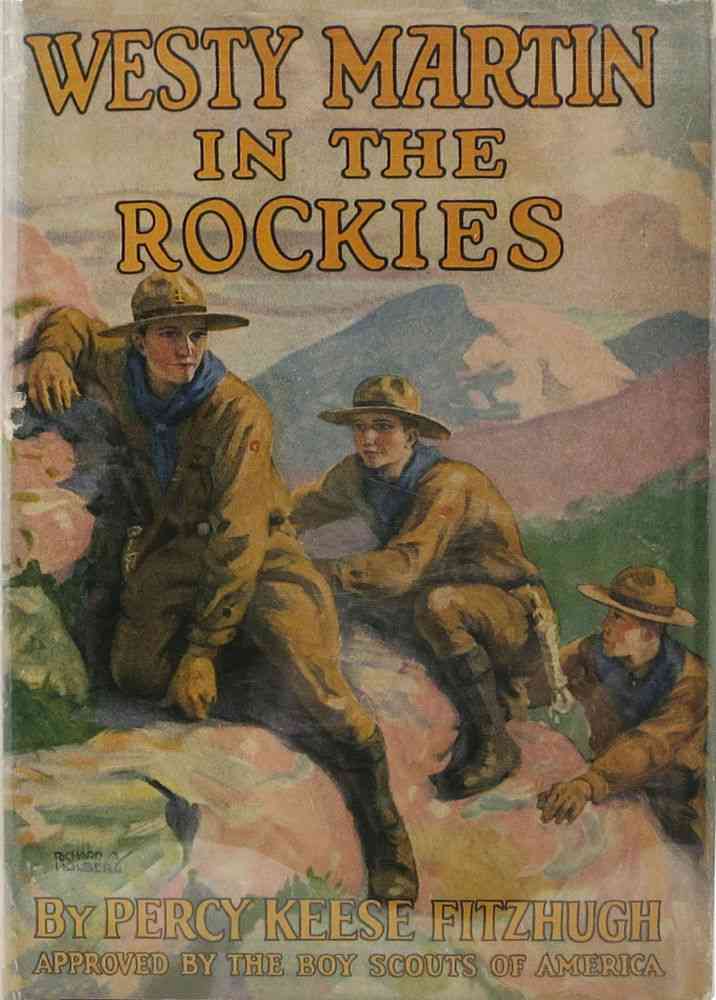
THEY WERE GAZING IN AWE AND ADMIRATION AT THIS SCENIC WONDER.
Uncle Jeb, Westy and Artie had bid farewell to Ol’ Pop Burrows and his retinue (Ollie) and turned their steps still further westward.
Their equipage consisted of two old mules that carried their week’s supply and baggage—and themselves.
The journey was not such a long one, but precipitous, Uncle Jeb informed them in his drawling manner. He led the way through narrow trails, resplendent with the verdure of late spring, sometimes ascending the craggy slopes, sometimes descending. At last, after a few hours’ of steady going, they came to an open space reminding one of a deep bowl in the center, where a mountain lake peacefully reposed. Before them and behind them the mountains loomed high and imposing in their majestic serenity.
As they were gazing in awe and admiration at this scenic wonder, Uncle Jeb directed their attention high above them, where the steady flap-flap of a mountain eagle’s wings sounded like the drone of an aeroplane in the distance. A terrific screech broke the quiet as another one approached—evidently its mate. They circled around high above the lake and then disappeared among the crags and fastnesses of mountain forests.
“Thar hain’t a bird I know of thet I like to leave alone better ’n an eagle,” said Uncle Jeb with a speculative gesture toward the spot where they had disappeared. “Right nasty customers when they’re cornered, yuh kin depend on thet. Fight to the last ditch fer their young ’uns.”
“Where do they nest, Uncle Jeb?” questioned Westy, his interest now thoroughly aroused.
“Wa-al,” answered Uncle Jeb, “I reckon yuh cud find out soon enough if yuh set by the lake very long. I’m a-goin’ to warn ye, both of ye, if yuh finds out, steer clear, or yuh’ll git the worst of the bargain.”
Uncle Jeb never wasted words and the boys were well aware of it, so did not ply him with idle questioning. They were both burning with curiosity to ask him of Mr. Temple’s visit with him so long ago and the story of the surveyors; but they felt sure now, because of his reticence on the subject, that it must be a matter of confidence, so they left it for some more propitious occasion.
So they did not bother him with the whys and wherefores of the habits of the eagles, for they had too much respect for Uncle Jeb’s knowledge of the mountains, its inhabitants and their respective habits.
His was a knowledge, so the boys contended, that far surpassed anything one could learn in school.
Westy and Artie, following Uncle Jeb around the lake and up the trail on the last lap to the cabin, walked silently and serenely, confident in the superior knowledge of Uncle Jeb Rushmore.
CHAPTER XX—WESTY MAKES A DISCOVERY
It was well along toward mid-morning, when they came in sight of Uncle Jeb’s picturesque cabin almost hidden among the giant pine trees. It stood there solitary and imposing, bespeaking character, such as only one like he himself could give it.
It has often been said that a man’s house is but a reproduction of his life, and nothing more true could be said of Uncle Jeb’s wilderness cabin.
The door was bolted from the outside to keep away intruders of the forest, but always open to the weary stranger.
As Uncle Jeb opened the door, the boys could see at once that the place was meticulously clean, notwithstanding its long state of unoccupancy.
There were bear skins covering the floor and walls, and the furniture consisted of a table and some chairs carved out of the productive forest trees. There was a stove in the back where some wood was lying beside it, all cut and ready for use. A few pictures hanging on the walls were distinctive of the good taste of this hardy mountaineer. The most prominent of these pictures was one of the late President Roosevelt, autographed. Uncle Jeb was very proud of this and did not conceal the fact.
There were no beds in this little quaint cabin, just four bunks built along the walls like berths.
After unpacking their belongings and helping Uncle Jeb put the place in order they all set to, getting the noonday meal with zest.
Artie stayed in the cabin peeling the potatoes, while Westy went with Uncle Jeb to fetch some water from the neighboring brook back of his place. He told Westy that this cheery little brook tinkled its silvery way down into Eagle Lake.
“More trout ’n you could ever eat in a lifetime, here in this brook, son,” Uncle Jeb told Westy. “Kin hear it most any hour of the night when everything is quiet. Best company any one would want.
Westy could well believe this, for the gurgling water, plashing down the rock-ribbed mountainside on its journey to Eagle Lake, was heard quite distinctly above the chirping birds and the screeching of little forest folk even at noonday.
After lunch was over, Uncle Jeb told them they were at liberty to do as they wanted, for it was quite late in the day to do any exploring. He promised them, however, that he would take them on a hike the following day over some all but forgotten Indian trails.
Uncle Jeb seated himself quite comfortably outside the cabin with his pipe and Artie decided he would stick around also and read.
But the restless Westy, being the true scout he was, strolled off into the forest to do a little exploring on his own.
He walked along noiselessly, striking into a trail that wound its precipitous way up through the mountains still further. Then suddenly it seemed to merge itself into another trail, one part running on down to the lake and the other part running straight up to a formidable looking cliff directly opposite the one that they had seen the eagles disappear from earlier in the day.
Looking skyward, Westy observed that the sun was on the decline, but he figured he could make the top of the cliff and get back by supper time.
After a strenuous climb he came at last to the top of the cliff that seemed to jut far out into space. Earlier in the day, when Westy had looked upwards from the lake, it had occurred to him then, that perhaps one could almost reach across from one cliff to the other. From below it really looked as though the two cliffs, jutting out on opposite sides, met in mid-air above Eagle Lake. But, as Westy scrambled out over the rocky precipice, he realized just how much the naked eye can be deceived by distance.
Sitting on an overhanging rock, he looked across and then below him. He smiled when he saw what a gap it really was that separated the two cliffs. And with a shudder as he glanced downward, he saw that he was sitting directly above the center of the lake.
“Whew,” he said aloud, “that’s some drop if any one should ask me. Wait’ll Artie sees it from here.”
Then his attention was directed elsewhere, for from the distance came that droning sound now familiar to him. Suddenly he saw an enormous eagle descending (it almost seemed to come from heaven) and heading straight for the cliff opposite.
In a second another appeared joining the first one and they both disappeared as before behind the rocky cliff.
“There,” said Westy half-aloud, “is their aerie and that means we are to keep away from that cliff!”
CHAPTER XXI—THE MYSTERIOUS HOLLOW
As he came into the open clearing by Uncle Jeb’s cabin, Westy could detect the smell of bacon frying crisp and brown. Uncle Jeb hailed him and good-naturedly asked if he had any trouble getting back.
“Not so’s you could notice it,” he retorted.
While they were eating supper he related to them his experience and discovery of the afternoon. Uncle Jeb listened intently and then cautioned the boys to be careful about going so far out on the cliff.
“Not only thet,” he said, “but yuh can’t allus tell when them birds’ll take it into their fool heads to make a new nest on t’other side where Westy wuz.”
They sat in breathless silence, as he told them many thrilling and hair-raising adventures of his boyhood days.
“What do yuh boys say we turn in now?” he concluded.
Indeed the boys did not need coaxing to turn in, for their eyes were already heavy with weariness and want of sleep.
They tumbled into their respective berths with goodwill and soon Sleep drew her mystical curtain about them and their first night in the bosom of the Rocky Mountains.
Uncle Jeb and the boys generally made a weekly visit to the Inn. As he and Ol’ Pop had much to say to one another as a rule, Artie and Westy would try to kill time by getting Ollie to talk. Between them they would hurl a veritable barrage of questions at his poor, meek-looking head, until one would imagine he would answer, if only to silence them.
Nothing, however, seemed to perturb his calm in the least. He was utterly unaware that any one was speaking at all, except for an occasional flicker of interest, visible only when Ol’ Pop’s name was mentioned.
On this particular early summer morning, Artie and Westy were sitting on the spacious porch reading some letters from home and many from Temple Camp, when Pop Burrows remarked he had “fetched them from town nigh onto three days ago. Could jes’ as well o’ let Ollie take ’em up to ye, but I thinks to meself that you’d be down afore long.
“Ollie, he generally takes hisself off for long hikes in the afternoons. Sez he never gits tired o’ climbin’ the hills. When he fust came, Uncle Jeb used to say as how it was durn funny, a tenderfoot like Ollie never got tired o’ climbin’ the hills every afternoon jes’ for pleasure. Well, after thet, I kinda feels Ollie out once ’n fer all. I sez, ‘Ollie, how come yer so fond of roamin’ the hills every day, you thet’s a tenderfoot?’ ‘Well,’ he sez to me, ‘I been brought up in de city; never outside it till I comes here, and when me woik is done I likes to go off by me lonesome with me pipe and sit quiet, that’s all.’ Thet’s all he ever told me about hisself,” continued Pop, “no more ’n no less. After thet we never bothered him and he never bothers us.” He looked toward Uncle Jeb as if for verification of his story.
Uncle Jeb nodded his assent between puffs of his pipe. Then he arose quietly as Ollie came around from the back of the Inn, leading the two mules who were bearing a fresh supply of provisions for the scouts.
Taking their leave of Ol’ Pop they were soon on their way, walking single file where the trail narrowed. Presently Westy called to Artie and told him of the word he had received from home.
They also talked of the news which they had heard from Temple Camp and this Uncle Jeb listened to with interest.
Roy Blakeley wrote that, as usual, Pee-wee Harris was doing good turns; that is, he started out to do them, but rarely accomplished his purpose without a series of mishaps intervening. “At any rate,” Roy concluded, “we’re not a bit envious of you fellows out there (Oh, no!) so long as we have Scout Harris to disturb the calm of a hot summer’s day.”
Just then they came out into the clearing by Eagle Lake and Uncle Jeb suggested that they sit for a while and rest, when their eagle friends announced their advent with a series of screeches.
Instead of disappearing beyond the cliff this time, one flew into a small hollow just underneath the precipice.
Before Artie could retract his words they were out: “Isn’t that where the surveyors disappeared, Uncle Jeb?”
Uncle Jeb was quiet for a while but then finally he answered softly: “Yes, my boy, ’n I always figgered somehow thet the holler is responsible. I cudn’t say jes’ why I do, but still thar’s no tellin’ ’bout them spooky lookin’ places after all!”
CHAPTER XXII—SOMETHING TO THINK ABOUT
As they were nearing the cabin Artie called to Westy: “I’m looking forward,” he said, “with delight to having Ollie bring our mail twice a week. We couldn’t have a more pleasant visitor and I hope he comes early, so he’ll have time to tell us all the news, don’t you?”
“Yeh,” answered Westy, “he’s too talkative to suit me. I’m afraid he’ll annoy Uncle Jeb’s neighbors.”
“They might move or even threaten to have Uncle Jeb evicted for allowing such noisy people on his premises.”
“I reckon Ollie ain’t sech a bad sort, boys, if I’m any jedge of human naitchur and I think I am. No one hain’t ever fooled me yit, and at my age I don’t think I’m likely ter be fooled. All Ollie Baxter asks in life is a good home ’n he has thet with Ol’ Pop sure enough. Why, Pop hasn’t a relative in the world and that’s what Ollie likes about staying with him. Nobuddy to bother him.”
“Well, but listen, Uncle Jeb,” said Westy, his interest now thoroughly aroused. “Doesn’t Ol’ Pop make quite a lot of money during the summer season?”
“Yes, indeedy, son,” he answered, chuckling, “and thar hain’t a livin’ soul knows whar he keeps it. All the folks aroun’ are thet curious to know jes’ what he does with his money. I even heard say thet thar are some who call him eccentric. Durn busybodies, thet’s what I call sech folks. Tain’t any one’s affairs what he does with his money.”
“Perhaps you’re right,” said Artie seriously, “but it may be people are afraid some harm will come to him during the long winter months, when he is alone there except for Ollie. Hoarding money is a dangerous practice. I should think he’d prefer putting it in the bank anyway so it would draw some interest for him.”
“Listen to the young banker!” Westy teased. “I bet you’ll never let your money get rusty in the ground!”
“Not while there’s banks to put it in,” Artie retorted. “Believe me, I’m no believer in this Captain Kidd stuff anyway. It always causes a lot of trouble; people even killing one another trying to find it. You always read that in books and in the end no one finds it after all.”
“Who can tell but what Ol’ Pop will die some day without having the chance to tell any one where it is,” Westy cheerfully added.
“’Tain’t likely Ol’ Pop will die for a long time yit,” Uncle Jeb said, touched with the evident concern of the boys for his old friend. “Barrin’ accident he’s good fer twenty year at least, so thar’s no need to worry. I spec when he gets ready he’ll tell me.”
“Let’s hope so, anyway,” Westy said as if quite willing to consign the subject to the mercy of Fate for a while.
CHAPTER XXIII—THE OBJECT ON THE CLIFF
The days seemed to merge themselves one into the other, and, as Westy remarked, “Night did not seem to be a dividing factor in the present scheme of things at all.”
Uncle Jeb built them a canoe, showing them how it was done in true Indian fashion. They launched it in Eagle Lake, with all the ceremony one would accord some palatial yacht.
One morning quite early, they set out for a swim, leaving Uncle Jeb behind whittling some wood with which to make a new bench for the cabin.
It promised to be a very warm day and Artie and Westy had no sooner arrived on the shores of the lake than they were into its cooling waters. They shouted in pure exultation, trying to outdo one another in aquatic prowess. Finally tiring of this, they clambered upon the banks to rest.
Westy had picked up a handful of pearly white pebbles that lined the shores and started skimming them across the surface of the transparent water. Artie, meanwhile, was musing thoughtfully, eyes cast overhead, when he observed the two enormous eagles emerging from their rocky fortress and almost instantly disappearing above the clouds.
Upon hearing these miniature aeroplanes “take off,” Westy also followed their swift flight with an observant eye until the billowy clouds hid them from his view, thereupon resuming his pebble skipping.
Artie, however, kept his watchful eye glued upon the spot that the birds had so recently left. Perhaps it was the steadfastness of his vision; perhaps not; but Artie could all but swear to it that some small object was moving on the cliff. He rubbed his eyes, thinking it was the sun deceiving him.
Yes, he was sure of it now; something surely was moving. Without speaking, he simply gripped Westy’s arm, as if fearful that his voice would break the spell. He pointed above them.
Feeling the tensity of Artie’s grip upon him, Westy followed the direction of that hand in utter bewilderment.
The small object seemed to be moving on the very edge of the cliff. Now it looked to be hanging on the precipice, while the boys sat breathless—waiting.
There was a slight movement as the object revealed itself to them.
“It’s an eaglet!” exclaimed Westy in an excited whisper. “Probably just trying out its wings.”
“Gw-an,” answered Artie, as if thoroughly informed as to the eagles and their habits. “Whatcha think, a bird that size is just trying out its wings? It’s trying something you can bet on that, but that isn’t any eaglet, it’s too full grown.”
“Well, I won’t argue with you about it. I know that eaglets are pretty big birds though. I know that much!” Westy said decisively.
“It’s hard to tell from here,” Artie said sagaciously. “Whatever it is, I’d like to know what kind of a stunt it’s trying to pull off.”
“Gee, so would I,” Westy said with enthusiasm.
The minutes passed and still the stately young bird clung tenaciously to the precipice. The boys decided that it must be clinging with its sharp talons to the luxuriant undergrowth that wound itself around the cliff.
They still sat in silence and watched every move. It was swaying now, swaying dizzily, as if it was losing its grip.
“Why, I wonder,” Artie spoke up, “doesn’t he fly?”
“Search me!”
Suddenly, then, a harsh scream pierced the air as the unfortunate bird lost its hold and dropped—into the hollow just under the precipice.
Another scream; more shrill than the one before, a scream of pain—then Eagle Pass lapsed into its usual deathlike silence.
CHAPTER XXIV—ARTIE AS A MODERN DANIEL
“Well,” said Westy, jumping to his feet, “we ought to try and save that bird. I think its wing was broken!”
“Yeah, so do I,” answered Artie. “How can it be done, I ask you? Besides being dangerous, I don’t think that Mother and Father Eagle would appreciate our heroic efforts to do a good turn for their progeny, should they happen to return in the meantime. Also, young Eaglet may not possess a sense of gratitude if he’s still alive and kicking when we get there.”
“Granting what you say is true,” said Westy seriously, “if we are to live up to the scout ideal we’ll have to take a chance, just so we can relieve that poor wounded creature of its suffering. Certainly it must be in agony the way it screamed! Another thing,” he continued, as if by way of explaining the feasibility of his plan, “there are two of us, and while one rescues the bird the other can be on the lookout for the older birds’ return.”
“If you ask me which I’d rather do,” said Artie with mock-seriousness, “I can tell you without a moment’s hesitation.”
“This isn’t any time for fooling, Art!” pleaded Westy, craving action. “We’ve got to act, not talk.”
“I got you the first time!” Artie answered good-naturedly; then: “I’ll rescue the bird providing you act as lookout!”
“Well said!” replied Westy. “We’ll step on it first and talk afterwards. Suppose we paddle across and save time?”
“Whatever you say, big boy!”
They paddled swiftly across the lake and landed almost at the foot of the trail to the cliff. Westy jumped out first and just as though it were agreed between them, led the way.
The trails to both cliffs were the same, going straight up from the lake like a stairway. They hurried along silently, stumbling over the loose rocks and underbrush that was more pronounced on this trail, being rarely trod upon.
Here and there, Westy noticed with his discerning eye that some one lately, perhaps even the day before, had been walking up there also and descended the same way. A twig here and there had been snapped off and trampled underfoot as if in leisurely contemplation. Who, thought Westy, would be using that trail, and for what purpose? Then he reminded himself that it wasn’t the time to be speculating on anything but the real object of their own presence on that forbidden trail. He deferred then to say anything to Artie of his discovery until later.
Artie, however, had not missed anything either, but kept silent and stumbled after Westy in a state of thrilled expectancy.
Approaching the edge of the cliff quite cautiously, they looked, first above and then around them. Then on their hands and knees they crawled over the jagged rocks. At last peering over the edge into the hollow, Westy could see the bird lying prone. Even with his inexperienced eye he could tell that it was a very young bird, but yet enormous. Artie was also looking and thinking the same thing. About to say so to Westy, he turned to find a very dubious expression on that young man’s face.
“D’ye think you could make it, Art?” whispered Westy half-fearfully. “Even though I’m shorter than you I’m pretty sure I could do it.”
“Tut tut, m’lad!” answered Artie with an effort to conceal his appreciation of Westy’s concern for his safety. “Sure I can make it all right. What I’m worrying about is what’ll I do when I get there?”
“Why,” said Westy relieved, “all you have to do is hand me the bird. It’s too exhausted to show any resistance.”
“Well, here goes, then,” said Artie softly, making ready to swing over the ledge. “I feel like Daniel entering the lion’s den!”
CHAPTER XXV—TAKING CHANCES
The bird had fallen in such a position that it lay out on the very edge of the hollow, thus making Artie’s descent less precarious.
Westy helped him over until Artie’s feet pointed directly to the center. Letting himself slowly down, he landed finally with a thump, safe and sound. Taking a cautious view of his present situation, he thought it looked like a box seat in a theater, the precipice forming a protective roof overhead. One of even medium stature could not stand upright in this haven of rock, so sequestered from all the world.
“Hey, Art, make it snappy, will you?” called Westy impatiently. “This isn’t the time to dream!”
Artie leaned forward and touched the inert bird with his finger. It did not move. He repeated the action to make sure. Then, he lifted it slowly, gently, and ever so cautiously with both hands, but was convinced that he had nothing whatsoever to fear from that source.
His next move was to lift the bird high enough so that Westy (who was hanging perilously over the edge with outstretched hands) could grasp it. To do this, it was necessary for him to step out on the tip-end of the ledge, where there was a slight eminence. From there he thought he could reach up to Westy’s dangling fingers without having to release his hold on the helpless bird at all.
Artie realized as he pondered over the wisdom of this, that one misstep meant—eternity. Holding his breath and with a firm resolve not to look out nor down, he concentrated his mind solely on his two feet. He quickly mounted the jagged edge, clasping the bird tight with both hands.
“All set?” he cried to Westy excitedly. “You’ll have to grab it quick for I won’t be able to keep my balance for long.”
“Righto!” answered Westy, sensing the peril of both, but putting all of his courage in each of his hands, he leaned as far over as he possibly could, without throwing himself over altogether.
They both reached, but, alas, came about within three inches of making it.
“I can’t, Wes, it’s no use,” Artie cried, “it just can’t be done!” He was feeling sick now from the suspense.
“Could you just throw it easy, Art? Try it! I won’t miss it and this little distance won’t hurt it any more than it has been hurt!”
“Sure—anything, so long as I get off from here.”
Artie tried to steady himself once more. Then as lightly as possible he tossed it to Westy, who caught it, surprisingly gentle.
Seeing Westy slowly but surely drawing himself back again upon terra firma, Artie, with a dizziness amounting almost to nausea, stepped down from that Pinnacle of Destiny and into safety.
Unashamed, he wiped the perspiration from off his face and sat down in the hollow a minute to regain his composure.
“Well!” he called to Westy. “I’m down, but how am I going to get out?”
“What were you saying, Art?” Westy shouted from above.
Artie repeated his question.
“Why you can get out the same way as you got in, can’t you?”
“Not so’s you can notice it!”
“Why not?”
“Why? Just because there isn’t a place for me to get a foothold on the whole darn precipice; it’s just as smooth as glass.”
CHAPTER XXVI—THE EAGLES’ RETURN
“Never mind, Artie old boy,” Westy said soothingly. “I’ll run down and get the rope out of the canoe. Won’t take me a minute! You take a rest and try and enjoy the view while I am gone. Bet the lake looks like a regular amphitheater from there, doesn’t it?”
“You told it!” replied Artie. “Say though, it’s a shame you didn’t get the chance to come down and take a look at the amphitheater yourself. If you had told me of your curiosity, I’d have let you get the bird yourself. There’s not a selfish motive in my make-up!”
“I’ll say there isn’t,” Westy answered, glad of Artie’s good humor.
“Artie!”
“What?”
“I am pretty sure I think I hear the eagles coming back!”
“Don’t tell me that! You sure?”
“Yep.”
“What did you do with the bird?”
“I laid it back on a rock and wrapped my scarf around it until I can see what’s the trouble with it.”
“You better take it and run to the lake, Wes! They’re coming fast. I can see them way off.”
“You don’t think I’m going to let you stay here all alone, do you?” Westy fairly screamed. “What kind of a scout do you think I am, huh?”
“I’m safe enough here. You grab that bird and beat it as quick as you can. There’ll be something doing if they find the bird lying there hurt and you too! Two of us can’t fit in here and besides there isn’t time. You run and wait by the lake until they go away again, then you can help me get out. Oh, hurry, Wes, please, they’re almost here!”
Not having any other choice, Westy was spurred into action by Artie’s pleading voice. He took the bird up carefully and started on a run, skillfully dodging in and out of the trees and bushes down along the trail. This he did to camouflage his presence from the two eagles, who had already descended upon the cliff.
He maneuvered his descent without discovery, looking back from time to time to reassure himself that Artie was safe from detection.
Reaching the lake, he went over to the canoe, where they had beached it. To his dismay he found that in their excitement they had turned it over after getting out, leaving the end that had held the rope hanging over the water’s edge. Consequently it had dropped out and floated away and probably by this time it was floating its merry way down into the subterranean depths of Eagle Lake.
“Can you beat that for luck?” Westy questioned aloud. “I can’t paddle the darn thing across either with this bird in my hands, and I’m afraid to lay it down. I’ll have to get around to the other side of the lake so I can keep my eye on Artie. I better hurry so I can tend to the poor thing. It’s still alive all right; I can feel something moving.”
He was out of breath between talking to himself and running, but finally he reached a spot where he could command an excellent view of the hollow. He waited a while, apprehensively. His patience was soon rewarded for he became aware of something moving within the hollow, and then perceived it was Artie waving his handkerchief to assure him of his safety.
Westy drew a deep breath, the first he had stopped to take since he had left Artie. He hated to think of having been forced to leave him up there alone.
“Gee whiz,” he said aloud, as he slowly unwound his scarf from the bird, “if we hadn’t stopped to fool we might have made it at that. Jiminy, I wonder?”
CHAPTER XXVII—HELP
As the scarf came slowly off, Westy gazed with awe and admiration at this ferocious, yet magnificent bird that he held within the hollow of his left arm. Tenderly he placed it down on the soft warm earth. Instantly an expression of perplexity, then amazement, appeared on his face. He stared and then bent closer.
Could it be possible, he thought? That he, Westy Martin, had so deceived himself and was so stupid as to hold the creature all this while and not know it?
“Why,” he said aloud now, “I could swear I felt his heart beating!”
Then the light of reason dawned in his bewildered mind. It must have been his own heart palpitating with excitement and the exertion of running. Hadn’t he held the bird close to his left breast? Of course!
“Well!” he spoke softly now, but with exasperation. “I’m the original dumb-bell! It probably was dead when Artie handed it to me! It’s stone cold now! Can you beat it? And all this for nothing! As usual, poor Artie’s the goat!” he murmured regretfully, looking up toward the imprisoned boy hopefully for some further sign from him.
There was none, for Artie wisely kept himself well within the enclosure, as the two eagles were now perched menacingly on the edge of the precipice.
“Can it be,” thought Westy, “that they are already scenting their young one to where he had fallen?”
He felt suddenly panic-stricken as the birds, now screeching and fluttering back and forth over the cliff, seemed to be threatening something. He wondered if he should run back up there and try to fight off the birds. But the futility of the thought became apparent, when he remembered the missing rope and realized how utterly impossible it would be for him to try and fight those two enormous birds single handed. As yet, they did not seem to be aware of any intruder in their midst, so Westy decided the only course, and perhaps the wisest one, was to run back to the cabin for Uncle Jeb, while there was yet time. He figured that Artie, with luck on his side, could manage for a while at least to keep in concealment.
It would be a race against odds; but nevertheless the chance would have to be taken.
Westy’s feet hardly touched the ground, as he ran impetuously onward. Yet, it occurred to him, as one so often experiences in a dream, that his legs were moving, and although he knew he must have covered quite some distance, still it seemed that he was not gaining much momentum after all.
Thinking to save time, he struck into a trail that he and Artie had explored shortly after their arrival. It was a short cut to the cabin and they had only used it a few times. He hadn’t gone far when he discovered that it had become so overgrown with weeds and a maze of underbrush, that it was almost impenetrable and would retard his progress considerably.
Disgustedly he turned back, stumbling over rocks, his hands cut from brambles, his face bleeding from overhanging branches that struck him as he rushed blindly on.
Retrieving his way once more, he at last came within sight of the cabin, all the while shouting lustily for Uncle Jeb. There wasn’t a sign of him inside or out, he soon realized, almost distracted. What to do next he did not know!
“Here,” he thought aloud, “this isn’t any way for a scout to do things! Why, I’m acting like a panicky schoolgirl. I’ve got to get help and get it quick!”
He decided first that Uncle Jeb couldn’t have gone very far, as the shavings of the partly made bench were still lying scattered over the ground back of the cabin. That in itself was sufficient proof of his imminent return, he reasoned, because one of the many fine qualities Uncle Jeb possessed was neatness. It was characteristic of him that, despite his extremely interesting career devoted wholly to the Great Outdoors, disorder of any kind never held a place in his fine, wholesome life.
Coming around to the front of the cabin, an idea presented itself to him as he happened to glance westward. At a short distance from the clearing around the cabin, there was a decided and almost sharp break in the ground that reminded one of a sort of jumping-off place. This declined straight downward, forming a gulley running on either side of the cabin as far as the eye could see. Beyond, the mountains climbed again in their eternal race with the clouds, utterly indifferent to the yawning gulley that nature had so inconsistently cleft in their sides.
Before the idea was fully formed in his mind, Westy was going foot over foot down the rocky ladder that Mother Earth through æons of time had, in her process of reconstruction, worn away. This she had generously provided, realizing, in her infinite wisdom, the helplessness of the poor human mortal.
Reaching the bottom, Westy looked around for a second and then started his climb up the other side. Not losing a moment, he soon gained a high spot that commanded a pretty fair view of the wild country surrounding the isolated cabin.
Raising his hands to his mouth and bringing all his lung power into play, he hallooed vehemently in each direction. His voice reverberated, it seemed to him, throughout the whole United States. He thought actually five whole minutes had passed before the echo died away into nothingness.
Just as he was about to try once again, he was rewarded with a faint, almost unintelligible answer....
CHAPTER XXVIII—BETWEEN TWO FIRES
Everything was silent again, and Westy waited, all the while listening intently. Then he tried it once more. This time the answer came not so clear, but louder. He recognized the voice immediately as Uncle Jeb’s and it did not sound far away either.
“Where—are—you?” he called ever so slowly.
“Up—at—the—elm,” came the answer, faint again.
“M’gosh!” exclaimed Westy. “The elm? The elm?” he repeated, trying to figure out where it was and what had happened. There was only one distinctive elm tree that he had heard Uncle Jeb mention, and that was a little distance above the cabin, overhanging the gulley. That must be the place, he assured himself.
That he didn’t meet with disaster was nothing short of good luck, for he didn’t walk or run—he fairly slid down that precipitous slope.
The elm wasn’t far and, by keeping in the gulley, Westy soon reached it, not much the worse for wear. There he found Uncle Jeb lying helpless and bleeding quite profusely from a hole in his head. His foot was securely caught in an old rusty bear trap. He was not unconscious, but quite exhausted from the pain in his foot that the trap with its terrible pressure was causing. Also, Westy detected at once, he was extremely weak from loss of blood. He bandaged his head with strips of his own and Uncle Jeb’s handkerchief. Then with the aid of some old sticks lying around in the gulley he finally succeeded in dislodging the old scout’s foot.
In spite of his age, Uncle Jeb was no weakling and though his foot and head were throbbing with intense pain, he managed to raise himself with Westy’s aid.
“Wa-al, son, so fur, so good,” he said weakly. “Can’t expect a young fella like yuh to act as a crutch fer me though. Yuh better get Artie!”
Helping him down on a rock so he could rest, Westy related to Uncle Jeb all the events leading up to Artie’s present peril.
“Sakes alive, boy!” he exclaimed, looking up with a discerning eye on the waning sun. “Thar’s not a secunt to waste fer yuh to git to the lake afore dark. As fer me, I kin take muh time and crawl back to the cabin slow. I kin make it all right!” he added, noting Westy’s look of anxiety.
“Are you perfectly sure, Uncle Jeb?”
“Sure as yure a foot high,” he answered with a forced cheeriness.
Westy accepted this declaration, not without a little dubiousness however. He had every reason to feel that way, for Uncle Jeb looked anything but capable of helping himself. If he was ever between two fires, he was now.
“Yuh go straight to the cabin, Westy! Take my rifle off the wall, but don’t use it ’cept yuh get in a tight corner, ’n yuh’ll find the rope and a lantern. I say tuh take the lantern so yuh kin signal Artie, ’n not cause I didn’t think you cud find yer way back in the dark!” the old scout reassured Westy.
“I know you didn’t, Uncle Jeb,” Westy said, his voice quivering, and hating to leave, though he knew the time was flying.
“Go along now, boy!” Uncle Jeb commanded. He was wishing fervently that Westy would go, for his head was reeling and his mouth felt parched and therefore he was afraid lest Westy should discover his steadily weakening condition.
So Westy took his leave of Uncle Jeb with a heavy heart and climbed out of the gulley, so as not to be tempted to look back and weaken.
After Westy disappeared from view, Uncle Jeb, with much difficulty and effort, managed to get on his hands and knees. It seemed to take him an hour to crawl a few feet, his foot felt so heavy and the pain was so great. After lying face downward for a few minutes so as to rest his dizzy head he raised up a bit and to his consternation it seemed to be growing dark.
“Funny!” he said aloud, “it’s a-taken me all this time to get this fur. I’m feelin’ durn sleepy, I know thet much!”
But it wasn’t growing dark at all—except in Uncle Jeb’s fevered mind, for a merciful unconsciousness had come to his rescue and was already plunging his tortured senses into oblivion.
CHAPTER XXIX—FACE TO FACE
When Artie caught sight of Westy breaking into a run up the trail, he thought intuitively that he was going for help. Instantly he was warmed with good feeling and hope that they would return soon and find a way to effect his escape. He sat silent and rigid within the hollow, for the birds had put in their appearance now, frantically strutting back and forth over the precipice, evidently searching for some trace of their lost young.
One or the other kept guard on the precipice continuously, screeching with such terrific force that Artie felt as though the echo itself would all but ruin his hearing. His muscles were stiff and sore from the cramped position he was crouching in, and not only that, but he was getting hungry. He had had nothing to eat since breakfast, but tried to cheer himself with the thought that it was better for him to be hungry, and keep quiet about it, than to let the birds in on it.
At times when the eagle was stalking on the very edge of the cliff, the sun would reflect the bird’s shadow upon the jagged rock in front of him, worn smooth and glass-like with age. Then, poor Artie would sit in a state of nervous terror until the shadow had passed.
His legs were aching violently, even though they seemed to be numb when he would try and relax them. His back felt almost as if it had become brittle and would snap in two, should he get the chance to stand upright. He was beginning to doubt very much that the chance would come, for whole months had passed in those hours since Westy went out of his life. What he would give, he thought, for one glimpse of the athletic young figure swinging furiously down the trail!
His vision was becoming blurred from the strain of watching so intently from such a distance. He was beginning to fancy at times that some of the pine trees along the trail were moving a little. Then he tried to reason that the lethargic state he was in from the hours of waiting, was responsible for his double vision. He did not want to admit that his nerves were giving way under the tense strain.
The sentry on guard was still screaming at intervals, and poor Artie began to think he was screeching when he wasn’t, and wasn’t when he was. Then he tried to muster up his ebbing courage and with renewed hope looked down upon the trail once more. Surely, he thought, Westy could not be much longer! What on earth was keeping him?
The afternoon wore on and it began to get damp and chilly in the hollow after the sun had left. Slowly, ever so slowly, it was withdrawing its warm friendly rays from all about him. Then, finally, the last lingering light that had cast sort of a farewell shadow down upon the lake, died away and Artie felt now that he was surely deserted and left completely alone in the unfriendly chill of near-twilight.
A dozen times he had examined the smooth rocks over which he had slid into the hollow. Nowhere had he found a foothold with which to brace himself over the cliff. But, as hope springs eternal and the screeching had ceased now for quite a while, Artie arose to a stooping position. With eager eyes he sought once more some hidden crevice that perhaps he had overlooked. He felt cautiously of the smooth surface and with a gesture of despair resigned himself to the knowledge that without help it could not be done.
A deep silence now reigned and it gave Artie hope, thinking that perhaps the birds had given up the watch and gone back to their aerie. He stretched his aching body and getting to his feet boldly, carefully raised on his tiptoes, throwing his arms upward and running his fingers along the wall of rock. It was maddening, he thought, that his fingers couldn’t grasp something! Oh, if only he were a few inches taller!
In this cogitative state of mind he heard a distinct rustle—silk-like; maybe the wind. Then again—nearer. He listened intently as it came closer, and suddenly he felt something touch his fingers ever so lightly.
His warm blood seemed suddenly turned into an ice-like substance. For, peering above him, he found that he was looking directly into the face of an eagle!
CHAPTER XXX—CRIES
When Westy left Uncle Jeb and started toward the cabin, he was frantically trying to dope out a plan with which to rescue Artie. A hundred and one ideas had already been half-formulated in his anxious mind, but none seemed logical when he tried to think of them being put into action.
He hadn’t asked Uncle Jeb’s advice, not only because he thought himself quite capable, but also because he didn’t wish to overtax Uncle Jeb’s needed strength by asking questions. He knew one thing, and that was, that the eagles wouldn’t give up their search until dark anyway. And it was better that he should get Artie out before pitch dark and get back to the cabin.
Hurrying along with Uncle Jeb’s rifle over one shoulder and the rope and lantern supported by his other arm, Westy could not help feeling a certain thrill. He felt like a real scout now, and an honest-to-goodness hunter. No one could possibly know what a glorious feeling it really was. There wasn’t the least bit of vanity or egotism about him, but nevertheless, just this once, he cherished a secret desire that his father, mother and sister might see him thus.
His thoughts he did not let interfere with his progress, for his flying feet had already outdistanced them, as it was still quite light when he began the last descent to the lake. The nearer he came the more fearful he was that perhaps it would be too late.
A half-finished prayer was still on his lips, as he swung out of the trail by the open lake. Walking over to the spot where he had left the dead bird, he raised his eyes apprehensively toward the hollow. He gasped!
There, perched on the ledge of the hollow, was an eagle, wings spread, as if for attack!
He frantically tried to perceive if Artie was moving within, but the eagle’s spread wings screened Artie—if he was still there, alive—
“It can’t be possible,” he cried aloud, “that God would be so unmerciful!” Unashamed he dashed away the tears that were streaming down his cheeks. His cry echoed all around in the Pass.
It must have attracted the bird’s attention, for Westy could see that it had turned on the ledge of the hollow and was looking down to the spot where he was standing. Then to his great joy, he heard a cry, a human voice, almost plaintive in tone.
The eagle, evidently nonplussed, flew back to the precipice with a screech that was awful to hear.
Westy realized with a deep sense of relief that not only had he been given an inspiration, but he had also succeeded in combating the bird’s purpose, whatever it was, for the time being, at least. He now emitted a cry more cogently this time and valiantly tried to imitate the eagle’s screech.
It answered!
Again and again Westy would cry and each time he was rewarded with an answer. But he knew he could not waste valuable time by keeping it up. It would be dark before a half hour elapsed. Then his face brightened as his eye lighted upon the still figure lying under his scarf.
“Will it do any good?” he questioned quite loud. “I wonder! Yet, it might work at that!”
Taking the bird in his arms and screaming intermittently, as before, Westy started up the trail at breakneck speed, keeping his eye all the while on the hollow opposite and the precipice above it.
The eagle was now pacing to and fro on the ledge, giving Westy cry for cry.
It was a decidedly difficult thing for Westy to do, running up-hill at the pace he was and using his lung power to the limit besides.
By the time he reached the cliff he was exhausted. His throat was sore and he thought that perhaps when he finally got through shouting, he would certainly never be able to yell again. That, in itself, would be a tragic calamity to a scout such as Westy Martin.
CHAPTER XXXI—WESTY MAKES A SACRIFICE
Quickly and quietly, with a discerning eye around him, Westy picked a spot near the edge of the precipice in which to carry out his plan. At the foot of a giant tree in the moss-covered earth, with trembling but dexterous fingers, he dug into the ground, tearing away small rocks and dirt with a will that was born of strong determination.
The eagle, meanwhile, had been joined by its mate and together they screamed for vengeance, while the shadows gathered around them.
At last, apparently satisfied with the depth of the hole he had dug, Westy carefully lowered the dead bird into it, making sure it was so placed as to allow the tip-end of its wing to reach just above the top of the excavation. He then set to the task of refilling the grave and went about it with a diligence that his frenzy for Artie’s safety inspired.
Making sure there was ever so little of the bird’s wing exposed, he packed the mound of earth around it, but not too hard, and covered it high with pieces of broken rock of a certain size, and over the whole he placed a larger rock than those which he had placed around the mound.
All this time the birds seemed to be holding a sort of pow-wow as to what to do with Artie, who was anxiously wondering what Westy’s scheme would bring about. In one breath he would mutter “good old Wes,” and in the next one he would silently beseech him to hurry. It was awful, he thought, the time Westy was taking to do whatever he was at, when in reality it had not covered the whole of ten minutes. That one half hour of Artie’s life, he afterward recalled, seemed to have covered a span of years. Undeniably he was no end thankful that the bird hadn’t bothered him, and he realized it was Westy’s timely return that saved him from a fate he shuddered to think of.
Westy had managed until now to keep his presence concealed from the ferocious birds. He wanted to; but now that his purpose was accomplished, he stood in full view of them, having crawled out to the edge of the precipice on his hands and knees.
Taking out his penknife, he clenched his teeth, and gashed several fingers on his left hand without uttering a sound. He held his hand in such a way that the blood dripped over the ledge, and so walked back, marking a crimson trail over the gray-colored rocks, until he reached the little mound, allowing the scarlet fluid to saturate it and the earth around.
The pain from his wounded fingers was so intense and his throat felt so terribly sore when he began his cry, that his hoarse voice, plaintively reverberating through the tomb-like hills and valleys, bewailed like some spectral chorus in the shadowy twilight.
The aggressive birds listened now in silence. But only for a few seconds. Their shrieks of threatening retribution that had previously been directed down to Artie’s deafened ears were now transferred to the retreating Westy. He had gone down the trail a way and hid behind the protecting trunk of a large pine tree, still crying in answer to the eagle’s screeches, his voice almost unintelligible now. His anxiety was soon diminished and he gave way to a sheer exultation of feeling, for the eagles had left the precipice and landed on the cliff, scenting the trail of fresh blood that Westy had sacrificed.
Moving nearer and nearer toward the mound under the tree, their cries told Westy that the search was at an end. He did not wait to see the culmination of their discovery, he glanced back only long enough to make sure they would have a long and difficult struggle to get the pile of rocks and dirt from off the uncovered wing.
Stopping long enough to wrap his scarf tightly around his hand and stem the flow of blood, Westy ran on down to the lake and continued so on up the other side to Artie’s rescue.
Darkness had almost enveloped the hollow when Westy gained the precipice. Placing the lantern in such a position that he could see, he leaned over and in an inarticulate voice called Artie’s name.
There was no answer.
CHAPTER XXXII—THE BOND IS SEALED
The perspiration stood out like little particles of frost on Westy’s forehead.
“What,” he asked himself, “has happened?”
Had Fate inevitably overtaken Artie after all? He couldn’t and just wouldn’t believe it! So raising the lantern above his head he swung it over the hollow that it might penetrate every niche of it. Then peering eagerly, he caught sight of a foot sticking out from under the projecting rock. His heart felt as if it had dropped a couple of inches, for the fact that Artie was lying there prostrate was perfectly evident.
Tying the rope around the lantern as best he could, considering that his maimed hand was little or no use, he lowered it carefully into the hollow. A sound emanated from below, and to Westy, who was expecting the worst, it sounded like some one groaning.
“Whassa matter?” the voice said in guttural tones. “Haven’t you got any sense? Letting the sun shine in my face like that, huh? Lot of feeling you got for a guy, I’ll tell the world!”
“The Lord have mercy on us,” reverently exclaimed Westy, “he’s delirious!”
“Delirious, my eyebrow!” the voice, now assuredly Artie’s, replied. “M’gosh, zat you, Wes?”
“Bet your life!” answered Westy, with a heartfelt sigh of deep relief. Then: “How do you feel, Art? Think you can stand being hoisted up now?”
“Say now!” replied Artie, gazing gratefully up at Westy’s worried countenance. “How do you get that way? Can I stand it? Well, I guess!”
“All right then,” Westy murmured dubiously, “you better keep the lantern, Art, and tie the rope around your waist. I’ve got the other end O.K. Think you can manage to tie it?”
“Tie it?” Artie couldn’t seem to comprehend.
“Yes,” said Westy and then with hesitancy, “Will you be able to, I mean!”
“Well,” exclaimed Artie, “I’ll be blistered! Whatcha think I am, Wes, a cripple?”
“You can bet I don’t think any such thing when you can talk that way.”
“That’s better, Wes; but say, where are my enemies?”
“The eagles?”
“Sure! What a foolish thing to ask. Who else would I be inquiring about so solicitously?”
“I don’t like to hurry you, Art, but we can’t spare any more time gossiping like a couple of old ladies over a clothesline. Our friends won’t be much longer in digging out their progeny. Not only that but it’s imperative we get back to Uncle Jeb as quick as possible, if you feel up to it!”
There were many questions and remarks that Artie would have liked to voice at that moment, but he realized that the seriousness of Westy’s tone forbade it. He told him to go ahead and tie the rope to the tree and when he felt the tug he’d start.
It was like witnessing some one arising from the dead for Westy to see the familiar form of his friend come safely over the edge of the precipice. There was joy ringing in his soul and tears in his eyes, when he saw him get to his feet and untie the rope from around his waist. Westy rushed forward and put both his hands on Artie’s shoulders.
“Gee, Art!” he said chokingly, “able to stand all right and all, huh?”
“Sure,” Artie answered with a catch in his voice, affected by Westy’s emotion, and then to cheer him: “I’m standing all right, but I suppose I’ll feel like a pretzel for the next few days, until I get the kinks out from sitting down all wound around myself.”
“Same ol’ Artie! Then you weren’t hurt at all?”
“Hurt? When?”
“When I first called you.”
“Search me! I didn’t know you were there until the lantern awakened me and you said something about me being delirious.”
“Awakened you? Then—”
“Sure. I must have fallen asleep. I don’t remember anything after I saw those enlarged screech owls fly away. No doubt their departure affected me to the point of exhaustion.”
“Well, I’ll be darned!” was all Westy could say. “You’ve an eye for slumber, I’ll say that. Come on now, old boy, we have something to do before the night is over, I’m afraid. Will you take these things from me now? Then I can walk faster.”
When Westy explained to him all that had occurred since he left the lake in the afternoon, he skipped lightly over the cause of his wounded hand. That he was in pain from it, Artie could almost feel in the darkness.
“And to think that you did all that for me, Wes!” he said, intense feeling in his words. “You’re the best scout that ever lived!”
They had left the lake and were going up the trail. Artie could think of no other way to express his heartfelt gratitude to this true and tried friend of his, so he put his arm out and about Westy’s shoulder firmly. Silently and hurriedly they went on through the dark, deep mountain forest, feeling in their hearts that the incidents of the day had served to cement a bond between them of loyalty and everlasting friendship that nothing could sever.
With his arm still about him, Artie seemed to feel that Westy’s step dragged and halted a little now and then.
“Bet you’re tired, Wes, huh?”
“Just a little, Art.”
The moon came out just then in all her silver splendor, lighting up the trail along their way. Artie grasped the opportunity to glance at Westy so as to smile his deep appreciation, and was dismayed to see that his face was white and his lips looked almost green in the moonlight.
Renewing his grip on Westy’s shoulder, he felt his body relax against his and saw his eyes close slowly.