
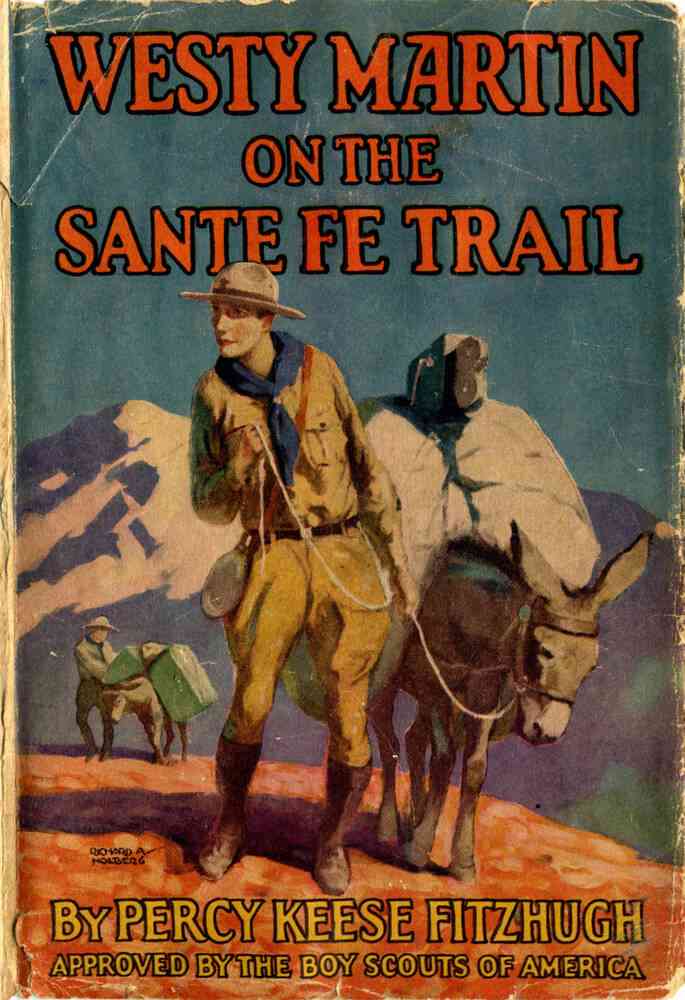
WESTY DECIDED TO DO THE COOKING AND LET RIP DO THE MENIAL CHORES.
Just as he turned away from the brook to go back he felt instinctively the presence of some one near him. Glancing around, he saw nothing. Then he looked upward and something moved in the refractory light shining through the gaunt-limbed trees. Breathless, he fled. His uncle sensed something amiss as he ran toward them.
“Gee, you know, Unk, strike me pink if I didn’t see a girl sitting up in a tree down there. Looks to me like an Indian, s’ help me Sam!”
“You’re one heck of a scout, you are,” Mr. Wilde chided him, “running away from a poor helpless Indian girl. What in thunder were you afraid of?”
“Aw, I wasn’t afraid of her at all, I was just taken off my feet when I saw it was a girl. I don’t like ’em much, anyway. That is, most of ’em!”
“Of course not,” Mr. Wilde said with mock sympathy, and as an afterthought added, “Not until you get a little older! Come on, we’ll take a stroll down and inquire who this maid of the mountains happens to be.”
Westy left his bacon to an unknown Fate and followed the rest to the brook, where they beheld Rip’s dryad sitting, feet under her, on the limb of a huge tree.
The setting sun threw a halo of scarlet around her. Bobbed hair, dark and straight, with a band of crimson ribbon encircling her forehead. Eyes as dark as the forests at night with a laughing light in them. Her small face and strong looking arms were tanned. They could see at first glance that here was a child of the open spaces.
A girl of about thirteen, they judged, when she slipped out of the tree as noiselessly as a wildcat and stood before them slim and tall for her age.
One would gather at first that she was an Indian, until she smiled at them one and all, sweetly yet fearlessly.
“How do you do!” Mr. Wilde said, as he bowed graciously. “My name is Madison Wilde, young lady! Who, may I ask, are you?”
She laughed gayly at Mr. Wilde’s mock gallantry, and her voice echoed like a silver bell ringing throughout the forest.
“Why—I’m a girl called Lola!”
CHAPTER X—ON THE EDGE OF THE WORLD
“So you’re Lola, are you, and not some ephemeral wood-sprite that disappears with the advent of dawn? I feel disappointed that you cannot truthfully tell me your home is the trunk of the tree and that you sip the nectar from the flowers as your sole diet. Now that you’re really a human being we will have to make the best of it. I suppose you live near here?”
She pointed a slim brown finger southward where a column of smoke was curling high above the clump of evergreen pines and tall straight cedars beyond.
“I wonder,” she said, showing two rows of even white teeth, “if you gentlemen would take supper with us?” Manifestly, this was inclusive of all.
With all her feminine sweetness there was nothing coy about her nor her question. She spoke simply but with an amazing frankness, accentuated by the soft deep tones in her voice. A typical tomboy, Mr. Wilde thought.
Westy and Rip liked her at once and the fact that she included them as gentlemen had a marked effect upon this consideration.
“Now, that’s kind of you,” Mr. Wilde answered, “but we are all pretty tired to-night. We wouldn’t make very sociable guests I’m afraid. Besides, the hour is quite late now and for four men to presume upon your mother’s kind hospitality would be too much of a good thing.”
“Oh, no, not at all. I live alone with my grandmother, my father and mother are dead. It’s such a holiday when we have any visitors—it happens so very seldom.” She said it with a wistful sadness that touched them. “Are you camping here long?”
“Two weeks at the most. Perhaps we will take advantage of your invitation to-morrow evening if we are still welcome!”
“By all means, Mr. Wilde.” She moved away from the spot and extended her hand to each one in turn, acknowledging the introductions. “Our cabin is off the main trail; take the first path to the left. If you could make it in the afternoon I could show you some interesting views for your pictures. Good evening, gentlemen!”
They answered in chorus as she took the path through the trees, walking erect with long, graceful strides. Just before disappearing around the bend she turned and waved a hearty farewell.
“Gee, that’s what I call a regular girl,” Rip exploded. “Not pretty, but straight from the shoulder.”
“I’ll say,” Westy exclaimed. “She’d certainly knock the spots out of Bridgeboro’s dumb Doras.”
“Well, are you kids going to stand there gassing all night while I’m starving to death? Come on with the feed!” This was from Billy, who looked upon life as a continual unwinding of film, interrupted only by the process of eating and sleeping.
Late that night, under a moon not quite full, they sat outside talking over the events of the day.
“I say, Mr. Wilde, how did that girl know about your pictures?”
“I don’t know, Westy. It would seem uncanny—her knowing that, only I have a faint idea she saw us before we saw her. Probably when we were unloading our stuff. I hadn’t any idea of a human being living around here. Of course, it’s perfectly delightful, but inaccessible. I dare say it must be dreadfully lonely for such a spirited girl as she.”
About mid-afternoon of the next day they set out for Lola’s cabin. It was a longer hike than they thought, judging from the distance they had reckoned where the smoke was curling the previous evening.
Presently a clearing appeared just ahead and, reaching it, they beheld the “cabin” as she called it, but really a little cottage, painted white with green trimmings and embowered in flowers of variegated hue. Truly a veritable little paradise in the heart of the mountains.
So sequestered, so cool and peaceful it stood there, with the brook to one side bubbling its hurried way as its crystal waters glistened and sparkled in the sunlight.
Running back of the cottage to the south, the ground ended abruptly in a jagged ledge of rock that looked down into a deep ravine from its dizzy heights.
“I told Grandmother one time that at least we have the distinction of living on the edge of the world!” Lola had come out of the house quietly and noting their evident abstraction in the awe-inspiring depths of the ravine, she had spoken—their very thoughts.
Unconsciously, Westy had made that deduction. On the edge of the world! Indeed it was, for the formidable-looking chasm with the mountains rising ever higher to the south seemed to separate the little cottage in its realms of imagination from the world of reality beyond!
CHAPTER XI—MANY YEARS AGO
In this everyday world of ours, what with the rapid strides that civilization has taken in every direction and the progress of our own generation, we have become cynical and apathetic regarding the ingenuity of mankind.
This fact was never brought to mind so much as on that Sunday afternoon when Westy got his first glimpse of Lola’s home. It must represent the love and labor of three quarters of a century and more, he thought, to attain such a triumph against such odds. How these sturdy people had outwitted stubborn Nature, to have made this paradise possible in a wilderness, when all the soil surrounding it even now seemed unwilling to give sustenance to anything save a few hardy trees and lifeless mosses. It was astounding and worthy of praise.
A little arbor had been built to one side of the house and it was here that Lola entertained them. At length her grandmother appeared, Lola introducing her as Mrs. Redmond.
Mr. Wilde could not help noticing that in spite of her simple costume she was a woman of marked aristocratic bearing, welcoming them all in the same soft, deep voice as her granddaughter.
Their hospitality was overwhelming, and in spite of the plainness of the food served at supper, the sweetness and wholesomeness of the two lonely creatures made the meal taste like a king’s feast.
Their eager interest about everything in the world outside was pathetic. They encouraged Mr. Wilde and Billy to talk of their work and listened attentively to Westy and Rip talk of the scouts. It was obvious that they did not want to talk of themselves at all, mentioning nothing of their own daily lives and routine.
Westy’s heart was filled with pity as he watched Lola’s dark eyes widening with interest as she listened to the desultory conversation around the table. She fairly gurgled with delight at times when little touches of humor were added here and there. It was a meal that none of them ever forgot.
After supper was over, the night being so warm, it was suggested that they go outside. The air was heavy with the scent of the flowers and the crooning hum of all the mountain night folk had begun.
Lola and the boys flopped themselves in the cool, thick grass at the feet of the older folks who were sitting in the rough-hewn chairs, bearing all the earmarks of true pioneer handicraft.
“I say, Miss Lola,” Westy said suddenly, breaking the spell, “are there any Indians in these woods? The honest-to-goodness kind, I mean!”
He wasn’t sure, but Westy imagined that he saw Lola startle at his question and in the faint light from the rising moon he detected a bright flush on her cheeks. Glancing at Mrs. Redmond, he saw that she also wore that same strange look. But then in the next moment Lola seemed to have regained her poise, for she smiled—perhaps a trifle sadly, he thought.
“You must remember, Westy, the red man no longer roams the mountain forests at will, nor does he fish in the streams unmolested that were once his by the divine right of Providence. The government sees to it that the Indian makes his home where the white man wishes him to make his home. They are now herded together, these once proud red men, like cattle and their freedom is as limited. The white man has wished it so!”
To say that they were startled at this speech from so young a girl was putting it mildly. They were amazed and no one missed the bitterness that infused her outburst.
“Gee, I know, you sure are right—there, Miss Lola,” Westy said sympathetically. “I’ve always thought it a darn shame to coop them up. They wouldn’t do any harm now, that’s a cinch!”
“I have often wondered myself,” Mr. Wilde put in, “wherein the fault did really lie in the beginning. It is true after all I suppose that the white man has been more or less of a thief, too. He took away their land at the start and then snatched from them the very birthright of every red man—his freedom. It is a fact to be deplored by the white man, really!”
Both Lola and her grandmother seemed to be looking back into the past, so grave were they in their meditation.
“Would you like to hear a long story, gentlemen?” Lola said inquiringly.
The very silence spoke consent.
In the realms of imagination they sat, waiting for Lola to begin. The moon broke full through the dark, star-flecked heavens as an elfin breeze stirred the sleeping flowers, wafting their heavy languorous perfume through the air. The cry of some distant night-prowler pierced the stillness and she looked away where the black shadows hid the deep ravine from view. With her face uplifted to the moonlight, her lips parted slowly:
“Many years ago——”
CHAPTER XII—JUST A FEW
“When the Moon of the Snow Shoes had come upon the prairies, the North Wind, cruel and merciless, blew its stinging fury in the faces of the red men. Ice and snow covered the earth, spreading itself like a huge blanket.
“Months passed and still no sunrise nor sunset could penetrate the frozen ground beneath its icy coverlet. The moon and stars each night looked down upon a silent, shivering world.
“The owl in the forest, the birds from the northland; all living things were rendered inanimate by the wrath of the Ice-god who ruled the plains that winter.
“When the early spring should have caused the sap to run in the trees, making ready to burst forth the tiny buds, still nothing stirred. Even the sun was implacable, withholding its warmth and brightness from the pleading earth.
“Day was as night, with the dark clouds hiding the blue of the heavens and the mantle of white still draping the whole world beneath.
“Death, stark and grim, hovered over the wigwams of the red men and the cabins of the white man. Suffering, sorrow and hunger were everywhere, recognizing no creeds nor classes.
“Then, when the spring was late and his purpose accomplished, this harbinger of all that was Misery and Gloom, stole subtly away into the night, giving way to a day that brought sunshine and new hope.
“On that day a band of braves were returning to the lands of their fathers, having wearied of waiting for the ice to break and had ventured forth to hunt. Turning back with much rejoicing and provisions, they hurried homeward. Thankful, they were, these warriors of the Cheyennes, that the God of the Sun was shining once more upon their people.
“Their leader, in the course of their journey, sighted a lone tepee standing in the heart of the prairie wilderness.
“Bold and brave though they were, the scene that they beheld upon entering the wigwam caused them great anguish. A scene of past suffering and desolation it had been.
“In the center of the lone tepee sat an Indian chief attired in his full splendor. Kneeling, as in an attitude of prayer, his squaw, her head resting in his lap and her hands clasped before her, was found. They had either frozen or starved to death.
“While deploring this tragedy, they heard a faint cry and found a tiny cradle with a girl babe inside, just on the borderland. They fought for many hours to keep the spark kindled, and after hope was almost gone—it came back—to live.
“With due ceremony the babe’s royal father and mother were started on the way to the Happy Hunting Grounds and the braves set out again with the tiny princess, bearing it tenderly home.
“The whole tribe came out to welcome this little daughter of an unknown chief and she was given to Black Waters, tribal chief and very powerful.
“A feast, very joyful, was held that night and the girl babe was named in honor of her finding—alone with Death.
“Lone Star, they called the babe, and she, gentlemen, was my great-grandmother!”
CHAPTER XIII—PAGES
“The years went by swiftly and Lone Star grew into girlhood. Adored by her foster father and his squaw, Singing Bird, her precocious wisdom soon made itself manifest among the tribe.
“Peace-loving, gentle and tolerant, Lone Star exercised great influence over Black Waters, and the Cheyennes lived many, many moons contented and at peace with even their hereditary enemies.
“Under her tuition a plea was sent to the white man by Black Waters, asking them not to entice their warriors with fire-water. On the whole, this plea was respected except by those unprincipled enough to make use of the Indians’ ignorance when their brains were befuddled with liquor. Braves were prohibited from indulging and to those whose behavior lapsed from this rule, punishment was meted accordingly.
“The Cheyennes were not inherently peace-loving and a time came when they chafed under their subjection and longed for war paint and feathers again.
“Lone Star’s serenity was a source of bitterness to the restless braves. Their dislike for her deepened into hate, but they dared not voice this openly in fear of incurring Black Waters’ wrath.
“Young maidenhood found her the virtual ruler of the tribe. Black Waters was getting quite feeble in body, but nevertheless still strong in mind. Then one day when Singing Bird and Lone Star were absent a tragedy occurred.
“Black Waters was slain by some mysterious enemy, a poisoned arrow having found its way into the heart that had known such great love for the waif of the prairies.
“Her grief was unappeasable and with Black Waters’ squaw she went into seclusion for a time.
“A new chief was ruling the domain upon Lone Star’s return. Ruling it contrary to all that she had taught them in her labors of love; for she had grown to love the people of her adoption.
“She and Singing Bird were given a new tepee, but a very cold welcome. It was alongside that of the new ruler, and one evening as she sat outside in the shadows, quite accidentally she overheard a plot. It was being discussed between some braves and the Chief himself who were obviously victims of the white man’s fire-water.
“The plan was to rob the stage coach on its regular run to Santa Fe. One of the tribe had secured the information and reported to his chief that much loot would be secured if the attack was carried out successfully.
“Lone Star deplored this and straightway entered the wigwam, protesting against breaking the long period of peace that they all had shared. Her pleading was all in vain and she was immediately made a prisoner in her own wigwam to prevent any further recurrence of intruding into their affairs. It was understood that she wasn’t to have her freedom until the robbery was over.
“The next morning, goaded on by the highly spirited alcohol, the warriors set forth at dawn for the Old Santa Fe Trail to await their victims at Old Point of Rocks.
“The next day went by and then as the last red glow of evening gave way to the night they returned, victorious and triumphant, bringing with them the fruits of the victory and two male prisoners.
“They were both young men who had been successful in gold mining and on their way to visit in Santa Fe. That they had been saved was due to the unusual bravery displayed by the one—an English gentleman. The fact that the other was his dearest friend and partner saved him also. The red man, admiring bravery more than a life, spared them and brought them back to their tribe for further consultation.
“The chief, a man inclined to malevolence and also wishing to taunt her, demanded that Lone Star come forth to view his prisoners.
“Head erect and eyes flashing proudly, she came. Tossing her raven hair defiantly, she faced them one and all and then glanced at the captives with pity.
“As her eyes met those of the Englishman, the shadows of her life seemed to steal away—for in the light of his eyes was the Light of the World.
“The Englishman, gentlemen, was John Redmond, my great-grandfather!”
CHAPTER XIV—OUT
“The days and nights that followed were a period of torment, not only to the white men, but to Lone Star also as a result of her open display of pity for them. She was forced daily to witness certain forms of torture inflicted upon the prisoners.
“John Redmond bore these tortures without flinching, even daring to smile between times upon Lone Star’s anguished face, as if to reassure her that it was nothing. Paul Mitchell, his friend and partner, was not quite as resolute in bearing these inflicted sufferings. Each new trend these tortures were taking seemed but to increase his anger and resentment toward the Indian maiden. He hated the warriors that were enjoying his pain, but most of all he hated her for having been the direct cause which instigated the red men in these deeds.
“After some days Lone Star learned from Singing Bird that in order to punish her completely the Cheyennes were going to put the young men to death in her presence on the dawn of a certain day.
“Thereupon a plan was made and late that night she succeeded in getting one of the boys who was guarding the prisoners to allow her to go in the wigwam on the pretense that she wished to give them some food.
“Her ruse was successful and she revealed to them how she intended to help them escape. Redmond was overjoyed and admired her daring. Mitchell also was thankful in the anticipation of his freedom, but viewed with disfavor the attachment between his friend and the Indian maid. Notwithstanding that she was risking her own life in helping him, too, he never lost his resentment for her and as long as he lived he didn’t even try to forgive or forget.
“As the time approached when they were to escape, Redmond mentioned that he intended carrying Lone Star off with them. Mitchell was terribly angered on hearing this, but to all his pleas his friend turned a deaf ear.
“In the dark of a moonless night, Lone Star and Singing Bird waited for them with their ponies, at a place not far from the Indian camp. The discovery of the young men’s escape they knew would be made just about the time the two women were returning and that, of course, would mean exposure and certain death for them. So they valiantly determined to flee after the white men had gotten safely away. They would outlaw themselves rather than return to their people as traitors—and Death.
“A sound of dried leaves being trod upon warned them that Redmond and Mitchell were safe from their enemies—so far. Then they appeared through the trees.
“Without a word being spoken, the women motioned the young men to mount quickly as time fled. And then Redmond with an imperious gesture demanded Lone Star to mount the pony with Mitchell, for which act this gentleman straightway swore to retaliate.
“Singing Bird and Redmond on the other pony led the way to freedom and struck out for the Old Santa Fe Trail, and before the sun had set that evening they had put great distance between their enemies and themselves.
“They stopped to rest for the night, feeling sure of being safe from any pursuers. While Redmond went to a near-by stream and got some fish for the evening meal, Mitchell, with malice hidden under his smiling countenance, gravely told Lone Star that John Redmond had secreted upon his person a paper that represented great wealth. He told her that in the event of encountering another attack or robbery it would be safer in his interests for her to have it. If she cared about his safety, he told her, she would manage to get it that very night while he slept and hide it under the bright band that held her thick hair in place. If she wanted to save him from any more robberies like the one her people had just perpetrated upon them, this act would save him.
“In the depths of her trusting heart she believed him, and that night accomplished her purpose, thinking it a deed of much loyalty.
“When the dawn came, penciling the gray horizon with streaks of pinkish hue, Lone Star awakened to find her beloved Singing Bird ill and suffering intensely. Awakening Redmond, they both discovered that Mitchell was nowhere about. Thinking he had gone to the spring to refresh himself, they awaited his return.
“A half hour, then an hour, elapsed and still no sign of him anywhere. Becoming alarmed, they hurried to the spot where the ponies had been tied the evening before. Where they had left two ponies grazing contentedly in the lingering summer twilight, there was now only one.
“John Redmond uttered a cry of bewilderment and the truth of the matter came vividly to Lone Star as she raised her hand to her forehead.
“The paper was gone!”
CHAPTER XV—OF THE PAST
Lola had evidently finished her tale. She still sat unmoved, hands clasped idly in her lap and staring out into blank space. Her physical being was there, living and breathing the same as they, but Westy thought that her spirit was somewhere in the Great Beyond with Lone Star.
“My dear child,” Mr. Wilde said finally, “we are waiting to hear the rest of your story. You’ve left the best part untold, haven’t you?”
“You mean the hardest part,” she answered; “for them, at least it must have been! There isn’t much more to tell except that Lone Star confessed to John Redmond her innocent theft and how Paul Mitchell had duped her.
“Singing Bird being in such a precarious condition and with only one pony, their progress was exceedingly slow. All along the way their dangers were manifold and one day a stage coach overtook them. They were overjoyed, of course, but their joy was short lived, as there wasn’t any available room for them.
“One of the occupants was a padre from the mission in Santa Fe, so on the Old Trail right at the threshold of the mountains which had become hallowed with the blood and martyrdom of many brave men, Lone Star and John Redmond joined their hearts and hands.
“The passengers did all they could for Singing Bird and, being helpless to do more, went on their way. Putting the old woman on the pony’s back, this fearless maid and man stood for a moment watching.
“Hands tightly clasped, they looked where the coach was disappearing around a bend in the Trail. When they couldn’t see it longer, they listened, the pounding of the horses’ hoofs resounding along the highway and the friendly creak of the wheels sounding like music to their ears. On and on they went, riding into the sunset and out of their lives.
“Singing Bird died when they reached these mountains. In searching for a place to give her burial they came across a deserted cabin standing where our cottage is now.
“Whether it was that they were weary or disillusioned and skeptical of all mankind through Paul Mitchell’s act, I do not know. At all events they decided to live their lives alone and unmolested, and stayed on here, enduring terrible hardships in their endeavors to make possible this little garden spot as a retreat from all the world.
“One son was born to them, who afterward married an English girl, his second cousin, and now my grandmother. They also stayed on here with the parents and in the due course of time a son was born to them—my father.
“In his young manhood he brought to the home of his father a young bride of gentle bearing whose forefathers had also fought and triumphed over great odds on the Old Trail.
“They, too, stayed on, building the old cabin anew and at my birth my mother died. My father was deeply grieved and when the war came he went to France—never to return. Like his grandfather who had lived bravely—he died bravely.
“John Redmond and Lone Star passed out of this life within a few minutes of one another—loyal even unto Death. Unhappily, I do not remember them; they died when I was an infant.
“After my father’s death in France my grandfather also left this life and they are all lying peacefully over there on the hillside.”
She waved her hand to the right, where four little white stones on a grassy slope stood out visibly in the bright moonlight.
“Just grandmother and I now—that is all, dear friends, for you have just heard a tale of three generations.”
CHAPTER XVI—THOUGHTS
Late that night when they got back to the little shack every one was sleepy enough to turn in. Long after Mr. Wilde and Billy had entered the somnolent state, Westy and Rip lay wide awake, eyes boring the darkness, and thinking.
Lola’s story had deeply affected them all, but in the boys it had so stimulated their interest that they lay pondering the whole thing as she told it from beginning to end. Westy had a thought and he just couldn’t keep it until morning.
“Hey, Rip, watcha doing?” he said softly.
“Pickin’ flowers in the Sahara!”
“Say, now, I’m serious!”
“You always are. What in heck do you want now?”
“I’ve just been thinking——”
“You don’t do anything but think. I don’t see that it gets you anywhere. Look at those bandits, for instance——”
“Shush! Are you out of your mind?”
“Don’t shush me! Anyhow, do you think I’m a boob? If you did something else besides thinking you’d a-heard. Unk and Billy sound like a couple of steam shovels already. They can’t hear!”
“All right, but there’s no use of spilling the beans now and crying the blues, too. We can’t get credit for everything, can we?”
“No, you won long before you started.”
“What I started to tell you was: Do you think there’s been a part of Lola’s story left out? On purpose, I mean!”
“How do I know! I’m not a mind reader.”
“Well, I’m convinced there was.”
“Yes?”
“Of course. Do you remember her telling about that Mitchell chap?”
“Yeh, what about him?”
“Well, she never said what became of him, nor if they ever tried to locate him. It would be interesting to know where he went. He certainly must have copped all the gold that belonged to Redmond. Didn’t she say something about the paper representing great wealth?”
“Sure!” Rip was getting very drowsy and half heard Westy’s question.
“Well, there you are. He must have had half interest with that Mitchell in the mine. A gold mine! Think of it! Gee, they ought to be rich, eh, Rip?”
“Sure! Huh!”
“But they’re not! That’s where the mystery of it comes in. They must be terribly poor or they wouldn’t be living that way. Lola talks well—but then her grandmother educated her most likely. I can’t get it out of my head that there’s a nigger in the woodpile somewhere. Gee, I’d like to get up the courage to ask her what else she knows, wouldn’t you?”
There was a protracted silence and when Rip did answer it seemed to come from afar.
“Sh-sh-ure!”
“Can’t you say anything but sure?”
“Sure! Good-night!”
CHAPTER XVII—A LAKE BEWITCHED
The next morning early, the Educational Film squad set out early to meet Lola, who had promised to show them some of the beauties of Raton Range that no one but a native of the mountains would be cognizant of.
Lola, Westy and Rip walked ahead chatting gayly. Up narrow paths they went single file. Paths that were partially hidden with underbrush and had felt the tread of many generations of mankind, both red and white, were now overgrown from disuse.
Above them the barren-coned peaks rose high into the cloudless blue, and the weird-shaped forms stood like sentinels guarding the miles of untracked mountain wilderness.
After lunch Lola led the way out of a narrow ravine, up ever higher, and thence out on a broad terrace. Brilliant Alpine plants and flaming cactus were growing in profusion, and further on they came to a lake gleaming like a mirror in the afternoon sun.
On all three sides of it were towering cliffs covered with pine and great piles of gray rock.
On one side of the lake, directly opposite them, straight upwards from the water’s edge, a cliff was indented in places like a narrow stairway and ended abruptly in what looked to be a depression from where they stood. It attracted the onlooker at once by virtue of this peculiarity.
Where the other cliffs had piled their growth of rock until they seemed to merge themselves with the white-capped crest of the Range this one resembled a dwarfed step-sister, stunted and despised by its loftier kin.
The younger members of the party sat down at the edge of the lake, while Billy and Mr. Wilde maneuvered around for some good scenes. Then they went back a way to the broad terrace and left them to their own interests for awhile.
Rip was talking loudly and skipping some stones in the lake. It was this that Westy thought at first made the sounds he was hearing. But he heard it again, and again, whenever Rip lowered his voice or when Lola answered.
“What’s that noise, I wonder?”
“What noise?” Rip inquired.
“I don’t know what it is, that’s why I’m asking you. Can’t you hear it?”
“No! You’re crazy!”
“Well, quit talking for five minutes and you’ll hear some sounds besides your own!”
They all sat quiet for a few minutes and it came again; a sound like thousands of bees droning their delight in a world overflowing with nectar. Sometimes it would gradually lessen and die away slowly against the rock-ribbed cliffs, like the finale of an organ’s peal, echoing and reëchoing in the dim recesses of an old cathedral. Then it would start again, the same as before. It was weird.
Westy looked to Lola, a question half formed on his lips. She was smiling.
“What’s the joke?”
“I forgot to mention it before,” she said simply.
“What?”
“Only that there’s a legend connected with this place. The lake supposedly is bewitched and the stunted cliff you see up there is haunted!”
CHAPTER XVIII—THE LEGEND OF DEATH RIVER
“Aw, go on!” gasped the skeptical Rip. “Who says it’s haunted?”
“I don’t know who started it,” Lola answered complacently, “but people around here have believed it for many hundreds of years. I could neither deny nor affirm it, never having been in or on the lake or up there.”
The romantic and adventurous Westy was thrilled to the utmost. He had fairly hung on Lola’s every word.
“If they say it is, it is!” he cried with emphasis, and believed it because he wanted to believe it.
“Well, maybe it is, but you’ve got to go some to make me believe it, I know that!” Rip was defiant. “Anyhow, if it’s only a legend, why should we have to swallow it? People in those days were likely to believe everything. They didn’t have anything else on their minds! Why, gee whiz, look at those times when the poor dubs practiced witchcraft. Would you believe that now? Huh, I guess not! Then why fall for this kind of stuff? Not a bit of difference between witchcraft and haunted places. It’s all bunk!” Rip was panting for breath.
“Mr. Smarty!” Westy put in, “I hope you’re resting easier with that off your chest! And I’ll tell you one thing, if you call yourself a gentleman, I don’t! Arguing with a lady—you ought to be ashamed of yourself. Weren’t you brought up to believe everything a lady tells you? and if you don’t to keep it to yourself? That’s the way I was brought up! Now can the chin music until Lola tells us what it’s all about. Go on, Lola!”
“Lone Star told it to my grandmother,” she began. “All the old pioneers hereabouts know of it. In fact it had been handed down generation after generation until Black Waters’ time and that is how my Indian kin learned it. Of course, they all believe it implicitly—but that is ill to the purpose just now. The story is what you want to hear.
“Ages ago, as we have all been told, the continent of North America was vastly populated by the red man. Whether of the Aztec race or not, it is not known, but at any rate the tribe I am going to tell you about were cliff dwellers and said to be very intelligent in their way.
“The lake here was then a deep, dangerous river called the River of Death or Death River. It was fed by a gigantic waterfall that came roaring over one of the cliffs yonder. The stream then ran on submerging each little stream in its swift, greedy course. It wanted no tributaries emptying mild waters in its superstrong current. It wanted only itself; its own master and any of those who dared defile these virgin waters were put to death and violently carried downstream and from there emptied into an enormous basin, where the bodies of those who had also dared were devoured by huge fish. That basin is now called Le Purgatoire (The River of Lost Souls) or Purgatory River. Many legends are also told of that river.
“At any rate, the stunted cliff was occupied by this tribe whose homes had been chiseled out of the rock. It was higher then than any of the neighboring cliffs and for many, many years they lived there in peace and prosperity.
“The men were stalwart and handsome and their women folk were reputed far and wide to possess extraordinary beauty and grace. Their braves were lacking however in one thing—prowess in war. They weren’t as skillful with the bow and arrow as their contemporaries who roved the plains.
“But their lives were serene. They hunted and fished; their homes were strong and comfortable and they had the River of Death flowing past their very doors to protect them from envious invaders.
“It was true, an enemy could reach them by the long and tortuous trails over the range. But the way was dangerous and would take many moons to travel, so they did not fear this as they well knew the laziness of their brother redskins, who would avoid such a route if they could reach and fight them another way. They preferred paddling their canoes in comfort to stalking over hazardous trails.
“A day came, however, when a distant tribe heard of the serenity, the prosperity and beautiful maidenhood this tribe possessed. This distant tribe were noted for their great skill with the arrow and it was said they could slay a deer on the mountain, aiming from the prairie land below. So the cliff dwellers with their Death River and all could not deter them from setting out to fight them.
“They were tired of their prairie wigwams, exposed to the wintry blasts and the summer suns. They wanted comfort and determined to take the homes of the cliff dwellers for their own.
“Upon reaching the banks of the River, they called forth a challenge to the warriors of the cliffs. Now, though not skilled in archery, these braves were not cowards and at once answered the challenge of their enemies. The women and children clambered to the top of the cliff and hid back in the safe seclusion of the deep forest.
“Alas, the handsome men of the peaceful tribe were no match for the enemy, who were indescribably ugly and ferocious. After a few days and much fighting between the river’s bank and the cliffs, a sunset found them all completely wiped out—victims of the treacherous poisoned arrows of their opponents, who were now shouting with malicious glee the songs of triumph.
“The women and maidens hearing no more shouts from their loved ones came to the edge of the cliff and straightway were weighed down with terrible sorrow. Before their very eyes their braves were being rushed face downward in the terrific currents of Death River, while others had fallen by their own dwellings, which they had fought to protect.
“The enemy tribe then called them to prepare the homes anew, for they intended to seize the women also. They were going to take the trail over the range, knowing the dangers of the river.
“The women and maidens, aware of the length of time it took to cross the range, set about destroying their possessions. Arising before dawn on the morning that the enemy’s arrival was expected, they arrayed themselves in their most beautiful costumes.
“When all were assembled (some two hundred and more) the oldest woman of the tribe began to chant a hymn of death. It was taken up along the line by the older women first, the mothers with their babes and children, the maidens and girls and boys.
“Filled with pathos, the last wailing note lingered long in the air and finally died away in the roaring din of the waterfall. Paying their last homage to the four gods of their fathers, the heavens above, the earth below, the winds and the sea, they cried a prayer of farewell.
“As the approaching dawn flooded the world in a sea of light and as the sun looked silently on, with one accord they flung themselves into the rushing waters below!”
CHAPTER XIX—RIP MAKES HIMSELF HEARD
“Shut up!” Westy said vehemently and looked meaningly at Rip when Lola paused in her narrative.
“What are you chirping about, Birdie?” Rip came back, surprised. “I didn’t say a word yet!”
“Well, you were going to and you can thank me now that you didn’t!”
“I’ll be darned!” was all that Rip could find suitable to say.
“Do you promise not to quarrel again—either of you, if I finish?” Lola sounded serious.
“Sure, we do!”
“When the enemy reached the cliff that had been so precipitous, their amazement knew no bounds to see that it had been reduced to half its former size and the cliff dwellings a mass of solid gray rock, as if they had never been there at all. Running all the way down to the water’s edge, a series of indentations had been formed as if chiseled by a human hand.
“All was as silent and still as the tomb. The great waterfall rushing over the cliff to the west had disappeared as well and the rocky surface that had been wet with the spray for ages was now bone dry in the hot sun.
“Beneath, where the river had swirled and eddied and flowed on as far as the eye could see, was now a small, placid mountain lake, and they sought to penetrate (with their bewildered eyes) all this mystery in its mirror-like depths.
“For there is mystery in its depths, say what you like. Looking at its calm surface, you are vastly deceived, because it is said that there are no end of little whirlpools underneath that suck one down to the bottomless depths. Fish cannot live in it; I have seen that proven, and the water is almost hot at times. A singular thing, you know, for a mountain lake.”
Westy nodded, eyes wide with wonderment, but Rip, as was to be expected, hadn’t flopped entirely yet.
“All right, Lola! So far I don’t say I do believe and I don’t say I don’t.” Rip was at least trying to keep within the law governing the status of a gentleman. “What I want to know is, what has that to do with the whole blooming outfit being haunted?”
“This is where that part comes in,” Lola said, quite undaunted. “When the Indian women chanted their death hymn they invoked the God of the Waterfall to punish the enemy tribe for the willful destruction of their braves. Also, they called upon the God of the Forest to make its depths so impenetrable that the cruel redmen would become lost and never find their way out.
“There was a landslide of rock that obliterated the dwellings, after the wholesale sacrifice had been made. And, the forest god, coöperating with the God of the Waterfall, ingeniously devised the natural stairway to entice the warriors down to cross the lake, whose waters became warm to make the snare more alluring.
“Those of the enemy who didn’t drown in the lake, which the waterfall is now supposed to be hiding beneath, became lost and died in the jungle that had grown on the cliffs. That forest there is also said to be infested with snakes.
“And so to this day, boys, no man dares entrust himself to the warm waters of the lake, or dares to traverse the forest fastnesses with impunity!”
“Huh!” exclaimed Rip with perfect self-assurance. “I’d like to see any one stop me if I wanted to go!”
“My dear Rip,” explained Lola, “I certainly wouldn’t try to stop you, but at the same time I surely wouldn’t urge you. In all my family history we have known no man who would think of attempting it and I am proud to say they weren’t cowards, either. I guess it was that they had enough trouble without going to seek for it.”
“Oh, don’t listen to him, Lola! He says more than his prayers!” Westy assured her.
“I do, do I?” Rip was plainly aroused.
“Sure!”
“Well, what would you say if I told you I was going in that lake for a darn good swim to-morrow?”
“I’d say you were just a poor nut, and that if you did, it’d be your own funeral!”
CHAPTER XX—SHADOWS OF DOUBT
On the way home it was pretty plain that Rip was peeved at Westy. He said nothing to either of them and when they left Lola at her cabin he said goodnight with the rest, but didn’t speak again the rest of the way to their own little shack. There seemed to be a tacit understanding between them, too, that nothing but silence should prevail.
Mr. Wilde and Billy were dog-tired after a long strenuous day, and they were too engrossed in their own affairs to notice anything amiss with the boys. So Westy decided not to mention anything of the haunted cliff and lake that evening.
Rip immediately went to his bunk and pretty soon they all followed suit. As Westy lay in his bunk thinking of his comrade’s foolish statement, he heard the cries of a wildcat not far off. Then an owl hooted dismally in the distance and soon he felt the warm delicious drowsiness of sleep enveloping him like a cloak, protecting his senses from the disturbing night noises.
When he arose in the morning everyone was up and about. In fact, the faithful Billy and Mr. Wilde bore all the evidences of readiness for departure.
“Say, Westy,” Mr. Wilde said on seeing him up, “I didn’t call you because there’s no hurry for you two kids this morning. Billy and I are going down on the lower range to shoot at some wild plant life and all that kind of bunk. There wouldn’t be anything for either of you to do, and it’s pretty narrow in some places, Lola tells me, so you’re better off keeping the home fires burning. Take a run over and see her this afternoon, why don’t you? You two boys are as welcome in that poor kid’s lonely life as the rain in the desert, and that reminds me that it looks as though we’ll have a drop or two on our noble brows before the day is over, don’t you think so, Billy?”
“Uh huh!”
“You mean you don’t care whether it does or not, is that it, Billy? Well, come on, we better get along. S’long, Westy!”
“S’long!”
It wasn’t until then that Westy became aware of Rip’s absence. He looked outside and then concluded that he must have slipped down to the brook to wash. Westy decided to have breakfast first before he did that very thing also.
He ate slowly and listened to hear Rip’s footsteps coming up from the brook.
“I s’pose he’s still peeved and is taking his time so he won’t have to talk first. Well, he needn’t stay away on account of that, because I intended to apologize to him this morning before I was even up. I can’t think what I did or said to make him peeved, but it doesn’t make any difference what it was—I’ll apologize anyhow.”
Westy was that kind of a chap.
He gathered up the breakfast dishes and placed them in a neat pile, noting absently by the presence of the fourth cup and plate that at least Rip had not fasted in making his anger complete.
A few minutes later after he had become tired of waiting, Westy trudged leisurely toward the brook and whistled loudly on purpose to warn his friendly enemy of his casual approach.
Whistling as he was, he also was thinking and planning what he would say to Rip when he met him at the brook.
“I’ll say to him, when I see him, I’ll say just like this: ‘Rip, if I said anything yesterday to make you sore, why I’m darned sorry, yes, sir!’ Then I’ll say just to make him laugh: ‘We’ll kiss and make up, how about it?’ He’s bound to fall for that, I should think.”
Hands in his pockets and sauntering nonchalantly toward the little stream, he started another tune, but it stopped abruptly on his lips as he reached there. He looked about wonderingly.
Rip was nowhere to be seen.
CHAPTER XXI—GROWING DEEPER
For a second or two Westy was thoroughly alarmed, but soon felt reassured when his eyes fell upon the crystal-like water gurgling against the pearly stones.
“The little rascal, he’s gone straight up the brook to Lola’s to get away from me!”
With that knowledge under way he hurried back to the cabin to make himself look more presentable in the presence of ladies.
He was tying a little string tie, trying to knot it at just the right angle. In a cracked mirror that was just half its original size, he valiantly tried to accomplish the feat. He could see his face all right without standing on his toes and that notwithstanding his height. Of course, the cracks in the mirror gave him a most grotesque appearance. He really shivered as he viewed his own countenance. It looked so painfully distorted and his nose was cracked in three places. When he stood on his toes to see if he had tied the knot, all that appeared to his struggling vision was his Adam’s apple moving furiously with suppressed rage. So he gave it up and started out without caring another hang about appearances.
It was around ten o’clock when he struck off the main trail for Lola’s and it occurred to him that perhaps Rip wouldn’t like it, running him down in such a fashion. Rip was funny that way; Westy didn’t know exactly how to take him, but he knew this much—that a good deal of the younger boy’s skepticism was put on. But still he liked him in spite of that. He wanted the whole world to think he was something he wasn’t.
“That’s nothing,” Westy said aloud, “there are plenty like that lying around loose in the world, and he’s just a boy yet. He’ll get over it—I hope. I bet he would go up there some time just to show me he was real brave and all the time he would be afraid himself. Lots of heroes have been made of that kind of stuff, too.
“I’ll whistle again when I get near the place so he won’t think I’m sneaking up on him. Maybe he’ll have told Lola he’s sore and don’t want to see me and beat it down the brook, when he hears me. I won’t let on anything about it if she asks me. I got a good excuse for going there, anyway; Mr. Wilde told me to.”
He came to a queer-shaped pine tree that was now familiar in marking the last few hundred feet before coming to the Redmond clearing. He started to whistle and slowed down his gait.
Presently Lola came to the opening and waved to him gayly. He returned the greeting and smiled inwardly to think that Rip was doing the very thing that he expected he would do, and there she was smiling just as though she knew nothing about it. She wanted to be loyal to both of them, Westy mused, and that was the right thing to do.
“’Lo, Westy,” she said, beaming. “It’s nice to see you this early. Now what could have brought you, I wonder?”
Just like a woman, Westy thought. Giving herself dead away.
“Oh, I don’t know,” Westy answered indifferently. “Mr. Wilde told me to run over and keep you folks company.”
“Isn’t that just like him! Do you know, Westy, my grandmother and I are going to miss you all very much when you leave here.” She looked away wistfully: “I’d like to see what other cities look like!”
“Have you ever been away from here, Lola?” Westy asked.
“Only to Santa Fe three times; just on short visits. Father took me before he went to France, but I have never been any further. I’ve seen pictures of cities much bigger than Santa Fe; still I was terribly thrilled when I went there!”
Westy was touched and longed to ask her why they didn’t leave their isolated home, but he just couldn’t trespass upon her private affairs.
“You must forgive me, though, talking about myself,” she continued, “but grandmother and I feel freer to talk with you all. We have never spoken so to any one before. Most people aren’t interested in the petty troubles of a mountaineer. You can’t blame them, really!”
“Not at all! Why shouldn’t we be interested in other people’s troubles? A scout should be—particularly!”
“Isn’t that fine! Tell me more about them, Westy?”
Westy thought that herein was his chance to be real helpful in their poverty and was thinking how to go about the delicate topic when Mrs. Redmond came out into the garden and smilingly nodded to him.
“Where’s Rip this morning?” she asked.
Westy looked at Lola and her face was a blank as far as he could see. Then she turned to him in an apologetic manner.
“I never asked, did I? I really meant to ask you where he was when you came along. He isn’t ill, is he?”
Her expression was so manifestly one of concern that Westy lost his poise for a moment as the memory of Rip’s threat flitted through his mind.
“Why, hasn’t he been here at all this morning?” He couldn’t seem to make himself believe it.
“No,” Lola said. “We haven’t seen him at all. Where do you think he is?”
“I wish I was sure—but then he wouldn’t if he did go up there——”
“You mean all his talk of yesterday, don’t you? I wouldn’t worry about that a bit, Westy. He wouldn’t dare go in after all I told him. He’s just a little peeved because you didn’t urge him. Go on up—you’ll find him ready to make up, I guess!”
Westy started on a dog trot and as he disappeared through the trees he called back to her excitedly: “If he did go in anyway, do you think he’d have any chance——”
She couldn’t hear the rest he said for his words were lost in the distance.
CHAPTER XXII—TO THE RESCUE
Westy wasn’t as optimistic as Lola. Stumbling over tree stumps and through underbrush, he continually berated himself for having wasted so much valuable time in talking.
Here and there he could see Rip’s tracks in the soft damp earth. The ground must always be damp around there, he thought, for it hadn’t rained in the mountains since they arrived four days ago.
In some places through the forest, on the way to the lake, twilight was perpetual, the trees being so thickly clustered that the sunlight was forever barred from penetrating through.
“If I had thought for a minute,” Westy said aloud, “that he would really go up there, I’d have told Mr. Wilde this morning. He’s one stubborn kid, I’ll say. Maybe, though, he’ll only go up there and sit around long enough to make me think he carried out his threat. I suppose he’ll be hopping mad when I catch him stalling for time.”
And so Westy’s thoughts rambled on as hurriedly as his feet. He felt that the faster he went the less progress he made and all the while the time was flying.
He figured from the day before how long it would be before he could get there. The middle of the afternoon easy, he reckoned. The sun was at its zenith now and he was mighty hungry. But he didn’t care at that, so long as he brought Rip safely back.
For some reason or other, Westy felt a certain parental superiority toward him, notwithstanding the slight difference in their ages. In short, he had a real responsibility where Rip was concerned.
Away to the right through a space where some trees had been felled, he could see the gray cliffs worn shiny and smooth from Time. “At last,” he thought, “I’m almost there! I hope he don’t fly up when he sees me.”
So for the third time that day Westy whistled the warning of his advance. He slowed down as he gained the broad terrace, before cutting around to the lake.
Approaching with his eyes cast on the ground, he waited to hear Rip’s voice. Sauntering along slowly and kicking the earth with his shoe tip in an offhand manner, his heart leaped within him as he spied something on the mossy ground under a near-by tree.
A small pile of clothes he saw and a pair of scout shoes, giving mute evidence of its owner’s absence. He dared not turn around for fully a minute, so sure was he of seeing nothing living and breathing in the lake.
Then above the droning hum of the haunted lake he heard a faint sound. He strained every nerve to catch it again and raised his eyes to scan the surface of the water.
He started.
On the further side of the lake an enormous tree that had undoubtedly fallen long ago from some cause or other, hung far out over the water, its branches spread on either side and its huge trunk securely wedged on land between the crevices in the stunted cliff.
Then he saw something move on the surface, right by the tree, and a faint cry rose above the incessant humming.
“Help!”
CHAPTER XXIII—WESTY HAS A STRUGGLE
It was almost inaudible, yet Westy knew the cry to be Rip’s. It sounded exhausted, too, so there was no time to be lost!
Kicking off his heavy shoes, he dove straight in the water, striking it without hardly a ripple. He struck out with an overhand stroke and gained splendidly at the offset when suddenly he felt something pulling at his legs and had all he could do to keep himself up. Each time he attempted to go ahead, just that much he was pulled back again.
Westy was an excellent swimmer and had many experiences with the undertow in the waters of the Atlantic. He knew just how to buck the tide and when not to. But this was different; a new state of affairs entirely, and not much headway could be gained.
Every few feet he would be almost sucked under by this impetuous thing that lay hidden beneath the calm and gleaming surface. It was almost incredible that Nature could be so subtle as to entice the poor, weak human being into such a trap by virtue of its warm, soothing waters.
However, for another short distance it seemed he was granted a respite and had shaken himself free of it, and in his joy he raised his head and called to Rip a few words of comfort.
All he could see of the trapped boy was his head and shoulders and his arms clasping the tree in a tight grasp. Rip didn’t answer him.
“Do you hear, old boy?” Westy called again. “I’m on the way at last!”
Westy kept on and realized that Rip’s exhaustion was pretty complete when it prevented him answering. And then again he felt the tugging at his legs. This time it was worse, much worse than before, and he realized that it was going to take all his strength to make it.
His arms were beginning to ache as the result of his body dragging its weight upon them. But with determined effort he at last got within twenty feet or so of Rip and the tree.
In the glimpses he got of the boy’s face as it partially submerged and then reappeared with the terrific undercurrent, he saw that it was of a death-like pallor.
“Rip, it’s not much longer. Try and hold on a minute!”
Rip turned his head slowly, never loosening his grasp on the tree, and a look of pathetic hopelessness was in his tired eyes.
“You can’t make it, Wes!” he called, his voice just above a whisper. “It’s a regular whirlpool here within ten feet of me. I’m so tired, but it’s my own fault!”
“Only a second now, kid!” Westy’s voice was so cheerful, but he was thinking: “Huh! About ten feet, is it?” He didn’t see how he was going to make it, either. His arms were so cramped, and if it was a whirlpool there.... He stopped about twelve feet from Rip and rested a precious second, swinging one arm and then the other to revive his circulation.
Gauging the distance in his mind’s eye, he took a plunge and was whirled like a top through the water, coming up directly alongside of the tree twelve feet or so nearer to the cliff than Rip was and out of the worst of the vortex.
Swinging his body with all his strength, he managed to get one leg over the tree trunk and pulled the rest over gradually. Dragging himself forward, he reached the end, where the exhausted boy encircled the tree with his arms.
As he leaned forward to grasp them, Rip let one slip off and Westy saw to his dismay that his eyes were blinking suspiciously and grabbed the remaining hand quickly as Rip’s head fell slowly forward on his chest.
Westy tried to pull, taking a firmer hold on the fainting boy’s arm by twisting his own legs about the trunk to fortify himself. It was a terrible struggle, holding that inert body by one hand.