
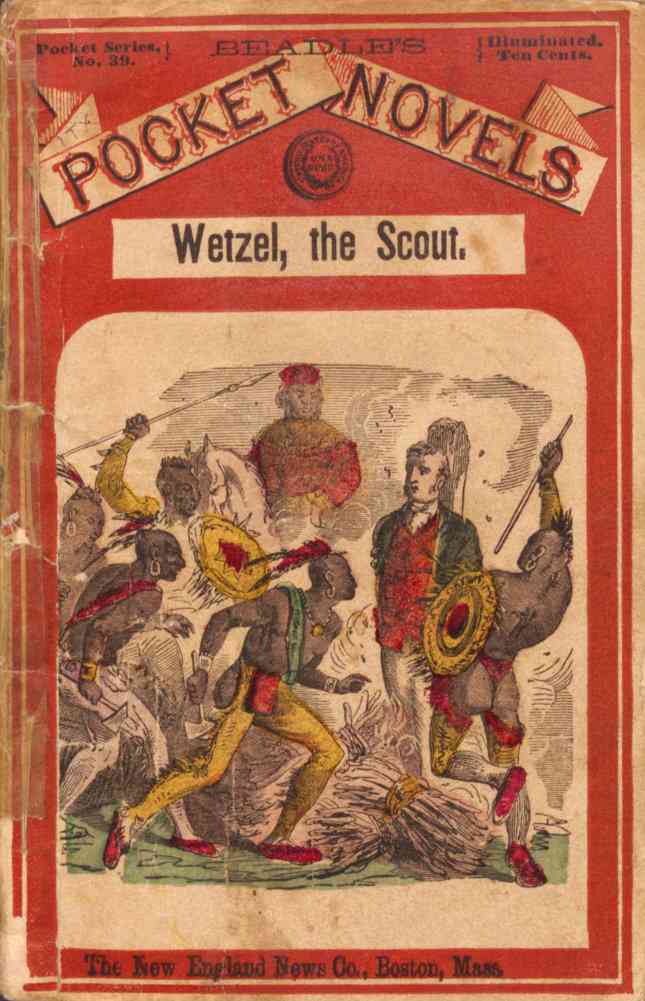
Some of these were victims to the cruelty of the renegades and savages, but their places were filled by others as hopeful and eager as they had been.
And amid all these formidable circumstances there were meek and good men who hesitated not to brave all for the pleasure of their good Master. The Moravian missionaries had penetrated the wilderness, and the seed sown by them was already bearing good fruit. Numbers of Indians were converted to Christ, and withstood all the temptations of the chase and battle-field. They remained together and engaged in agriculture, and withdrew entirely from their rude and warlike brethren. It was a beautiful and instructive sight—the one small spot radiant with the smile of Heaven amid the mighty wilderness, made doubly dark and gloomy by the hand of man.
The faithful energetic followers of Wesley were already numbered among the pioneers. They were brave, resolute men, who could shoulder the rifle and lead to battle, swing the glittering ax in the forest, or point the way to heaven. Theirs was the religion for the time. Freed from the restraints and conventionalities of civilized life, it was from the heart. Its representatives were men whose words were plain to the uneducated backwoodsman, and who never set forth truth beyond their comprehension.
For a time after the expedition of Colonel Clark comparative peace reigned along the frontier. A number of flat-boats descended the river, and reported that they had not been disturbed during the passage. This made the settlers hopeful, and many began to believe war over. Numbers engaged in felling the trees around their settlements, and extending their boundaries; strong commodious cabins made their appearance; and some, more venturesome than their tired neighbors, erected their dwellings in the edge of the wood, beyond the immediate protection of the block-house, and here they removed with their families. Emigration received an impetus which otherwise would have required years.
But matters could not remain thus. The warlike disposition of the powerful Shawnees could brook restraint for a long time.
In the summer of 1781, reports reached the settlements that a boat had been stopped near the mouth of the Sciota and all its inmates—nearly a score—had been massacred. The notorious Pete Johnson and Simon Girty figured in this outrage. They made several attempts to decoy them to shore, but the whites had been warned, and would have escaped had they possessed any knowledge of the channel of the river; but unfortunately they ran ashore during the night, and before they could escape, the savages, headed by Girty, poured a volley into them, which killed or rendered helpless all on deck, and then rushed upon the boat.
The women were outraged and tomahawked, Pete Johnson leading in the latter barbarity; and, as if to incite the settlers along the river, the flat-boat was carefully preserved from injury, and with several of the mangled corpses upon it set afloat.
It glided some twenty or thirty miles when it struck the shore and grounded.
One of the rangers, passing down the river, discovered it, and suspecting foul play, waded out and climbed into it.
As he passed over the gunwale he was nearly overcome with the horrid stench of the putrefying bodies. Nothing daunted, he plunged resolutely into the cabin, where the full horrors burst upon his vision. Stretched out at full length lay some eight or nine women and men, bloated and bloody, piled upon each other, and glued together in their own blackened blood.
He waded to the shore, broke off several dried branches, and piled them at the cabin door. It was now nearly dark, and he set fire to them and pushed the boat into the stream. At last the hull, burnt to a charred cinder, dipped beneath the water and disappeared from view.
CHAPTER XI.
THE CAPTAIN AND THE INDIAN.
The report of the outrage on the flat-boat, we say, reached our settlement, but it was discredited by many, among whom, of course, was Captain Parks. And even when the ranger himself related to the astonished people what he had witnessed and done, the irascible captain told him he had imagined it all. He held such faith in the chastisement given by Colonel Clark, that there was but one argument which could make him believe the savages had really commenced their outrages again. That argument, in its most convincing form, he was to receive.
As is generally the case, the long pre-emption from attack gave to the pioneers an undue sense of security, and many of them more than once culpably exposed themselves to danger. No warning or remonstrances could induce some from plunging into the forest and erecting their cabins more than a rifle-shot from the block-houses. The restless, eager enterprise, so peculiar to the American people, manifested itself in every proceeding.
In those days nearly every species of game abounded in the wood: the bear, buffalo, deer, panther, elk, coon, wolf, and the numberless smaller animals. These, with the myriads of delicious fish, showed the goodly inheritance of the pioneer.
One morning, in the late summer, Captain Parks shouldered his rifle and plunged into the wood, determined to spend the day in the hunt. The minister, Edwards, ventured to caution him, but he only received an impatient “Umph!” for his good intentions. He would neither permit any one to accompany him, and evinced considerable temper when it was ventured upon the ground of safety. He turned his footsteps toward the Licking river, and his object was to bring down several deers. In a short time he reached a celebrated deer lick, and bringing his dog to him, concealed himself in the bushes.
Lying thus, with his gaze turned up the lick, he saw nothing behind him until his dog uttered a low growl of alarm. Turning around, instead of an animal, he saw nothing less than a Shawnee Indian following his trail!
But at this unlucky moment the dog gave a bark and sprang to his feet. The Indian, at the first alarm, sprung backward, and stood on the defensive, and the captain seeing that he was discovered, arose and approached him, while each held his rifle ready to fire at the first demonstration of the other. But neither fired, as they both recognized each other.
The savage had often been in the settlement, and was generally known to the whites as a drunken, worthless sot. Some suspected him of treachery, although he had never been detected in any overt act, and professed friendship to them. But he had the appearance of a low, cunning fellow, and was carefully shunned by the most cautious. He had been christened Bill by the settlers, and it had been remarked that for the last few months he had not been noticed in the vicinity of the settlement.
“Why, how see you, Bill?” asked the captain, extending his hand.
“Me good. How captain?”
“All right. Hunting, I see?”
“Yeh; me huntin’ for dam deer.”
“Wal, did you get on their track?”
“Purty nigh track o’ sunken’.”
“Track of what?” demanded the captain, in a towering passion.
“Me don’t know; tink him dam Mingo,” eagerly replied the savage.
“Umph! our tracks looks a good deal alike.”
“Yeh! much like,” repeated the Indian.
“If I’s sure you were following me, Bill, I’d shoot you in a minute.”
The small restless eye of the Shawnee fairly snapped with electric blackness for an instant as he gazed at the captain; but the latter returned his look with his own glittering orbs and awed him at once.
“I hardly think you would try such a thing, because I always treated you gentlemanlike; kicking you out the house when you gave me any of you jaw, and licking you like blazes when you insulted the woman. And you chaps got such a whipping from our boys that I hardly believe you will try any of your tricks very soon again.”
“Shawnees do nothing; much ’fraid.”
“S’pose so. Come, Bill, be honest. Did the Shawnees stop a flat-boat up the river and butcher all hands?”
“No; big lie; nebber do such thing.”
“Well, I don’t believe they did. Where’s Simon Girty and that devil, Pete Johnson? Raising the devil among your people?”
“Girty am so (imitating the action of scalping) and Johnson gone back with own folks.”
“You don’t say?” asked the captain, swallowing the falsehood.
“Yeh; me help to do it to Girty.”
“Umph! that’s one good thing you have done in your life. How came them to scalp Simon Girty.”
“Him want to kill all whites: he do too much.”
“I haven’t seen you around the settlement since you went off so drunk. Thought maybe you were gone.”
“Bill go live with squaw and take care of ’em.”
“Oh, married, I see. Well, that’s all right, I s’pose—but I started out on a deer hunt, and I am of the opinion that it’s few deer we shall see if we stand here talking.”
“Very good; Bill shoot deer, too.”
Captain Parks returned to his hiding place, and the Indian followed, and passed beyond and concealed himself behind him. The Shawnee held his rifle toward the captain, and continually raised his head as though he expected the approach of some animal; but the captain soon became convinced that these glances were bestowed upon himself. They remained in this position for an hour. At the expiration of that time the captain arose and expressed his determination of going home. The savage arose also, and they started together.
When within a few miles of home, they reached a large brook, in which were thrown several stones, to assist in crossing over. Without hesitation, our friend stepped on these and commenced passing. As he reached the opposite shore, he turned suddenly around to see the savage. This movement saved his life, for at that instant the savage raised his rifle and fired. The bullet shattered the powder-horn at the captain’s waist, and before he could recover, the Indian uttered a yell of defiance and disappeared in the forest.
“After him, dog, and tear him to pieces!” he exclaimed, furiously.
The dog plunged into the forest with a howl, and took his trail with the quickness of lightning. Suddenly the yelp of the dog ceased, and before he had taken a dozen steps, the moaning, bleeding form of his dog appeared. He dropped with a whine at the captain’s feet. The poor brute was dead, and Captain Parks was convinced that the Shawnees were pretty well rid of their friendly feeling toward the settlers.
CHAPTER XII.
It is one of those pleasant summer days, a few months after the occurrence of the events recorded in our last chapter, that we take a glance at the settlement which figures so conspicuously in our narrative, and which latterly had enjoyed comparative quiet.
Captain Parks, on his return from the adventure related in our last chapter, had given his opinion that the whole Shawnee tribe, and Bill especially, were a set of unmitigated scoundrels, and that it would never do to repose the least confidence in them.
Late in the evening of the beautiful summer’s day of which we speak, Kingman and Irene passed through the block-house and arm-in-arm made their way slowly toward the river.
The girlish beauty of Irene had ripened into all the fascinating charms of womanhood. There was a deeper blueness in her mild, affectionate eye, though it could still sparkle with its wonted fire, and a meeker, more subdued expression of the countenance.
“What a magnificent night,” remarked Kingman.
“Too beautiful to sleep,” returned Irene.
“For what, then, is it made?”
“For meditation and devotion.”
“And love!” added Kingman, pressing the girl impulsively to him. “It is now three years since I first asked you to be my bonny wife, Irene. You did not refuse me, but thought you were too young, and I waited another year before I asked you. You made the same answer the second time, and I have now waited two long years without making the slightest reference to it. We are both older, and I trust I am wiser now. Irene, will you be my wife?”
“I guess I am too old now.”
Kingman looked down into the face resting upon his shoulder, for he did not know the meaning of the words—but it was not dark enough to conceal the roguish twinkle of her eyes.
“Don’t you think I am getting too old?” she asked, reaching up and brushing the hair from his forehead.
“Well, you are rather old, that’s a fact—older than I ever knew you to be before—‘but better late than never,’ you know.”
“Then it matters little how late it is—so suppose we wait a few years longer yet.”
“An unsupposable case, my dear.”
“But not an impossible one.”
“I hope so. My gracious! I have waited three years already.”
“But we will be wiser and older then.”
“We will be older, I suppose, but little wiser.”
“And wiser, too, I am sure. We can try it and see, at all events.”
“Irene, will you not promise me now?” asked Kingman, in an earnest tone.
“Perhaps so. Ask and see.”
“Well, then, will you be my wife?”
“Yes.”
“Within a year?”
“Yes.”
“Within six months?”
“Yes.”
“Within three months?”
“No, sir.”
“When will you, Irene?”
“Next spring.”
“In February?”
“February is not in the spring; no, sir, not then.”
“Do name the time; I suppose it will be the last day of the season.”
“No, George. I will become your wife on the first of May—in the month of roses and flowers.”
Kingman drew the trembling girl closer to him, and pressed a pure kiss on her burning cheek. They sat and conversed far into the night, their voices just loud enough to reach only the ears for which they were intended.
“Should we not return?” at length asked Irene.
“I see no need of hurrying. Why do you ask?”
“It is somewhat late; and, besides,” she added, in a lower tone, “I believe I have heard something wrong.”
“Not frightened, Irene, are you?”
“Yes: for I fear we are in danger.”
“In danger from whom, I should like to know.”
“From Indians and wild animals.”
“From Indians! do you suppose there could be found a savage, Irene, who would harm a hair of your head?”
Kingman had hardly ceased speaking when he heard a rustling, and started to his feet. He reached forward to his rifle, which he had leaned against a tree not three feet away. It was gone!
“By heavens! we are in danger. Keep quiet, dearest,” he whispered.
The next instant they heard the deep, suppressed laughter of some one. Both were confounded. Wonder for a moment held them silent, then, as Kingman looked up he saw a form standing in the entrance.
“Frighten you any?” asked the well-known voice of Abe Moffat.
“Rather,” laughed Kingman. “Have you got my rifle?”
“I picked one up that was leaning against a tree here.”
“How did you get it without my knowing it?”
“Just reached over and hauled it up without saying a word. You needn’t blush so, Irene; I didn’t hear George ask you to be his bonny wife; I didn’t hear you promise him you would; but, George, if you value your little angel, you’d better get out of this as soon as convenient.”
“What mean you?” asked both, eagerly.
“O nothing! only the devil is to pay among the Shawnees again.”
“How did you know we were here?”
“I seen you go, and I can tell you, as I just now told you, you must do this courting at home, or in some safer place than this.”
Kingman concluded that the advice of the ranger was good, and arose at once.
Whether the storm of war would not have reached our settlement or not it is difficult to tell. But the smouldering fire among the frontier was fanned into a raging flame by the perpetration of one of the greatest outrages that ever disgraced the American history. In March, 1782, Colonel Daniel Williamson and his command inhumanly massacred over a hundred of the peaceful Moravian Indians. These had long been such warm friends to the whites that they had incurred the displeasure of their own people thereby, and their murder was therefore entirely unprovoked and without the shadow of excuse.
Colonel Williamson sowed the wind and others reaped the whirlwind.
CHAPTER XIII.
REAPING THE WHIRLWIND.
A few days subsequent to the massacre of the Moravian Indians, Abe Moffat made his appearance at the village, and reported their slaughter. For days nothing else was referred to, and the minister, Edwards, was so heartbroken that he started at once and alone through the wilderness to satisfy himself of the full extent of horrors.
The distance to the scene of the massacre was great, and it was a week’s journey to go and return; but an impetus, such as seldom influence the motives of any one, impelled him forward. He arrived upon the ground late at night. With a silent and cautious tread the divine emerged from the forest and walked through the stricken village.
There was a faint moon overhead that threw a ghastly light upon the scene, and the ripple of the muddy Tuscarora, as it flowed darkly by, was the only sound that disturbed the solemn stillness. All at once, and unconsciously to himself, he came upon the edge of the pit containing the slaughtered bodies. At sight of the putrid Indians, piled promiscuously together, and rendered doubly woful by the moonlight streaming down upon them, a sudden faintness overcame him, and ere he could withdraw, he fainted and swooned away.
He recovered in a few moments, and without trusting himself to look again, turned and disappeared in the forest.
Late at night he started a fire against the dark trunk of a huge oak, and lay down to rest.
The divine generally slept heavily; but the terrible sight which he had so lately witnessed still haunted him in his dreams. He was feverish, and often uttered words that showed upon what his mind was constantly running. After a while he commenced dreaming. He saw the whole butchery again, as his terribly excited imagination conceived it, and finally it seemed that one of the Indians suddenly sprang up and brandished a tomahawk over his head. He possessed no power of moving, and finally awoke, covered with cold and perspiration. As he started up he found a portion of his dream a reality. In the dim moonlight the glowing eyeballs and gleaming visage of an Indian were visible close to his face.
“Why, Wingenund, is that you? What is the matter that you look so?”
This Wingenund was a Shawnee chief who was known and respected by many of the whites for the sterling qualities he possessed. He was brave, honorable, and—what was almost a paradox in a Shawnee—was merciful. He had taken little part, in the frontier wars, although, in the battles with other Indian tribes, he was the bravest among the brave. He was a middle-aged man, of much intelligence, and often visited the different settlements. He spoke the English language very fluently, and avoided that extravagant manner of expression so common among the North American Indians. Hence, the astonishment of Edwards was natural at seeing him in such a suspicious attitude.
“What is the matter, Wingenund? You would not take my life, would you?”
“I did not know you, good man, and came near doing it. But Wingenund will never harm you.”
“Nor any other white man, I hope.”
“Wingenund has dug up the hatchet, and it shall never be buried again until it has drank the blood of the cowardly white men.”
“What does this mean, good friend? I thought you were our friend.”
“I was, good man, but am no longer.”
“Not the friend of our settlement?”
“I am the friend of no man in whom a drop of pale-faced blood runs, except of Simon Girty and his men.”
“Are you not a friend to me, good Wingenund?”
“If we meet in battle, there is nothing but enmity between us.”
“I am sorry for that, but I trust we shall never meet thus. But, Wingenund, let me ask the meaning of this change, although I fear I know the reason already.”
“Have you been yonder?” asked the savage, pointing his hand back of him.
“I have only just returned,” replied the divine.
“You have seen the Moravian Indians?”
“I have seen them, Wingenund.”
“And yet you ask why I have dug up the hatchet!”
“But, remember, Wingenund, that none of us undertake to justify the cause of Williamson, and why should you seek to take vengeance upon the innocent?”
The chieftain’s brow grew darker still as he replied:
“It cannot do, good man; the tribes who have fought each other will unite together to make war upon you. I have passed through the villages and stirred them up. I told them what Williamson and his men had done, and that was enough. You must beware now.”
“Wingenund, I know you are a brave man, and do not believe you would harm anyone whom you believed to be a friend. Listen, then, to what I say. We heard, some months ago, that Colonel Williamson, with one hundred men, was preparing to march against the Shawnees. The Shawnees had broken in upon their settlements at night, had burned their houses and scalped their women and children. They did this without provocation upon the part of the whites, and we knew they would do it again. To prevent this, these men were sent to chastise the offenders. They were not sent to murder defenceless people, as they did. One of our men joined them. He accompanied them to the Moravian towns, not dreaming of their intentions. When he saw the awful work they were about to commence, he told Colonel Williamson to his face that he was a base coward and villain to undertake it. He appealed to the men to join him in their resistance, running the risk of being shot himself while he did so. Nearly a score besought their commander to spare the lives of the Indians, and boldly stepped forward and demanded that it should be done. But the others refused. They were determined that all in their power should die, and those who first spoke against it, finally joined the others. But he from our settlement did not. He did what he could to prevent it, but could not. But he took no part in it. He was their friend, and felt as all but these men did. When this man arrived, and reported that he had seen these things, I could not believe him at first. I hastened here alone to satisfy myself of what I saw. I have told you how we feel, and, Wingenund, will you raise the hatchet against us?”
The chief trembled at this question, and Edwards saw that he was deeply affected. He remained silent a moment, and then answered:
“The good man has spoken truth. The other Shawnees and Indians may slay your people, but Wingenund never will.”
“That rejoices my heart, my good friend.”
“But I warn you,” he added, impetuously, as he recoiled a step—“I warn you, good man, of what is coming, that you may be prepared. The red men have gathered like the stars in heaven, and they have sharpened their knives and sung the war-song around the camp-fires. Wo to him who crosses into the country! He shall never return. Our scouts are scouring the woods, and none shall escape their eyes. Be warned, good man, Wingenund has spoken.”
Before Edwards could intercept the chieftain or make a reply, he wheeled around and darted away into the darkness.
The minister replenished his fire, and although he knew that the warnings of his savage friend should be heeded, he did not hesitate to lie down again in slumber. This time he was not disturbed, and when he awoke the sun was shining high in the sky, and the songsters of the wood were chattering gaily overhead. Slinging his rifle over his shoulder, he turned his face toward home.
The savages had comparatively little success along the frontier. The different settlements were so thoroughly armed and prepared, and the rangers so watchful and vigilant, that it was impossible to come upon them unprepared. Stragglers and hunters underwent the most danger, as they were followed and attacked by superior numbers in the woods, and rarely escaped their implacable foes. The great Tecumseh at this time was but a mere boy, yet the valiant deeds of his companions fired his soul, and he gave evidence even at this early day, of that wonderful prowess and courage which has since rendered his name immortal.
The Indians, growing bolder and more exasperated at their ill-success, finally crossed the frontier and attacked the settlers in Western Pennsylvania and Virginia. Several houses were burned, and their inmates either put to the torture or carried away into captivity. This was a bold proceeding, and demanded punishment immediately. A call was made for volunteers, and the incensed settlers collected together at once. Nearly five hundred men enrolled themselves for the campaign, and to show the feeling which actuated the settlers, we have only to mention that the monster, Williamson, was elected leader; and he made no secret of his intention to murder the remaining Moravian Indians. This created so much indignation among the men and subordinate officers that Col. Crawford, a brave and humane man, was appointed to the command, with power to control the actions of the entire force.
On account of the unexpected change in the aspect of affairs along the frontier, Irene had informed Kingman that she considered it best to defer their marriage day until there was peace, or at least, a nearer approach to it than at present. In the midst of war, when their own people were engaged in it, it seemed hardly proper their marriage should take place. Kingman saw the justice of what she said, and agreed that an indefinite postponement was demanded.
On the 22nd of May, a glorious spring morning, Colonel Crawford marched with his force into the Indian country. The first point visited was the Moravian towns, which they found deserted and forsaken. Here Abe Moffat, who had joined the company as spy, notified Crawford that their motions were watched by numerous Indian spies, and that every preparation was made to give them battle. The greatest care was necessary to avoid being drawn into ambush, and Crawford ordered the men to march slowly, keeping a good distance behind the rangers and scouts. There were nearly a dozen of these constantly outlying the army, who communicated at all times with it. As there was a score of Indian spies, most consummate tact and cunning was called into play for the two forces to avoid each other. As it was, personal encounters took place between the scouts, and the soldiers often heard the report of their arms or the yells of conflict. The Indian spies concealed themselves in the thick tops of the trees, and as this was practiced by numbers of the white rangers, it more than once happened that an Indian or American spy found themselves both inhabitants of the same tree. In such a case a short contest, always fatal to one and often to both, took place.
In this manner the American party marched forward, until at Upper Sandusky they found themselves compelled to give battle to an overwhelming force of Indians. The rangers warned Crawford that it would be a desperate and bloody struggle, as the savages were exasperated to the high pitch of fury by the slaughter of the Moravian Indians, and they had learned that Colonel Williamson was with him.
Crawford formed his men in order of battle as quickly as possible, addressing them, and awaking an enthusiasm which gave him great confidence. The battle commenced immediately, Crawford’s force preserving admirable order, and withstanding nobly the charge of the savages. But at the next charge Crawford saw, with inexpressible disgust, the cowardly Williamson (who feared the Indians were endeavoring to secure him) turned in with the utmost confusion and make a break for the woods. Crawford, in a voice of thunder, sprang forward and endeavored to check the retreat; but it was impossible. A panic had taken possession of them, and the exulting Indians gave them no chance or opportunity to reform.
Simon Girty took part in this memorable conflict, and during the retreat dashed into the woods and took prisoner—Abe Moffat! This he would never have accomplished had Abe not labored under the greatest disadvantages. He had broken the lock of his rifle so as to be unable to fire it, and was singled out by Girty, who being mounted ran him down before he had the slightest chance of concealing himself. Giving him in charge of several Indians, Girty again took to the woods and captured two more whites. Upon arranging them, it was found that there were over forty. Among these was Colonel Crawford himself. A council was immediately held, and the whole were painted black, and condemned to the stake!
We shall dwell upon the fate of but two of these—Colonel Crawford and Abe Moffat.
At the village resided the Indian chief, Wingenund. This chief had been known to Crawford sometime before, and had been on terms of true friendship with him, and kindly entertained by him at his own house; and such act of kindness, all red men remember with gratitude. Wingenund does not appear to have been present when the preparations were made for burning of the prisoners, but resided not far from the village and had retired to his cabin that he might not see the sentence of his nation executed upon one calling him his friend; but Crawford requested that he might be sent for, cheering his almost rayless mind with the faint hope that he would interfere and save him. Accordingly Wingenund soon appeared in the presence of the bound and naked white men.
He was asked by Crawford whether he knew him, when the Indian said he believed he did, and then asked:
“Are you not Colonel Crawford?”
“I am,” replied the colonel.
The chief displayed much agitation and embarrassment.
“Do you not recollect the friendship that always existed between us?” said Crawford.
“Yes,” said the chief, “I remember that you have been kind to me and we have often drank together.”
“I hope the same friendship continues,” said Crawford.
“It would, of course, were you where you ought to be.”
“And why not here?” urged the colonel. “I hope you would not desert a friend in time of need. Now is the time for you to exert yourself in my behalf, as I should do for you were you in my place.”
“I cannot. The King of England himself, were he to come to this spot, with all his wealth and influence, could not interfere. The blood of the innocent Moravians, more than half of them women and children, cruelly and wantonly murdered, calls too loudly for revenge!”
“My fate, then, is fixed,” said the wretched man, “I must prepare to meet death in its worst form.”
Wingenund, shedding tears, and deeply affected, then withdrew.
The colonel, observing terrible preparations going forward, called to Girty, who sat on horseback, and asked if the Indians were going to burn him. Girty replied in the affirmative. The colonel heard the intelligence with firmness, merely remarking that he would bear it with fortitude. At this juncture a Delaware chief arose and addressed the crowd in a tone of great energy, pointing frequently to the colonel. As soon as he had ended, a loud whoop burst from the assembled throng, and they all rushed at once upon the unfortunate Crawford.
A terrible scene of torture was now commenced. The warriors shot charges of powder into his naked body, commencing at the calves of his legs, and continuing to his neck. The boys snatched the burning hickory poles, and applied them to his flesh.
The squaws would take up a quantity of coals and hot ashes, and throw them upon his body, so that in a few moments he had nothing but fire to walk upon!
While this awful scene was being enacted, Girty rode up to the spot where Dr. Knight stood. After contemplating the sufferings of the colonel for a few moments, Girty told the doctor that he had a foretaste of what was in reserve for him. He swore that he need not expect to escape death, but should suffer it in all the extremity of torture.
The terrible scene had now lasted more than two hours, and Crawford had become much exhausted. At length he sunk in a fainting fit upon his face, and lay motionless. Instantly an Indian sprung upon his back, knelt lightly on one knee, made a circular incision with his knife upon the crown of his head, and clapping the knife between his teeth, tore the scalp off with both hands.
Scarcely had this been done when a withered hag approached with a board full of burning embers, and poured them upon the crown of his head, now laid bare to the bone. The colonel groaned deeply, arose, and again walked slowly around the stake. But why continue a description so horrible?
Nature at length could endure no more, and at a late hour in the night he was released by death from the hands of his tormentors.
When Colonel Crawford was stripped and painted black for the stake, his shoes were also taken off and cast away.
Moffat stood by when this was done, and the action seemed to have given him a thought, for he kicked off his own moccasins, and walking forward to where the shoes lay, he managed to work his feet into them.
Of course his actions were observed by the Indians, but they supposed that nothing was intended by it further than to secure a protection for his feet.
When Crawford, in his torture, was compelled to walk barefooted over the living coals, Girty turned upon his horse and spoke to Moffat:
“Ah, that’s what you put on them shoes of his’n for, is it? Never mind—when we come to toast you, they won’t do you no good.”
One or two more of the prisoners were burned upon the spot, when it was determined to march the others to the Shawnee towns, where hundreds of others might feast themselves with the sight. For this purpose the prisoners were separated, and under the guardianship of either one or two Indians, marched off singly into the wood.
Dr. Knight, the companion of Crawford, as said before, was given in charge of one warrior, from whom he managed to escape in the wood during the march. The others, who had any appearance of stubbornness, or who seemed likely to give trouble, were given over to well-armed savages to watch their motions.
Such was the case with Moffat.
The Shawnee towns were a long distance away, and, as the prisoners were compelled to keep separate by their masters, the march required considerable time.
Moffat was the very last one who started. He rejoiced at this, as it left the coast clear behind him, and Girty had accompanied those in front.
The ranger could see, from the looks the two savages gave him, that they were anxious to ascertain his feelings. If his eye sparkled, or he retained his usual vivacity, their suspicions would be aroused; and he accordingly feigned the deepest despondency and despair.
During the day, Moffat’s hands had been simply tied behind him, and he marched in front of the two savages. At night, he well knew he should be more securely bound, and it was his determination to elude his enemies, if possible, before that time.
In the afternoon he feigned sickness, beseeching the savages to halt and rest at short intervals. Although hungry, he refused all food, and on one or two occasions actually dropped to the ground, as if with faintness.
The suspicions of the Indians were naturally roused at first, but the sickness of their captive was so well assumed and carried out, that they were finally deceived. They halted several times, and allowed him a few moment’s rest. As Moffat lay upon the ground, at such times, he groaned and rolled and writhed as though in great pain; but, in reality, he was working at the thong which held his wrists. By doubling his foot beneath him, catching it and twisting the thong over the shoe, he succeeded in getting it in such a position as to allow him to chafe and rub it against the nails in the shoe. Now, it is no easy matter for a person to bring his foot and hand together behind him and keep them in that position for any length of time; and if one is disposed to doubt it, they can easily satisfy themselves by a trial. But with the lithe, muscular ranger it was quite an easy matter. His great hope was to chafe the ligature until it could be broken by a desperate tug. In this he was more successful; for, as he lay upon the ground, rolling and writhing as usual, he felt the cord part behind him, and his hands were free. In a moment he arose, of course keeping them behind him, and the string in its position as much as it was possible for him to do so.
From the manner of the savages, it was evident they suspected nothing.
Abe, however, rather overdid the matter at last. He became so faint, and sank to the ground so often, that the savages began to get out of patience. They ordered him to his feet several times, and once, when he did not rise soon enough, he was brought up all standing by a rousing kick. This did not suit him very well; but under the circumstances he concluded to pocket the insult, for the good reason that there was no other course for him to pursue.
At last darkness commenced settling over the forest. The savages were anxious to reach some point ahead, and as their frequent halts for their prisoner had delayed them, they now hurried forward and traveled later than they otherwise would. One savage, as stated, walked in front of Moffat, and the other behind.
As they were walking in a part of the forest darker and denser than usual, Moffat suddenly wheeled upon his feet, and before the hindmost savage could suspect his intention, struck him a stunning blow that felled him like a death-stroke. As he darted away the rifle of the other Indian was discharged and he started in pursuit. But he was out of sight, and in the forest—that is all a Western ranger asks. The whole night was before him, and he would have every opportunity that he wished.
He had run but a few rods when he settled down to a walk, for he felt that his escape was effected. The settlement was reached in due time, where he was gladly received by his friends. His escape may be considered one of the most remarkable that he had yet met with.
CHAPTER XIV.
When Abe Moffat reached the settlement, he heard startling news indeed. Irene Stuart, while wandering a short distance from the stockade the afternoon before, had been heard to utter a piercing shriek, and when the minister, Edwards, who was the nearest, ran toward the spot, he saw her in the hands of a brawny, painted savage, who, carrying her as he would have carried an infant, dashed into the woods, and immediately disappeared.
This bold abduction, as a matter of course, created the greatest excitement. Several started at once in pursuit; but it being near dusk, they were unable to follow the trail, and they shortly returned without having gained a glimpse of the captor or captive. It happened that at this time Lewis Wetzel, the renowned ranger, was at the settlement, and he and the leading men at once met together for consultation. Kingman, naturally enough, was anxious to begin the pursuit instantly.
“No use,” said Wetzel; “we can’t help getting off the track, and then we shall lose all the time it’ll take us to come back and start agin.”
“But will they pause to camp to-night—for there must be other Indians in the vicinity—and will we come up to them right away in the morning?” asked the excited lover.
“I hardly think we shall. They will hurry, of course, all they can, for they know well enough they will be pursued, and we’ll have to travel pretty fast if we get sight of them before they are safe home again.”
“The plan, then, is decided,” said Edwards. “Wetzel and Kingman, here, will start at daylight, in pursuit, while, from the necessity of the case, we are compelled to remain at home. May God be with them!”
This moment there was a movement at the door, and as they parted, Abe Moffat entered. Several grasped his hand, and he asked:
“What’s the row? No trouble, I hope, this time?”
“Trouble enough,” replied Kingman, and he gave, in a few words, the particulars of what is already known to the reader.
“And I have bad news, too, for you,” said Abe. “Colonel Crawford’s force was defeated more completely than was Sanford’s. Over one hundred have been killed, and more than thirty burnt at the stake! I seen Colonel Crawford burnt myself! I was painted black for the stake, but the Lord helped me to get away, and I’m down here, ready for any service.”
The effect of this intelligence can scarcely be imagined.
“I’m good for a two week’s tramp, and I ask it as a special favor, Wetzel, that you let me take your place.”
“I’ve a great notion to foller that girl, and I don’t see how Abe can do much, as he must be about used up now.”
“Why not both of you go?” queried Stuart.
Both Wetzel and Abe shook their heads.
“It won’t do,” replied the former. “There mustn’t be over two in pursuit. Just as sure as there are, they won’t do nothing. No sir—it won’t do.”
“Two is just the number that is needed,” added Abe.
“You can go, Abe,” said Wetzel, after a moment’s reflection. “It hurts my feelings to back out, but I don’t believe you would ask to go unless there was some good idee in your head. If you can draw a sight on that Pete Johnson, just make it your special duty to wipe him out from the face of the universe!”
It was agreed by Moffat that he would rise at the earliest sign of morn, awake Kingman, and the two pass noiselessly out into the forest without disturbing the others. Each was provided with a rifle, some thirty charges of powder, and a piece of jerked venison sufficient to last them several days.
At a late hour the men departed from Edward’s house to their homes.
As the night settled over the village, it was still and motionless, as though all were wrapped in the profoundest slumber. Not a soul was moving save the few sentinels, conversing together and exchanging their places at long intervals.
Hour after hour wore slowly away, and for the twelfth time Kingman returned, fretful and impatient, to his corner, as the light of day had not yet illumined the east. He sat a moment, when he heard Moffat move.
“Hallo! anybody about?” called out the latter.
“Yes, yes, I’m here! Do wake up, for your sleep seems eternal.”
“Fudge! Now don’t be in a hurry,” replied Moffat, kicking his blanket off from him. “Just take a peep at the door to see if there’s any light.”
“No, there is not a streak of day. I looked only this minute.”
“Look again. I’ll bet my rifle against your life you will see it this time.”
Kingman stepped to the door, and again looked forth. Sure enough, just over the eastern edge of the wilderness a gray, misty light was visible, and there was no mistaking its cause.
“Day is at hand, indeed!” exclaimed he, joyously. “Let us be off at once.”
“Not too fast, for there must be considerable more light before we start.”
The two men made noiseless but careful preparations for their journey. A burning pine knot afforded them a bright, though oily and smoky light. Their hunting shirts were buckled tightly beneath their girdles, from each of which protruded the handles of a couple of knives; their moccasins secured, and their rifles examined most minutely; and as Moffat looked around and saw that nothing else was wanting he blew out the light and the two men stepped forth into the open air. No one was yet visible stirring in the settlement, and they made their way cautiously toward the northern and largest block-house. It was yet so early and dark that there was no necessity of starting for a half hour yet. As they reached the block-house Kingman was surprised to find a considerable number of their friends already there. Among them he noticed Captain Parks, Wetzel, Stuart, Prentice, and several others.
“Rather ’arly, ain’t you?” remarked Wetzel.
“Yes; we will wait here a while before we start. Lew, do you suppose it is the Shawnees who have carried her off, or some other tribe?”
“I guess it’s the Shawnees. They’re generally in all kinds of deviltry, and that Pete Johnson, I believe, figures among them.”
“He is as often in the other tribes, so that you can hardly tell anything by that. She’s in desperate hands, I can tell you,” added Moffat, in a lower tone.
“I know that, and you have a hard job before you, Abe.”
“Umph!” remarked the captain; “If you can only rid the country of that Pete Johnson, you will be immortalized. Do it, and I’ll never kick you again—I won’t, upon my honor.”
“Then I think I will do it,” laughed the ranger.
“Isn’t it time to be moving?” asked Kingman, anxiously.
“Yes; it’s getting light, and we might as well start.”
“George,” said Stuart, as he took our hero’s hand, and the tears streamed down his face, “be careful, and do your utmost, for you know what there is at stake. She is yours forever if you can save her. God grant it.”
All now bade our friends farewell, and they made their way cautiously out of the block-house. By this time the sun was just appearing above the edge of the forest, and they hurried forward upon their dangerous duty.
The trail was immediately taken, and pursued with the most unwearying assiduity. Kingman, whose border experience had toughened his sinews and strengthened his muscle, was unwilling to pause for more than a moment’s rest. The great fear that his beloved was in the power of the renegade Johnson, was too tormenting to allow a moment’s rest.
In a few hours they reached the spot where the fugitives had encamped. A brief examination revealed the gratifying fact that they were all comparatively a slight distance ahead, although there was no question but that they were proceeding quite rapidly.
With this was made a startling and dreaded discovery—a white man was one of the captors. Such being the case it could be no other than Johnson the renegade.
“Merciful heavens!” exclaimed Kingman, in agony. “We must soon overtake them or it will be too late.”
“You’re too excited,” said Moffat, to whom the same question could be applied. “You’re too excited. Take things coolly.”
“But how can I? How much longer is that man to desolate the frontier?”
“I have an idea that he has run about the length of his rope. I somehow or other feel as though we were going to wipe him out.”
“God grant it!” fervently exclaimed Kingman. “He has earned his death over and over again for the last dozen years.”
An hour or two later Moffat announced that they were rapidly gaining upon the captors, and if they continued progressing as they were evidently doing at that time, the probabilities were that they would be overtaken by nightfall, or sooner.
It was only when the hunter insisted upon it that our hero would consent to stop and take a few mouthfuls of food.
There was a cool deliberation in the movements of Moffat that was strangely in contrast with the nervous restlessness of the lover. In fact they were just the men to engage in the enterprise. In the afternoon the trail showed signs of an increased gait upon those who were being pursued. This discovery gave Kingman increased anxiety. Finally the gathering darkness compelled them to give up the pursuit.
“Just what I expected!” exclaimed Kingman, in despair. “We may now as well yield up, and go home.”
The ranger touched him on the shoulder, and pointed ahead.
“What does that mean?”
The glimmer of a camp-fire was discernible through the trees. That it was the camp-fire of those whom they were searching for, there could not be a moment’s doubt.
“All now depends upon keeping cool,” said the ranger. “We will steal up until we get a good view. You may take the Indian and I will take the renegade.”
Side by side the two crawled cautiously forward. The Indian was preparing supper, while Pete Johnson was lying upon the ground, smoking a pipe. Irene sat on a fallen tree, her wrists bound together, and her head bowed as though she was giving away to her great woe.
Abe Moffat looked at Kingman, and whispered so that he was just able to hear him.
“Take your man, and be sure that you don’t miss, or he may not miss me.”
“All right; I will take the savage. Never fear for me.”
Simultaneously the rifles came to their shoulders, and pointed like the finger of fate toward the doomed ones. Simultaneously their sharp crack broke upon the stillness, and at the same instant the two victims fell forward upon their faces, dead.
Irene Stuart was still gazing in wonder for the explanation of this, when her lover came rushing toward her, and the next moment she was enfolded in his arms.
Abe Moffat scratched his head until they were through, and then suggested that they take the back trail. This they did until they were far removed from the dead bodies, when, as all three were thoroughly exhausted, they halted for the night.
Bright and early, after a refreshing breakfast, the homeward journey was resumed, and just as night set in they came in sight of the settlement. As they looked toward it Kingman said:
“As we are now safely back again, and our marriage has been postponed several times, don’t you think it is about time it was consummated?”
“You need wait no longer, dearest,” said she, leaning on his arm; “you have been very good to submit to my whims thus far.”
* * * * * * *
It was a genuine old-fashioned wedding, such as our grandmothers tell about. Fiddling, and dancing, and mirth, and cider, and apples, and jollification were the distinguishing features. All went as merry as a goodly number of marriage bells, and it was not until the “wee small hours ayant the twal” that the parties separated and went to their homes.
The death of Johnson the renegade, was a relief to all the settlements. His influence, beyond all question, had incited most of the massacres, and now that he was gone, there was some hope felt that peace might be reasonably looked for.
But peace did not come until 1794, about a dozen years later, when the incomparable Anthony Wayne—“Mad Anthony”—gathered his invincibles together, and scattered the combined forces of the aggressive tribes as the autumn leaves are scattered before the tornado. A long, lasting peace then came, unbroken until the mighty Tecumseh arose, and led his warriors to battle. But his history belongs not to us. Our work is done, and we now bid our kind readers an affectionate adieu.
BEADLE & ADAMS’
New Twenty Cent Novels!
The TWENTY CENT NOVELS’ series will embrace none but NOTED WORKS OF NOTED AUTHORS, chiefly in the field of a purely American romance, of marked originality and high interest—price, size and literary character all adapting them to the widest circulation. Those seeking for The Best American Novels will find them in this series. The books already issued embrace:
ALBERT W. AIKEN’S
NOTED DICK TALBOT ROMANCES!
NAMELY: