
The Project Gutenberg eBook of What a Young Wife Ought to Know
Title: What a Young Wife Ought to Know
Author: Emma F. Angell Drake
Release date: June 26, 2018 [eBook #57406]
Language: English
Credits: Produced by The Online Distributed Proofreading Team at
http://www.pgdp.net (This file was produced from images
generously made available by The Internet Archive/American
Libraries.)
Pure Books on Avoided Subjects
Books for Men
By Sylvanus Stall, D. D.
- “What a Young Boy Ought to Know.”
- “What a Young Man Ought to Know.”
- “What a Young Husband Ought to Know.”
- “What a Man of 45 Ought to Know.”
Books for Women
By Mrs. Mary Wood-Allen, M. D.,
And Mrs. Emma F. A. Drake, M. D.
- “What a Young Girl Ought to Know.”
- “What a Young Woman Ought to Know.”
- “What a Young Wife Ought to Know.”
- “What a Woman of 45 Ought to Know.”
PRICE AND BINDING
The books are issued in uniform size and but one style of binding, and sell in America at $1, in Great Britain at 4s., net, per copy, post free, whether sold singly or in sets.
PUBLISHED BY
IN THE UNITED STATES
THE VIR PUBLISHING COMPANY
2237 Land Title Building Philadelphia
IN ENGLAND
THE VIR PUBLISHING COMPANY
7 Imperial Arcade, Ludgate Circus, London, E.C.
IN CANADA
WILLIAM BRIGGS
29-33 Richmond Street West Toronto, Ontario
EMMA F. ANGELL DRAKE, M.D.
Price $1.00 net
4s. net
PURITY AND TRUTH
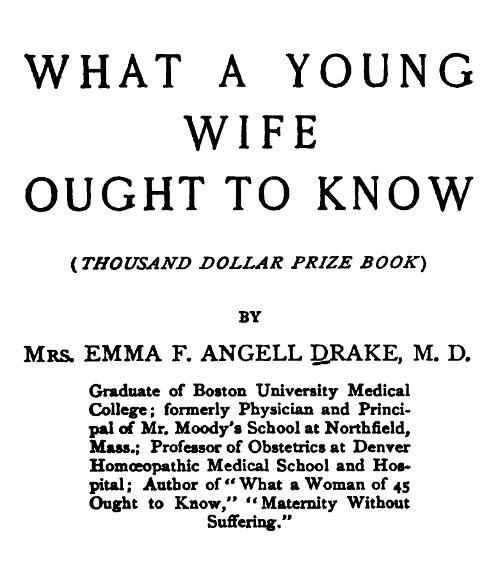
WHAT A YOUNG
WIFE
OUGHT TO KNOW
(THOUSAND DOLLAR PRIZE BOOK)
BY
Mrs. EMMA F. ANGELL DRAKE, M. D.
Graduate of Boston University Medical College; formerly Physician and Principal of Mr. Moody’s School at Northfield, Mass.; Professor of Obstetrics at Denver Homœopathic Medical School and Hospital; Author of “What a Woman of 45 Ought to Know,” “Maternity Without Suffering.”
Philadelphia, Pa.: 2337 Land Title Building.
THE VIR PUBLISHING COMPANY
London:
7, Imperial Arcade,
Ludgate Circus, E. C.
Toronto:
Wm. Briggs,
33 Richmond St., West.
Copyright, 1901, by SYLVANUS STALL
Copyright, 1902, by SYLVANUS STALL
Entered at Stationers’ Hall, London, England
Protected by International copyright in Great Britain and all her colonies, and, under the provisions of the Berne Convention, in Belgium, France, Germany, Italy, Spain, Switzerland, Tunis, Hayti, Luxembourg, Monaco, Norway, and Japan
All rights reserved
[PRINTED IN THE UNITED STATES]
Dedicated
To the Young Wives Who Desire the Best
for Themselves, for their Husbands
and for their Offspring
PREFACE
To this generation as to no other, are we indebted for the awakening of woman. Not the awakening alone which has led her out of the old lines into nearly every avenue open to man in his pursuit of the necessities and luxuries of life; but that other and larger awakening which has set her down face to face with herself, and in her study of woman she has shown herself courageous.
Bravely acknowledging her own limitations, she has set herself the task of fortifying the weak points, curbing the more daring aspirations, and getting herself into trim, so to speak, that she may traverse the sea of life, without danger to herself, her cargo, or to any of the countless ships which follow in her wake, or that pass her in the day or the night.
Not all women have yet awakened, and for those who have eyes to see, and have seen, a great work is still waiting to be done. They must reach out and rouse their sisters. Will they do it? With our young wives rests the weal or woe of the future generations. To them we say, “What of the future, and what sort of souls shall you give to it?”
Emma F. A. Drake.
Denver, Colorado,
United States of America.
February 1st, 1901.
CONTENTS.
| CHAPTER I. INTELLIGENCE OF THE YOUNG WIFE. |
|
| Out of girlhood into wifehood.—The setting up of a new home.—Woman’s exalted place.—Earlier influences.—Importance of intelligence.—Woman fitted by creator for wifehood and motherhood.—The position of reproductive organs in the body.—Dangers of crowding contents of abdomen.—What all young wives need to know.—Premium previously set upon ignorance.—Heredity.—Failures and successes of our ancestors.—Faults and virtues transmitted through heredity, | 21-35 |
| CHAPTER II. HOME AND DRESS. |
|
| Preparations for successful home-makers.—The importance of sensible dress.—An opportunity for reform.—The conditions of attractive dress.—A question of healthfulness.—What wives need to know concerning dress.—The kind to be avoided.—Injurious dress destroying the race.—The ailments caused by wrong dressing.—The corset curse.—A summary of the evils of dress, | 37-46 |
| CHAPTER III. HEALTH OF THE YOUNG WIFE. |
|
| Health insures happiness.—Be ambitious for health.—The scarcity of perfectly healthy women.—Fashion to the Rescue.—The boon of health.—Necessity of ventilation and fresh air.—Duties to the home.—The greatness of woman’s sphere.—In the society drift.—The extreme of wholly avoiding society.—Keeping in the middle of the road.—Pleasures and recreations taken together.—Taking time to keep young.—Mistakes which some husbands make.—Wrecks at the beginning of married life, | 47-55 |
| CHAPTER IV. THE CHOICE OF A HUSBAND. |
|
| Higher standards are being set up in the choice of a husband.—Should be worthy of both love and respect.—Love likely to idealize the man.—The real characteristics necessary.—Deficiencies in character not to be supplied after marriage.—The right to demand purity.—Young men who “sow wild oats.”—Importance of good health.—Weaknesses and diseases which descend from parents to children.—The parents’ part in aiding to a wise choice.—The value of the physician’s counsel.—One capable of supporting wife and children.—A dutiful son makes a good husband.—Essential requisites enumerated.—The father reproduced in his children.—The equivalents which the wife should bring to her husband, | 57-64 |
| CHAPTER V. WHAT SHALL A YOUNG WIFE EXPECT TO BE TO HER HUSBAND? |
|
| The young wife should seek to be her husband’s equal, but not his counterpart.—The recognized centre of the home.—Woman’s true greatness.—Man’s helpmeet.—Mrs. Gladstone’s part in her husband’s greatness.—Should attract her husband from the club to the home.—Continuing to be attractive in dress and manners.—Should accept both wifehood and motherhood.—Should keep pace with his mental growth.—Guarding against improper use of literary clubs, reading circles, etc.—Solomon’s picture of the model young wife.—A converted heathen’s estimate of his Christian wife, | 65-72 |
| CHAPTER VI. TROUSSEAU AND WEDDING PRESENTS. |
|
| Husband and wife ruined before their “crane is hung.”—The foolish and ruinous display at weddings.—An illustration given.—How wedding presents lead to debt and unhappiness.—Living does not need much machinery.—Mistake of copying after people of large wealth.—Wise choice of furniture.—The best adornments for the home.—The trousseaux of our foremothers.—The need of simplicity.—Artificialities that make a veil between our souls and God, | 73-78 |
| CHAPTER VII. THE MARITAL RELATIONS. |
|
| The subject approached with reluctance.—The marital state should be the most sacred of sanctuaries.—Wrongly interpreted it is the abode of darkness and sin.—Its influence for good or evil upon character.—Responsibility of mothers for the unhappy lives of their daughters.—Commercial marriages.—Marriage as it should be.—The husband’s danger from “aggressiveness.”—The wife should not provoke the wrongs she suffers.—Marital modesty.—Parenthood the justification of the marital act.—Reproduction the primal purpose.—Harmony of purpose and life.—Love’s highest plane.—The value of continence.—The right and wrong of marriage.—The relation during gestation.—Effects of relation during gestation illustrated.—The wrong-doings of good men.—The fruits of ignorance.—The better day coming, | 79-96 |
| CHAPTER VIII. PREPARATION FOR MOTHERHOOD. |
|
| Motherhood the glory of womanhood.—Maternity natural and productive of health.—Prevalence of knowledge of methods used to prevent conception.—Mothers should prepare their daughters for maternity.—Motherhood the sanction for wifehood.—Effect of fixed habits of mother upon offspring.—Adjustment of clothing to expectant motherhood.—Importance of proper exercise.—The sitz bath.—Effects of environment upon the unborn.—Why Italian children resemble the madonnas.—The child the expression of the mother’s thoughts.—The five stages of prenatal culture stated and illustrated.—The mother of the Wesleys.—The child the heir and expression of the mother’s thought and life, | 97-112 |
| CHAPTER IX. PREPARATION FOR FATHERHOOD. |
|
| The command to “replenish the earth.”—Preparation for motherhood more written about than preparation for fatherhood.—Questions which would test the fitness of young men for marriage.—Parents should know the character of young men who desire their daughters in marriage.—Many young men of startling worth.—The improving of a good heritage.—Effects of bad morals and wayward habits.—Effects of tobacco and alcoholics.—How young women help to contribute bad habits in young men.—The years of rooting and weeding necessary.—Attaining the best.—The father reproduced in his children, | 113-121 |
| CHAPTER X. ANTENATAL INFANTICIDE. |
|
| The alarming prevalence of this hideous sin.—How daughters are initiated.—How expectant mothers appeal to reputable physicians.—Young women should be taught to associate the idea of marriage with motherhood.—Destruction of own health and life go hand in hand with prenatal murder.—Effect of such attempts upon the physical life and character.—Life from the moment of conception.—The injustice and cruel wrongs inflicted upon wives by uncontrolled passions of husbands.—Obligation of motherhood should be recognized.—Its blessings.—The duty of the physician as educator of public sentiment, | 123-134 |
| CHAPTER XI. THE MORAL RESPONSIBILITY OF PARENTS IN HEREDITY. |
|
| The duty of the present to future generations.—Darwin on heredity.—Nature inexorable.—The mother’s investment of moulding power.—The father’s important part in the transmission of heredity.—The parents workers together with God.—Parents must reap what they sow.—The law and the gospel of heredity contrasted.—The children of inebriates and others.—Lessons from reformatory institutions.—The outcast Margaret.—The mother of Samson.—How a child became an embodiment of “The Lady of the Lake.”—The woman who desired to be the mother of governors.—Importance of this study, | 135-145 |
| CHAPTER XII. AILMENTS OF PREGNANCY. |
|
| Pregnancy not an unnatural but a normal state.—Tendency to neglect hygienic rules.—Morning sickness.—How to correct it.—Important questions of diet.—Displaced uterus as cause of nausea.—Mental states.—Companionship.—Various gastric troubles.—Insomnia.—Hysteria.—Constipation and how to correct it.—Longings.—Self-control.—With proper care, as a rule all goes well, | 147-154 |
| CHAPTER XIII. DEVELOPMENT OF THE FŒTUS. |
|
| Minuteness of the germ of human life.—The embryo cell and its store of food.—Its journey to the uterus.—Meeting the spermatozoön, conception occurs.—The changes which take place in the uterus.—Life is present the moment conception takes place.—The mysterious development of the embryo.—The sin of tampering with the work of the infinite.—The various changes in the development of the embryo and fœtus set forth.—The changes that occur each month.—Parenthood the benediction of husband and wife, | 155-162 |
| CHAPTER XIV. BABY’S WARDROBE. |
|
| The question that comes with fluttering signs of life.—Importance of wise choice of material and style of dress.—The blessedness of mother’s joy in preparing baby’s clothing.—The questions of dress important.—Formerly seemingly planned for discomfort.—The “binder” an instrument of torture.—Better methods now prevail.—The napkin.—How to establish regular habits for baby.—The pinning blanket.—The little shirt.—Baby’s earliest and best dress described.—The complete wardrobe described.—The furnishings of the basket.—Things which are not to baby’s taste or comfort.—The later wardrobe, | 163-171 |
| CHAPTER XV. THE CHOICE OF PHYSICIAN AND NURSE. |
|
| Choice of physician and nurse of real consequence.—Choose a physician whom you can trust implicitly.—A cleanly man.—The wife should make the selection.—A Christian physician.—Choice of nurse.—Wife most capable of making choice.—Advice of the physician desirable.—She should be pleasing to the wife.—Cleanliness.—Gentleness.—A person of individuality.—Neatness in manner and clothing.—Should be intelligent.—Physician and nurse should work in sympathy.—A good cook.—Able to converse, but not a gossip.—Many such physicians and nurses, | 173-177 |
| CHAPTER XVI. THE BIRTH CHAMBER. |
|
| Memory’s dissimilar pictures of birth-chamber scenes.—Newborn souls welcomed to mother’s arms and love.—The rebellious mother with empty heart and unwilling arms.—The older children reflect the spirit of the mother toward the newcomer.—Illustrations of conduct of intelligent children toward mother at birth period.—How to calculate date of confinement.—Birth chamber no terror for those who live hygienically.—Anæsthetics.—Their use explained.—Allaying anxiety.—Earliest premonitions.—Preparation.—The three stages of labor.—Tying the cord.—The rest and joy that complete and crown labor, | 179-187 |
| CHAPTER XVII. SURROUNDINGS AND AFTER-CARE OF THE MOTHER. |
|
| Maternity should have the largest and brightest room in the house.—It is her coronation room.—Simplicity of labor with healthy women.—Science has reduced risk to the minimum.—The exaltation of motherhood.—The rest after labor.—How to prepare a bed for the parturient.—Deliverance of mother from friends and visitors.—Sanitary pads.—Regular nursing.—Undisturbed sleep.—No binder necessary for mother.—The care of the breasts.—Diet.—Sitting up.—Six or eight weeks needed to regain normal condition.—The use of the douche.—Sore nipples.—The bearing of children not to be dreaded.—The joy of motherhood, | 189-200 |
| CHAPTER XVIII. CARE OF THE BABY. |
|
| The more thoughtful treatment of babies than formerly.—The first attention that baby needs.—Its oil bath.—The care of the eyes.—The care of the placentic cord.—Baby’s first bath.—Its covering after the bath.—The basket.—Regularity in nursing.—Waking at night.—Rocking to sleep.—Quantity of food.—The appointments of the nursery.—The mother and the care of her own children.—To her children the mother should be the dearest creature in the world.—The babies born of love.—The babies born in bitterness.—The responsibilities and joys of motherhood, | 201-212 |
| CHAPTER XIX. THE MOTHER THE TEACHER. |
|
| Food, clothing and restraint not the mother’s full duty to her children.—Teach them self-knowledge.—Mother should give honest answers to honest inquiries.—Ignorance leads to vice, and vice to ruin.—When shall children be taught physical truths.—How to teach little children physical truth.—Questions of sex should be the most sacred things of their knowledge.—How to teach the children in this sacred way.—Mothers should teach their boys as well as the girls.—How boys grow away from their mothers.—How mothers may win and hold their boys.—An honest mother’s reward, | 213-228 |
| CHAPTER XX. COMMON AILMENTS OF CHILDREN. |
|
| Little ailments.—Nursing babies affected by condition of mother.—Sleep and health.—The baby’s food.—Why babies are restless when nursed from the right breast.—Children’s symptoms often more grave than the ailment.—Illustrations.—Fevers and teething.—Vomiting.—The cause of rash.—Pallid children.—Chafing.—Babies do not cry without cause.—Need of water and fresh air.—Sleeping in open air.—Relief in constipation.—Important suggestions, | 229-236 |
| CHAPTER XXI. GUARDING AGAINST SECRET VICE. |
|
| The mother’s preparation as guide and protector of her children.—Safeguards for tiny babyhood.—Cleanliness, regularity, chafing, pin worms, servants, nurse girls, etc., etc.—How to teach and guard them during childhood.—Safeguarding the children with knowledge.—Inborn curiosity concerning physical mysteries.—How to meet these questions.—Sleeping alone.—How to correct vice where it exists. The duty of physicians to the public.—Symptoms which call for parental watchfulness.—Results of secret vice.—Rewards of parental vigilance, | 237-244 |
| CHAPTER XXII. THE TRAINING OF CHILDREN. |
|
| The training which develops talents.—When child-training should begin.—The training of her children the mother’s all-important calling.—The influence of the mother’s own character and life.—The children imitators of their parents.—Importance of earliest training.—Spoiled children.—Children’s rights.—The proper correction of children.—Broken promises and parental falsehoods.—Value of tact in parental discipline.—Value of parental sympathy.—The mother, herself, the best gift to her children.—The choice of books and stories.—The choice of companions for the children.—Toys, sports and amusements.—An appeal to mothers, | 245-262 |
| CHAPTER XXIII. BODY-BUILDING. |
|
| Our duty to nourish, strengthen and build up strong bodies.—Eradicating inherited infirmities.—Children inherit the permanent states of their parents.—The parents’ duty to those who are not well born.—What has been accomplished along these lines.—The relation of babies’ clothing and food to physical growth.—Unwise feeding.—The laws of nutrition.—The relation of food to national greatness.—A list of good foods.—The relation of exercise to appetite.—Comparative value of meat and vegetables.—Importance of rest and sleep.—Regular sleeping hours.—Schools and nervousness in children.—Many children are not properly nourished.—Food poorly prepared and poorly served.—The importance of hygienic cooking.—The cause of weak eyes in children.—Children and bare feet.—The dosing of children with nostrums.—The use of brandy and wine in cooking, | 263-285 |
| CHAPTER XXIV. MOTHERS’ MEETINGS, STUDY CLUBS AND BOOKS. |
|
| The awakening along new lines.—A better brand of mothers.—Books that will help along this line.—Mothers’ clubs as factors.—Their need in cities, villages, and rural communities.—A rich mine, | 287-292 |
CHAPTER I.
INTELLIGENCE OF THE YOUNG WIFE.
Out of Girlhood into Wifehood.—The Setting up of a New Home.—Woman’s Exalted Place.—Earlier Influences.—Importance of Intelligence.—Woman Fitted by Creator for Wifehood and Motherhood.—The Position of Reproductive Organs in the Body.—Dangers of Crowding Contents of Abdomen.—What all Young Wives Need to Know.—Premium Previously set upon Ignorance.—Heredity.—Failures and Successes of our Ancestors.—Faults and Virtues Transmitted through Heredity.
What a young wife ought to know is a large question, and one which we neither hope nor expect to answer fully in this little book, but if what we shall say shall set our girls to thinking a little more seriously and more exaltedly, of the great possibilities which await them: if it shall prepare them to enter the sacred realm of marriage with holier thoughts of the high duties they are assuming, we shall be content, feeling we have accomplished our purpose.
Out of girlhood into wifehood, seems a short step, but it is one fraught with grave responsibilities. If all along your girlhood way, your aspirations have been high, and you have been living for the best, you are prepared for the new life and its duties; if, on the other hand, you have been drifting thoughtlessly, as so many girls are allowed to do, you will have little conception of what the future holds for you.
A new home at your touch is to be called into being; a new altar reared, upon which the sacrificial offerings shall be those of love, and confidence, and life, and mutual endeavor, and work, not for self, but for that other self whom you have chosen out of all the world to be the sharer of everything that life means and that you hold dear.
“And the Lord said, it is not good that the man should be alone; I will make him an help meet for him.” And have you ever thought that in all these years we have made the mistake of writing these words together as one? We lose half of the designed meaning when we do this. “Meet means to have bestowed upon or sent to one: to have befall one, to have happen appropriately or deservedly. How full of meaning with this definition do the two words become. As if the Creator left the calling into life of woman, until he saw the great need, and then bestowed her as a blessing upon man: that goodness was only accomplished when he made woman to be a helper to man.”
We are very sure that there was nothing in the creative thought, of degradation, in this giving of woman to man. Nothing of degradation in the thought of her sphere and work. It is a work distinct from that of man, and yet supplemental to it; in many ways unlike his and yet not inferior to it. It is a large half of the work of the great busy world—a work that is beautiful, noble, helpful, uplifting; and when done in the spirit of love and willingness that should always characterize it, it beautifies and ennobles the worker.
Dear young wives, begin your married lives with the thought that it is no mean place that you are called to fill, and make it your highest pleasure to fit yourselves for it worthily.
Some of you have come from homes of wealth, where you have been accustomed to have every wish gratified, often before it was expressed; and it may be that the one you have chosen will not be as able to gratify your wishes. Be very sure that in the light of his love and companionship you will not miss the abundance to which you have hitherto been accustomed, and take great care that you keep fast hold of this thought, and work it out into reality daily, through your oneness with him, and your sweet, strong, self-assertive love. Together you can work up to the greater affluence in worldly things and grow the richer in character as you attain.
Others of you have come from homes where the necessities of life must be planned for carefully, and where luxuries were few. Perhaps the man who has chosen you for his mate, may rejoice that the hard work and careful planning to make the ends meet, which has been your lot hitherto, will no longer be necessary, for he will lift you to a home and position of plenty, and his heart delights in so doing. Take care, dear young wife, your lot will be beset with more difficulties than those spoken of above. The invitations to ease and prodigality, to which you have not been accustomed, but which seem so delightful now, will prove a snare to your higher womanhood and nobler self-contained independence of character, if you do not put your better self on guard; and all your strong lessons that were learned in your earlier life of patient endeavor will be forgotten in the new life of ease and pleasure.
Others of you will begin from the same level the united climb towards success, and your care will be, that you do not let into your hearts the dangerous guests, envy and greed. Either will spoil your home if entertained, and prevent your gathering the sweets of life by the way.
In the days which precede marriage, everything relating to it has been idealized, and the awaking to the knowledge that ideality and reality are two very different things, will come to you with a severe shock, unless you bring to the issue all the good common sense and womanliness you possess. The rose-color which everything assumed in courtship, is now toned down to a more sober hue, and it is yours to see that it becomes not too sombre; but rather mingle with it enough of the vermilion and the rose to brighten the entire day of married life, and glorify its sunset. After all, you have only reached the haven towards which your bark has been tending since your earliest recollection. Every day of your girlhood life has had in it some hope, some confident thought, some sweet vision, of the days when you would be a woman, and some one, the only one in all the world for you, would come a-wooing and prove to you surely that your life was planned as the complement of his; that the home he intends to set up shall be perfect only when you consent to be its queen; that his life, in short, is only waiting for its fulfilment—which really means fillfullment when you shall come in to fill it full.
Should your love compel consent to this, and should you have courage, and unselfishness, and power, and real character, and self-abnegation, and hopefulness, and help-fullness, and uplifting patience, and hidden leadership sufficient, you will make of the two-in-one life a beautiful strength that shall bless the world.
Now you have come to the realization of these dreams, and never for a moment must your courage falter, never for a moment your ideals be lowered.
If perchance some of you have come to wifehood uninformed upon all the questions of girlhood and womanhood, which will prepare you for the sacred duties and responsibilities before you, it is not yet too late to learn; although this disadvantage confronts you, that very much must be crowded into a short space of time, and that many experiences will overtake you before you are prepared for them. Even at this do not be discouraged. Everything is possible to her who wills, and if you will to prepare yourself better for wifehood and motherhood, even at so late a day, the way is open. By enquiry you will find many books to help you, and many motherly women, who, having learned in the dear school of experience, are fitted to teach you the pitfalls you must avoid, and encourage you with promises of success, if you are patient.
Perhaps some of you approach wifehood with a dread of its cares and duties. Wrongly taught, or wrongly thinking, you have a nameless dread that you cannot shake off, and it distresses you. There is nothing to alarm you. Physically, woman as created, answers the question of fitness for the work laid upon her.
Let us consider a little, her peculiar adaptation, and the suitability of each part to the purpose intended by the all-wise Creator.
The nervous system is a little more highly organized than in man; the heart and blood vessels adjusted to swifter work; the brain quicker; the muscles not so hard and tense. In place of the logical, she possesses the intuitive mind, which makes her capable of reaching a conclusion while man is thinking about it. She has less strength, but greater endurance; less daring in achievement, but more patience; less forcefulness, but more quiet insistence; less practicality, but more of the æsthetic; less ambition to assume the great responsibilities of life, but more painstaking in the little and no less important things which go so far towards making the days sweet and peaceful. All these differences from man, her companion, but make her the more desirable and attractive.
Unlike man in her physical form, her departure from his type, was to fit her for motherhood. Narrower shouldered and less muscular, because not needing the brawn for lifting and laboring with her hands in the harder, coarser way; she is broader through the hips to give ample room for cradling her children.
The pelvis is the broad flat basin, at the lower part of the body, formed by the union of the two large bones, the ossa inominata, which bound it on either side and in front, and the sacrum and coccyx which complete it behind. The sacrum and coccyx are the nine lower vertebræ of the spinal column, five in the sacrum and four in the coccyx.
All the bones in the pelvis in woman are lighter and more delicate than in man—in whom they are designed mainly for strength—and the protuberances for the attachment of muscles are less prominent, making a smoother inner surface in the pelvis of woman. Neither are the joints so inflexible as in man; that of the coccyx with the sacrum being quite movable, while the union of the two bones in front will permit slight separation during the act of childbirth.
Within this pelvis lie the internal generative organs, namely, the uterus, or womb, the ovaries and fallopian tubes, and beside these the rectum and bladder. The pelvis belongs to these organs and to these alone; but how often their sphere is trespassed upon by the crowding down of the organs above, is matter for grave consideration. To each of these organs is given space sufficient, if their room be not infringed upon by each other or by the abdominal viscera above.
First let us consider the unlawful demand made by one or the other organ within the pelvis for more space than rightfully belongs to it. Girls very often from want of thought, and from ignorance of the gravity of results which such carelessness may lead to, neglect the regular evacuation of the bladder and bowels, and the result is from the fulness of the bladder long continued, a pushing of the uterus backward which may, if the habit be kept up, result in permanent displacement. On the other hand, from a neglect of the bowels, a full rectum may force the uterus forward and downward. If this carelessness is persisted in, a displacement becomes a permanent condition, and a consequent adhesion of the walls of the uterus to the neighboring organs often follows. This, as you can readily see, will make serious difficulty for the uterus when performing its functions in pregnancy, and brings on many nervous troubles which greatly affect the entire organism.
The womb too, by its false position, crowds the blood vessels of the pelvis, and thus interferes with the circulation of the pelvic organs and all parts below. Added to this it interferes with the portal circulation,—or circulation through the liver,—and thus disturbs the distribution of blood in the digestive organs, and all parts supplied by the blood-flow through the liver. For this reason, you can readily understand how many stomach troubles may be caused by wrong conditions in the pelvis.
As the bladder and rectum are capable of great distension, when full they allow little space for the womb. If when distended these organs always pushed the uterus upward, the displacement would cause less serious results; but on the contrary, from the natural position of all the organs, when crowded, the tendency is downward; especially is this so as the result of a neglected and distended rectum, which causes the prolapse, or falling of the womb with all its attendant ills. And the evil does not always stop with this organ alone, but may lead to grave bladder difficulties, and to hemorrhoids and other rectal diseases.
The abdominal cavity, or space between the diaphragm above and the pelvis below, has also sufficient room for all the organs located in it, but this cavity too is abused, by faulty dressing, and not only are the contents of the abdomen compelled to suffer; but by their being crowded downward the contents of the pelvis are encroached upon, and the ills I have already alluded to in the pelvis are further aggravated.
So much for the knowledge of the physical needed by the young wife, and this is but a beginning. In a book of this compass scarcely more than hints can be given.
Every young woman before entering into marriage should have at least a fair knowledge of the following subjects.
1. The human organization, the various organs which compose it, and the functions of each.
2. The care requisite to the healthy maintenance of these organs, and the food required to nourish them.
3. How to dress so that organic functions may not be disturbed, and so that beauty and form may be preserved.
4. How to exercise so that muscles and nerves may be kept in vigor, and the blood in active circulation.
5. How much rest to take thoroughly to recuperate the wasted energies, and keep the spirits buoyant.
6. What to deny one’s self, that health may be preserved and the temper kept sweet.
7. As a part of the great human family, what is one’s responsibility to herself, to her family, to the best use of her time, and the generation which shall come after her?
8. Is reproduction a multiplying of one’s self; and if so, is she willing that herself, just as she is, should be reproduced.
9. What faults and failings has she, that she would not like to entail upon her offspring?
10. A thorough knowledge and understanding of the reproductive system.
11. Hereditary influences, and her moral responsibility in the inheritance of the generations to follow her.
To quote from Dr. Wm. Capp, “An appreciation of the situation cannot, however, be expected in the young who, in the surge of mental and bodily development, with its charming surprises of novelty, heedlessly float along in the present quite unconscious of future dangers, of which it is impossible for them to know, except they be warned by trusted guides.” He then adds, “The best social interests of the race are in the keeping of faithful mothers. Their education, both of intellect and heart, should be of the highest order.”
Instead of any inducement having been offered our young people for extending their knowledge of self, a premium has been put upon ignorance, and the result has been in many cases disastrous to both health and morals. The time is not far distant, we believe, when our young people will refuse any longer to be considered, in the knowledge of self, ignorantly pure. Ignorance is not purity, but is often the cause of the grossest impurity; while intelligent knowledge is productive of purity of the highest and noblest type.
Further if our young wives would know themselves, they must of necessity become acquainted with the peculiarities, physical and mental, of father, mother, grandfather and grandmother. In other words, they must not only know themselves as they are, but the families from which they sprang; then will they know, measurably, the possibilities of their natures, and their limitations.
As well might the botanist talk of knowing the lovely American Beauty rose, when he had only studied its form and color, its budding and blossoming. He could tell you of its beauty, its fragrance, its colors and its season; but to know it perfectly, he must go patiently back, through every member of the rose family which has a share in its production; and study until he knows every strain which has combined to produce the beautiful harmonious entirety, which we find in this full red rose. So, my dears, go patiently back through the lines of your ancestry and learn your heritage—mental, moral and physical. Could you add to this knowledge the share that environment and education can rightly claim, and then deduce the possibilities which belong to such a life, you would be at the threshold of achievement, at the morning of a successful life, if you are ready to enthrone a consecrated will, and put real purpose into your life.
There is something, perhaps, in a family tree that is desirable; but one to my liking must contain more than the names of the ancestors. Each must have his prominent characteristics attached, his failures and his successes, as necessary guides for his descendants. It might not in many instances engender family pride, while on the other hand, were these records possessed, they could certainly be made a great incentive to noble endeavor.
Is the human family of less consequence than the horse? It would be an interesting study and full of suggestiveness, to take down the books which contain the pedigree of our blooded horses, and note how sire and dam through generations, have transmitted their faults and virtues to their offspring. Further note how the possibilities of a colt are based upon the achievements of his progenitors. Alas! Man in his study and knowledge of the equine race has gotten far ahead of man in his study of the human family. I fancy that if a college for the training of fine horses were established, one of the chief things in the curriculum would be a knowledge of pedigree. And why? Because upon such knowledge is based the possibilities of the individual.