
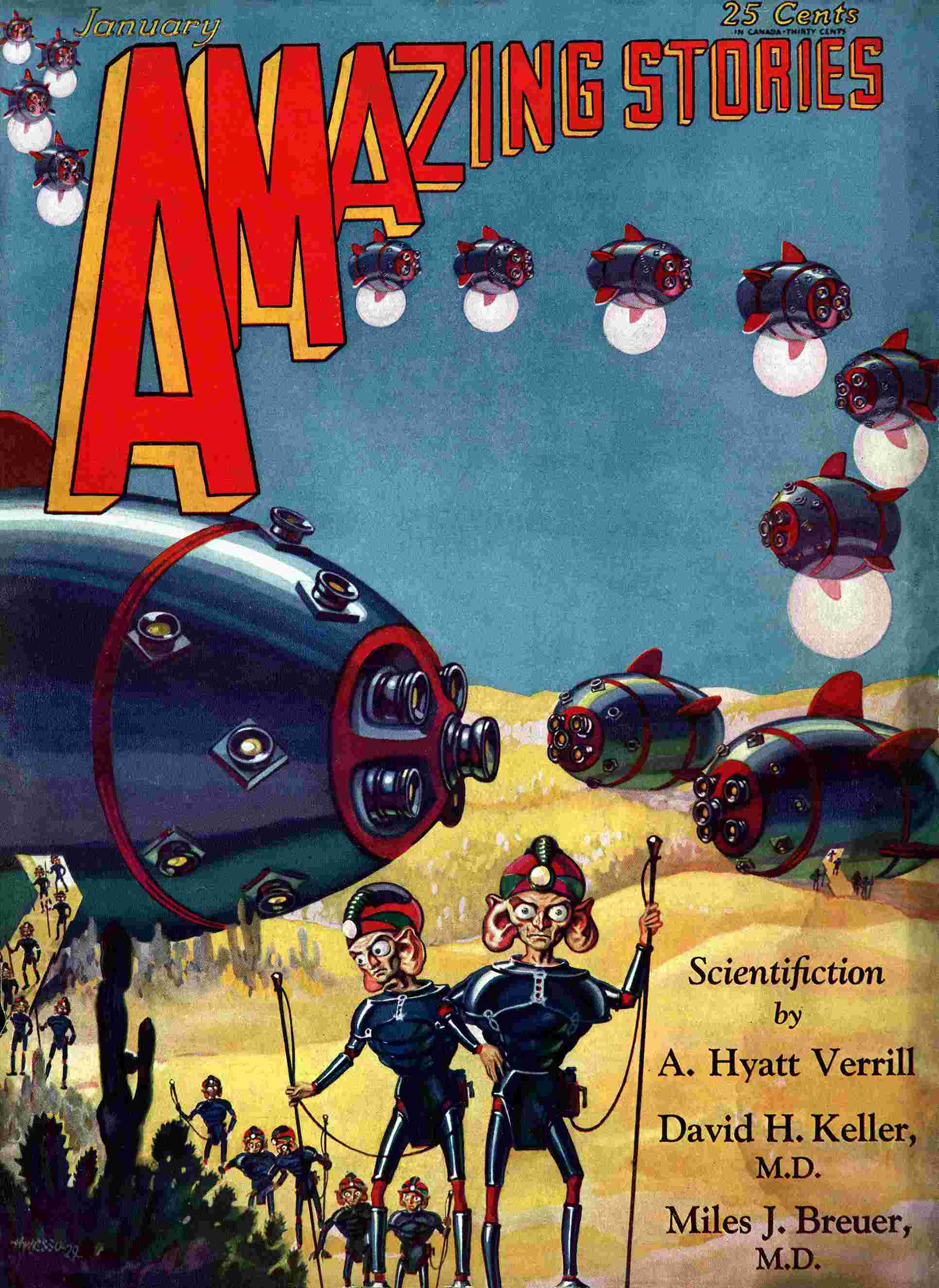
The Project Gutenberg eBook of When the atoms failed
Title: When the atoms failed
Author: Jr. John W. Campbell
Illustrator: Hans Waldemar Wessolowski
Release date: May 24, 2024 [eBook #73680]
Language: English
Original publication: Jamaica, NY: E.P. Inc, 1929
Credits: Greg Weeks, Mary Meehan and the Online Distributed Proofreading Team at http://www.pgdp.net
When the Atoms Failed
By John W. Campbell, Jr.
Our new author, who is a student at the Massachusetts Institute of Technology, shows marvelous ability at combining science with romance, evolving a piece of fiction of real scientific and literary value. A careful perusal of this story should give the reader not only keen enjoyment, but a considerable amount of instruction, because most of our readers will want to confirm their views of cosmic topics, of atoms, of energy—atomic and material—and the other subjects that blend so well in the text of this tale. A great deal of interesting material may be found on these subjects in recent text books.
Illustrated by WESSO
[Transcriber's Note: This etext was produced from
Amazing Stories January 1930.
Extensive research did not uncover any evidence that
the U.S. copyright on this publication was renewed.]
Author's Foreword
When the events of which I am to tell took place all the world was interested solely in their final outcome, but when that last awful day was ended, and time enough had passed to give our world a chance to find a way to apply and use the awful forces it had had forced upon it, or, indeed, had even found how to control their immense energies, men began to wonder about the true story of the Invasion.
I had always been a writer, first newspaper work, then a book or two. Perhaps because of this the world expected that an account would soon be presented. But had those millions seen that awful battle, seen those mighty wrecks on the hot sands, even then might they understand my dread of telling of that titanic conflict—a conflict in which the weaker was a million times more powerful than any force man had previously seen! It still burns in my memory, that awful scene in its desolate setting—the vast rolling desert below, seared, blasted, fused in great streaks where the intense, stabbing heat rays had cut it, mighty craters blasted in its surface where the terrific explosions of the shells had heaved thousands of tons of sand into great mounds, and those ghastly wrecks that lay crushed and broken on the hot sands below, bathed in the ruddy light of the sun of sunset, now slowly sinking behind the distant purple hills, as the last of the Invaders crashed on the packed sands below.
Two men of all Earth's billions saw that scene—but those two will never forget—as Stephen Waterson and I can testify.
Ten years have passed, ten years of stupendous change, readjustment, and cosmic conquest. Ten years in which a world has been added to man's domain, yet still sharp and clear in my memory is the picture of those shapeless masses, those lumps of glowing metal, that lay on the sands beneath us, the sole vestiges of the mighty ships of Mars.
Never have I wanted to think long on that scene of titanic destruction, destruction such as man never before knew, but friends have convinced me that it is my duty as one who lived in closest contact with the facts, and one of the two men who saw that last struggle, to tell the story as it unrolled itself before me.
Brief it is. The entire event, for all its consequences, lasted but two days—days that changed the history of a Universe!
But in this march of mighty events, I was but a spectator, and as a spectator I shall tell it. And I shall try to depict for you the character of the greatest man of all the System's history—Stephen Waterson.
Waterson Laboratories
May, 1957
David Gale.
It was late afternoon in May, 1947, and the temperature had climbed to unbelievable heights during the day. It seemed impossible to work with that merciless sun beating down on the roof. It is odd that a temperature of 95 in May should seem far higher than a similar temperature in July. On the top floors of the great apartments it was stifling. The great disadvantage of roof landings for planes had always been the tendency of the roofs to absorb heat in summer, yet on the top-most floors of those apartments people were living, and in one of those apartments a man was trying to work. Heat was a great trouble, but he found thoughts of hunger in the not too distant future an even greater inspiration to work. The manuscript he was correcting was lengthy, but this was the final revision, which was some comfort. Still the low buzz of the telephone annunciator was a relief. It was so much easier to talk. He took up the telephone.
"Gale speaking."
"Hello Dave, this is Steve. I hear you are having a bit of hot weather in New York today. I have a suggestion for you—I'm coming to pick you up in an hour and a half, and if you will be ready on your roof then, in a camp suit, and with camp clothes for about a month packed, I can guarantee you some fun, providing, of course, that you're still the man I knew. But I can't guarantee to return you! Meet me on your roof in an hour and a half."
"Well, I'll—now what's up? So he isn't sure I'll get back—and he calls that a 'suggestion'! Anyhow it sounds interesting and I'll have to hurry. I wish he'd get into the habit of warning a fellow when he is going to start one of his expeditions! And I may not come back—I wonder where on Earth he's going now—and where he was then. The only reason he gives me an hour and a half is because it will take him that long to get here. He would drop in on me without any notice otherwise. In that case he must be about three hundred miles from here. But where?"
An hour and a half later he was on the roof, watching the darting planes, there were a good many, but by far the larger part of the world's business and pleasure was on the ground in those days. Still the crimson and gray special of Waterson's ought to be easily visible. He was late—unusual for Steve. Gale hadn't seen him in more than a year—probably been working on one of his eternal experiments, he decided.
Still he searched the skies in vain. Only the regular planes, and one dirigible—tiny in the distance—it seemed to be coming toward him—and it certainly was coming rapidly—it couldn't be a dirigible—no gas bag could go that fast—then he saw the crimson and the gray band around it—it was Steve.
And now as it darted down and landed gracefully on the roof beside him, he saw that the machine was but thirty-five feet long, and ten or so in diameter. Suddenly a small round hatchway opened in its curved, windowless side of polished metal, and a moment later Stephen Waterson forced his way out. The door was certainly small, and forcing that six-foot-two body in and out through it must have been a feat worthy of a magician. Gale noticed that he would just about fit it, but the giant Waterson must have intended to use it very infrequently to make it that size.
"Hello, Dave—how do you like my new boat? But get in, we're going. There, your bag's in already."
"Good Lord, Steve, what is this? I gather you invented it. Certainly I never saw nor heard of it before," said Gale.
"Well Dave, I suppose you might say I invented it, but the truth is that a machine invented it—or at least discovered the principles on which it is based."
"A machine! A machine invented it? What do you mean? A machine can't think, can it?"
"I'm not so sure they can't, Dave, but get in—I'll tell you later. I promised Wright I would be back in three hours, and I've lost ten minutes already. Also, this machine weighs three thousand tons—so I don't want to leave it on this roof longer than is absolutely necessary."
"But, Steve—let me look at it. Man, it is beautiful. What is that metal?"
"Try the inside, Dave—there!"
Dave Gale was rather good sized—five feet ten, and weighing over one hundred and sixty pounds, but Waterson was in perfect physical condition, two hundred and ten pounds of solid muscle, and Gale had been popped into the hatch like a bag of meal, so quickly was it done.
Now he turned to look at the tiny room in which he found himself. It was evidently the pilot room, and around the front of the room there ran a clear window, curved to fit the curve of the ship's walls, and about three feet high, the center coming at about the level of the eye of a person sitting in either of the two deeply cushioned chairs directly facing it. The chairs were evidently an integral part of the machine, and from the heavy straps attached to them it was obvious that the passengers were expected to need some support. The arms of each chair were fully two feet broad, and many small instruments and controls were arranged on their polished black surfaces. Waterson had seated himself in the right hand chair and strapped himself in. Gale hastened to secure himself in the left chair.
"Take it easy Dave, and be prepared for a shock when we start."
"I'm ready Steve, let's go!"
Waterson moved his right hand a bit, and a tiny red bulb showed on his left instrument panel; many of his instruments began to give readings and several on Gale's board did so also. Another movement, and there was a muffled hum of an air blower. Then Waterson looked at Gale and turned a small vernier dial—Gale had been watching intently—but suddenly the look left his face—and was replaced by a look of astonished pain. The entire car had suddenly jerked a bit, then that peculiarly unpleasant sensation connected most intimately with a rapid elevator or helicopter starting from rest had made itself unpleasantly pronounced. Gale's pained and somewhat sick expression caused Waterson's smile to broaden.
"Whew—Steve—what is this—why don't you warn a fellow of what's coming!"
"I did warn you, Dave," answered Waterson, "and if you will look out, I think you will understand this."
The car was rising, at first slowly, but ever faster and faster, from the roof, not as a helicopter rises, not as a dirigible rises, but more as a heavy body falls, with high acceleration ever faster and faster. Soon it was rising quite rapidly, straight up. Then another tiny red bulb flashed into life on Waterson's switchboard, and the ship suddenly tilted at an angle of thirty degrees. Then it shot forward, and continually accelerated an already great speed, till New York lay far behind, and then the sky became dark and black, and now the stars were looking in at them, not the winking, blue stars of Earth, but the blazing, steady stars of infinite space, and they were of every color, dull reds, greenish, and blue. And now as they shot on across the face of Earth far below, Gale watched in rapture the magnificent view before him, seeking the old friends of Earth—Mars, Venus, Jupiter, and the other familiar, gleaming points. Then he turned his gaze toward the Sun, and cried out in astonishment, for the giant sphere was a hard, electric blue, like some monster electric arc, and for millions of miles there swept from it a great hazy, glowing cloud, the zodiacal light, almost invisible from Earth, but here blazing out in indescribable beauty.
"We're in space! But, Steve, look at the sun! What makes it look blue? The glass of the window isn't blue, is it?" said Gale excitedly.
"We're in space all right—but it isn't glass you're looking through; it is fused quartz. Glass that thick would crack in a moment under the stress of temperature change it has to undergo. The sun looks blue because, for the first time in your life, you are seeing it without having more than half its light screened off. The atmosphere won't pass blue light completely and it cuts off the ultra-violet transmission very shortly after we leave the visible region of the spectrum. The reason the sun has always looked yellow is that you could never see that blue portion of its spectrum. Remember, a thing gets bluer and bluer as it gets hotter. First we have red hot, bright red, yellow, white, then the electric arc is so hot that it gives blue light. But the sun is nearly two thousand degrees centigrade hotter than the electric arc. Naturally it is blue. Also, I'll bet you haven't found Mars, have you?"
"No, Steve, I haven't. Where is it?"
"Right over there. See it?"
"But that can't be Mars. It's green, green as the Earth."
"But it is Mars. The reason Mars looks red from Earth is that the light that reaches us from Mars has had to go through both its own atmosphere and through ours, and by the time it reaches us, it is reddened, just as a distant plane beacon is. You know how a light in the distance looks red. That is what makes Mars look red."
"Mars is green. Then it is possible that the life on Mars may be the same as that of Earth!"
"Right, Dave. It probably is. Remember that the chlorophyll that gives the planets their color is also the material that can convert sunlight energy into fixed energy of starches and sugars for the plant, and probably the same material is serving in that capacity all over the universe, for carbon is the only element of the more than a hundred that there are that can possibly permit life's infinitely complicated processes to progress."
"But I thought there were only ninety-two elements."
"There are ninety-two different types of atoms, but if you have half a dozen men all doing exactly the same thing, can you call them 'a man'? They have found more than six different kinds of lead, two different kinds of chlorine, several different kinds of argon, and many of the other elements are really averages of several kinds of atoms, all of which do exactly the same thing, but have different weights. They are called isotopes. We say the atomic weight of chlorine is 35.457, but really there is no atom that has that weight. They have weights of 35 and 37, and are jumbled together so that the average is 35.457. Really there are over a hundred different kinds of atoms. In my work on this ship I found it made quite a difference which kind of chlorine atom I had."
"Well, how does this machine work, and what do you mean by saying that a machine invented it?"
"Dave, you know that for a number of years the greatest advances in physics have been made along the lines of mathematical work in atomic structure. Einstein was the greatest of the mathematicians, and so the greatest of the atomicists. Now as you well know, I never was too good at mathematics but I did love atomic structure, and I had some ideas, but I needed someone to work out the mathematics of the theory for me.
"You remember that back in 1929 in the Massachusetts Institute of Technology they had a machine they called the integraph, an electrical machine that could do calculus too complex for Einstein himself to work out, and problems it would take Einstein months to solve, the machine could solve in a few minutes. It could actually do mathematics beyond the scope of the human brain. The calculus is a wonderful tool with which man can dig out knowledge, but he has to keep making his shovel bigger and bigger to dig deeper and deeper into the field of science. Toward the end of this decade, things got so the tail was wagging the dog to a considerable extent, the shovel was bigger than the man—we couldn't handle the tool. When that happened in the world once before they made a still bigger shovel, and hitched it to an electric motor. All the integraph did was to hitch the calculus to an electric motor—and then things began to happen.
"I developed that machine further in my laboratory, and carried it far beyond the original plans. I can do with it a type of mathematics that was never before possible, and that mathematics, on that machine, has done something no man ever did. It has found the secret of the atom, and released for us atomic energy. But that wasn't all, the machine kept working at those great long equations, reducing the number of variables, changing, differentiating, integrating, and then I saw where it was leading! I was scared when I saw what those equations meant. I was afraid that the machine had made an error, I was deathly afraid to test that last equation, the equation which the machine was absolutely unable to change. It had been working with the equations of matter, and now it had reached the ultimate, definitive equation of all matter! This final equation gave explicit instructions to the understanding; it told just how to completely destroy matter! It told how to release such terrific energy, I was afraid to try it. The equations of atomic energy I had tested and found good, I had succeeded in releasing the energy of atoms.
"But the energy of matter has been known for many years; simple arithmetic can calculate the energy in one gram of matter. One gram is the equivalent of about ten drops of water and that much matter contains 900,000,000,000,000,000,000 ergs of energy, all this in ten drops of water! Mass is just as truly a measure of energy as ergs, as foot-pounds or as kilo-watt hours. You might buy your electricity by the pound. If you had five hundred million dollars or so, you could buy a pound. You have heard of atomic energy, of how terrifically powerful it is. It is just about one million times as great as the energy of coal. But that titanic energy is as little compared to the energy of matter itself, as the strength of an ant is compared to my strength. Material energy is ten thousand million times as great as the energy of coal. Perhaps now you can see why I was afraid to try out those equations. One gram of matter could explode as violently as seven thousand tons of dynamite!
"But the machine was right. I succeeded in releasing that awful energy. I happened to release it as a heat ray, and the apparatus had been pointed in the direction of an open window luckily. Beyond that was just sand. The window was volatilized instantly, and the sand was melted to a great mass of fused quartz. It is there, and will be there for centuries, a two-mile streak of melted sand fifty feet broad! It makes a wonderful road of six foot thick glass! The machine showed me a thousand ways to apply it. I am driving this ship by means of an interesting bit of apparatus that the calculating machine designed. You remember Einstein's general relativity theory said that mass, gravity, bent space; but as it didn't fall in, as it would if attracted and not resisting, it must be that it is elastic. The field theory that he brought out back in 1929 showed that gravity and electrostatic fields were at least similar. I found, with the aid of my machine, that they were very closely related. I charge the walls of my ship strongly negative, then I have a piece of apparatus here that will distort that electrostatic field so it cuts off gravity—and the ship has no weight. The propulsion is simple also. I told you that space was elastic. I have a projector, or series of projectors all around the ship which will throw a beam of a ray which tends to bend space toward it. The space resists, and since the mountain won't come to Mahomet, Mahomet goes to the mountain—and the ship sails along nicely.
"The only theoretical limit to my speed is, of course, the velocity of light. At that speed any body would have infinite mass, and as you can't produce an infinite force, you certainly can't go any faster, and you can't go that fast in fact. If I accelerated one of the little five gram bullets I use in that machine gun to the speed of an alpha particle such as radium shoots off, not a very high speed in space, it would require as much energy to get it up to that speed, 10,000 miles a second, as five thousand fast freights, each a thousand tons apiece, would require to get up a speed of a mile a minute. You see that there is no possibility of getting up any speed like that even with material energy—it is too expensive even with that cheap energy—for it costs just as much to slow down again!
"The interesting thing about this energy is that scientists have known about it for a good many years, and while hundreds of people told about atomic energy, no one outside of the scientists ever spoke of the far greater energy of matter. The scientists said that the sun used that energy to maintain its heat—forty million degrees on the interior of the sun. They said man could never duplicate that temperature nor that pressure that prevails at the interior of the sun. They therefore said that man would never be able to release that energy. But the sun had to raise thousands of tons of water, and blow that vapor many miles, and do a lot of other complicated things before there was any lightning. Man would never be able to reproduce those conditions, and he would never be able to make lightning. Besides, if he did, what good would his electricity do him; it would be so wild, and so useless.
"But man discovered other ways of releasing his energies and converting it into electricity in a way that did not exist in nature. Manifestly it is possible to do the same with the energy of matter, and I have done it.
"The object of this trip, Dave, is exploration. I am going to the other planets, and I want you to come along. I believe I am prepared for any trouble we may meet there. That machine gun shoots bullets loaded with a bit of matter that will explode on impact. There is only a dust grain of it there, but it is as violent as ten tons of dynamite. If I exploded the entire shell, remember I would get the equivalent of thirty-five thousand tons of dynamite—which is manifestly unsafe. There are also a series of projectors around the car that project heat rays. These rays are capable of volatilizing anything that will absorb them. The projectors of all the rays have a separate generator unit directly connected. The unit is built right into the projector, but controlled from here. They are small, but tremendously more powerful than any power plant the Earth has ever seen before—each one can far outdo the great million and a half horse power station in San Francisco. They can develop in the neighborhood of fifty million horsepower each!"
"Lord, Steve, I'm no scientist, and when you speak glibly of power sources millions, billions of times more powerful than coal, I'm not only lost, I'm scared. And you have a couple dozen of those fifty-million-horse-power-generators around this ship. What would happen if they got short-circuited or something?"
"If they did, which I don't believe they will, they would either explode the entire ship, and incidentally make the Earth at least stagger in its orbit, or fuse it instantaneously and so destroy themselves. I might add that we would not survive the calamity."
"No, I rather guessed that. But, Steve, here in the utter cold and utter vacuum of space I should think that it would be hard to heat the ship. How do you do it?"
"The first thing to do in any explanation is to point out that space is neither empty nor cold. In the second place, a vacuum couldn't be either hot or cold. Temperature is a condition of matter, and if there is no matter, there can be no temperature. But space is quite full—about one atom per cubic inch. There is so much matter between us and the fixed stars that we can actually detect the spectrum of space superposed on the spectrum of the star. The light that the stars send us across the intervening spaces comes to us laden with a message of the contents of space—and tells of millions of tons of calcium and sodium. Even the tiny volume of our solar system contains in its free space about 125,000,000,000 grams of matter. That doesn't mean much to an astronomer—but when you remember that every gram of that can furnish as much energy as 10,000,000,000 grams of coal, we see that it isn't so little! And as space does have matter, it can have a temperature, and does. It has a temperature of about 15,000 degrees. Most of the atoms of that space have escaped from the surface of stars and have a temperature about the same as that of the surface of the stars. So you see that space utterly cold—is hotter than anything on Earth! The only difficulty is that it takes a whale of a lot of space to contain enough atoms to weigh a gram, and so the average concentration of heat is so low that we can say that space is cold. Similarly a block of ice may contain far more heat than a piece of red-hot iron. Nevertheless; I would prefer to sit on the ice."
"Quite so, I see your point, and I believe I'd prefer the ice myself. But that's interesting! Space isn't empty, it's not cold, in fact it is unusually hot!"
"Now we've started this let's finish it, Dave. It is hot, but not unusually hot—if anything it is unusually cold! The usual, or average temperature of all the matter in the universe is about one million degrees, so space at 15,000 is really far below the average, and so we can say that it is unusually cold. The temperature of the interior of the stars is uniformly forty million degrees, which brings the average up. But it is the unthinkably great quantities of matter in interstellar space that brings the average down. Remember that the nearest star is four and a half light years from us, and between the stars there is such a vast space in which the matter is thinly distributed that the few pinpoint concentrations of matter have to be extremely hot if they are to bring the average up any appreciable amount. But here and there in this vast space there are a few tiny bits of matter that have cooled down to terrifically frigid temperatures—temperatures within a few degrees of absolute zero, only two or three hundred degrees above; spots of matter so cold that hydrogen and oxygen can unite; so cold that this compound can even condense to a liquid; so cold that life can exist. We call those pinpoints planets.
"In the interstellar range of temperatures we have everywhere from absolute zero to forty million above. Life can exist between the temperatures absolute, of about two hundred and three hundred and twenty—a range of one hundred degrees in a range of forty million. That means that the temperature of this planet must be maintained with an allowable inaccuracy of one part in four hundred thousand! Do you see what the chances of a planet's having a 'habitable' temperature are?
"But we are near my laboratory now, Dave, and I want to introduce you to Wright, my laboratory assistant, a brilliant student, and an uncannily clever artisan. He made Bartholemew, as I call the mathematics machine, and most of the parts of this ship. He had heat rays to work with, and had iridium metal as his material, and plenty of any element. He had a fine time working out the best alloy, and the best treatment. The shell of the car is made of an alloy of tungsten, iridium and cobalt. It is exceedingly tough, very strong, and very hard. It will scratch glass, is stronger than steel, and is as ductile and malleable as copper—if you have sufficient force. Iridium used to sell for about 250 dollars an ounce, but these powers allow me to transmute it, which renders it cheap for me. After this, sodium metal will be cheaper than sodium compounds!"
"I wish that that trip had not been so short, Steve. There were a lot of things I wanted to ask you. Where are we now? I don't seem to recognize this country."
"We are over Arizona—see there is the laboratory now—off there."
"What, Arizona! How fast were we going?"
"We were going slowly, considering we were in space, but considering our proximity to the Earth we are going rapidly. The actual speed is difficult to determine—remember we had cut loose all ties of gravity, and I had to follow the Earth in its orbit, and the whole solar system along through space. From here to New York City is about three thousand miles, and as we made the trip in just under one hundred minutes, we traveled at a speed of thirty miles a minute, or half a mile a second."
"Well, the airplane speed record was about four hundred and twenty, wasn't it—I mean an hour—you have to specify now! You set a new record, I guess!"
They were slanting down through the atmosphere toward the distant low building that had seen the construction of that first of Earth's space cruisers. The long gentle glide slowly flattened out and the car at last glided slowly, gently through the open hangar doors. Wright was there to greet them, but Waterson called out that he would stay in the ship a few minutes to show Gale around.
"Steve, you sure picked a desolate place to work in. Why did you go way out here?"
"For two reasons. First I wanted a place that was quiet; and second I wanted a place where I could safely work with atomic energy—where explosions, premeditated or accidental, would not blow up an entire city. Did you notice that crater off to one side as we came in? That is where I tried out my first bullet. I hadn't gotten a small enough charge in it. I had nearly a milligram—a hundredth of a drop of water. But come, I guess you saw the pilot room. I'll show you how to run the ship tomorrow."
He led the way to the rear end of the pilot room, where a small door opened in the smooth, windowless metal partition. It too gleamed with that strangely iridescent beauty of metallic iridium.
"This bunk room should appeal to an apartment house addict. I had about eleven feet I could use to make it, and it is just a bit crowded."
Considering Waterson's six-feet-two, a room eleven feet long, ten feet high, and about as wide, would certainly be crowded if there was anything or anyone else in the room. As the bunk room was also dining room, gallery, and chart room, it was decidedly crowded. One thing that particularly interested Gale was a small screen on which were a series of small lights, projected from the rear.
"What is that, Steve?" he inquired.
"That is my chart. It is the only kind of a chart you could well expect on board a space ship. The lights are really moving and maintain the relative positions of the planets. I think we will go to Mars first, because it is now as close as it will be for some time. I want to go to Venus soon, but that is on the other side of the sun. I will find that there are detours even in space when I go there!"
"That's quite a chart! I suppose you have more accurate ones too?"
"No, I have no need of more accurate ones. I start for my objective, and it is so big I can't miss it!"
"That's true too! But I haven't seen any apparatus for taking care of your air. I suspect that door over there hides something."
"It does. It leads to the store room and the apparatus room. There are all the tools I carry, the air purifier and water renewer. Remember that the break-up of the atomic energy gives me unlimited amounts of electricity, so I have all the electric power I can use. I find that there is a way to electrolyse carbon dioxide to carbon and oxygen. In this manner I recover the oxygen for the air—at least part of the necessary oxygen—and at the same time remove the menace of the CO2. There is considerable oxygen fixed as H2O, however, so I installed an electrolyser to take care of that. The moisture of the air is in this way kept down to a comfortable maximum. The same apparatus is useful for reducing the water. All the water I have I must carry in tanks, which require space. I am able to make them considerably smaller by taking the water, passing it through this electrolyser, reducing it to hydrogen and oxygen, burning them to water again, and thus getting pure H2O. The one difficulty is in getting rid of the heat. Remember that all the heat I lose I must lose by radiation. But the sun is radiating to me. I receive heat at exactly the same rate the Earth does and I have no protective atmosphere, so the tendency is to reach a super-tropical temperature. The easiest solution of this problem is to go with the ship at such an angle to the sun that the shadow of the exposed surface shades the greater portion of the ship, then by adjusting the angle of the ship, I can adjust the ratio of radiating to receiving area to any value I wish, and get almost any temperature I need."
"That is an idea, I never heard of electrolysing carbon dioxide, though. Tell me—how do you do it?"
"That is a process I developed. It requires considerable explaining. However, I am doubtful whether it wouldn't have been easier to convert the stuff directly to oxygen by transmutation."
"Steve, I notice you have plenty of light, but why not have windows?"
"I have no windows except in the main pilot room. The trouble with windows is that they reduce the strength of the shell. Also, as this is a sleeping room, and there will be no night in space, why not have it this way? I need considerable strength in the walls of the ship, because the accelerations that I use in starting and turning and stopping are really rather a strain on any material. The outer wall is a six-inch iridio-tungsten alloy shell, with two openings in it, the window, and the door. The rest is absolutely seamless, one solid casting. The window is so designed, in connection with the placement of the ray projectors that it doesn't weaken the shell. There is no frame work, but the two partitions across the ship are each six inches thick, and act as braces. The inner wall is a thin one-inch layer of metal, supported by the outer shell, and separated from it by small braces about two inches high. This intervening space has been evacuated by the simple process of going out into space and opening a valve, then closing it before returning to Earth."
"That one-inch layer of metal of yours is bothering me. There is something strange about it, and all the trim and mouldings in here. The green I suppose is to relieve eye strain, but it is not the color itself that seems strange. It is the impression I have that the metal itself is of that beautiful leaf green shade, and that it is the metal in the chairs, table, and racks that gives them that color."
"Quite right Dave, it is."
"But Steve, I thought that there were no more elements to be discovered. In the collection at the Museum in New York they had all ninety-two, and I saw no colored metals."
"In the first place, remember I told you there really were more than ninety-two elements, if we treat the isotopes as elements, and I don't believe they had all the ninety-two there, for there are several elements that disintegrate inside of a few days. They couldn't keep those. But these metals are compounds."
"Compounds! Do you mean alloys?"
"No, chemical compounds, just as truly as salt or sulphuric acid. They are related to tetra ethyl stibine, Sb(C2H5)4, which is a compound that acts like a metal physically and chemically. It is too soft to be any good, but there are hundreds of these organic compounds of carbon. There are red ones, green ones, blue ones, and a thousand different ones, soft, brittle, liquid, solid; some are even gaseous."
"Colored metals! What a boon to artists! Think what fun they will have working in that stuff!"
"Yes, but it is also useful for decorative purposes, although the large molecule makes it too soft to be used as a wearing surface."
"Well Steve, you sure have a mighty fine little ship! What do you call it? You said that you called the mathematics machine 'Bartholemew.' What do you call this?"
"As yet it has not been named. I wanted you to suggest some name for it."
"That's a sudden order, Steve. What have you thought of?"
"Well, I thought of calling it fluorine, for the chemical element which is so active that it can not be displaced by any other, but will, on the other hand, force any other non-metal out of its compound. Then I thought of Niña, the name of Columbus' ship which first touched a new world, and Wright reminded me that Eric, the Red's son Lief landed here in about 1000 and suggested Eric as a name."
"Well, that's a good assortment. Why pick on me?"
"We thought you ought to be good at inventing names, since you had written several books."
"That is a fine excuse! I get mine from old magazines! But I might suggest 'The Electron.' It sounds well, and I remember that you said that you charged it negatively to cut out the gravity of the Earth and an electron—or is it a proton that has a negative charge?"
"'The Electron'—sounds good—and the idea is good. An electron has a negative charge. Wright also suggested the 'Terrestrian,' as it would be the first ship of Earth to visit other worlds. It is between 'Electron' and 'Terrestrian' now. Which do you like better?"
"I prefer 'Terrestrian.' It has more meaning."
"Well, we'll tell Wright about it. In the mean time, come in to the laboratory and meet Bartholemew."
Bartholemew was at the moment engaged in tracing a very complicated curve, the integral of a half dozen or so other curves. Wright was carefully watching the thin line left by the pencil. There was a low steady humming coming from the machine, and a bank of small transformers on the other side of the room connected to it. Wright turned off the machine as they entered, and after greeting Waterson, and meeting Gale, proceeded at once with an enthusiastic description of the machine. He was obviously proud of the machine, and of the man who had developed it. The entire machine had been enclosed in a metal case when Gale entered, but now Wright opened this, and Gale was decidedly surprised to see the interior. He really had had no reason to form any opinion of the machine, but he had expected a maze of gears, shafts, levers, chains and every sort of mechanical apparatus. Somehow the mention of a machine for doing mathematics conveyed to him that impression. The actual machine seemed quite simple—merely a small cable leading from the separate "graph interpreters," as Wright called them, to the central integrater, and hence a small motor carried the integrated result into practice and put it on paper.
This machine made possible a type of mathematics hitherto unknown. This new calculus was to the previous integration what integration was to addition. Integration is an infinite summation of very small terms, and this new mathematics was an integration in an infinite number of dimensions. The beginner first learns to integrate in two dimensions. Then come three. Einstein had carried his mathematics to four. The machine seemed to work in an infinite number of dimensions, but the conditions of the problem really chose the four out of infinity that were under discussion. An infinite number of dimensions has no physical meaning. It might be put this way, Wright said: there are an infinite number of solutions to the equation x=2+y, and as such it has no meaning. But if for example you say also that 2y=x, then auto-mathematically you choose two of an infinite number of values that fit the problem in hand. A man might have done all this machine did, had he lived long enough and been patient enough. This machine could do in an hour a problem that would have taken a man a lifetime. Thus it had been able to develop the true mathematical picture of the atom.
Over the supper table that night they had a final discussion as to the name of the ship. It was decided that the name should be "Terrestrian," and plans were made to christen it in as scientific a manner as possible. Considering that the shell was made of iridium, and therefore highly inert to chemical action, they decided on a bottle of aqua regia which dissolves gold and platinum, and does not attack iridium. A bottle was prepared, and they were ready for the christening in the morning. Just as they decided to call the day done, the telephone rang. It was Dr. Wilkins of Mt. Wilson calling Waterson. The conversation was rather lengthy, and Wright, who had answered, told Gale that Dr. Wilkins had called before, about two months ago, on a question in astro-physics, and Waterson had been able to give the answer. This time however, Dr. Wilkins, it seemed, was greatly agitated. Just then Waterson returned.
"Gale, it seems we chose our name well. Also I am lucky in having you here. I must go to Mt. Wilson at once, I'll be back about dawn, and I'll tell you two all about it then. I've got to hurry. So long."
A moment later the two men heard the hum of the motor as the hangar doors were opened. Another moment and the entire countryside was flooded with a blaze of bluish white light, that illuminated the desolate dry desert for miles, and for all those weary miles it was an unending, rolling surface of sand. In the glow of sudden light, great strange shadows which started up by the buildings gave weird effects on the sand, but with it all there was a rugged and compelling beauty to the little world which the light had cut from the darkness. There was a sudden whistle of air, and the light faded as the car shot off toward Mt. Wilson.
"What a mass of sand there is around here! It would seem almost like a dried up ocean bed," said Gale.
"I suppose there is a lot of sand in the world—there should be though, it is the direct compound of the two most abundant elements on Earth, silicon and oxygen."
"Wright, I've often wondered why it is that oxygen, which combines with almost anything, should be found free in nature. Why is it?"
"I don't know, I'm sure. At that I suppose one reason is that there is so much of it. Just a very small fraction less than half of the Earth's surface layers is oxygen. It forms over forty-nine per cent of it to a depth of ten miles at least. It is the second most active element on Earth—in the universe for that matter, and of the active elements there is only one with which it can't combine, namely, fluorine. Of course it can't combine with the inert gases, so I say the active elements. I suppose it is left free principally because there was nothing else to do. Apparently there weren't enough partners to go around. At that it did a mighty good job of it! Forty-seven per cent. of the solid crust is oxygen, 85% of the water is oxygen, and 20% of the air is free oxygen. Well, let's not look so favorable a gift horse in the mouth. If it hadn't been left free, where would we be?"
The discussion soon died down and the men retired for the night, each wondering what it was that had called Waterson away so suddenly, and each determined to be on hand when he returned in the morning.
The coming of the light of dawn had, perforce, put an end to the activities at Mt. Wilson, so it was shortly after sunrise that the two men heard the hangar doors open. And it was very shortly after sunrise that they had dressed and gone down to greet Waterson. The worried look on his face told a great deal, for both men knew him well, and when Waterson looked worried there was something of tremendous import under way.
"Hello. Had a good night Dave? I have something that is going to interest you—and two and a half billion other human beings. They have discovered something at the Mt. Wilson observatory that is going to change our plans quite a bit. We had intended going to other planets to visit the inhabitants, but we won't have to go. They are coming to us; furthermore, twenty ships are coming, and I have an idea they are good sized ships. But Wright, I think you had better start breakfast. We can discuss it at the table. I'm going to wash, and if you will help Wright, Dave, I think we will be at work pretty soon." Waterson left the room, and the two men looked at his retreating figure with astonishment and wonder. An announcement that our planet was to be invaded from space is a bit hard to take in all at once, and particularly when it is given in the matter of fact way that Waterson had presented it, for he had known it now for over ten hours, and had been working on it during all that time.
At the table the explanation was resumed.
"The ships were first sighted in the big telescope when they turned it toward Mars last night. You remember that Mars is at its closest now, and they are taking a good many pictures of it. When they saw these spots of light on the disc of Mars they were at once excited and started immediate spectroscopic and radiometric observations. The fact that they showed against the disc of Mars meant that they were nearer than the planet, and by measuring the amount of energy coming from them they tried to calculate their size. The results at once proved that they could not be light because of reflection, for the energy that they emitted would require a surface of visible dimensions, and these were points. Their temperature was too low to be incandescent, so they were violating all the laws of astro-physics. By this time they had shifted sufficiently to make some estimate of their distance, shifted because of the movement of the Earth in its orbit, Dave, and so they were covering a different spot on the disc of Mars. Allowing that they were going in a straight line, they were some ten and a half million miles away. The spectroscope showed by displacement of one of the spectral lines that they were coming toward us at about 100 miles a second. The line of their flight was such that they would intercept the Earth in its orbit in about thirty hours. That means that we have about twenty to work in.
"It doesn't take any alarmist to guess that this means trouble. They would not be coming in twenty ships if they were coming on a peaceful mission. Also considering that they come in only twenty ships it shows that they have considerable confidence in those twenty. Since they are coming here without first sending a scouting party of one or two ships, I suspect that they already know that the conditions of Earth are suitable to them. To determine our conditions would require exceedingly powerful telescopes, but they are helped by the thin air of their planet. I believe that they can actually see our machines and weapons, and that they know just about what we have. I think that they are counting on cleaning up the world very easily—as indeed they would but for one factor, for they have atomic energy. Wright, do you remember that we decided to use electronic rockets to drive the car, once we discovered atomic energy? And that having discovered material energy, we naturally decided not to? Well, they have electronic rockets. This makes me feel sure that that means that they have atomic energy, but have no material energy."
"Fine Steve. Your reasoning is most admirable—but will you please translate 'electronic rocket' and a few of those other terms into English? And otherwise make yourself clear to the layman?"
"Well, I suppose I have no right to call a cathode ray tube an electronic rocket, but when a cathode ray tube gets that big it really needs a new name. The idea is the same as that of a rocket. You know the experiments the Germans, the millionaire Opel, and others carried out in 1927 with rocket automobiles? They had a terrible time with their rockets because the heat of one set off the next. The result was a disastrous explosion—and they had a whole ocean of air to cool them! What would a rocket do in free space? Also remember the principle of a rocket is that you shoot particles out of the rear at a very high speed and thus impart the kick to the ship. The electronic rocket does the same thing—but instead of shooting molecules of hot gas, it shoots electrons, a giant cathode ray tube such as Coolidge had in 1927, but his was so small that the kick was immeasurable. Remember that as the velocity of the electrons approaches that of light, the mass increases and so the electrons as shot from a cathode ray rocket may weigh as much as a milligram. The problem of propulsion then is not hard with atomic energy to supply the terrific voltages needed to run the tube. But the cathode rays are going to be their first weapon. Cathode rays are absorbed by any object they hit, and their terrific energy is converted to heat. They are deadly in themselves, and the heat is of course deadly. They will also have heat rays. I can make a heat ray with atomic energy, though mine is derived from material. The only way we can fight them is to know beforehand what we are to meet. This is to be a war for a world, and the war will be a battle of titanic forces. The weaker of the forces will be a million times greater than anything man has ever known before, and either of these two forces would, if fully applied, blast our planet from its place around the sun! Such forces can not be withstood. They must be annulled, deflected, or annihilated by some greater force. Only when we know what to expect can we fight them, and live. Remember, if they once succeeded in getting one weak spot in our armor, we can never have another chance, and the world can never hope to fight them—mere armies and a navy or two, with a couple of air forces thrown in—what would they amount to? The energy of atoms could destroy them like paper in a blow-torch—think what would happen to one of those beautifully absorbing grey battleships if a heat ray touched it! Their eighteen-inch steel armor would not melt—it would boil away! A submarine would be no safer—they could explode the water about it into steam and crush it. The effect of a heat ray in water is just that—the water is converted to steam so suddenly that there is a terrific explosion. The cathode rays could sweep an army out of existence as hose might wash away an army of mud soldiers. They won't have gases. They will have no use for them. They could wipe a city off the map, leave only a great crater in the scarred Earth, while men were getting ready to lay a gas barrage. A shell would certainly just bounce off of the armor of my ship and I suspect that it would do the same with the Martian ships. Earth has only one weapon that can even bother them! And that one weapon is the one factor they did not figure on! It is the 'Terrestrian.' But now, if we want to make that one factor upset the whole equation, we have to calculate how to make its value a maximum, and to do that we have to know every other factor in the equation. I have suggested two weapons they will have, the cathode rays and the heat ray. They will, of course, have others; they will have atomic bombs, and I am sure that they will find us so dangerous that they will be willing to lose a ship and crash us. This gives us something else to avoid. Can any of you think of something else?"
"Good Lord Steve, haven't you thought of enough?"
"Plenty, Dave, but it isn't considered good form in military proceedings to permit the enemy to surprise you. In fact, it is highly probable that if he does, you will get a new form, one more adapted to aerial transit."
"Yes, that's true, too. But I remember reading once that ultra-violet light was invisible, and very dangerous to the body. I wonder if they will use that?"
"They may, but I greatly doubt it. Air is very nearly opaque to ultra-violet light, above a certain limit, and below that limit it is not very harmful. The infra-red heat rays, though, are going to be a very great menace. I can't think of any way to make them harmless. Of course, the polished iridium shell of the ship will protect us from the sides, as the heat will all be reflected. The difficulty will be that the heat will fuse the window, and thus attack us. The quartz glass is nearly opaque to heat rays, as is all glass. Being opaque, it absorbs it, 'cuts it out' as we say. The result will be that the glass will melt instantly, whereupon we will go very quickly. The idea of putting a polished metal shutter before the window is the one we will have to adopt, but we must modify it somehow. The heat rays will be turned back all right—and so will the light rays. The question is to shut out heat and let in light. Any suggestions?"
"I wonder if there isn't some selective reflector that we could use, Dr. Waterson?"
"That is a good idea, Wright—but I don't know of any that will pass all the light and reflect all the heat!"
"What is a selective reflector, Steve?"
"There are lots of things that have that property Dave, gold leaf is one, it can transmit green light—that is you can see green light through it, but it reflects yellow light—the complement of the green it transmits. There are a great many organic dyes that are one color when you look at them and the complement of that color when you look through them. The trouble is we need one that transmits the visible portion of the spectrum and—boy—that's it, Wright, that's it—spectrum—take a totally reflecting diffraction grating, reflect out all that part of the spectrum that we don't want, take what we do, pass it through a prism to recombine it to white light, then through lenses so we can see as if through a telescope! We will have absolutely cold light!"
"Again it sounds good, but I'd like to hear it in English, Steve."
"The idea is to take a diffraction grating, a piece of metal with, usually, 14,438 lines to the inch ruled on it, and previously highly polished, so that it reflects most of the light that hits it. Now it is reflected at different angles, so that we have a spectrum. The spectrum spreads out light and heat waves as well—I use the reflection grating as no material will pass the heat rays, and it then is possible to reflect out of the car again those rays we do not want. The light, which we do want, we will pass through a prism which will recombine it to white light. A prism can either split up light into different colors, or recombine them to white. Lenses then will be needed to make the images clear. The effect will be much the same as a telescope. And that takes care of the heat waves. The cathode rays, luckily won't bother us for the car is already charged strongly negative, and negatively charged electrons will be strongly repelled, as they are in the grid of a vacuum tube, so will never hit us. The bombs constitute the worst menace. The only defense we have against them is the very doubtful one of not being there when they are. That is a good policy in any case.
"As a last precaution—a bit grim—I will arrange it so that if the 'Terrestrian' is damaged to the point of utter helplessness we can, by pushing a single button, explode the entire car—as material energy. It will utterly destroy everything within a radius of a hundred miles, and damage everything within a much greater radius. I believe it will not be serious enough to change the Earth's orbit, though."
"Good—cheerful man, aren't you, Steve! Now what have we to meet that delightful array?"
"We have things even more delightful. Our heat ray is considerably more powerful, I imagine. It is generated by a force ten thousand times as great. Our bombs will be worse. Wright, I wish you would make about a hundred shells that will explode with the full thirty-five thousand ton equivalent of dynamite. And then we will have everything they have that is going to be effective, and have it in a more concentrated form. Can any of you suggest anything else?"
"Steve, you said that your car was nearly pure iridium on the outside, and that is very inert. The outside of their ship will be polished too, won't it?"
"Probably—though I don't believe they were expecting to meet a heat ray."
"Well, I wonder if there isn't some chemical you could spray out that would tarnish their ship, without hurting your iridium ship? Then it wouldn't be polished and would absorb your heat rays."
"That's a good idea, Dave. I might use a sulphide—nearly all sulphides are colored, and form very easily and rapidly. Or I might use liquid ozone. That will tarnish almost anything to an oxide, which is also apt to be colored. I could certainly heat the ship that way, but I wonder—I'm afraid that the oxide or sulphide would break down too easily. There is only one metal that they might use on which that would work, namely steel. Iron sulphide is black, stable, and will not decompose readily. The oxide forms readily, is highly colored, and will not decompose before the metal is incandescent, or even melted. The only difficulty is that steel is so readily attacked, that they wouldn't use it. They would probably coat it with an inert metal, silver for instance. That forms a black sulphide very readily. I'm afraid that won't work Dave. But Wright, I think that it would be a good idea to develop a few of those field theory equations in a different way. Try integrating number two-six-thirty-nine—I think that's it—and between the limits of equation one-four-twenty-three and zero. I have an idea that a little development of that idea will give us a beam that will be very useful. We haven't time to make much apparatus, but I think the result will be near enough to the space curving projector to allow us to change the extra projectors we have in the laboratory to fit. Also, try calculating the arrangement we will need for the heat eliminator, please. I'm going to give Dave his first lesson in space navigation. We'll be back about noon—if at all!" But Gale caught the wink, so the effect was lost.
Ten thousand miles out in free space the practice began. As Waterson pointed out, it would require some mighty poor handling to hit the Earth now. For the first time in Gale's life he could practice with a machine with no fear of hitting anything.
When the ship slanted down in a long graceful glide, to enter the hangar doors that noon, Gale was in control. The controls of the ship were remarkably easy to master and extremely simple. The one thing that was hard to master was the tremendous range of power. It could be changed in a smooth climb from a fraction of a horsepower to billions! The first attempts had been a bit hard on the passengers, the seat straps coming in for their share of use.
When they returned to the laboratory, they found Wright had just prepared a light lunch, and at once began to demolish it. Six hours between breakfast and lunch is conducive to a husky appetite.
Wright had finished the integration on the machine, and had calculated the mathematics of the heat eliminator in a little less than four hours. The results were very satisfactory, and in the remaining time he had converted six of the extra projectors to their new use, and had them ready for installation. After lunch the men began on the construction of the heat eliminators. Two were to be installed, one for the observer as well as one for the pilot. The heavier work of installing the projectors and the iridium shield was reserved for later in the afternoon.
By six that evening, the new projectors were completely installed and the connections made, and the great iridium shield was cooling from blinding incandescence in its mold. It would be installed that night, but now they felt that a rest and a meal were due them. They had been working under a great strain that afternoon, for they knew that they must get that machine ready before the Martians reached Earth, and there was a great deal to do. After the brief dinner they went out to the shining "Terrestrian." As yet, the new projectors had not been tried.
Gracefully the great shining shell backed out into the ruddy glory of the sinking sun, the red light had turned the desert to a sea of rolling fire, with here and there a wave that showed dark—a mound. In the far distance the purple hills of Nevada seemed like distant islands in this burning sea, and above it rode this lone, shining ship, magnificently iridescent in the setting sun. Now it stopped, hovered, then suddenly a pile of metal ingots that lay to one side of the laboratory leaped into the air and shot toward it—then paused in mid-air, hung poised for an instant, then sank lightly to the ground. Now the sand of the desert began to roll into some strange wave that began just beneath the ship, then sped away—further—till it died in the far distance, by means of an invisible beam. A wall of sand thirty feet high had been built in an instant, and it extended as far as the eye could reach! Now the ship settled, and slowly, light as a feather for all its three thousand tons of metal, it glided into the hangar.