
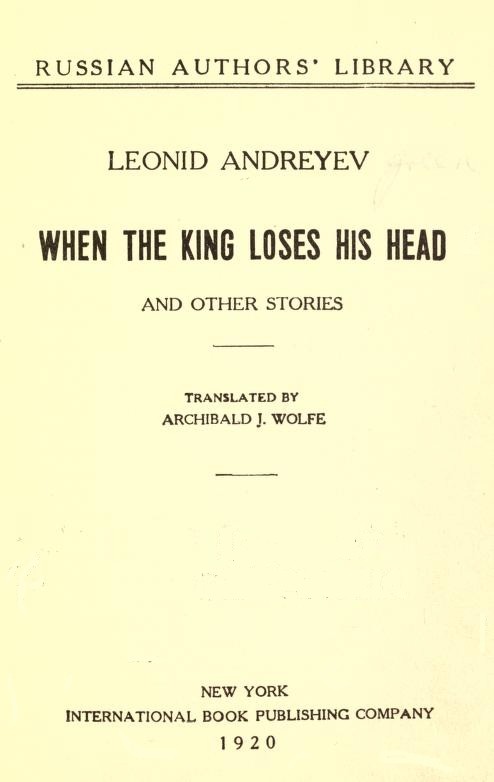
Life of Father Vassily.
I.
A strange and mysterious fate pursued Vassily Feeveysky all through his life. As though damned by some unfathomable curse, from his youth on he staggered under a heavy burden of sadness, sickness and sorrow, and the bleeding wounds of his heart refused to heal. Among men he stood aloof, like a planet among planets, and a peculiar atmosphere, baneful and blighting, seemed to enshroud him like an invisible, diaphanous cloud.
The son of a meek and patient parish priest, he was meek and patient himself, and for a long time failed to observe the ominous and mysterious deliberation with which misfortunes persistently broke over his unattractive shaggy head.
Swiftly he fell, and slowly rose to his feet; fell again, and slowly rose once more, and laboriously, speck by speck, grain by grain, set to work restoring his frail anthill by the side of the great highway of life.
But when he was ordained priest and married a good woman, begetting by her a son and a daughter, he commenced to feel that all was now well and safe with him, just as with other people, and would so remain for ever. And he blessed God, for he believed in Him solemnly and simply, as a priest and as a man in whose soul there was no guile.
And it happened in the seventh year of his happiness, in the noon hour of a sultry day in July, that the village children went to the river to swim, and with them went Father Vassily’s son, like his father Vassily by name, and like him swarthy of face and meek in manner. And little Vassily was drowned. His young mother, the Popadya,[1] came running to the river bank with the crowd, and the plain and appalling picture of human death engraved itself indelibly on her memory: the dull and ponderous thumping of her own heart, as though each heart beat threatened to be her last; and the odd transparence of the atmosphere in which moved hither and thither the humdrum familiar figures of people, though now they seemed so strangely aloof, as if severed from the earth; and the disconnected, confused hubbub of voices, with each word rounding in the air and slowly melting away as new sounds come into being.
And she conceived a lifelong fear of bright and sunny days. For at such times she saw again the barricade of muscular backs gleaming white in the light of the sun, and the bare feet planted firmly among the trampled cabbage heads, and the rhythmic swing of something bright and white in the trough of which freely rolled a light little body, so gruesomely near, so gruesomely far, and for ever estranged. And long after little Vassya[2] had been buried, and the grass had grown over his grave, the Popadya kept repeating that prayer of all bereaved mothers: “Lord, take my life, but give me back my child.”
Soon Father Vassily’s whole household learned to dread the bright days of summer time, when the sun shines too glaringly and sets ablaze the treacherous river until the eyes cannot bear the sight of it. On such days, when the people, the beasts and the fields all around were radiant with gladness, the members of Father Vassily’s household were wont to watch his wife with awestricken eyes, engaging purposely in loud conversation and laughter, while she, sluggish and indolent, rose to her feet, eyeing the others so fixedly and queerly that they were forced to avert their gaze, and languidly lolled through the house, as though hunting for some needless article, a key, or a spoon or a glass. Whatever she needed was carefully placed in her path, but she continued to seek, and her search increased in intentness and agitation in the measure that the bright and merry orb of the sun rose higher in the firmament. And she approached her husband, placing her lifeless hand on his shoulder and kept repeating in a pleading voice.
“Vassya! Vassya! I say!”
“What is it, dear?” meekly and hopelessly responded Father Vassily, trying to smooth her disheveled hair with trembling fingers that were sunburnt and black with the soil and were badly in want of trimming. She was still young and pretty, and her arm rested upon the shabby cassock of her husband as though carved of marble, white and heavy.
“What is it, dear? Will you have some tea now? You have not had any yet.”
“Vassya! Vassya, I say!” she repeated pleadingly, removing her arm from his shoulder like some needless, superfluous object, and returned to her searching, only still more restlessly and excitedly. Walking all through the house, not a room of which had been tidied, she passed into the garden, from the garden into the court yard, and again into the house, while the sun rose higher and higher, and through the trees could be seen a flash of the warm sluggish river. And step after step, clinging tightly to her mother’s skirt, Nastya[3], the Popadya’s daughter, shambled after her, morose and sullen, as though the black shadow of impending doom had lodged itself even over her little six-year-old heart. She anxiously hurried her little steps to keep pace with the distracted big stride of her mother, casting furtively yearning glances upon the familiar, but ever mysterious and enticing garden, and she longingly stretched out her disengaged hand towards a bush of sour gooseberries, and stealthily plucked a few, though the sharp thorns cruelly scratched her. And the prick of these thorns that were sharp as needles, and the acid taste of the berries, intensified the scowl on her face, and she longed to whimper like an abandoned pup.
When the sun reached the zenith, the Popadya closed tightly the shutters in the windows of her room, and in the darkness gave herself up to liquor until she was drunken, drawing from each drained glassful fresh pangs of agony and searching memories of her perished child. She shed bitter tears, and in the awkward drone of an ignorant person trying to read aloud out of a book, she kept telling over and over again the story of a meek and swarthy little boy who had lived, laughed and died; and with this bookish singsong she resurrected his eyes and his smile and his oldfashioned manner of speech.
“‘Vassya’, I say to him, ‘why do you tease kitty? Don’t tease her, dear. God told us to be merciful to all—to the little horsies, and to the kittens and to the little chicks’. And he lifts up his sweet eyes to me, the darling, and says: ‘And why isn’t kittie merciful to little birdies? See the pigeons have raised their little ones, and kittie eats up the pigeons, and the little birdies are calling, calling for their mamma.’”
And Father Vassily listened meekly and hopelessly, while outside, under the closed shutters, amid burdocks, nettles and thistles, little Nastya sat sprawling on the ground, and played sulkily with her doll. And always her play was this: dollie refused to mind and was punished and she twisted dollie’s arms till she thought they hurt and whipped her with a twig of nettles.
When Father Vassily had first found his wife in a state of inebriety, and from her rebelliously agitated, bitterly exulting face had realized that this thing had come to stay, he shriveled up and the next moment burst cut in a fit of subdued, senseless laughter, rubbing his hot dry hands. And a long time he laughed, a long time he kept rubbing his hands; he strove to restrain this desire to laugh, which was so obviously out of place, and turning aside from his sobbing wife, he snickered softly into his fist like a naughty school boy. Then just as abruptly he turned serious, his jaws snapped like metal; but not a word of comfort could he utter to the hysterical woman, not a caressing word could he find for her. But when she had fallen asleep, the priest bent down, making three times the sign of the cross over her. Then he went cut and found little Nastya in the garden, coldly patted her on the head and stalked out into the fields.
For a long time he followed a little path through the rye which was standing fairly high in the field and looked down into the soft white dust which here and there retained the impress of heels and the outline of someone’s bare feet. The sheaves nearest to the path were crushed to the ground, some lying across the path, and the grain was crushed, blackened and flattened.
Where the path turned, Father Vassily stopped. Ahead of him and all around him swayed the full grain on slender stalks, overhead was the shoreless blazing sky of July grown white with the heat, and nothing more: not a tree, not a hut, not a man. Alone he stood, lost in the dense field of grain, alone before the face of Heaven—set high above him and blazing.
Father Vassily lifted up his eyes—they were little eyes, sunken and black as coal; they were aglow with the bright reflection of the heavenly flame, and he pressed his hands to his breast and tried to say something. The iron jaws quivered, but did not yield. Gnashing his teeth the priest forced them apart, and with this movement of his lips that resembled a convulsive yawn, loud and distinct came the words:
“I—believe!”
Unechoed in the wilderness of sky and of fields was lost this wailing orison that so madly resembled a challenge. And as though contradicting some one, as though passionately pleading with some one and warning him, he repeated once more:
“I—believe.”
And returning home, once more, speck by speck, grain by grain, he fell to the work of restoring his wrecked anthill: he watched the milking of cows, with his own hands he combed Nastya’s long and coarse hair, and despite the late hour he drove ten versts into the country for the district physician in order to seek his advice with regard to his wife’s ailment. And the doctor prescribed her some drops.
II.
No one liked Father Vassily, neither his parishioners, nor the vestry of the church. He intoned the service awkwardly, without decorum: his voice was dry and indistinct, and he either hurried so that the deacon had a hard time to keep up with him, or he fell behind without rime or reason. He was not covetous, but he accepted money and donations so clumsily that all believed him to be greedy and scoffed at him behind his back. And everybody knew that he was unlucky in his private life and avoided him, considering it a poor omen to meet him or to talk with him. His Saint’s Day[4] was celebrated on November the twenty-eighth. He had invited many to dinner, and in compliance with his ceremonious invitation every one promised to come, but only the vestrymen made their appearance, and of the better parishioners not a soul attended. And he was humiliated before the vestrymen, but the Popadya felt the insult most keenly, for the delicacies and wines which she had ordered from the city had to go to waste.
“No one even cares to come and see us,” she said, sober and downcast, when the last of their few guests had departed, noisy and drunken, after a senseless gorging, having paid no regard to the rare vintage of wines or to the quality of the food.
But it was the head of the vestry, Ivan Porfyritch Koprov, who treated the priest worse than the rest of the parishioners. He openly exhibited his contempt for the luckless man, and when the Popadya’s periodical lapses into appalling inebriety had become a public scandal, he refused to kiss the priest’s hand. And the good-natured deacon tried vainly to reason with him.
“Shame on thee. It is not the man, but his holy office that must be respected.”
But Ivan Porfyritch stubbornly refused to dissociate the office from the man, and replied:
“He is a worthless man. He can neither keep himself in order, nor his wife. Is it right for a spiritual adviser’s wife to persist in drunkenness, without shame or conscience? Let my wife try and go on a spree, I’d stop her quickly.”
The deacon shook his head reproachfully and mentioned the long-suffering of Job, how God had loved him, but turned him over to Satan to be tried, but later rewarded him an hundredfold for all his sufferings. But Ivan Porfyritch smiled scornfully into his beard and without the slightest compunction cut short the disagreeable admonition.
“Don’t tell me, I know. Job, so to speak, was a righteous man, a holy man, but what is this one? Where is his righteousness? Rather remember, deacon, the old proverb: God marks a rogue. There is sound sense in that proverb.”
“Wait, the priest will get even with thee, for refusing to kiss his hand. He’ll drive thee out of the church.”
“We’ll see about that.”
“All right, we’ll see.”
And they bet a gallon of cherry brandy whether the priest would expel him or not. The vestry man won; next Sunday he turned his back on the priest with an insolent air, and the hand which the priest had extended to be kissed, burnt brown it was from the sun—remained desolately suspended in midair, and Father Vassily flushed a deep purple, but did not say a word.
And after this incident which was much talked about in the village, Ivan Porfyritch became still more firmly convinced that the priest was a bad and an unworthy man and began to incite the villagers to complain to the bishop and to ask for another parish priest.
Ivan Porfyritch himself was a man of wealth, very fortunate in all things, and enjoyed general esteem. He had an impressive face, with firm round cheeks and an immense black beard, and his whole body was covered with a growth of dense black hair, particularly his legs and his chest, and he believed that hairiness was a sign of great good luck. He believed in his luck as firmly as he believed in God, and considered himself an elect among the people; he was proud, self-reliant and invariably in good spirits. In a terrible railroad wreck in which a multitude of people had perished, he merely lost a cap which had been trampled into the mire.
“And it was an old one at that!” he was wont to add with much self-satisfaction, evidently considering this incident an eloquent proof of his merits.
He regarded all men as rogues and fools, and knew no mercy towards either variety. It was his habit with his own hands to strangle the pups, of whom his black setter Gipsy presented him yearly a generous litter; only the strongest one among them he suffered to live for breeding purposes, though he willingly distributed some of the others to those who wanted a dog, for he considered dogs to be useful animals. In forming opinions Ivan Porfyritch was rash and unreasonable, but he easily departed from them, without noticing his inconsistencies; yet his actions were uniformly firm and resolute and only rarely erroneous.
And all this made the head of the vestry a terrible and an extraordinary personage in the eyes of the hunted priest. When they met, he was the first to raise his broad-rimmed hat, which he did with indecorous haste, and as he walked away, he felt that his gait grew faster and more shuffling, revealing itself as the gait of a man who was scared and ashamed, and his scrawny legs were tangled in the folds of his cassock. It seemed as though his very fate, cruel and enigmatic, was personified in that immense black beard, in those hairy hands, and in that resolute, straight stride, and if he did not crumple up and slink away and hide behind his four walls, this menacing monster would crush him like an ant.
And whatever pertained to Ivan Porfyritch or belonged to him, aroused the eager interest of the priest, so that some times for days at a stretch he could think of nothing else but of the churchwarden, his wife, his children, his wealth. Working with the peasants in the fields, (in his coarse, tarred boots and in his cheap working blouse he greatly resembled an humble peasant) Father Vassily would often turn his face to the village, and the first sight that greeted his eyes alongside of the church, was the red iron roof of the churchwarden’s two-story house. Then behind the greying green of wind-wrecked willows he traced with difficulty the outline of the weather-beaten shingle roof of his own little home; and the sight of these two so contrasting roofs filled the heart of the priest with the anguish of hopelessness.
One feast day the Popadya returned from the church in tears and told her husband that Ivan Porfyritch had grossly insulted her. As she was making her way to her place, he remarked from behind the lectern, loudly enough for the whole congregation to hear:
“This drunken wench ought not to be allowed in the church at all. She’s a disgrace!”
As the Popadya sobbingly related this incident to her husband, Father Vassily observed with horrible and merciless clearness how she had aged and come down in the four years which had passed since Vassya’s death. She was still young, but silver threads were running through her hair, the teeth once so white had turned black, and her eyes were baggy.
She was now a confirmed smoker, and it was painful to watch her puffing a cigarette which she held in a clumsy, feminine fashion between two rigidly extended fingers. She smoked and wept and the cigarette trembled between her lips that were swollen with sobbing.
“Why, oh why, oh Lord?” she kept repeating in anguish, and with the intentness of stupor she gazed through the window against which pattered the chill drops of a September rainstorm. The panes were dim with water, and the birch outside, heavy with rain drops, seemed to sway back and forth with the shadowy deliquescence of a specter. In their efforts to save fuel, they had not yet started heating the house, and the air in the room was damp and chilly and almost as uncomfortable as outdoors.
“What can you do with him, Nastenka?”[5] retorted the priest rubbing his dry warm hands. “We must bear it.”
“Lord, Lord, is there not a soul to take my part?” wailed the Popadya, and in the corner gazed dry and immobile the wolfish eyes of skulking little Nastya through a hedge of coarse and unkempt hair.
The Popadya was drunk before bedtime, and then ensued that appalling, abominable, piteous scene which Father Vassily could never thereafter recall without a sense of chaste horror and of consuming, unbearable shame. In the morbid gloom of tightly closed shutters, amid the monstrous visions born of alcohol, in the wake of obstinate wails for her lost first-born, his wife had conceived the insane notion of bringing a new son into the world. To resurrect his sweet smile, to resurrect those eyes that once had sparkled with benign radiance, to bring back his calm and sensible speech: to resurrect the lad himself, as he had lived in the glory of his sinless childhood, as he had appeared on that horrible day in July when the sun blazed so brightly and the treacherous river glistened so blindingly. And consumed with a frenzy of hope, all beauteous and hideous with the flames that had enwrapped her, the Popadya stormily demanded her husband’s caresses, pleaded for them with piteous humility. She coyly primped herself, she coquetted with him, but the expression of horror never passed from his face. She strove with the energy of passionate anguish to become again as tender and desirable as she had been ten years back, and she tried to assume a shy, maidenly look, whispering coy, girlish words, but her liquor-lamed tongue refused to obey her, and through her shyly lowered eyelashes ever more luridly and obviously flashed the flame of passionate desire, while the swarthy face of her husband remained transfixed with horror. He had covered his burning head with his hands, weakly whispering:
“Don’t! Don’t!”
And she sank to her knees and hoarsely pleaded:
“Have pity on me! Give me back my Vassya! Give him back to me, priest! I say, give him back to me, curse you!”
And the autumnal rain gusts beat fiercely against the tightly closed shutters, and the stormy night heaved deep and painful sighs.
Cut off from world and life by the walls and the curtain of night, they seemed to be whirling in the throes of a frenzied labyrinthic nightmare, and around them swirled wails and curses that would not die. Madness stood guard at the door; the searing air was its breath; and its eyes the lurid glare of the oil lamp stifling in the maw of a soot-grimed globe.
“You will not? You will not?” cried the Popadya, and with maniacal yearning for motherhood she tore off her raiment, shamelessly baring her body, ardent and terrible like a Bacchante, piteous and pathetic like a mother mourning for her child. “You will not? Then before God I tell you I’ll go out into the street. I will throw myself on the neck of the first man I meet. Give me back my Vassya, curse you!”
And her passion vanquished the chaste-hearted priest. To the weird moaning of the autumnal storm, to the sound of her frenzied babble, life itself, the eternal liar, seemed to bare her dark and mysterious loins, and through his darkening consciousness flashed like a gleam of distant lightning a monstrous conception: of a miraculous resurrection, of some far-off miraculously hazardous chance. And to the demoniac passion of the Popadya, heart-chaste and shamefaced, he responded with a passion as frenzied, wherein all things blended: the glory of hope, and the fervor of prayer, and the boundless despair of a great malefactor.
In the dead of night, when the Popadya had fallen into a heavy sleep, Father Vassily took his hat and his stick, and without stopping to dress, in a shabby nainsook cassock went out into the fields. The storm had subsided. The vapory drizzle had spread a moist and chilly film over the rainsoaked earth. The sky was as black as the earth, and the night of autumn breathed utter desolation. Within its gloomy maw the man had vanished, leaving no trace. Once his stick knocked against a boulder that chanced to lie in its path, then all was still, and a lasting silence ensued. A lifeless vapory mist stifled each timid sound in its icy embrace. The moribund foliage did not stir, not a voice, not a cry, not a groan was heard. Long lasted the silence—and it was the silence of death.
And far beyond the village, away from any human habitation, an invisible voice pierced the gloom. It was a voice that was broken, choking and hoarse, like the moaning of infinite loneliness. But the words it spoke were as clear as celestial fire:
“I—believe!” said the invisible voice. And in it were mingled menace and prayer, warning and hope.
III.
In the spring the Popadya knew that she would be a mother; all through the summer she abstained from liquor, and a peace, serene and joyous, was enthroned in Father Vassily’s household. But the invisible foe still dealt his blows: now the twelve-pood[6] hog which they had fattened for the market took sick and died; now little Nastya broke out all over her body in a malignant rash and refused to respond to treatment. But all these blows were borne lightly, and in the innermost recesses of her heart the Popadya even secretly rejoiced thereat: she was still doubtful of her great good fortune, and all these calamities seemed to be a premium which she was glad to pay for its assurance. She felt that if the prize hog fattened at such expense had died on her hands, if Nastya ailed so persistently, if anything else went wrong and caused repining, then no one would dare to lay a finger on her coming son or to harm him. But as for him, why, she would give up not only the whole household and her little daughter Nastya, but even her own body and soul would she gladly yield to that relentless unseen one who clamored for continual sacrifices.
She had improved in looks and ceased even to fear Ivan Porfyritch himself, and as she walked to her accustomed place in church she proudly paraded her rounded form and looked about with daring and self-reliant glances. And lest she should harm the babe in her womb, she had stopped all housework and was passing daily long hours in the neighboring fiscal forest, amusing herself by picking mushrooms. She was in mortal terror of the ordeal of birth, and resorted to fortune telling with mushrooms, trying to forecast whether the birth would pass off favorably or not; and mostly the answer was favorable. Sometimes under the impenetrable green dome of lofty branches, in some dark and fragrant bed of last season’s leaves, she gathered a small family of little white mushrooms, all huddled together, darkheaded and naive, and resembling a brood of little children, and their appearance evoked in her keen pangs of tenderness and affection. With that saintly smile peculiar to people who in solitude yield themselves up to truly pure and noble meditation, she cautiously dug the fibrous ashen-gray soil around the roots, and seating herself on the ground beside her mushrooms, gazed at them for a long time caressingly, a little pale from the greenish shadows of the forest, but fair to look upon, gentle and serene. And then she rose and walked on with the cautious waddling gait of a woman on the eve of childbirth, and the ancient forest, the hiding place of numberless little mushrooms, seemed to her a thing of life, wisdom and goodness. Once she took Nastya along for company, but the child capered, frolicked and raced through the bushes like a boisterous wolf-pup and interfered with her mother’s thoughts; and she never took her again.
And the winter was passing quietly and happily. She spent her evenings busily sewing a multitude of tiny shirts and swaddling cloths, or pensively stroking the linen with her white fingers upon which the oil lamp threw its bright glow.
She smoothed the soft fabric and stroked it with her hand, as though caressing it, thinking the while intimate thoughts of her own, the wonderful thoughts of motherhood, and in the blue reflection of the lampshade her beautiful face seemed to the priest as though illumined by some sweet and gentle radiance that came from within. Fearing by some incautious movement to disturb her beautiful and happy dreams, Father Vassily softly paced about the room, and his feet, clad in felt slippers, touched the floor gently and noiselessly. He let his gaze dwell now on the living room, cozy and agreeable like the face of a cherished friend, now on the figure of his wife, and all seemed well, just like in other people’s homes, and everything about him breathed peace, profound and serene. And his soul was peaceful and smiling, for he neither saw, nor felt that from somewhere there had fallen the diaphanous shadow of great grief and was now silently resting on his forehead, somewhere between his eyebrows. For even in these days of rest and peace a stern and mysterious fate was hovering over his life.
On the eve of Epiphany, the Popadya gave birth to a boy and he was named Vassily. His head was large and his legs were thin and little, and there was something strangely vacant and insensate in the immobile stare of his globe-shaped eyes. For the space of three years after the child’s birth the priest and his wife lived ’twixt fears, doubts and hopes, but when three years had passed it became evident that little Vassya had been born an idiot.
Conceived in madness, he had come into the world a madman.
IV.
Another year passed in the benumbed stupefaction of grief, but when they emerged from this comatose state and began to look about, they discovered that above their thoughts and their lives sat enthroned the monstrous image of the idiot. The household routine went on as in olden days; they built their fires, they discussed their daily affairs, but something new and dreadful had come into their lives: no one had any real interest in life, and all things were going to pieces. The farm hands loafed, refused to obey orders, and frequently gave notice without any apparent cause, and those who were hired in their place soon fell into the same queer state of indifference and restlessness and commenced to be insolent. Dinner was served either too late or too early, and someone was always missing from the table: either the Popadya, or little Nastya, or Father Vassily himself. From some unfathomable sources there appeared an abundance of tattered garments: the Popadya kept saying that she must darn her husband’s socks, and she even fussed with them, but the socks remained unmended and Father Vassily was footsore. And at night everyone in the house tossed about restlessly, tormented by vermin which came crawling from all crevices, and shamelessly paraded upon the walls, and try as they might, nothing seemed able to stop their loathsome invasion.
And wherever they went, whatever they undertook, they could not for a moment forget, that there in the darkened room sat one, unexpected and monstrous, the child of madness. When they left the house to go outdoors, they tried hard to keep from turning around or from glancing back, but something compelled them to glance back, and then it seemed to them that the framehouse itself in which they dwelt was conscious of some terrible change within: it stood there squat and huddled, as though in an attitude of listening, listening to that misshapen and dreadful thing that was contained within its depths, and all its bulging windows, its tightly shut doors seemed barely able to suppress an outcry of mortal anguish.
The Popadya went frequently visiting and spent hours at a stretch in the house of the deacon’s wife, but even there she failed to find rest, as though from the idiot’s side came forth threads of cobweb thinness—and stretched out towards her, binding her to him indissolubly and for all eternity. And though she were to flee to the ends of the earth, though she were to hide behind the high walls of a nunnery, even though she were to seek escape in death, then into the very gloom of her grave those weblike threads would pursue her and enmesh her with fears and anguish.
And even their nights lacked peace: the faces of the sleepers seemed stolid, but within their skulls, in their dreams and waking nightmares the monstrous world of madness returned to life, and its lord was this same mysterious and dreadful image, half-child and half-brute.
He was four years old but had not yet learned to walk and could utter but one word: “give”; he was spiteful and obstinate, and if anything was denied him he screamed with piercing, ferocious animal cries and stretched out his hands with fingers that were rapaciously curved. And in his habits he was as filthy as an animal, performing his bodily functions wherever he chanced to be, and it was agonizing to attend to him: with the cunning of malice he awaited the moment when his mother’s or sister’s hair came within his reach, and then he tenaciously clutched at it, tearing it out by the roots in handfuls. Once he bit Nastya, but she flung him back on the bed and beat him long and mercilessly, as though he were not human, not a child, but a mere piece of spiteful flesh, and after this beating he developed a fondness for biting and snapped menacingly, showing his teeth like a dog.
It was also a difficult task to feed him: greedy and impatient, he could not gauge his movements, and would upset the dish, choking as he tried to swallow and wrathfully stretching his curving fingers towards the feeder’s hair. And his appearance was repulsive and horrible: on a pair of narrow, almost baby-like shoulders rested a small skull with an immense, immobile, broad face, the size of an adult’s. There was something disquieting and terrifying in this monstrous incongruity between face and body, and it seemed as though a child had for some reason put on an immense and repulsive mask.
And the tortured Popadya commenced to drink as in the days of old. She drank heavily, to unconsciousness and delirium, but even mighty alcohol could not release her from the iron circle in the centre of which reigned the horrible and monstrous image of the semichild, semi-beast. And as of yore she sought to find in liquor burning sorrowful memories of the perished firstborn, but the memories refused to come, and the lifeless insensate void yielded neither image nor sound. With every fibre of her inflamed brain she strove to resurrect the sweet face of the little gentle lad; she sang his favorite ditties; she imitated his smile; she pictured to herself his agony as he was choking and strangling in the turbid waters; and she felt his nearness, felt the flames of the great and passionately desired grief blaze up within her heart, but with abrupt swiftness—unperceived by eye or ear—the conjured vision, the longed for grief, vanished into nothingness, and out of the chilling lifeless void the monstrous, motionless mask of the idiot was staring into her eyes. And she felt as though she had just buried her little Vassya, buried him anew, interring him deeply in the bowels of the earth, and she longed to shatter her faithless head in the inmost depths of which so insolently reigned an alien and abominable image.
Terror-stricken she tossed about the room, calling her husband:
“Vassily! Vassily! Come—quick!”
Father Vassily came and without opening his mouth sat down in a far corner of the room; and he was unconcerned and still, as though there had been no outcry, no madness, no terror. And his eyes were invisible; but under the heavy arch of his eyebrows yawned the immobile black of two sunken spots, and his haggard face resembled a skeleton’s skull. Leaning his chin on his scrawny arm, he seemed congealed in torpid silence and immobility, and remained in this attitude until the Popadya quieted down by degrees. Then with the intense care of a maniac she painstakingly barricaded the door which led into the idiot’s room. She dragged in front of it every table and chair she could find, piling cushions and clothing upon them, and still the barricade seemed too frail to suit her. And with the strength of drunkenness she wrenched a ponderous antique chest of drawers from its accustomed place, and scratching the floor in so doing she dragged it towards the door.
“Move the chair aside,” she called to her husband all out of breath, and he rose in silence, cleared the place for her and once more resumed his seat in the corner.
For a moment the Popadya appeared to regain her composure and sank into a chair, breathing heavily and holding her hand to her breast, but in the next instant she sprang to her feet again, and flinging back her disheveled hair to release her ears she listened in terror to the sounds which her morbid imagination seemed to conjure up beyond the wall:
“Hear it, Vassily? Hear it?”
The two black spots gazed upon her unmoved and a stolid distant voice answered:
“There’s nothing there. He is sleeping. Calm yourself, Nastya.”
The Popadya smiled the glad and radiant smile of a comforted child, and irresolutely sat down on the edge of the chair.
“Do you mean it? Is he sleeping? Did you see it yourself? Don’t lie, it’s a sin to tell lies.”
“I saw him. He is asleep.”
“But who is talking back there?”
“There is no one there. You only imagine it.”
And the Popadya was so pleased that she laughed out loud, shaking her head in amusement and warding off something with an uncertain movement of her hand: as though some ill-disposed joker out of deviltry had tried to frighten her and she had seen through the joke and was now laughing at him. But like a stone that falls into a fathomless abyss her laughter fell into space without evoking an echo and died right there in loneliness, and her lips were still curved in a smile while the chill of new terror appeared in her eyes. And such stillness reigned in the room that it seemed as though no one had ever uttered a laugh there; from the scattered pillows, from the overturned chairs, so queer to look upon in their upset state, from the ponderous chest of drawers so clumsily skulking in its unwonted position, from all sides there stared upon her the greedy expectancy of some dire misfortune, of some unknown horrors which no human had ever gone through before. She turned to her husband—in the dark corner she saw a dimly grey figure, lanky, erect and shadowy like a spectre; she leaned over: and a face peered at her, but it was not with its eyes that it peered; these were hidden by the dark shadow of the eyebrows; it seemed to peer at her with the white spots of its haggard cheekbones and of the forehead. She was breathing fast—with loud, terrified gasps, and softly she moaned:
“Vassya, I am afraid of you! You’re so strange ... Come here, come to the light!”
Father Vassily obediently moved to the table, and the warm glow of the lamp fell upon his face, but failed to evoke a responsive warmth. Yet his face was calm and was free from fear, and this sufficed her. Bringing her lips close to his ear, she whispered:
“Priest, do you hear me, priest? Do you remember Vassya—that other Vassya?”
“No.”
“Ah!” joyously exclaimed the Popadya. “You don’t? I don’t either. Are you scared, priest? Are you? Scared?”
“No.”
“Then why do you groan when you sleep? Why do you groan?”
“Just so. I suppose I am sick.”
The Popadya laughed angrily.
“You? Sick? You—sick?” with her finger she prodded his bony, but broad and solid chest. “Why do you lie?”
Father Vassily was silent. The Popadya looked wrathfully into his cold face, with a beard that had long known no contact with the trimming shear and protruded from his sunken cheeks in transparent clumps, and she shrugged her shoulders with loathing.
“Ugh! What a fright you have become! Hateful, mean, clammy like a frog. Ugh! Am I to blame that he was born like that? Tell me. What are you thinking about? Why are you forever thinking, thinking, thinking?”
Father Vassily maintained silence, and with an attentive, irritating gaze studied the bloodless and distorted features of his wife. And when the last sounds of her incoherent speech died away, gruesome, unbroken stillness gripped her head and breast as though with iron clamps and seemed to squeeze from her occasional hurried and unexpected gasps:
“And I know ... I know ... I know, priest....”
“What do you know?”
“I know what are you thinking about.” The Popadya paused and shrunk from her husband in terror. “You—don’t believe ... in God. That’s what!”
And having uttered this she realized how dreadful was what she had said, and a pitiful pleading smile parted her lips that were swollen and scarred with biting, burnt with liquor and red as blood. And she looked up gladly, when the priest, with blanching cheeks, sharply and didactically replied:
“That is not true. I believe in God. Think before you speak.”
And silence once more, stillness once more, but now there was in this silence something soothing, something that seemed to envelop her like a wave of warm water. And lowering her eyes, she shyly pleaded:
“May I have a little drink, Vassya? It will help me to go to sleep, it’s getting late,” and she poured out a quarter of a glassful of liquor, adding irresolutely more and more to it, and draining the glass to the bottom with little, continuous gulps, with which women drink liquor. And the glow of warmth returned to her breast, she now longed for gaiety, noise, lights and for the sound of loud, human voices.
“Do you know what we’ll do, Vassya? Let’s play cards, let’s play ‘Fools’[7]. Call Nastya. That will be nice. I love to play ‘Fools’. Call her, Vassya, dear. I’ll give you a kiss for it.”
“It is late. She is sleeping.”
The Popadya stamped the floor with her foot. “Wake her. Go!”
Nastya came in, slender and tall like her father, with large clumsy hands, that had grown coarse with toil. Shivering with the cold, she had wrapped a short shawl about her shoulders and was counting the greasy deck of cards without emitting a sound.
Then silently they sat down to a boisterously funny card game—amid the chaos of overturned furniture, in the dead of night, when all the world had long sought the oblivion of sleep—men, and beasts and fields. The Popadya joked and laughed and pilfered trumps out of the deck, and it seemed to her that the whole world was laughing and jesting, but the moment the last sound of her words died in the air, the same threatening and unbroken stillness closed over her, stifling her. And it was terrible to look upon the two pairs of mute and scrawny arms that moved slowly and silently over the table, as though these arms alone were alive and the people who owned them did not exist. Then shivering, as though with a crazedly drunken expectation of something supernatural, she looked up above the table—two cold—pallid—sullen faces loomed desolately in the darkness and swayed back and forth in a queer and wordless whirl—two cold, two sullen faces. Mumbling something, the Popadya gulped down another glassful of liquor, and once more the scrawny hands moved noiselessly, and the stillness began to hum, and someone else, a fourth one made his appearance behind the table. Someone’s rapaciously curved fingers were shuffling the cards, then they shifted to her body, running over her knees like spiders, crawling up towards her throat.
“Who’s here?” she cried out leaping to her feet and surprised to find the others standing up and watching her with terrified glances. Yes there were only two of them: her husband and Nastya.
“Calm yourself, Nastya. We’re here. There’s no one else here.”
“And he?”
“He is sleeping.”
The Popadya sat down and for a moment everything stopped rocking and slipped back into place. And Father Vassily’s face looked kind.
“Vassya! And what will happen to us when he starts to walk?”
It was little Nastya who replied:
“I was giving him his supper to-night and he was moving his legs.”
“It’s not so,” said the priest, but his words sounded dead and distant, and all at once everything started to circle in a frenzied whirl, lights and gloom began to dance, and eyeless spectres nodded to her from every side. They rocked to and fro, blindly they crept upon her, tapping her with curved fingers, tearing her garments, strangling her by the throat, plucking her hair and dragging her somewhere away. But she clutched the floor with broken finger nails and screamed out loud.
The Popadya was beating her head against the floor, striving impetuously to flee somewhere and tearing her clothes. And so powerful was she in the raging frenzy which seized her that Father Vassily and Nastya could not handle her unaided, and they were forced to summon the cook and a laborer. It required the combined efforts of all four to overpower her; then they tied her arms and legs with towels and laid her on the bed, and Father Vassily remained with her alone. He stood motionless by the bedside and watched the convulsive writhings and twitchings of her body and the tears that were flowing from beneath the tightly shut eyelids. In a voice that was hoarse with screaming she pleaded:
“Help! Help!”
Wildly piteous and terrible was this desolate cry for help, and there was no response. Darkness, dull and dispassionate, enveloped it like a shroud, and in this garment of the dead the cry was dead. The overturned stools were kicking up their legs absurdly, and their bottoms blushed with shame. The ancient chest of drawers stood awry and distracted, and the night was silent. And ever fainter, ever more pitiful sounded this lonely cry for help:
“Help! I suffer! Help! Vassya, my darling Vassya....”
Father Vassily never stirred from the spot, but with a cool and oddly calm gesture, he raised up his hands and clasped his head even as his wife had done a half hour before, and as calmly and deliberately he brought them down again, and between his fingers trembled threads of black and greying hair.
V.
Among people, mid their affairs and conversations, Father Vassily was so evidently a man apart, so unfathomably alien to all, that he did not seem human at all, but a moving cerement. He did whatever others did, he talked, he worked, he ate and drank, but it seemed at times as though he merely imitated others, while he personally lived in a different world that was inaccessible to any. And all who saw him asked themselves: what is this man thinking about? so manifest on his every movement was the impress of deep thought. It was seen in his ponderous gait, in the deliberateness of his halting speech, when between two spoken words yawned black chasms of hidden and distant thought; it hung like a heavy film over his eyes, and nebulous was his distant gaze that faintly glowed beneath his shaggy overhanging eyebrows. Sometimes it was necessary to speak to him twice before he heard and responded. And sometimes he neglected to greet others, and because of this some accounted him haughty. Thus once he failed to greet Ivan Porfyritch. The churchwarden was astounded for a moment, then hurried back and overtook the priest who was walking slowly.
“You’ve grown proud, Father! Won’t even greet a man!” he said mockingly. Father Vassily looked up at him in surprise, blushed a little and apologized:
“Pardon me, Ivan Porfyritch, I did not notice you.” The churchwarden attempted to look down upon him, measuring him with a look of censure, but for the first time he realized that the priest was the taller of the two, although the churchwarden was reputed to be the tallest man in the parish. And the churchwarden found something agreeable in this discovery, for unexpectedly to himself he invited the priest to call on him:
“Come and see me some day, Father.”
And several times he glanced back, in order to size up the receding figure of the priest. Even Father Vassily was pleased, but only for a moment. He had hardly taken two steps, when the burden of persistent thought, heavy and hard like a millstone, succeeded in stifling the memory of the churchwarden’s kindly words and crushed the quiet and bashful smile that was on its way to his lips. And he lapsed again into thought—thinking of God and of people and of the mysterious fate of human life.
And it happened during confession; fettered by his immovable thoughts Father Vassily was coldly putting the customary queries to some old woman, when he was suddenly struck by an odd thing which he had never noticed before: there he stood calmly prying into the innermost secret thoughts and feelings of another, and that other looked up to him with awe and told him the truth—that truth which it is not given to anyone else to know. And the wrinkled countenance of the old woman assumed a peculiar expression, it became brightly radiant, as though the darkness of night reigned all around, but the light of day was falling on that face alone. And suddenly he interrupted her and asked:
“Art thou telling the truth, woman?”
But what the old woman answered he heard not. The mist had departed from before his face, with flushing eyes—as though a bandage had fallen from them—he was gazing in amazement upon the face of the woman, and it seemed to him to bear a peculiar expression: clearly outlined upon it was some mysterious truth of God and of life. On the old woman’s head, beneath an openwork kerchief, Father Vassily noticed a parting line, a narrow grey strip of skin running through hair that was carefully combed on either side of it. And this parting line, this absurd care for an ugly, aged head that nobody else had any use for, was likewise a truth: the sorrowful truth of the ever lonely, ever sorrowful human existence. And it was then, for the first time in his life of forty years, that Father Vassily became aware with his eyes and with his hearing and with every one of his senses that beside him there were other creatures on earth—creatures that were like him, having their own lives, their own sorrows, their own fates.
“And hast thou children?” hurriedly he inquired, interrupting the old woman again.
“They’re all dead, Father!”
“All dead?” inquired the priest in surprise.
“All dead,” she repeated and her eyes became bloodshot.
“And how dost thou live?” inquired Father Vassily in amazement.
“How should I live?” cried the woman. “I live by alms.”
Stretching out his neck, Father Vassily from the height of his immense stature riveted his gaze upon the old woman but did not utter a sound. And his long, scraggy face, fringed by his disheveled hair, seemed so strange and terrible to the woman that she was chilled to the tips of the fingers which she was holding clasped before her breast.
“Go now,” sounded a stern voice above her.
Strange days commenced now for Father Vassily, and something unwonted was going on in his mind; hitherto only this had been; there had existed a tiny earth whereon lived only the enormous figure of Father Vassily. Other people did not seem to exist. But now the earth had grown, had become unfathomably big, peopled all over with creatures like Father Vassily. There was a multitude of them, each living an individual existence, suffering individual sufferings, hoping and doubting individually, and among them Father Vassily felt like a lonely tree in a field about which suddenly an immense and trackless forest had grown. Gone was the solitude; and with it the sun and the bright desert distances, and the gloom of the night had grown in intensity.
All the people gave him truth. When he did not hear their truthful utterances, he saw their homes and their faces: and upon homes and faces was engraved the inexorable truth of life. He sensed this truth, but he was unable to grasp and name it and he eagerly sought new faces and new words. Few came to confession during the fast days of Advent, but he kept them in the confessional for hours at a time, examining each one searchingly, insistently, stealing himself into the most intimate nooks of the soul where man himself looks in but rarely and with awe. He did not know what he was searching for and he mercilessly plowed up everything—that the soul rests on and lives by. In his questions he was pitiless and shameless, and each thought which he conceived was a stranger to fear. But it did not take him long to realize that all these people who were telling him the whole truth, as though he were God, were themselves ignorant of the truth of life. Back of their myriads of trifling, severed, hostile truths he dimly saw the shadowy outlines of the one great and all-solving truth. Everyone was conscious of it, everyone longed for it, yet none could define it with a human word—that overwhelming truth of God and of people, and of the mysterious fates of human life.
And Father Vassily himself began to sense it, and he sensed it now a despair and frenzied fear, now as pity, wrath and hope. And as heretofore, he was stern and cold to look upon, while his, mind and his heart were already melting in the fire of unknown truth and a new life was entering his old body.
On the Tuesday of the week preceding Christmas, Father Vassily had returned from the church rather late. In the dark cold vestibule someone’s hand arrested him and a hoarse voice whispered:
“Vassily, don’t go inside.”
By the note of terror in her voice he recognized his wife and stopped.
“I’ve been waiting an hour for you, I’m all frozen,” and her teeth chattered with the cold.
“What has happened? Come.”
“No. No. Listen, Nastya! I came in and found her standing before the mirror, making faces just like him, waving her hands like him.”
“Come.”
By main force he dragged the resisting Popadya into the living room, and there, looking around in fear, she told him more. While on her way into the living room to water the plants she had found Nastya, standing still before the mirror, and in the mirror she had seen the reflection of her face, not as it always looked, but oddly idiotic, with a savagely contorted mouth and squinting eyes. Then, still in silence, Nastya raised up her hands, and curving her fingers convulsively like the idiot, she stretched them out towards her own reflection in the mirror—and everything was so still, and all this was so terrible and unreal that the Popadya screamed and dropped her water pot. And Nastya ran away. And row she did not know whether it had really happened or her own imagination had been playing a trick on her.
“Call Nastya and step out!” ordered the priest.
Nastya came and stopped on the threshold. Her face was long and scraggy like her father’s, and when she was talking she copied his posture: her neck extended, inclined a little to one side, looking sullenly askance from beneath her eyebrows. And she held her hands behind her back just as he was in the habit of doing.
“Nastya, why do you do these things?” firmly, but calmly inquired Father Vassily.
“What things?”
“Mother saw you near the mirror. Why did you do that? He is sick.”
“No, he is not sick, he pulls my hair.”
“Why do you imitate him? Do you like a face like his?”
Nastya stood sullenly with downcast eyes.
“I don’t know,” she answered. And then with a queer look of candor she looked into her father’s eyes and resolutely added: “Yes, I like it.”
Father Vassily looked at her searchingly but did not say a word.
“Don’t you like it?” semi-affirmatively inquired Nastya.
“No.”
“Then why do you keep thinking about him? I would kill him if I were you.”
And it seemed to Father Vassily that even then she was making a face like the idiot: something dull and brutish flitted over her cheeks and drew her eyes together.
“Go!” he sternly commanded. But Nastya did not move and with the same queerly candid expression she kept on gazing straight into her father’s eyes. And her face no longer resembled the repulsive mask of the idiot.
“But you never think of me,” she observed simply, as though expressing an abstract truth.
And then, in the gathering gloom of the wintry dusk, there occurred between these two—who were so like, yet so unlike one another—a brief and curious dialog:
“You are my daughter. Why did I know nothing about it? Do you know?”
“No.”
“Come and kiss me.”
“I don’t want to.”
“Don’t you love me?”
“No, I love nobody.”
“Even as I,” and the priest’s nostrils extended with repressed laughter.
“Don’t you love anybody either? And how about mama? She drinks so much. I’d kill her too.”
“And me?”
“No, not you. You talk to me at least. I feel sorry for you sometimes. It must be very hard, don’t you know, when your son is a silly. He is terribly mean.”
“You don’t begin to know how mean he is. He eats cockroaches alive. I gave him a dozen and he ate them all up.”
Without moving away from the door she sat down on the corner of a chair, cautiously, like a scullery maid, folded her hands on her knees and waited.
“It’s a weary life, Nastya,” pensively said the priest.
Unhurriedly and importantly she agreed with him:
“It certainly is.”
“And do you pray to God?”
“Of course I do. Only at night, in the morning there is too much work, I have no time. I must sweep, make up beds, put things in order, wash the dishes, get tea for Vasska[8], serve it to him, you know yourself how much work that is.”
“Just like a servant maid,” said Father Vassily indefinitely.
“What did you say?” said Nastya uncomprehendingly.
Father Vassily bowed low his head and maintained silence. Immense and black he loomed against the dull white background of the window, and his words seemed to Nastya round and shiny like glass beads. She waited long, but her father was silent and she called out timidly:
“Papa!”
Without raising his head Father Vassily commandingly waived his hand, once, then the second time. Nastya sighed and rose, but hardly had she turned in the doorway when something rustled behind her and two powerful, sinewy arms raised her up in the air and a mocking voice whispered in her very ear:
“Put your arms around my neck. I’ll carry you.”
“Why? I am big.”
“No matter. Hold fast.”
It was hard work breathing in the embrace of two arms that were holding her like hoops of iron, and she had to duck her head in the doorway in order not to knock against the transom; she did not know whether she was pleased or merely surprised. And she did not know whether she merely imagined it or her father had really whispered into her ear:
“You must be sorry for mama.”
But after she had said her prayers and was getting ready for bed, Nastya sat for a long while on her bed, lost in musing. Her slim little back with the pointed shoulder blades and the distinctly marked vertebrae was almost humped; the soiled nightshirt had slipped from the angular shoulder; folding her hands about her knees and rocking back and forth, she resembled a ruffled bird that was overtaken in the field by the frost. She was staring straight ahead with unblinking eyes that were plain and enigmatic like the eyes of a beast. And with pensive obstinacy she whispered:
“And still I’d kill her.”
Late at night, when everyone was asleep, Father Vassily silently stole into the room, and his face was cold and austere. Without casting a glance at Nastya, he set the lamp down on the table and bent over the calmly sleeping idiot. He was lying on his back, his misshapen chest stretched out, his arms spread out; his little shriveled head had fallen back, and its receding chin gleamed white. As he lay sleeping, under the pale reflected light which was falling upon him from the ceiling, his face, with the closed eyelids hiding his witless eyes, did not seem as horrible as in the daytime. It seemed wearied, like the face of an actor exhausted after playing a difficult part, and around his tightly shut enormous mouth lay the shadow of stern grief. It was as though there were in him two souls, and while one was sleeping, the other was wakeful—all-knowing and sorrowful.
Father Vassily straightened up slowly, and maintaining an austere and stolid expression, walked out and proceeded to his room without casting a glance at Nastya. He was walking slowly and calmly, with the ponderous and lifeless stride of profound meditation, and the darkness scattered before him, hiding behind him in deep shadows and cunningly pursuing him at his heels. His face was shining brightly in the light of the lamp and his eyes were gazing fixedly into the distance, far ahead, into the very depths of fathomless space, while his feet slowly and clumsily pursued their automatic march.
It was late at night and the second cocks had crowed.
VI.
Lent had arrived. The muffled church-bell commenced its monotonous tinkle, but its wan, melancholy, modest sounds of summons could not dispel the wintry stillness which was lying over snow-covered fields. Timidly they leaped from the belfry into the misty air below, and sank and died, and for a long time nobody came to the little church in response to its appeal—faint at first, but persistent and growing more imperious every day.
Towards the end of the first week of Lent two old women came to church—hoary they were, hazy and deaf like the very air of the dying winter, and for a long time they mumbled with toothless mouths, repeating, forever over and over repeating their dull, uncouth plaints which had no beginning and knew no end. Their very words and tears seemed to have grown aged in service and ready for rest. They had received absolution, but they failed to realize it, and were still praying for something, deaf and hazy like fragments of a vapid dream. But in their wake came a throng of people, and many youthful, fervid tears, many youthful words, pointed and gleaming, cut their way into Father Vassily’s heart.
When Semen Mossyagin, a peasant, had thrice bowed to the ground, and cautiously advanced towards the priest, the latter gazed upon him sharply and fixedly, but the pose which he maintained did not seem to befit the occasion.
With his neck extended, his hands folded across his chest, he was tugging at the end of his beard with the fingers of one hand. Mossyagin walked up to the priest and was astounded: the priest was watching him and smiling softly with nostrils distended like a horse.
“I have been waiting for thee for a long time,” said the priest with a snicker. “Why hast thou come, Mossyagin?”
“For confession,” quickly and eagerly replied Mossyagin and with a friendly grin exposed his white teeth—they were white and even like a string of pearls.
“Wilt thou feel better after confession?” continued the priest, smiling, as it seemed to the peasant, in a merry and friendly fashion.
“Of course I will.”
“And is it true that thou hast sold thy horse and the last sheep and mortgaged thy wagon?”
Mossyagin looked at the priest seriously and with a show of annoyance: the priest’s face was stolid, his eyes were downcast. Neither broke the silence. Father Vassily turned slowly towards the lectern and commanded:
“Tell thy sins.”
Mossyagin coughed, assumed a devotional expression, and cautiously inclining his head and his chest towards the priest began to speak in a loud whisper. And while he spoke, the priest’s face became more and more forbidding and solemn, as though it had turned to stone under the hail of the peasant’s painful and constraining words. His breath came fast and heavy as though choking in that senseless, dull and savage something which was called the life of Semen Mossyagin and which seemed to grip him as though in the black coils of some mysterious serpent. It was as though the stern law of causality had no dominion over this humble but phantastic existence: so unexpectedly, with such clownish absurdity there were linked in it trivial transgressions and unmeasured suffering, a mighty, an elemental will to a mighty elemental creativeness and a monstrously vegetating existence somewhere in No-man’s land between life and death. Endowed with a fine mind that slightly inclined to sarcasm, strong in body like a ferocious beast, enduring as though fully three hearts beat in his breast, so that when one of the three died, the ethers gave life to a new one,—he seemed capable of overturning the very earth upon which firmly, though clumsily were planted his feet. But in reality what happened? He was forever on the verge of starvation, as were his wife, his children, his cattle; and his bedimmed mind reeled drunkenly as though unable to find the door of its own abode. Desperately straining every effort in an endeavor to build up something, to create something, he merely fell sprawling into the dust, and his work collapsed and disintegrated, rewarding him with a mock and a sneer. He was a man of compassion, and had adopted an orphan, and everybody scolded him; and the orphan lived awhile and died of constant malnutrition and illness, and then he began to scold himself and ceased to understand whether it was the right thing to be compassionate or not. It seemed as though the tears should never dry in the eyes of so unfortunate a man, or that the outcries of wrath and resentment should never die upon his lips, but strange to say he was always goodnatured and cheerful, and even his beard seemed somehow absurdly gay; blazing red it was, with each hair seemingly awhirl and agog in an interminable whimsical dance. And he even took part in the village choral dances with the young lads and lassies, singing the melancholy folksongs with a high tremolo voice that brought tears to the eyes of the hearers, while on his own lips played a smile of gentle sarcasm.
And his sins were so trivial and formal: a surveyor whom he had driven to the nearest village—Petrovki—had offered him a meatpie on a fast day, and he had eaten of it; and in confessing he dwelt as long upon this transgression as though he had committed a murder; and the year before, just before communion, he had smoked a cigarette and this too he described at great length and with agonized anguish.
“That’s all!” finally said Mossyagin, in a cheery voice, and wiped the perspiration from his brow.
Father Vassily slowly turned his haggard face to him:
“And who helpeth thee?”
“Who helps me?” repeated Mossyagin. “Nobody. It’s a scant fare for us villagers, you know that yourself. Still Ivan Porfyritch helped me out once,” the peasant winked slyly at the priest: “he gave me three poods of flour, and promised four more towards fall.”
“And God?”
Semen sighed and his face grew sad.
“God? I daresay I’m undeserving.”
The priest’s superfluous questions were beginning to annoy Mossyagin. He glanced back over his shoulder at the empty church, carefully counted the hairs in the priest’s sparse beard, surveyed his half-rotted teeth and it occurred to him that the priest might have spoilt them by eating too much sugar. And he heaved a sigh.
“What art thou waiting for?”
“What I am waiting for? What should I be waiting for?”
And silence again. It was dark and cold in the church, and the chilly air was stealing under the peasant’s blouse.
“And must it go on like this always?” asked the priest, and his words sounded listless and distant like the thud of the earth thrown into the grave upon the lowered coffin.
“And must it go on like this always?” repeated Mossyagin listening to the sound of his own words. And all that had passed in his life rose before him again: the hungry faces of the children, the reproaches, the killing toil, the dull heartache that makes one long to drink and fight; and so it must go on, for a long time, all through life—until death steps in. Blinking his white eyelashes, Mossyagin cast a teardimmed misty glance upon the priest and met his sharp and blazing gaze—and in this exchange of glances they recognized an intimate sorrowful kinship. An instinctive movement drew them together, and Father Vassily laid his hand on the peasant’s shoulder: lightly and gently it rested upon it like a cobweb in autumn time. Mossyagin’s shoulder quivered affectionately, he lifted up his eyes trustingly, and pitifully smiling with a corner of his mouth he said:
“But like as not it may ease up!”
The priest removed his hand imperceptibly and was silent. The peasant’s white eyelashes blinked faster and faster, the little hairs in the blazing red beard danced ever more merrily, while his tongue babbled something unintelligible and incoherent:
“No. I dare say it won’t ease up. You’re right.”
But the priest did not suffer him to finish. He stamped his foot with repressed emotion, scared the peasant with a wrathful, hostile glance, and hissed at him like an angry adder:
“Don’t weep! Don’t dare to weep. Oh, why do they blubber like senseless calves? What can I do?” he prodded his chest with his finger. “What can I do? Am I God, am I? Ask HIM! Ask HIM! Ask HIM! I tell thee.”
He pushed the peasant’s shoulder.
“Down on thy knees.”
Mossyagin knelt.
“Pray.”
Behind him loomed the walls of the deserted and gloomy church, above him rang the angered voice of the priest: “Pray! Pray!”, and without rendering account to himself of his actions, Mossyagin commenced to cross himself swiftly, touching the ground with his forehead. And the swift and monotonous movements of his head, the extraordinary nature of the penance, the consciousness of being at that very instant subject to some powerful and mysterious will—filled the mind of the peasant with awe and at the same time with a peculiar sense of relief.
For in this very awe before something mighty and austere was born the hope of intercession and mercy. And ever more frantically he was pressing his brow to the cold floor, when the priest abruptly commanded:
“Arise!”
Mossyagin arose, made his obeisance to the nearest images, and the fiery-red hairs of his beard whirled and danced willingly and cheerfully when he again approached the priest. Now he was sure that he would find relief and he calmly awaited further commands.
But Father Vassily merely measured him with a sternly curious glance and pronounced the absolution. On his way out of the church Mossyagin looked back: still in the same spot stood the nebulous figure of the priest, the faint glimmer of a wax taper could not fully outline it, and it loomed black and immense as though it had no definite contours and limits but was merely a particle of the gloom which was filling the church.
Communicants were now flocking daily in increasing numbers to the confessional and numberless faces, both wrinkled and youthful, alternated before Father Vassily in wearisome procession. He quizzed them all insistently and severely, and timid, incoherent speeches were poured into his ears by the hour, and the purport of each speech was suffering, terror and a great expectation. All united in condemning life, but none seemed anxious to die, and everybody appeared to be waiting for something, and this expectation seemed to have been handed down as an inheritance from the father of the race. It had passed through minds and hearts long since vanished from the world, and for this reason it was so imperious and potent. And it had become bitter, for on its way it had absorbed all the grief of hope unrealized, all the bitterness of faith deceived, all the consuming anguish of infinite desolation. The blood of all hearts, living and dead, had nourished its roots, and it had branched out over the whole of life like a great and mighty tree. And losing himself among these souls like a wanderer in the forest primeval, he was also forgetting his own pent-up sufferings which had crowned his head with a stern sorrow, and he too began to wait for something with a stern impatience.