
WeRead Powered by ReaderPub
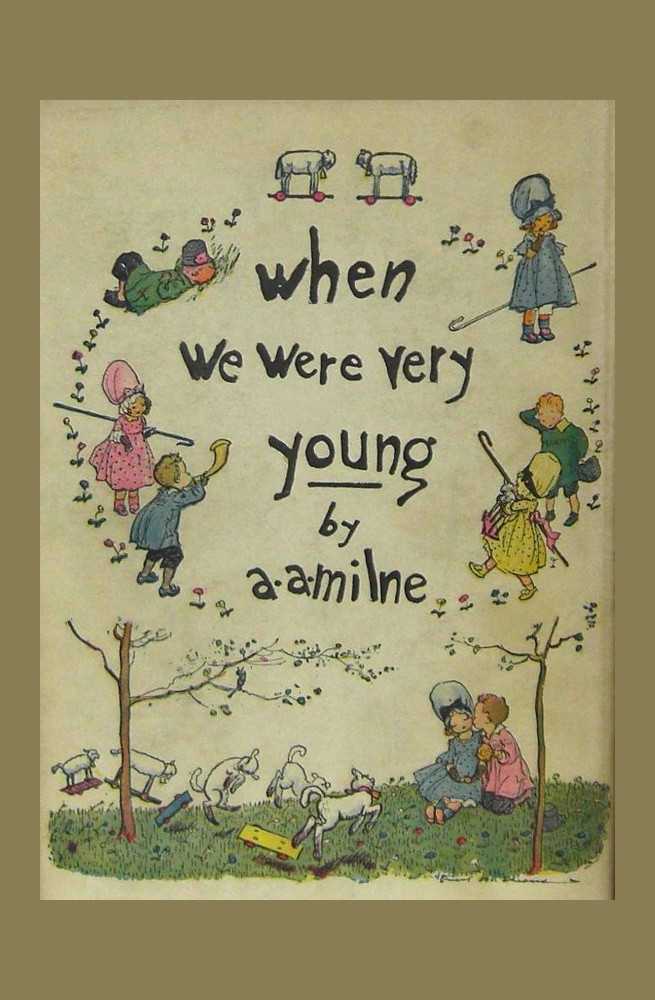
When we were very young cover

When we were very young

Chapter 12: Independence
Open in WeRead

About This Book

A collection of short, playful poems spoken from a child's perspective that blend gentle humor, whimsy, and quiet tenderness. The verses move between everyday scenes—streets, markets, gardens, and play—and fanciful encounters with animals, imaginary companions, and small domestic dramas. Simple rhyme and rhythm shape vivid snapshots, wordplay, and repetitive refrains that echo childhood cadence. Several pieces touch on growing up, manners, and the border between reality and make-believe without didacticism. Overall, the book gathers brief lyrics and comic sketches that aim to evoke memory, voice, and the surprising seriousness of small things.

The Project Gutenberg eBook of When we were very young

This ebook is for the use of anyone anywhere in the United States and most other parts of the world at no cost and with almost no restrictions whatsoever. You may copy it, give it away or re-use it under the terms of the Project Gutenberg License included with this ebook or online at www.gutenberg.org. If you are not located in the United States, you will have to check the laws of the country where you are located before using this eBook.

Title: When we were very young

Author: A. A. Milne

Illustrator: Ernest H. Shepard

Release date: March 12, 2023 [eBook #70271]
Most recently updated: April 18, 2024

Language: English

Original publication: United States: E. P. Dutton Company, 1924

Credits: deaurider, David Wilson and the Online Distributed Proofreading Team at https://www.pgdp.net (This file was produced from images generously made available by The Internet Archive)

*** START OF THE PROJECT GUTENBERG EBOOK WHEN WE WERE VERY YOUNG ***

[i]
WHEN WE WERE
VERY YOUNG
[iv]
[Boy seated on stairs]
HALFWAY DOWN
[v]
[Title page]

when
we were very
young
by
a.a.milne

e.p.dutton & co.
[vi]
Copyright, 1924
By E. P. DUTTON COMPANY
All rights reserved

First Published in 1924

First Edition Nov., 1924
Second Edition Dec., 1924
Third Edition 〃    1924
Fourth Edition 〃    1924
Fifth Edition 〃    1924
Sixth Edition 〃    1924
Seventh Edition 〃    1924
Eighth Edition Jan., 1925
Ninth Edition 〃    1925
Tenth Edition 〃    1925
Eleventh Edition 〃    1925
Twelfth Edition 〃    1925
Thirteenth Edition 〃    1925
Fourteenth Edition 〃    1925
Fifteenth Edition 〃    1925
Sixteenth Edition 〃    1925
Seventeenth Edition Mar., 1925
Eighteenth Edition 〃    1925
Nineteenth Edition 〃    1925
Twentieth Edition 〃    1925
Twenty-first Edition 〃    1925
Twenty-second Edition 〃    1925
Twenty-third Edition 〃    1925

Printed in the United States of America

[vii]
TO

CHRISTOPHER ROBIN MILNE
OR
AS HE PREFERS TO CALL HIMSELF

BILLY MOON
THIS BOOK
WHICH OWES SO MUCH TO HIM
IS NOW
HUMBLY OFFERED

[ix]
JUST BEFORE WE BEGIN

At one time (but I have changed my mind now) I thought I was going to write a little Note at the top of each of these poems, in the manner of Mr. William Wordsworth, who liked to tell his readers where he was staying, and which of his friends he was walking with, and what he was thinking about, when the idea of writing his poem came to him. You will find some lines about a swan here, if you get as far as that, and I should have explained to you in the Note that Christopher Robin, who feeds this swan in the mornings, has given him the name of “Pooh.” This is a very fine name for a swan, because, if you call him and he doesn’t come (which is a thing swans are good at), then you can pretend that you were just saying “Pooh!” to show how little you wanted him. Well, I should have told you that there are six cows who come down to Pooh’s lake every afternoon to drink, and of course they say “Moo” as they come. So I thought to myself one fine day, walking with my friend Christopher Robin, “Moo rhymes with Pooh! Surely there is a bit of poetry to be got out of that?” Well, then, I began to think about the swan on his lake; and at first I thought how lucky it was that his name was Pooh; and then I didn’t think about that any more ... and the poem came quite differently from what I intended ... and all I can say for it now is that, if it hadn’t been for Christopher Robin, I shouldn’t have written it; which, indeed, is all I can say for any of the others. So this is why these verses go about together, because they are all friends of Christopher Robin; and if I left out one because it was not quite like the one before, then I should have to leave out the one before because it was not quite like the next, which would be disappointing for them.

[x]
Then there is another thing. You may wonder sometimes who is supposed to be saying the verses. Is it the Author, that strange but uninteresting person, or is it Christopher Robin, or some other boy or girl, or Nurse, or Hoo? If I had followed Mr. Wordsworth’s plan I could have explained this each time; but, as it is, you will have to decide for yourselves. If you are not quite sure, then it is probably Hoo. I don’t know if you have ever met Hoo, but he is one of those curious children who look four on Monday, and eight on Tuesday, and are really twenty-eight on Saturday, and you never know whether it is the day when he can pronounce his “r’s.” He had a great deal to do with these verses. In fact, you might almost say that this book is entirely the unaided work of Christopher Robin, Hoo, and Mr. Shepard, who drew the pictures. They have said “Thank you” politely to each other several times, and now they say it to you for taking them into your house. “Thank you so much for asking us. We’ve come.”

A. A. M.

[Boy walking away from bear sitting on a line]
[xiii]
WHEN WE WERE
VERY YOUNG

[1]
[Boy skipping followed by woman, with wind blowing leaves]
CORNER-OF-THE-STREET

            Down by the corner of the street,
                Where the three roads meet,
                                And the feet
Of the people as they pass go “Tweet-tweet-tweet—”
Who comes tripping round the corner of the street?
            One pair of shoes which are Nurse’s;
            One pair of slippers which are Percy’s . . .
                        Tweet!  Tweet!  Tweet!

[2]
[Woman and boy entering the palace gate]
BUCKINGHAM PALACE

They’re changing guard at Buckingham Palace—
Christopher Robin went down with Alice.
Alice is marrying one of the guard.
“A soldier’s life is terrible hard,”
                                                    Says Alice.

They’re changing guard at Buckingham Palace—
Christopher Robin went down with Alice.
We saw a guard in a sentry-box.
“One of the sergeants looks after their socks,”
                                                    Says Alice.

They’re changing guard at Buckingham Palace—
Christopher Robin went down with Alice.
We looked for the King, but he never came.
“Well, God take care of him, all the same,”
                                                    Says Alice.

[3]
They’re changing guard at Buckingham Palace—
Christopher Robin went down with Alice.
They’ve great big parties inside the grounds.
“I wouldn’t be King for a hundred pounds,”
                                                    Says Alice.

They’re changing guard at Buckingham Palace—
Christopher Robin went down with Alice.
A face looked out, but it wasn’t the King’s.
“He’s much too busy a-signing things,”
                                                    Says Alice.

They’re changing guard at Buckingham Palace—
Christopher Robin went down with Alice.
“Do you think the King knows all about me?
“Sure to, dear, but it’s time for tea,”
                                                    Says Alice.
[Boy saluting guard]

[4]
[Ducks in the rain]
HAPPINESS

[Boy wearing gumboots and rainhat]
[Boy putting on raincoat]
John had
Great Big
Waterproof
Boots on;
John had a
Great Big
Waterproof
Hat;
John had a
Great Big
Waterproof
Mackintosh—
And that
(Said John)
Is
That.
[Boy standing in puddle with ducks in the rain]

[5]
[Boy watching mouse on table]
THE CHRISTENING

            What shall I call
                My dear little dormouse?
            His eyes are small,
                But his tail is e-nor-mouse.

I sometimes call him Terrible John,
’Cos his tail goes on—
And on—
And on.
And I sometimes call him Terrible Jack,
’Cos his tail goes on to the end of his back.
And I sometimes call him Terrible James,
’Cos he says he likes me calling him names. . . .

            But I think I shall call him Jim,
            ’Cos I am so fond of him.

[6]
PUPPY AND I

I met a man as I went walking; [Boy talking with man]
We got talking,
Man and I.
“Where are you going to, Man?” I said
  (I said to the Man as he went by).
“Down to the village, to get some bread.
  Will you come with me?” “No, not I.”

I met a Horse as I went walking;
We got talking,
Horse and I.
“Where are you going to, Horse, to-day?”
  (I said to the Horse as he went by).
“Down to the village to get some hay.
  Will you come with me?” “No, not I.”
[Boy patting horse]
[7]
I met a Woman as I went walking;
We got talking,
Woman and I.
“Where are you going to, Woman, so early?”
  (I said to the Woman as she went by).
“Down to the village to get some barley.
  Will you come with me?” “No, not I.”
[Boy talking with woman]
I met some Rabbits as I went walking;
We got talking,
Rabbits and I.
“Where are you going in your brown fur coats?”
  (I said to the Rabbits as they went by.
“Down to the village to get some oats.
  Will you come with us?” “No, not I.”
[Boy with rabbits]
[8]
I met a Puppy as I went walking;
We got talking,
Puppy and I.
“Where are you going this nice fine day?”
  (I said to the Puppy as he went by).
“Up in the hills to roll and play.”
  I’ll come with you, Puppy,” said I.
[Boy playing with puppy]

[9]
[Fairy and apple branch]
TWINKLETOES

                        When the sun
Shines through the leaves of the apple-tree,
                        When the sun
Makes shadows of the leaves of the apple-tree,
                        Then I pass
                        On the grass
                From one leaf to another,
                From one leaf to its brother
                        Tip-toe, tip-toe!
                        Here I go!

[10]
[Elephant, lion, goat and snail]
THE FOUR FRIENDS

Ernest was an elephant, a great big fellow,
    Leonard was a lion with a six-foot tail,
George was a goat, and his beard was yellow,
                And James was a very small snail.

Leonard had a stall, and a great big strong one,
    Ernest had a manger, and its walls were thick,
George found a pen, but I think it was the wrong one,
                And James sat down on a brick.
[Snail crossing a brick]
[11]
[Elephant trumpeting]
Ernest started trumpeting, and cracked his manger,
    Leonard started roaring, and shivered his stall,
James gave the huffle of a snail in danger
                And nobody heard him at all.

Ernest started trumpeting and raised such a rumpus
    Leonard started roaring and trying to kick,
James went a journey with the goat’s new compass
                And he reached the end of his brick.

Ernest was an elephant and very well-intentioned,
    Leonard was a lion with a brave new tail,
George was a goat, as I think I have mentioned,
                But James was only a snail.
[Lion roaring]

[12]
[Bears in wait on the footpath]
LINES AND SQUARES

Whenever I walk in a London street,
I’m ever so careful to watch my feet;
    And I keep in the squares,
    And the masses of bears,
Who wait at the corners all ready to eat
The sillies who tread on the lines of the street,
    Go back to their lairs,
    And I say to them, “Bears,
    Just look how I’m walking in all of the squares!”
[Bears on the footpath]
[13]
[Boy walking past bears in a stairwell]
And the little bears growl to each other, “He’s mine,
As soon as he’s silly and steps on a line.”
And some of the bigger bears try to pretend
That they came round the corner to look for a friend;
And they try to pretend that nobody cares
Whether you walk on the lines or squares.
But only the sillies believe their talk;
It’s ever so portant how you walk.
And it’s ever so jolly to call out, “Bears,
Just watch me walking in all the squares!”
[Boy standing in squares, with bear in the background]

[14]
[Boy peeking behind curtain]
BROWNIE

In a corner of the bedroom is a great big curtain,
    Someone lives behind it, but I don’t know who;
I think it is a Brownie, but I’m not quite certain.
    (Nanny isn’t certain, too.)

I looked behind the curtain, but he went so quickly—
    Brownies never wait to say, “How do you do?”
They wriggle off at once because they’re all so tickly.
    (Nanny says they’re tickly too.)

[15]
[Boy astride branch]
INDEPENDENCE

I never did, I never did, I never did like “Now take care, dear!”
    I never did, I never did, I never did want “Hold-my-hand”;
I never did, I never did, I never did think much of “Not up there, dear!”
    It’s no good saying it. They don’t understand.

[16]
NURSERY CHAIRS

                One of the chairs is South America,
                    One of the chairs is a ship at sea,
                One is a cage for a great big lion,
                    And one is a chair for Me.
[Boy in paper hat sitting in chair]
The First Chair.

                When I go up the Amazon,
                I stop at night and fire a gun
                    To call my faithful band.
                And Indians in twos and threes,
                Come silently between the trees,
                    And wait for me to land.
                And if I do not want to play
                With any Indians to-day,
                    I simply wave my hand.
                And then they turn and go away—
                    They always understand.
[17]
[Boy kneeling on chair scaring Nanny]
The Second Chair.

                I’m a great big lion in my cage,
                    And I often frighten Nanny with a roar.
                            Then I hold her very tight, and
                        Tell her not to be so frightened—
                    And she doesn’t be so frightened any more.
[Boy hugging Nanny]
[18]
[Boy standing on chair, ships and ocean in background]
The Third Chair.

                When I am in my ship, I see
                    The other ships go sailing by.
                A sailor leans and calls to me
                    As his ship goes sailing by.
                Across the sea he leans to me,
                    Above the winds I hear him cry:
                “Is this the way to Round-the-World?”
                    He calls as he goes by.
[19]
The Fourth Chair.

                Whenever I sit in a high chair
                    For breakfast or dinner or tea,
                I try to pretend that it’s my chair,
                    And that I am a baby of three.
[Boy seated at table saying grace]
                Shall I go off to South America?
                    Shall I put out in my ship to sea?
                Or get in my cage and be lions and tigers?
                    Or—shall I be only Me?