
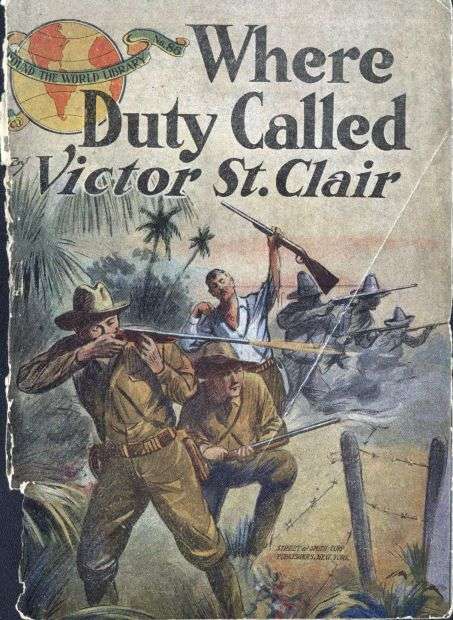
The Project Gutenberg eBook of Where Duty Called; or, In Honor Bound
Title: Where Duty Called; or, In Honor Bound
Author: George Waldo Browne
Release date: December 30, 2010 [eBook #34792]
Most recently updated: January 7, 2021
Language: English
Credits: Produced by Al Haines
Round the World Library No. 86
Where Duty Called
OR
IN HONOR BOUND
By
VICTOR ST. CLAIR
Author of "On His Merit," "Zip, the Acrobat,"
"Cast Away in the Jungle," etc.
STREET & SMITH CORPORATION
PUBLISHERS
79-89 Seventh Avenue, New York
Copyright, 1904
By STREET & SMITH
Where Duty Called
All rights reserved, including that of translation into
foreign languages, including the Scandinavian.
Printed in the U. S. A.
Contents
| Chapter | |
| I. | "A Grand Opportunity." |
| II. | A Suspicious Craft. |
| III. | The Young Exile. |
| IV. | Put in Irons. |
| V. | Escape from the Libertador. |
| VI. | A Swim for Life. |
| VII. | Taken Ashore. |
| VIII. | Jaguar Claws. |
| IX. | The Mystery of the Photograph. |
| X. | "We have been Betrayed!" |
| XI. | A Perilous Flight. |
| XII. | A Lonely Ride. |
| XIII. | In the Enemy's Country. |
| XIV. | Indian Warfare. |
| XV. | A Friendly Voice. |
| XVI. | Colonel Marchand. |
| XVII. | A Cunning Ruse. |
| XVIII. | Ronie Receives a Commission. |
| XIX. | The Scout in the Jungle. |
| XX. | Adventures and Surprises. |
| XXI. | "The Mountain Lion." |
| XXII. | A Fight with the Guerillas. |
| XXIII. | The News at La Guayra. |
| XXIV. | Interview with General Castro. |
| XXV. | The Spy of Caracas. |
| XXVI. | "It is Manuel Marlin!" |
| XXVII. | Good News. |
| XXVIII. | Victory and Peace. |
WHERE DUTY CALLED.
CHAPTER I.
"A GRAND OPPORTUNITY."
"Hurrah, boys! here is a letter from home. At least, it is from the homeland, as it is postmarked New York. Who can be writing us from that city?" and the youthful speaker, in his exuberance of feeling, waved the missive over his head, while he began to dance a lively step.
"I know of no better way to find out than to open it, Harrie, or let one of us do it for you; you seem suddenly to have lost your faculty for doing anything rational yourself. Hand it to Jack if you do not want to trust me with it."
"Your very words, to say nothing of your impatient gestures, Ronie, show that you are not one whit less excited than I am over receiving some news from the great world outside of this lost corner," replied the first speaker, beginning to tear open the end of the bulky envelope he held in his hand.
"There must be a lot of news, judging by the size of the package," said the second, approaching so he could look over the shoulder of his companion while he tore open the covering.
"Go slow, lads," said a third person, who had been sitting slightly apart from the others, but who moved near to the twain now. "It won't do to get unduly excited in this climate."
The three were none other than our old friends of the jungles of Luzon, Ronie Rand, Harrie Mannering and Jack Greenland, whose exploits in opening up one of the great forest tracts on that island were described in "Cast Away in the Jungle," first of THE ROUND WORLD SERIES. They had not been long in Manilla, the capital of the island, since completing that hazardous undertaking, when an incoming steamer brought them the letter which awakened such an interest, and which was to play such an important part in their future actions. As its bulk indicated, it was a lengthy epistle, and this length was more than doubled in reading matter by the fine chirography which covered its large pages.
Standing where he could not scan the mysterious pages, Professor Jack fell to watching the countenance of Harrie Mannering as he followed with his eye the closely written pages. As he read, his features began to change their expression from gayety to seriousness, and by the time he had finished a puzzled look had settled upon his sunburned but good-looking face, and his lips, forming themselves unconsciously into a pucker, gave vent to a prolonged whistle. Then, as if to obtain a more comprehensive understanding of the message, he returned to the beginning, and was about to read it through again, when Jack said:
"Look here, boy, you are taking an unfair advantage of a fellow. You must know that I am just as much interested in news from the homeland as you, so read it aloud this time. If it is good news, I want to enjoy it with you; if it is bad news, then I certainly ought to share it with you."
"Forgive me, or rather us, Jack—for I am sure Ronie has seen every word—but it is all so strange and unexpected that my head is not quite clear yet as to whether I have been reading or dreaming."
"Then it is all the more necessary that I should hear it, as it is possible my poor head may help unravel the skein. You remember the story of the great novelist, Sir Walter Scott, who, upon recovering from a long illness, was given a book to read for amusement. But upon reading the book, he could get so little sense out of it that he feared he had lost his reason. In this perplexed state of mind he handed the work to another to read without giving his reason, while he waited anxiously for the result. She, after reading a few chapters, threw the book aside, declaring it was such senseless twaddle that she did not care to follow it any further, whereupon the great author breathed easier."
"No offense was meant, Jack, and I will try and make amends at once. In the first place, this is an invitation for us to start upon another undertaking somewhat similar to the one we have just completed."
"What! return to the jungles of Luzon?"
"No; it is to South America this time—to Venezuela. A party of men, some of whom are connected with the local government, are anxious to open up the interior of the country in quest of rubber trees. The writer, who is one of the company, and, I judge, an influential member, has recommended us as 'capable persons'—you needn't laugh, Ronie, for those are his words—to survey and engineer for the party. If we conclude to go, he wants us to meet him at Caracas as soon as possible. In the meantime, he will get everything in readiness to start as soon as we arrive. I am at a loss to know what to think of it. The writer, who is Colonel Rupert Marchand, is very enthusiastic over the scheme, and he seems anxious that we should come. I never thought the colonel was one to get wild over anything that was not likely to prove successful."
Jack made no reply in words, but took the letter from the hand of his young friend, and began to hastily run over its contents, saying, by way of apology for his action:
"You will pardon me, Harrie, but it may not be best for us to read aloud or talk to any great extent here. There may be those about whose motives are not friendly."
Thinking this suggestion a wise one, Harrie and Ronie willingly followed their companion to a more retired place, where the three spent fully five minutes looking over the lengthy missive together before one of them spoke. Then Ronie said:
"Well, what do you think of it, Jack?"
"That it is a grand opportunity for two such adventure-loving fellows as you are to embrace. But I would not advise less daring and energetic youths to think of it for a moment."
"So you think there is likely to be some dangerous experiences attached to the journey?"
"It has all of that appearance, though you may come out of it without a scratch. Colonel Marchand, unless I have misjudged him, is just such a man as would throw all thought of hazard to the wind if the prize was worth striving for."
"You do not believe he would lead any one into needless danger, Jack?"
"Certainly not; he is too good a soldier for that, and you know he made an honorable record in our recent war with Spain."
"I judge, then, you think the people we should be likely to fall among might be a dangerous element," said Ronie.
"That is just what I meant. The inhabitants of the interior of the country where he would have you go are treacherous and dangerous, if they happen to take a dislike to you; and that they are more prone to dislike than to like has been my experience."
"What about this rubber business?" said Harrie. "Colonel Marchand speaks as if he wants us to take an interest in the company as part pay for our work. He seems very enthusiastic over that."
"His excuse for having us take some shares is that we might possibly have more interest in the venture," said Ronie. "That stipulation makes me think there may be some sort of a trap to inveigle us into a profitless adventure, though I do not think the colonel would do that."
"You are as well able to judge of that as I am. In regard to the rubber part of the venture, to use a poor simile, that is very elastic. Unless you have given the matter some consideration you will not, at first thought, realize the importance of that commodity, which must govern the possibilities of the article in the markets. I will acknowledge that I am very favorably impressed with the idea. Rubber is fast becoming one of the most important commercial articles in existence. Turn whichever way you will, do whatever you wish, and you will almost invariably find that rubber is the most necessary thing needed.
"Not only is it used in large quantities toward helping clothe men and creatures, but it is used in house furnishings, such as mattings for floors, stairs and platforms, on board of ships, as well as in houses, and in hundreds of other places. It is utilized largely in the manufacture of druggists' materials; in the manufacture of all kinds of instruments and machinery that require pliable bearings and supporters, printers' rollers, wheel tires, rings on preserve jars. Erasers on lead pencils call for tons of the article.
"Then steam mills must have rubber belts, cars rubber bearings, and gas works call for miles of rubber hose, to say nothing of that used in gardens and on lawns. Billiard tables alone call for nearly a third of a million dollars' worth of rubber every year, while over a million dollars are spent for the rubber used in baseball and football! Typewriters call for a vast amount; so do the makers of rubber stamps, water bottles, trimmings for harness, and fittings for pipes of one kind and another. Altogether, the rubber factories of the United States alone utilize sixty million pounds of rubber annually. You will not wonder now if I say that rubber ranks as third among the imports of the country, and that its handling is one of the most profitable callings of the day. If this is the electrical age, as it has been called, it is rubber that makes possible the many applications of electricity."
"I had not thought it of such importance," remarked Harrie, frankly. "Where does it all come from?"
"A very pertinent question," replied Jack. "Originally it came from India, hence the name of India rubber, which still clings to it, though the great bulk now, and that which is of the better quality, comes from other countries. Foremost among these is South America. It is true a large amount comes from Central America, the west part of Africa, and the islands of the Indian Archipelago, but the best rubber comes from the great belt of lowlands bordering upon the Amazon, the Rio Negro and the Orinoco, the last named tract lying largely in Southern Venezuela. This country in many respects is the Eldorado of South America."
"Then we shall not be going into a country without at least one source of wealth."
"No; Venezuela is wonderfully well favored by nature. Capable of producing abundant supplies of first quality coffee, sugar cane, cocoa palm and cotton plant, it has its rich gold mines, its mines of asphalt, affording paving enough for the cities of the world; while last, but not least, are its rubber forests, which have only very recently been considered as a valuable and available resource. It is here American capital has entered the field of conquest."
"Do you think we had better go there, Jack?"
"That is a question you must answer yourselves. I know you will not act hastily, and, having acted, will not regret the step taken."
"What about the climate, Jack?" asked Harrie. "I believe you have been there?"
"Yes, I have been there," replied the other, shaking his grizzled head slowly, "and it was likely at one stage of the scene that I should stay there forever. But I am not answering your question. The climate of South America, as a whole, is not very bad, though much of its territory lies within the torrid zone. This is largely due to local modifications. The burning heat of the plains of Arabia is unknown in the western hemisphere. The hottest region of South America, as far as I know, is the steppes of Caracas, the capital of Venezuela; but even there the temperature does not reach a hundred degrees in the shade, while it rises to one hundred and twelve degrees in the sand deserts surrounding the Red Sea. In the basin of the Amazon, owing to the protection of vast forests and the influence of prevailing easterly winds, offshoots of the trade winds, which follow the great river nearly to the Andes, the climate is not very hot or unhealthy."
"What do you say, Ronie? Is it go, or stay here until something else comes our way?"
"I will suggest the way I would settle it. Let each one take a slip of paper, and, without consulting the Others, write upon it his answer. Whatever two of us shall say to be our decision, to go or to remain here."
His companions were nothing loath to agree to this, so paper and pencils were quickly obtained, and each one wrote his reply. Upon comparing notes a moment later, it was found that all three had written the short but decisive word:
"Go!"
CHAPTER II.
A SUSPICIOUS CRAFT.
"I tell you, boys, there is something wrong about this vessel."
The speaker was Jack Greenland, and his companions were Ronie and Harrie, but the scene is now many leagues from the quiet corner where they took their vote to hazard a journey to the rubber forests of Venezuela. Instead of the quaint old buildings of Manilla on the one hand, and the sullen old bay, filled with its odd-looking crafts, on the other, roll the blue waters of the Caribbean Sea, almost as placid as the southern sky that bends so benignly over their heads, while they stand by the taffrail of the rakish ship upon which they have only recently taken passage to the South American coast.
To explain in detail this change of base would require too much space. A few words will suffice to describe the long journey by water and land necessary to make this stupendous change. In the first place, having decided unanimously to undertake the trip, they were exceedingly fortunate in finding that they could leave Manilla within twenty-four hours by steamer for San Francisco. This required some smart hustling, but our trio were used to this, and the next morning found them safely aboard ship, looking hopefully forward to a speedy and safe arrival in the city of the Golden Gate. In this they were not disappointed, while the run down the coast to Panama was also made under favorable conditions. Then the isthmus was crossed with some delay and vexation, when their adventures and misadventures began in earnest.
At Colon tidings of war in Venezuela reached them. These being somewhat indefinite, and the republic in question being a land of revolutions and uprisings, but little attention was given these vague reports. They had barely left port, however, before the captain of the little coastwise vessel declared that they were likely to have trouble.
The next day they were, indeed, fired upon by a strange craft, and instead of keeping on toward La Guayra, the port of Caracas, he put to sea. While bent upon this aimless quest, they were overtaken by a tropical storm, and were eventually driven upon one of the small isles forming the lower horn of that huge crescent of sea isles known as the Windward Islands. From this they managed to reach, after repairing their damages somewhat, Martinique, where our three heroes were only too glad to part with such uncertain companions.
There was a strange ship in this port, which immediately attracted them. Learning that the captain, though he had taken out papers for Colon, intended to stop at La Guayra, they engaged passage. At the outset they had felt some distrust in doing this, while the commander showed equal hesitation in taking them. Still, it was their only chance to get away, so they resolved to take their chances, with the determination to keep their eyes and ears open. Thus they had frequently expressed the opinion among themselves that they had been justified in their suspicions, though this was the first outspoken belief in the fact.
"I agree with you, Jack," declared Ronie.
"What have you learned that is new, Jack?" asked Harrie.
"Enough to confirm what doubts I already had as to her character. Captain Willis does not intend to put in at La Guayra, as he claimed he should to us."
"Perhaps he dares not," said Ronie.
"Ay, lad, that's where you hit the bull's-eye. He dares not do it."
"That means either that his intentions are not honest, or that the war in Venezuela is more than a civil war," said Harrie.
"Now you've hit the bull's-eye with a double shot. I do not believe he is honest," nodding in the direction of the commander, "and that this is an international war!"
"Whew!" exclaimed the young engineers in the same breath. While both had really about come to this conclusion, the proposition seemed more startling when expressed in so many words.
"Before we fully agree to this," continued Professor Jack, "let's compare notes. In the first place this vessel before undergoing some slight alterations came to Martinique as a Colombian vessel, officered and manned by Englishmen. Upon reaching this island she was immediately sold, and her English crew discharged. But her captain remained the same, while she still carried the English colors. The next day it was claimed she had been again sold, this time passing into the possession of followers of General Matos, the leader of the Venezuelan revolutionists. Her English flag was now replaced by the colors of Venezuela, and she was renamed from the Ban Righ to the Libertador. Can the chameleon beat that in changing colors? It is my private opinion she is a cruiser in the employ of the insurgents, and that we are booked for lively times."
"With small chance of reaching Caracas for a long time, if at all," added Ronie.
"How came England to allow such a vessel to leave her port?" asked Harrie.
"She must have been deceived as to her real character. Thinking she was a Colombian ship, and being on peaceful terms with that republic, she had no business to stop her.[1] Hi! what have we here?"
Jack's abrupt question was called forth by the sudden appearance almost by his side of a tall, slender youth, whose tawny skin and dark features proclaimed that he belonged to the mixed blood of the South American people. He had risen from the midst of a coil of rope, and in such close proximity that it was evident he had overheard what had been said. The three Americans realized their situation, though the opening speech of the young stranger reassured them.
"Señors speak very indiscreetly," he said, "of affairs which they must know bode them ill, in case their words reach the ears of others."
"Who are you?" demanded Jack, who was the first to speak. He remembered having seen this youth among the men on board, but had not given him any particular notice, although he noticed that he presented an appearance that showed he did not belong to the class of common sailors, while dressed no better than the poorest. There was an air of superiority about him which they did not possess.
"It is not always well for one to be too outspoken to strangers," he answered, glancing cautiously about as he said the words. "Even coils of rope have ears," he added, significantly.
"You overheard what we said?" queried Jack, who continued to act as spokesman for the party.
"Si, señor. I could not help hearing some of it, though you did speak in a low tone. My ears are very keen, and not every one would have heard the little I did."
"It is not well for one to repeat what one hears, sometimes," said Jack, by way of reply.
"I have a mind as well as ears, señors," replied the youth. "While I can see as well as I can hear, I can think for both eyes and ears. You are not satisfied with the appearance of the Libertador?"
"I judge you are pretty well informed as to our opinion," replied Jack, more vexed than he was willing to show that they should have been caught off their guard. "Listeners are not apt to hear any good of themselves, we are told."
"Had I been a spy," retorted the youth, with some animation, "I should have remained quietly in my concealment, and not shown my head at all, and most assuredly not when I was likely to hear that which was to prove the most important."
"Please explain, then, your motive in addressing us at all."
"Not here—not now," he answered. "When the Southern Cross appears in the sky, and the sharp-eyed, doubting Englishman at the head sleeps, I will meet one of you here, and make plain many things you do not understand."
"Why not meet all of us?" demanded Jack, suspiciously.
"Because one of you in conversation with me would create less suspicion than all of you would be likely to do. That is my only reason, señor."
"By the horn of rock—Gibraltar, if you please," exclaimed Professor Jack, "there is a bit of common sense in that. One of us will be here, if we find it convenient."
"Good, señor. Now, as we seem to be attracting attention, it may be well for us to separate. I will be on hand at the appointed time."
A moment later the unknown youth mingled with the motley crew, leaving our friends wondering what their meeting with him portended.
"He seems honest," declared Ronie.
"He must be half Spaniard, and the other is doubtless something worse, if that is possible," said Jack, who confessed that he had no liking for the South American races.
"Shall we accept his proposition?" asked Harrie. "I will confess I am curious to know what he has to tell."
"I do not understand what this disturbance between the countries means," said Ronie. "When foreign nations take a hand in the affair it would seem to show that something more serious than a civil revolt is likely to follow. There could not have been a suspicion of this outside preparation of war in the United States, or Colonel Marchand would have known of it. I do not see how this has gone on under the American eyes."
"It is probably due to the fact that these republics of South America are almost continually at war. Venezuela has had a stormy time of it from the very first. I think one of us had better listen to what this young Venezuelan has to say. He is evidently not in sympathy with the commander of this vessel."
"Who is working in the interest of Matos, the leader of the revolutionists?"
"As President Castro is at the head of the government, and the target for the fire of the whole world at this time."
It was finally decided that Harrie should meet the stranger at the appointed time, while Ronie and Jack were to remain nearby to lend their assistance in case the youth showed any signs of treachery. Having come to this decision, the three waited, as may be imagined, with considerable anxiety for the hour to come.
[1] Jack hit nearer the truth than he realized at the time. The Ban Righ had, in fact, awakened the suspicions of the English authorities, and the attention of the custom officers was directed to her by the placing of a searchlight on her foremast. An examination disclosed the fact that parts of guns and gun-mountings had been stowed away below deck, where passages had been cut to allow the crew to move about with facility. She was released and permitted to leave port because the Colombian official in London claimed that she was being fitted out for the service of his government. Sailing ostensibly for Colon, she called at Antwerp, where she was loaded with 175 tons of Mausers and 180 tons of ammunition, besides field guns, billed as "hardware, musical instruments and kettledrums." She also took on here a French artillery captain, a doctor, and two sergeants. The guns were mounted before she reached Martinique, and while there a sham sale was made. So it will be seen that Jack and the young engineers had ample reason for mistrusting the vessel whose career reads like a chapter from romance rather than the actual history of a ship that, possibly, did more to foment international disputes concerning the Venezuelan war than anything else.—AUTHOR.
CHAPTER III.
THE YOUNG EXILE.
The night proved clear and beautiful, a typical southern evening most fitly closing a day that had been flawless. All the afternoon the sky and sea, so nearly of the same cerulean hue that where they met they matched so perfectly as to seem a curtain of the same texture, had appeared to vie with each other in their placidity, while now the stars overhead were scarcely brighter than their reflections in the waters below. On the rim of the distant horizon shone with a soft luster the glorious radii of the gem of the Antipodes, the Southern Cross.
Harrie was promptly on hand to keep his meeting with the strange youth, but no earlier than the other, who greeted him in his musical voice:
"Señor is in good season. It is well, for our time cannot be long in which to talk. While we speak let us walk slowly back and forth, arm in arm, so we shall not be overheard."
He spoke in a low tone, a little above a whisper, while Harrie allowed his arm to be drawn into the other's grasp, though he was very watchful not to be taken unawares in case of an attack on him.
"In the first place," said the young Venezuelan, "I judge señor is anxious to know who it is who has placed himself in his way. But before that I would speak of the ship which is at this moment bearing us whither we fain would not go."
"What about the ship?" asked Harrie, as he hesitated. "What have you to say of that?"
Lowering his voice so our hero could barely catch his words, he said:
"It is a pirate ship, señor!"
Harrie could not repress a low exclamation at this startling announcement, but he quickly recovered his presence of mind, saying, as he recalled the wild deeds of Morgan and his freebooters, Conrad and his Blue Water Rovers, who once boasted dominion over these seas:
"How can that be?"
"At least it is outlawed by the Venezuelan Government, and a big reward offered for its capture. It is a conscript working in the interest of Matos, the outlaw."
"Who are you who says this, and how come you by this information? You appear to be one of the crew; why is this so?"
"I could answer the last question by asking the same of señor. I am here solely with the hope of getting back to my native land, and to the side of my dear mother. Perhaps you will understand my situation better when I tell you that I belong to a family that once ruled Venezuela. The two Guzman Blancos, the elder of whom was an American, were my ancestors. My name is Francisco de Caprian. My family is hated by Matos, while father, who is not living now, did something to incur the displeasure of Castro, so I am in ill-favor all around," he added, with a smile which disclosed two rows of very white teeth.
"Notwithstanding this," he added, "I am anxious to get back to Caracas, to protect my dear mother in these perilous times, and, it may be, strike one blow more for my country. The De Caprians can trace their ancestry back to Juan Ampues, who founded the first Spanish settlement in Venezuela, and one of them was a captain under Bolivar. Whatever they may say of my family, they have ever been true to their native land. The illustrious General Blanco did much for downtrodden Venezuela, if some complained of him. You cannot suit all, señor, at the same time. Whither do you wish to go?"
"To Caracas," replied Harrie.
"I am glad to hear that, señor, for it will enable us to join fortunes. That is, if you do not hesitate to associate with me. I am frank to say that I am likely to involve you in trouble; but, at the same time, judging you are strangers there, I may be able to help you. Then, too, I do not believe they will dare to molest you to any serious extent, so long as your country is not mixed up in this imbroglio. Yet a South American aroused is like a wild bull, whose coming actions are not to be gauged by his former behavior. I never have found an American who could not take care of himself."
"Thank you, Señor Francisco. I trust you have not found one who would desert a comrade in an hour of need."
Quick and earnest came the reply, while the young Venezuelan grasped Harrie's hand.
"Never, señor."
"You shall find my friends and me faithful to our promises."
"I was confident of that, or I should not have dared to address you. Believe me, the risk was greater than you may realize. Were my identity to become known on this ship I have no doubt but I should be hung at the yardarm, or shot down like a brute, within an hour."
The youthful speaker showed great earnestness, and with what appeared to be genuine honesty and candor. At any rate, Harrie was fain to believe in his honor, and without further delay related enough of his experiences for the other to understand the situation of his friends and himself.
"I was very sure you were here involuntarily," said Francisco, when he had finished. "It is likely we can be of service to each other. From what I have been able to pick up, we are to coast along the shore of Venezuela, leaving here and there arms and ammunition for Matos and his insurgents. It is possible we shall stop at Maracaibo. In case we do so, that will be the place for us to leave the Libertador. If there is a chance before, we shall be remiss as to our personal welfare if we do not discover and improve it. The eyes of the watch are upon us," he said, in a lower tone, "and we had better separate. Keep your eyes and ears open until we have opportunity to speak to each other again."
Before Harrie could reply, the other had slipped away, and he was fain to return to his companions, whom he found anxiously awaiting him. In a few words he apprized them of what had passed between him and the young Venezuelan outlaw, Francisco de Caprian.
"His words only confirm what we had concluded, and for that I am inclined to believe the young man in part, at least. I was in Venezuela at the time of the downfall of that pompous patriot Guzman Blanco, and I knew something of the De Caprians. Possibly it was this fellow's father who was mixed up in the muddle, and who was killed, according to report, soon after I got away. Mind you, I say this, but it will be well for us if we are careful whom we trust. In Venezuela every man is a revolutionist, and where revolutions reign the sacredness of human faith is lost. As we seem to be in for our share of lively times, it may be well for us to look at the situation intelligently."
"I am surprised at the small amount I know of these South American republics," declared Harrie. "Though they are much nearer to us, I really know far less of them than I do of European nations of to-day, or the ancient empires that crumbled away long years ago."
"It is usually so," replied Jack. "It is a trait of human nature to be reaching after the things beyond our reach, while we push right over those near us. The history of South America is a most interesting one, but the most interesting chapter is close at hand, when out of the crude material shall crystallize a government and a people that shall place themselves among the powers of the world. I should not know as much as I do of Venezuela if it had not been for the two years I spent there quite recently—years I am not likely to forget."
"Ojeda, the Spanish adventurer who followed Columbus, named the country Venezuela, which means "Little Venice," from the fact that he found people living in houses built on piles, which suggested to him the 'Queen of the Adriatic,'" said Ronie.
"Very true," argued [Transcriber's note: agreed?} Jack. "These were natives living about Lake Maracaibo, but the name was extended to cover the whole country, though its original inhabitants did not, as a whole, live in dwellings on poles, and move about in canoes. This Alonso de Ojeda carried back to his patrons much gold and many pearls that he stole from the simple but honest natives."
"If I am not mistaken, Vespucci, who had so much to do with naming the new continent,[1] accompanied Ojeda's expedition," said Harrie.
"Very true," replied Jack. "I am glad to think that he was more humane than the majority of the early discoverers, who treated the natives so cruelly. The Indians of this country were not only rapidly despoiled of their gold and pearls, but they were themselves inhumanly butchered or seized and sold into captivity. The result was they soon became bitter enemies to the newcomers, who thus found colonization and civilization not only difficult but dangerous. Among those of a kinder heart who came here was Juan Ampues, whom your young friend, Harrie, claims was an ancestor of his. Ampues succeeded, through his kindness, in winning over the natives to his side, and he was thus enabled to found the first settlement in Venezuela. This was in 1527, and the town whose foundations he laid still exists under the name he gave it, Santa Ana de Coro. But for the most part the Spaniards treated the Indians in a brutal manner, and in the end the unfortunate race was looted and slain."
"But I have read that the people of Venezuela fell into worse hands when the country was leased for a while to the Germans," said Ronie.
"Right!" declared Jack, earnestly. "You are evidently well posted on history. Germany's hold was broken in 1546, but it took two hundred years to conquer and settle Venezuela, while all the slaughter of human lives and vast outlay of wealth proved in the end a poor investment for old Spain. One by one her American dependencies have slipped away from her control, and Venezuela has the honor of being the first to gain her freedom from Old World tyranny.
"The first effort to break the chains was made in 1797. This was unsuccessful, and another attempt was made in 1806, this time by General Francisco Miranda, who invaded Venezuela with an expedition organized in the United States, This revolution was successful only so far as it served to awaken the people to the possibility that lay before them. The prime opportunity came when Napoleon dethroned Ferdinand of Spain, and the inhabitants of this dependency declared that they would not submit to this Napoleonic usurpation. Though this movement was made under a claim of allegiance to the deposed king of Spain, he was incapable of seeing that it was for his interest to stand by them, so he renounced their declaration. The result was another declaration made on July 5, 1811, a declaration of independence and a constitution in some respects like ours."
"It seems a bit strange that they should have an independence day that comes so close to ours," said Harrie.
"Yes; and it is quite as singular that the first blow for liberty was struck by their ancestors on the same day in April that our forefathers fired their opening guns upon the British at Concord and Lexington," replied Jack.
"What means that confusion and those loud voices upon the deck?" asked Ronie, as they were arrested in the midst of their conversation by the sounds of a great commotion having suddenly begun over their heads.
"There is something new afoot!" declared Jack. "It sounds as if there was going to be a fight. Follow me, and we will find out what it means."