
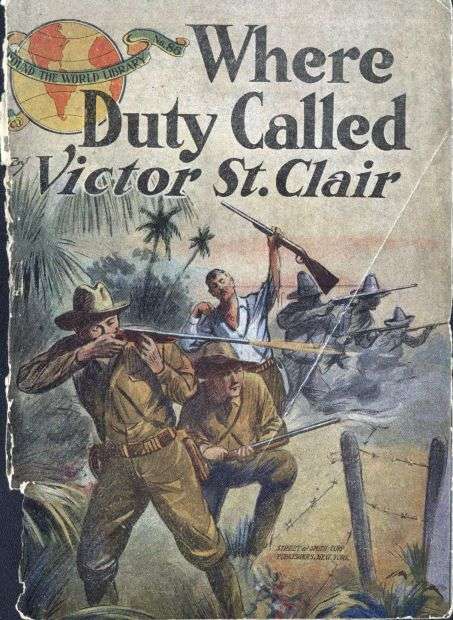
CHAPTER XVII.
A CUNNING RUSE.
"Speaking about joining our forces," said Colonel Marchand, "under the circumstances it will be impossible for me to fulfill my promise to you when I wrote. Neither would it be practicable to carry out plans made under different conditions. Join our army for a while; it will prove a lively vacation for you, and just as soon as this little cloud blows over we will start. We will have the government behind us, too. It is a great undertaking in more senses than one. I expect to become regularly attached to Castro's army within a short time. In fact, I am away now only temporarily. What do you say to becoming comrades under Castro?"
"I should want to consult Harrie before I decided," replied Ronie.
"So you shall. Now that is settled, let us talk of other matters. It is perfectly natural, however, that you should cast your fortunes with ours for a short time. Venezuela does not forget that it was due to Miranda's experience gained in fighting for the independence of the Great Republic that he learned something of what might come to his native land, and that it was the friendship of Lafayette, Hamilton and Fox which encouraged him to push forward. When the revolution opened in 1810, the United States furnished Venezuela with her munitions of war. Two years later, when the earthquake destroyed twenty thousand of our people, she sent supplies with a liberal hand to us. In this crisis, which I believe is to be the most important affair in her history, we stand in need of Northern friendship. Europe is against us, and in the jealousy of the powers there would gladly hail any pretext upon which she could seize us."
"The Monroe Doctrine must be a great safeguard to you."
"If it hadn't been for that these little South American republics would have been swallowed by European powers long before this."
"While the swallowing would have caused some bloody wars."
"Very true, but we are used to that. There has not been a time within my remembrance when there has not been a war of some form in process. Speaking of the European nations swallowing us, you may forget that we are three times as large as France or Germany, and five times as large as Italy. We are larger than any European country outside of Russia. Something of its natural features may be understood from the fact that it holds within its domain some beautiful bodies of inland water, the largest of which, Lake Maracaibo, is somewhat larger than Lake Ontario. Within the republic are over a thousand rivers, the largest of which is the Orinoco, next in size to the Amazon of the rivers of South America.
"In regard to its physical features, the country may be divided into three great zones, increasing in size according to the following order: First, the zone of agriculture; second, the zone of grazing land; last, the larger in area than both of the others, the zone of the forests. There are two seasons, the wet and the dry, called winter and summer.
"Venezuela is thinly populated, having about two and one-half millions of inhabitants. They still preserve the type of the Spanish race, which afforded them origin, though they have become largely a cosmopolitan race, due to the mixture with the natives. These have retained to a wonderful extent their primitive beauty, so the men are manly and symmetrical, the women graceful and beautiful."
"How is it about the wild horses our geographies describe as still roaming with flowing manes and foaming nostrils and llanoes and pampas?" asked Ronie.
"They disappeared before the buffalo vanished from your Western plains. I would say also of the people, instead of the wild beauties your books tell you are yet living in almost primitive simplicity, you will find, when you get to the capital, women and maidens looking quite as anxiously for the fashion sheet from Paris as her sisters in New York. We are apt to think the only civilization is that around us. How well do I remember that my first impressions were that the little space about me in which I was reared comprised the world. Gradually my vision extended, and my knowledge expanded, until I find it is a big old world, and that it holds many people."
Colonel Marchand's kindly words, and his willingness to inform his friends, put our couple very much at their ease. Ronie improved the first opportunity to speak of that matter which was frequently uppermost in his mind, the finding of his mother's photograph under such peculiar circumstances. He was unable to offer any solution of the mystery, while he showed a deep concern.
"I cannot think your mother would come to this country, even with the hope of meeting you, without first sending me word of her intentions. Of course, I should have tried and met her at La Guayra."
"You have not heard from her?"
"Not a word, though I did expect to get a letter in regard to your coming. I feel very sure the photograph must have been brought from New York by some disinterested party, who came into possession of it by accident. I cannot imagine anything else, though this is rather hard to believe."
Realizing that Colonel Marchand had affairs that needed his attention, Ronie and Jack asked if they might look about the town, and the simple request being granted, they passed the next few hours in exploring the place, though finding little to interest them. The regular inhabitants had nearly all fled, and those who had remained appeared ill at ease under the existing conditions, as they might have been expected to be.
"I tell you what it is, Jack," said Ronie, "it looks to me as if these revolutions are sapping the very life out of the country."
"Ay, lad; and now it looks as if you and I were to become actors in one of them. I wonder what is going on yonder."
These words were spoken by Jack as their attention was caught by the sight of a group of people gathered near the building where they had been lodged. As they advanced with quickening steps, it became evident that a fight or street brawl was in process. Around this a couple of dozen or more civilians had clustered, and by the way they encircled the combatants it looked as if they were trying to shield them from the gaze of the soldiers, should any of these happen to come that way. For a wonder not one of these was in sight at that moment, though the steady tread of the sentry within the building could be heard as he paced back and forth with measured step.
"Better give them a wide berth," declared Jack. "It never does any one good to get mixed up in one of these senseless encounters. Why, if you should go to the assistance of one of them, thinking he was being abused, the chances are more than even he would join with the other in abusing you. By the horn of rock—Gibraltar, if you please! this does not seem to be a fight by common brawlers, for their mantas show they belong to the better class of civilians."
The garment which had attracted the attention of Jack was the manta or poncho made of white linen, which has the quality of repelling the heat of the sun on a warm day. These garments are worn almost continually by certain classes, among them the vaqueros, or riders of the pampas. That of the latter consists of two blankets sewed together, one of a dark blue color and the other of a bright red. These hues are universally selected for a purpose, as they receive light and heat differently, and are used so as to afford the best results. Thus in dark and cloudy days the dark side of the blanket is turned outward; on other days this is reversed. The double blanket thus formed is quite two yards square, with a hole in the center to admit the head of the owner. Its purpose is two-fold, to protect the rider from the heavy dews and showers of the tropics, and to spread under him at night when there is no place to sling up his hammock. But the effect of this linen manta worn by these street fighters was even better than that of the woolen cobija of the vaqueros. These mantas worn by this twain were fancifully embroidered, and showed that they were expensive garments. At a distance they would present a striking, picturesque appearance.
Our heroes found it difficult to get near enough to obtain a view of the stirring scene in the little opening made by the encircling on-lookers, and, caring little for the affair, anyway, quietly retreated. Then, the alarm having been spread, no doubt, the soldiers began to appear in sight, and a squad led by an orderly started in to disperse the crowd. But the spectators seemed too earnest to be easily driven off, while the soldiers themselves quickly became so interested in the contest that they tried little more than to get a good look at the tableau.
"I never saw a Venezuelan yet who didn't relish a good fight," remarked Jack.
"But look there, Jack!" exclaimed Ronie. "What is going on that way?"
As Ronie pointed toward the rear of the building already mentioned, Jack saw half a dozen loungers hanging along in a manner suspiciously like a row of loafers, and not in knots, as men of this kind usually congregate.
"See! two of them are helping away a woman. Why, Jack! it is the prisoner, Señora de Caprian! She is trying to escape."
In a moment the whole situation was plain to them. The brawl and fight was simply a ruse to catch the attention of the soldiers while the captive woman made her escape. So cleverly had it been carried out so far, that it was likely to succeed beyond the most sanguine expectation.
Ronie glanced hurriedly around to see that the orderly and his men were in the thickest of the mob, oblivious of all except the hand-to-hand tussle. Another minute and the captive would be beyond recapture, except, possibly, after a long chase. His first thought was that of gladness for the unfortunate woman, then he remembered that there was another side to the question, and that it might be well to retain her as a prisoner of war. He decided quickly upon his course of action; whether it was right or wrong must be proven in the future.
CHAPTER XVIII.
RONIE RECEIVES A COMMISSION.
"She must not be allowed to escape, Jack!" exclaimed Ronie. "I heard Colonel Marchand say that she knows secrets which it would not be well for his enemies to learn."
"Ay, lad; it is not too late for us to stop them."
Without further delay the twain sprang forward, and were in season to intercept the fugitives. As they brought their firearms to bear upon the men who had constituted themselves Señora de Caprian's escort, Ronie cried, sharply:
"Stand where you are!"
The woman uttered a cry of dismay at this command, while the men suddenly stopped, facing the determined Americans with frightened looks.
"Let me pass, señors, I implore you," begged the prisoner, the tears springing to her eyes, while she clasped her hands and turned upon them such looks of agony as haunted them for many a day. Ronie, at least, felt that he had committed an act which he should regret, and it is possible if the opportunity had remained when he could have allowed her to escape with safety, he might have done it. But the die was cast, and there was no retreat. The loud, authoritative words had aroused others. The soldiers were suddenly recalled to their duty, while the sight of the fugitive and their captors quickly caught the attention of the newcomers upon the scene, foremost among these being Colonel Marchand!
He instantly comprehended the situation, and a look of admiration for the prompt deed lightened the bronze upon his cheeks, while he said:
"By the soul of Bolivar! you have done well, señors. Soldiers, secure the prisoner immediately, and see that her liberators are taken into custody."
"I hope there will be no cause for us to regret what we have done, colonel," said Ronie, who really felt sorry for the prisoner.
"You may cut off my right hand if you do, Señor Rand. At present it is necessary that we hold the woman as a prisoner of war, but she shall be well treated, and I have no doubt be set free soon."
Ronie knew Colonel Marchand was a man of his word, and he felt better over what he and Jack bad done. This pleasure was further increased by the words of the colonel as they accompanied him to his headquarters.
"This will prove a good day's work for you, Ronie. I only regret I had not been able to report it to General Castro when I sent my dispatch, but better late than never. What do you say to going with us on our campaign toward Maracaibo? We start within an hour. The rebels are rallying in that direction, and we must look after them before they become too strong."
The fact that it was likely to take them nearer to Harrie, if not quite to San Carlos, was enough to shape their decision, and inside of an hour they were mounted and riding with the troops toward the west, Ronie getting his first taste of warfare.
The days that followed would never be forgotten by our American soldiers in the service of Venezuela. Colonel Marchand seemed to be always on the move, but the enemy was even more active than he, and always kept one scene ahead of him. For instance, he left the little hamlet where Ronie and Jack joined his forces to go to another country town called Verona, where it was reported the insurgents had made a raid. Upon reaching this settlement, which was little more than a collection of coffee planters' conical dwellings, it was ascertained that the enemies had been gone a few hours, and that they were headed toward Juan. Hither, posthaste, dashed the Venezuelan cavalry, resolved to be in season this time, only to find that again the bird had flown. But Castro's troops were led by a captain who had the name of never sleeping, and once more he followed on their heels. Then he learned they had gone back to Verona! Thus two weeks were spent in vain advances and retreats, swift dashes ahead and equally as rapid doubling upon the track, until we finally find the grimy riders halted near the rim of a little plain which formed the foot of a mountain range trending away toward the more lofty peaks making the highest elevations of land in the Western World. As may be imagined, the doughty colonel was in no enviable mood, as he sat by the door of his tent, whose roof was the bended sky. It was one of those inns found at those outposts between the agricultural and pastoral regions.
The men were busy getting the evening meal, which was to be made up largely of a fat bullock killed a few minutes before. Evidence had been witnessed where the insurgents had broken into a herd that very day and slaughtered several of the best beeves. This killing of cattle was characteristic of Venezuelan warfare. The ragged troops of the revolutionists must be fed, and what easier way to do it?
Ronie and Jack, who had ridden until they were tired and sore, were attending to their tough ponies before spreading their ponchos over the stony spot which they had cleared of the rank vegetation so as to prepare their couch for the night, as there were no posts upon which to hang their hammocks, when a messenger informed them that Colonel Marchand wished to see them immediately. At a loss to know what this order could mean, they lost no time in answering the summons.
They found the colonel, usually so genial, very much out of humor. At first Ronie feared that he had done something to arouse this uncommon state of mind on the part of his superior.
"Sergeant Rand," greeted the colonel, brusquely, giving our hero a title quite unexpected to him, "I have sent for you to see if your Yankee ingenuity and courage cannot help me out of this difficulty."
"I am at your service, colonel," replied Ronie, with a military salute, "and I am sure my friend here is equally as faithful."
"Ay, ay, Colonel Marchand; where Ronie Rand leads I——"
"Sergeant Rand, if you please, Señor Greenland," interrupted the officer. "I will now explain what I want of you."
Though taken somewhat aback by this greeting, our twain bowed and waited respectfully for the other to explain.
"In the first place," began the colonel, "I need not tell you how I have been buffeted about for the last ten days. It has set my teeth on edge. On every hand my scouts have been baffled by these scoundrels of the bush, who make a farce of war and style themselves 'Sons of Liberty!' Word comes in that they are everywhere successful, and that Castro is discouraged. I know better than the last. He is not that kind of a man. But enough of that. What I want of you is simply this: Take as many men with you as you wish, and reconnoiter the country as far as you think best, and report to me as often as possible. Are you willing to undertake this hazardous mission?"
"I am willing to do my duty, Colonel Marchand."
"Ay, ay, colonel," added Jack.
"Spoken like true soldiers. I know I can depend on you. Now name the number of men you want to go with you, and I will have them detailed at once. Remember you are to have command of the squad, with your friend as deputy."
"I assure you, colonel, we appreciate the honor. I think three men will be sufficient. A small body of men can go where a large one would be likely to attract attention."
"Good! My scouts dare not stir out of their hammocks without an army is at their heels. How soon can you be ready to report, sergeant?"
"In half an hour, colonel."
"Thank you, sergeant. That will give me time to detain [Transcriber's note: detail?] the men, and I will see that you have the best in the regiment. By the way, sergeant, I wish to say that I have received as yet no reply from General Castro, but I probably shall before you get back. I would also add that I expect to move to Baracoa in the morning, where I shall await news from you."
"Well, Jack, what do you think of this?" asked Ronie, as soon as they had left the presence of Colonel Marchand.
"Looks as if we were going to taste of real warfare," replied Jack. "I can't say that I am sorry, for as long as we cannot go ahead with our work it will serve to break the monotony."
"If I only knew that mother was safely at home, and Harrie was with us, I really think I should enjoy it. If there was only some way I could get a letter sent to her, I would write to mother in New York, hit or miss."
"Perhaps the colonel will have a chance to get it to the capital," suggested Jack. "If you want to write it, I will see that everything is got in readiness for our start."
"You are very kind. I think I will do it. It will certainly do no harm."
So Ronie wrote his letter to his mother, describing briefly his recent experiences, and speaking particularly of the portrait he had picked up. He had to make his letter short, for he not only prepared that, but he ate a hasty meal, which Jack had prepared, and with his faithful companion presented himself at the commander's tent in exactly half an hour.
"I am glad to find you so punctual," remarked the colonel. "Yes, I will send your letter along at the first opportunity. Here are the men who are to accompany you. I wish you success, but I do not believe I need to caution you to move cautiously. You have been here long enough to know something of the character of these bush rebels."
In this brusque manner Colonel Marchand saw them depart, though he did not return to his papers until they had disappeared beyond the line of forest vegetation which encircled the clearing in the shadows of the mountains. His eye trained upon the spot where he had last seen them after they had vanished for several minutes, he finally turned back, saying, under his breath:
"I hope I shall not be disappointed in them as I have the others who have gone before them."
CHAPTER XIX.
THE SCOUT IN THE JUNGLE.
Riding at a leisurely pace, the five scouts started upon their dangerous quest, Ronie and one of the Venezuelans riding side by side, with Jack and another behind them, leaving the single man to follow. The young sergeant was pleased to find that the trio selected to accompany him by Colonel Marchand were very prepossessing men, one of them a man with gray hair, while the others were but a little over twenty years of age. The oldest, whose name was Riva Baez, claimed he knew the country well, so it was he who rode beside our hero to show the way.
"About ten kilometers to the west we shall strike the main road to Truxillo," he remarked. "But it may be well for us to avoid that. El Capitan and his followers are believed to be hovering around the foothills between here and Barquisimete. It is a country just suited to ambuscade and concealment."
"How far is it to the nearest town?"
"Less than five kilometers. It is a small town called Caro."
"Is it held by the insurgents?"
"No, though it bears the marks of one of their raids. The people have been left too poor to be either feared or sought for."
"We need not go there?"
"About a kilometer this side we can strike a mountain road leading into the wild country."
"Where we are likely to find El Capitan and his insurgents?"
"Si, Sergeant Rand."
"Then that is our course, señor. Show us the way."
Nothing further was said until possibly three miles had been passed, when Riva Baez drew rein. The road they had taken soon after leaving the encampment of the troops, by this time had sort of "dwindled away," as Jack put it, until it was now little more than a cattle path. The country ahead was thinly populated, if settled at all. The guide of the little party was the first to speak:
"If we follow this course half a kilometer farther we shall come out upon the road leading to Caro, which winds down from the mountains. Beyond, the country is infested with the insurgents, and we are likely to run upon them at every turn. If we keep on through Caro we shall soon come into the lower country, where we shall find a string of towns along the way, but the people, as a rule, unfriendly to us. If we bend to the left here we shall be able to make a short cut over the spur of the ridge and reach the region of Maracaibo without much risk of stirring up El Capitan's hornets. Which way shall we go, sergeant?"
"Our purpose is to learn all we can of the enemy," replied Ronie. "According to your account, we shall learn very little of them by keeping to the left. Neither are we especially anxious just at present to seek towns in the lower country. But we will go to Caro first."
"Si, Sergeant Rand," and without longer delay Riva Baez led the march forward again. Owing to the unfavorable conditions of the route, they had advanced slowly, and it was now past midnight. The moonbeams tipped the treetops with a silvery halo, but underneath this foliage it was so dark that our riders had to pick their way with constant caution, lest they should run into some trap of nature or set by the hand of an enemy that claimed this country as his own.
Nothing to cause them actual alarm, however, took place, and after a while Riva declared they were close down to Caro, which he described as lying in a narrow valley through which wound one of the numerous mountain streams watering the country. Upon receiving this intelligence, Ronie called a halt, and after a short consultation with his guide and Jack, he decided to enter the town alone with the former, leaving the others to await their return, unless called by a signal agreed upon. With this understanding he and the guide rode cautiously forward, the road overhung with the dense vegetation springing from a rich soil under most favoring conditions of the atmosphere.
A ride of less than five minutes, even at a slow pace, brought the two scouts in sight of the little hamlet made tip of coffee planters' homes. At that time the silence of sleep lay upon the place, no sound of night breaking the gentle murmur of the river flowing parallel with the road. Near the edge of the first plantation Ronie motioned for his companion to stop, when he slipped from the saddle to the ground.
"I am going to make a little exploration alone," he whispered. "Do you remain here with the horses. I will not be gone over ten minutes. If I am, you may understand that I am in trouble, and act at your own discretion."
"Look sharp, señors," warned Riva Baez. "No one seems to be astir, but, for all that, one of El Capitan's sharpshooters may be lying in wait to shoot you down like a jaguar."
"I have had a bit of experience among the Igorrotes of Luzon," replied Ronie, "and you can count upon me not running headlong into an ambush. What a beautiful night it is," he could not refrain from adding.
"If you think this is delightful, sergeant, you ought to witness a night on the Orinoco in the great rubber country of the south."
Without making any reply to this, Ronie stole silently forward upon foot, soon finding himself in the midst of the beehive homes of the small coffee planters. But not a soul seemed to occupy the primitive dwellings without doors or windows, but left free for the passage of the night breeze.
"It is singular no one should be awake," he mused, "but the houses appear to be as deserted as if they had never been occupied. There is a mystery about this I do not understand. I am inclined to risk my chances and enter one of them. I will if they all prove to look as empty as these."
With these thoughts in his mind he moved stealthily along past hut after hut, reached by avenues bordered by stately, flowering plants of tropical brightness and verdure. But everywhere he went prevailed the utter loneliness and emptiness which had first struck him as so unusual. Finally, satisfied in his own mind regarding the actual situation, he ventured to enter one of the dwellings, though not without extreme caution. He crept along under cover of a row of broad-leafed guamos bearing pods eight or ten inches in length, which were filled with rows of black beans enveloped in a pulp of snowy whiteness and agreeable sweetness. But if these facts had been known to the young scout at this time they would certainly have been unheeded by him, as he made his stealthy advance. He was aware that the time for his return to Riva Baez was nearly passed, but he disliked to return until the mystery of the silent town had been solved. So he continued his advance until at last he stood on the earth floor under the thatched roof, where the complete silence of undisturbed repose reigned.
The conviction which had at first forced itself upon him had before this become a settled fact. The dwelling was entirely deserted. Not only was this the case with the hut he had entered, but it was true of all the others. Caro was an abandoned town!
Anxious now to return to his companions with the intelligence, he lost no further time in retracing his steps, but he had barely gained the road when he was aware of the approach of a horse! Ay, listening a moment, he was certain there were two of them. Knowing it was necessary for him to be on the alert for enemies, he drew back into the mass of plants and waited until he should obtain a good view of the riders who were abroad, half expecting one of them to be Riva Baez. He was rewarded a moment later by the sight of his guide, who had become uneasy and had come in search of him. A signal from him attracted the Venezuelan's attention, and he showed unfeigned delight at finding his leader so quickly.
Riva Baez expressed little surprise when Ronie told him that Caro was a deserted settlement, though he could offer no satisfactory explanation for the fact.
"El Capitan may have taken them all captives, or butchered them in cold blood."
"There is nothing to show that violence has been done them. The huts are simply deserted, just as if the owners had been called suddenly away for a brief absence."
"True, Sergeant Rand. Shall we stop here a while or push on toward the next place?"
"We have no time to waste at this stage of action," replied the energetic young American. "Let's move on into the country of the insurgents. We can learn nothing by keeping away from them. The day will soon be breaking."
"Si, sergeant; I am at your command. We will climb the hill back of us, and then turn to the right. At the top of the hill I think a call will bring our comrades."
"The safer call is to go to them. I will wait on the hill while you are gone."
From the vantage he had gained where he waited for his companions to rejoin him, Ronie obtained a wide sweep of the surrounding country, a view he knew was likely to prove of great value to him in his future actions. He could not follow, even in the pale light of the western moon, which was beginning to lose its glory before the coming of the new light on the eastern horizon, the trend of the mountain ranges as he had not been able to do before. He was really in the region of a distinct offshoot of mountains from those that lead away from the greatest mountain chain on the globe, the mighty Andes. The mountain system which crosses Venezuela in this district is an offset from the eastern Cordillera, and runs down to the Caribbean Sea in irregular conformity with the eastern shore of the Lake of Maracaibo. From this chain the Venezuelan system of two ranges, running almost side by side, extends toward the east, the most northerly branch, which follows quite closely to the seashore culminating in the Island of Trinidad. As he looked down upon it in the still morning atmosphere, the whole panorama of country appeared like a solid mass of forest, uneven, it is true, but unbroken by the hand of man. The intense silence which had hung over deserted Caro was intensified here, so that it became oppressive. Ronie could not fully throw off this spirit of utter loneliness which weighed down his very soul, so that he exclaimed involuntarily, in an undertone:
"Strange I should feel so impressed that something wrong is going to happen. Somehow, I cannot shake off the impression that I stand in the presence of a power that portends me mortal danger."
He had only partially succeeded in overcoming this passing weakness when he hailed with delight the reappearance of his companions, and the five then moved ahead with their accustomed caution.
Half an hour later, when the light of the new day was beginning to penetrate the tropical foliage with growing brightness, they were still slowly moving along the narrow way, overhung by tall, graceful trees, adorned at their tops with brilliant flowers, when the silence of the scene was suddenly broken by a loud rifle shot. It was, in fact, two reports blending into one, for two bullets cleft the air; with a swift, hissing sound. One of these struck the horse ridden by Riva Baez, and the poor animal reared suddenly into the air, and snorted with pain and terror. The other bullet cut away a lock of hair from the temple of Ronie, and for an instant he was stunned by the force of the shot.
CHAPTER XX.
ADVENTURES AND SURPRISES.
While Riva Baez was struggling with his wounded horse, whose sudden plunge had nearly unseated him, Ronie was also active, but in quite another manner. The flash of the shots from the treetops had not sent out its blaze of lurid light before he had discovered a pair of dark forms crouching in the foliage overhead, and the double report had not died away before he had covered one of these with his rifle, his clear, ringing voice exclaiming:
"Hold, there! Move an inch, and I will send a bullet through your head!"
Immediately cries of fright were uttered by the twain in their lofty ambush, but neither man offered to move. The companions of Ronie and Riva Baez, who had fallen behind a little, startled by these shots and outcries, now dashed hurriedly upon the scene.
"Cover the other rebel up there with your Mauser, Jack," commanded Ronie. "Do not hesitate to fire if he dares to lift a finger."
Jack quickly comprehended the situation, and no sooner had his youthful commander spoken than he took swift aim at the trembling wretch in the tree, saying, loud enough for the victim to hear:
"Ay, sergeant; I glory in such shooting!"
By this time Riva had succeeded in quieting his horse, which had not received a fatal wound, and the veteran scout was ready to do his part in the exciting drama.
"Stand at the foot of the tree to receive them, boys," ordered Ronie. "I am going to invite them to join us. Their company may be more desirable than we think."
Then, addressing the twain above, he continued in the best Spanish he could command:
"Come down, señors, as quickly as may be."
"Spare our lives, señor!" begged the one whom the young American had selected as his victim.
"Upon the condition that you surrender peacefully. As proof that you mean what you profess, please drop your weapons down to my men."
Without delay, the couple dropped their Mausers, which were caught by the young Venezuelans.
"If you have any other firearms, kindly let them down, We have more use for them than you."
This demand was followed by two braces of heavy pistols, followed by a couple of ugly-looking knives.
"Any more such playthings?" asked Ronie.
"No, señor. We have no more weapons, unless you call this rope such."
"Let that down, too. It will come in handy in a few minutes. You were very thoughtful to take it along with you."
The stout hempen rope was next thrown to the ground, after which the terrified sharpshooters waited for the succeeding order.
"Now, come down yourselves. Don't waste any powder, boys, if they are foolish enough to think of trying to run away."
"Ay, sergeant, trust us for that," replied Jack.
Ronie soon had the satisfaction of seeing the two cringing before him like a couple of curs about to receive a whipping. One of them was evidently a half-breed, while his companion, who had done the talking so far, showed more of Spanish blood.
"You have been caught in an ugly game, señors," said Ronie, whereupon both bowed, the spokesman saying:
"Do not shoot us, Señor Americano. If you will spare our lives, we will fight for you."
"A pretty mess you'd make of it. You were scouts for El Capitan?"
"Si, señor."
"You mistook us for Castro's soldiers?"
"Si, señor. We could not see very plain, and we thought you were only two."
"Which made your shooting more justifiable, I suppose. Seeing you are such poor marksmen, we will forgive you, providing you will answer my questions."
"Si, señor."
"Where is El Capitan?"
"At Morova."
"How far is that from here?"
"Four kilometers, señor."
"What is he doing there?"
"Waiting for reinforcements."
"What does he need reinforcements for?"
"To whip the dogs of Castro."
"No doubt he needs them. But are there any of Castro's soldiers in this vicinity?"
"Si, señor, at Baracoa."
This bit of information caused Ronie to resume his questioning with greater interest, for he knew this referred to Colonel Marchand's regiment.
"How many men has El Capitan under him?'
"Five thousand, señor."
"Beware, señor, for I know now you lie."
"He will have, señor, before he reaches Valencia."
"So he is headed in that way?"
"Si, señor."
"What I want to know is, how many men has he now? Be careful, for another lie will send your cringing souls to purgatory. How many men has El Capitan now?"
"Spare me, señor! I do not lie. El Capitan has about two hundred with him now, but he expects more soon."
"Do you mean to say he has two hundred at Morova?"
"Señor misunderstood me. He will have two hundred as soon as Calveras reaches him with his troops."
"Dog!" cried Ronie, looking as fierce as he could, while he threatened to resort to violence then and there, "you are trying to cheat me. I asked you how many soldiers El Capitan has at Morova."
"Fifty, señor," and the frightened wretch and his companion seemed about to collapse.
"That is all now," declared the young sergeant. "Secure them, men, at once."
Nothing loath, his companions began to carry out his order, Jack assisting Riva Baez in binding the spokesman of the twain. While they were doing this, the former heard the sound of paper crumpled in the prisoner's pocket. Thrusting his hand into the receptacle, he quickly drew forth two soiled and wrinkled missives.
"What have we here?" he asked. "As I live, here is a dispatch for Colonel Marchand from General Castro," handing, as he spoke, the paper to Ronie. Then, his eye falling upon the well-known envelope and stamp of his own country, he exclaimed:
"A letter for you, Ronie; and from New York!"
If honest Jack Greenland had unconsciously committed a breach of good respect in thus addressing a superior, Ronie did not heed it, while he took the crumpled missive handed him, his own hand trembling and a mist coming over his eyes at this unexpected communication from his native land. This mist deepened and his hand shook more violently, as he murmured, after glancing at its superscription:
"It is from mother, Jack!"
It was fortunate for the reputation of our hero that his companions were attentive to their duty, or the prisoners might have eluded their captors. But he was certainly excusable for his temporary lack of discretion. The finding of this letter from his mother, under the circumstances and condition of affairs, was enough to rob him of his usual presence of mind. While the others completed their tasks, he examined the missive, to find that it had already been opened. With blurred sight, he ran hastily over its closely-written page, saying, when he finished:
"It is as I expected. Mother was to leave New York soon after writing this, to meet me in Caracas. This was directed in the care of Colonel Marchand, and has been forwarded through the courtesy of General Castro to the colonel. She is here in this country, and in trouble, as I have feared."
"Let us hope it is nothing serious," said Jack. "At least, we can only hope for the best until we are able to learn more and do more. Has the dispatch to Colonel Marchand been opened?"
"Excuse me, Jack, for forgetting my duty. It must be duty before personal afflictions, I suppose. Yes, this has been opened. In that case, it will do no harm for me to read it, particularly as I may learn something to guide us in our work. It says," he continued, while he scanned the document, "that General Castro has been elected president of the republic for a term of six years. It says also that a body of his troops have been defeated at Barquismoto by the insurgents; that the Libertador has fixed on and sunk a Venezuelan ship named Crespo off Cumarebo, and that Matos has succeeded in landing twenty thousand rifles and two million cartridges at Trinidad.
"Now I come to news that interests us more. General Castro has sent to San Carlos demanding that Harrie be set at liberty immediately. That is good news indeed. But he goes on to say that he cannot set Francisco free until his case has had an investigation. Well, this has proved to be a pretty fortunate capture."
"A newsy one, certainly, and not all of it bad news, by any means. Shall we take these fellows along with us, sergeant?"
"Pardon me, Jack, I must be more mindful of my duty. Yes, I suppose we shall have to do so. It is also necessary that one of us return to Colonel Marchand with all haste possible, apprising him of what we have done, and to take him this dispatch from the general. While you are arranging for one of the boys to undertake this duty, I will write a few words to the colonel."
Then Ronie prepared his first war dispatch, succinctly describing what he had done and discovered. By the time he had finished this Jack had got one of the younger Venezuelans in readiness for his journey back to the regiment. Though he was loath to trust these important messages with this scout, Ronie felt that he could not do any better. He could not very well spare Jack or Riva Baez. Then, too, the latter vouched for the honesty and capability of the other, so he saw him depart with full confidence that the arduous duty would be performed faithfully.
The hands of the prisoners having been securely bound behind them, they were ordered to march in front of Jack and the younger Venezuelan, while Ronie and Riva Baez rode in front. In this manner the journey was resumed, though continued but a short time. It was now getting to be sunrise, and Riva having a friend in that vicinity, it was deemed best to stop there for a while—at least, long enough for the animals to recuperate.
The plantation of this man proved to be a huge farm of many thousand acres, but much of it valueless on account of the revolutionary state of the country. He was at home, and as soon as he learned the character of his visitors from his old friend Riva, he extended a most cordial greeting to them, promising to do everything in his power to assist them. The sight of the prisoners pleased him hugely, for he was a most pronounced admirer and supporter of Castro, and he quickly placed the two spies in quarters from which they could not escape without help.
"How is it," asked Ronie, "that you keep from being molested by the insurgents, when you are situated in the heart of the debatable ground?"
"The reason is simply because I can muster a force that can outwhip any army of curs that El Capitan can muster," he replied, rather vaingloriously. "Oh, they have tried it, Sergeant Rand, but I have routed them like a band of monkeys, and I can do it again."
Our little party fared sumptuously at the hands of this rather pompous Venezuelan, whose name was Don Isadora Casimiro, and so they could find no fault if he was a bit boastful and radical in his ideas. He insisted that they remain with him during the day, showing the advantage they would gain by waiting until nightfall before starting out. As much as Ronie disliked this inactivity, he believed it was wisest to do so. During the day the news was brought in by one of Don Isadora's scouts that El Capitan was mustering his forces to march on San Carlos with the purpose of liberating El Mocho.
As soon as the shadows of night began to fall, Ronie prepared to start anew on his expedition, Jack and the two Venezuelans accompanying him, the prisoners being left in care of the followers of Don Isadora. The ride for half an hour continued through an archway of trees growing on the plantation of their host, when Riva declared that they had reached the limit of his broad domains. They soon after entered a valley, the hoof-strokes of their horses muffled by the soft, spongy earth.
It must have been nearly midnight, for they had ridden several miles up and down the country without discovering any trace of the enemy, when Riva, who was slightly ahead of the others, abruptly paused in his advance. Ronie quickly gained his side, where he stopped to learn the cause of this unexpected halt. It required no words on the part of the guide to explain his action, as he mutely pointed with his right hand to a ravine, or gorge, running parallel with the road. The sound of human voices came up distinctly to the ears of Ronie.
Handing the rein of his horse to his companion, he silently dismounted, and crept toward the brink of the chasm overhanging the place. In a moment the light of a camp-fire struggled dimly upward through the thick foliage, while with the sound of voices came the noise and confusion of a body of men moving about.
"I believe it is an encampment of El Capitan," he whispered to Jack, who had joined him. "I have a mind to get a little closer."
"I need not tell you to be careful," said Jack. "Can I go with you?"
"I do not believe you had better, Jack. I will not be gone long. From the sounds, I judge the party below are about to start on some midnight raid."
Before he had finished speaking, Ronie began to lower himself down the descent, moving with such care that he made no noise. The bank did not prove to be perpendicular, but its smooth side sloped gently away to its foot, and covered as it was with rank vegetation, Ronie had little difficulty in descending, except that at places the matted mass of growth was so dense that he could penetrate it only after persistent effort. At the end of five minutes he found himself so near the bottom that his next step was upon the thatched roof of one of the primitive buildings that seemed to form a row on this side.