
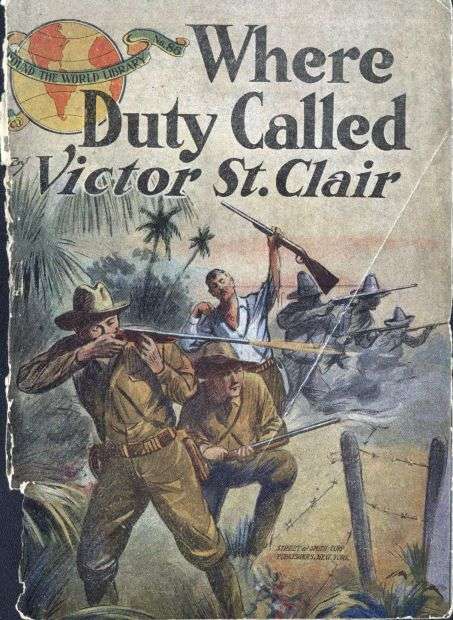
CHAPTER XXI.
"THE MOUNTAIN LION."
The sight which met Ronie's gaze was one of wildness bordering upon grandness. Its wildness consisted of a body of armed troops drawn up in front of the rude building, a mob of untamable savages, as the spectator from a civilized country must have judged them. They were half clad, poorly fed, as shown by their emaciated visages, and armed mainly with the rude implements that the uncivilized use. This wild aspect of the scene was given the touch of a certain grandeur by the sublime attention this motley throng paid to him who stood upon a slightly-raised dais addressing them at this moment.
This speaker was a man of stalwart figure, with a countenance naturally dark, bronzed by long exposure to the tropic sun, and flashing eye that could look without flinching upon the midday sun or upon the wildest rabble that ever gathered under the shadows of the land of revolutions. His speech was uttered in a manner and tongue in keeping with the man and the scene. Ronie could not understand all of the fierce language which seemed to have partaken of the mountain boldness and flowed from the lips of the orator like a torrent springing from its fountain head amid the rugged fastness of its native gorge, but he understood enough to catch the import of this stimulating harangue. He knew the man was El Capitan, and he was evidently resuming a speech which, for some reason, had been temporarily broken.
"Soldiers of freedom," he was saying, "the time for action has come. You have rallied bravely at my call, and now I am ready to lead you to battle and victory! Our path is clearly marked. To-night let us teach that braggart, Don Isadora, that he is not a little king; that he cannot longer defy El Capitan! From the smoking ruins of his estate we will sweep downward like a torrent from the mountain, and like a torrent we will gather volume as we sweep along. A trail of devastated plantations shall mark our course wherever the foolhardy defy us, and above the ruins of the smaller towns shall rise the captured columns of Valencia, La Guayra, Caracas—ay, Caracas! When the capital shall be ours, then will we make laws that lift the poor man into his just deserts, while the lawless rich shall feel the spur of oppression as his meeted judgment. Then shall the name of El Capitan stand beside that of Crespo, the mountain lion!"
As might have been expected, this bombastic speech was frequently interrupted with wild applause, especially when the orator compared himself to the late president of the republic. In one respect, at least, the harangue of El Capitan was apt. Crespo, like himself, was of humble birth and very large of stature. Whether he would equal the ex-president in other ways remained to be seen. Crespo was the idol of his brave followers, who were a dashing, picturesque soldiery, that the inhabitants of Venezuela looked upon very much as the Parisians must have looked with awe upon Napoleon's Mamelukes.
The story of this Venezuelan conqueror is a most interesting one. Following the rule of three or four presidents and dictators who succeeded the noted Blancos[1]—there were two of these, father and son—were three or four presidents and dictators whose main object seemed to be to rob the government of all the money they could, and then flee from the country. Such proceedings gave the right man an excuse and an opportunity to rebel. This man was General Crespo, who with seven hundred followers set out to conquer the country. You have read history, know how the ambitious Pizarro, in the stormy days of conquest following the discovery of America by Columbus, overthrew the empire of the Incas with a handful of followers—only thirteen at the start. Crespo did better than that, for with only seven men he made himself president of a country more than twice as large as Spain and Portugal together, while I am glad to be able to say there was less of bloodshed and far less of inhuman sacrifice of innocent lives than in the case of the conqueror of the Incas.
I cannot refrain from giving the following story as typical of the man: His half-wild followers needed arms, and there was no manufactory to replenish them. In this extremity, when almost any other leader must have faltered, Crespo gave the order for his men to strip their bodies naked to the belt, and cover them with a liberal coating of grease. In this shape they were to charge upon an encampment of the enemy numbering more than six to one. This was to be done under cover of darkness, and as they ran through the camp each man was to hold his left hand straight out from his body. If it came in contact with a man wearing a shirt he was to overpower him and seize his firearms. If the body was like his own, he was to know it was a friend, and to keep on. In this wild, impressive manner less than three hundred half-naked men, armed only with their short knives, routed and disarmed over three thousand troops, comprising the flower of the government's army.
It will be noticed that El Capitan's appeal was personal rather than patriotic. Like many another Venezuelan revolutionist, he was fighting for selfish purposes, but his barbaric followers did not stop to consider this. Some one, with a memory of other days, asked concerning the liberation of El Mocho, when El Capitan replied:
"El Mocho is not to be trusted," meaning, no doubt, in his mind that he did not propose to give such a dangerous rival opportunity to be in his way.
Ronie felt that he had learned enough to show him his path of duty. Every moment was precious if he would warn Don Isadora of his peril, and he had no desire to leave the well-meaning don to the hands of this mountain outlaw. So he at once began his ascent of the bluff, which he found extremely difficult. But he accomplished the feat in safety, to find Jack and the Venezuelans anxiously awaiting him. A few words sufficed to explain the situation to them, when they heartily agreed with him that it was best for them to hasten to the plantation of the don as quickly as possible.
"I judge from what I heard while I was leaving my perch that El Capitan is expecting another body of his followers to join him this side of Don Isadora's. This division comes from the way of San Carlos. If it is half as large as the force now under him he will lead a formidable army against the don."
"A mere rabble," said Riva. "Don Isadora has some trained soldiers under him."
By this time the four were riding silently away, being careful to move as cautiously as they could. Riva again led the way, but Ronie and Jack were close behind him, while the younger Venezuelan kept as near to them as he could. In this manner the return journey to the don's plantation was speedily made, and without being discovered by the enemy.
As may be expected, the wealthy planter was profuse in his thanks for the information they gave him, and he began to prepare for the enemy at once, with a confidence in his ability to defeat the other that was sublime. As much as Ronie would have liked to remain and see the outcome of the affair, he felt it was his duty to start immediately to find Colonel Marchand. Don Isadora seemed to understand that it was the proper course for the scouts to pursue, so he offered no objections.
As our little party rode out of the grounds, having left their prisoners under the don's care, they saw that he had mustered his entire forces, numbering fully a hundred men, all of whom were armed with Mausers, pistols and short knives.
"El Capitan will be the one surprised this time," remarked Ronie to his companions. "I really wish we could stay and see the fun."
Little did any one of the quartet dream of the amount of "fun" in warlike earnest that he was to take part in before they should get beyond the don's big estate.
[1] Bolivar the "Liberator" was followed by others who managed the affairs of Venezuela very satisfactorily, until in 1846 two political parties formed. These were styled the "Liberals" and the "Conservatives," and trouble increased swiftly. In 1859 Guzman Blanco became the head of the stronger party, holding his sway until 1864, when he was succeeded by a rival. In less than ten years, however, his son came to the front, and, more powerful than his father, he made himself president, with all the prerogatives of a dictator. This office he held until 1884, when Crespo became president. Still the hold of Blanco was not broken, and two years later he reassumed the reins of government, but in 1890 his successor was defeated, and he suffered a loss of his good name. In fact, a complete change of heart for the family which had been dominant in affairs for over thirty years followed. His name was stripped from one of the States where it had been placed, and the public statues he had caused to be erected were torn down, and much of the really good work he had done was destroyed. But these radical denunciations could not remove the name of the pompous leader from the historic pages of Venezuela, and it is well to be so, for with all his shortcomings he did much for the rising republic, though his stalwart figure is the landmark of a stormy period.—AUTHOR.
CHAPTER XXII.
A FIGHT WITH THE GUERRILLAS.
Our scouts had gone about a mile, and Ronie was riding slightly in advance, when he became aware of the approach of a body of horsemen coming at a leisurely trot. In a moment he signaled for his companions to stop.
"We cannot avoid meeting them," he said, "and no doubt they are a part of El Capitan's army. We have started too late to escape them. Is there any path turning off from the road that we can turn into, Riva?"
"None, señor."
"Then we must turn aside here. Quick! push your horses back into the forest, making as little noise and disturbance as you can."
They were so successful in this work that before the approaching riders had come into sight they were all safely ambushed where they could peer out upon the passers-by without being seen, except by some scrutinizing eye. Ronie and Jack sat in their saddles, side by side, while Riva and his companion were only slightly removed. As the sound of the horsemen indicated their close proximity, our hero parted the bushes enough to enable him to obtain a good view of the road.
"If our horses will only keep quiet," he began, "there is a——"
Ronie's attention, in the midst of his speech, had become fastened upon the foremost of the approaching riders, so his companions never knew what he was about to say. Nor did he speak until the horsemen were within half a dozen yards of them. The body of men were riding two and two, and what had arrested his eyes was the sight of the nearest rider in the lead.
"It must be—it is Harrie!" he whispered.
"Ay, lad!" responded Jack, who had been watching as eagerly and closely as his companion.
"He is lashed upon the horse, and his hands tied behind him. What does it mean?"
Jack had no time to reply, but the situation was plain to both. The horsemen were a portion of El Capitan's followers, and were on their way to attack the don. Could they stand idle there and see Harrie taken to some fate they could not understand? Ronie's impetuous temperament would not permit it. He believed a sudden attack, a few shots, and the unsuspecting enemy could be routed, and their friend rescued. Jack must have been revolving the same daring scheme in his mind, for at this critical moment he nudged Ronie, whispering:
"Ready when you say the word, sergeant."
Our hero spoke hastily to Riva and his companion, who quickly comprehended what was wanted of them. Then the clear command of the young sergeant broke the stillness of the lonely scene:
"Ready, men, fire!"
In the twinkling of an eye the flashes of the Mausers lightened the night, and three of the leading riders reeled in their seats, while sudden commotion took place among the others.
"Forward—charge!" thundered Ronie, setting the example by dashing furiously from his covert. "Look sharp, Harrie; we are here to save you."
The animal bestridden by the young engineer began to snort and plunge excitedly, but Ronie was soon at its bit. His comrades were as swiftly charging upon the surprised insurgents, who, no doubt thinking they had been attacked by superior numbers, broke and retreated in wild disorder.
"Give them a parting shot, lads!" cried Jack, who, in his adventurous career had led more than one regiment upon an enemy.
The Mausers spoke right merrily, the reports mingling with the yells of the discomfited rebels, who fled down the road as fast as they could make their steeds go.
In the midst of this rout and confusion Ronie freed Harrie, but he had barely accomplished this before the thunder of horses' hoofs down the road suddenly increased in volume, and loud shouts reached their ears. The clatter of retreating horses abruptly stopped, and it was apparent to the scouts that the insurgents had come to a stand.
"El Capitan is on the road," declared Ronie. "He is rallying his men. Come on, boys! We can do no better than to return to the don's. Ha! who comes here? Halt! Who comes?"
"A friend from Don Isadora," was the prompt reply. "Word came to him of a party of rebels taking an American prisoner to El Capitan, and he sent me to warn you."
"In good time, señor. We have saved our friend. Hark! Yonder riders are El Capitan's hornets. Back to the estate, and we will go with you."
There being no need of silence now, the six horsemen rode back to the estate at a furious gait, the messenger going ahead when they had nearly reached the avenue leading to the building, so as to inform the don of the approach of friends. He hailed them with hearty gladness, but quickly prepared to meet the expected onset of the enemy.
Ronie and his companions having decided to lend their assistance to the defenders of the estate, Harrie asked for a rifle, that he might join his friends. This was soon forthcoming, and while they waited for the attack of the mountain rabble he found opportunity to say to Ronie:
"I don't know how glad I am to see you, for I have supposed you were drowned on the night we started to escape from the Libertador. How is it I find you here?"
"It is a long story, Harrie. I will tell it at the first opportunity. Jack and I have seen our share of excitement, and it looks as if it wasn't over yet. Did you escape from the prison at San Carlos?"
"Not through my own efforts. An order came from General Castro for me to be set at liberty. This was done, and a small escort started with me to find the regiment of Colonel Marchand. Only think he is somewhere in this vicinity. We were surprised by a body of rebels, who put my guard to rout and made me a prisoner. I do not know what would have become of me if you had not rescued me as you did. Hark! the foes are coming!"
It was a part of the don's plan to hold back his men, and not to fire upon the enemy until they should come into close quarters, so no response was given to the shouts and shots of the oncoming horde, whose leader expected to carry everything before him by storm. A tempest of lead followed his command to attack, but not a man was injured on the estate. Thinking that an easy victory lay before him, El Capitan then ordered his men to the double-quick.
Don Isadora proved that he had had some military experience, as his men were not only all well armed, but they stood coolly at bay waiting for his word to open the fight on their part. Even Ronie began to get impatient before his stentorian voice cried:
"Now, men, mow them down like grass—fire!"
The entire side of the estate toward the road was illuminated by a sheet of flame as his followers obeyed the sharp command, and it was like mowing a swath through grass to see how the motley mob led by the "mountain lion" went down. The roar of rifles was followed by wild shouts and shrieks of pain, while those who had escaped the deadly fire beat a hasty retreat.
"Follow them up, men!" cried the don, but he had barely uttered the order before a bullet from a stray shot hit him, and staggering back, he fell into the arms of Jack Greenland, while he murmured:
"I am a dead man!"
It was a sad occurrence. The moment the Venezuelans found their leader had fallen, confusion and disorder reigned.
"Is he fatally hurt?" asked Ronie, anxiously, as Jack bent over him.
"I cannot tell yet, sergeant. The wound is bleeding profusely. Some of you help me get him where I can examine him more closely. Is there a surgeon about the place?"
No one seemed to know. But half a dozen lusty fellows lifted the wounded don and bore him into the house, while others stared after them in complete dismay.
"El Capitan is rallying," said Ronie. "It's too bad for us to be in this condition. He will sweep the place, now the don has fallen."
"Why not take the lead, Ronie?" asked Harrie. "Some one must, or we are all lost."
"I am not sure they would follow me. Here comes Señor Riva."
"Sergeant Rand, Don Isadora begs me to tell you that he is better, but is not able to lead his men. He beseeches of you to do this."
There was no opportunity for hesitation. El Capitan was already advancing for his second attack.
"Help me rally them, Riva, and I will do it," replied Ronie.
Swiftly the word was carried along the ranks, when new life was enthused into the men, who were really brave fellows. The young sergeant decided that prompt action would be the most successful, and to meet El Capitan halfway would show him that the forces on the plantation were alive to the situation. So the word for an advance was passed along the line. It met with a hearty response, and as Ronie sprang forward with his rousing command he found himself supported by a determined force.
"Open fire—charge!"
The volley of shots was succeeded by loud cheers from the Venezuelans, who bounded forward under the lead of their gallant champion.
"Forward!" cried Sergeant Rand.
Harrie was close behind him, and so was Riva Baez, all three having dismounted from their horses as soon as returning to the estate. A random volley from the rebels answered their first fire, and at the second, in spite of all that the mountain chief could do, his followers fled in wild disorder, disappearing from the scene with a rapidity that was surprising.
That night, at the very outset of his campaign, El Capitan received his first defeat.
CHAPTER XXIII.
THE NEWS AT LA GUAYRA.
Great rejoicing reigned at the plantation of Don Isadora following the complete rout of the enemy, and this joy was increased by the fact that the don had not received a fatal wound. In fact, it was believed with careful nursing he would soon be about again. As he deserved, Ronie was the hero of the occasion, while his friends shared with him the praise showered upon them by one and all.
As soon as the news of the victory had been carried to the master of the estate he sent for our hero, and was lavish in his commendation, declaring that he had been instrumental in saving them all from the brutal clutches of El Capitan. But, as pleasant as all this hearty applauding was, Ronie was glad to break away from his admirers in order to be alone with Harrie and Jack. He and the former had much to say, all of which was listened to with sincere interest by the latter. Harrie explained how he and Francisco had drifted about in their boat, looking in vain for their companions until daylight, when they had sighted land, and gone ashore. Soon after, they were captured and thrown into prison, as Ronie knew. Then came the unexpected release, the journey to find Colonel Marchand, the capture by El Capitan's followers, and the rescue by his friends, which seemed the most miraculous part of his adventures. Ronie, in turn, told what had befallen Jack and himself, saying in conclusion:
"There is only one thing more that troubles me. If I knew mother was safe I could bear this troublesome waiting without murmuring. But I am afraid some fearful fate has overtaken her. I shall not rest until I know the truth."
"You know I am with you, Ronie," said Harrie.
"Ay, lad; you can count on old Jack Greenland to stand by you both, through thick and thin."
"God bless you, Jack!" exclaimed Ronie, clasping one hand, while Harrie seized the other, echoing the words of his friend:
"God bless you, Jack; a nobler soul never lived."
When the three had hastily reviewed the troubles they had passed through they decided unanimously to return to Colonel Marchand with such haste as was consistent with safety. They had important intelligence to bear, beside the fact that El Capitan was upon his track. Under the changed circumstances, they decided to take the captives with them, and of course Riva and his friend would keep along. While the don was very loath to see them depart, he knew it was their duty to go, and so he offered to send an escort of fifty men to conduct them on their way as far as might be deemed necessary. At first thought, Ronie felt like declining this, but he finally asked for an escort of ten men, who went with them until noon of the second day, when they turned back and the scouts kept on, reaching the encampment of the Venezuelan regiment that night in safety.
I need not describe the reception accorded our heroes by the impetuous colonel, any more than I need dwell upon the scenes that followed. The campaign had now opened in deadly earnest, and weeks of great activity and considerable fighting and skirmishing ensued. El Capitan rallying after a few days from his discomfiture at Isadora sought in every way to disconcert and capture the doughty Venezuelan regiment. In his efforts he was encouraged on every hand by the reports of the success of the insurgents in almost every section. First intelligence came of the capture of a town on the island of Margarita by the audacious cruiser Bolivar, erstwhile the Libertador, and earlier the Ban Righ. Close upon this, Castro's troops under Castillo were defeated near San Antonio. In May, reports of insurrections came in from every quarter. Castro suppressed two newspapers which had become pronounced against him, and in his lack of sufficient funds to carry on the war, levied a million bolivars from the widow of Guzman Blanco, the former president. Then the revolution broke out in the State of Bolivar, and after five days' fighting the president of the State was driven out of the capital. In June General Matos, encouraged by the success of his followers, announced a provincial government, with himself as president.
This bit of news reached Colonel Marchand at the close of a warm day's fight with his old-time enemy, El Capitan. As usual, it had been a draw game, and the colonel was sitting in his hammock feeling in anything but an amiable mood.
"By the soul of Bolivar!" he exclaimed, slapping his knee by way of emphasis, "he is like a ground mole, that runs for its hole the moment an enemy is in sight. I wish we might meet a foe worthy of our steel. Orderly, send for Sergeant Rand at once."
Ronie was with his friends, discussing the outcome of the recent meeting with the enemy, and deliberating upon their own fortunes since they had become comrades under Castro, when this order was given him.
"I wonder what this means?" he exclaimed. "Say to Colonel Marchand I will report at once."
Upon reaching the officer, the young sergeant found that he was anxious to send a message to President Castro, and at the same time to reconnoiter the country between them and the capital.
"Castro must take the field himself," declared our hero, in the course of the conversation. "If this growth of the insurgents is allowed to continue much longer his cause will become hopeless."
"By the soul of Bolivar! you are right, Sergeant Rand, and it is just what I want you to say to Castro himself. You can do it and not offend him, while I could not. You will go to him at once, taking as many men as you choose. I have only to instruct you to start as soon as may be."
"It shall be as you say, colonel. I desire to have only three companions, Señor Riva Baez and my countrymen, Harrie Mannering and Jack Greenland."
"As you say, sergeant. Here are the dispatches I wish you to hand to President Castro personally."
Handing this package to our hero, the colonel offered no further delay. With feelings akin to gladness, Ronie returned to his expectant companions.
"I hail it as good news," he said. "We are to meet the 'Little Captain,' President Castro, with what haste we can. I say we, for I have the honor of being selected by Colonel Marchand to choose such companions as I wish and hasten to the capital. You know whom I select."
Ronie was really pleased with this commission, as it would enable him to enter a wider range of inquiry concerning his mother than he had been situated to do so far. Thoughts of her were last in his mind as he lay down to rest after a day's campaigning and the first to arouse him in the morning.
"Poor mother! how I pity you, and wish that I knew where you are!"
Within an hour the little party was ready to start, deciding to go by the way of La Guayra, which they reached without adventure, This old-fashioned Spanish town is the chief seaport of Venezuela, as well as the entrance way to the capital, situated about five miles inland behind the series of mountain peaks whose chain runs down to the very edge of the water. Our young engineers did not fail to notice, as they looked out over the harbor, the close affinity to the same cerulean hue that touched both sea and sky, so it was difficult to tell where they met on the horizon, and blended like a curtain of the same soft texture. Under the reflections the vessels appeared to rest flat on the mirror-like surface, in the words of the poet:
"Like a painted ship upon a painted sea."
The most conspicuous spot about La Guayra is the little fortress made famous by Charles Kingsley, in his "Westward Ho," as the prison house of his heroine, the Rose of Devon. This was the residence of the Spanish governors in the days when Venezuela was a dependency of Spain. Past this ancient point of defense against attacks from the sea and the winds lead those three ways of travel to the capital, aptly illustrating the changes of centuries; first, but of least importance now, the mule path worn no doubt by the natives in their passages back and forth; second, the wagon track, cut, it may be, when the continent was young; and finally, that iron-banded course of modern construction, the railroad. Caracas is embowered among the mountains three thousand feet above the streets of La Guayra.
Their arrival was soon after the bombardment of Macuto by Venezuelan ships on account of an outbreak there. As this place was near to La Guayra, great excitement was prevailing in the latter place. In fact, the inhabitants everywhere were in an uproar. News came that General Riera, who, it will be remembered, was a passenger on the Libertador when our heroes were on that vessel, had captured La Vela de Coro, while the insurgents had also captured Barquisemoto, and Riera had sacked Coro, the capital of the State of Falcon.
Our party did not continue their journey to the capital, on account of the fact that Castro was toward Barcelona, where the revolution had become centered. With this bit of news came a rumor which, if it bore but a light bearing on the international contention focused on Venezuela, awakened an anxious interest on the part of Ronie Rand and his friends. Riva Baez first learned of it from a native who had come down from the mountainous districts. This man said an American woman was held by the insurgents as a hostage of war. He could not give the name of the woman, but believed she had not been long in the country.
"It is mother!" exclaimed Ronie, as Riva related the story to him. "I must see this man at once."
"I am sorry, señor, but he disappeared before I started to find you. Knowing how you would feel about it, and not being able to find you at once, I went to speak to him again, fearing he would slip away. He was gone, and no one could tell me where he had left for. I believe he is a spy."
"Do you not know of some one who saw him?"
"I will see what I can learn, Sergeant Rand."
"Thank you, Riva. Meanwhile, the rest of us will do a little looking around. Describe the fellow as minutely as possible."
This Riva did, with the graphic speech peculiar to him, and then the four went out to look for the missing man. In the midst of this unsuccessful search Ronie learned that Castro had returned to La Guayra.
CHAPTER XXIV.
INTERVIEW WITH GENERAL CASTRO.
A soldier's first duty is always to obey his superior in command. Upon hearing of General Castro's return to La Guayra, Ronie immediately abandoned his search, leaving his companions to carry it on, while he sought the president. He found him without difficulty, for he was already besieged with callers. But our hero had only to send in his passport from Colonel Marchand to receive an urgent request to come at once.
He was a little disappointed in the personal appearance of the man who had become so prominent in the affairs, and whose name he had heard spoken more often than any dozen others since he had come to Venezuela. He was below medium height, of rather slight build, and moved with a limp in one limb, caused by a wound he had received in battle. His eye was the feature which bespoke most the man, and as Ronie stood before him he seemed to read him at a glance.
"Sergeant Rand," he greeted, in a hearty manner, which quickly won the American boy's friendship, "I welcome you gladly to La Guayra. Colonel Marchand sends his message by you?"
"Here are your dispatches, General Castro. I trust they will prove valuable to you."
"Be seated, sergeant, while I read them."
Ten minutes of silence followed, during which Ronie had ample time to study the man before him, who seemed absorbed in the written messages just placed in his hands. Then he laid the last one down, and said:
"If I am not mistaken, you are the young American the colonel spoke of in such laudable terms in his last. It seems by what he says now that you have not let your reputation suffer by more recent conduct. It was your friend I sent to have liberated from the penitentiary at San Carlos, was it not?"
"It was, general."
"Is he in La Guayra?"
"He is."
"I wish he had come with you, for I am heartily glad to meet two such allies in a time when the whole world seems against me. Forgive me for saying that, as I would not have you think I distrust your own republic. But tell me of what you have seen in the West, Sergeant Rand. I am glad to get such information as I believe you can give me of the hotbed of rebellion in my poor country. Take your time, and do not be afraid to speak of yourself."
Then Ronie described such portions of the events that had come under his observation as he thought the other would be pleased to hear, referring to himself very modestly, while General Castro listened with great interest, now and then asking some question or expressing admiration at the conduct of Colonel Marchand and his regiment. He was especially pleased with the rout given El Capitan at the estate of Don Isadora, and he made Ronie describe the affair so minutely that he was forced to speak of the part he had taken.
"I have heard nothing so pleasing," said the president. "You shall be rewarded for your gallant conduct. I am again saying that I am sorry this friend, or these American friends of yours, did not accompany you here. I will send for them."
"I am afraid you will not find them readily, as they are in search of a man in La Guayra that we want to find very much." Then he hastened to add: "But this is a personal matter, General Castro, and you will pardon me for introducing it to you. I did not intend to."
"What concerns my comrades, concerns me," cried Castro, with possibly more vehemence than he had intended. "Tell me all about it, Sergeant Rand."
Thus urged, Ronie explained what he knew in regard to his mother, the president listening attentively to every word. When he had finished, the latter said:
"Sergeant, this is a grave matter. To say nothing of my feelings for you, I cannot afford to let this affair escape my notice. It might easily be construed to mean an offense against your government. Have you communicated with Minister Bowen?"
"No, General Castro."
"I should advise you to do so as early as may be. But in the meantime we will leave no stone unturned to find her."
"You are very kind, general. What would you suggest that we do first?"
"Find the man who had her photograph, and make him tell all he knows."
"I have regretted, general, that we did not return and do that."
"You were hardly prepared to do it, as I understand your condition."
"True, General Castro. We were glad to escape with our lives, and we have been kept escaping ever since."
"You have proved lively enough in the race. You spoke of that young De Caprian. What do you know of him?"
"I believe he is as true a patriot as you have in Venezuela," replied Ronie, boldly.
"I would not let anybody else say that," declared Castro, frankly. "You think I have misjudged the man, Sergeant Rand?"
"Perhaps I ought not to say it, but he appeared honest to us."
"You would like to see him set free?"
"Not if he is an enemy to your government, General Castro."
"I understand. When you go to San Carlos to get your man I will send by you the papers which shall give him his freedom. I will try him a while, and if he proves faithful his mother shall be given her liberty. I have given orders to see that she is given all the privileges possible under the circumstances. I have been very much interested in your intelligence, Sergeant Rand, and I trust I shall meet your friends when you come again."
Taking this as a hint that the interview was ended, Ronie saluted in military style, and was in the act of withdrawing when Castro said:
"Sergeant, I wish to ask you a question, and trust you will answer it in the same good faith in which it is asked. What do you believe would be the most effective thing for me to do toward quelling this rebellion in the vicinity from which you have come?"
The answer to be made came as quick as a flash into Ronie's mind, and without stopping to consider how it might sound expressed in so many words, he said:
"Take the field yourself, General Castro!"
If this reply suited him or not, the president did not show it by the look upon his features, as he said, simply:
"Good-day, Sergeant Rand."
While in doubt as to the effect his words would have upon the energetic president of the republic, Ronie was pleased in a large measure with his interview. He regretted that Harrie was not with him, and he resolved that the next time he would not go alone. Upon second thought, he could not see that there would be any occasion for him to call again. Then he drove these thoughts from his mind, and thinking of his mother and what her fate might be, he began to look anxiously for his companions.
About half an hour later he found his friends, but they had to report a failure in regard to finding the unknown man they had hoped to find. Riva Baez, as well as Harrie and Jack, listened with interest to Ronie's account of his meeting with General Castro.
"I have faith to believe he will help us find your mother," said Harrie, "and with his assistance we cannot fail."
"Unless we are too late," replied Ronie. "I cannot bear this inactivity."
"I have always found it good policy to 'make haste slowly,'" declared Jack, quoting an old saw. "Meanwhile let us see how Castro takes to your advice, sergeant."
"To think that I should have dared to speak in that way," said Ronie, who feared he had overstepped his position so far as to incur the displeasure of his superior. But he was speedily disarmed of this fear, for the following day General Castro came out with a proclamation in which he defined his purpose of taking the field personally, and of leading the campaign in the West. An hour later a summons came for our three Americans to visit the commander, and they met with a welcome that proved the president had only the kindliest feelings toward them. They were urged to accompany his army, and were only barred from being offered a commission from the fact that General Castro did not wish to curtail any of the liberties they might have if they were not regularly attached to his forces.
"You can go as far as Valencia with me, and from thence I will send you an escort to San Carlos, so you may find your man if you can, and also see that young De Caprian is given his liberty. To prove my good faith with him, I will hold a commission for him, if he wishes to accept it."
Thanking the general for the kindly interest in them, our three withdrew, certain that at last something definite was being done. The next day the entire force moved toward Valencia, and they accompanied the Venezuelans, Riva also going along.
The week that followed was one of great activity; but very little was accomplished that seemed to forward matters with the impatient Ronie and his friends. Leaving Castro's army at Valencia, they reached San Carlos to find that the bird they were after had flown. As near as they could learn, he had disappeared the morning our heroes had been driven away, and that he had not been seen since he had taken them across the bay in the boat. It was currently believed that he had either been shot or drowned. In this way was lost what might have proved an important clew in their search for Ronie's mother.
Their disappointment was brightened somewhat by the joy with which Francisco hailed his liberty. He embraced his American friends, and showered upon them praises for their action in his behalf. When he was told about his mother, he grew less demonstrative, but learning that she was unharmed, with a promise of good protection, he recovered exuberance of spirits.
"I shall accept any commission General Castro will bestow upon me," he said, "and I will show him my fealty to him and the true government of my country. I am impatient to see him."
Knowing nothing could be gained by remaining longer at San Carlos, our heroes returned to the army at once. Having learned that he had removed to Ocumare, they headed thither, learning all along the way that the insurgents were everywhere successful, until it seemed as if the government was doomed. These accounts were rendered more hopeless to the cause by the fact that before they could reach him, Castro had begun his retreat toward Caracas.
In the face of this, he issued his decree of amnesty to all insurgents laying down arms within forty days.
"Unless he makes some more decided stand and wins a decided victory to offset all this noise on the other side, Castro will have no government for them to lay down their arms to," said Jack, grimly. "Of course it isn't my dish that's cooking, but I feel just like saying so much."
"General Castro will act decisively when the time comes, according to his idea," said Ronie.
In the midst of this uncertainty word reached them from La Guayra that the cables were to be cut, and that Minister Bowen had sent to Washington for warships.
Castro's next movement was to take charge of his troops at Guaicaipuro, and to establish his government there. Then followed the week's battle with the insurgents led by Mendoza at La Gloria, which was to prove the turning point in the war. Colonel Marchand's regiment of volunteers was there, and in the thickest of the fight our heroes had ample opportunity to prove the metal of which American soldiers are made. It was a bitter fight, the more trying as it was made with bush-fighters—scattered bodies of men who fought after the style of the North American Indians, from behind trees, or whatever cover was at hand. Fortunately, our friends escaped without a scratch, though Colonel Marchand received an ugly wound that was likely to drive him from the field for a time.
His was not the only regiment that covered itself with glory, for there was another, led by a boyish captain, who seemed everywhere in the thickest of the fight. This little band gained the high-water mark of the battle, and it was that more than any other which turned the tide of the struggle and made of La Victoria a victory indeed. The name of that gallant leader, who received special mention in the list of honor, was Francisco de Caprian. General Castro had no longer any reason to doubt his loyalty to Venezuela, and the president greeted him with the promise that his conduct had chased away the shadows upon his family name.
The result of this victory for the government at La Victoria was such that Matos, the head of the insurgents, gave up active command, while Castro prepared for a triumphal return to Caracas.