
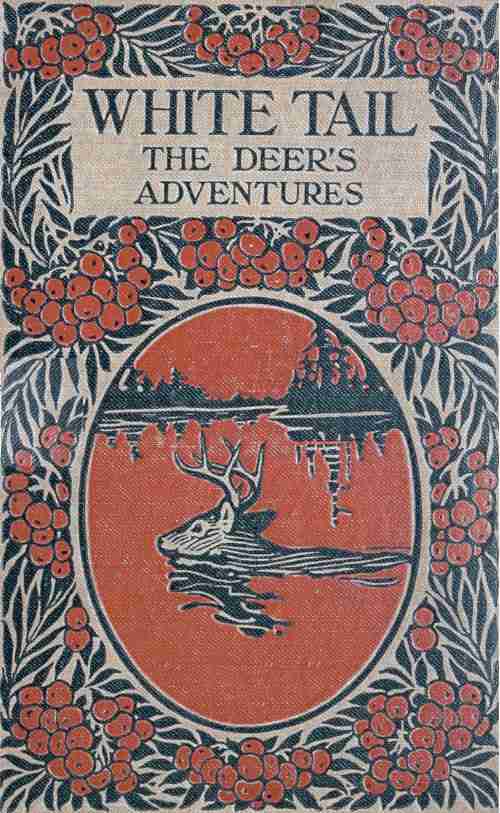
STORY XVI
White Tail Made Leader of the Herd
By defeating Young Black Buck in combat, White Tail was, according to the law of the herd, chosen leader until another should grow up and displace him. The decision on the battlefield could not be changed or altered. Even Black Buck and his son recognized this, and without protest they permitted Father Buck to complete the ceremony.
“The law of the herd has been vindicated,” he said, after White Tail had trotted around the vast circle, and challenged in vain any other antagonist. “White Tail shall henceforth be your leader. To him obedience shall be given, and any who refuses shall be driven into exile. If there is any opposition it must be stated now.”
Black Buck’s wicked eyes flashed angrily. He was doubly disappointed that his son had failed, for his own defeat years before came back to torment him. Young Black Buck was too exhausted to speak, and if there was any protest it had to come from his father.
“Young Black Buck have you anything to say?” continued Father Buck, turning to the defeated.
Young Black Buck shook his head wearily. There was no fight left in him.
“You promise to obey the new leader?”
Again the weary shaking of the head, followed by a sign as the vanquished dropped down and closed his eyes.
“And you, Black Buck of Dismal Swamp?”
“I will follow and obey the leader, as I followed and obeyed you, Father Buck,” was the answer. “There is nothing else for me to do. I submit to the law.”
Father Buck turned to White Tail, whose distended nostrils and flashing eyes indicated that he was still ready to fight for his honor. The eyes of father and son met an instant in an exchange of pride and happiness.
“It is well then,” continued the ex-leader. “White Tail shall henceforth be the head of the herd. I go back to my place among the older bucks to follow.”
A certain wistfulness crept into his voice and eyes. It was hard to yield the proud position, to hand over the burdens and glory of leader to another. None could do it without a certain amount of regret—not even though the successor was his own son.
“I have led you many, many seasons,” continued Father Buck, “and always with success. Puma and Timber have never raided the herd in my time. We have foiled and deceived them, finding new pasture fields where they could not come. We have been safe from Loup the Lynx and Sneaky the Gray Wolf. I have fought them both, holding them at bay with my mighty horns, and once I remember it was a hard fought, desperate battle with Sneaky. But before he could call his pack the herd had escaped, and I fled from him on the wind.”
He paused a moment, swinging his head proudly from side to side. “And our pasture fields have always been rich and sufficient,” he continued. “I have led you where the food was plentiful even in the depths of the winter. In snow and rain we have fared well. Our fawns and does have been safe. Not one has been lost through bad leadership. We have multiplied and grown strong. Today we stand first among the great herds of the timberland. May we continue to grow and thrive under our new leader.”
With his farewell address finished, Father Buck stepped from under the Council Tree, and White Tail, knowing that he was expected to assume control, trotted up to take his place. Some noticed that, as he passed Father Buck, he was taller and stronger in limb than the ex-leader. The tips of his antlers towered a full foot higher than those of Father Buck. Even his enemies noticed this, and were satisfied that he would prove a good leader.
“Father Buck has spoken well,” White Tail began, as he glanced proudly around at the herd. “His leadership has been successful, and I shall make it more so. If I fail you, may I fall in the chase and break my neck! If I show weakness or cowardice, may Puma or Timber Wolf pull me down and eat out my heart! If I show lack of wisdom and justice, may Loup the Lynx or Sneaky trip me, and devour me. I shall be your leader, and next to me—”
He stopped and glanced from one to another. He had the right to choose the one next to him in power, one who would lead the herd if he were sick or away.
“—and the next to me in authority,” he added, “comes Young Black Buck. I have no ill will for him. The past must be forgotten. All I ask from him is loyalty and support. The safety of the herd must always be his first thought. He must give his life, if necessary, to protect the does and fawns in my absence. Do you promise this, Young Black Buck?”
Surprised by this honor thrust so unexpectedly upon him, Young Black Buck opened his weary eyes, and jumped to his feet. He trotted into the circle, and once more held his head high.
“White Tail,” he began in a trembling voice, “I don’t deserve this, but if you ask it I shall accept. I pledge loyalty and friendship. I shall make it the law of my life to support your leadership and to do all I can for the herd. Is that enough?”
“It is all we can ask, Young Black Buck,” answered White Tail. “Now, under the Council Tree, we pledge ourselves to the service of the herd and to each other’s support. Let it be understood that when I am away, Young Black Buck shall be in command, and it is the duty of every one to follow and obey him. It is so agreed! The Council is now finished.”
The meeting immediately broke up, and the deer and bucks mingled together to congratulate the new leaders, for the council had ended happily, and there was no bitter feeling carried away. The older ones related to the young ones stories of other similar meetings under the Council Tree, and the latter listened eagerly to these tales.
Father Buck and Mother Deer withdrew silently, leaving White Tail in command, with the whole herd crowding around him to flatter and congratulate. There was a new spring in the ex-leader’s steps as he trotted away, and Mother Deer, walking along by his side, noticed it.
“You do not act like a fallen leader,” she said, smiling. “I haven’t seen you walk so lightly and happily for a long time.”
“A fallen leader is not always to be pitied, my dear,” Father Buck replied. “The greatest thing he can do is to lead his people successfully, and the next greatest thing is to rear a son to take his place. Have I not done both?”
Mother Deer nodded and smiled. Father Buck turned to her and affectionately licked her neck. “And the greatest thing you could do,” he added, “is to train your son so that he is worthy to lead. I’m proud of White Tail, and still prouder of you, Mother Deer. He is your son!”
A little later White Tail found them together in the woods, talking and smiling, and so happy in the possession of each other’s love that neither seemed to regret the loss of authority. And White Tail, watching them, said to himself:
“The honor of being leader of the herd is not all mine. I owe much of it to them. They have trained me and taught me, and suffered for me, that I might succeed. I shall never forget that.”
And to the end of his days, which were many, White Tail never forgot that to have good parents was greater even than to be leader of the herd.
The next story in the Twilight Series is entitled: Washer the Raccoon.
There was once an old woman who had so many rabbits that she hardly knew what to do. They ate her out of house and home, and kept the cupboard so bare she often had to go to bed hungry. But none of the rabbits suffered this way. They all had their supper, and their breakfast, too, even if there wasn’t a crust left in the old woman’s cupboard.
There were big rabbits and little rabbits; lean ones and fat ones; comical little youngsters who played pranks upon their elders, and staid, serious old ones who never laughed or smiled the livelong day; boy rabbits and girl rabbits, mother rabbits and father rabbits, and goodness knows how many aunts, uncles, nephews, nieces, cousins, second cousins and distant relatives-in-law! They all lived under one big roof in the
| THE JOHN C. WINSTON COMPANY, Publishers | ||
| 517 S. Wabash Ave. | Winston Building | 129 Spadina Ave. |
| CHICAGO, ILL. | PHILADELPHIA, PA. | TORONTO, ONT. |
In the North Woods where Buster was born, a wide river tinkles merrily over stones that are so white you’d mistake them for snowballs, if you were not careful, and begin pelting each other with them. The birches hanging over the water look like white sticks of peppermint candy, except in the spring of the year when they blossom out in green leaves, and then they make you think of fairyland where everything is painted the colors of the rainbow.
The rocks that slope up from the bank of the river are dented and broken as if some giant in the past had smashed them with his hammer, cracking some and punching deep holes in others. It was in one of these holes, or caves, that Buster was born.
He didn’t mind the hard rocky floor of his bed a bit, nor did he mind the darkness, nor the cold winds that swept through the open doorway. He was so well protected by his
| THE JOHN C. WINSTON COMPANY, Publishers | ||
| 517 S. Wabash Ave. | Winston Building | 129 Spadina Ave. |
| CHICAGO, ILL. | PHILADELPHIA, PA. | TORONTO, ONT. |
TRANSCRIBER’S NOTES
- Changed “more Black Buck” to “more Young Black Buck” on p. 126.
- Silently corrected typographical errors.
- Retained anachronistic and non-standard spellings as printed.