
The Project Gutenberg eBook of Why is the Negro Lynched?
Title: Why is the Negro Lynched?
Author: Frederick Douglass
Release date: March 24, 2019 [eBook #59116]
Language: English
Credits: Produced by hekula03, David E. Brown, and the Online
Distributed Proofreading Team at http://www.pgdp.net (This
file was produced from images generously made available
by The Internet Archive)
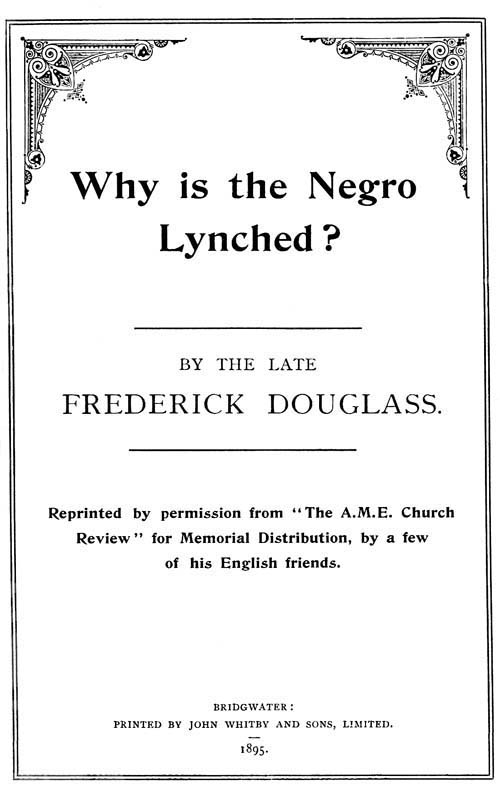
Why is the Negro
Lynched?
BY THE LATE
FREDERICK DOUGLASS.
Reprinted by permission from “The A.M.E. Church
Review” for Memorial Distribution, by a few
of his English friends.
BRIDGWATER:
PRINTED BY JOHN WHITBY AND SONS, LIMITED.
1895.
We have felt that the most fitting tribute that we, of the Anti-Caste movement, can pay to the memory of this noble and faithful life is to issue broadcast—as far as the means entrusted to us will allow—his last great appeal for justice (uttered through the pages of “The A.M.E. Church Review” only a few months before his death). A slanderous charge against Negro morality has gone forth throughout the world and has been widely credited. The white American has had his say both North and South. On behalf of the accused, Frederick Douglass claims, in the name of justice, to be heard.
Copies can be obtained free from the Editor of “Anti-Caste,” Street, Somerset, England.