
The Project Gutenberg eBook of Wild Animals of the Rockies
Title: Wild Animals of the Rockies
Author: James P. Gilligan
Release date: July 10, 2019 [eBook #59885]
Language: English
Credits: Produced by Stephen Hutcheson and the Online Distributed
Proofreading Team at http://www.pgdp.net
wild animals of the ROCKIES
with a list of mammals found
in Rocky Mountain National Park
By James Gilligan
Additional copies of this booklet may be obtained by writing to the author at Boise Junior College, Boise, Idaho
CONTENTS
- Page
- Wildlife of the Last Hundred Years 7
- Wildlife Management 13
- Life Zones and Animal Distribution 18
- The Mammals of Rocky Mountain National Park 20
- The Hoofed Animals
- Elk 20
- Mule Deer 21
- Mountain Sheep 22
- The Flesh-eaters (Carnivores)
- Black Bear 25
- Mountain Lion 26
- Bobcat 26
- Coyote 31
- Red Fox 31
- Cross Fox 32
- Badger 32
- Striped Skunk 32
- Spotted Skunk 32
- Marten 32
- Mink 35
- Long-tailed Weasel 35
- Short-tailed Weasel 35
- The Plant-eaters (Rodents)
- Beaver 36
- Muskrat 36
- Porcupine 39
- Marmot 39
- Abert Squirrel 40
- Chickaree 40
- Richardson Ground Squirrel 40
- Golden-mantled Ground Squirrel 43
- Least Chipmunk 43
- Western Chipmunk 44
- Northern Pocket Gopher 44
- Bushy-tailed Pack Rat 44
- Deer Mouse 47
- Cliff Mouse 47
- Jumping Mouse 47
- The Voles 47
- The Hares, Rabbits, and Pikas
- Pika 48
- Cottontail Rabbit 51
- White-tailed Jack Rabbit 51
- Snowshoe Hare 51
- The Shrews (Insectivores) 52
- The Flying Mammals (Bats) 55
ILLUSTRATIONS
- Identification Marks of Similar Animals:
- Marten, Mink, Weasel, Pika, Cottontail, Jack Rabbit, and Snowshoe Hare 28
- Abert Squirrel, Chickaree, Chipmunk, Golden-mantled Ground Squirrel, Pack Rat, Richardson Ground Squirrel, and Pocket Gopher 29
- Photographs
- The Tundra from Trail Ridge Road, and Elk on Their Winter Feeding Grounds 11
- Deer Fawn and Mountain Sheep Rams 23
- Bobcat and Black Bear 27
- Red Fox and Coyote 33
- Marten 34
- Weasel and Badger 37
- Porcupine and Muskrat 38
- Marmot 41
- Chickaree and Golden-mantled Ground Squirrel 42
- Least Chipmunk 45
- Pika and Cottontail Rabbit 49
- Deer Mouse and Big Brown Bat 53
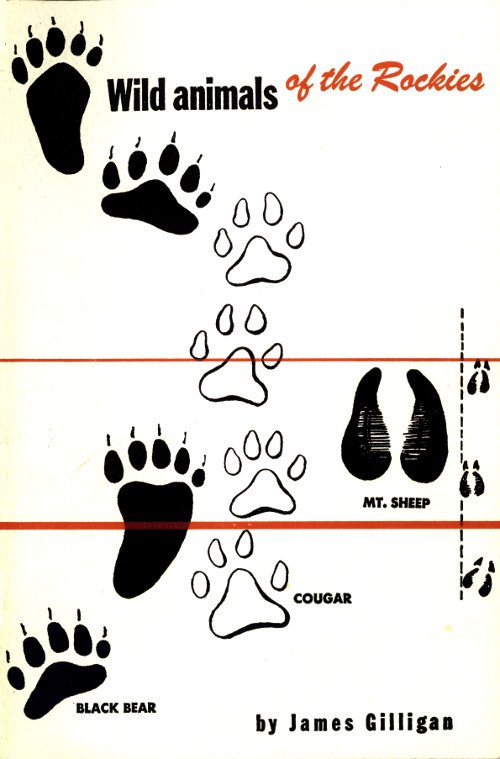
- Tracks cover
PREFACE
Among the frequent questions by visitors to the Rocky Mountain region are those pertaining to the wild animals. What animals are found here? How can they be identified? What are the wildlife problems of the high country? These are common queries which this booklet attempts to answer.
The author, a former ranger-naturalist in Rocky Mountain National Park, discovered through a visitor study in 1948 that a predominating interest of vacationers was in the wildlife of the area. Therefore, the writing has been limited to brief descriptions of the four-footed animals as they are seen in nature, with some explanation of their habits and habitat so they may be more readily located. The cover “tracks” and identification plates further this intent.
Many find it difficult to understand why they cannot see “more” animals in this rugged country. These animals are wild in the strictest sense. Many are nocturnal in habit, hiding during daylight, and others must be approached very cautiously. One satisfactory method of observing wildlife is to select a “spot” off the beaten trails and sit quietly for several hours, allowing animal life to move about in a normal manner.
A secondary purpose of this booklet is to provide a check list of all mammals known to use the National Park. Not all species listed have been collected in the area. It is hoped this will be a start toward providing an accurate, more substantial, and growing list of mammals for the Park. The scientific names of the 50 species given conform to all revisions to date. Those interested in a comprehensive discussion of individual mammals should consult such publications as Warren’s Mammals of Colorado, or Cahalane’s Mammals of North America.
An effort has been made to reduce and simplify the many common names attached to certain mammals. The most representative, and yet accurate name, has been selected for each animal for use throughout its entire area of distribution. For example, there is a large group of ground squirrels (Callospermophilus) inhabiting most western states which closely resemble one another in external features. The variety of common names given these squirrels (due to differences in locality or in minute external characters) is highly perplexing to the average person. Therefore the name golden-mantled ground squirrel, by which most of this group is known in far western states, is given for the group representative in north central Colorado, formerly known as the Say’s ground squirrel. Similar methods have been followed in limiting the names of other mammals. It is suggested that those interested in wildlife adopt one common name for each similar group of animals in an effort to standardize terminology for the multitude.
Dr. William H. Burt, Curator of Mammals, University of Michigan Museum of Zoology, has reviewed the manuscript and made many helpful suggestions. Miss Diana Wiltse, of the Ann Arbor Press, designed the cover and identification pages. I am also grateful for files of information and many photographic cuts furnished by the National Park Service. Unless otherwise indicated, photos were provided through the courtesy of Nature Magazine.
WILDLIFE OF THE LAST HUNDRED YEARS
Before the arrival of settlers in the mountain valleys of north-central Colorado in 1860, only the Ute and Arapaho Indians of the region and a few adventuresome white trappers knew the wildlife then so abundant throughout the area. They alone had observed the thousands of elk and small groups of mountain bison (buffalo) grazing the alpine meadows in the summer. Plentiful herds of mule deer roamed the valleys and forests and hundreds of flocks of wild mountain sheep fed on tufts of grass and flowers on rugged mountain slopes above timberline. Even an infrequent moose wandering down from his more northerly habitat could be seen in the lower wet meadows.
Along with these wonderful groups of hoofed animals lived the predatory, or carnivorous, animals. The powerful and vicious wolverines were common in the heavy forests of the high mountains, as were huge grizzly bears, occasional timber wolves, and cougars. The Canada lynx and mountain bobcat preyed on animals their size and smaller in the pine and spruce timber, while the red fox and rare gray fox were effective squirrel, mouse, and rabbit catchers. Pine martens chased small rodents through deeper forested regions, and they in turn were preyed on the larger carnivores. Numerous otter, mink, and weasel played in and along rushing mountain streams and clear lakes, feeding on a great variety of aquatic animals, fish, and small meadow rodents.
This scene might have remained relatively undisturbed had not white man arrived in the region. His rapid settlement and use of the area after 1870 had a startling and widespread effect on the wildlife populations in the next fifty years. Had he been satisfied to develop a small portion of the mountain country and take only sufficient food and clothing materials as they were needed from the wild species, the story might have been different. Instead, the unprecedented mountain scenery, climate, and animals attracted scores of vacationists, sport hunters, trappers, and market hunters, all anxious to profit from the newly-discovered virgin territory.
The great fur demand in St. Louis and Denver at this time attracted scores of trappers; they diligently pursued the valuable fur-bearers until, in 1915, the otters and wolverines were practically extinct in the Rocky Mountain regions of Colorado, and remain in that condition today. A few have been seen recently in the state, but they are exceedingly rare. Beaver were heavily trapped even before the settlers arrived. Mink, marten, and red fox also reached a very low ebb in population in the early 1900’s.
The “sportsmen” and market hunters were taking an even greater toll with their systematic slaughter of big game animals. The small herds of mountain bison, as well as any sign of transient moose, had disappeared by 1865. Deer and elk were so plentiful and easy to kill that wagon loads of their meat were hauled from the mountains to Denver markets where they were sold for as little as four cents a pound. Probably the easiest to condemn are the hunters who, in the late 1880’s, killed hundreds of elk, plus many deer and sheep, with little effort on their frequent organized hunts of “sport.” Often the carcasses were left to rot or just the head trophy and a few choice steaks were taken from the fallen animals. The area around Estes Park was particularly noted for this irresponsible recreation. Actually the greatest reduction in animal numbers was accentuated by the actions of a few individuals and not by the concentrated efforts of all those present in the area. By 1913 elk had entirely disappeared from the Estes Park region and almost from the state. Also, during this infamous period sheep had been reduced from an estimated 4,000 in 1870 to a little over 1,000 forty years later. The mule deer, having a wider natural range, and not banding together in the summer as elk frequently do, were able to survive the hunting pressures somewhat better; however, the former abundant herds were then considerably reduced. The increase of settlements and the introduction of domestic stock further lessened the numbers by decreasing available feeding grounds.
The establishment of man in the main mountain valleys leading to the foothills was particularly important to the past and even present welfare of the rugged mountain sheep, one of the finest of all wild animals in the mountains. Wild sheep in early days always migrated through these valleys in the winter to the foothills (5,000 to 6,000 feet), where they were able to obtain bone-building minerals available in the sedimentary rocks. These minerals were not available in the high mountain granitic rocks and present evidence indicates that they are highly essential for successful and sturdy lamb crops. Man’s dwellings created an effective barrier to these animals and no longer did they make their way to the foothills each winter. This situation probably weakened the breeding stock. In addition, there were other declining factors such as hunting and in particular, the grazing of domestic sheep on former wild sheep ranges. This not only reduced available forage for wild sheep, but also introduced certain diseases of domestic sheep into the flocks. Sheep scabies reached epidemic proportions in the late 1800’s, wiping out hundreds of wild bighorn.
A woefully miscast belief that gained common acceptance in the early 1900’s forecast the decline of another group of interesting animals—the carnivores. The conception, fostered mainly by stockmen of the mountains, was that any kind of animal known to kill domestic sheep or cattle was detrimental and therefore all those animals should be eliminated. Consequently, an organized effort was made by stockmen with the co-operation of the federal government to “trap out” and kill these species. The success of their efforts in Colorado is evidenced in the virtual extinction of such indigenous mammals as the grizzly bear, the timber wolf, and the Canada lynx, and in a great reduction in the numbers of black bears, cougars, and bobcats. The coyote, while not so abundant in the mountains earlier, was the only predatory animal able to hold his own against the trapping, and has actually thrived in settled areas. Wildlife investigators have assembled a mass of evidence indicating that it is not the ordinary habit of these carnivores to feed regularly on domestic stock. Rather, it is the occasional or rare individual animal which confines its predation to domestic sheep or cattle. This being the case, it is the more usual practice now to confine extermination to those marauding individuals, rather than the entire race of animals. Many of the carnivorous animals have been protected since 1926 by state and federal laws.
The hopefulness of mankind regarding wildlife is seen in the aesthetic consideration finally given to these decimated animal populations. The establishment of protection areas, especially Rocky Mountain National Park in 1915, where complete protection is given to all animals, and the passing of state and federal laws for protection of game and regulation of hunting, were last minute efforts to save this splendid portion of American heritage.
In an effort to re-establish the elk in Rocky Mountain National Park, about thirty of these large animals were transported from Wyoming, 1913 to 1914, and released near Estes Park. Under complete protection these elk increased to approximately 1500 animals in 1941. Other early elk “releases” in Colorado brought the total elk population to about 25,000 in the state during the same period. The protection of mule deer in the Park increased their numbers to over 1,700 in 1941 and in Colorado to nearly 400,000. From less than 1,000 in number, the mountain sheep in the area started to increase gradually in 1909 and were “coming back” satisfactorily in the Park area. For Colorado in 1922, Seton optimistically estimated a bighorn sheep population of 8,000. However, in 1922 there began a gradual decline of sheep culminating in a counted number of 300 within the National Park boundaries in 1939. The estimate for Colorado in 1947 was 2,700, most of which were on National Forest land.
Of the formerly trapped smaller mammals in the region, the beaver and marten have come back remarkably well, being abundant in many locations now. As an indication of beaver numbers and value in Colorado, some 40,000 beaver were estimated to be in the state in 1946; of these, 8,640 were trapped. A gross value of $272,323 was realized from beaver for this year. The black bear, cougar, bobcat, red fox, and mink, while not considered common, are still sufficiently abundant to be glimpsed occasionally in the region of the Park. They appear to be maintaining their numbers. Coyotes, originally plains animals, are abundant, probably numbering over 200 individuals. The presence of other mammals such as skunk, badger, porcupine, marmot, muskrat, squirrel, rabbit, and other small rodents indicates they are holding a steady or increasing population, although no definite counts have been made. There is good reason to believe that the coyote, richardson ground squirrel, and abert squirrel are examples of mammals relatively new and increasing in the mountains over 6,000 feet.
Lush tundra vegetation, above 11,000 feet, provides summer forage for deer, elk, and sheep. Photo by author from Trail Ridge Road.
Elk wintering in lower mountain valleys. Cow elk in background is feeding on aspen bark. Photo by N.P.S.
WILDLIFE MANAGEMENT
The problem of restoring and maintaining wildlife in our national parks is not as simple as one might suppose. The mere creation of a preserve or area within which all wild animals are protected has proved non-sufficient. While it is true that these areas offer excellent opportunity for preserving a wonderful variety of primitive wildlife stock in its native habitat for future generations, it is equally true that the very laws establishing the National Park Service in 1916 have almost defeated their original intentions. The law emphasizes that the fundamental purpose of the Park Service shall be to conserve the scenery of Park areas and the wildlife therein, and to provide for the enjoyment of the same in such a way as will leave them unimpaired for the enjoyment of future generations. Roads, camp and picnic grounds, trails, and dwelling conveniences represent efforts by the Service to provide for the enjoyment of Park scenery and wildlife. However, each new road, trail, and “tourist convenience” removes wildlife food and cover from the Park and causes timid animals to retreat from these zones of human use. Moreover, it destroys the natural area which is supposed to be left “unimpaired for the enjoyment of future generations.” Furthermore, many animals lack the flexibility to adapt themselves to new habitats, once the ancestral areas are invaded or destroyed by man. With increasing numbers of visitors using the Parks, how can this tremendous conflict between man and wildlife be reconciled without the impairment of primitive wildlife or the restriction of human occupancy? It probably cannot be, and each ideal will have to sacrifice a portion of the original grand intentions. In every decision of human or wildlife use, the Park Service makes a strenuous effort to establish a happy medium and still conform to the basic purpose of the national parks.
The U. S. Forest Service which administers most of the mountain lands surrounding the National Park, considers wildlife as a crop to be cultivated and harvested by hunting under Colorado state game laws. National forest wildlife judgments are dove-tailed with other important forest policies such as timber growing, watershed protection, and domestic stock grazing.
The invasion of man into these now semi-wild areas has created changed, even severe, conditions for the existing wildlife. The efforts by man to counterbalance certain unfavorable conditions for the animals and therefore to conserve and administer them satisfactorily, constitute what is now called wildlife management. Some of the problems that have existed and now exist in this area should be mentioned briefly to help us understand their scope and character.
ELK-RANGE PROBLEM
It is the normal habit of the elk in the region to spend the nine winter months in the lower mountain valleys and the summer months foraging on the fresh and succulent meadow grasses of the subalpine forest and alpine tundra country above 10,000 feet. Because of man-made restrictions in their winter territory, the elk congregate principally in Moraine Park, Beaver Meadows, and Horseshoe Park at this time. The past years of protection and adequate vegetation so increased their numbers that early in the 1940’s there were some signs of large herds “grazing off” most of their natural winter food available in these valleys. To alleviate this overgrazing in the Park, the state of Colorado authorized elk hunting on adjacent national forest lands in 1941 in order to remove excess elk migrating out of the Park. However, this effort did not remove sufficient numbers from the Park herds. Instead of allowing this potentially serious condition to continue and the eventuality of either watching the elk starve or else feeding the animals year after year, a harvest of surplus numbers by hunting was conducted in the winter of 1944-1945. In this way a possible catastrophe of starving and dying off of the entire elk herd was halted. The present reduced elk herd of about 800 animals is considered more nearly within the winter range carrying capacity. The fact that there are no longer grizzly bear and sufficient cougar to take a normal number of these animals as food was an aiding factor to the rapid increase of elk. Concentrated numbers of elk seeking refuge in the aspen groves during heavy winters in the lower valleys have heavily damaged the aspen trunks by stripping bark for food. It is believed that pregnant cow elk, in particular, are able to obtain vitamin A from the aspen bark for their welfare at that time. This stripping or opening of the aspen trunk allows penetration of fatal tree fungi, which may damage many aspen groves. Fortunately, the prolific aspen grows rapidly and soon should reappear satisfactorily.
DEER-RANGE PROBLEM
Essentially the same problem has existed for mule deer as for elk, with the exception that deer, which do not congregate so readily into herds, browse principally on low shrubs or bush plants rather than on grass. They do not strip bark from aspen trees. This habit permits both elk and deer to range fairly compatibly within the Park area. Nevertheless, the deer population was also considered to be excessively large for the amount of winter food available. Therefore, a smaller proportion of their number was also “removed” in the winter of 1944-1945, resulting in a present population of a little under 1,000 deer. For reasons unknown, however, the deer population has recently and gradually been declining within the Park. There is a possibility that the large number of coyotes now in the vicinity has assisted in keeping the deer herds from increasing.
BIGHORN SHEEP POPULATION DECLINE
This country provides an extensive summer sheep range in the high rolling tundra and rugged peaks above timberline, in addition to a large wintering area in the lower timber and valleys. Strong winds in the winter sweep snow from the scant tundra vegetation and often make it possible for sheep to feed at these high altitudes even during the winter months. Even with these adequate topographic conditions, wild sheep in the National Park since 1922 have shown a slow, steady decrease in numbers until 1941, when there were about 300 sheep present. Since this date there has been a leveling off of sheep numbers, no decided increases or decreases being evident. All the related factors probably contributing to the decline of bighorn population or their present stability at low level are not known. One substantial reason advanced has been the deficiency of mineral in sheep diet in the higher mountains, as indicated on previous pages, with a resultant weakening of sheep stock and a consequent susceptibility to parasitism and diseases found prevalent among sickened and dead sheep over a period of years. Another possibility for the decline may be present in the great increase of elk and subsequent competition for similar grass foods. The Park Service has placed salt and mineral blocks at known bighorn concentration places in an attempt to improve the physical condition of the sheep and thereby increase the sturdiness of their offspring. The results of this experiment are difficult to measure, but it is believed to have met with varying success.
BEAVER PROBLEM
The beaver, being a versatile and adaptable animal, is able to establish himself wherever there are small, permanent streams and sufficient aspen to provide him with logs and twigs for dams and houses and to provide food for his family. Consequently, any of the valleys in the Park which supply these requirements now contain numerous beaver. They represent more of a nuisance factor than a real game management problem. Occasionally they will inundate and drown aspen stands and associated vegetation. Also, their dams will cause flooding of roads or other man-made improvements. Infrequently their dams are dynamited to release these waters and the beaver are live-trapped and transported to “wilder” areas in the state. Beavers were so numerous in the Park in 1941 that 106 were live-trapped and taken by state conservation officials to other Colorado areas. The fact that beavers work chiefly at night and have no serious predation worries has helped their normal increase.
These wildlife management problems are but samples of similar situations occurring throughout the country, but in varying degree and with different animals. These are types of conditions which wildlife managers must face. It is evident in the National Park that suitable study and research on such factors as animal-mineral requirements, parasites and diseases, bighorn-elk competition for food, rodent and big game food competition, condition and availability of winter foods, and predator relationships are vital to properly reconcile the use of the same area by man and various wildlife.
Animal populations are rarely in an “ideal condition of balance” in the same area. Rather, the normal condition is a series of population waves or fluctuations either increasing or decreasing the total numbers of a kind of animal. While some exhibit a kind of regularity, they do not always occur with definite rhythm or in exact cycles. This was probably true in nature before the arrival of white man and will likely exist in wilder areas with little modification by man.
Another condition which must be considered normal among animals is the practice of predation, or killing of one kind of animal by another. The predator should be given the same opportunity to live its normal life as are the greatly favored species.
More often than not the predator takes the weakened or diseased animals of an area and thus aids in preventing the diseased animals from roaming among their fellows and spreading the ailment. Nature’s sustaining law requires only the survival of the fittest and the predator fits admirably into this scene, unless he becomes too abundant.
The fear of wild carnivores or the “unknown” at night in the mountains is still somewhat prevalent. A comparatively brief knowledge of animal habits will soon force the less intrepid to concede that “wild animals” rarely attack a human in the wilderness, unless unduly provoked.
Finally, we should contemplate the wildlife of this country from another than the hunter or commercial aspect. The range limits of some of the more superb animals in America today are shrinking into closely confined areas where the few spots of virgin wilderness remain. Man should direct his efforts toward assisting these grand animals to at least hold their own.
The thrill of close observation of a wild animal in natural surroundings, without the artificiality of bars or fences, is one of the outstanding satisfactions still available to man in this country. This inspiration and enjoyment, provided by the study and practice of wildlife preservation in the national parks, is of great importance as an intangible, but powerful influence on personal and national well-being.
LIFE ZONES AND ANIMAL DISTRIBUTION
Two interpretations governing the vertical distribution of plants and animals in the western mountain regions have been developed in the past years. Both are based on the premise that definite plants and animals (known as zone indicators) have maximum and minimum altitudes, above and below which they are unable to survive. The net effect is to group these plants and animals into belts or zones on mountain slopes, which vary but little in elevation above sea level throughout the western United States. The reasons why increases or decreases in mountain elevation so markedly affect the distribution of plant life, and to a much lesser degree the animal life, are closely correlated with the differences of temperature, available moisture, wind velocity, exposure of area to sunlight, soil, and topographic variations existing between these zones. Temperature in particular, being an easily measurable difference, has been used by Merriam in his classification of life zones. He computed the mean annual temperatures and made temperature summations for each clearly recognized zone of plant and animal life; he found that for each 1,000 foot rise in elevation there was a corresponding decrease in temperature of 3° F. Based on these temperature differences, definite geographical belts were formed and given names—arctic-alpine, hudsonian, canadian, transition and sonoran zones. Although in current use throughout the west, these zones are not clearly separable in the north-central Rocky Mountain region of Colorado, and therefore are not used here.
Weaver and Clements, following the same general idea, but considering all of the various factors mentioned above, devised a classification of zones which is applicable to the Park mountains and will be mentioned below. Actually, the trees and smaller plants fit very well into these zones, but animals, because of their mobility and wide adaptibility, can hardly be classed in any definite zones. Most animals range at various times of the year through all three zones mentioned, but because a few do inhabit certain areas a large part of the time, they are considered to be typical of these zones. Probably the real limiting factor for animal localization is the degree of severe winter conditions they can endure; the more adaptable they are to low temperatures, the higher they may be found in the mountains throughout the year. Of course, the distribution of herbivorous (plant-eating) animals largely determines the range of the predatory animals feeding on them.
LIFE ZONES (Weaver and Clements)
Alpine Zone—Any area above timberline—(About 11,300 feet) Grasses and herbaceous plants
These mammals could live the year ’round here if necessary, but all can and do range into the other two zones below:
- Pika
- Marmot
- Pocket Gopher
- Coyote
- Red Fox
- Snowshoe Hare
- Mountain Sheep
- Long-tailed Vole
- Dwarf Vole
Subalpine Zone—9,000 feet to timberline—Dense forests of alpine fir and engelmann spruce, with occasional limber pine.
These animals extend but rarely into the alpine zone during the coldest part of the winter, and can and do range into the zone below:
- Chickaree
- Bobcat
- Marten
- Cottontail
- White-tailed Jack Rabbit
- Dusky Shrew
- Golden-mantled Ground Squirrel
- Least Chipmunk
- Red-backed Vole
- Porcupine
- Long-tailed Weasel
Montane Zone—6,000 to 9,000 feet—Predominantly western yellow pine with scattered Douglas fir and aspen trees.
These animals are considered characteristic of this lowest Park zone and rarely wander into the subalpine zone.
- Striped Skunk
- Badger
- Richardson
- Abert Squirrel
- Cliff Mouse
- Ground Squirrel
All other mammals in the area, not mentioned above, probably range throughout these zones, especially during the summer months. Lodgepole pine may occur in the montane zone, while lodgepole pine and aspen are also abundant in the burned-over areas of the subalpine region. They are classified as sub-climax species and therefore not acceptable as zone indicators. When considering the altitude of timberline, it is important to understand that it will vary as much as 500 feet above or below the average of 11,300 feet, depending generally on the quantities of sunlight received. On warmer south and west slopes, timberline may go as high as 11,800 feet, while on the shaded north and east slopes it may drop down to 10,800 feet.
THE MAMMALS OF ROCKY MOUNTAIN NATIONAL PARK
While the term “animal” is commonly used in speaking of our four-footed wildlife, it is best to record with more complete accuracy that “animals” include any living thing having sensation and the power of voluntary movement. This would therefore admit a great variety of creatures such as one-celled protozoa, worms, fish, frogs, snakes, birds, and finally the four-footed animals mentioned—mammals. Mammals are set apart as a special group of animals for two reasons: they have some sort of hair covering on their bodies and the females are equipped with mammary (milk) glands for nursing their young, features which none of the other “animals” possess.
THE HOOFED ANIMALS
ELK (Cervus canadensis nelsoni)
Much taller and heavier than deer, with a dark brown, shaggy neck mane contrasting with the tan of the body. Large, round, cream-colored patch on rump. No antlers on females (cows). Running or galloping type gait.
A large number of these majestic animals are present in the region. In late June when snows melt from the high country meadows, bands of cows with their calves, may be found grazing in high valleys near timberline, or in the open tundra country above timberline. Cow elk usually bear a single calf each year. The characteristic white spotting on young calves usually disappears by mid-August, whereas deer fawn spots persist into the fall season. Occasionally, a bull will mingle and wander with a band. Large summer herds are often seen on the distant tundras from the Trail Ridge Road above timberline. Hikers have recently reported abundant elk in the extensive, isolated areas north of the Mummy range. The elk remain above 10,000 feet usually until the first week of September, when they migrate to the lower timber and valleys. This is the start of the mating (or “rutting”) season, when the bull antlers are being polished and hardened. The challenging “bugle” of the bull elk can then be heard ringing out in a soul-stirring manner. The bulls at this time engage in a series of minor skirmishes with one another, for the purpose of dominating a group of cows (a harem) during the rutting season. Sometimes these meetings develop into mighty battles, with these large, antlered beasts weighing up to 700 pounds apiece, pushing and gouging with their antlers and striking at each other with large front hoofs, until the vanquished flees. This is illustration on a grand scale, of nature’s way of providing the strongest animals for breeding and continuation of a strong stock.
Beaver Meadows and Horseshoe Park are particularly good places to view elk in the fall, from an auto. These cautious animals have excellent hearing ability and an exceptionally good sense of smell. They can detect a human a half mile away in proper wind, and once alarmed will retreat immediately to the wooded slopes. At the height of the rutting season, however, the elk are less easily alarmed. When elk can be seen from road parking areas, it is best to remain quietly in the car, as the gasoline odors seem to overpower any human scent they might obtain. Whatever the season, elk are most easily observed when they are feeding, either in early morning hours or at dusk. Often they can be “spotlighted” from the highway after twilight either on the tundra or in the valleys.
MULE DEER (Odocoileus hemionus hemionus)
A stout, chunky-bodied deer with a yellowish-gray coat, turning to gray in winter. Has big ears, small white rump patch; white tail with black tip is held down while running. Has stiff legged, bounding type gait. Antlers on males (bucks) only.
These beautiful creatures are the most abundant and widely distributed large animals in the Park. They may be found singly or in small groups throughout the forest and meadows, during the summer, and often graze at dusk and during the night near the Trail Ridge Road, from 8,000 to 12,000 feet altitude. In early June the females (does) usually bear their white-spotted, twin fawns in the deep forests; while the males (or bucks), having left the family circle, are ranging far and wide in the wilderness. In early October the snows and winds usually drive the deer into the lower regions, where they assemble in small herds. The necks of the bucks begin to swell, heralding the approach of the rutting season, and a series of fights or “tussles” ensue among the bucks for possession of their harems of three to five does. These fights consist of the males horning and pushing one another around for short periods, when the stronger buck will finally throw the other off his feet and gore him with sharp, pointed antlers until he leaves. Mule deer herd together in the winter, feeding on aspen leaves and branches, and pawing away the snow from low bushes and shrubs to obtain their preferred diet. When the snow has melted on the steep south slopes in early June, they break up into little bands and scatter to the four winds.
Mule deer have sharp eyes and a good sense of smell and hearing. However, they have a peculiar sense of curiosity and, if not alarmed, will often approach a spectator quite closely.
The number of points on mule deer antlers is a very poor indication of age. A yearling will usually have a pair of spikes six to eight inches long, but between two and five years of age the antlers may continue to hold the four points (tines). Deer (and elk) antlers frequently deteriorate with age and “go back” to two points or to a freakish number of points, sometimes numbering up to twenty-four points on a head. Very old deer and elk usually have short, scrubby sets of antlers and, of course, all elk and deer males lose their antlers in early spring and start immediately growing a new set. The hoofed animals in the Park are preyed on by cougar, coyotes, and bobcats. The coyote, originally a plains animal, has developed into a stronger and heavier mountain species, capable of bringing down adult deer and the younger elk and sheep.
MOUNTAIN SHEEP (Ovis canadensis canadensis)
A large, grayish-brown sheep with a distinct whitish rump patch. Males (rams) larger; up to 300 pounds, having horns which sweep back and down and finally, in older rams, curling forward. Females (ewes) weigh up to 175 pounds, with smaller horns pointing backward with slight curvature. Ewe horns have a vague resemblance to the mountain goat horns, but there are no wild goats in the southern Rocky Mountains. Mountain sheep are also called bighorns.
No other animal of the Rockies is so symbolic of the wild, rugged grandeur of the Western mountain peaks as the mountain sheep. While they graze on sweet summer grasses and flowers of the alpine meadows and slopes, at 12,000 or more feet altitude, they are truly kings of all the vast domain they survey. They are all the more precious in the sanctuary of Rocky Mountain National Park. It is possible to drive up Trail Ridge Road and if one is ambitious, continue on foot up several miles of tundra slope to see one of the finest animal creatures placed on our planet. There are few places in this country where access to the high mountain peaks and sight of the bighorn is as easy.