
Flowers—Purplish pink or yellowish white, the cone tipped with yellow; few or numerous, hanging on slender, recurved pedicels in an umbel at top of a simple scape 6 in. to 2 ft. high. Calyx deeply 5-parted; corolla of 5 narrow lobes bent backward and upward; the tube very short, thickened at throat, and marked with dark reddish purple dots; 5 stamens united into a protruding cone; 1 pistil, protruding beyond them. Leaves: Oblong or spatulate, 3 to 12 in. long, narrowed into petioles, all from fibrous roots. Fruit: A 5-valved capsule on erect pedicels.
Preferred Habitat—Prairies, open woods, moist cliffs.
Flowering Season—April–May.
Distribution—Pennsylvania southward and westward, and from Texas to Manitoba.
Ages ago Theophrastus called an entirely different plant by this same scientific name, derived from dodeka = twelve, and theos = gods; and although our plant is native of a land unknown to the ancients, the fanciful Linnaeus imagined he saw in the flowers of its umbel a little congress of their divinities seated around a miniature Olympus! Who has said science kills imagination? These handsome, interesting flowers, so familiar in the Middle West and Southwest, especially, somewhat resemble the cyclamen in oddity of form. Indeed, these prairie wild flowers are not unknown in florists’ shops in Eastern cities.
Few bee workers are abroad at the shooting star’s season. The female bumblebees, which, by striking the protruding stigma before they jar out any pollen, cross-fertilize it, are the flower’s chief benefactors, but one often sees the little yellow puddle butterfly about it. Very different from the bright yellow cowslip of Europe is our odd, misnamed blossom.
GENTIAN FAMILY (Gentianaceae)
Bitter-bloom; Rose Pink; Square-stemmed Sabbatia; Rosy Centaury
Sabbatia angularis
Flowers—Clear rose pink, with greenish star in centre, rarely white, fragrant, 1½ in. broad or less, usually solitary on long peduncles at ends of branches. Calyx lobes very narrow; corolla of 5 rounded segments; stamens 5; style 2-cleft. Stem: Sharply 4-angled, 2 to 3 ft. high, with opposite branches, leafy. Leaves: Opposite, 5-nerved, oval tapering at tip, and clasping stem by broad base.
Preferred Habitat—Rich soil, meadows, thickets.
Flowering Season—July–August.
Distribution—New York to Florida, westward to Ontario, Michigan, and Indian Territory.
During the drought of midsummer the lovely Rose Pink blooms inland with cheerful readiness to adapt itself to harder conditions than most of its moisture-loving kin will tolerate; but it may be noticed that although we may often-times find it growing in dry soil, it never spreads in such luxuriant clusters as when the roots are struck beside meadow runnels and ditches. Probably the plant would be commoner than it is about populous Eastern districts were it not so much sought by herb-gatherers for use as a tonic medicine.
It was the Centaurea, represented here by the blue Ragged Sailor of gardens, and not our Centaury, a distinctly American group of plants, which, Ovid tells us, cured a wound in the foot of the Centaur Chiron, made by an arrow hurled by Hercules.
Three exquisite members of the Sabbatia tribe keep close to the Atlantic Coast in salt meadows and marshes, along the borders of brackish rivers, and very rarely in the sand at the edges of fresh-water ponds a little way inland. From Maine to Florida they range, and less frequently are met along the shores of the Gulf of Mexico so far as Louisiana. How bright and dainty they are! Whole meadows are radiant with their blushing loveliness. Probably if they consented to live far away from the sea, they would lose some of the deep, clear pink from out their lovely petals, since all flowers show a tendency to brighten their colors as they approach the coast. In England some of the same wild flowers we have here are far deeper-hued, owing, no doubt, to the fact that they live on a sea-girt, moisture-laden island, and also that the sun never scorches and blanches at the far north as it does in the United States.
The Sea or Marsh Pink or Rose of Plymouth (S. stellaris), whose graceful alternate branching stem attains a height of two feet only under most favorable conditions, from July to September opens a succession of pink flowers that often fade to white. The yellow eye is bordered with carmine. They measure about one inch across, and are usually solitary at the ends of branches, or else sway on slender peduncles from the axils. The upper leaves are narrow and bract-like; those lower down gradually widen as they approach the root.
Fringed Gentian
Gentiana crinita
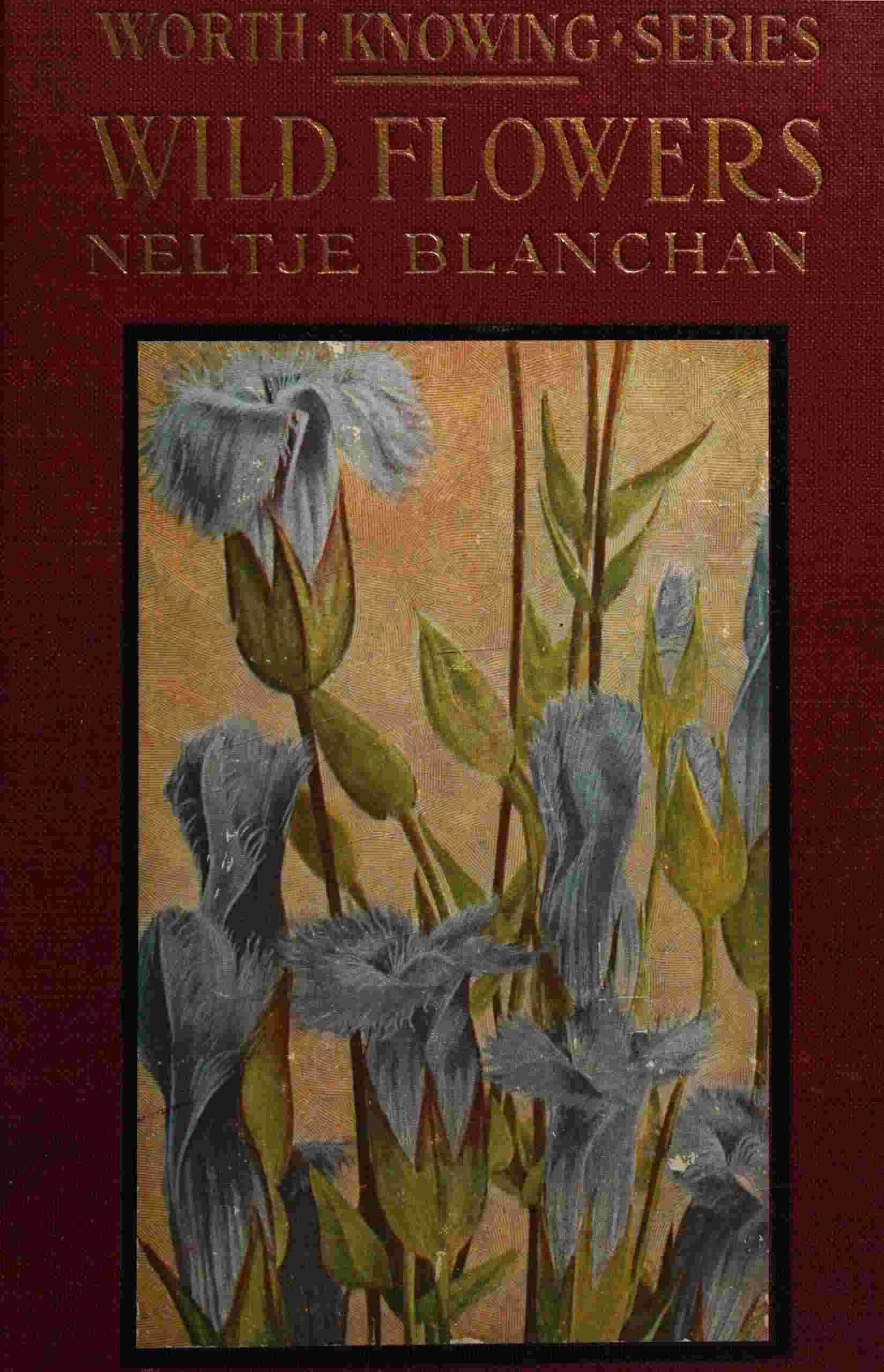
Flowers—Deep, bright blue, rarely white, several or many, about 2 in. high, stiffly erect, and solitary at ends of very long footstalk. Calyx of 4 unequal, acutely pointed lobes. Corolla funnel form, its four lobes spreading, rounded, fringed around ends, but scarcely on sides. Four stamens inserted on corolla tube; 1 pistil with 2 stigmas. Stem: 1 to 3 ft. high, usually branched, leafy. Leaves: Opposite, upper ones acute at tip, broadening to heart-shaped base, seated on stem. Fruit: A spindle-shaped, 2-valved capsule, containing numerous scaly, hairy seeds.
Preferred Habitat—Low, moist meadows and woods.
Flowering Season—September–November.
Distribution—Quebec, southward to Georgia, and westward beyond the Mississippi.
When we come upon a bed of gentians on some sparkling October day, we can but repeat Bryant’s thoughts and express them prosaically who attempt description. In dark weather this sunshine lover remains shut, to protect its nectar and pollen from possible showers. An elusive plant is this gentian, which by no means always reappears in the same places year after year, for it is an annual whose seeds alone perpetuate it. Seating themselves on the winds when autumn gales shake them from out the home wall, these little hairy scales ride afar, and those that are so fortunate as to strike into soft, moist soil at the end of the journey, germinate. Because this flower is so rarely beautiful that few can resist the temptation of picking it, it is becoming sadly rare near large settlements.
Fifteen species of gentian have been gathered during a half-hour walk in Switzerland, where the pastures are spread with sheets of blue. Indeed, one can little realize the beauty of these heavenly flowers who has not seen them among the Alps.
A deep, intense blue is the Closed, Blind, or Bottle Gentian (G. Andrewsii), more truly the color of the “male bluebird’s back,” to which Thoreau likened the paler Fringed Gentian. Rarely some degenerate plant bears white flowers. As it is a perennial, we are likely to find it in its old haunts year after year; nevertheless its winged seeds sail far abroad to seek pastures new. This gentian also shows a preference for moist soil. Gray thought that it expanded slightly, and for a short time only in sunshine, but added that, although it is proterandrous, i.e., it matures and sheds its pollen before its stigma is susceptible to any, he believed it finally fertilized itself by the lobes of the stigma curling backward until they touched the anthers. But Gray was doubtless mistaken. Several authorities have recently proved that the flower is adapted to bumblebees. It offers them the last feast of the season, for although it comes into bloom in August southward, farther northward—and it extends from Quebec to the Northwest Territory—it lasts through October.
DOGBANE FAMILY (Apocynaceae)
Spreading Dogbane; Fly-trap Dogbane; Honey-bloom; Bitter-root
Apocynum androsaemifolium
Flowers—Delicate pink, veined with a deeper shade, fragrant, bell-shaped, about ⅓ in. across, borne in loose terminal cymes. Calyx 5-parted; corolla of 5 spreading, recurved lobes united into a tube; within the tube 5 tiny, triangular appendages alternate with stamens; the arrow-shaped anthers united around the stigma and slightly adhering to it. Stem: 1 to 4 ft. high, with forking, spreading, leafy branches. Leaves: Opposite, entire-edged, broadly oval, narrow at base, paler, and more or less hairy below. Fruit: Two pods about 4 in. long.
Preferred Habitat—Fields, thickets, beside roads, lanes, and walls.
Flowering Season—June–July.
Distribution—Northern part of British Possessions south to Georgia, westward to Nebraska.
Everywhere at the North we come across this interesting, rather shrubby plant, with its pretty but inconspicuous little rose-veined bells suggesting pink lilies-of-the-valley. Now that we have learned to read the faces of flowers, as it were, we instantly suspect by the color, fragrance, pathfinders, and structure that these are artful wilers, intent on gaining ends of their own through their insect admirers. What are they up to?
Let us watch. Bees, flies, moths, and butterflies, especially the latter, hover near. Alighting, the butterfly visitor unrolls his long tongue and inserts it where the five pink veins tell him to, for five nectar-bearing glands stand in a ring around the base of the pistil. Now, as he withdraws his slender tongue through one of the V-shaped cavities that make a circle of traps, he may count himself lucky to escape with no heavier toll imposed than pollen cemented to it. This granular dust he is required to rub off against the stigma of the next flower entered. Some bees, too, have been taken with the dogbane’s pollen cemented to their tongues. But suppose a fly call upon this innocent-looking blossom? His short tongue, as well as the butterfly’s, is guided into one of the V-shaped cavities after he has sipped; but, getting wedged between the trap’s horny teeth, the poor little victim is held a prisoner there until he slowly dies of starvation in sight of plenty. This is the penalty he must pay for trespassing on the butterfly’s preserves! The dogbane, which is perfectly adapted to the butterfly, and dependent upon it for help in producing fertile seed, ruthlessly destroys all poachers that are not big or strong enough to jerk away from its vise-like grasp. One often sees small flies and even moths dead and dangling by the tongue from the wicked little charmers. If the flower assimilated their dead bodies as the pitcher plant, for example, does those of its victims, the fly’s fate would seem less cruel. To be killed by slow torture and dangled like a scarecrow simply for pilfering a drop of nectar is surely an execution of justice medieval in its severity.
MILKWEED FAMILY (Aselepiadaceae)
Common Milkweed or Silkweed
Asclepias syriaca (A. cornuti)
Flowers—Dull, pale greenish purple pink, or brownish pink, borne on pedicels, in many flowered, broad umbels. Calyx inferior, 5-parted; corolla deeply 5-cleft, the segments turned backward. Above them an erect, 5-parted crown, each part called a hood, containing a nectary, and with a tooth on either side, and an incurved horn projecting from within. Behind the crown the short, stout stamens, united by their filaments in a tube, are inserted on the corolla. Broad anthers united around a thick column of pistils terminating hi a large, sticky, 5-angled disk. The anther sacs tipped with a winged membrane; a waxy, pear-shaped pollen-mass in each sac connected with the stigma in pairs or fours by a dark gland, and suspended by a stalk like a pair of saddle-bags. Stem: Stout, leafy, usually unbranched, 3 to 5 ft. high, juice milky. Leaves: Opposite, oblong, entire-edged smooth above, hairy below, 4 to 9 in. long. Fruit: 2 thick, warty pods, usually only one filled with compressed seeds attached to tufts of silky, white, fluffy hairs.
Preferred Habitat—Fields and waste places, roadsides.
Flowering Season—June–September.
Distribution—New Brunswick, far westward and southward to North Carolina and Kansas.
After the orchids, no flowers show greater executive ability, none have adopted more ingenious methods of compelling insects to work for them than the milkweeds. Wonderfully have they perfected their mechanism in every part until no member of the family even attempts to fertilize itself; hence their triumphal, vigorous march around the earth, the tribe numbering more than nineteen hundred species located chiefly in those tropical and warm temperate regions that teem with the insects whose cooperation they seek.
Commonest of all with us is this rank weed, which possesses the dignity of a rubber plant. Much more attractive to human eyes, at least, than the dull, pale, brownish-pink umbels of flowers are its exquisite silky seed-tufts. But not so with insects. Knowing that the slightly fragrant blossoms are rich in nectar, bees, wasps, flies, beetles, and butterflies come to feast. Now, the visitor finding his alighting place slippery, his feet claw about in all directions to secure a hold, just as it was planned they should; for in his struggles some of his feet must get caught in the fine little clefts at the base of the flower. His efforts to extricate his foot only draw it into a slot at the end of which lies a little dark-brown body. In a newly-opened flower five of these little bodies may be seen between the horns of the crown, at equal distances around it. This tiny brown excrescence is hard and horny, with a notch in its face. It is continuous with and forms the end of the slot in which the visitor’s foot is caught. Into this he must draw his foot or claw, and finding it rather tightly held, must give a vigorous jerk to get it free. Attached to either side of the little horny piece is a flattened yellow pollen-mass, and so away he flies with a pair of these pollinia, that look like tiny saddle-bags, dangling from his feet. One might think that such rough handling as many insects must submit to from flowers would discourage them from making any more visits; but the desire for food is a mighty passion. While the insect is flying off to another blossom, the stalk to which the saddle-bags are attached twists until it brings them together, that, when his feet get caught in other slots, they may be in the position to get broken off in his struggles for freedom precisely where they will fertilize the stigmatic chambers. Now the visitor flies away with the stalks alone sticking to his claws. Bumblebees and hive-bees have been caught with a dozen pollen-masses dangling from a single foot. Outrageous imposition!
Better than any written description of the milkweed blossom’s mechanism is a simple experiment. If you have neither time nor patience to sit in the hot sun, magnifying-glass in hand, and watch for an unwary insect to get caught, take an ordinary house-fly, and hold it by the wings so that it may claw at one of the newly-opened flowers from which no pollinia have been removed. It tries frantically to hold on, and with a little direction it may be led to catch its claws in the slots of the flower. Now pull it gently away, and you will find a pair of saddle-bags slung over his foot by a slender curved stalk. If you are rarely skilful, you may induce your fly to withdraw the pollinia from all five slots on as many of his feet. And they are not to be thrown or scraped off, let the fly try as hard as he pleases. You may now invite the fly to take a walk on another flower in which he will probably leave one or more pollinia in its stigmatic cavities.
Doctor Kerner thought the milky juice in milkweed plants, especially abundant in the uppermost leaves and stems, serves to protect the flowers from useless crawling pilferers. He once started a number of ants to climb up a milky stalk. When they neared the summit, he noticed that at each movement the terminal hooks of their feet cut through the tender epiderm, and from the little clefts the milky juice began to flow, bedraggling their feet and the hind part of then-bodies. “The ants were much impeded in their movements,” he writes, “and in order to rid themselves of the annoyance, drew their feet through their mouths.... Their movements, however, which accompanied these efforts, simply resulted in making fresh fissures and fresh discharges of milky juice, so that the position of the ants became each moment worse and worse. Many escaped by getting to the edge of a leaf and dropping to the ground. Others tried this method of escape too late, for the air soon hardened the milky juice into a tough brown substance, and after this, all the strugglings of the ants to free themselves from the viscid matter were in vain.” Nature’s methods of preserving a flower’s nectar for the insects that are especially adapted to fertilize it, and of punishing all useless intruders, often shock us; yet justice is ever stern, ever kind in the largest sense.
If the asclepias really do kill some insects with their juice, others doubtless owe their lives to it. Among the “protected” insects are the milkweed butterflies and their caterpillars, which are provided with secretions that are distasteful to birds and predaceous insects. “These acrid secretions are probably due to the character of the plants upon which the caterpillars feed,” says Doctor Holland, in his beautiful and invaluable “Butterfly Book.” “Enjoying on this account immunity from attack, they have all, in the process of time, been mimicked by species in other genera which have not the same immunity.” “One cannot stay long around a patch of milkweeds without seeing the monarch butterfly (Anosia plexippus), that splendid, bright, reddish-brown winged fellow, the borders and veins broadly black, with two rows of white spots on the outer borders and two rows of pale spots across the tip of the fore wings. There is a black scent-pouch on the hind wings. The caterpillar, which is bright yellow or greenish yellow, banded with shining black, is furnished with black fleshy 'horns’ fore and aft.”
Like the dandelion, thistle, and other triumphant strugglers for survival, the milkweed sends its offspring adrift on the winds to found fresh colonies afar. Children delight in making pompons for their hats by removing the silky seed-tufts from pods before they burst, and winding them, one by one, on slender stems with fine thread. Hung in the sunshine, how charmingly fluffy and soft they dry!
Among the comparatively few butterfly flowers—although, of course, other insects not adapted to them are visitors—is the Purple Milkweed (A. purpurasceus), whose deep magenta umbels are so conspicuous through the summer months. Humming birds occasionally seek it, too. From eastern Massachusetts to Virginia, and westward to the Mississippi, or beyond, it is to be found in dry fields, woods, and thickets.
Butterfly-weed; Pleurisy-root; Orange-root; Orange Milkweed
Asclepias tuberosa
Flowers—Bright reddish orange, in many-flowered, terminal clusters, each flower similar in structure to the common milkweed (see above). Stem: Erect, 1 to 2 ft. tall, hairy, leafy, milky juice scanty. Leaves: Usually all alternate, lance-shaped, seated on stem. Fruit: A pair of erect, hoary pods, 2 to 5 in. long, 1 at least containing silky plumed seeds.
Preferred Habitat—Dry or sandy fields, hills, roadsides.
Flowering Season—June–September.
Distribution—Maine and Ontario to Arizona, south to the Gulf of Mexico.
Intensely brilliant clusters of this the most ornamental of all native milkweeds set dry fields ablaze with color. Above them butterflies hover, float, alight, sip, and sail away—the great dark, velvety, pipe-vine swallow-tail (Papilio philenor), its green-shaded hind wings marked with little white half moons; the yellow and brown, common, Eastern swallow-tail (P. asterias), that we saw about the wild parsnip and other members of the carrot family; the exquisite, large, spice-bush swallow-tail, whose bugaboo caterpillar startled us when we unrolled a leaf of its favorite food supply; the small, common, white cabbage butterfly (Pieris protodice); the even more common little sulphur butterflies, inseparable from clover fields and mud puddles; the painted lady that follows thistles around the globe; the regal fritillary (Argynnis idalia), its black and fulvous wings marked with silver crescents, a gorgeous creature developed from the black and orange caterpillar that prowls at night among violet plants; the great spangled fritillary of similar habit; the bright fulvous and black pearl crescent butterfly (Phyciodes tharos), its small wings usually seen hovering about the asters; the little grayish-brown, coral hairstreak (Thecla titus), and the bronze copper (Chrysophanus thoë), whose caterpillar feeds on sorrel (Rumex); the delicate, tailed blue butterfly (Lycena comyntas,) with a wing expansion of only an inch from tip to tip; all these visitors duplicated again and again—these and several others that either escaped the net before they were named, or could not be run down, were seen one bright midsummer day along a Long Island roadside bordered with butterfly weed. Most abundant of all was still another species, the splendid monarch (Anosia plexippus), the most familiar representative of the tribe of milkweed butterflies. It is said the Indians used the tuberous root of this plant for various maladies, although they could scarcely have known that because of the alleged healing properties of the genus Linnaeus dedicated it to Aesculapius, of whose name Asklepios is the Greek form.
CONVOLVULUS FAMILY (Convolvulaceae)
Hedge or Great Bindweed; Wild Morning-glory; Rutland Beauty; Bell-bind;
Lady’s Nightcap
Convolvulus sepium
Flowers—Light pink, with white stripes or all white, bell-shaped, about 2 in. long, twisted in the bud, solitary, on long peduncles from leaf axils. Calyx of 5 sepals, concealed by 2 large bracts at base. Corolla 5-lobed, the 5 included stamens inserted on its tube; style with 2 oblong stigmas. Stem: Smooth or hairy, 3 to 10 ft. long, twining or trailing over ground. Leaves: Triangular or arrow-shaped, 2 to 5 in. long, on slender petioles.
Preferred Habitat—Wayside hedges, thickets, fields, walls.
Flowering Season—June–September.
Distribution—Nova Scotia to North Carolina, westward to Nebraska. Europe and Asia.
No one need be told that the pretty, bell-shaped pink and white flower on the vigorous vine clambering over stone walls and winding about the shrubbery of wayside thickets in a suffocating embrace is akin to the morning-glory of the garden trellis (C. Major). An exceedingly rapid climber, the twining stem often describes a complete circle in two hours, turning against the sun, or just contrary to the hands of a watch. Late in the season, when an abundance of seed has been set, the flower can well afford to keep open longer hours, also in rainy weather; but early in the summer, at least, it must attend to business only while the sun shines and its benefactors are flying. Usually it closes at sundown. On moonlight nights, however, the hospitable blossom keeps open for the benefit of certain moths.
From July until hard frost look for that exquisite little beetle, Cassida aurichalcea, like a drop of molten gold, clinging beneath the bindweed’s leaves. The small perforations reveal his hiding places. “But you must be quick if you would capture him,” says William Hamilton Gibson, “for he is off in a spangling streak of glitter. Nor is this golden sheen all the resource of the little insect; for in the space of a few seconds, as you hold him in your hand, he has become a milky, iridescent opal, and now mother-of-pearl, and finally crawls before you in a coat of dull orange.” A dead beetle loses all this wonderful lustre. Even on the morning-glory in our gardens we may sometimes find these jewelled mites, or their fork-tailed, black larvae, or the tiny chrysalids suspended by their tails, although it is the wild bindweed that is ever their favorite abiding place.
Gronovius’ or Common Dodder; Strangle-weed; Love Vine; Angel’s Hair
Cuscuta Gronovii
Flowers—-Dull, white minute, numerous, in dense clusters. Calyx inferior, greenish white, 5-parted; corolla bell-shaped, the 5 lobes spreading, 5 fringed scales within; 5 stamens, each inserted on corolla throat above a scale; 2 slender styles. Stem: Bright orange yellow, thread-like, twining high, leafless.
Preferred Habitat—Moist soil, meadows, ditches, beside streams.
Flowering Season—July–September.
Distribution—Nova Scotia and Manitoba, south to the Gulf states.
Like tangled yellow yarn wound spirally about the herbage and shrubbery in moist thickets, the dodder grows, its beautiful bright threads plentifully studded with small flowers tightly bunched. Try to loosen its hold on the support it is climbing up, and the secret of its guilt is out at once; for no honest vine is this, but a parasite, a degenerate of the lowest type, with numerous sharp suckers (haustoria) penetrating the bark of its victim, and spreading in the softer tissues beneath to steal all their nourishment. So firmly are these suckers attached, that the golden thread-like stem will break before they can be torn from their hold.
Not a leaf now remains on the vine to tell of virtue in its remote ancestors; the absence of green matter (chlorophyll) testifies to dishonest methods of gaining a living (see Indian Pipe), not even a root is left after the seedling is old enough to twine about its hard-working, respectable neighbors. Starting out in life with apparently the best intentions, suddenly the tender young twiner develops an appetite for strong drink and murder combined, such as would terrify any budding criminal in Five Points or Seven Dials! No sooner has it laid hold of its victim and tapped it, than the now useless root and lower portion wither away leaving the dodder in mid-air, without any connection with the soil below, but abundantly nourished with juices already stored up, and even assimilated, at its host’s expense. By rapidly lengthening the cells on the outer side of its stem more than on the inner side, the former becomes convex, the latter concave; that is to say, a section of spiral is formed by the new shoot, which, twining upward, devitalizes its benefactor as it goes. Abundant, globular seed-vessels, which develop rapidly while the blossoming continues unabated, soon sink into the soft soil to begin their piratical careers close beside the criminals which bore them; or better still, from their point of view, float downstream to found new colonies afar. When the beautiful jewel-weed—a conspicuous sufferer—is hung about with dodder, one must be grateful for at least such symphony of yellows.
POLEMONIUM FAMILY (Polemoniaceae)
Ground or Moss Pink
Phlox subulata
Flowers—Very numerous, small, deep purplish pink, lavender or rose, varying to white, with a darker eye, growing in simple cymes, or solitary in a Western variety. Calyx with 5 slender teeth; corolla salver-form with 5 spreading lobes; 5 stamens inserted on corolla tube; style 3-lobed. Stems: Rarely exceeding 6 in. in height, tufted like mats, much branched, plentifully set with awl-shaped, evergreen leaves barely ½ in. long, growing in tufts at joints of stem.
Preferred Habitat—Rocky ground, hillsides.
Flowering Season—April–June.
Distribution—Southern New York to Florida, westward to Michigan and Kentucky.
A charming little plant, growing in dense evergreen mats with which Nature carpets dry, sandy, and rocky hillsides, is often completely hidden beneath its wealth of flowers. Far beyond its natural range, as well as within it, the Moss Pink glows in gardens, cemeteries, and parks, wherever there are rocks to conceal or sterile wastes to beautify. Very slight encouragement induces it to run wild. There are great rocks in Central Park, New York, worth travelling miles to see in early May, when their stern faces are flushed and smiling with these blossoms.
BORAGE FAMILY (Boraginaceae)
Forget-me-not; Mouse-ear; Scorpion Grass; Snake Grass; Love Me
Myosotis scorpioides (M. palustris)
Flowers—Pure blue, pinkish, or white, with yellow eye; flat, 5-lobed, borne in many-flowered, long, often 1-sided racemes. Calyx 5-cleft; the lobes narrow, spreading, erect, and open in fruit; 5 stamens inserted on corolla tube; style thread-like; ovary 4-celled. Stem: Low, branching, leafy, slender, hairy, partially reclining. Leaves: (Myosotis = mouse-ear) oblong, alternate, seated on stem; hairy. Fruit: Nutlets, angled and keeled on inner side.
Preferred Habitat—Escaped from gardens to brooksides, marshes, and low meadows.
Flowering Season—May–July.
Distribution—Native of Europe and Asia, now rapidly spreading from Nova Scotia southward to New Jersey, Pennsylvania, and beyond.
How rare a color blue must have been originally among our flora is evident from the majority of blue and purple flowers that, although now abundant here and so perfectly at home, are really quite recent immigrants from Europe and Asia. But our dryer, hotter climate never brings to the perfection attained in England
Tennyson thus ignores the melancholy association of the flower in the popular legend which tells how a lover, when trying to gather some of these blossoms for his sweetheart, fell into a deep pool, and threw a bunch on the bank, calling out, as he sank forever from her sight, “Forget me not.” Another dismal myth sends its hero forth seeking hidden treasure caves in a mountain, under the guidance of a fairy. He fills his pockets with gold, but not heeding the fairy’s warning to “forget not the best”—i.e., the myosotis—he is crushed by the closing together of the mountain. Happiest of all is the folk-tale of the Persians, as told by their poet Shiraz: “It was in the golden morning of the early world, when an angel sat weeping outside the closed gates of Paradise. He had fallen from his high estate through loving a daughter of earth, nor was he permitted to enter again until she whom he loved had planted the flowers of the forget-me-not in every corner of the world. He returned to earth and assisted her, and together they went hand in hand. When their task was ended, they entered Paradise together, for the fair woman, without tasting the bitterness of death, became immortal like the angel whose love her beauty had won when she sat by the river twining forget-me-nots in her hair.”
It was the golden ring around the forget-me-not’s centre that first led Sprengel to believe the conspicuous markings at the entrance of many flowers served as pathfinders to insects. This golden circle also shelters the nectar from rain, and indicates to the fly or bee just where it must probe between stigma and anthers to touch them with opposite sides of its tongue. Since it may probe from any point of the circle, it is quite likely that the side of the tongue that touched a pollen-laden anther in one flower will touch the stigma in the next one visited, and so cross-fertilize it. But forget-me-nots are not wholly dependent on insects. When these fail, a fully mature flower is still able to set fertile seed by shedding its own pollen directly on the stigma.
Viper’s Bugloss; Blue-weed; Viper’s Herb or Grass; Snake-flower; Blue
Thistle; Blue Devil
Echium vulgare
Flowers—Bright blue, afterward reddish purple, pink in the bud, numerous, clustered on short, 1-sided curved spikes rolled up at first, and straightening out as flowers expand. Calyx deeply 5-cleft; corolla 1 in. long or less, funnel form, the 5 lobes unequal, acute; 5 stamens inserted on corolla tube, the filaments spreading below, and united above into slender appendage, the anthers forming a cone; 1 pistil with 2 stigmas. Stem: 1 to 2 ½ ft. high; bristly-hairy, erect, spotted. Leaves: Hairy, rough, oblong to lance-shaped, alternate, seated on stem, except at base of plant.
Preferred Habitat—Dry fields, waste places, roadsides
Flowering Season—June–July.
Distribution—New Brunswick to Virginia, westward to Nebraska; Europe and Asia.
Years ago, when simple folk believed God had marked plants with some sign to indicate the special use for which each was intended, they regarded the spotted stem of the bugloss, and its seeds shaped like a serpent’s head, as certain indications that the herb would cure snake bites. Indeed, the genus takes its name from Echis, the Greek viper.
VERVAIN FAMILY (Verbenaceae)
Blue Vervain; Wild Hyssop; Simpler’s Joy
Verbena hastata
Flowers—Very small, purplish blue, in numerous slender, erect, compact spikes. Calyx 5-toothed; corolla tubular, unequally 5-lobed; 2 pairs of stamens; 1 pistil. Stem: 3 to 7 ft. high, rough, branched above, leafy, 4-sided. Leaves: Opposite, stemmed, lance-shaped, saw-edged rough, lower ones lobed at base.
Preferred Habitat—Moist meadows, roadsides, waste places.
Flowering Season—June–September.
Distribution—United States and Canada in almost every part.
Seeds below, a circle of insignificant purple-blue flowers in the centre, and buds at the top of the vervain’s slender spires do not produce a striking effect, yet this common plant certainly does not lack beauty. John Burroughs, ever ready to say a kindly, appreciative word for any weed, speaks of its drooping, knotted threads, that “make a pretty etching upon the winter snow.” Bees, the vervain’s benefactors, are usually seen clinging to the blooming spikes, and apparently asleep on them. Borrowing the name of Simpler’s Joy from its European sister, the flower has also appropriated much of the tradition and folk-lore centred about that plant which herb-gatherers, or simplers, truly delighted to see, since none was once more salable.
Ages before Christians ascribed healing virtues to the vervain—found growing on Mount Calvary, and therefore possessing every sort of miraculous power, according to the logic of simple peasant folk—the Druids had counted it among their sacred plants. “When the dog-star arose from unsunned spots” the priests gathered it. Did not Shakespeare’s witches learn some of their uncanny rites from these reverend men of old? One is impressed with the striking similarity of many customs recorded of both. Two of the most frequently used ingredients in witches cauldrons were the vervain and the rue. “The former probably derived its notoriety from the fact of its being sacred to Thor, an honor which marked it out, like other lightning plants, as peculiarly adapted for occult uses,” says Mr. Thiselton Dyer in his “Folk-lore of Plants.” “Although vervain, therefore, as the enchanter’s plant, was gathered by witches to do mischief in their incantations, yet, as Aubrey says, it 'hinders witches from their will,’ a circumstance to which Drayton further refers when he speaks of the vervain as '’gainst witchcraft much avayling.’” Now we understand why the children of Shakespeare’s time hung vervain and dill with a horseshoe over the door.
In his eighth Eclogue, Virgil refers to vervain as a charm to recover lost love. Doubtless this was the verbena, the herba sacra employed in ancient Roman sacrifices, according to Pliny. In his day the bridal wreath was of verbena, gathered by the bride herself.
MINT FAMILY (Labiatae)
Mad-dog Skullcap or Helmet-flower; Mad weed; Hoodwort
Scutellaria lateriflora
Flowers—Blue, varying to whitish; several or many, ¼ in. long, growing in axils of upper leaves or in 1-sided spike-like racemes. Calyx 2-lipped, the upper lip with a helmet-like protuberance; corolla 2-lipped; the lower, 3-lobed lip spreading; the middle lobe larger than the side ones. Stamens, 4, in pairs, under the upper lip; upper pair the shorter; 1 pistil, the style unequally cleft in two. Stem: Square, smooth, leafy, branched, 8 in. to 2 ft. high. Leaves: Opposite, oblong to lance-shaped, thin, toothed, on slender pedicles, 1 to 3 in. long, growing gradually smaller toward top of stem. Fruit: 4 nutlets.
Preferred Habitat—Wet, shady ground.
Flowering Season—July–September.
Distribution—Uneven throughout United States and the British Possessions.
By the helmet-like appendage on the upper lip of the calyx, which to the imaginative mind of Linnaeus suggested Scutellum (a little dish), which children delight to spring open for a view of the four tiny seeds attached at the base when in fruit, one knows this to be a member of the skullcap tribe, a widely scattered genus of blue and violet two-lipped flowers, some small to the point of insignificance, like the present species, others showy enough for the garden, but all rich in nectar, and eagerly sought by their good friends, the bees.
The Larger or Hyssop Skullcap (S. integrifolia) rarely has a dent in its rounded oblong leaves, which, like the stem, are covered with fine down. Its lovely, bright blue flowers, an inch long, the lips of about equal length, are grouped opposite each other at the top of a stem that never lifts them higher than two feet; and so their beauty is often concealed in the tall grass of roadsides and meadows and the undergrowth of woods and thickets, where they bloom from May to August, from southern New England to the Gulf of Mexico, westward to Texas.
Self-heal; Heal-all; Blue Curls; Heart-of-the-Earth; Brunella; Carpenter-weed
Prunella vulgaris
Flowers—Purple and violet, in dense spikes, somewhat resembling a clover head; from ½ to 1 in. long in flower, becoming 4 times the length in fruit. Corolla tubular, irregularly 2-lipped, the upper lip darker and hood-like; the lower one 3-lobed, spreading, the middle and largest lobe fringed; 4 twin-like stamens ascending under upper lip; filaments of the lower and longer pair 2-toothed at summit, one of the teeth bearing an anther, the other tooth sterile; style thread-like, shorter than stamens, and terminating in a 2-cleft stigma. Calyx 2-parted, half the length of corolla, its teeth often hairy on edges. Stem: 2 in. to 2 ft. high, erect or reclining, simple or branched. Leaves: Opposite, oblong. Fruit: 4 nutlets, round and smooth.
Preferred Habitat—Fields, roadsides, waste places.
Flowering Season—May–October
Distribution—North America, Europe, Asia.
This humble, rusty green plant, weakly lopping over the surrounding grass, so that often only its insignificant purple, clover-like flower-heads are visible, is another of those immigrants from the old countries which, having proved fittest in the fiercer struggle for existence there, has soon after its introduction here exceeded most of our more favored native flowers in numbers. Everywhere we find the heal-all, sometimes dusty and stunted by the roadside, sometimes truly beautiful in its fresh purple, violet, and white when perfectly developed under happy conditions. In England, where most flowers are deeper hued than with us, the heal-all is rich purple. What is the secret of this flower’s successful march across three continents? As usual, the chief reason is to be found in the facility it offers insects to secure food; and the quantity of fertile seed it is therefore able to ripen as the result of their visits is its reward. Also, its flowering season is unusually long, and it is a tireless bloomer. It is finical in no respect; its sprawling stems root easily at the joints, and it is very hardy.
Motherwort
Leonurus Cardiaca
Flowers—Dull purple pink, pale purple, or white, small, clustered in axils of upper leaves. Calyx tubular, bell-shaped, with 5 rigid awl-like teeth; corolla 2-lipped, upper lip arched, woolly without; lower lip 3-lobed, spreading, mottled; the tube with oblique ring of hairs inside. Four twin-like stamens, anterior pair longer, reaching under upper lip; style 2-cleft at summit. Stem: 2 to 5 ft. tall, straight, branched, leafy, purplish. Leaves: Opposite, on slender petioles; lower ones rounded, 2 to 4 in. broad, palmately cut into 2 to 5 lobes; upper leaves narrower, 3-cleft or 3-toothed.
Preferred Habitat—Waste places near dwellings.
Flowering Season—June–September.
Distribution—Nova Scotia southward to North Carolina, west to Minnesota and Nebraska. Naturalized from Europe and Asia.
How the bees love this generous, old-fashioned entertainer! One nearly always sees them clinging to the close whorls of flowers that are strung along the stem, and of course transferring pollen, in recompense, as they journey on. A more credulous generation imported the plant for its alleged healing virtues. What is the significance of its Greek name, meaning a lion’s tail? Let no one suggest, by a far-stretched metaphor, that our grandmothers, in Revolutionary days, enjoyed pulling it to vent their animosity against the British.
Oswego Tea; Bee Balm; Indian’s Plume; Fragrant Balm; Mountain Mint
Monarda didyma
Flowers—Scarlet, clustered in a solitary, terminal, rounded head of dark-red calices, with leafy bracts below it. Calyx narrow, tubular, sharply 5-toothed; corolla tubular, widest at the mouth, 2-lipped, 1 ½ to 2 inches long; 2 long, anther-bearing stamens ascending, protruding; 1 pistil; the style 2-cleft. Stem: 2 to 3 ft. tall. Leaves: Aromatic, opposite, dark green, oval to oblong lance-shaped, sharply saw-edged, of ten hairy beneath, petioled; upper leaves and bracts often red.
Preferred Habitat—Moist soil, especially near streams, in hilly or mountainous regions.
Flowering Season—July–September.
Distribution—Canada to Georgia, west to Michigan.
Gorgeous, glowing scarlet heads of Bee Balm arrest the dullest eye, bracts and upper leaves often taking on blood-red color, too, as if it had dripped from the lacerated flowers. Where their vivid doubles are reflected in a shadowy mountain stream, not even the Cardinal Flower is more strikingly beautiful. Thrifty clumps transplanted from Nature’s garden will spread about ours and add a splendor like the flowers of salvia, next of kin, if only the roots get a frequent soaking.
With even longer flower tubes than the Wild Bergamot’s the Bee Balm belies its name, for, however frequently bees may come about for nectar when it rises high, only long-tongued bumblebees could get enough to compensate for their trouble. Butterflies, which suck with their wings in motion, plumb the depths. The ruby-throated humming bird—to which the Brazilian salvia of our gardens has adapted itself—flashes about these whorls of Indian plumes just as frequently—of course transferring pollen on his needle-like bill as he darts from flower to flower. Even the protruding stamens and pistil take on the prevailing hue. Most of the small, blue, or purple flowered members of the mint family cater to bees by wearing their favorite color; the bergamot charms butterflies with magenta, and tubes so deep the short-tongued mob cannot pilfer their sweets; and from the frequency of the humming bird’s visits, from the greater depth of the Bee Balm’s tubes and their brilliant, flaring red—an irresistibly attractive color to the ruby-throat—it would appear that this is a bird flower. Certainly its adaptation is quite as perfect as the salvia’s. Mischievous bees and wasps steal nectar they cannot reach legitimately through bungholes of their own making in the bottom of the slender casks.