
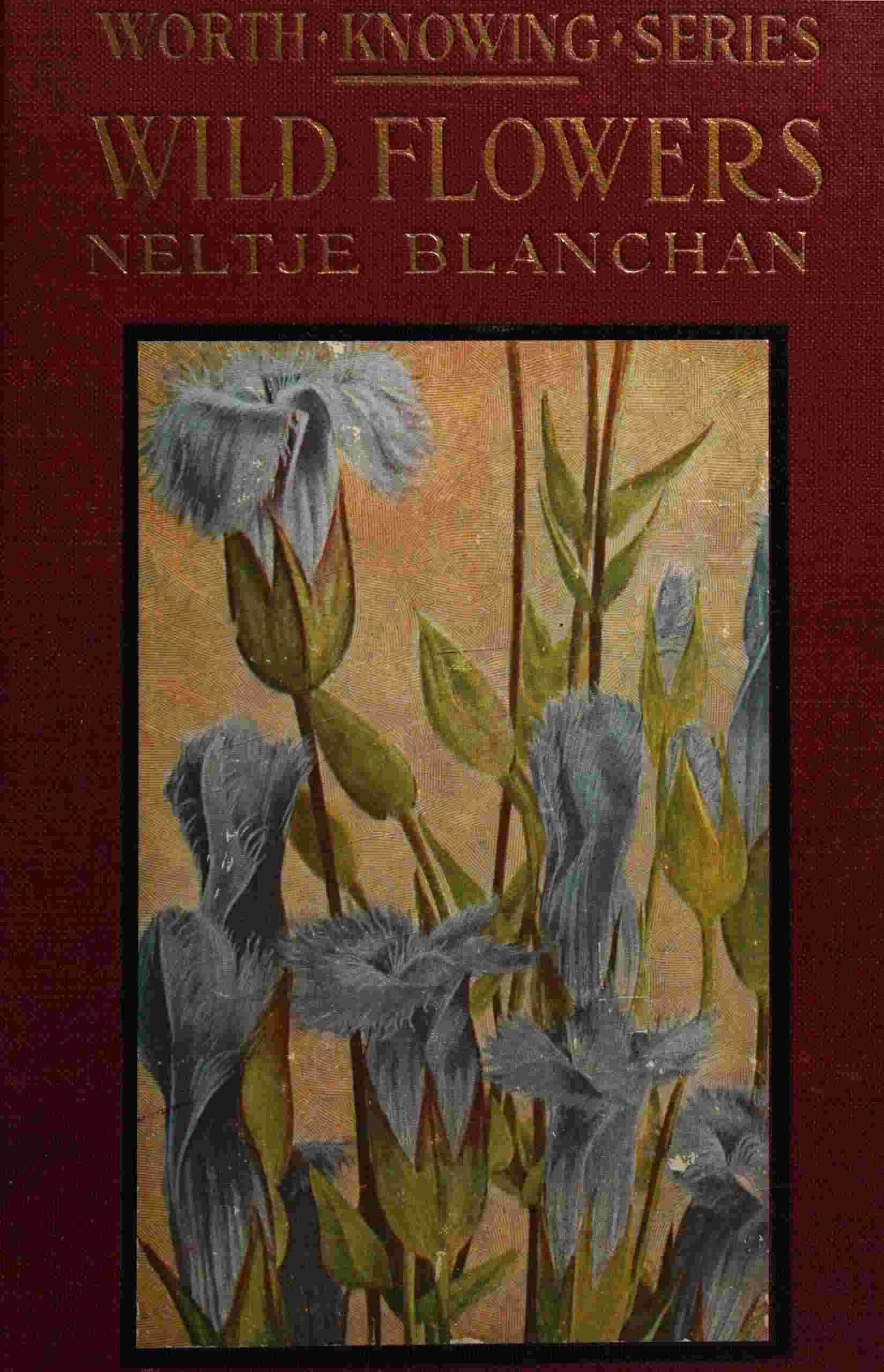
Great Lobelia; Blue Cardinal Flower
Lobelia syphilitica
Flowers—Bright blue, touched with white, fading to pale blue, about 1 in. long, borne on tall, erect, leafy spike. Calyx 5-parted, the lobes sharply cut, hairy. Corolla tubular, open to base on one side, 2-lipped, irregularly 5-lobed, the petals pronounced at maturity only. Stamens 5, united by their hairy anthers into a tube around the style; larger anthers smooth. Stem: 1 to 3 ft. high, stout, simple, leafy, slightly hairy. Leaves: Alternate, oblong, tapering, pointed, irregularly toothed 2 to 6 in. long, ½ to 2 in. wide.
Preferred Habitat—Moist or wet soil; beside streams.
Flowering Season—July–October.
Distribution—Ontario and northern United States west to Dakota, south to Kansas and Georgia.
To the evolutionist, ever on the lookout for connecting links, the lobelias form an interesting group, because their corolla, slit down the upper side and somewhat flattened, shows the beginning of the tendency toward the strap or ray flowers that are nearly confined to the composites of much later development, of course, than tubular single blossoms. Next to massing their flowers in showy heads, as the composites do, the lobelias have the almost equally advantageous plan of crowding theirs along a stem so as to make a conspicuous advertisement to attract the passing bee and to offer him the special inducement of numerous feeding places close together.
The handsome Great Lobelia, constantly and invidiously compared with its gorgeous sister the cardinal flower, suffers unfairly. When asked what his favorite color was, Eugene Field replied: “Why, I like any color at all so long as it’s red!” Most men, at least, agree with him, and certainly humming birds do; our scarcity of red flowers being due, we must believe, to the scarcity of humming birds, which chiefly fertilize them. But how bees love the blue blossoms!
Linnaeus named this group of plants for Matthias de l’Obel, a Flemish botanist, or herbalist more likely, who became physician to James I of England.
COMPOSITE FAMILY (Compositae)
Iron-weed; Flat Top
Vernonia noveboracensis
Flower-head—Composite of tubular florets only, intense reddish-purple thistle-like heads, borne on short, branched peduncles and forming broad, flat clusters; bracts of involucre, brownish purple, tipped with awl-shaped bristles. Stem: 3 to 9 ft. high, rough or hairy, branched. Leaves: Alternate, narrowly oblong or lanceolate, saw-edged, 3 to 10 in. long, rough.
Preferred Habitat—Moist soil, meadows, fields.
Flowering Season—July–September.
Distribution—Massachusetts to Georgia, and westward to the Mississippi.
Emerson says a weed is a plant whose virtues we have not yet discovered; but surely it is no small virtue in the iron-weed to brighten the roadsides and low meadows throughout the summer with bright clusters of bloom. When it is on the wane, the asters, for which it is sometimes mistaken, begin to appear, but an instant’s comparison shows the difference between the two flowers. After noting the yellow disk in the centre of an aster, it is not likely the iron-weed’s thistle-like head of ray florets only will ever again be confused with it. Another rank-growing neighbor with which it has been comfounded by the novice is the Joe-Pye Weed, a far paler, old-rose colored flower, as one who does not meet them both afield may see on comparing the colored plates in this book.
Joe-Pye Weed; Trumpet Weed; Purple Thoroughwort; Gravel or Kidney-root;
Tall or Purple Boneset
Eupatorium purpureum
Flower-heads—Pale or dull magenta or lavender pink, slightly fragrant, of tubular florets only, very numerous, in large, terminal, loose, compound clusters, generally elongated. Several series of pink overlapping bracts form the oblong involucre from which the tubular floret and its protruding fringe of style-branches arise. Stem: 3 to 10 ft. high, green or purplish, leafy, usually branching toward top. Leaves: In whorls of 3 to 6 (usually 4), oval to lance-shaped, saw-edged, petioled, thin, rough.
Preferred Habitat—Moist soil, meadows, woods, low ground.
Flowering Season—August–September.
Distribution—New Brunswick to the Gulf of Mexico, westward to Manitoba and Texas.
Towering above the surrounding vegetation of low-lying meadows, this vigorous composite spreads clusters of soft, fringy bloom that, however deep or pale of tint, are ever conspicuous advertisements, even when the golden-rods, sunflowers, and asters enter into close competition for insect trade. Slight fragrance, which to the delicate perception of butterflies is doubtless heavy enough, the florets’ color and slender tubular form indicate an adaptation to them, and they are by far the most abundant visitors, which is not to say that long-tongued bees and flies never reach the nectar and transfer pollen, for they do. But an excellent place for the butterfly collector to carry his net is to a patch of Joe-Pye Weed in September. As the spreading style-branches that fringe each tiny floret are furnished with hairs for three quarters of their length, the pollen caught in them comes in contact with the alighting visitor. Later, the lower portion of the style-branches, that is covered with stigmatic papillae along the edge, emerges from the tube to receive pollen carried from younger flowers when the visitor sips his reward. If the hairs still contain pollen when the stigmatic part of the style is exposed, insects self-fertilize the flower; and if in stormy weather no insects are flying, the flower is nevertheless able to fertilize itself, because the hairy fringe must often come in contact with the stigmas of neighboring florets. It is only when we study flowers with reference to their motives and methods that we understand why one is abundant and another rare. Composites long ago utilized many principles of success in life that the triumphant Anglo-Saxon carries into larger affairs to-day.
Joe-Pye, an Indian medicine-man of New England, earned fame and fortune by curing typhus fever and other horrors with decoctions made from this plant.
Boneset; Common Thorough wort; Agueweed; Indian Sage
Eupatorium perfoliatum
Flower-heads—Composite, the numerous, small, dull, white heads of tubular florets only, crowded in a scaly involucre and borne in spreading, flat-topped terminal cymes. Stem: Stout, tall, branching above, hairy, leafy. Leaves: Opposite, often united at their bases, or clasping, lance-shaped, saw-edged, wrinkled.
Preferred Habitat—Wet ground, low meadows, roadsides.
Flowering Season—July–September.
Distribution—From the Gulf states north to Nebraska, Manitoba, and New Brunswick.
Frequently, in just such situations as its sister the Joe-Pye Weed selects, and with similar intent, the boneset spreads its soft, leaden-white bloom; but it will be noticed that the butterflies, which love color, especially deep pinks and magenta, let this plant alone, whereas beetles, that do not find the butterfly’s favorite, fragrant Joe-Pye Weed at all to their liking, prefer these dull, odorous flowers. Many flies, wasps, and bees also, get generous entertainment in these tiny florets, where they feast with the minimum loss of time, each head in a cluster containing, as it does, from ten to sixteen restaurants. An ant crawling up the stem is usually discouraged by its hairs long before reaching the sweets. Sometimes the stem appears to run through the centre of one large leaf that is kinky in the middle and taper-pointed at both ends, rather than between a pair of leaves.
An old-fashioned illness known as break-bone fever—doubtless paralleled to-day by the grippe—once had its terrors for a patient increased a hundredfold by the certainty he felt of taking nauseous doses of boneset tea, administered by zealous old women outside the “regular practice.” Children who had to have their noses held before they would—or, indeed, could—swallow the decoction, cheerfully munched boneset taffy instead.
Golden-rods
Solidago
When these flowers transform whole acres into “fields of the cloth-of-gold,” the slender wands swaying by every roadside, and Purple Asters add the final touch of imperial splendor to the autumn landscape, already glorious with gold and crimson, is any parterre of Nature’s garden the world around more gorgeous than that portion of it we are pleased to call ours? Within its limits eighty-five species of golden-rod flourish, while a few have strayed into Mexico and South America, and only two or three belong to Europe, where many of ours are tenderly cultivated in gardens, as they would be here, had not Nature been so lavish. To name all these species, or the asters, the sparrows, and the warblers at sight is a feat probably no one living can perform; nevertheless, certain of the commoner golden-rods have well-defined peculiarities that a little field practice soon fixes in the novice’s mind.
Along shady roadsides, and in moist woods and thickets, from August to October, the Blue-stemmed, Wreath, or Woodland Golden-rod (S. caesia) sways an unbranched stem with a bluish bloom on it. It is studded with pale golden clusters of tiny florets in the axils of lance-shaped, feather-veined leaves for nearly its entire length. Range from Maine, Ontario, and Minnesota to the Gulf states. None is prettier, more dainty, than this common species.
In rich woodlands and thicket borders we find the Zig-zag or Broad-leaved Golden-rod (S. latifolia)—its prolonged, angled stem that grows as if waveringly uncertain of the proper direction to take, strung with small clusters of yellow florets, somewhat after the manner of the preceding species. But its saw-edged leaves are ovate, sharply tapering to a point, and narrowed at the base into petioles. It blooms from July to September. Range from New Brunswick to Georgia, and westward beyond the Mississippi.
During the same blooming period, and through a similar range, our only albino, with an Irish-bull name, the White Golden-rod, or more properly Silver-rod (S. bicolor), cannot be mistaken. Its cream-white florets also grow in little clusters from the upper axils of a usually simple and hairy gray stem six inches to four feet high. Most of the heads are crowded in a narrow, terminal pyramidal cluster. This plant approaches more nearly the idea of a rod than its relatives. The leaves, which are broadly oblong toward the base of the stem, and narrowed into long margined petioles, are frequently quite hairy, for the silver-rod elects to live in dry soil and its juices must be protected from heat and too rapid transpiration.
When crushed in the hand, the dotted, bright green, lance-shaped, entire leaves of the Sweet Golden-rod or Blue Mountain Tea (S. odora) cannot be mistaken, for they give forth a pleasant anise scent. The slender, simple smooth stem is crowned with a graceful panicle, whose branches have the florets seated all on one side. Dry soil. New England to the Gulf states. July to September.
The Wrinkle-leaved, or Tall, Hairy Golden-rod or Bitterweed (S. rugosa), a perversely variable species, its hairy stem perhaps only a foot high, or, maybe, more than seven feet, its rough leaves broadly oval to lance-shaped, sharply saw-edged, few if any furnished with footstems, lifts a large, compound, and gracefully curved panicle, whose florets are seated on one side of its spreading branches. Sometimes the stem branches at the summit. One usually finds it blooming in dry soil from July to November throughout a range extending from Newfoundland and Ontario to the Gulf states.
The unusually beautiful, spreading, recurved, branching panicle of bloom borne by the early, Plume, or Sharp-toothed Golden-rod or Yellow-top (S. juncea), so often dried for winter decoration, may wave four feet high but, usually not more than two, at the summit of a smooth, rigid stem. Toward the top, narrow, elliptical, uncut leaves are seated on the stalk; below, much larger leaves, their sharp teeth slanting forward, taper into a broad petiole, whose edges may be cut like fringe. In dry, rocky soil this is, perhaps, the first and last golden-rod to bloom, having been found as early as June, and sometimes lasting into November. Range from North Carolina and Missouri very far north.
Perhaps the commonest of all the lovely clan east of the Mississippi, or throughout a range extending from Arizona and Florida northward to British Columbia and New Brunswick, is the Canada Golden-rod or Yellow-weed (S. canadensis). Surely every one must be familiar with the large, spreading, dense-flowered panicle, with recurved sprays, that crowns a rough, hairy stem sometimes eight feet tall, or again only two feet. Its lance-shaped, acutely pointed, triple-nerved leaves are rough, and the lower ones saw-edged. From August to November one cannot fail to find it blooming in dry soil.
Most brilliantly colored of its tribe is the low-growing Gray or Field Golden-rod or Dyer’s Weed (S. nemoralis). The rich, deep yellow of its little spreading recurved, and usually one-sided panicles is admirably set off by the ashy gray, or often cottony, stem, and the hoary, grayish-green leaves in the open, sterile places where they arise from July to November. Quebec and the Northwest Territory to the Gulf states.
Bewildered by the multitude of species, and wondering at the enormous number of representatives of many of them, we cannot but inquire into the cause of such triumphal conquest of a continent by a single genus. Much is explained simply in the statement that golden-rods belong to the vast order of Compositae, flowers in reality made up sometimes of hundreds of minute florets united into a far-advanced socialistic community having for its motto, “In union there is strength.” In the first place, such an association of florets makes a far more conspicuous advertisement than a single flower, one that can be seen by insects at a great distance; for most of the composite plants live in large colonies, each plant, as well as each floret, helping the others in attracting their benefactors’ attention. The facility with which insects are enabled to collect both pollen and nectar makes the golden-rods exceedingly popular restaurants. Finally, the visits of insects are more likely to prove effectual, because any one that alights must touch several or many florets, and cross-pollinate them simply by crawling over a head. The disk florets mostly contain both stamens and pistil, while the ray florets in one series are all male. Immense numbers of wasps, hornets, bees, flies, beetles, and “bugs” feast without effort here: indeed, the budding entomologist might form a large collection of Hymenoptera, Diptera, Coleoptera, and Hemiptera from among the visitors to a single field of golden-rod alone. Usually to be discovered among the throng are the velvety black Lytta or Cantharis, that impostor wasp-beetle, the black and yellow wavy-banded, red-legged locust-tree borer, and the painted Clytus, banded with yellow and sable, squeaking contentedly as he gnaws the florets that feed him.
Where the slender, brown, plume-tipped wands etch their charming outline above the snow-covered fields, how the sparrows, finches, buntings, and juncos love to congregate, of course helping to scatter the seeds to the wind while satisfying their hunger on the swaying, down-curved stalks. Now that the leaves are gone, some of the golden-rod stems are seen to bulge as if a tiny ball were concealed under the bark. In spring a little winged tenant, a fly, will emerge from the gall that has been his cradle all winter.
Blue and Purple Asters or Starworts
Aster
Evolution teaches us that thistles, daisies, sunflowers, asters, and all the triumphant horde of composites were once very different flowers from what we see to-day. Through ages of natural selection of the fittest among their ancestral types, having finally arrived at the most successful adaptation of their various parts to their surroundings in the whole floral kingdom, they are now overrunning the earth. Doubtless the aster’s remote ancestors were simple green leaves around the vital organs, and depended upon the wind, as the grasses do—a most extravagant method—to transfer their pollen. Then some rudimentary flower changed its outer row of stamens into petals, which gradually took on color to attract insects and insure a more economical method of transfer. Gardeners to-day take advantage of a blossom’s natural tendency to change stamens into petals when they wish to produce double flowers. As flowers and insects developed side by side, and there came to be a better and better understanding between them of each other’s requirements, mutual adaptation followed. The flower that offered the best advertisement, as the composites do, by its showy rays; that secreted nectar in tubular flowers where no useless insect could pilfer it; that fastened its stamens to the inside wall of the tube where they must dust with pollen the underside of every insect, unwittingly cross-fertilizing the blossom as he crawled over it; that massed a great number of these tubular florets together where insects might readily discover them and feast with the least possible loss of time—this flower became the winner in life’s race. Small wonder that our June fields are white with daisies and the autumn landscape is glorified with golden-rod and asters!
Since North America boasts the greater part of the two hundred and fifty asters named by scientists, and as variations in many of our common species frequently occur, the tyro need expect no easy task in identifying every one he meets afield. However, the following are possible acquaintances to every one:
In dry, shady places the Large, or Broad-leaved Aster (A. macrophyllus), so called from its three or four conspicuous, heart-shaped leaves on long petioles, in a clump next the ground, may be more easily identified by these than by the pale lavender or violet flower-heads of about sixteen rays each which crown its reddish angular stem in August and September. The disk turns reddish brown.
Much more branched and bushy is the Common Blue, Branching, Wood, or Heart-leaved Aster (A. cordifolius), whose generous masses of small, pale lavender flower-heads look like a mist hanging from one to five feet above the earth in and about the woods and shady roadsides from September even to December in favored places.
By no means tardy, the Late Purple Aster, so-called, or Purple Daisy (A. patens), begins to display its purplish-blue, daisy-like flower-heads early in August, and farther north may be found in dry, exposed places only until October. Rarely the solitary flowers, that are an inch across or more, are a deep, rich violet. The twenty to thirty rays which surround the disk, curling inward to dry, expose the vase-shaped, green, shingled cups that terminate each little branch. The thick, somewhat rigid, oblong leaves, tapering at the tip, broaden at the base to clasp the rough, slender stalk. Range similar to the next species.
Certainly from Massachusetts, northern New York, and Minnesota southward to the Gulf of Mexico one may expect to find the New England Aster or Starwort (A. novae-angliae), one of the most striking and widely distributed of the tribe, in spite of its local name. It is not unknown in Canada. The branching clusters of violet or magenta-purple flower-heads, from one to two inches across—composites containing as many as forty to fifty purple ray florets around a multitude of perfect five-lobed, tubular, yellow disk florets in a sticky cup—shine out with royal splendor above the swamps, moist fields, and roadsides from August to October. The stout, bristle-hairy stem bears a quantity of alternate lance-shaped leaves lobed at the base where they clasp it.
In even wetter ground we find the Red-stalked, Purple-stemmed, or Early Purple Aster, Cocash, Swanweed, or Meadow Scabish (A. puniceus) blooming as early as July or as late as November. Its stout, rigid stem, bristling with rigid hairs, may reach a height of eight feet to display the branching clusters of pale violet or lavender flowers. The long, blade-like leaves, usually very rough above and hairy along the midrib beneath, are seated on the stem.
The lovely Smooth or Blue Aster (A. laevis), whose sky-blue or violet flower-heads, about one inch broad, are common through September and October in dry soil and open woods, has strongly clasping, oblong, tapering leaves, rough margined, but rarely with a saw-tooth, toward the top of the stem, while those low down on it gradually narrow into clasping wings.
In dry, sandy soil, mostly near the coast, from Massachusetts to Delaware, grows one of the loveliest of all this beautiful clan, the Low, Showy, or Seaside Purple Aster (A. spectabilis). The stiff, usually unbranched stem does its best in attaining a height of two feet. Above, the leaves are blade-like or narrowly oblong, seated on the stem, whereas the tapering, oval basal leaves are furnished with long footstems, as is customary with most asters. The handsome, bright, violet-purple flower-heads, measuring about an inch and a half across, have from fifteen to thirty rays, or only about half as many as the familiar New England aster. Season: August to November.
White Asters or Starworts
In dry, open woodlands, thickets, and roadsides, from August to October, we find the dainty White Wood Aster (A. divaricatus)—A. corymbosus of Gray—its brittle zig-zag stem two feet high or less, branching at the top, and repeatedly forked where loose clusters of flower-heads spread in a broad, rather flat corymb. Only a few white rays—usually from six to nine—surround the yellow disk, whose florets soon turn brown. Range from Canada southward to Tennessee.
The bushy little White Heath Aster (A. ericoides) every one must know, possibly, as Michaelmas Daisy, Farewell Summer, White Rosemary, or Frost-weed; for none is commoner in dry soil, throughout the eastern United States at least. Its smooth, much-branched stem rarely reaches three feet in height, usually it is not more than a foot tall, and its very numerous flower-heads, white or pink tinged, barely half an inch across, appear in such profusion from September even to December as to transform it into a feathery mass of bloom.
Growing like branching wands of golden-rod, the Dense-flowered, White-wreathed, or Starry Aster (A. multiflorus) bears its minute flower-heads crowded close along the branches, where many small, stiff leaves, like miniature pine needles, follow them. Each flower measures only about a quarter of an inch across. From Maine to Georgia and Texas westward to Arizona and British Columbia the common bushy plant lifts its rather erect, curving, feathery branches perhaps only a foot, sometimes above a man’s head, from August till November, in such dry, open, sterile ground as the white Heath Aster also chooses.
Golden Aster
Chrysopsis mariana
Flower-heads—Composite, yellow, 1 in. wide or less, a few corymbed flowers on glandular stalks; each composed of perfect tubular disk florets surrounded by pistillate ray florets; the involucre campanulate, its narrow bracts overlapping in several series. Stem: Stout, silky, hairy when young, nearly smooth later, 1 to 2½ ft. tall. Leaves: Alternate, oblong to spatulate, entire.
Preferred Habitat—Dry soil, or sandy, not far inland.
Flowering Season—August–September.
Distribution—Long Island and Pennsylvania to the Gulf states.
Whoever comes upon clumps of these handsome flowers by the dusty roadside cannot but be impressed with the appropriateness of their generic name (Chrysos = gold; opsis = aspect). Farther westward, north and south, it is the Hairy Golden Aster (C. villosa), a pale, hoary-haired plant with similar flowers borne at midsummer, that is the common species.
Daisy Fleabane; Sweet Scabious
Erigeron annuus
Flower-heads—Numerous, daisy-like, about ½ in. across; from 40 to 70 long, fine, white rays (or purple or pink tinged), arranged around yellow disk florets in a rough, hemispheric cup whose bracts overlap. Stem: Erect, 1 to 4 ft. high, branching above, with spreading, rough hairs. Leaves: Thin, lower ones ovate, coarsely toothed, petioled; upper ones sessile, becoming smaller, lance-shaped.
Preferred Habitat—Fields, waste land, roadsides.
Flowering Season—May–November.
Distribution—Nova Scotia to Virginia, westward to Missouri.
At a glance one knows this flower to be akin to Robin’s plantain, the asters and daisy. A smaller, more delicate species, with mostly entire leaves and appressed hairs (E. ramosus)—E. strigosum of Gray—has a similar range and season of bloom. Both soon grow hoary-headed after they have been fertilized by countless insects crawling over them (Erigeron = early old). That either of these plants, or the pinkish, small-flowered, strong-scented Salt-marsh Fleabane (Pluchea camphorata), drive away fleas, is believed only by those who have not used them dried, reduced to powder, and sprinkled in kennels, from which, however, they have been known to drive away dogs.
Robin’s, or Poor Robin’s, or Robert’s Plantain; Blue Spring Daisy;
Daisy-leaved Fleabane
Erigeron pulchellus
Flower-heads—Composite, daisy-like, 1 to 1½ in. across; the outer circle of about 50 pale bluish-violet ray florets; the disk florets greenish yellow. Stem: Simple, erect, hairy, juicy, flexible, from 10 in. to 2 ft. high, producing runners and offsets from base. Leaves: Spatulate, in a flat tuft about the root; stem leaves narrow, more acute, seated, or partly clasping.
Preferred Habitat—Moist ground, hills, banks, grassy fields.
Flowering Season—April–June.
Distribution—United States and Canada, east of the Mississippi.
Like an aster blooming long before its season, Robin’s Plantain wears a finely cut lavender fringe around a yellow disk of minute florets; but one of the first, not the last, in the long procession of composites has appeared when we see gay companies of these flowers nodding their heads above the grass in the spring breezes as if they were village gossips.
Pearly, or Large-flowered, Everlasting; Immortelle, Silver Leaf;
Moonshine; Cottonweed; None-so-pretty
Anaphalis margaritacea
Flower-heads—Numerous pearly-white scales of the involucre holding tubular florets only; borne in broad, rather flat, compound corymbs at the summit. Stem: Cottony, 1 to 3 ft. high, leafy to the top. Leaves: Upper ones small, narrow, linear; lower ones broader, lance-shaped, rolled backward, more or less woolly beneath.
Preferred Habitat—Dry fields, hillsides, open woods, uplands.
Flowering Season—July–September.
Distribution—North Carolina, Kansas, and California, far north.
When the small, white, overlapping scales of an everlasting’s oblong involucre expand stiff and straight, each pert little flower-head resembles nothing so much as a miniature pond lily, only what would be a lily’s yellow stamens are in this case the true flowers, which become brown in drying. It will be noticed that these tiny florets, so well protected in the centre, are of two different kinds, separated on distinct heads: the female florets with a tubular, five-cleft corolla, a two-cleft style, and a copious pappus of hairy bristles; the staminate, or male, florets more slender, the anthers tailed at the base. Self-fertilization being, of course, impossible under such an arrangement, the florets are absolutely dependent upon little winged pollen carriers, whose sweet reward is well protected for them from pilfering ants by the cottony substance on the wiry stem, a device successfully employed by thistles also.
An imaginary blossom that never fades has been the dream of poets from Milton’s day; but seeing one, who loves it? Our amaranth has the aspect of an artificial flower—stiff, dry, soulless, quite in keeping with the decorations on the average farmhouse mantelpiece. Here it forms the most uncheering of winter bouquets, or a wreath about flowers made from the lifeless hair of some dear departed.
Elecampane; Horseheal; Yellow Starwort
Inula Helenium
Flower-heads—Large, yellow, solitary or a few, 2 to 4 in. across, on long, stout peduncles; the scaly green involucre nearly 1 in. high, holding disk florets surrounded by a fringe of long, very narrow, 3-toothed ray florets. Stem: Usually unbranched, 2 to 6 ft. high, hairy above. Leaves: Alternate, large, broadly oblong, pointed, saw-edged, rough above, woolly beneath; some with heart-shaped, clasping bases.
Preferred Habitat—Roadsides, fields, fence-rows, damp pastures.
Flowering Season—July–September.
Distribution—Nova Scotia to the Carolinas, and westward to Minnesota and Missouri.
The elecampane has not always led a vagabond existence. Once it had its passage paid across the Atlantic, because special virtue was attributed to its thick, mucilaginous roots as a horse medicine. For more than two thousand years it has been employed by home doctors in Europe and Asia; and at first Old World immigrants thought they could not live here without the plant on their farms. Once given a chance to naturalize itself, no composite is slow in seizing it. The vigorous elecampane, rearing its fringy, yellow disks above lichen-covered stone walls in New England, the Virginia rail fence, and the rank weedy growth along barbed-wire barriers farther west, now bids fair to cross the continent.
Black-eyed Susan; Yellow or Ox-eye Daisy; Nigger-head; Golden
Jerusalem; Purple Cone-flower
Rudbeckia hirta
Flower-heads—From 10 to 20 orange-yellow neutral rays around a conical, dark purplish-brown disk of florets containing both stamens and pistil. Stem: 1 to 3 ft. tall, hairy, rough, usually unbranched, often tufted. Leaves: Oblong to lance-shaped, thick, sparingly notched, rough.
Preferred Habitat—Open sunny places; dry fields.
Flowering Season—May–September.
Distribution—Ontario and the Northwest Territory south to Colorado and the Gulf states.
So very many weeds having come to our Eastern shores from Europe, and marched farther and farther west year by year, it is but fair that black-eyed Susan, a native of Western clover fields, should travel toward the Atlantic in bundles of hay whenever she gets the chance, to repay Eastern farmers in their own coin. Do these gorgeous heads know that all our showy rudbeckias—some with orange red at the base of their ray florets—have become prime favorites of late years in European gardens, so offering them still another chance to overrun the Old World, to which so much American hay is shipped? Thrifty farmers may decry the importation into their mowing lots, but there is a glory to the cone-flower beside which the glitter of a gold coin fades into paltry nothingness. Having been instructed in the decorative usefulness of all this genus by European landscape gardeners, we Americans now importune the Department of Agriculture for seeds through members of Congress, even Representatives of States that have passed stringent laws against the dissemination of “weeds.” Inasmuch as each black-eyed Susan puts into daily operation the business methods of the white daisy, methods which have become a sort of creed for the entire composite horde to live by, it is plain that she may defy both farmers and legislators. Bees, wasps, flies butterflies, and beetles could not be kept away from an entertainer so generous; for while the nectar in the deep, tubular brown florets may be drained only by long, slender tongues, pollen is accessible to all. Any one who has had a jar of these yellow daisies standing on a polished table indoors, and tried to keep its surface free from a ring of golden dust around the flowers, knows how abundant their pollen is. The black-eyed Susan, like the English sparrow, has come to stay—let farmers and law-makers do what they will.
Tall or Giant Sunflower
Helianthus giganteus
Flower-heads—Several, on long, rough-hairy peduncles; 1½ to 2¼ in. broad; 10 to 20 pale yellow neutral rays around a yellowish disk whose florets are perfect, fertile. Stem: 3 to 12 ft. tall, bristly-hairy, usually branching above, often reddish; from a perennial, fleshy root. Leaves: Rough, firm, lance-shaped, saw-toothed, sessile.
Preferred Habitat—Low ground, wet meadows, swamps.
Flowering Season—August–October.
Distribution—Maine to Nebraska and the Northwest Territory, south to the Gulf of Mexico.
To how many sun-shaped golden disks with outflashing rays might not the generic name of this clan (helios = the sun, anthos = a flower) be as fittingly applied: from midsummer till frost the earth seems given up to floral counterparts of his worshipful majesty. If, as we are told, one ninth of all flowering plants in the world belong to the composite order, of which more than sixteen hundred species are found in North America north of Mexico, surely more than half this number are made up after the daisy pattern, the most successful arrangement known, and the majority of these are wholly or partly yellow. Most conspicuous of the horde are the sunflowers, albeit they never reach in the wild state the gigantic dimensions and weight that cultivated, dark-brown centred varieties produced from the common sunflower have attained. For many years the origin of the latter flower, which suddenly shone forth in European gardens with unwonted splendor, was in doubt. Only lately it was learned that when Champlain and Segur visited the Indians on Lake Huron’s eastern shores about three centuries ago, they saw them cultivating this plant, which must have been brought by them from its native prairies beyond the Mississippi—-a plant whose stalks furnished them with a textile fibre, its leaves fodder, its flowers a yellow dye, and its seeds, most valuable of all, food and hair-oil! Early settlers in Canada were not slow in sending home to Europe so decorative and useful an acquisition. Swine, poultry, and parrots were fed on its rich seeds. Its flowers, even under Indian cultivation, had already reached abnormal size. Of the sixty varied and interesting species of wild sunflowers known to scientists, all are North American.
Moore’s pretty statement,
lacks only truth to make it fact. The flower does not travel daily on its stalk from east to west. Often the top of the stem turns sharply toward the light to give the leaves better exposure, but the presence or absence of a terminal flower affects its action not at all.
Sneeze weed; Swamp Sunflower
Helenium autumnale
Flower-heads—Bright yellow, 1 to 2 in. across, numerous, borne on long peduncles in corymb-like clusters; the rays 3 to 5 cleft, and drooping around the yellow or yellowish-brown disk. Stem: 2 to 6 ft. tall, branched above. Leaves: Alternate, firm, lance-shaped to oblong, toothed, seated on stem or the bases slightly decurrent; bitter.
Preferred Habitat—Swamps, wet ground, banks of streams.
Flowering Season—August–October.
Distribution—Quebec to the Northwest Territory; southward to Florida and Arizona.
Most cows know enough to respect the bitter leaves’ desire to be let alone; but many a pail of milk has been spoiled by a mouthful of Helenium among the herbage. Whoever cares to learn from experience why this was called sneezeweed, must take a whiff of snuff made of the dried and powdered leaves.
Yarrow; Milfoil; Old Man’s Pepper; Nosebleed
Achillea Millefolium
Flower-heads—Grayish-white, rarely pinkish, in a hard, close, flat-topped, compound cluster. Ray florets 4 to 6, pistillate, fertile; disk florets yellow, afterward brown, perfect, fertile. Stem: Erect, from horizontal root-stalk, 1 to 2 ft. high, leafy, sometimes hairy. Leaves: Very finely dissected (Millefolium = thousand leaf), narrowly oblong in outline.
Preferred Habitat—Waste land, dry fields, banks, roadsides.
Flowering Season—June–November.
Distribution—Naturalized from Europe and Asia throughout North America.
Everywhere this commonest of common weeds confronts us; the compact, dusty-looking clusters appearing not by waysides only, around the world, but in the mythology, folk-lore, medicine, and literature of many peoples. Chiron, the centaur, who taught its virtues to Achilles that he might make an ointment to heal his Myrmidons wounded in the siege of Troy, named the plant for this favorite pupil, giving his own to the beautiful Blue Cornflower (Centaurea Cyanus). As a love-charm; as an herb-tea brewed by crones to cure divers ailments, from loss of hair to the ague; as an inducement to nosebleed for the relief of congestive headache; as an ingredient of an especially intoxicating beer made by the Swedes, it is mentioned in old books. Nowadays we are satisfied merely to admire the feathery masses of lace-like foliage formed by young plants, to whiff the wholesome, nutty, autumnal odor of its flowers, or to wonder at the marvellous scheme it employs to overrun the earth.
Dog’s or Foetid Camomile: Mayweed; Pig-sty Daisy; Dillweed;
Dog-fennel
Anthemis Cotula (Maruta Cotula)
Flower-heads—Like smaller daisies, about 1 in. broad; 10 to 18 white, notched, neutral ray florets around a convex or conical yellow disk, whose florets are fertile, containing both stamens and pistil, their tubular corollas 5-cleft. Stem: Smooth, much branched, 1 to 2 ft. high, leafy, with unpleasant odor and acrid taste. Leaves: Very finely dissected into slender segments.
Preferred Habitat—Roadsides, dry waste land, sandy fields.
Flowering Season—June–November.
Distribution—Throughout North America, except in circumpolar regions.
“Naturalized from Europe, and widely distributed as a weed in Asia, Africa, and Australasia” (Britton and Brown’s “Flora”). Little wonder the camomile encompasses the earth, for it imitates the triumphant daisy, putting into practice those business methods of the modern department store, by which the composite horde have become the most successful strugglers for survival.
Dog, used as a prefix by several of the plant’s folk-names, implies contempt for its worthlessness. It is quite another species, the Garden Camomile (A. nobilis), which furnishes the apothecary with those flowers which, when steeped into a bitter, aromatic tea, have been supposed for generations to make a superior tonic and blood purifier.
Common Daisy; White-weed; White or Ox-eye Daisy; Marguerite; Love-me,
Love-me-not
Chrysanthemum Leucanthemum
Flower-heads—Disk florets yellow, tubular, 4 or 5 toothed, containing stamens and pistil; surrounded by white ray florets, which are pistillate, fertile. Stem: Smooth, rarely branched, 1 to 3 ft. high. Leaves: Mostly oblong in outline, coarsely toothed and divided.
Preferred Habitat—Meadows, pastures, roadsides, waste land.
Flowering Season—May–November.
Distribution—Throughout the United States and Canada; not so common in the South and West.
Myriads and myriads of daisies, whitening our fields as if a belated blizzard had covered them with a snowy mantle in June, fill the farmer with dismay, the flower-lover with rapture. When vacation days have come; when chains and white-capped old women are to be made of daisies by happy children turned out of schoolrooms into meadows; when pretty maids, like Goethe’s Marguerite, tell their fortunes by the daisy “petals”; when music bubbles up in a cascade of ecstasy from the throats of bobolinks nesting among the daisies, timothy, and clover; when the blue sky arches over the fairest scenes the year can show, and all the world is full of sunshine and happy promises of fruition, must we Americans always go to English literature for a song to fit our joyous mood?
sang Shakespeare. His lovely suggestion of an English spring recalls no familiar picture to American minds. No more does Burns’s.
Shakespeare, Burns, Chaucer, Wordsworth, and all the British poets who have written familiar lines about the daisy, extolled a quite different flower from ours—Bellis perennis, the little pink and white blossom that hugs English turf as if it loved it—the true day’s-eye, for it closes at nightfall and opens with the dawn.
Now, what is the secret of the large, white daisy’s triumphal conquest of our territory? A naturalized immigrant from Europe and Asia, how could it so quickly take possession? In the over-cultivated Old World no weed can have half the chance for unrestricted colonizing that it has in our vast, unoccupied area. Most of our weeds are naturalized foreigners, not natives. Once released from the harder conditions of struggle at home (the seeds bring safely smuggled in among the ballast of freight ships, or hay used in packing), they find life here easy, pleasant; as if to make up for lost time, they increase a thousandfold. If we look closely at a daisy—and a lens is necessary for any but the most superficial acquaintance—we shall see that, far from being a single flower, it is literally a host in itself. Each of the so-called white “petals” is a female floret, whose open corolla has grown large, white, and showy, to aid its sisters in advertising for insect visitors—a prominence gained only by the loss of its stamens. The yellow centre is composed of hundreds of minute tubular florets huddled together in a green cup as closely as they can be packed. Inside each of these tiny yellow tubes stand the stamens, literally putting their heads together. As the pistil within the ring of stamens develops and rises through their midst, two little hair brushes on its tip sweep the pollen from their anthers as a rounded brush would remove the soot from a lamp chimney. Now the pollen is elevated to a point where any insect crawling over the floret must remove it. The pollen gone, the pistil now spreads its two arms, that were kept tightly closed together while any danger of self-fertilization lasted. Their surfaces become sticky, that pollen brought from another flower may adhere to them. Notice that the pistils in the white ray florets have no hair brushes on their tips, because, no stamens being there, there is no pollen to be swept out. Because daisies are among the most conspicuous of flowers, and have facilitated dining for their visitors by offering them countless cups of refreshment that may be drained with a minimum loss of time, almost every insect onv wings alights on them sooner or later. In short, they run their business on the principle of a cooperative department store. Immense quantities of the most vigorous, because cross-fertilized, seed being set in every patch, small wonder that our fields are white with daisies—a long and a merry life to them!