
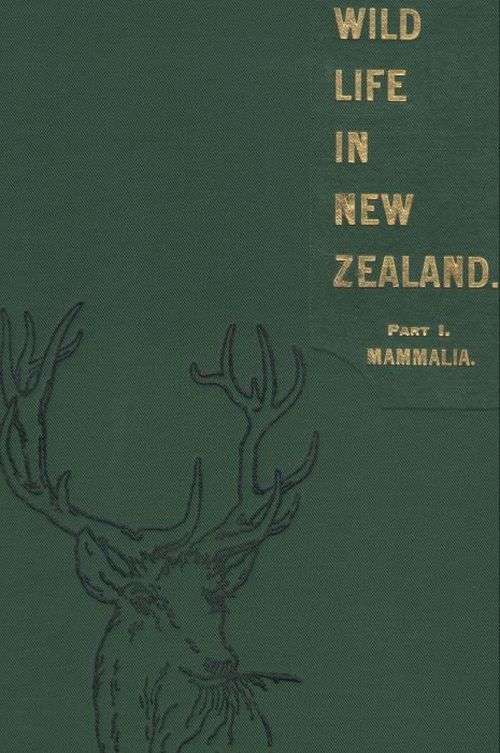
The antlers of the red deer are very complex. “In the spring of the year following its birth the antlers are nothing more than straight, conical, and unbranched ‘beams,’ the animal being then known as a ‘brocket.’ In the following spring the antler has, besides the ‘beam,’ a small branch from its base, directed forwards, known as the ‘brow antler’; it is then termed ‘spayad.’ In the third year an extra front branch is formed, known as the ‘tres,’ and the whole antler is larger. This ‘tres’ is sometimes seen in the smaller antler of the ‘spayad.’ In the fourth year the ‘brow-antler’ is doubled, to form the ‘brow’ and ‘bez-tine,’ at the same time that the top of the main beam divides into the ‘sur-royals’ of the ‘staggard,’ or four-year male. In the fifth year the ‘sur-royals’ become more numerous, the whole antler of the ‘stag’ being heavier than previously, only to be exceeded in weight by those of the fully adult ‘great hart,’ with ten or more points, each being larger and longer than the year before. In Britain the conditions of life and food are not of the quality which develops first-rate antlers; at the same time it is—in Scotland, at least—the habit to shoot those with the finest heads, and so leave the indifferent specimens to perpetuate the species. In some of the ancient forests of Germany superb herds of the red deer were to be obtained [this was before the war, of course], whilst in several of the old castles of that country antler trophies are preserved as memorials of sport in times gone by with as many as six-and-sixty points.”
It is clear that there are several distinct strains of red deer in the country, recognized chiefly by the form and growth of the antlers, which are usually what sportsmen look to. This mixing of breeds probably tends to the production of a strong race, and the efforts of the main acclimatization societies are directed—often, it must be admitted, rather blindly—to the elimination of defective deer. In the case of some of the large herds attempts are frequently made to thin out all weeds and deer with malformed antlers. According to Mr. Hardcastle, the majority of malformations occur in the skull and not merely in the horns, the horn-pedicle being often misplaced. In Otago these malforms are most common in open tussock land or open birch bush; they are not met with, as a rule, in rugged gorges or in rough and dense bush country. Perhaps malformation is due to want of nourishment at some period of growth, but there is no definite information on the point, nor is it known whether the trouble is hereditary or not.
The pairing season in New Zealand is in March or April, and at that time the stags are dangerous creatures. They drop their antlers usually about September, the youngest being the latest to do so. The fawns are born in November or December, and the animals continue to increase in bulk and strength till they are about twelve years old. They probably do not live more than twenty years, “though superstition credits them with very many more.”
Wherever they are abundant red deer live mostly on certain trees and shrubs, and eat grass only when other food is not obtainable. In the North Island it is stated that fuchsia is the principal food in spring and autumn, but that in winter they take to Veronica salicifolia (koromiko) and other shrubs. Probably they eat the majority of the native shrubs. In the South Island forests the following trees are mostly eaten: Broadleaf, species of Panax, Nothopanax, Coprosma, ribbonwood, pepper-tree, milk-tree, and tutu.[1] But when these are scarce they will eat almost any shrub. They will not eat birch or beech (Nothofagus), nor celery-pine (Phyllocladus), till other food is exhausted.
- [1]Note.—Tutu is not poisonous, but rather fattening, when animals become slowly accustomed to its use.
The first specimens appear to have been brought—a pair of them—to Nelson in 1851; but the doe was killed soon after, and the buck, after remaining about Motueka for ten years, joined a lot then introduced. In 1861 a stag and two hinds, presented by Lord Petre from his park in Essex, England, were landed in Nelson. The progeny of these animals increased, and rapidly spread themselves over a great part of the high country in the provincial districts of Nelson and Marlborough. Of late years they have farther spread into North Canterbury and over towards the West Coast. Mr. Hardcastle, who in 1906 wrote a report on the red-deer herds in the country, says, “The heads obtained in Nelson are of a good colour and fairly massive, but compared with those of Wairarapa and Hawea they have not the same average of span or spread. Lord Petre’s herd had had no new blood introduced into it for many years, so that a particular type of antler had been fixed from which there is no throwing back.” According to Mr. Hardcastle, the type of head of the first imported stag continues to persist, and dominates all the deer of the Nelson herd. (In 1900 a herd, descended from Nelson deer, was started in the Lillburn Valley, west of the Waiau River, in Southland.)
In 1862 a stag and two hinds, presented by the late Prince Consort to Governor Weld, were handed over by him to Dr. Featherston, then Superintendent of the Wellington Province, and were liberated on the property of Mr. Carter, East Taratahi, Wairarapa. They did not stay there long, however, but crossed into the Maungaraki Range, where they rapidly increased. Mr. Hardcastle reported in 1906, “The Wairarapa forest is probably the best-stocked red-deer ground on the globe. On Te Awaite Run, bordering on the east coast, the deer may now be seen in bunches of up to one hundred head. At the beginning of last year it was estimated that there were fully ten thousand head on the station. According to information given in The Field of the 15th September, 1906, the Windsor Park herd, from which the original stock came, has been replenished from English, Scottish, German, and probably Danish stock. The result has produced in the Wairarapa herd stags that are remarkable for their massive antlers, some of which are of the German type, and others again more resembling the Scottish form. The antlers do not grow to great length, but some are very wide in spread, and there is a great proportion of ‘Imperials,’ the most number of points recorded being twenty-two. The stags mature their antlers early. A number of heads have been shot on Te Awaite Station showing the abnormal development of the back tines, such as is seen to be the case in the great Warnham Park stags in England, and which is probably due to the highly favourable conditions of climate, food, and shelter.”
In 1871 the Otago Acclimatization Society imported fifteen red deer, some of which were sent to the care of Mr. Rich, of Bushy Park, Palmerston; while seven were liberated on the Morven Hills Run, east of Lake Hawea. Those at Bushy Park spread over into the Horse Range; but they did not succeed, and no definite explanation of the failure has been given. Probably the country was not high and wild enough: on one side they were encroaching all the time on well-stocked sheep-country, and on the other on old-settled farm land; besides which there were many old diggers still about the neighbourhood. From one cause or another they did not succeed. The Otago Acclimatization Society reported them as quite extinct in 1892, but Mr. Hardcastle, writing in 1918, says they are still to be found on the Horse Range.
The deer liberated at Morven Hills were from the estates of the Earl of Dalhousie, in Forfarshire, Scotland. They are the only lot of pure Scottish-bred deer in this country. In their new home in the New Zealand mountains they multiplied at a great rate, and have in these forty-odd years spread over the country between Lakes Wanaka, Hawea, and Ohau. They have worked their way up the Hunter and Makarora Rivers, across the Haast Pass into south Westland, and right up to the neighbourhood of Mount Cook. The most of this country runs from 3,000 ft. to 7,000 ft. in height, and much of it is very steep, rugged, and inaccessible. But it contains much bush in the valleys and gullies, and the open country is well grassed in summer. Hardcastle says, “The North Otago stags maintain the true Scottish type of antler, but they grow to much greater length than the antlers of any stags that have been shot in the British Isles. The antlers are also remarkable for their symmetry and perfection in the development of the tines, and particularly the lower tines. Some magnificent heads have been got, including a seventeen-and an eighteen-pointer, and two royals, each 46 in. in length of antlers; more recently a head 49 in. in length with a spread of 50½ in., and either one or two with twenty points, have been obtained. The coats of the stags are generally shaggy, owing, no doubt, to the severe climate in winter.”
In 1895 the Otago Society obtained two fine stags from the Hunt Club, Melbourne, to add to the North Otago herd; but I do not know what special strain these belonged to. Again, in 1913, the society imported a stag and six hinds from Warnham Park, England, the object in both cases being to introduce new blood into the herds.
In 1897 the Canterbury Acclimatization Society imported nine red deer from the Warnham Park herd, and liberated them in the gorge of the Rakaia River. They have increased rapidly since, herds of forty and more having been seen from time to time. Some of the heaviest heads secured in New Zealand have been got from this herd. The record length head from this herd is 48½ in.; the record spread is 46¾ in.; and the record points twenty-four. The heaviest heads shot in New Zealand have been obtained in the Rakaia Gorge herd, a number of dry skulls and horns from thence weighing from 22 lb. to 23¾ lb. Mr. Hardcastle, my informant, states that he does not think more than an odd head going as much as 20 lb. has been shot in any other herd in New Zealand.
More recent importations have been as follows: In 1903 either seven or eight fawns from Victoria, presented by Miss Audrey Chirnside, of Werribee Park, were liberated at Mount Tuhua, in Westland. In 1906 four more from the same source were added to this herd; and eight were liberated at Lake Kanieri. In 1903 the Tourist Department obtained eight deer from the Duke of Bedford, and liberated them at Lake Wakatipu. In 1908 four were obtained from Warnham Park, Sussex, England, and were liberated at Paraparaumu. In 1909 three were liberated at Dusky Sound.
The original importations of red deer account for the vast numbers of these animals which are now to be met with in so many mountainous parts of both Islands, for many of the acclimatization societies, as well as the Tourist Department, have obtained deer from one or other of these original herds, and have started new herds in other districts—for example, in the country round Taupo and Rotorua, the West Coast Sounds of the South Island, and Stewart Island—and these are all increasing. In regard to the last-mentioned locality, a conflict has now arisen between the would-be sportsmen of the Southland Acclimatization Society and those who desire to see the rare native bird fauna of Stewart Island preserved. It is to be hoped that no shooting of game will be allowed in the island.
Sambur Deer, or Sambar (Cervus unicolor).
This is a handsome deer from the hill-country of India. The stag stands about 5 ft. high, is of a deep-brown colour, with the hair of the neck developed almost into a mane. It is massively built, and carries great antlers over 3 ft. in length, and presenting three powerful points. Above the considerable brow-tine the beam bifurcates high up into two fairly equal snags, and no more, in well-grown antlers. The hind is much less massive, and of a yellowish tint. Captain Kinloch says of the species that “Sambur delights in stony hills where there is plenty of cover, and where they can have easy access to water. They browse more than graze, and are nearly nocturnal in their habits. During the daytime they seek the most shady retreats, and old stags especially are most difficult to find, frequently betaking themselves to almost inaccessible places, where the uninitiated would never dream of looking for them.”
The introduction of sambur into New Zealand is difficult to trace. In 1875 the Auckland Acclimatization Society received a buck from a Mr. Larkworthy, and in the following year a doe, but there is no further mention of these deer in the society’s reports. However, in the annual report of the Wellington Society for 1894 the following statement occurs: “The Ceylon elk (sambur deer) imported into the Carnarvon district, Manawatu, by Mr. Larkworthy have been brought under the provisions of the Animals Protection Act, and are at present under the control of the society. It has been reported that the herd now numbers about thirty.” There is no previous record of these deer in the Wellington Society’s reports. In 1900 the herd is reported to number about a hundred, “but there is good reason to think that they are really more numerous.... A pair of antlers was found on the hills near Cambridge, and two deer were shot there,” some two hundred miles from Carnarvon. In 1906 stag-shooting was opened for the first time in the Marton district (Rangitikei), but there were numerous complaints about poaching. The herd seems now to be a fairly large one, but the local Rangers complain of indiscriminate destruction of deer in season and out of season.
In 1907 the Tourist Department imported two sambur deer from Noumea, and liberated them in the Rotorua district, adding to them some others secured in the Manawatu, so as to form the nucleus of a new herd.
Virginian or White-tailed Deer (Cariacus virginianus).
In 1905 the Tourist Department imported eighteen white-tailed deer from America, and liberated nine of them at Port Pegasus, in Stewart Island, and nine in the Rees Valley, Lake Wakatipu. The former location should not have been chosen, for Stewart Island was long ago proclaimed a sanctuary for native birds, and its selection illustrates the haphazard way in which acclimatization work has been carried on in this country. The introduction and the location were both apparently the choice of Mr. Donne, of the Tourist Department, who is now in London. These deer have increased to such an extent that in October, 1919, regulations for shooting them were gazetted, which means that the island will cease to be a sanctuary. The white-tailed deer is about 3 ft. high. The upper part of the body is a bright chestnut colour in summer, changing to a yellowish speckled grey in winter, and with black markings on the face and tail. The distinctive feature, from which the popular name is derived, is the white colour of the underside of the tail. The antlers are rather large, up to 14 in. or more between the tips, and have as many as eighteen points in the largest specimens. I do not know whether they are very numerous in Port Pegasus, while there is no information available about the herd in the Lake Wakatipu region.
CHAPTER VI.
UNGULATA—WILD CATTLE, SHEEP, AND GOATS.
Wild Cattle.
The animals which form the group called the Bovidae (from the Latin bos, an ox), including cattle, sheep, goats, and their allies, differ in several respects from Cervidae, or deer. One of the most important differences is the structure of the horns. Those of the Bovidae are hollow and permanent, while the antlers of deer are made of solid bone and are deciduous, being renewed each year.
The wild cattle of New Zealand are (like the wild pigs) only domesticated animals which have been running in unfenced country for several generations back. They are not nearly so abundant to-day as they were forty or fifty years ago. In these earlier days most of the cattle on the larger runs—to whatever breed they belonged—were more or less wild. They became greatly excited when they saw a man on foot, for they were mostly accustomed to men on horseback, to whom they gave only a passing notice. When mobs of such half-wild cattle were to be yarded, either for branding of calves or for drafting, they were handled pretty roughly. On enclosed roads they were dangerous, and even in open country the presence of people on foot scared and often scattered them. It is no wonder that when such cattle got into wild country where they were undisturbed and never saw human beings they and their progeny quickly became quite wild. When I first came to Southland, about fifty years ago, we were bothered a good deal by wild cattle. They found shelter during severe winter weather in the extensive bush country which formed such a feature of Southland in those days, and they used to come into our paddocks overnight. Fences and ditches never troubled them: they hopped over them as if they were non-existent. In the open country it was impossible to approach them on foot, while even on horseback one had to make a wide circuit to get within range of them. The gradual settlement and enclosure of the land displaced them in time, and they are now found chiefly in distant and seldom-visited parts.
It is difficult to find exact records of the introduction of cattle into New Zealand. They were no doubt brought over by the missionaries, and also by the whalers who settled along the coast. Thus in 1833 John Bell set out from Sydney for Mana Island, in Cook Strait, with ten head of cattle and 102 sheep. Apart from a reference in Marsden’s journal to the landing of some cattle, this is the first record I can find since the days of Cook and Vancouver. In 1839 E. J. Wakefield saw wild cattle on the hills at the entrance of Pelorus Sound. In 1840 he states that they were abundant on Kapiti, and says that they were the descendants of some which were given to the Natives in exchange for flax. The Hon. S. Thorne George, writing to me four years ago, said, “When I first went to Kawau, in 1869, there was a large number of wild cattle. The island was originally occupied as a cattle-station, but owing to the rough country and heavy bush very many were lost and became quite wild.” Mr. A. C. Yarborough, of Kohukohu, informs me that forty years ago wild cattle were very numerous in all the bush country, and in those days Hokianga and the large areas of the west coast of the Island north of Auckland were nearly all covered with bush. The Natives used to kill them in large quantities for the sake of their hides, which were valued at 6s. to 12s. each. In later years these wild cattle have been driven farther and farther back, until they are now found only in the ranges distant from settlement. These cattle are merely the descendants of tame ones which have wandered, the Maoris’ fences being usually of a defective character.
The wild cattle of these early days were an extremely mixed lot, and it is hard to say to what breed they were most nearly allied. Shorthorns, Ayrshire, and Polled Angus were commonly mixed in the South Island, but all sorts of strains were represented.
Mr. B. C. Aston, who crossed over part of the Wellington district in 1914 and 1915, says, “Wild cattle are abundant in unfrequented valleys and gorges of the Tararua Range. They are apparently Hereford cattle gone wild. They eat out many species of native plants, and have destroyed great numbers of Ligusticum dissectum, which is one of the most abundant and characteristic plants of the higher ground.” He adds that cattle are particularly fond of certain native trees and shrubs, such as hinahina, karamu, broadleaf, mangrove, tawa, and karaka. I myself noticed in Ulva, in Paterson Inlet, forty years ago, that the only winter food for the cows was hinahina and similar small trees, which had to be cut down for them. My son Stuart informs me that wild cattle are found in the high country between Lake Wakatipu and the west coast of the South Island; their tracks are numerous, for example, in the valley of the Rockburn.
In 1841 cattle were first introduced into the Chatham Islands. Many of them soon became wild, and used to be trapped by the Natives in the early “sixties.” Wild cattle are now very numerous in the central tableland.
In 1850 cattle were landed on the Auckland Islands, but they were all killed off by sealers. In 1894 cattle were landed from the “Hinemoa” at Enderby and Rose Islands for the use of shipwrecked mariners who were unfortunate enough to be cast ashore on these inhospitable shores. Dr. Cockayne tells me that in 1903 there were about fifteen and ten head respectively on these two islands, and Mr. B. C. Aston adds that on Enderby Island they have exterminated the huge tussocks of Poa litorosa.
Wild Sheep.
The first attempt to introduce sheep into New Zealand was made by Captain Cook during his second voyage to this country. It was unsuccessful, but the record is interesting. He brought away two rams and four ewes from the Cape of Good Hope, but by the time the “Resolution” entered Dusky Sound in March, 1773, only a ram and a ewe survived, and they were in such a bad state, “suffering from an inveterate sea-scurvy,” that their teeth were loose, and they could not eat the green food which was given to them. Forster in his journal states that they “were in so wretched a condition that their further preservation was very doubtful.” However, they must have improved, for, considering the country about Dusky Sound too rough and forest-clad for them, Cook took them on to Queen Charlotte Sound, which was entered on the 18th May. In his journal he says, “On the 22nd, in the morning, the ewe and ram I had with so much care and trouble brought to this place were both found dead, occasioned, as was supposed, by eating some poisonous plant. Thus my hopes of stocking this country with a breed of sheep were blasted in a moment.” Most probably they had eaten tutu, which is common in the Marlborough Sounds district.
I cannot find when sheep were next brought into New Zealand, but as soon as settlement began they were freely imported from New South Wales. In those early days fences were very rough, and little or no attempt was made to keep sheep within enclosures. They were therefore allowed to roam freely over the open country, and were mustered at only rare intervals for shearing, tailing the lambs, culling, &c. It was inevitable, therefore, that numbers escaped the musterers, especially in high and inaccessible country, and that thus wild sheep became very common in the mountainous districts of the South Island.
Wild sheep are still abundant in some of the wilder parts of the country, and are especially numerous in the high limestone country of Marlborough. Much of this country is a terra incognita, for it is most inaccessible, except in certain rare states of the river-gorges, and very few people know anything about it. Mr. Aston, who recently visited this region on a botanical quest, says, “On the north-west side of Isolated Hill is a gently sloping tussock-land, stretching down towards the Ure River, on which are hundreds of wild sheep in small flocks of about half a dozen in each. All—rams, ewes, and particularly the lambs—are, as far as we could see, in excellent condition. Some were curiously marked and coloured. One had a brown body, black legs and face, and white forehead. The rams had large horns, and all were tamer than ordinary domestic sheep. Their food appears to consist of the silver-tussock (Poa caespitosa)—which was well eaten down—spear-grass, and several other native plants and shrubs.” In another part of his account he adds, “These sheep destroy the mountain-ribbonwood trees (Gaya Lyallii) by eating the bark, which we watched one stripping off in large sheets.”
In the district of Strath Taieri, in Otago, some forty years ago certain sheep on one of the runs—probably the progeny of a single ram—were found to be evidently short-winded. Apparently the action of the heart was defective, for when these sheep were driven they would run with the rest of the flock for a short distance, and then lie down panting. The result of this peculiar affection was that at nearly every mustering these short-winded sheep used to be left behind, being unable to be driven with the rest. Sometimes they were brought on more slowly afterwards, but if it happened to be shearing-time they were simply caught and shorn where they lay. As a result of this peculiar condition a form of artificial selection was set up, the vigorous, active sheep being constantly drafted away for sale, &c., while this defective strain increased with great rapidity throughout the district, for whenever the mobs were mustered for the market, shearing, or drafting, these “cranky sheep,” as they came to be called, were left behind.
This defective character appeared in every succeeding generation, and seemed to increase in force, reminding one of the Ancon sheep referred to by Darwin. At first, of course, the character was not recognized as hereditary, but as the numbers of this “cranky” breed increased to a very great extent, and spread over the district, it came at last to be recognized as a local variety. When the runs on which these sheep were abundant were cut up and sold, or released in smaller areas, the purchasers found it necessary, for the protection of their own interests, to exterminate the variety, of which hundreds were found straggling over the country. This was easily and effectively done in the following manner: As soon as a sheep of this variety was observed it was pursued, but after running for a couple of hundred yards at a great rate of speed it would drop down panting behind a big stone or other shelter, and seemed incapable for a time of rising and renewing its flight. It was immediately destroyed, and in this manner a useless—but to the naturalist a very interesting—variety was eliminated.
Sheep were introduced into the Chatham Islands in the early “forties,” but as late as 1855 there were only about two hundred of them. When sheep-stations were organized in 1866 there were about two thousand on the island, and by 1900 they had increased to about sixty thousand, and by this time a great many had become wild. Dr. Cockayne says they have profoundly altered the native vegetation by eating out many characteristic species of plants, such as Myosotidium nobile, Aciphylla Traversii, Veronica Dieffenbachii, and allied species, all of which they eat greedily.
On the Auckland Islands sheep have been liberated at various times since 1890, and on the Antipodes between 1886 and 1900, for the benefit of shipwrecked mariners, but they either died off or were killed by castaways. They were also liberated on Campbell Island between 1888 and 1890. In 1896 the island was taken up as a sheep-run—a piece of vandalism on the part of the men who did it and the Government which granted it—and in 1903 there were about 4,500 sheep on it. The changes produced in the vegetation have been described and discussed at length by Dr. Cockayne. In 1907, according to Mr. R. M. Laing, there were some eight thousand sheep on the island, and the transformation and destruction of the native flora was going on at a great rate.
Wild Goats.
The introduction of goats dates from Captain Cook’s second voyage. He says in his journal, “On June 2, 1773, I sent on shore on the east side of the sound [Queen Charlotte Sound] two goats, male and female. The former was something more than a year old, but the latter was much older. She had two fine kids some time before we arrived in Dusky Bay, which were killed by cold.” Forster in his journal says they were left by Captain Furneaux in an unfrequented part of East Bay, “this place being fixed on in hopes that they would there remain unmolested by the Natives, who, indeed, were the only enemies they had to fear.”
On the third voyage the “Resolution” was in Queen Charlotte Sound from the 12th to the 25th February, 1777, and Captain Cook says, “I gave Matahouah two goats (a male and a female with kid) and to Tomatongeauooranuc two pigs (a boar and a sow). They made me a promise not to kill them, though I must own I put no great faith in this. The animals which Captain Furneaux sent on shore here, and which soon after fell into the hands of the Natives, I was now told were all dead.”
It is popularly believed that the wild goats of New Zealand are descended from those introduced by Captain Cook; but while this may be partly true of those in the South Island, especially at its northern end, it can hardly explain those found in the North Island. It is more likely that they are descended from escaped animals. Mr. F. G. Gibbs tells me that goats were imported into Nelson some time in the “forties.” “In the ‘fifties’ a large number were kept tethered on some hills in the Maitai Valley, still called the Goat Hills. Some of these goats escaped into the back country, and were the progenitors of the wild goats.”
Wild goats are very abundant in many parts of New Zealand. Great numbers of them are to be met with in the rocky and precipitous country west of Palliser Bay, near Wellington. Except when they move they are difficult to see, as their colours blend almost undistinguishably with that of their natural surroundings. They were abundant also on Kapiti Island, but have recently been greatly reduced in number by the caretaker, who has shot several thousands. They also occur, though not so commonly, on the sparsely scrub-clad faces of the west coast north and south of Hokianga, as well as on the outskirts of bush land. In the high country of Marlborough they are very abundant, and are mainly of three colours—black (which is, perhaps, the commonest), khaki, and white. In a trip through the cañon of the Ure River Mr. B. C. Aston says, “The fusillades of stones showered down on us by the goats which we had disturbed were a source of ever-present danger.” Mr. W. R. Bullen, of Kaikoura, informs me that they are numerous on his run, but, while they eat very much the same food as the sheep do, they keep the scrub and bush open, so that the sheep can move through it.
Writing of things in the Lake Wakatipu district, Mr. L. Hotop, of Queenstown, tells me that there is an immense number of wild goats spread all over the Lakes district—a moderate estimate gives them as many as thirty thousand. “They are principally at Moonlight, Skipper’s, Sandhills, and at the lower end of the lake, seriously interfering with the pasturage in these localities; one runholder has paid year after year for as many as one thousand during the season. At Moonlight a digger, during the past nine months [in 1916], has shot 550. My informant tells me he was offered 2s. 3d. a skin for as many as he could send.”
Mr. W. H. Gates, of Skipper’s, writing in 1916, said, “There are a lot of wild goats here, almost within rifle-range of my cabin. One sheep-farmer gave 1s. for each pair of ears, and 1s. for each pelt. The male is a rough-looking customer; some have horns 15 in. in length and 2½ in. by 1¾ in. at the root, and they grow in a slightly spiral form. I think there is a strain of many breeds running through them all. Some have long hair, but are not the Angora breed. Some are almost white, but the chief colours are black-and-white or black-and-tan. I have noticed here (and also on the west coast) that the female has her young in the winter, when food is not plentiful. Why this is so I never could understand.”
Goats are still found wild on the Galloway Station, Central Otago, though not so abundantly as in former years. They live in the high country, and do not come down to the settlements. Mr. A. Gunn, who managed this large run for many years, tells me that they are of great use to sheep-farmers, as they keep down the “lawyers” (Rubus australis), and thus save the sheep from being entangled. In shooting them, if the wind is coming from their direction, you can smell them before you see them; and a billygoat is always found standing on guard while they are feeding. While they are of many colours, black-and-white is the commonest, though brownish-red, grey, and even occasionally a white one is found. They live in the roughest places they can find.
Goats are also found in considerable numbers round the south-east corner of the South Island, but whether they have escaped from the settlements about Preservation Inlet or have worked overland from Southland it is not possible to say with certainty. Probably the former is the explanation of their occurrence from Puysegur Point inland.
The attempts made from time to time to acclimatize goats on the outlying Southern Islands are of interest. Captain Enderby landed some on Enderby Island in 1850, and Captain Norman landed them on both the Auckland and Enderby Islands in 1865, but none appear to have survived. Dr. Cockayne says, “Two or three were landed on Ewing Island in 1895, but none have been seen recently. On Ocean Island, a very small islet in the Auckland Group, goats are numerous at the present time, but I have no details as to how they got there.” Captain Bollons, of the “Hinemoa,” writing me in February, 1916, speaks also of the last-named island, and adds, “Goats have been sent down from time to time to the Auckland Islands since 1890, most of which have either died or been killed off for food by castaways. At the Snares they were liberated about 1889, but soon died off. At Campbell Island some were landed in 1883 and 1890, and several were alive when the main island was taken up for a sheep-run in 1896. At the Antipodes several were liberated between 1886 and 1900, but were either used for food by the castaways or died off.”
Other Species of Bovidae.
The Tourist Department has in recent years introduced various species of large game into New Zealand. Thus a small number of thar, or Himalayan goats (Capra jemlaica), are now running wild on the Sealey Range, near Mount Cook. Apparently they are increasing rapidly.
Chamois are also increasing in the neighbourhood of Mount Cook. The first were introduced in 1907, when eight were received as a present from the late Emperor of Austria. By latest accounts there is now a considerable flock in that mountain region.
CHAPTER VII.
CETACEA—WHALES, DOLPHINS, AND PORPOISES.
How little any of us in New Zealand know about the monsters of the deep which are to be met with in the seas round our coasts! I seldom meet with any one who knows anything about them, or who can furnish me with anything beyond the merest shreds of information. I myself have seen a few whales and dolphins, and numerous porpoises; and this is the experience of all who travel by sea and care to observe its wonders. But such observers are few. Most of those whose business takes them on the great waters are concerned with other things than the animal life which the sea contains; and even fishermen, whose occupation takes them out constantly among this animal life, can give little information which is of the slightest value on anything but fishes.
Whales and their allies are not fishes, but are warm-blooded mammals, which suckle their young, and which breathe air—not dissolved oxygen, as fishes do. They constitute the order Cetacea. Twenty or more species are met with in New Zealand seas. Of these many are most imperfectly known, and several are only recognized by their bones.
Zoologically cetaceans are fish-like mammals, which have the tail expanded into horizontal flukes, the anterior limbs converted into fin-like paddles, and the posterior limbs represented by some rudimentary bones. Their bodies are nearly quite destitute of hair, and, as they have to breathe air, their nostrils are represented by a single or double blowhole, which is nearly always situated far back upon the skull. Some of the order have simple conical teeth; others have the jaws furnished with plates of baleen, or whalebone.
Whales include the largest of all vertebrate animals, but their reputed measurements, like those of many fish, have to be received with a grain of salt. The largest whales are the Rorquals, and perhaps 85 ft. is about the maximum recorded length. Compare that with the biggest dray-horse or the prize fat bullock at a show, and then try to realize what a huge bulk it is.
The whalebone-whales are well represented in New Zealand waters, though individuals are now rare compared with their relative abundance a century ago. A Norwegian company which started operations on a large scale in the North Island a few years ago abandoned the enterprise after trying it for a year or two. There was not enough money in it. Yet whalebone is enormously valuable—it was worth £2,000 a ton twenty years ago, and, in spite of numerous substitutes, it still keeps its place.
The Fin-back, or Rorqual (Balaenoptera musculus), runs up to 70 ft. in length, and yet its food seems to consist chiefly of small pelagic crustaceans belonging to the Copepoda. These little creatures, which can be taken by a fine-mesh surface net at all seasons of the year, vary from one-tenth to one-fortieth of an inch in length. It would be a somewhat difficult calculation to find how many of these little creatures would be required to assuage the appetite of a hungry whale. The whale has about 330 baleen plates on each side of its jaw, and these act as strainers to catch the little crustaceans. The production and destruction of inconceivable myriads of organisms are among the extraordinary and awe-inspiring phenomena of the sea.
Two other species of Balaenoptera are the Blue Whale (B. sibbaldii), which has been taken 85 ft. in length—the giant of its race—and the Pike Whale (B. rostrata), which seldom exceeds 30 ft.
The Humpback Whale (Megaptera lalandii) is so called because it has a lowish hump on its back, which represents the dorsal fin. Its maximum length is probably 60 ft. None of these whales, which are species with a very wide geographical distribution, are of much commercial value.
Of the “right” whales—which are merely the right kind of whales for the whaler to pursue, as their whalebone is longer and more valuable, and their oil more abundant and superior in quality to that of the other species named—the most important is the Southern Right Whale (Balaena australis). This animal is world-wide in its distribution, occurring in all seas but the Arctic regions, where its place is taken by the Greenland Whale (B. mysticetus).
Allied to this is the Little Australian Whale (Neobalaena marginata), which occurs only in the ocean south of New Zealand and Australia, and which grows only about 16 ft. long.
The most important of all these animals from a commercial point of view is the Sperm Whale, or Cachalot, an animal 60 ft. to 70 ft. in length—nearly one-third of it head—which used to be common in these southern seas, though mainly an inhabitant of warmer regions. The specific name—Physeter macrocephalus—refers to its gigantic head. The mouth is ventral in position, and the lower jaw is furnished with a great row of teeth, and according to Frank Bullen, who gives a picture of it, the animal turns over on its back like a shark when it is going to bite. I cannot vouch for the accuracy of this statement.
These animals are still fairly common, though they are persistently and unremittingly pursued for their destruction. Bullen, writing of Foveaux Strait in the “nineties,” says, “Only three days elapsed after our arrival when whales were seen. For the first time I realized how numerous these gigantic denizens of the sea really are. As far as the eye could reach, extending all round one-half of the horizon, the sea appeared to be alive with spouts—all sperm whales, all bulls of great size. The value of this incredible school must have been incalculable. Subsequent experience satisfied me that such a sight was by no means uncommon here—in fact, ‘lone whales’ or small ‘pods’ were quite the exception.”
The cavity lying below the skull in the great square head of this whale is filled with spermaceti, which is fluid fat during the life of the animal. Up till as late as the middle of the eighteenth century this oil was regarded as the brain of the cachalot. The most valuable product yielded by the Sperm Whale is ambergris, which is a product of the intestinal canal. When first extracted it has a greasy feel and consistency, and then as it hardens it acquires its characteristic sweet, earthy odour. It is occasionally found floating at sea or washed up on beaches, and it is extraordinary how constantly lumps of fat or tallow thrown overboard by passing vessels get picked up on the shore and are eagerly seized by the finders, who think they have discovered a treasure. I have had numbers of such finds brought to me for identification. They nearly always turned out to be chunks of mutton-fat. The value of ambergris is very problematical—anywhere from 5s. to 10s. per ounce, probably. As far as I know, it is used only in connection with perfumery.
Professor Beddard says of the Sperm Whale, “Its food is chiefly cuttlefishes, and it is said to have a predilection for those colossal cuttlefishes whose existence has until recently been doubted. Mr. Bullen has sketched a conflict between these two giants of the deep. On the other hand, it is said that its large throat, more than big enough to swallow a man (this whale is credited with being that which swallowed Jonah) does not usually admit fishes larger than bonitos and albacores.” Bullen’s account of this fight is worth reading by all interested in these creatures. It is, of course, unsubstantiated, and the illustration which accompanies it is in part imaginary and taken from the description. But the account is probably correct, and the fact of their choice of food is well authenticated. In another part of his work, describing the contents of the mouth of a captured Sperm Whale, he writes: “In the maw there were, besides a large quantity of dismembered squid of great size, a number of fish, such as rock-cod, barracouta, snapper, and the like, whose presence there was a revelation to me. How in the name of wonder so huge and unwieldy a creature as the cachalot could manage to catch those nimble members of the finny tribe I could not for the life of me divine! Unless—and after much cogitation it was the only feasible explanation that I could see—as the cachalot swims about with his lower jaw hanging down in its normal position, and his huge gullet gaping like some submarine cavern, the fish unwittingly glide down it, to find egress impossible. This may or may not be the case; but I, at any rate, can find no more reasonable theory, for it is manifestly absurd to suppose the whale capable of catching fish in the ordinary sense, indicating pursuit.”
Whaling was a most profitable industry in these Islands a century ago. Waikouaiti was a well-known whaling-station when John Jones started his settlement there over seventy years ago. Otakou (or Otago) was another; and it is not so long ago that the old trying-down plant was still lying about Harrington Point. Stewart Island and Foveaux Strait, Tautuku Bay, and other sheltered spots on the coast were all originally settled by whalers. But these days are gone, and the whales themselves are comparatively rare. Whaling, however, is still carried on by motor-launch from Tory Channel and other places.
Besides the species I have mentioned, another, allied to the Sperm Whale, is occasionally met with. This is the Pigmy Whale (Kogia breviceps), which differs in various anatomical respects from its larger relative, but most markedly in its size, for it seldom exceeds 15 ft. in length.
Several species belonging to the family of beaked whales have been described from New Zealand waters by the late Sir James Hector and other naturalists. They are by no means common animals, but one reason of their rarity may be the fact of their being chiefly found right down in the Antarctic Ocean, where they are scarcely disturbed, as they have little commercial value.
Of the Porpoise Whale (Berardius arnouxi) only four or five specimens have been met with, yet it is the only well-known species of the genus. “It is 30 ft. to 32 ft. in length, and is of a velvety black colour, with a greyish belly. Instead of lowing like a cow, this whale has been described as ‘bellowing like a bull’!”
Of the genus Mesoplodon, which are known as Scamperdown Whales, some five species are said to occur in New Zealand. They are moderate-sized whales, 15 ft. to 17 ft. in length, which have a world-wide distribution.
Another whale, known as the Goose-beak Whale (Ziphius cavirostris) is probably the only species of the genus, and its distribution is also world-wide. Beddard says of it, “Our knowledge of Ziphius dates from the year 1804, when a skull, ‘completely petrified in appearance,’ was picked up upon the Mediterranean coast of France, and described by the great Cuvier. It was forty years before another specimen was found. In the New Zealand specimen described by von Haast the body was scored by numerous lacerations. These wounds may have been due to fights among the whales themselves; the forwardly-situated teeth would be capable of inflicting such wounds. But it has also been stated that the armed suckers of gigantic cuttlefish are responsible for these scratches.”
Every one who has travelled up and down the coast, and most who have sat by rocks overlooking the open ocean, are familiar with the schools of porpoises which are so common in these southern seas. It is interesting to watch them from the deck of a steamer, and to see how they dash along near the surface of the water with their peculiar gliding movement, curving their bodies as they plunge in and out of the water. They keep a wonderful regularity in their distance from one another, moving as if by mechanical means with a remarkable rhythmic movement. Bullen gives a short account of porpoise-hunting in the “Cruise of the Cachalot.” He states that these animals have “no skin—i.e., hide—the blubber or coating of lard which encases them being covered by a black substance as thin as tissue paper. The porpoise-hide of the boot-maker,” he adds, “is really leather made from the skin of the Beluga, or ‘White Whale,’ which is found only in the far north.” I cannot say whether this is accurate or not, for though I have frequently seen porpoises at close quarters I have never seen them cut up. Our species—Cephalorhynchus hectori—is usually from 5 ft. to 7 ft. long; it is quite distinct from the common European species, which, indeed, belongs to a totally different genus.
The dolphin—Delphinus delphis—is perhaps the most familiar of all cetaceans. It is a world-wide species, which is particularly common in the Mediterranean. There it has been observed from very early days, and a great number of mythical stories have gathered round it; hence the stories of Arion and others. “The leaping of the dolphin out of the water is exemplified in many Mediterranean coins and coats-of-arms; the heraldic dolphin is represented with an arched back as in leaping.” Many of the animals usually claimed as porpoises are really dolphins.