
From "The Family of William Penn" by Howard M. Jenkins.
Four of William Penn's Grandchildren.
Painted by Sir Joshua Reynolds.
The picture shows the children of Thomas Penn—Juliana, Louisa Hannah, John, and Granville.
The soldiers did not fire, and the Paxton boys thereupon helped themselves to all the horses they wanted, took the ammunition wagons belonging to the regulars, and set out for Philadelphia. There were almost a thousand of them when they arrived on the high ground of Germantown, and there demanded that certain Indians who were being kept under guard in the Northern Liberties[2] should be given to them on pain of their sacking the city otherwise.
The citizens found that the regular troops could not be relied on, and sent some deputies to treat with the rebels. By agreeing to all the latter demanded, except the massacre of the Indians, the deputies were finally able to induce the mountaineers to return to their homes.
Very soon afterward the Assembly petitioned the English Parliament to abolish the Proprietary government. Before Parliament did this, however, another misadventure had occurred in the province. About 1762 fifty families from Connecticut had moved to the Wyoming Valley of Pennsylvania, and believing the country there to be very productive, they had made some clearings, built log cabins, and grown some fields of corn. John Penn, the governor, heard of this, and in 1764 he sent constables to this settlement to order the pioneers off, claiming that they were on land that had been granted to his grandfather.
The Wyoming settlement now numbered about three thousand persons, and naturally they were unwilling to give up their lands. Then a company was formed in Philadelphia to buy that section of the country from John Penn, and, making use of the improvements of the Connecticut settlers, market it as the company saw fit. They would only buy it, however, on condition that John Penn should first drive out the settlers.
So John Penn, in 1770, hired a crowd of rascals to go into the Wyoming Valley and drive the pioneers away from their cabins and fields. The settlers answered Penn's demands by building a fort which they christened Forty Fort, in honor of the first settlers, who were forty in number. They were always referred to as the First Forty, and were held in high esteem. They had been sent by the Susquehanna Company of Connecticut into the Wyoming Valley.
After some fighting the settlers managed to hold their ground. This became known as the Pennamite War; and, although the governor was backed by some of the leading men of Philadelphia, his attempts to oust the settlers made his rule more distasteful than ever to a people who were growing more and more fond of liberty.
The American Revolution was now at hand, and the Pennsylvania Committee of Safety decided that it was time to annul the charter that had been granted to William Penn, and abolish the Proprietary government. Therefore, two months after the Declaration of Independence was signed, in 1776, the Committee of Safety, now calling itself the "Supreme Executive Council," deposed John Penn from his office, and decreed that what had been the province of Pennsylvania should become a state in the new American Union.
The boundaries of Pennsylvania were by that time definitely settled, and incidentally those boundaries included the rich Wyoming Valley, where now stands the prosperous city of Wilkes-Barre. The title that had belonged to the Penn family was now vested in the state, and the state appropriated £130,000 to be paid to the heirs of William Penn. In addition to this amount the heirs of William Penn, having sided with the Tories during the Revolution, claimed a large sum from the English government after the Revolution, basing their claim on the Act of Parliament that agreed "to indemnify loyal subjects of his Britannic Majesty for losses suffered in the American War." The English government settled this claim by paying William Penn's heirs £500,000. As a result these heirs secured from Pennsylvania and from England more than three million dollars, besides retaining the private estates in Pennsylvania that they had always owned.
Eventually, therefore, Penn's province proved of very great value to his children and grandchildren, although the people who had opened up and settled that new country had gained little from those descendants; they had to look back to the great founder, William Penn, the noble and steadfast Quaker, for the liberty-loving ideas and wise principles of government that helped to make Pennsylvania one of the greatest of the new union of states. It is well that his name should forever be associated with that state, for it is the name of a man of noble character and a fearless champion of liberty.
FOOTNOTE:
[2] It is interesting to recall that this term, "Liberties," had been applied to certain tracts of land lying north and west of the original limits of Philadelphia. The soil contained in these tracts was called "liberty land" or "free lots" because William Penn had made a gift of land in these sections to the first purchasers of lots in the city proper, the amount of "free" land given being in proportion to the amount of "town" land that was bought. The term, "City and Liberties of Philadelphia," was commonly used in the early days of the province, the city containing about 1820 acres, and the Liberties about 16,236 acres. Later, the Northern Liberties became a part of the city of Philadelphia.
Printed in the United States of America.
The following pages contain advertisements of Macmillan books on kindred subjects
True Stories of Great Americans
Each volume illustrated, cloth, 12mo, 50 cents
It is the purpose of this new series to tell simply and attractively the life stories of Americans who have achieved greatness in different fields of endeavor. The author has been chosen in each instance either because he is particularly interested in the subject of the biography or is connected with him by blood-ties and possessed, therefore, of valuable facts. Only those, however, who have shown that they have an appreciation of what makes really good juvenile literature have been intrusted with a volume. The result is that the books are graphic, vivid reviews of the principal events in the careers of these makers of the nation.
ROBERT E. LEE. By Bradley Gilman.
CAPTAIN JOHN SMITH. By Rossiter Johnson.
BENJAMIN FRANKLIN. By E. Lawrence Dudley.
ROBERT FULTON. By Alice C. Sutcliffe.
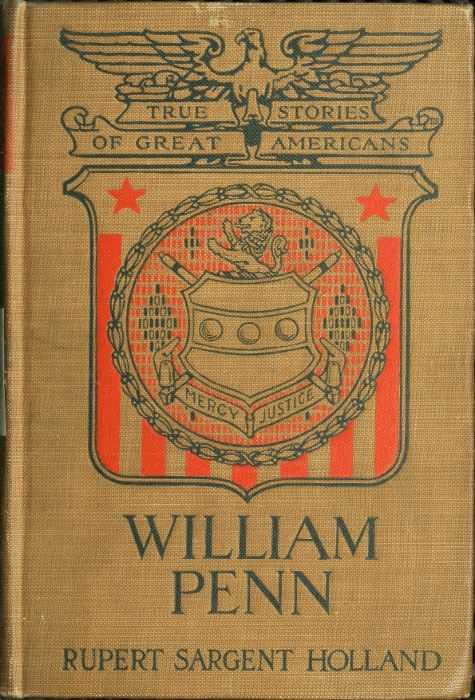
WILLIAM PENN. By Rupert S. Holland.
DAVY CROCKETT. By W. C. Sprague.
CHRISTOPHER COLUMBUS. By Mildred Stapley.
THE MACMILLAN COMPANY
Publishers 64-66 Fifth Avenue New York
NEW BOOKS FOR BOYS AND GIRLS
The Kingdom of the Winding Road
By CORNELIA MEIGS
With illustrations in color and in black and white by Frances White
Cloth, 12mo
A fanciful story relating the experiences of a beggar as he travels the country over in his tattered red cloak and playing his penny flute—in reality a wonderful magical pipe. He always knows the best thing to be done and he comes to the aid of the hero when he is in the worst distress. In his own fashion he helps the bad and the good alike. The book is part fairy tale, part romance, part allegory, but always literature. In a very human way the beggar stands for the soundness and sweetness of life and there are lessons that may be drawn from his adventures. But whether one bothers with the moral and the metaphors or not, there is an inescapable charm to the narrative and an interest and appeal that increases the further one goes on the beggar's highway.
A Maid of '76
By ALDEN A. KNIPE and EMILIE B. KNIPE
With illustrations by Mrs. Knipe
Decorated cloth, 12mo
The little heroine of this book is a girl of Revolutionary times, a patriot through and through, but whose family is loyal to the king. Out of the difficulties with which she finds herself confronted and which she brings ultimately to a satisfactory conclusion the authors have made a most entertaining story.
THE MACMILLAN COMPANY
Publishers 64-66 Fifth Avenue New York
MACMILLAN'S JUVENILE LIBRARY
Each volume, cloth, 12mo, $.50
NEW VOLUMES
The Fairy Queen and Her Knights
By ALFRED J. CHURCH
Peggy Stewart at School
By GABRIELLE E. JACKSON
The Little King
By CHARLES MAJOR
The Voyage of the Hoppergrass
By EDMUND LESTER PEARSON
Hero Tales of the Far North
By JACOB RIIS
Gray Lady and the Birds
By MABEL OSGOOD WRIGHT
Tommy-Anne and the Three Hearts
By MABEL OSGOOD WRIGHT
Southern Soldier Stories
By GEORGE CARY EGGLESTON
The addition of these eight titles to the Juvenile Library increases the usefulness and broadens the scope of that popular series of books for younger readers. Each of these stories will be found good reading, reading of the kind which specialists in the study of child literature can heartily recommend.
THE MACMILLAN COMPANY
Publishers 64-66 Fifth Avenue New York
The Everychild's Series
Edited by Dr. JAMES H. VAN SICKLE
Each volume, cloth, 12mo, illustrated, 40 cents
The Everychild's Series is a library of fiction and dramatics, science and information, literature and art for children. Its contents include a wide range of subject matter, which will broaden the child's interest in plays and games, fairy-tales and fables, nature study and geography, useful arts and industries, biography and history, government and public service, myths and folk-lore, fine arts and literature.
This series seeks not only to instruct the child with simplicity, charm, and wholesomeness, but to heighten his finer appreciation of the beautiful, and to give him, along with keen enjoyment, the things of life that are interesting and valuable.
The authors of the books of this series have been chosen for their special fitness to write books for children. To each author has been given the choice of topic and method of treatment. The result is that the books in the series are not only charming and enjoyable but intellectually satisfying to the child.
The volumes are interesting and attractive in appearance. They are neatly and strongly bound in cloth with design in two colors. The type page is set leaded in large type with a wide margin. The illustrations are numerous and attractive and designed especially to represent the characters that appear in the story.
The series is a splendid source of supplementary reading material. It consists of over a score of volumes.
THE MACMILLAN COMPANY
Publishers 64-66 Fifth Avenue New York