Chapter XV
There is not much more of the story of William Tell. The death of Gessler
was a signal to the Swiss to rise in revolt, and soon the whole country
was up in arms against the Austrians. It had been chiefly the fear of the
Governor that had prevented a rising before. It had been brewing for a
long time. The people had been bound by a solemn oath to drive the enemy
out of the country. All through Switzerland preparations for a revolution
were going on, and nobles and peasants had united.
Directly the news arrived that the Governor was slain, meetings of the
people were held in every town in Switzerland, and it was resolved to
begin the revolution without delay. All the fortresses that Gessler had
built during his years of rule were carried by assault on the same night.
The last to fall was one which had only been begun a short time back, and
the people who had been forced to help to build it spent a very pleasant
hour pulling down the stones which had cost them such labour to put in
their place. Even the children helped. It was a great treat to them to
break what they pleased without being told not to.
"See," said Tell, as he watched them, "in years to come, when these same
children are gray-haired, they will remember this night as freshly as they
will remember it to-morrow."
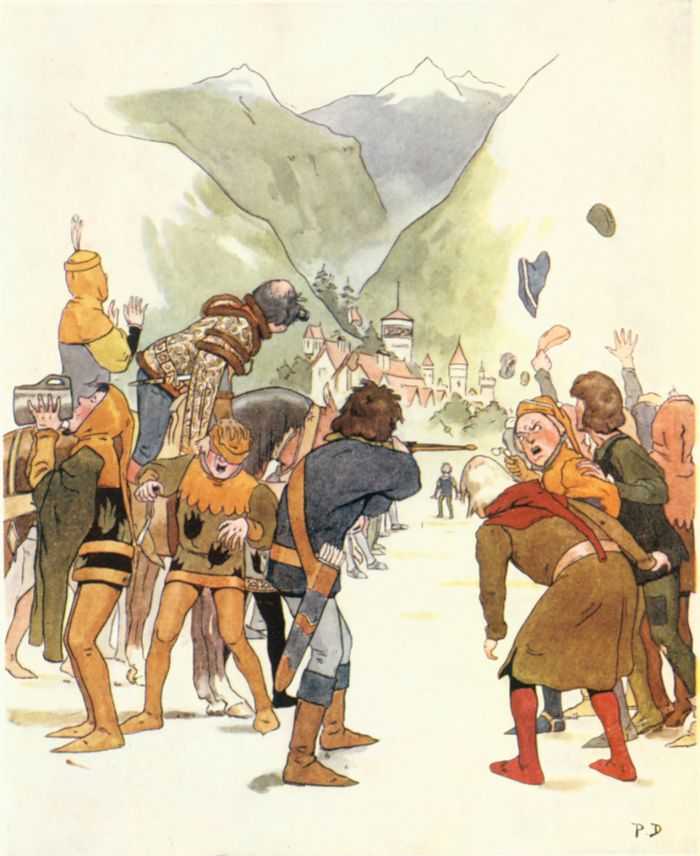
A number of people rushed up, bearing the pole which Gessler's soldiers
had set up in the meadow. The hat was still on top of it, nailed to the
wood by Tell's arrow.
"Here's the hat!" shouted Ruodi--"the hat to which we were to bow!"
"What shall we do with it?" cried several voices.
"Destroy it! Burn it!" said others. "To the flames with this emblem of
tyranny!"
But Tell stopped them.
"Let us preserve it," he said. "Gessler set it up to be a means of
enslaving the country; we will set it up as a memorial of our newly-gained
liberty. Nobly is fulfilled the oath we swore to drive the tyrants from
our land. Let the pole mark the spot where the revolution finished."
"But is it finished?" said Arnold of Melchthal. "It is a nice
point. When the Emperor of Austria hears that we have killed his friend
Gessler, and burnt down all his fine new fortresses, will he not come here
to seek revenge?"
"He will," said Tell. "And let him come. And let him bring all his mighty
armies. We have driven out the enemy that was in our land. We will meet
and drive away the enemy that comes from another country. Switzerland is
not easy to attack. There are but a few mountain passes by which the foe
can approach. We will stop these with our bodies. And one great strength
we have: we are united. And united we need fear no foe."
"Hurrah!" shouted everybody.
"But who is this that approaches?" said Tell. "He seems excited. Perhaps
he brings news."
It was Rösselmann the pastor, and he brought stirring news.
"These are strange times in which we live," said Rösselmann, coming up.
"Why, what has happened?" cried everybody.
"Listen, and be amazed."
"Why, what's the matter?"
"The Emperor----"
"Yes?"
"The Emperor is dead."
"What! dead?"
"Dead!"
"Impossible! How came you by the news?"
"John Müller of Schaffhausen brought it. And he is a truthful man."
"But how did it happen?"
"As the Emperor rode from Stein to Baden the lords of Eschenbach and
Tegerfelden, jealous, it is said, of his power, fell upon him with their
spears. His bodyguard were on the other side of a stream--the Emperor had
just crossed it--and could not come to his assistance. He died instantly."
By the death of the Emperor the revolution in Switzerland was enabled to
proceed without check. The successor of the Emperor had too much to do in
defending himself against the slayers of his father to think of attacking
the Swiss, and by the time he was at leisure they were too strong to be
attacked. So the Swiss became free.
As for William Tell, he retired to his home, and lived there very happily
ever afterwards with his wife and his two sons, who in a few years became
very nearly as skilful in the use of the cross-bow as their father.
EPILOGUE.
Some say the tale related here
Is amplified and twisted;
Some say it isn't very clear
That William Tell existed;
Some say he freed his country so,
The Governor demolished.
Perhaps he did. I only know
That taxes aren't abolished!
[Descriptive Verses]
|
Prologue
|
|
The Swiss, against their Austrian foes,
Had ne'er a soul to lead 'em,
Till Tell, as you've heard tell, arose
And guided them to freedom.
Tell's tale we tell again--an act
For which pray no one scold us--
This tale of Tell we tell, in fact,
As this Tell tale was told us.
|
|
|
Plate I
|
|
Beneath a tyrant foreign yoke,
How love of freedom waxes!
(Especially when foreign folk
Come round collecting taxes.)
The Swiss, held down by Gessler's fist,
Would fain have used evasion;
Yet none there seemed who could resist
His methods of persuasion.
|
|
|
Plate II
|
|
And pride so filled this Gessler's soul
(A monarch's pride outclassing),
He stuck his hat up on a pole,
That all might bow in passing.
Then rose the patriot, William Tell--
"We've groaned 'neath Austria's sway first;
Must we be ruled by poles as well?
I've just a word to say first!"
|
|
|
Plate III
|
|
The crowd about the pole at morn
Used various "persuaders"--
They flung old cans (to prove their scorn
Of all tin-pot invaders);
And cabbage-stumps were freely dealt,
And apples (inexpensive),
And rotten eggs (to show they felt
A foreign yoke offensive).
|
|
|
Plate IV
|
|
Said William Tell, "And has this cuss
For conquest such a passion
He needs must set his cap at us
In this exalted fashion?"
And then the people gave a cry,
'Twixt joy and apprehension,
To see him pass the symbol by
With studied inattention!
|
|
|
Plate V
|
|
At first the sentinel, aghast,
Glared like an angry dumb thing;
Then "Hi!" he shouted, "not so fast,
You're overlooking something!"
The sturdy Tell made no response;
Then through the hills resounded
A mighty thwack upon his sconce--
The people were astounded.
|
|
|
Plate VI
|
|
Could Tell an insult such as this
Ignore or pass? I doubt it!
No, no; that patriotic Swiss
Was very cross about it.
The people, interested now,
Exclaimed, "Here! Stop a minute
If there's to be a jolly row,
By Jingo! we'll be in it!"
|
|
|
Plate VII
|
|
Said Tell, "This satrap of the Duke
Is sore in need of gumption;
With my good bow I will rebuke
Such arrow-gant presumption."
"Stand back!" the soldier says, says he;
"This roughness is unseemly!"
The people cried, "We will be FREE!"
And so they were--extremely!
|
|
|
Plate VIII
|
|
They dealt that soldier thump on thump
(He hadn't any notion,
When on Tell's head he raised that bump,
Of raising this commotion);
Tell's arrow sped, the people crowed,
And loudly cheered his action;
While Tell's expressive features showed
A certain satisfaction.
|
|
|
Plate IX
|
|
Now, when the cat's away, the mice
Are very enterprising,
But cats return, and, in a trice--
Well, Gessler nipped that rising.
And when those soldiers lodged complaint
(Which truly didn't lack ground),
The people practised self-restraint
And fell into the background.
|
|
|
Plate X
|
|
And Tell, before the tyrant hailed,
No patriot you'd have guessed him,
For even his stout bosom quailed
When Gessler thus addressed him:--
"As you're the crack shot of these Swiss
(I've often heard it said so),
Suppose you take a shot at this,
Placed on your youngster's head--so!"
|
|
|
Plate XI
|
|
"The bearing," as they say, "of that
Lay in the apple-cation,"
And nobody will wonder at
A parent's agitation;
That anguish filled Tell's bosom proud
Needs scarcely to be stated,
And, it will be observed, the crowd
Was also agitated.
|
|
|
Plate XII
|
|
Said Gessler, "This is all my eye!
Come, hurry up and buck up!
Remember, if you miss, you die--
That ought to keep your pluck up.
The flying arrow may, no doubt,
Your offspring's bosom enter--"
But here there rose a mighty shout:
"By George! He's scored a centre!"
|
|
|
Plate XIII
|
|
But, as the arrow cleft the core,
Cried G. with indignation,
"What was the second arrow for?
Come, no e-quiver-cation!
You had a second in your fist."
Said Tell, the missile grippin',
"This shaft (had I that apple missed)
Was meant for you, my pippin!"
|
|
|
Plate XIV
|
|
With rage the tyrant said, said he,
"It's time to stop this prating;
I find your style of repartee
Extremely irritating.
You'll hang for this, be pleased to note."
On this they bound and gagged him
(For Gessler's castle booked by boat),
And through the village dragged him.
|
|
|
Plate XV
|
|
But slips between the cup and lip,
When least expected, peer through--
A storm arose upon the trip
Which Tell alone could steer through.
Thus, of all hands he quickly got
(As you may see) the upper,
At Gessler took a parting shot,
And hurried home to supper.
|
|
|
Epilogue
|
|
Some say the tale related here
Is amplified and twisted;
Some say it isn't very clear
That William Tell existed;
Some say he freed his country so,
The Governor demolished.
Perhaps he did. I only know
That taxes aren't abolished!
|
|