
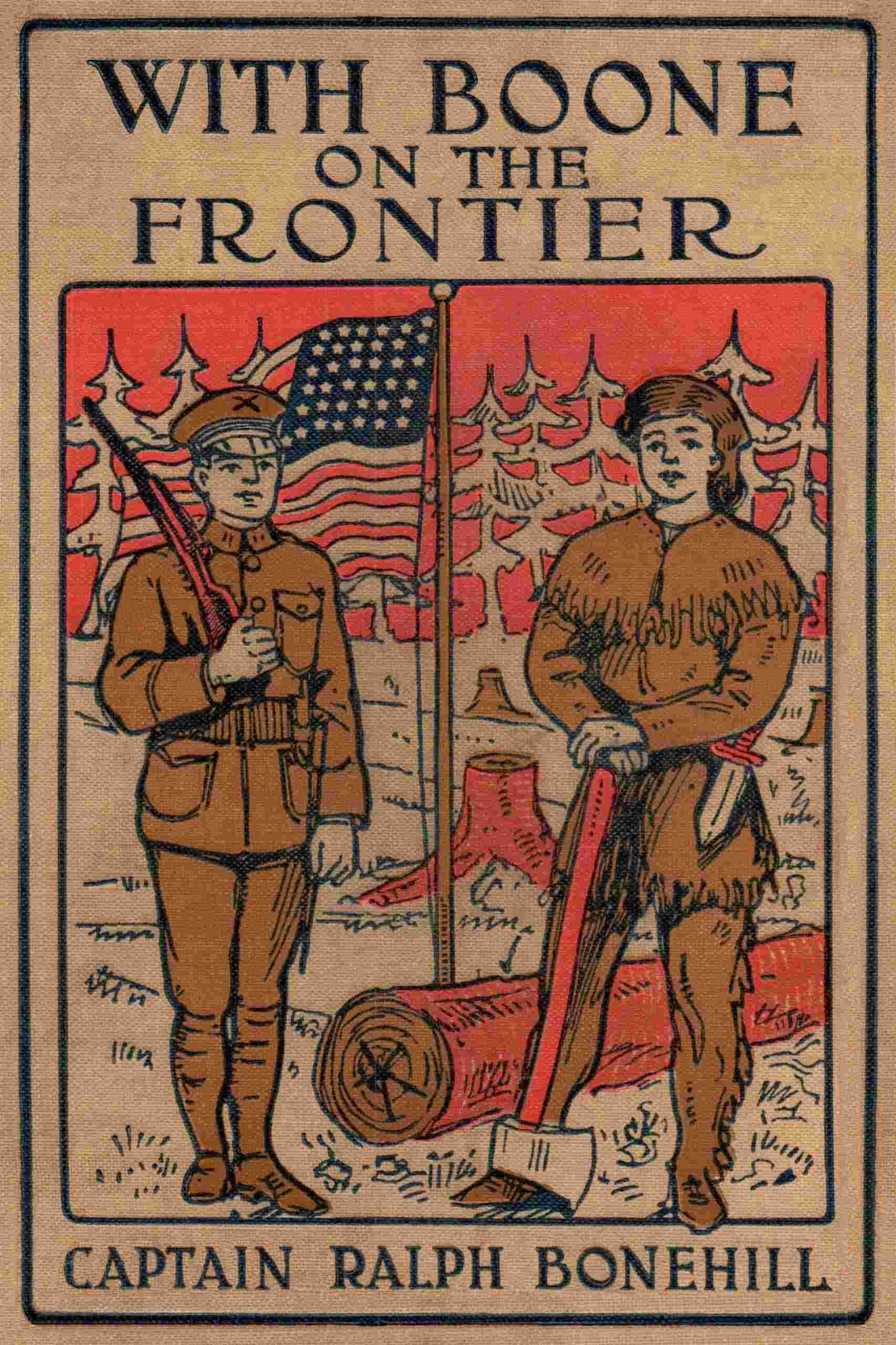
WITH BOONE ON THE
FRONTIER
CHAPTER I
TWO BOYS OF THE WILDERNESS
“Hark, Joe, what was that?”
“It sounded like the report of a gun, Harry. But I didn’t imagine that anybody was within gunshot of this place outside of ourselves.”
“That was what I was thinking. Do you imagine any of those Indians we met yesterday had guns?” went on Harry Parsons thoughtfully.
“I didn’t see any,” answered Joe Winship. “And if they had ’em I think we would have seen ’em,” he added, as he took up his gun from where it was resting against a tree and looked at the priming.
“We didn’t come out here to have trouble,” continued Harry Parsons. “We only came to see if we couldn’t bag a fine deer or two. If those Indians followed our party——”
The youth came to a stop, for at that instant another gunshot rang out, somewhat closer than the first which had attracted their attention. Then came a rush through the forest and a few seconds later four beautiful deer burst into view.
“Deer!” cried Joe Winship, and leveled his gun at the nearest of the game.
“Don’t shoot, Joe!” cried his companion.
“Why not?”
“If the Indians are after ’em we may have trouble.”
There was no time to argue the matter, for even as Harry Parsons spoke the deer leaped the small brook which wound its way through the mighty forest and in a twinkling were out of sight again. Then all became as quiet as before.
“Don’t hear any Indians,” was Joe Winship’s comment, after straining his ears for a full minute. “And lost a tremendously good shot,” he added regretfully.
“Well, it’s best to be on the safe side. If half a dozen redskins were after those deer we wouldn’t stand any show at all against ’em,” said Harry Parsons, with a decided shake of his curly-haired head. “You remember what our folks told us—to keep out of trouble.”
“But what beautiful deer they were!”
“You are right. And it isn’t likely they’ll come back this way——”
“Hush!”
As Joe Winship uttered the word he caught his companion by the sleeve and pointed through the forest to where there was an opening, perhaps an acre in extent, dotted here and there with small brushwood.
“What did you see, Joe?”
“A couple of Indians. There they are again—getting ready to cross the brook!”
“They came up quietly enough. What shall we do?”
“Let us get behind yonder bushes. They are on the trail of the game, and I don’t think they’ll come this way. But if they do we’ll have trouble just as sure as you are born,” concluded Joe Winship, and led the way to the shelter he had mentioned, quickly followed by his companion.
Joe Winship was a youth of fifteen, tall and as strong as outdoor life can make a boy of that age. He was the only son of Ezra Winship, a hardy hunter and pioneer, one of the number who did so much to build up our country in years gone by. Besides Joe, the family consisted of the boy’s mother and his two sisters, named respectively Cora and Harmony, both of whom were younger than himself.
Harry Parsons was a few months older than Joe. He too was an only son, and had one sister, Clara, two years older than himself. His father, Peter, had in years gone by been a cattle dealer doing business in and around Philadelphia, and had there married his wife, Polly, of Quaker stock.
It was during a visit to Williamsburgh that Mr. Peter Parsons had fallen in with Ezra Winship, about four years previous to the opening of this story. A chance acquaintanceship had ripened into true friendship, which speedily spread from all the members of one family to all the members of the other.
From Williamsburgh the Winships and the Parsons migrated to a small settlement in North Carolina known by the name of Jackson’s Ford. Here log cabins were built and some planting was done by the boys and the others, while Mr. Winship and Mr. Parsons spent a good deal of their time in bringing down game in the almost trackless forests to the west of the rude settlement—the game being used to supply the table with meat and the pelts being sold or traded for household commodities at a trading-post thirty-five miles away.
In those days—just previous to the Revolution of 1776—the great West was an unknown country to the American colonists. There were settlements in plenty along the Atlantic seacoasts, and for several hundreds of miles inland, but beyond this was, to them, the trackless forests and the unknown mountains, inhabited by game of all sorts and Indians.
One of the leading pioneers of those times, and one who will figure quite largely in our story, was Daniel Boone. Boone had already gone into the wilderness beyond the Kentucky River, and had come back to tell of the richness of the land there and the abundance of game. As a result a company was formed to settle the territory now known as the State of Kentucky, and among the first of the pioneers to take part in this move westward was Peter Parsons, who helped to erect a fort at what was afterwards called Boonesborough.
The settlement at Boonesborough was quickly followed by other settlements at Harrodsburgh, Boiling Spring, and St. Asaph, and when it became an assured fact that Kentucky was to be settled and held by the bold pioneers who had followed in the footsteps of Daniel Boone, Peter Parsons sent back word to Jackson’s Ford asking Ezra Winship to join him in this “far western country,” and bring all the members of the two families with him. He stated that he had selected two fine grants of land upon which they could build, and that upon his arrival Mr. Winship should have his pick of the two prospective farms.
In those days to move, especially with one’s household effects, was no easy matter, and it was a good two months before all was in readiness for the start. The Winship and the Parsons family did not go alone, but were accompanied by four other pioneers and their families and a pack train of fourteen horses, for to get anything like a wagon or cart through the wilderness was utterly impossible.
To the boys the move westward seemed to promise no end of sport, and they willingly did all they could to further the project. But the girls and their mothers dreaded to think of this step into the great wilderness, and Mrs. Parsons shook her head doubtfully as she said in her quaint Quaker way:
“Friend Ezra, since Peter wishes me to come to him, I will go with thee. But I am of a mind that our journey will be a troublous one, and that the Indians will not be as friendly as thee imagines.”
“Have no fear, Mistress Parsons, but that we will get through in safety,” answered Ezra Winship. “The trail has now been used half a score of times, so we cannot very well get lost, and as for the Indians, if we do not harm them I doubt if they harm us.”
But even though he spoke thus, Ezra Winship knew that all who were to move westward with him were sure to encounter more or less of peril. Wild animals roamed the forest, and the Indians, although apparently friendly, were not to be trusted. To this were to be added the perils of storms and of forest fires, and the dangers of crossing rapidly flowing streams in such frail craft as they could build, or upon horseback.
All told, there were five men and six boys in the train that started out from Jackson’s Ford one warm and pleasant day. Before the exodus began Ezra Winship called the men and the older boys aside and gave them a little advice.
“We are moving into a strange territory,” he said. “There is no telling what perils we may have to face. You have made me your leader, and that being so, I feel it my duty to warn each one to be on his guard constantly. In traveling, always be sure to keep the rest of our train in sight, and never discharge your weapons without reloading immediately. If any Indians appear, treat them well so long as they are friendly, but do not trust them too far.”
The progress westward was slow, but twelve miles being covered the first day, fifteen the second, and ten the third. The trail—a narrow path used occasionally by the buffalo and by the Indians—was an exceedingly rough one, winding in and out of the forest and along the banks of rivers and small streams. At certain spots were huge rocks, over which buffalo and Indians could scramble with ease, but around which the pack horses had to make their way slowly and cautiously.
The party were out a week before any Indians appeared. Then one of the pioneers announced that he had discovered three red men looking down upon them from a nearby cliff.
“They disappeared the minute I spotted ’em,” said the pioneer, whose name was Pepperill Frost, generally shortened to Pep Frost.
“We must be on our guard against them,” said Ezra Winship, and that night a strict guard was kept, but no red men appeared.
But the next afternoon, about three o’clock, four Indians showed themselves at a spot where the trail crossed a shallow, rocky brook. They came up with their hands before them and with their bows and arrows and other weapons slung over their backs.
“To what place journey our white brothers?” questioned one of the Indians, after the usual greeting in his native tongue.
“To some place where they can live in peace with our red brethren,” answered Ezra Winship cautiously.
After this the Indians said little, but begged for some tobacco and some Indian meal, a small quantity of which was given to them. They then departed into the forest, disappearing as rapidly as they had come.
“I think we’ll see more of those Indians,” said Pep Frost.
“I believe you,” answered Ezra Winship. “And perhaps they’ll not be so friendly another time. But do not alarm the women folks, for it will do no good.”
Early the following morning an accident happened which came close to proving fatal to one of the boys, Chet Rockley by name. He was driving a pack horse loaded with provisions along the river bank when the horse slipped and fell into the stream, carrying the lad with him. In the struggle that followed the boy was kicked in the head by the animal. Chet Rockley was rescued by Ezra Winship, but the horse was carried away by the swift current and drowned, and the provisions were lost.
It was decided to rest for two days, to care for young Rockley, and to bring in some game to take the place of the provisions which had been lost. A temporary camp was established at the fork of two small streams, and as soon as this was done the men folks and the boys took turns in going out hunting and fishing.
Joe and Harry had been cautioned not to go too far, and to keep a close watch for Indians. But their anxiety to bring in at least one good-sized deer had caused them to roam further from the camp than at first anticipated. They had seen no game until the four deer burst into view, closely followed by the two Indians already mentioned.