
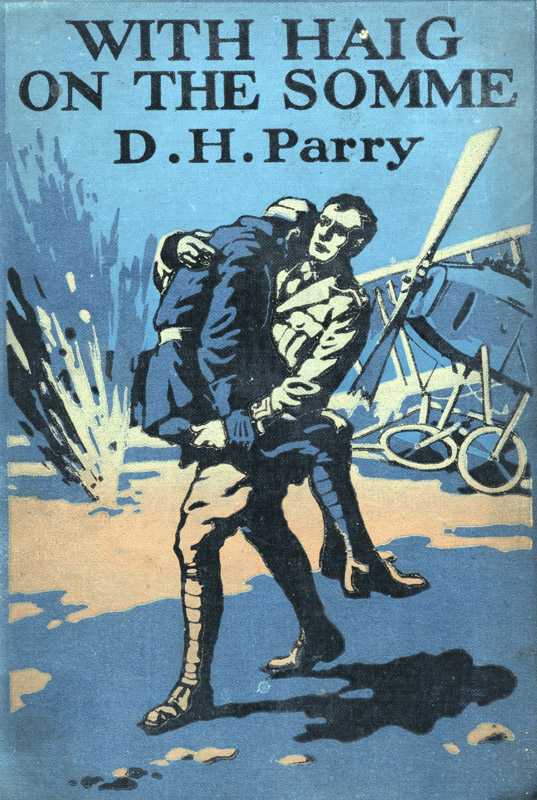
The Project Gutenberg eBook of With Haig on the Somme
Title: With Haig on the Somme
Author: D. H. Parry
Illustrator: Archibald Webb
Release date: October 21, 2008 [eBook #26982]
Language: English
Credits: Produced by Chris Curnow, Barbara Kosker, Lindy Walsh and
the Online Distributed Proofreading Team at
http://www.pgdp.net
WITH HAIG ON THE SOMME
With Haig on the Somme
BY
D. H. PARRY
Author of "Gilbert the Outlaw"; "The Scarlet Scouts";
"The V.C.: Its Heroes and their Valour," etc. etc.
With Four Colour Plates by
ARCHIBALD WEBB
CASSELL AND COMPANY, LTD
London, New York, Toronto and Melbourne
First Published 1917
"The Commandant threw up his arms and pitched backward; Dennis dropped his weapon and caught him as he fell"ToList
CONTENTS
| CHAPTER | PAGE | |
| 1. | An Uncensored Letter Read Aloud | 1 |
| 2. | Off to the Front | 14 |
| 3. | At Ten o'Clock Sharp! | 22 |
| 4. | His First Time under Fire | 33 |
| 5. | How Dennis came in for a Taste of Dispatch Riding | 42 |
| 6. | A Terrible Adventure at Dawn | 50 |
| 7. | A Friend in Need | 60 |
| 8. | In the Enemy Trenches | 70 |
| 9. | In the Sniper's Lair | 78 |
| 10. | In which Dennis Meets Claude Laval, Pilote Aviateur | 87 |
| 11. | A Daring Dash | 97 |
| 12. | In the Hands of the Enemy | 107 |
| 13. | A Mad Gamble for Liberty | 116 |
| 14. | The Sing-Song in the Dug-out | 128 |
| 15. | Reedshires!—Get Over! | 136 |
| 16. | The Silencing of the Guns | 146 |
| 17. | The Exploits of A Company | 155 |
| 18. | With the Lewis Gun—and After | 163 |
| 19. | What they Learned on the German Telephone | 173 |
| 20. | The Last Rung of a Broken Ladder | 183 |
| 21. | Von Dussel's Revenge | 191 |
| 22. | The Row in the Restaurant | 200 |
| 23. | Gas! | 210 |
| 24. | The Château at the Trench End | 219 |
| 25. | From Kite Balloon to Saddle | 229 |
| 26. | Under the German Eagle | 240 |
| 27. | On the Part Dennis Played in the Recapture of Biaches | 247 |
| 28. | The Exciting Adventures of "Carl Heft" | 255 |
| 29. | An Old Friend—and a Bitter Enemy! | 265 |
| 30. | Under the Enemy Wall | 275 |
| 31. | With Dashwood's Brigade | 284 |
| 32. | The Rewards of Valour | 295 |
LIST OF ILLUSTRATIONS
WITH HAIG ON THE SOMME
CHAPTER I
An Uncensored Letter Read Aloud
Private Harry Hawke, of the 2/12th Battalion Royal Reedshire Regiment (T.F.), sat on the step of the fire trench, his back against the parapet, busy with the bolt of his rifle.
There were two things he loved more than anything else in life, and that rifle was one of them. The other was his platoon commander, Captain Bob Dashwood, who chanced to be coming along the communication at the moment, and the Cockney private's eyes lit up as he saw him.
"Hallo, Hawke! All quiet?" said Captain Dashwood with a jerk of his head in the direction of the German lines, only one hundred and twenty yards across the mangled strip of Dead Man's Land that intervened.
"Quiet as the bloomin' grave, sir," replied Harry Hawke with a grin, though he had almost to shout to make himself heard.
A howitzer battery was shelling the enemy from the wood on the left, and the Germans were replying with "crumps," which luckily all went wide.
"Seen anything more of that sniper that picked Marshall and Brown off last night?" questioned the captain.
"Not likely, sir. I got 'im 'arf an hour after we took over the relief," grinned the marksman of A Company, pointing with an oily finger to a fresh notch cut on the rifle stock. "He tumbled out of the willer tree flat, same as if you chucked a kipper from the top of a bus."
Dashwood smiled, and the smile was reflected with interest in the wizened, mahogany-coloured face that looked up at his own from under the rim of the steel helmet.
"You're a terrible chap, Hawke," he said. "How many does that make?"
"Seventeen with the rifle, sir, but I've kept no tally of all I've done in wiv the bayonet," and he caressed his beloved weapon.
"Don't get up, Hawke," said his officer, moving along the trench. "I'm only going to take a squint at the beggars," and as the private dropped back into his seat again, Bob Dashwood put his foot on the fire step and raised his head above the parapet.
He looked across a broken waste, full of shell holes and mine craters, with a line of barbed wire fencing that followed the curve of the white enemy trench capped by sandbags.
The marksman, having got rid of an imaginary speck of rust that had troubled his soul, replaced the bolt, and was putting away the oil rag, when there was a sharp stifled gasp, followed by a slithering fall, and Captain Dashwood lay in a heap among the white wet mud at the bottom of the trench. His cap had spun round and dropped into a sump, and the blood was pouring down his face and neck as Hawke reached him.
"'Strewth, he's dead, and it's my fault!" he moaned, as a sergeant and several other men ran up.
"It was nobody's fault but his own," said the sergeant savagely. "I've warned him a dozen times—and he's not dead, either. Pass the word there. We must get him down to the aid post sharp."
While Hawke supported the battered head upon his knee the sergeant hastily applied a field dressing, and when a couple of bearers came running along the communication trench they laid the wounded man carefully on the stretcher, Hawke watching the receding figures with a dazed look until the angle hid them from view.
"Now, you rotter, I've got to get you set!" he muttered, bending down and peering into the periscope with his rifle gripped tightly in his hands.
Two or three days later news came up that the captain, still unconscious, had been sent to London straightway from the base hospital, and then for several weeks they heard no more of him, and a fresh notch cut on the stock of the Mark III. gave Private Harry Hawke very little satisfaction.
"If I hadn't told him that all was clear he'd never have shoved his 'ead over the blinkin' sandbags," he kept muttering to himself. "Home ain't like home without a mother, and I reckon 'e was father and mother to us all art 'ere. Wish I was dead—I'm fed up!"
"By Jove, mater, this is good news indeed. Fancy Dennis being gazetted to our battalion after all!" and Captain Bob's face lit up as he looked across the breakfast table with the telegram that had just arrived in his hand. "Only got a week's kit leave too, which means that he's to join at once. I'll put him through his facings and show him just what to get and what not to get, and if the Medical Board will only pass me fit for service again we can go over together. He will be here this morning too!"
A chorus of delight went up from the four youngsters on one side of the table, and Master Billy Dashwood, aged eight, clapped his hands and overturned the milk jug.
"Billy, Billy!" said his mother reprovingly. "When will you learn to behave yourself and to take care?"
"When will you let me join the Boy Scouts?" retorted her youngest born, gazing up at the ceiling with the face of an innocent cherub, and Mrs. Dashwood was obliged to smile as she looked at her eldest son.
"Your father will be very pleased, Bob," she said. "There have been Dashwoods in the regiment for generations, and it is nice to feel that both my boys will be in a battalion in their father's brigade."
"You should be very proud, madame, that yours is such a military family," said a young man who sat opposite to the children with his back to the tall windows. "Let me see, you will now have four members serving at this great crisis?"
"Yes, it is an honour of which I am indeed more than proud, Monsieur Van Drissel," said his hostess.
"But Uncle Eric doesn't count—he's only at the War Office, and they do nothing there," interposed the irrepressible Billy.
"I shall send you out of the room if you're rude," said his mother. "The War Office is a most important branch."
It was a pleasant room in a charming house, whose grounds sloped down to the ornamental water in Regent's Park, and if one had not known it, one might have imagined it to be one of those countless English homes into which the war had not penetrated.
Captain Bob, looking very different now from the crumpled figure at the bottom of the trench, had escaped death from the sniper's bullet by a fraction of an inch, but he had made quick recovery, and before his month's sick furlough was at an end he was already secretly yearning to get back again. He knew that there was a great push in contemplation, and his only fear was that he might not be in it.
Everything in that room spoke of comfort and money, and everything was very English, except the young man with his back to the windows, and the young woman with the dark eyes on the opposite side of the table.
Lieutenant Van Drissel, of the Belgian army, whose wound, received in the fighting outside Dixmude long months before, obstinately refused to heal, found himself in very pleasant quarters, thanks to the hospitality of Mrs. Dashwood, who had also given his sister an asylum as French governess to the small fry.
Like Captain Bob, he was in khaki, but the contrast between the two officers was very striking. The one was lean and athletic in every line of his figure, with laughing grey eyes in a handsome face; the other, a stolid, fair-haired Fleming, whose square visage would have been rather colourless and commonplace but for the pleasant smile which showed his white teeth.
He followed Mrs. Dashwood's every movement with the expression of a grateful dog, and waited upon her hand and foot, doing his best to justify his presence there.
"Ah, you have better luck than I, Dashwood," he said in perfect English, with a doleful shrug of his shoulders.
"Don't worry, Van Drissel; keep smiling, as my fellows sing," laughed Captain Bob encouragingly. "Your turn will come, and we shall both march into Berlin one of these days."
"It is a long time," said the Belgian lieutenant gravely. "Even Ottilie here loses heart," and he looked across the table at his sister.
Mademoiselle Ottilie, as dark as her brother was fair, heaved a deep sigh and made a funny little gesture with her hands. "For myself, I dread to go back to poor Belgium," she murmured in broken English. "I wish it might be possible that perhaps I might stay here for evaire—you are all to me so kind."
"Mamma," said Billy with a perfectly grave face as he mimicked her accent, "I wish it might be possible that perhaps I could have that last piece of toast, eh?"
"Billy, go out of the room," said Mrs. Dashwood severely, but Mademoiselle Ottilie threw an impulsive arm round the young monkey's neck, and looked appealingly at his mother.
"Oh, no, please not, madame. He is so young," she interposed.
"Well," said Captain Bob, rising, "I think it's the weather that has given you the hump, old chap. Still raining," and he glanced at the windows. "What do you say to a game of billiards? I'll play you three hundred up if you like."
"With all my heart," replied Van Drissel, getting up with a limp and opening the door for Mrs. Dashwood, and the two officers went into the billiard-room, whence they were no more seen for a couple of hours.
"Hard luck," said Bob Dashwood at last, as the Belgian missed an easy shot. "And you've left them for me, too. I'm afraid your leg is worrying you."
"Oh, that is nothing," replied his companion with a wry smile, as he limped towards the scoring board. "You only want five to win."
"And there they are," said Bob apologetically, as the white ball followed the red into a pocket. "But, you know, you're playing a very good game."
"It is nice of you to say so," replied the Belgian. "Unhappily, I have so much time for practice these days," and he lit a cigarette. "There is not much news in the papers this morning."
"The calm before the storm, my boy," smiled the captain with a twinkle of his grey eyes. "There will be some big news directly. By Jove! you ought to see the munitions they're piling up behind us. It is incredible! The worst of it is, our sector simply swarms with spies, and the beggars get to know everything almost as soon as we know it ourselves; in fact, sometimes before.
"They're very slick," the captain went on. "As a matter of fact, Germans often come over into our lines in British uniforms, and they are so thundering clever that you can't tell the difference. Why, not long ago, I yarned for half an hour with a major of the R.E., as I thought—didn't tell him much, luckily, but we hadn't parted five minutes when he was 'wanted,' and there was no end of a hunt, but he managed to get clear, and a genuine English major was within an ace of being shot in mistake for him if he hadn't been recognised by one of the staff in time."
"Ah, there you are," said Van Drissel. "When do you think Sir Douglas Haig will make a move?"
"Almost directly," said Captain Bob. "The day before I was wounded I had it on first-rate authority that—— Hallo! here's my young brother. Excuse me, Van Drissel," and without further ceremony he darted into the hall as a lad in the uniform of the O.T.C., who had just got out of a taxi, flew up the steps three at a time and dashed in with a shout.
"Why, Bob, old boy!"
"Dennis, dear old man! This is a bit of luck! How are you?"
"Top-hole!" laughed the new-comer, beaming all over his face, which was a clean-shaven, boyish reproduction of his brother's, brown as a berry from the arduous training he had undergone with the Artists', and, breaking loose from Bob's grip, he kissed his mother tenderly.
"You got my wire, dear little mater, but you didn't expect me so soon. It is good to be home again, even if it's only 'How d'you do?' and 'Bye-bye.' But isn't it fine putting me in Bob's battalion? How are the kids? And, I say, mater, is there any grub going? I didn't wait for breakfast before I left, and I'm hungry as a hunter."
The wounded Belgian lieutenant in the adjoining room bit his lips as he overheard the joyful greetings. The rain had cleared, and as he stood looking out where the trim lawn sloped down to the water, he saw a couple of English Tommies in hospital blue sculling round one of the tufted islets.
"Dennis, let me introduce you to Lieutenant Van Drissel, of the Belgian army," said Bob, coming in as Van Drissel turned round. "This is my brother whom we have been talking about," and the two shook hands.
"Glad to meet you," said Dennis frankly.
"Lucky bargee," smiled Van Drissel. "Isn't that right?"
"Ah, you speak English? Yes, it is quite right. I am," laughed Dennis.
"He speaks everything under the sun," said his brother. "And, by the way, Dennis is a great stunt on languages. You two will be able to make us feel thoroughly ashamed of ourselves. My regular verbs are as rusty as a trench button."
"Will you smoke?" said the Belgian, producing a silver cigarette-case.
"Not just now, thanks. I'm going to have some grub first, and if you don't mind I'll bunk upstairs and get a sluice."
"That boy is one of the best in the world, although he's my own brother," explained Bob Dashwood when Dennis had gone.
"How old?"
"Eighteen and a half," replied Bob.
"It is young to be killed," said Van Drissel gravely.
"But he isn't killed yet. Never knew such a fellow for falling on his feet. Of course, we all have to take our chances out there, but I don't mind betting you he comes off with a D.S.O. or a Military Cross, or something or other. You will hear of him yet, mark my words."
Thanks to Bob's experience, the kit buying did not take long, and in three days the boy sported his service uniform, to the rather oppressive admiration of Billy and the huge delight of his sisters. The Medical Board, too, had passed Bob as fit for service again, and the kit leave went like a flash.
Altogether, it had been a great week, with Dennis like a sea breeze filling the house with his wonderful spirits. There were people to dinner almost every evening, among them Uncle Eric, who was a staff captain at the War Office.
And then it all came to an end, and the last night arrived, and the mother and her two soldier sons sat down to dinner alone.
Mademoiselle Ottilie pleaded a headache, and her brother also invented an excuse for being absent.
"You would like to be together," he had said confidentially in Bob's ear.
"They are very charming and considerate," said Mrs. Dashwood when Bob told her. "I do not care very much for Belgians, as a rule, but the Van Drissels are exceptionally nice people."
Dennis said nothing, but he had his own thoughts. He did not like mademoiselle's bright black eyes, and the lieutenant's perpetual smile had begun to get on his nerves.
Mrs. Dashwood had kept up very bravely, though her heart was sad enough in all conscience, and when eleven o'clock struck, and Dennis, who had been living at high pressure, suddenly yawned and said: "Would you mind, mater, if I turned in? I'm as tired as a dog." Mrs. Dashwood made no demur, but signed to her eldest son to remain a little longer.
"Come into the drawing-room, Bob," she said, when they heard Dennis close his bedroom door with a bang. "I have a letter from your father which I want you to read. I did not show it to Dennis because he is excited enough already."
"Any news, dear?" questioned the captain as they seated themselves on the great padded settee, into which one sank so luxuriously that one never wanted to get out of it again.
"Yes, there is news. I suppose he has really told me more than he ought to have done. The date of the Great Push is fixed. But here is the letter; it only came this evening, and you can read it aloud to me."
As he did so, Captain Bob's eyebrows lifted, for the brigadier had been remarkably outspoken.
"We are going to make a simultaneous advance, we and the French on our right," he wrote in one place. "Our sector will bear the brunt of it. The thing has been kept wonderfully quiet, and so far the enemy knows nothing. All their attention is turned on the 'Clown' Prince's insane operations against Verdun, and the German General Staff seem to have forgotten the Somme region altogether, and to underrate the British as usual. But there will be a big surprise for them.
"My fellows are in fine fettle; in fact, so is the whole army corps in this region," he continued. "You should see the artillery we have massed ready for the preliminary bombardment, which promises to be the biggest in history. I hope Bob will be out in time, but I have no news of Dennis, and, between ourselves, I am not really sorry."
"By Jove! the governor's let himself go for once in his life," said Bob, when he had finished the letter. "Half a minute, mater, I'll show you all these places on the map, and then when the thing comes off you will be able to follow it," and, going out into the hall where his brother's kit was ready for the morning and his own simple outfit with it, he returned with a chart of that sector of the British line where it joined up with the French.
The ormolu clock on the mantelpiece struck half-past twelve before he had finished his lecture, which Mrs. Dashwood followed with the keenest interest, and when at last they got up, the brave little mother clung to him for a moment, very near to the breaking point.
"You will look after Dennis, Bob, as far as you can?" she said in a hushed voice. "He is very young and very impetuous, and regards the whole thing as a glorious game to be played as keenly as he plays rugger."
"You know I will do all I can, darling," he said, taking her face in his hands and kissing it, and then she passed out, and he switched off the lights.
When the drawing-room door closed a figure rose from behind the settee, where he had crouched all the time, and Anton Van Drissel dusted the knees of his khaki trousers.
"Ach Himmel!" he muttered in German. "It is worth a stiff back to have heard what I have heard to-night!"
CHAPTER II
Off to the Front
He stood quite still for fully five minutes to make sure that they had really gone, and then he stole with catlike tread over the noiseless carpet, and, opening the door, listened again.
The billiard-room was at the opposite end of the vestibule, and, closing the door gently behind him, he switched on the electric light, which revealed Mademoiselle Van Drissel evidently waiting for him.
"What have you learned, Anton?" she whispered in German.
"I have learned everything, my little wife," he replied. "We leave this house to-morrow, as soon as those two fools have gone to catch their boat-train."
"Zo!" she exclaimed, clasping her hands. "I, for one, shall be delighted. I shall have but one regret."
"And what is that, Ottilie?" inquired her husband.
"That I shall not be able to twist the neck of that detestable little pig-dog, Billy, before I go. Ach, Anton, you do not know how I hate the little beast!"
"I do not love him myself," said the spy, seating himself beside her. "Listen, this is a good opportunity for us to talk without interruption, and there is much to be arranged. You will stay in London; I shall cross over to-morrow night from the usual place, for my information must be in the Kaiser's hands without delay. It is now June 20, and the great attack is to take place on the first day of July."
As he spoke he drew out a pocket-book, and the girl leaning over his shoulder read the words he wrote down rapidly while all he had overheard was still fresh in his memory.
"Is it possible?" murmured his female confederate. "Our time has not been wasted after all, then. Our people knew what they were doing when they sent us to this house."
"Our people always know what they are doing," said the sham Belgian, with a cunning leer. "What would you have? A family, the father of which is a brigadier-general at the front; the eldest son also a captain at the front; and the young boy on the point of joining the Army. They were just the very people likely to talk, to say nothing of that greatest fool of all, Uncle Staff Captain, who told me a great deal when he dined here on Wednesday. Ottilie, these English are lunatics, and it is not for nothing that we have opened their letters for the last six months without their discovering it. Still, I must confess I had never expected a piece of luck so complete and so timely as this," and he tapped the notebook in which he had recorded everything.
He stooped towards her and kissed with as much affection as lies in the German nature to bestow upon anyone outside itself, and when he spoke again his whisper was very earnest.
"You had a headache to-night—good. You can make the excuse in the morning to visit the pharmacy in Shaftesbury Avenue. I need not tell you where you will really go. But tell them that word must be sent to Fritz Hoffer to take me off at the old spot at seven o'clock to-morrow night."
"Are you certain of a train that will get you there in time?"
"I shall not bother about trains," he replied. "The Kilburn Rifles are doing coast duty there, and I will borrow Dennis Dashwood's motor-bike ten minutes after their car has left for Charing Cross. I shall be in the vicinity of Folkestone before their train arrives, and may possibly pass them in the Channel."
"Sure everything's in?" said Captain Bob with a keen glance round the hall, which looked so pathetically empty now that the little pile of brown cases had been carried to the car. "Well, time's up. Au revoir, mon lieutenant. I must air my bad French, you know," and he shook hands warmly with the "Belgian officer," who stood bareheaded on the step to see them off. "Hope to meet you over there one of these days. Buck up and get all right, you know."
"We shall meet, never fear; perhaps sooner than you think," said Van Drissel with a quiet smile. "Good-bye and good luck to you both."
Then the skunk saluted, and the car drove off, Mademoiselle Ottilie waving her handkerchief. Now they were gone, and as the three little girls filed back into the hall wiping their eyes, the Van Drissels exchanged a look.
"You have nothing that matters if you leave it behind?" said the man.
"Nothing at all—a refugee is not supposed to have belongings," replied his wife.
"Very well, do not go yet until you have heard me start the engine. Then when I have gone, walk quietly out of the house just as you are. They might trace a taxi."
The motor-car came to a stand outside Charing Cross Station, and Mrs. Dashwood's heart seemed to come to a stand with it. In less than half an hour she knew she would have parted with her boys, perhaps for the last time, but she kept a brave face as Bob helped her out, and they found themselves on the fringe of the busy throng that every day marks the departure of the boat-train.
There were not quite so many people as usual, for nearly all leave had been stopped.
A porter, well over military age, followed them through the barrier on to No. 2 platform, where the long train was waiting. Three men of the Lincolns, loaded with packs and rifles and bulging haversacks, were looking for three seats in the same compartment.
A family of eight, of assorted sizes, were gathered round a short private of the A.S.C., all talking at once. Farther along, a very pale officer of the Northamptons, going out for the first time, stood with three ladies, keeping his end up very well. Three lieutenants going back from short leave, and lucky to get it, stood chattering, with red V's on the back of their tunics, and as he passed them Dennis saw that they belonged to the Northumberland Fusiliers.
Bob had secured places in the Pullman, and they walked along the train until they reached it, and read the name "Clementina, seats 1-19," and when their clobber had been put inside they stood on the curving platform, watching the scene.
A chaplain with three stars on his black shoulder-straps and a pipe in his mouth was talking to a tall curate, and two French officers in the new blue-grey uniform, with black belts and gaiters, gave a touch of unusual colour as they passed backwards and forwards through the groups. One of them had a long beard; the other, a merry little man talking very good English to three friends, wore the red ribbon of the Military Cross on his breast.
Quite a number of British staff officers came along, one with a very purple face, and the three Lincolns, who had been turned out of a second-class carriage, made their way back again in search of a third.
A collector came along and examined the tickets, and everyone drew a little closer to his carriage door.
"Only five minutes now," said Bob, glancing at the clock.
The staff officer with the purple face sat in his corner in the dining-car, but almost everybody else was still out on the platform.
Then the railway officials moved quietly among the little groups, saying: "Time is up, gentlemen. Please take your seats," and the little groups separated, the officers climbing into the carriages.
From the rear of the platform a low whistle sounded, and another official pressed a button close to the clock at the other end and blew a little note himself. That was all, and almost imperceptibly the boat-train glided away, with here and there a wave of a khaki arm, and from the third-class compartments at the end a heedless cheer from some youngsters who were going back again and did not seem to mind.
"What is this, Smithson?" said Mrs. Dashwood, as the parlourmaid handed her an envelope when she reached home.
"Mademoiselle asked me to give it to you as soon as you arrived, ma'am," said the maid, and she opened the letter.