
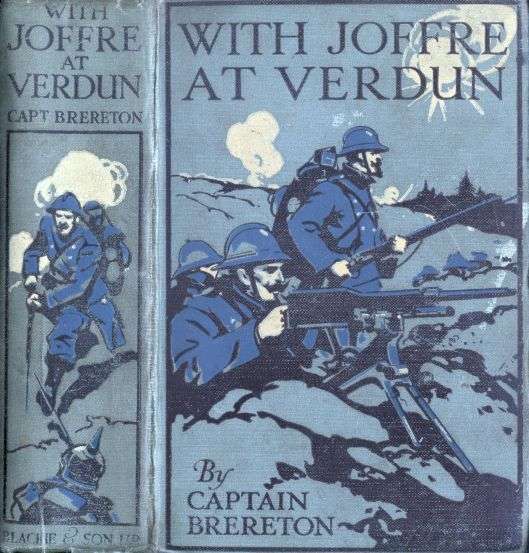
CHAPTER XIV
Frenchmen and Brandenburgers
Forbidding and grey, shell-marked and shattered and battered out of all recognition, yet of such a substantial nature that even the high explosives and the ponderous shells dropped upon it by the German gunners could not entirely demolish it, the fort of Douaumont stood up, cold and black, on that morning of Friday, the 25th February, seeming even to overshadow the trench, or the apology for a trench—for here, too, shells had done their work—in which Henri and his friend were lying. Out beyond them the shell-marked ground, across which flakes of snow were drifting, descended abruptly to the plain of the Woevre; and struggling up its slopes came, at that moment, the 5th Division of the 3rd Brandenburg Corps—a corps retired from the fighting-ranks months ago, specially fed, specially trained and armed, and prepared particularly for this Verdun fighting. Its 6th Division was, at the moment, invisible, for it was creeping up the ravine of La Voche, which sheltered it from the fire of the French defenders.
There is no need for us to repeat the tale of terrific fighting, of the stubbornness and gallantry of the Germans, and of the heroic resistance of that thin band of French poilus who still held the main outposts of the Verdun salient. Let us but say that they had been driven in four miles from the northern posts they had held, and on the east had been forced to fall back via Bezonvaux. But those positions had been but flimsily held, but indifferently fortified, when compared with the main defensive positions arranged by our allies. They were back upon that main defensive line now, where it swept from Vacherauville, on the River Meuse, opposite the Mort Homme and Hill 304, across the hill of Talou and Pepper Hill—ominous names already to the enemy—past Louvemont, and so to Douaumont and Damloup, where the trenches had now descended to the plain of the Woevre, and they held to it till they clambered once more up the slopes, and so to the other end of the base of the salient.
Checked on their right, where the 5th Division was advancing, the Brandenburgers were swept from the face of the earth by a tempest of shot and shell; but their 6th Division, advancing up the ravine in front of the shattered fortress, finally burst from cover, and, supported by a torrent of projectiles from the German guns, hurled itself from a close point upon the French defences, and, in spite of the heroic resistance of these soldiers, forced them back.
It was at that particular period that Henri and Jules and a dozen or more of their comrades found themselves in a portion of the fire-trench cut off from their comrades, who had retreated, and already almost surrounded by Germans.
"It's all up! We are surrounded! We are captured! Vive la France!" shouted one of their number; while others looked about them, at first doubtfully, and then with grim resignation.
"Yes, captured! Better lie down in the trench till we are discovered, or else those Huns will fire into us," counselled another of the men.
"And give in like that!" shouted Jules indignantly. "Give in without trying to crawl back to our people?"
"Crawl back!" a corporal answered him hotly. "As if we shouldn't do that if it were possible. Look for yourself, man; you've eyes in your head. See the lines of Brandenburgers between us and our people!"
As a matter of fact, just at the moment when he was pointing to a thick though somewhat scattered line of grey-coated infantry which had now swept on beyond them, a gust of wind came whirling round the corner of the shattered fortress, singing and whistling over the summit, and bringing with it heavier flakes of snow which obliterated the scene about them and made vision almost impossible.
"Well, then!" added the heated Corporal. "Even snow won't help us; for we don't belong to the Flying Corps, and can't, therefore, very well ascend and drop beyond them."
"But——" exclaimed Henri, who had been using his wits and his eyes all this time, and, though bound to feel somewhat helpless, seeing the position in which he and his comrades found themselves, was yet not quite resigned to the idea of becoming a prisoner. ("Not much!" he told himself. "I've had some!—as they say in America. Ruhleben was a lesson which has taught me that the lot of a prisoner is hardly inviting.") "But——" he called out.
"But——" shouted the Corporal back at him, standing quite close to Henri, and bellowing in his ear; for, indeed, the little fellow was very excited. "But you would like to call us cowards next, because we will not charge after the Germans."
"One moment," Henri said, patting him on the shoulder, "one little moment, mon cher ami! Neither you nor I wish to be prisoners, eh?"
"Vraiment!" the little fellow answered, a trifle mollified, his anger oozing out at the tips of his fingers. "But then—— Ah! It is Henri, eh? I did not recognize you earlier. Then what do you advise, Henri—you, who have tasted prison life in Germany?"
"Yes, yes! Let Henri tell us," called a number of the others; for already our hero had won no small reputation amongst his fellows.
Let us advance the story just a little and explain that already that officer to whom Henri and Jules had given a report of their reconnaissance had urged upon his colonel that they should be promoted instantly, and even then, as the conflict raged about Fort Douaumont, their names were in Regimental Orders. They were to be "non-commissioned" officers.
"What then?" the little Corporal asked again, eagerly peering up at Henri, for he was some inches shorter.
"I believe you, my dear fellow," exclaimed Henri. "Not being a bird, or, as you rightly observed, not belonging to the Flying Corps, we cannot very well get back to our fellows, that is, not yet. But—and that is just where you chipped in and prevented my saying what was in my mind—but we fellows might manage to hold out if we had some sort of decent cover."
"Aye! Cover—that's it! Out here we should be shot to rags," exclaimed a veteran. "Now, Henri, let's have your decision, and quickly, too, for the snow may stop at any moment."
"Then here it is: take up every cartridge you can find—boxes of ammunition if you can hit on them—get as much food from the haversacks of the killed as you can carry, and then let's creep towards the fort. There's a gateway on this side, for I noticed it in the early hours of the morning. Let's get behind those concrete and stone walls and search for a spot where we can hold out and stand a siege till our fellows counter-attack and relieve us."
The veteran poilu of the party smote his hands together and tilted his steel helmet backward.
"Mon Dieu," he cried, "but that is it! Our Henri has thought of a splendid thing for us. Ecoutez! Then I will tell you, I who have been of the Verdun garrison, not only during this war, but in peace times, I who helped to remove the big guns when the Kaiser showed us that guns behind a fort were no longer useful. There are caverns underneath that masonry, my boys, big galleries, and fortified chambers, to which even a big shell will hardly descend. Yes, there are rooms down below in the bowels of the earth which will shelter us, and hundreds beside us. It is a magnificent plan. I, who know the place, can lead you; and, of a truth, we will find a spot where men such as we are, fighting for France, can hold up a hundred of the enemy. Be busy, then! Pick up cartridges, seek for food and water."
"Yes—and water!" shouted Jules, darting from the trench and stooping over the nearest figure. All about them were the battered trenches of that thin force of noble Frenchmen who had fought hand to hand with the Brandenburgers. There were the bodies of the slain—of friend and foe—lying in every sort of posture, some half in and half out of the trenches; some, alas! unrecognizable, for such is the effect of high explosives; and others, yet again, almost buried already by upheavals of earth as shells burst close beside them. There were not a few wounded, too, who lay waiting the succour which might come some hours hence, and which, it was quite possible, might never come, for in a little while, no doubt, French fire would command the ground on which they lay, and neither troops nor hospital bearers could cross it.
Very eagerly, then, for every one of the men in Henri's party was anxious to escape capture, and eager to rejoin the French forces and again fight the Germans, the poilus scrambled about in the battered trench, or closely adjacent to it, taking up cartridges, despoiling the dead of their haversacks, from which they ejected all but the food contents, while every man loaded himself with as many water-bottles as he could conveniently carry.
"It's still snowing hard," said Henri, when some ten minutes had passed and the band was again collected. "Don't let us get into a flurry, or spoil our chances by being too hurried. Let's number off, and see how many we are."
"One! Two! Three!"——
Without a word of command the man on the left started, and Henri, at the far end of the line, announced his own number. It was twenty.
"Good!" he told them. "More than I thought. Twenty resolute men fighting for France, for la belle France, my comrades——"
"Ah! For la belle France, for home, for victory!" the veteran shouted.
"Yes, for victory. And listen, my friends; we may help towards it," Henri told them. "Resolute men, if they can reach some strong position in that fort, may well assist our friends battling farther back on the plateau. Well, now, there are twenty of us, and I see that there are half a dozen or more ammunition-boxes."
"Ten," the veteran corrected him instantly; "ten, Monsieur Henri"—it had come to "Monsieur" now, such was the veteran's opinion of our hero.
"Good! Ten boxes of cartridges is it? Ten thousand rounds. Now let's see to the water-bottles. How many are there?"
The men, on returning to the spot where Henri stood, had at once deposited their finds at the bottom of the trench, so that there was no difficulty in making an inventory; and now a mere glance discovered the fact that there were more than two water-bottles per man, all filled, as Henri was assured, and all big ones.
"One bottle will last a careful man, say, two days, eh?" he asked.
"In the dungeons of the fort, three days, Monsieur Henri," the veteran replied; "and, besides, it's bitterly cold weather, when a man does not need to drink so much."
"And food? Well, we must guess at that; but it appears from the number of haversacks, and from the way in which some of them are bulging, that there will be sufficient for some days."
"One mo'!" called Jules at that instant. "Each man's got his rifle and bayonet, that's understood; there's ammunition, say, for a four-days' fight, and water and food also. Why not a machine-gun? Here's one abandoned by our fellows when they were forced backward."
Some of the men almost burst into a cheer, while two of them dashed forward, and, dismantling the gun, shouldered the tripod and the barrel.
"Good idea!" Henri told him. "The difficulty, though, will be to carry in sufficient ammunition. But listen to this, you fellows; let's make tracks for the fort at once, decide upon a spot to hold, and deposit our belongings; then, if the snow continues and the Germans keep away, we'll creep out again and look for further ammunition."
They began to move off along the trench at once, the veteran and Henri leading, and Jules and the stout little corporal bringing up the rear. Staggering along, loaded with ammunition and water and food which they had collected, bending as low as possible and holding to the trench so long as it continued, the little band were soon directly under the walls of the fort, and though they peered anxiously about them, looking for the enemy, whose shouts, indeed, they could hear in all directions—even from the fort itself—yet not once did one of the Kaiser's soldiers approach them, while all the time the snow fell silently upon the fort and its surroundings. Then the gate seemed suddenly to open in front of them, and marching in—staggering in, indeed, for they were very heavily laden—they followed the veteran into a shattered courtyard, and from it down a flight of steps to a gallery beneath—a wide gallery with earth roof and cemented floor, along which ran steel rails. Indeed, there was a trolley on those rails, over which Henri stumbled.
"A trolley to run the ammunition round to the guns," the veteran exclaimed, "but useless now, my Henri, quite useless," he chuckled. "For, you see, the guns are behind the fort, and have already sent some of their shells into the enemy."
"That being so, this trolley will do to carry our produce. Pile your ammunition here. That's it. Those ammunition-boxes will weigh less heavily on you when stacked on this trolley. Now, my friend, which way? We are in a deep gallery which seems to be lighted by tunnels running to the outside. Do we turn left or right, or whither?"
The veteran turned to his right without a word, while Henri and one of the men followed, pushing the trolley. Following the gallery, which ran straight on for some fifty yards, they came to a point where the inside walls had been rounded, and the rail swept in a gentle curve round the corner and into the extension of the gallery.
"Halt!" shouted the veteran suddenly. "This is the spot that I have aimed for. Now look! On our left is a wide opening which enters the hall in which the garrison could take their meals and sleep, and which can accommodate, perhaps, at a squeeze, a thousand of them. Right opposite this entrance there is a stairway, and at its top another room—one of a series of gun emplacements now empty. It will do for us, my Henri, I believe. Let us ascend."
Taking up the ammunition-boxes at once, and leaving the trolley at the foot of the stairs, the party scrambled upwards till they found themselves in a square chamber lit by an embrasure in the wall, through which the wintry rays percolated. Standing just at the entrance, and turning round, Henri discovered that, thanks to the height of the opening into the big hall beneath the fort, he was able to look directly into it, though the far end was hidden from view by the stonework at the top. A swift glance round the chamber which they had reached showed him thick masonry all about, steel beams above, and iron rails of circular pattern on the floor, on which the guns had been wont to revolve.
"Well, then?" asked the veteran.
"It will do," Henri told him. "But what we shall want is someone to discover something with which to barricade the top of these stairs. Let us divide ourselves into three parties. Jules, you will command one, our friend the corporal another, and this bearded chum of ours the third. Now, listen."
"Yes, listen to him, to our Henri," cried the veteran. "For it's agreed, is it not, my comrades, that he shall command us?"
"Certainly!" they all shouted.
"Then, here is the plan: our bearded friend stays here and sends a portion of his command about the place to discover sacks of grain, blocks of stone or of timber, anything, in fact, which will allow us to build a wall across the top of the stairs. Jules and his men will descend the stairs and hunt round the fort, while our corporal and his party will retrace their footsteps, pushing the trolley with them, and will bring in to us as much food and as much small-arm ammunition as they can find, and then boxes of ammunition for our machine-gun."
The band of resolute poilus, whose eyes were now sparkling with excitement, for but a little while before they had resigned themselves to capture by the enemy, now separated, each man bustling about; while the veteran amongst them, Jules, and the corporal, snapped out orders, barked them, indeed, and sent their willing men flying. As for Henri, he went hither and thither, first watching one lot of men and then another; and, as they worked, as the veteran and his men sought for obstacles, and by lucky chance found them—for it happened that the French had stored sacks of grain for their transport animals in one of the chambers—while Jules and his men reconnoitred their surroundings, and the corporal, moving very swiftly and with intelligence, returned more than once laden with supplies from outside, the snow-flakes still whirled about the place, still enveloped the fort of Douaumont, to obtain which the Germans had now spent so many lives—spent the lives of their men indeed like water—and which they now almost surrounded.
Shells shrieked overhead, sent from those guns long since embedded in concrete, down under shelter of the evergreen fir-trees surrounding the salient of Verdun, while other shells, smaller missiles, shrieked and exploded as they hurled their way hither and thither, cast at random now, for the thick weather made shooting almost impossible. There came, too, through that embrasure, or through the gateway of the fort, every now and again, the rattle of rifles, the sharp tap-tap of machine-guns, and the snap and bark of the soixante-quinze as the French sent their curtain-fire out beyond the plateau. There was fighting still to the left and to the right of the fort, in the neighbourhood of Thiaumont farm and the village of Douaumont, while to the right, towards Vaux, the flash of weapons was sometimes visible. More than that, voices could be heard near at hand, the shouts of Frenchmen somewhere, either in the fort or closely adjacent to it, and presently the calls, the loud commands, of Germans.
It was, indeed, only half an hour later, when, thanks to the time given to them, Henri's little command had stacked the chamber with an ample supply of food and water, and procured such quantities of ammunition that they might fire it almost all day long and yet have sufficient for a week, that a terrific explosion shook the fortress, a huge German shell having burst almost within it. The far wall of that hall into which Henri had looked, and which faced the bottom of the stairs giving access to their chamber, fell in with a crash and clatter, the semi-darkness existing there being made denser at once by the dust and debris shot out by the explosion. Then figures raced across the hall, the figures of Frenchmen, coming from some point beyond, where Jules and his party had failed to discover them, while, quickly following them, could be seen German infantry—men of the Brandenburg Corps.
"Up here, up here!" shouted Henri, dashing down the stairs at once, and calling to the men running towards him. "Here are friends; come up the stairs and join us."
In rapid succession those men dashed through the opening of the hall, leapt up the stairs three at a time, and were dragged over the parapet which the veteran poilu had had erected. Then Henri retreated slowly, and, having rejoined his friends, sat down, rifle in hand, to see what would happen.
"Tell me," he asked one of the men who had just joined their ranks, and who was gasping for breath near him, "what has happened?"
"What has happened? Ah! They have driven our folks back from the fort, which is now isolated. We were holding on—I and perhaps a hundred of my comrades—near the eastern end, and then the Germans, having blasted the corner of the fort to pieces with that last shot, charged from some trenches in which they were lying, within a hundred metres perhaps, and burst their way into the place. We could not hold on any longer. It was a case of flight, or death, or capture."
"And so you chose flight! Good!" said Henri. "We chose the same. Here we are, snug in this place, with plenty of ammunition, and ready and eager to continue fighting. If any of you men understand a machine-gun, get to the one we have, at once, and man it; the rest, who have no rifles, can assist in any way that appeals to them. Ah! Watch those fellows. They are streaming into the hall. There are fifty—more—perhaps a hundred of them."
There were indeed considerably more of the Brandenburgers to be seen when the dust from that shattered wall had subsided. They came streaming in to the darkened hall, dishevelled, their Pickelhaubes gone in many cases, their rifles missing, their grey clothing now a mass of caked mud, and their hands and faces of the same colour. Shouting and bellowing their triumph, they massed in the room till an officer made himself apparent.
"Those men? Those Frenchmen who passed before us?" he asked in the arrogant manner of the Prussian; "you killed them—eh?"
"No! They went on ahead of us, up those stairs yonder," one of the men answered.
"Then no doubt they are cut off, like rats in a trap. Go in and kill them."
Henri turned and whispered to his friends.
"You heard that?" he asked them. "But perhaps you do not speak German. Then I will translate; they say they have us here like rats in a trap, and the order has been passed to come and kill us. Well, personally, I have a great objection to being killed, and I have every wish indeed to kill our enemies. Get ready! Load! Two hundred Germans shan't turn us out of these quarters."
CHAPTER XV
Rats in a Trap
Douaumont Fort was captured. But for that handful of men who had nominated Henri as their leader, and who crouched behind the parapet of grain-bags at the summit of the narrow flight of steps within the fort, not a Frenchman remained to defend it. The "pillar of the defence of Verdun", as the Kaiser and his War Staff had termed it, was in their hands, and at once the news was flashed broadcast across the States of Germany and to every neutral country.
"Douaumont has fallen. We hold the fortress firmly in our hands. The resistance of the French before Verdun is almost broken, and in a short time we shall capture that city."
That was the gist of the communiqué issued to the world—a communiqué which set the people of Germany, at this time rendered anxious and despondent by the position in which they found themselves, rejoicing and flying flags. For, indeed, they needed some sort of encouragement. To east and west, and on the seas in all directions, the Central Empires were hemmed in by a line of soldiers, steadily growing stronger, and by ships of the British Fleet which daunted those of the Germans. True, at this date, looking at the map of Europe, the Kaiser might crow and ask his people to behold the conquests their troops and those of Austria and Bulgaria had gained for them. There was the greater part of Belgium, all but that thin strip running from Ypres to Dunkirk; there was Luxembourg, that little State which had been captured without even protest; there were the north-eastern provinces of France, rich in iron ore and coal and iron industries; and to the east there was the whole of Serbia; while all Poland and a respectable slice of the Tsar's dominions were in his possession.
"See how we have succeeded! Behold our conquests; won for us by the blood and bravery of our soldiers!" the Kaiser had often called to his people.
And yet that was only one side of the picture. Territorial gains had no doubt been obtained—territorial gains of no mean dimensions; but, as we have inferred, and as the War Staffs of Austria and Germany knew well enough, the troops of the Allied Powers were unbeaten, were getting stronger every day, while those of the Central Powers were becoming less numerous; and more than that—far more perhaps—was the fact that trade for the Central Powers had ceased altogether. Nothing might come to either of these countries that did not first pass inspection by the ships of the British fleet; and, as a consequence, food-stuffs, raw material, everything, in fact, had practically ceased to enter the country. Thus food was short: bread was hardly obtainable, though a substitute had been invented; while meat was a luxury to be enjoyed only by the richest. Yes, the condition of affairs in Germany and Austria was none too exhilarating, and Austrians and Germans alike needed some stimulus—something to hearten them, to keep up their spirits and their courage. And here was stimulus indeed. The fort of Douaumont was captured—that fort which they had been led to believe was heavily armed, was deemed impregnable indeed, and the capture of which was a feat almost impossible of achievement, had fallen to the valour of the Germans, to the valour indeed of the Brandenburgers. What then could prevent the fall of Verdun itself? That indeed would compensate them for the hunger they suffered, and for the cruel losses the French were inflicting upon their soldiers.
And but for Henri's little band, as we have said, the fortress of Douaumont was captured.
"See them down in the hall, Henri, mon garçon," said the bearded veteran, who crouched beside our hero, and who, indeed, seemed to have taken him under his own particular protection—not that Henri needed much protection from anyone, for at that moment as he sat there in command of his detachment, he looked as resolute and capable a young fellow as one might wish to meet.
"Yes, they are there, mon ami," he replied. "I see them, and, moreover, they too see us. We shall hear from them shortly."
And hear from the Brandenburgers Henri and his party presently did. For an officer dragged a much-soiled handkerchief from his pocket and picked his way, over the tumbled masses of masonry littering the floor of the hall beyond, towards the exit which gave access to the stairs. Dapper and smart to a certain extent, though somewhat dishevelled by the charge in which he had taken a share; arrogant, like the majority of German officers, and bearing about his figure something which seemed familiar to Henri, he stopped at that exit, and, looking up the stairway, peered hard at the enemy.
"Above, there!" he called, and Henri and Jules instantly recognized his voice.
"Our friend of Ruhleben—the fellow who was so anxious to shoot us the other day when we tumbled into his bivouac in the forest. Well, the shooting will not be all on one side now," grinned Jules, his lips close to Henri's ear, as they both peered over the top of the barricade.
"Above, there!" the German officer snapped again. "Ah! You will not answer, then; though I know well enough that Frenchmen are there. Well, let it be so! But don't say that I have not warned you. I give you one minute to come down and surrender—after that, I will blow you to pieces."
"How very violent!" laughed Jules, and his voice, reaching the ear of that German officer, sent the blood flushing to his cheeks and his feet stamping with rage. "How very violent! 'Pon my word, Henri, this fellow needs a lesson, for every time we've listened to him he's been going to do something desperate—something desperate, that is, to other people. Shall we answer the beggar?"
"Yes. We'll do the square thing. A moment ago I had a mind to remain quite still and silent, and let the fellow find out for himself what sort of a place we had got; but we'll be quite fair with him, and then there can't be any complaints. Hallo, below there!" he called; "stand where you are, and don't move forward or one of my men will shoot you. You ask us to surrender, eh?"
"Ask you!" came the arrogant answer. "Not at all—I command you!"
"And we take commands only from our own people. Come and take us," Henri told him delightedly. "Come and take us, if you can, but I warn you to look out for the consequences."
The man below turned about with that precision to be found in the ranks of the Kaiser's armies, and strutted back across the hall, his figure lit up by the beams of light entering through shafts by which the chamber was ventilated. In less than a minute he had rejoined his men, and for a while Henri and his friends watched as a consultation was held. Then, of a sudden, the men dispersed and were lost to view for quite five minutes.
It was perhaps five minutes later when first one and then, perhaps, a couple of dozen grey-coated figures slipped into view from behind the tumbled masonry at the far end of the hall, and, darting to right or to left or down the centre, flopped down behind masses of stone and cement with which the floor was littered.
"Now keep down," Henri told his friends; "or, better still, keep right away from the barricade, and report instantly if bullets contrive to penetrate the sacks. Personally, I don't think they will, for we've piled them up two deep, and a bag of grain affords tremendous opposition even to a sharp-pointed bullet. Ah! There goes the first! Well, has it gone through?"
"No. Nor will any others," the veteran told him, with a chuckle. "We are safe—safer, indeed, behind these bags, than if we had a stone wall before us. For, mon garçon, you understand there will be no ricochetting, no splintering of bullets, no splashes of lead about us."
In a few minutes, as the firing from the hall down below became more general, and thuds on the outer face of the wall of sacks became almost continuous, it was borne in upon Henri and his gallant little band that even bullets discharged at such point-blank range had for the moment little danger for them.
"Then we'll line our wall," said Henri. "It's not more than twelve feet across, so that six men lying flat on their faces will be sufficient for the purpose; six more will kneel down behind them, so as to be ready to fire over the top of the barricade in case of a rush; and our machine-gun man must squeeze himself into the midst of them. Now, man the loopholes!"
It was a canny suggestion of the bearded veteran which had caused the men assisting him to build the barricade to leave loopholes for the rifles of the defenders, not only along the top of this improvised wall, with bags placed so that the heads of those who fired would be protected, but to leave apertures also just a foot from the bottom through which men lying flat on their faces might fire down into the hall. As for the machine-gun, it was piled round with bags, just the bare tip of the muzzle protruding, and, indeed, thanks to the dusk which occluded the top of the stairs, giving no indication of its presence to the enemy. Thus, with the wall manned, and the remainder of his little party squatting on the stone floor of the gun-chamber ready to support their comrades, Henri and his men waited for perhaps half an hour, during which time the fusillade from the men of the 24th Brandenburg Regiment sent a hail of bullets in their direction. They thudded against the bags continuously, while often enough a missile would strike the concrete ceiling of the chamber, and, ricochetting from it, would mushroom against the opposite wall; some even struck the walls limiting the stairway on either side, and, breaking off at a tangent and exploding from the impact, scattered strips of nickel and lead over the heads of the garrison.
"But it is nothing—nothing at all," that bearded veteran told his friends; and, indeed, he was as good as a reinforcement of a hundred men to them—so gay was he, so full of courage, so optimistic. "Poof! Who cares for noise? Not you, my comrades, who have stood days now when torrents of German shells were pouring on us, when our ears were deafened by the guns of either side. Then who cares for the scream and the hiss of these bullets? They are but a drizzle which follows a storm."
"Get ready to support the others!" Henri commanded of a sudden, having crept forward to the barricade and peered through one of the loopholes. "That officer man is getting impatient, and, if the truth be known, he is beginning to wonder if any of us are left up here; for, remember, we have made no answer."
"An easy shot, eh?" Jules told his chum, gripping the rifle which he had thrust through one of the upper loopholes. "I could bring him down like a bird, as easy as winking! But I won't," he added of a sudden; "no, for that would hardly be fair fighting."
A whistle sounded down in the hall below, and fifty or more grey-coated figures rushed from the far end, where, no doubt, they were waiting out of sight and under shelter. Forming up across the hall, they were given a sharp order, and almost at once dashed forward.
"They are coming!" Henri called softly to his following. "Don't show as much as a finger, if you can help it. Open fire only when they get to the exit from the hall, and cease fire immediately you have checked their dash towards us."
Rat-a-tat-tat! Rat-a-tat-tat! The machine-gun opened with two short bursts just as the Brandenburgers reached the foot of the staircase, while the Frenchmen manning the loopholes opened a furious fire, which first checked the rush of the enemy and then drove the survivors backwards. Indeed, in one minute they were all out of sight, and even those who had been sniping at the barricade had disappeared entirely.
"But it will not be for long; no, my friends," Henri told his party. "That dash is in the form of a reconnaissance, I expect; though, no doubt, they hardly expected to meet with such resistance."
"Bien! We shall hear from them again shortly," Jules laughed; while the bearded veteran banged one broad hand down on his thigh and chuckled loudly.
"Yes, indeed! Yes, indeed! We shall hear from them, and they shall hear from us, and our voices will be as loud as any Prussian's. But, my Henri, though you are already a commander, and have won our hearts, yet your inexperience of command has led you to forget one thing which is essential."
Henri started. Unconsciously he had been carrying on the work just as he would have done had he and Stuart and Jules been alone together; that is to say, he had just done his best, and no one could do more. Then what was it that he had forgotten, this essential point which a commander of experience would certainly not have omitted? He gaped at the veteran, who thereupon laughed and chuckled even more loudly.
"Listen, then, my Henri. You ask us to fight these Boches, to drive them back, to keep them out so that we may hold the fort for France and for Grand-père Joffre, and, of a truth, we would gladly do that. But listen, then. Men must eat to fight, and drink also, to retain their strength; for if men are not strong, how then can they fight as soldiers, my Henri? The hour has come for food, and is there not food and drink here in abundance?"
There were smiles all round at that; and presently the little garrison were seated close behind their barricade, where two men kept watch upon the enemy so that the rest could not be surprised, while the others ate the rations which forethought had caused them to bring into the fort, and took cautious draughts from their store of water. Then, having finished their meal, they drew cigarettes and pipes from their pockets, and presently a thick cloud of smoke almost hid the faces of Henri's detachment, and quite a column of it blew out from the aperture through which the gun, long since removed, had been wont to project its muzzle.
"Begins to look as though they intended to leave us alone, or perhaps they have been driven out of the fortress," said Jules, tiptoeing along from one of the loopholes. "There's not a sound down below, and not a single Prussian has put in an appearance. Perhaps our fellows have come up again, eh? Why not? And may be already above us and all about us."
"No. It is not so," called one of the garrison whom Henri had posted at the gun-embrasure, "for I have been watching here since we came to this chamber. The French troops have been driven back on to the plateau—not far, my friends, you will understand, not very far, but still far enough to take them hopelessly beyond us. No. We are cut off here; and if those Boches have left us alone for a while, and allowed us to enjoy a meal, it is not because they have forgotten. Maybe they are preparing a new attack; perhaps they have been engaged in consolidating their position; in any case, we shall hear from them again, and sooner rather than later."
The attack, when it did come, was indeed sudden and unexpected. A shout came from one of the men watching at the loopholes; and, darting forward, Henri discerned at once numbers of figures, which, dashing from the background, were rushing across the hall towards them. Indeed, half a dozen of the Brandenburgers were already at the exit from the hall, and as he looked through a loophole they leapt on the first step of the stairway.
"To your places!" he shouted. "Open fire! Supports get ready to come forward!"
Bang! There was the sharp report of a rifle from down below, a sudden piercing cry, and one of the defenders fell heavily against our hero. An instant later the wall of bags shook while a German bayonet transfixed one of the upper tier, and tore it from its position. Then the machine-gun opened, deafening all within the chamber, lighting by its flash the scene of the conflict; while the men at the loopholes blazed into the lines of Germans who were now swarming on the stairway.
That flimsy wall of bags filled with corn shook and swayed as bodies of frantic Germans, slaughtered by the defenders, fell heavily against it; while one huge Brandenburger who had leapt in advance of his friends, and who had been caught by a bullet fired from one of the loopholes, fixed a dying clutch on the summit of the wall, and held on convulsively for a few moments. Then, with a piercing scream, he fell backwards, carrying with him some two feet of the top of the slender defence which Henri and his friends had erected.
"Man the gap," shouted Henri at once, flinging himself towards the opening, and disentangling himself from another of the defenders who had fallen against him. "Bring bags up from behind and fill in the gap while we defend it."
What a pandemonium there was in that comparatively narrow space up which the stone steps ascended, and across the top of which the barricade of corn-sacks had been erected. Every step was crammed with Brandenburgers, while down below, in the gallery along which the miniature railway ran, which, with its truck, had proved of such service, the exit from the huge hall in the shattered interior of the fort, and that hall itself, were packed with shouting individuals, with men pressing forward to the attack, with fallen soldiers, and with wounded who called in shrill accents to their comrades. Those at the top of the stairs were bellowing with anger, and some with fear; for, forced on by the press from behind, and beaten by the opposition of the Frenchmen, they were, as it were, between two fires, and escape, and even the power of defence, were out of the question. They dropped, indeed, as Henri and his friends fired amongst them; while the bearded veteran, setting a splendid example to his comrades, leapt on to some of the fallen bags, and, leaning over the swaying wall, made havoc amongst the Germans with his bayonet. Then of a sudden the shouts died away, there was a rush of steps on the stairway, and silence—a silence which was almost painful, which seemed to smite the ear of those gallant men holding the gun embrasure and the chamber.
THAT BEARDED VETERAN, LEANING OVER THE SWAYING WALL, MADE HAVOC AMONG THE GERMANS WITH HIS BAYONET"
"It was hot work, my Henri, while it lasted," chuckled the bearded poilu as he wiped the sweat from his forehead, and stood up after having deposited a fresh bag in its place; "but, mon Dieu! those Brandenburgers fight like the devil! And how they hate us; and how we hate them! Yes, yes! This is a war to the death! This is fighting for France! And only over our bodies shall they advance towards Paris. Comrades, we are holding them back. We here in the remains of this fortress, we are helping to keep the Kaiser's hordes away from the interior of France; helping, too, to rob him of victory and conquest."
Yes, indeed! The violent efforts of these men were helping not a little to check the advance of the enemy, just as the heroic fighting of the French all along the battered trenches round the salient of Verdun was assisting in defeating the enemy's object. We have said already that the conquest and capture of Verdun alone could be of no particular or material benefit to the Kaiser and his armies. Verdun was, as it were, merely an empty shell, a sleepy old town in the hollow by the River Meuse, overshadowed by heights which formed the major portion of that salient held by our ally. Forts there were in abundance—forts, as we have said, long since dismantled. Yet in Germany the tale spread by the German War Staff, that Verdun was heavily armed and considered impregnable, was thoroughly believed, just as it was confidently believed that the valour of the Kaiser's soldiers would snatch it from the enemy.
This terrible World War had come, at this stage, to a period when the spirits of Germans and Austrians were failing, when some stimulus was sadly needed, and when the courage of the people was hardly what it had been when the conflict opened. Who knows? Who can state with certainty what was the real object of the German War Staff in launching an attack upon such an impregnable position—impregnable not because of those dismantled forts and the guns which had once filled them, but because of the nature of the terrain, those hills with their steep escarpments, and those positions on the left or western bank of the Meuse which gave such splendid opportunity to the defenders to outflank with their guns those attacking the northern portion of the salient. Perhaps a sensational capture of Verdun was the objective of the Germans, merely with the idea that it would act as a stimulus to the peoples of the Central Empires. More likely, finding themselves getting weaker as the months drew on, and terrible losses reduced their fighting effectives, the Kaiser and his war lords were determined to risk all in one mighty effort—an effort which should break through the French line at Verdun, thus bringing kudos to the armies of Prussia, and at the same time demoralizing the French soldiers. Who knows? They may have hoped to dash through the gap thus formed, and once more advance on Paris. In any case, they were well aware of the phenomenal rise in power of the British forces. Five million men had volunteered to fight for king and country; and now, on the top of that, there was news that Great Britain had adopted conscription; every man up to the age of forty-one was to become a soldier, was to fight for that liberty dear to all Britons.
Then, seeing that Germany's forces were rapidly dwindling, a blow must be struck now—a sensational blow—which would, it was hoped, break the power of France before those British reinforcements could reach her. Later, Germany might still have strength to tackle Britain alone; and in that case this risky, if determined, attack on Verdun would be worth the price paid for it.
To France then, and the French armies at Verdun, all eyes were turned, for at this moment she held the fate of the Allies in her hands. Let her hold on to Verdun, let her defeat the Germans there by successful resistance, and hold off the enemy till that hour arrived, now fast approaching, when fresh British forces would have sailed for France, and have taken their place beside the poilus. Every little helped; and the fierce encounter taking place beneath the shattered roof of the fortress of Douaumont was assisting not a little.
"They will come again, later on, perhaps, when it is dark," Henri told his friends, "and we must make ready to resist them. Pile up the bags and place them three deep now, for during the last attack they were nearly pulled over. After that there's little for us to do but to wait and smoke. Of fighting we shall have our full before this little business is ended."
Darkness came on after a while, and presently the gloom within the fortress was so deep that even the walls lining the stairway were invisible, nor had any of the party any means of illuminating them, or of lighting up the interior of the hall held by the Brandenburgers. All they could do was to crouch behind their wall and listen for the attack which they knew must be coming. Then, of a sudden, there was a violent explosion just outside their wall, and one farther back in the chamber which they occupied. Hand-grenades had been thrown by the enemy, and hardly had the explosions taken place than there was the sound of another charge, and a horde of men dashed up the stairs and flung themselves upon the barricade which the poilus were defending.