
CHAPTER XVI
HOW THE RANGER FOUGHT THE DRAKE
With cries of joy both Ethan and Longsword heard these welcome words. Ethan brought the schooner to; in a few moments a boat was lowered and rowed away from the American ship. When Wallingford, third lieutenant of the Ranger, climbed over the schooner’s rail he was astonished to find himself grasped by the hand.
“What, Carlyle,” he cried in amazement.
“None other,” laughed the boy. “You aren’t rid of me yet, you see.”
“We thought you taken by the enemy on St. Mary’s Isle.”
“So I was; but it’s a long story and will keep. You’d better have some men sent on board to take charge of this craft. It’s a prize that Longsword and I took some distance up the coast.”
Lieutenant Wallingford looked his surprise, but said nothing. A crew was soon placed on board the Condor, and Ethan and the Irish dragoon were taken to the Ranger.
John Paul Jones was undisguisedly delighted at the unexpected return of the two adventurers. He shook their hands and expressed his pleasure warmly.
“We are headed for Carrickfergus,” he said. “We understand that the frigate Drake has orders to come out after us.”
“She is already out,” said Ethan eagerly. “We met her and slipped away from her less than an hour ago.”
“Hah!” said the commander of the Ranger, “then the struggle may be nearer at hand than I fancied.”
He took Ethan down into the cabin, and listened to the news which the lad had of the dispatch.
“The villain,” cried the captain, with flushed face, when he heard of Danvers’ charge against Ethan and himself regarding the paper. “It will go hard with him if I ever come within reach of him.”
They talked for some time; the Ranger was once more under way and her nose was headed for Carrickfergus as before. Ethan and Longsword slept well that morning after they turned in, and awoke just as the Ranger ran into the outer harbor of the Irish port.
The Drake was there, having arrived some hours earlier, and just as Ethan came on deck her captain was sending off a boat to the Ranger to find out what she was. The boat was in charge of a hectoring British lieutenant, and as it came alongside the American vessel he cried sharply,
“Now you, sir, what ship is this?”
There came no answer from the Ranger; the lieutenant saw a long line of grinning faces looking down at him over her rail and he grew purple with rage.
“You unmannerly rascals,” he roared, “I’ll teach you respect to a king’s officer.”
He gave a command to his men; they dropped their oars, seized their arms and followed him up the Ranger’s side. The vessel’s ports were closed and the lieutenant had mistaken her for a saucy merchantman. But imagine his consternation when he found himself upon the deck of a fully armed ship and face to face with a smiling young officer who politely demanded his sword.
“What ship is this?” he demanded weakly.
“The Continental sloop-of-war, Ranger,” answered John Paul Jones, still smiling. “I think your commander has been in search of us.”
“He has,” answered the lieutenant, filled with anger at the result of his own and his captain’s lack of caution. “And he’ll sink you now, sir, you may be sure.”
“That remains to be seen.”
The American looked toward the Drake, which was now hoisting her anchors and apparently preparing to come out, and added:
“The Drake seems a pretty ship, indeed, in daylight. I have only seen her once before, and that was under cover of night. She looks as though she would offer a very interesting battle indeed.”
“You may be sure of that, sir,” answered the British officer stiffly.
Both he and his boat’s crew were disarmed and sent below; then their boat was cast off and the Ranger made ready for action. While this was being done Ethan cried suddenly to Captain Jones:
“Look there, sir!”
He pointed toward the British ship as he spoke; and the captain saw a number of boats containing soldiers, pulling out to her.
“Oh, Captain Burdon of the Drake is adding to his ship’s company,” commented he, evenly. “Well, perhaps he’ll need them.”
“They look like volunteers, by their uniform,” remarked Longsword.
In this the Irish dragoon was right. A Lieutenant William Dobbs had been engaged in recruiting a band for coast defense in the neighborhood of Carrickfergus; he had offered them to Captain Burdon for service upon the Drake at this crisis, and they had been accepted.
The regular ship’s company of the frigate was one hundred and fifty officers and men; she carried two more guns than the Ranger, but they were lighter; and so the vessels were pretty evenly matched.
The Drake finally stood out to sea toward the Ranger; the wind was blowing toward the shore and her progress was rather slow. Captain Jones remarked quietly to Ethan,
“In an hour or less the story will be told. I trust that the Lascar, Siki, is aboard this ship, as Danvers said; for after I take her I should very much like to question him.”
Just then Longsword came aft with a serious look upon his face. Saluting he said,
“Captain dear, there’s a ruction among the men, so there is.”
“What do you mean?” asked the officer quickly.
“I mean that they are growling among themselves like a pack of sullen dogs for’ard, there. It shames me to say it, sir, but I fancy that they have little stomach for the fight.”
The commander swept the deck of his ship with angry eye. The crew stood in groups, sullen and lowering; Lieutenants Simpson and Hall were upon the quarter-deck, and every action and word that they uttered seemed to add to the growing feeling among the men.
“This vessel is no match for a well set up frigate,” said Simpson, in a voice that carried to the ears of his captain. “We’ve come out after prizes, and not to be slaughtered by the guns of men-of-war.”
“The Drake carries more weight of metal than we,” agreed Hall, “and if I were in command of this ship I’d make a clean run for it. To wait for this frigate is to wait for plenty of hard knocks, little credit and no plunder.”
With a few swift steps John Paul Jones was at his side; there had been a low murmur of approval from the seamen at these words of their officers; and the commander’s eyes were stormy, and flashed menacingly as they rested upon his lieutenants’ dogged faces.
“So, gentlemen,” said he in a voice like ice, “I find you still at your old trick of demoralization, do I?”
“I don’t understand you, sir,” said Simpson drawing himself erect.
“Nor I, Captain Jones,” said Hall.
“Then allow me to make my meaning plain. Since this ship sailed from Portsmouth you have been daily increasing in your insubordination. Things have come to such a pass that it almost seems necessary for me to consult you before issuing a command.”
“A good captain always consults his officers,” said Simpson with a thinly-veiled sneer.
“In spite of the protestations which I offered that day on St. Mary’s Isle, you plundered the home of a defenseless woman. I submitted rather than risk a mutiny that would deprive my country of a valuable vessel. But if you think that I will continue to submit, you are very much mistaken.”
Simpson and Hall exchanged glances and smiled. The captain saw this and his eyes flashed with a more dangerous light.
“You are inciting to mutiny in the face of the enemy,” said he, still in the same cold, even voice. “And that is punishable by death.”
The two men started, and the smiles fled from their faces.
“I order you to your stations and expect you to carry out my orders to the letter. At the slightest sign of disinclination upon your part to do so, I’ll clap you in irons and take you to France for trial before the commissioners. To your posts, gentlemen.”
The two officers, pale of face and furtive-eyed, went to their places at the batteries as commanded. John Paul Jones followed them with his eyes for a moment. Then he said to Wallingford, who had stood by ready to support him in case of need,
“Mr. Wallingford, have the bos’en pipe all hands.”
The hoarse call rang through the ship and all the seamen stood at attention. The commander spoke to them from his quarter-deck.
“Men of the Ranger,” he said, “on this cruise we have taken many prizes and struck some good blows. We have made the British government fear us as it never feared ship before. But they have resolved to take us; they have said that we do not dare to stand and fight their armed ships man to man and gun for gun. The world has heard this, or at least that part of it which we care about; the young republic of the west is waiting to hear of the deeds of the ships which she sent to defy Britain in her own seas.”
There was a visible stirring among the men; for the greater part they were mercenary mariners, men of many nations who had shipped for the booty alone; but there were many Yankees among them, and these felt the appeal of their chief.
“Shall it be said of us that the first vessel of equal strength which we have met has daunted us?”
“No!” shouted a voice. And there was a murmur among the crew.
“Then I call upon you to help me fight this ship,” cried the captain, in ringing tones. “Stand to your guns manfully, and I promise, in one hour, to give you victory.”
A cheer swelled up and broke into a frantic hurrah; then with a wave of the hand the chief dismissed them to their stations.
“They will fight now,” remarked Ethan to Longsword.
“They will, faith,” said the Irish dragoon. “And it’s little chance of defeat we have if they do their best, for there are some useful lads among them, Master Ethan.”
John Paul Jones now stood out to sea and drew his foe as far away from shore as possible.
“In case he is defeated,” said the commander to Ethan, “Burdon might escape back into the harbor if we fought too far in shore.”
“Look at the yachts coming out with her,” said the young American who had watched every movement of the Englishman.
Paul Jones laughed.
“They desire to be eye-witnesses of an English victory, doubtless. It is a pity to dash their hopes, but I’m afraid that we will be forced to do so.”
When at last the British frigate had come within easy distance, she hailed.
“What vessel is that?” demanded Captain Burdon.
“The Ranger, Paul Jones, commander. We are waiting for you, so strip for the fight.”
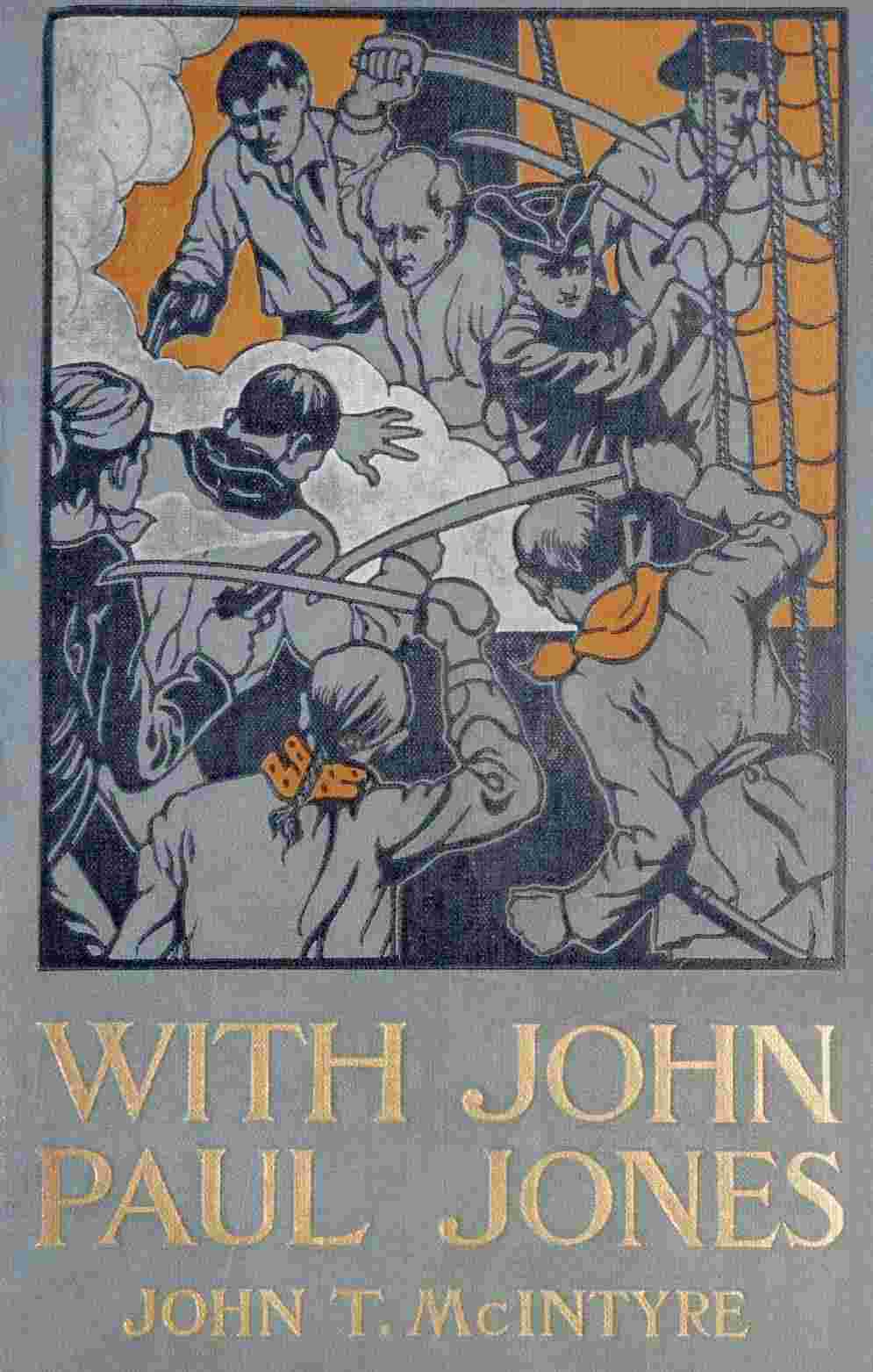
As he spoke the American captain gave a signal and the stars and stripes shot up to the masthead; then the helm was suddenly thrown up and the Ranger darted across the bows of the British vessel and poured a raking broadside into her. The captain of the Drake tried to bring the frigate across the Ranger’s stern, but Paul Jones prevented this; the two ships were now yard arm to yard arm and poured a terrific fire into each other’s rigging and hulls.
Ethan Carlyle, whose ability as a gunner had been discovered by Captain Jones long before, had charge of a six pounder in the bow. He and Longsword, stripped to the waists, and all begrimed with powder smoke, served this piece with deadly effect.
In the heat of the battle the gallant young Lieutenant Wallingford rushed up to Ethan.
“Captain Jones desires you to try for her forerigging,” panted he. “If we can cripple her badly aloft we’ll make her strike.”
Longsword had just rammed a charge into the gun, and Ethan sighted it coolly. A rain of musket shots was being poured into them by the soldier volunteers upon the Drake; but the young gunner paid no heed to this. Applying the match the gun roared redly; the foretop-gallant yard of the British ship splintered and hung down the mast in a tangle of rigging.
“Hurrah,” yelled Longsword. “A fine shot, faith!”
“And placed in the right spot,” said Wallingford. Almost as the words left his mouth, this brave young officer uttered a smothered groan, clasped both hands to his breast and sank into the arms of the Irish dragoon.
“Is he hit?” cried Ethan, anxiously, springing forward. “Is he badly wounded?”
“He have his death, sir,” replied Longsword solemnly. “It’s a musket-ball, and from the spot it struck, it split the boy’s brave heart.”
As he spoke the grim Irishman tenderly lowered the still, white form to the deck; then in silence, and with set, hard faces, he and Ethan Carlyle once more turned to the serving of the gun.
At length the Drake was little more than a wreck; her rigging and yards were a wilderness of broken spars and ropes; her canvas was in shreds and two flags had been shot away. Half her guns were dismounted and out of action, and forty of her crew were killed or disabled when at last she struck.
Ethan was with Captain Jones when he boarded the prize; when the prisoners were lined up for inspection they were bitterly disappointed to find that the Lascar was not among them. While Captain Jones was giving his attention to the repairing of the worst damages and the care of the wounded Ethan questioned the boatswain’s mate of the defeated ship.
“A blackamoor, eh,” said the man, thoughtfully. “Now let me see! Oh, yes! I remember. He was taken on board when we stopped in the harbor near St. Mary’s Isle not so long ago. We kept him safely guarded and ironed, sir, for it was said that he was an important prisoner; but on our second day at Carrickfergus he gave us the slip, somehow, and none of us have seen anything of him since.”