
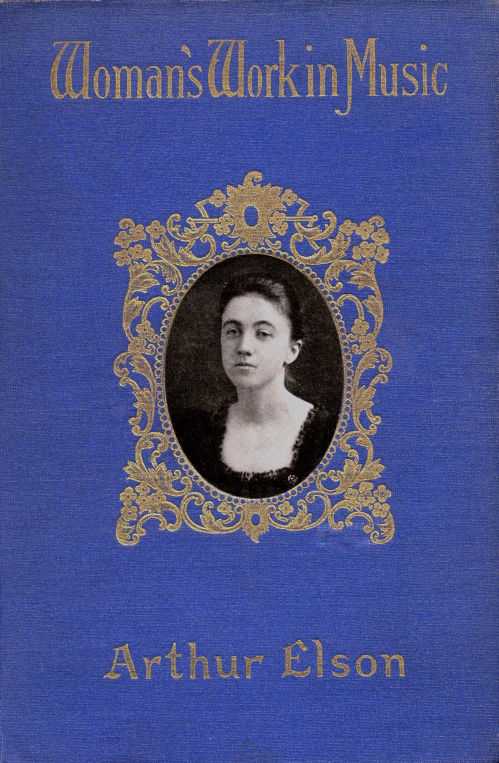
Among living composers gifted with musical wives, the most preëminent is Richard Strauss. As Clara Schumann could perform her husband's works, so the wife of Strauss, who is an excellent singer, is at her best when giving her husband's songs. Like Grieg's wife, she is more successful than all other singers in this rôle of domestic devotion. She usually appears with him as accompanist, a position in which he excels, and each modestly tries to make the other respond to the applause that is sure to follow their performance.
History has never witnessed a more perfect union of two similar natures, both endowed with rich mental gifts, and each filled with a perfect sympathy for the other, than the marriage of Robert Schumann and Clara Wieck. It holds a place in the story of music similar to that occupied by the romance of Abelard and Heloise in poetry. The lives of both composers afford an example of the most unselfish devotion and depth of affection, combined with the highest idealism in an art that poets themselves have admitted to be even nobler than their own.
The birth of Clara Wieck, on September 13, 1819, took place at Leipsic. That city had not yet entered upon the period of musical greatness that it was soon to enjoy. The day of Beethoven and Schubert was apparently passing, and only the lighter and more trivial styles of composition held sway. Her father, however, Friedrich Wieck, was a piano teacher of extensive reputation and most excellent qualities, and did his best to raise the standard of the place. From him, and from her mother as well, the young Clara inherited her innate musical taste. But the maternal influence was not of long duration, for domestic troubles soon caused the separation of Wieck and his wife, the latter marrying the father of Woldemar Bargiel, while the former also entered into a second union, with Clementine Fechner at Leipsic. A daughter of this second marriage, Marie Wieck, won some fame as a pianist, but was far surpassed by her elder half-sister.
Clara did not at first show signs of becoming a child prodigy, but in her fifth year she gave indications of possessing musical talent, and her careful father proceeded at once to develop her powers. So successful were his individual methods that in four years she was able to play Mozart and Hummel concertos by heart, and ready to sustain her part in public. Her first appearance was in conjunction with Emilie Reichold, one of her father's older pupils, with whom she played Kalkbrenner's variations on a march from "Moses." One important paper of the time spoke of her success as universal and well deserved, and did not hesitate to predict a great future for her under her honoured father's wise guidance.
Wieck has been the subject of much criticism on account of his supposed harshness and severity. In the matter of Clara's musical training, however, these charges cannot be sustained, as one of her own letters will show. "My father has come before the world in an entirely false light," she writes, "because he took art earnestly, and brought me up to regard it earnestly. People have no idea how utterly different from the usual standards must be the whole education and career of any one who wishes to accomplish something worth while in art. In connection with artistic development, my father kept the physical development especially in view also. I never studied more than two hours a day in the earliest times, or three in later years; but I had also to take a daily walk with him of just as many hours to strengthen my nerves. Moreover, while I was not yet grown up, he always took me home from every entertainment at ten o'clock, as he considered sleep before midnight necessary for me. He never let me go to balls, as he judged I could use my strength for more important things than dancing; but he always let me go to good operas. In many free hours I used to grow enthusiastic over piano arrangements of operas and other music. One cannot do that when one is tired out. Besides that, I had, even in earliest youth, intercourse with the most distinguished artists. They, and not dolls, were the friends of my childhood, though I was not deprived of the latter. Those people who have no comprehension of such a serious bringing up ascribed it all to tyranny and severity, and held my accomplishments, which may indeed have been more than those of a child, to be impossible unless I had been forced to study day and night. As a matter of fact, it was wholly my father's genius for teaching that brought me so far, by cultivation of the intellect and the feelings united with only moderate practice."
"To my pain," she continues, "I must say that my father has never been recognized as he deserved to be. I shall thank him during my entire lifetime for the so-called severities. How would I have been able to live through a career of art, with all the heavy difficulties that were laid upon me, if my constitution had not been so strong and healthy because of my father's care?"
About this time there came upon the scene a youth named Robert Schumann. Born in 1810, of a family that was literary rather than musical, he had obtained some knowledge of the art with his father's consent. After the death of the latter, his mother would not hear of his choosing a musical career, but insisted on his studying law. This he did at Heidelberg, in a rather original manner,—taking long walks, reading Jean Paul's works, and practising piano nearly all day. In the summer he met Wieck, whom he adopted as a teacher, and in this way he came to know the learned pedagogue's talented daughter.
Her musical education was now beginning to bear fruit. In the concert tours that she began soon after her first triumph, she never allowed herself to be carried away by the fondness of the public for mere display, but always aimed at something higher. Instead of making a show of her technical attainments, she consecrated her powers to the cause of true art. It required great courage to uphold her standard, for she came upon the scene at a time when only phenomenal playing, bristling with seemingly unconquerable difficulties, won the public homage and the public wealth. Herein both she and her future husband showed themselves actuated by the very highest motives.
Unfortunately for the romantic side of the story, theirs was not a case of love at first sight. No less than five years after their first meeting, we find Schumann deeply interested in a certain Ernestine von Fricken, another pupil of Wieck. It is stated that the beautiful numbers of the "Carneval" were due largely, if not wholly, to her inspiration, which at that time reached its highest point.[4] The letters A, S, C, and H (the German way of notating B) represent the Bohemian town of Asch, where she was born, and are also the only musical letters in Schumann's own name. He himself noted this coincidence in a letter to Moscheles, and built the themes of the various numbers almost wholly upon them.
However this may be, he certainly had a great admiration for Clara even in her early years. He took piano lessons of her father, and became for a time an inmate of their house. He owed much to the teaching, but still more to the stimulating artistic society of the Wieck family.
In 1829 he left his teacher, and made a final effort to prepare for the legal career that his mother had planned for him. It was of little avail, however, for in the next year we find him writing home that his entire life had been "but a twenty years' strife between poetry and prose,—or music and law,—and it must now cease." So earnestly did he plead his case that his mother at last yielded to his wishes, though with fear and trembling, and the final decision was referred to Wieck. That artist, who had by this time fully recognized Schumann's great gifts, gave his decision in favour of music, and the young enthusiast, after having his affairs duly settled, returned to Leipsic and devoted himself altogether to art.
It is probable that he would have given himself wholly to the career of a successful pianist, but for an accident. After a year of painstaking practice, he invented a contrivance by which the weaker fingers were allowed to gain strength by usage, while the third finger was held back. This mechanism was altogether too successful, for, after using it some time, he found his third finger so badly crippled that he was forced to give up hope of ever winning fame on the concert stage. What seemed a catastrophe to him has proven a blessing to the world, for, if he had spent his life in executing the works of others, he would never have had the leisure to create his own immortal compositions.
Meanwhile Clara was steadily improving her already remarkable powers. Besides keeping up her playing, she now began regular study in composition. In later life the two were to labour together in many pieces, but even at this time Schumann's interest in her work was great, and in one of his early compositions (Impromptu, Op. 5) we find him using a theme of hers as the basis of his own piece.
The eleven-year-old girl was now started upon a series of tours by her father, who wished to give her some idea of the world, and to let the world gain some knowledge of her attainments. From Dresden he writes home joyfully to his wife: "It is impossible to describe the sensation that your two little monkeys from the Leipsic menagerie have made here." But the fatherly care and wisdom were not lacking, for he continues: "I am anxious lest the honours and distinctions should have a bad influence upon Clara. If I notice anything of the sort, then I shall travel further at once, for I am too proud of her modesty, and would not exchange it for any decoration in the world." In the next year the triumphs were continued at Weimar, Cassel, and Frankfurt. After winning the approval of Spohr and other competent judges who were above all envy, she proceeded to Paris, where her father had the proud privilege of exhibiting her talents to Chopin. In Weimar, Goethe took a deep interest in the wonderful child, and sent his picture to the "Richly endowed (Kunstreichen) Clara Wieck," as a token of the pleasure her playing had given him.
As the result of her Parisian meeting with Chopin, she became one of the best interpreters of that master's works, and gave them to the world in much the same manner that she did those of Schumann soon afterward. Usually her work in educating the public was successful. But critics are not all safe guides, and even to-day we find many unmusical men in responsible newspaper positions, so it is not surprising to find an occasional misunderstanding occur. In Vienna, for instance, we find the influential but self-important Rellstab writing that it is "a shame that she is in the hands of a father who allows such nonsense as Chopin's to be played." These strictures did not extend to the performance, however, and the writer does not fail to acknowledge her marked talent. Fétis bears witness to the "lively sensation" she created on the banks of the Seine, while along the Danube she won victory on victory. The aristocracy were eager to admit her to their circle, and the Austrian Empress named her court virtuoso, an honour never before bestowed on a foreigner.
Some time before this, she had won the attention and interest of the young Schumann, if nothing more. He had been at work on a symphony in G minor (which, by the way, proved a failure and was never published), and the performance of the first movement in his native Zwickau took place at a concert given there by Clara, then only thirteen. Even then her performance was astonishing, and, as Schumann put it, "Zwickau was fired with enthusiasm for the first time in its life." Schumann was no less excited than the rest of the town. His letters of that time are full of expressions that seem to betray a deeper feeling, though he himself did not become conscious of it until later. "Call her perfection," he writes to a friend, "and I will agree to it." In a Leipsic tribute, he inquires: "Is it the gifted child of genius (Wunderkind), at whose stretch of a tenth people shake their heads, but admire? Is it the hardest of difficulties, which she throws off to the public as if they were wreaths of flowers? Is it perhaps mere pride, with which the city looks upon its daughter; or is it because she gives us the most interesting things of the most recent times with the least delay? I do not know; but I do feel, simply, that she has the spirit that compels admiration."
The great poets, too, gave her their tributes of praise. "They recognized in this inspiring vision," says Liszt, "a true daughter of their fatherland. They strewed their pearls of song before her, and glorified this Benjamin of their race, who, gazing about with inspired glances and wondrous smiles, seemed like a silent Naiad, who felt herself a stranger in the land of prose."
Meanwhile the love that had been growing in silence between her and Schumann began to take tangible form. His unspoken passion found expression in the written rhapsodies addressed to "Chiarina" in his new music journal, the Neue Zeitschrift für Musik. In a more purely musical manner, his feelings took shape in such works as his "Daidsbündler" Dances, the "Chiarina" of the Carnival, the F-Sharp Minor Sonata, the Kreisleriana, the Humoreske, the Novelettes, and the Nocturnes,—truly an offering of rare beauty, and well worthy to express the feelings of the inspired lover. They bore witness of his adoration to all who knew him, and all who were able to listen with understanding ears. And Clara, too, in spite of high honours and higher friendships, had already given her heart to the silent man endowed with the deep spirit of romance and poetry. She was his, in spite of the opposition of her father, who guarded his treasure with a jealous eye, and would hear of no marriage unless in the distant future.
It was in 1836 that the two lovers came to an understanding. In the next summer Schumann made formal mention of his suit to her father. Wieck's refusal may have been due to his entertaining higher hopes for his now famous daughter, but at any rate the father found an adequate reason in the vague and unsubstantial prospects of the young composer. This was a sad blow, but Schumann tacitly acknowledged its justice, for he soon began making efforts to better his condition, instead of working only for the glory of art. Although he tried to resign himself to give Clara up, he could not do so, and with her consent he left for Vienna in hopes of giving his music journal a broader field. The effort was not a success; Schumann found Vienna no less trivial in its tastes than many other places, and wrote home that people could "gabble and gossip quite as much as in Zwickau." His sojourn there had one important result in his discovery of Schubert's beautiful C major Symphony, which he sent to Mendelssohn for performance at the Leipsic Gewandhaus.
Disappointed in material prospects, he tried to obtain a more honourable position by getting a Doctor's degree from the University of Jena. "You know, perhaps, that Clara is my betrothed," he writes to an influential friend. "Her high rank as an artist has often led me to consider my own humble position, and, although I know how modest she is, and that she loves me simply as a man and a musician, still I think it would please her to have me seek a higher position in the civic sense of the word. Let me ask you: Is it very hard to get a Doctor's degree at Jena?" Apparently it was not hard when a man of Schumann's fame applied, for in another letter he writes: "Everything combined to fill the measure of my joy. The eulogy is so glorious that I certainly owe you a large share of thanks for it. It gave me and my friends most sincere pleasure. The first thing I did was, of course, to send a copy into the north to a girl who is still a child, and who will dance with glee at the idea that she is engaged to a Doctor."
But Wieck's refusal to sanction the marriage could not be altered. In fact, his opposition became even stronger and more determined. Finding any direct appeal of no avail, Schumann was forced to have recourse to law, and Wieck was compelled to give reason for his refusal before a legal tribunal. Although Schumann was not rich, yet he possessed some income from his paper, and his other work brought him enough reward to enable him to make a home for Clara. Besides these receipts, he had a small property that gave him an annual return of 500 thalers, and as he himself wrote: "We are young, and have hands, strength, and reputation.... Tell me now if there can be real cause for fear." Nevertheless the case dragged on, and a nature as sensitive as his must have been deeply mortified by the legal wrangling and the publicity of the affair. At last a favourable decision was reached, and after a year of doubt and suspense the marriage took place on September 12, 1840.
Henceforth their life was one perfect union. There could be no happier marriage in the world than this one, where a man of creative genius was mated with a woman gifted with the ability and the wish to interpret his works earnestly and faithfully. They regarded art from different points, but with the same ideas and ideals. Both were wholly devoted to all that was true and noble, and both felt the same antipathy to whatever was trivial or superficial. Together they moved along the pathway of life; together they won their laurels. "To admire one or the other was to admire both," says Liszt, "for, though they sang in different tongues, their life music made but one noble harmony. The annals of art will never divide the memory of these two, and their names can never be spoken separately."
And now Schumann's happiness began to take tangible form and show itself to the world. Hitherto his compositions had been chiefly for the pianoforte, but now his genius burst forth in song. Cycle followed cycle during the next few years, and the fortunate lover sang of his happiness in strains of such romantic beauty that their charm can never fade while love and music have power to sway the passions of mankind. The warm feeling and emotion in the poems of Rückert, of Chamisso, of Heine, were echoed and intensified by the choicest melodies of the art that is said to begin its expression where language ends. That Clara had some direct share in these songs, besides publishing many of her own, there can be no manner of doubt. She certainly formed their inspiration, and must have assisted in the task of preparing them.
These works placed Schumann in the foremost rank of song composers, and he is now held equal to Schubert and Franz in this form, if not actually the greatest song-writer in the world. Franz is more delicate, Schubert more simply melodious, but Schumann's songs are endowed with a warm vigour of strong emotion that has never been equalled. His contemporaries felt their force, but hardly realized their full power, for one of the writers on Schumann's own paper accorded them only a secondary rank. "In your essay on song-writing," the composer replies, "it has somewhat distressed me that you should have placed me in the second rank. I do not ask to stand in the first, but I think I have some pretensions to a place of my own." Posterity has been proud to place him with the foremost.
In other matters besides those relating to art, the marriage was perfectly happy. Both husband and wife possessed simple domestic tastes, and both were endowed with the innate modesty that prevented their being harmed by the continual praise of the world. They lived for each other, and for their children. He modelled his compositions on lines to suit her artistic nature, and she threw herself ardently into the task of giving these works to the world. Her days were spent in winning fame for him, or in shielding his sensitive and irritable nature from too rude contact with the world. Now that his life was one of perfect tranquillity, he withdrew more than ever from intercourse with strangers, and became wholly absorbed in his domestic felicity and his creative work. The complete happiness of his married life was bound to produce its effect on his nature, and not only in the songs, but in the larger works also, his most beautiful music is due to the inspiring influences of this part of his life.
After a time his wife was able to entice him from the quiet home (first in Leipsic, then Dresden, and finally Düsseldorf) that sheltered this scene of domestic harmony. Sometimes her tours were taken alone, but at last she was able to draw him with her into the world. In Germany, in the Netherlands, in Austria, even in Russia, constant triumphs awaited them. There were a few exceptions, chief among them being Vienna, the city where Mozart struggled so long in vain, and where Gluck was unable to produce more than a passing impression by his great operatic reforms. But nearly all the places they visited offered admiration and incense to the faithful pair of artists. Through Schumann's genius, that of his wife was influenced, and Clara Schumann became far greater than Clara Wieck had ever been. She became a true priestess of art. She did not rest until she gave the world a clear understanding of the depth of thought in his great works. She made her fame serve his, and considered the recognition of his qualities her own reward. Yet it still happened at times that this recognition came slowly, and in Vienna, as late as 1846, he was spoken of merely as the husband of Clara Wieck, and after the court concert given by her, some one turned to him with the question: "Are you musical, too?"
Gradually the perfect happiness was marred by the growing sickness of Schumann. Always extremely nervous and excitable, he had on one or two earlier occasions been forced to forego work. In 1851 the disease became evident again. By degrees his conduct grew more and more eccentric, and he became a victim of actual delusions. He often insisted that he heard one particular note, or certain harmonies sounding, or voices whispering messages of hope or of sorrow. One night the spirits of Schubert and Mendelssohn seemed to reveal a theme to him, upon which he tried to complete a set of variations. At times he would work calmly and sensibly, but one day, in a fit of mental anguish, he left his house, alone, and threw himself into the Rhine. Rescued by some boatmen, he went home to experience a few more lucid periods, but insanity gradually mastered him. His last two years were spent in a private asylum near Bonn, where he died July 29, 1846. His wife, who had been on a tour in London, returned just in time to witness his end. He was buried in Bonn, near the tombs of Beethoven and Schubert.
As widow, Clara Schumann continued faithfully the work of her married life. Her many tours were still a means of performing her husband's music, and she was able to know that her life-work was successful in Germany at least. Soon after his death, the name of Schumann became immortal, and the very peculiarities of his work were recognized as essentially national in character. His widow found a home with her mother in Berlin, where she stayed for four years, and whither she returned after twelve years in Baden-Baden. In 1878 she became chief teacher of piano in the school founded by Doctor Hoch at Frankfort, and there for ten years she lived and worked with the most complete success. In 1892 she retired from her labours, and on May 19, 1896, her long life of usefulness came to a quiet end. Five days later she was laid at rest with her husband in the peaceful little cemetery at Bonn.
In private life, as well as in public performance, her personality remained one of earnest simplicity and nobility of thought. She was admired and loved by all who knew her, and when failing health compelled her to give up her teaching, their affection showed itself in the substantial form of a large subscription.
Her compositions, according to the foremost critics, are not numerous, but show the sincerity of purpose that marks all her work. Even her earliest pieces, chiefly short dance forms for piano, are redeemed from triviality by interesting rhythms and fresh, almost abrupt, modulations. They are mostly delicate rather than forceful, with frequent ornaments and staccato passages that require a light and skilful touch. Among her later and more serious works, the G minor trio is musicianly and interesting; the three cadences to Beethoven concertos are charming examples of their kind, and the preludes and fugues (Op. 16) form an excellent legato study, and are eminently successful in construction as well. A piano concerto, Op. 7, dedicated to Spohr, is short and poorly balanced, the first movement being a single solo leading into the andante. The later works, especially the songs, show plainly the influence of her husband's great genius. The list of her published compositions is as follows:
Op. 1, Quartre Polonaises, piano.
Op. 2, Caprices en Forme de Valses, piano.
Op. 3, Romance Variée, piano.
Op. 4, Valses Romantiques, piano.
Op. 5, Four Piéces Caracteristiques, piano.
Op. 6, Soirées Musicales, 6 pieces, piano.
Op. 7, Piano Concerto in A minor.
Op. 8, Variations de Concert (Pirate de Bellini), piano.
Op. 9, Souvenir de Vienne, Impromptu, piano.
Op. 10, Scherzo for piano.
Op. 11, Three Romances, piano.
Op. 12, Three Songs from Rückert's "Liebesfrühling."
Op. 13, Six Songs.
Op. 14, Second Scherzo, piano.
Op. 15, Four Piéces Fugitives, piano.
Op. 16, Three Preludes and Fugues, piano.
Op. 17, Trio, G minor, for piano, violin, and 'cello.
Op. 18 and 19 did not appear.
Op. 20, Piano variations on a theme of Robert Schumann.
Op. 21, Three Romances, piano.
Op. 22, Three Romances, piano and violin.
Op. 23, Six Songs from Rollet's "Jucunde."
Without opus number, Cadenzas to Beethoven's concertos, Op. 37 and 58; Song, "Liebeszauber," Geibel; Andante and Allegro for piano; Song, "Am Strand;" and a march in E flat, composed in 1879 for a golden wedding.
Clara Schumann edited Breitkopf and Härtel's edition of her husband's works, and issued a volume of his early letters.
Although some of the great composers remained unmarried, many of them were influenced by women, and the effect is frequently visible in their compositions. Dedications of musical works to women are apparently a matter of little moment, but often they are surface indications of some deep feeling underneath, which is expressed in the music. Especially will this be found true in Beethoven's case, but it applies also to Schubert and other composers.
If George Frederick Handel never married, it was certainly not from lack of an opportunity to do so. In 1703, while still in his teens, he journeyed with his friend Mattheson, who was in search of a post as organist, from Hamburg to Lübeck. The place was occupied by the renowned Buxtehude, who was so advanced in age that he was forced to look for a successor. The two young aspirants tried the organs and clavicembalos, but did not care to accept the post. It seems that one of the conditions bound the successful applicant to marry the organist's daughter, and neither of them showed the slightest inclination to take this decisive step.
It is said of Handel that during his Italian trip he became engaged to the singer, Vittoria Tesi. But his biographer, Chrysander, disbelieves the story, and the historian Burney speaks of an Italian count as her lover. According to the latter account, she behaved very generously, and tried to dissuade her noble admirer from a marriage that would disgrace him and his family. Finding him insistent, she left her house one morning, and for fifty ducats persuaded a baker's apprentice to marry her, the pair to live separately, while the step would be used in dismissing the poor count. If she had really been engaged to Handel, or had loved him, she might have had a husband at less expense; and probably a musician is a more valuable article than a baker's apprentice.
During his long career in England, Handel was twice nearly married. In one case the mother of the fair charmer objected to her daughter's union with a "mere fiddler." Handel drew back with becoming pride, and was probably not much hurt. Certainly he never lost the magnificent appetite for which he was famous. Soon afterward the mother died, and the father, apparently put in control of the family by this event, stated to the composer that there was now no objection to the match. But Handel declined the offer, saying that it was too late. The situation was different from that at Lübeck, and his musical career now stood in the way of matrimonial ventures. At a later time he wished to marry a lady of wealth and position, but, as she made it a condition that he should give up his profession, he declined to pursue the match. None of these women were of especial influence upon him or his music, and he composed his long series of operas and oratorios in complete bachelor freedom.
Gluck owed much of his musical success to the aid of a woman. While in Vienna, gaining fame by his earlier works in Italian style, he won the interest and esteem of the ladies of the imperial court, among them the Empress Maria Theresa. He was chosen to direct music at court festivals, and after one of his later Parisian successes, the empress honoured him with the post of court composer. Gluck's wife had not the position or influence to help him in the musical side of his career, as Clara Wieck did Robert Schumann, but in the cultivated atmosphere of the court he found one woman who afterward aided him with all the force of her rank and influence,—his pupil, Marie Antoinette, the future Queen of France.
Even at Vienna Gluck was planning the reforms in opera that were to banish the prevailing vocal inanities from the stage, and make his name immortal. He did not minimize the beauty of contemporary operatic music, but claimed that it consisted merely of a set of conventional arias and scenas, and that the music did not in any way emphasize or illustrate the meaning of the words. As in the well-known sextet from "Lucia," which divides the sheep from the goats in our own day, the character of the music was often directly at variance with the spirit of the words. His memorable production of "Orfeo," though not remodelling the world at a single stroke, won a full triumph, and showed all music lovers the force of the new theories.
It was the French attaché, Du Rollet, actuated by a sincere admiration of the Vienna master's works, who first proposed to have Gluck come to Paris. One of the directors of the Royal Academy of Music, to whom Du Rollet addressed himself, made the matter public in France, but did not reply. After some time Gluck himself renewed the agitation for a hearing, with no better results. That his work was understood is shown by a note from the Academy to Du Rollet, wherein one of the directors promises to accept Gluck's opera if he will contract to furnish six more; for one such work would overthrow all the French operas produced up to that time. Finding the directors unable to come to a decision, Gluck appealed directly to the Dauphine Marie Antoinette, who gave the necessary orders, removed all difficulties, and invited Gluck to the city where she was to be his faithful friend and patroness through all struggles and trials.
Of the success of Gluck in Paris, this is hardly the place to speak. Through all the intrigues of his musical enemies, the queen remained a firm adherent of the new school. The contest was long and fierce. Singers left or pleaded some excuse at the last moment; rival composers produced opera after opera in hope of eclipsing him; critics, for and against, entered into a protracted war of words and wit; and finally Gluck's opponents, under the lead of Madame Du Barry, brought in the Italian Piccini, with the avowed intention of obliterating Gluck's fame. Great as his genius was, he might have had a harder fight for justice but for his firm friend at court. He always had access to the queen, and was always accorded more respect at court than his rivals, Piccini or Sacchini. Realizing the worth of his own works, he often laid himself open to the charge of conceit, but the queen was ever ready to defend him warmly.
Marie Antoinette was herself a composer, and no doubt Gluck's early tuition was responsible for her musical attainments. Hers was not the rank nor the period in which a woman could attempt to work in the larger forms, but her songs were eminently successful. One of those, since made familiar by a more modern setting, is reproduced for the benefit of the reader. Its grace and charm will speak for themselves.
With Haydn and Mozart ranking among the married men, the next tonal master who claims attention is the great Beethoven. He was a mental giant endowed with intense emotional vigour,—hearing inwardly the beautiful strains that he wrote down, dreaming of the millennium and human brotherhood, and expressing in the most heartfelt terms his yearning for the one and only love who would share his lot with him. Yet when we come to search for this one and only love, we find that her name is legion. We also find that Beethoven remained single through it all, and never won a helpmate to guide his destinies and curb his eccentricities. His love for women was pure and sincere, if not lasting, and many indications of the strength of his passion are to be found in the great works that bear his name.
That Beethoven stood in sore need of a wife to regulate his personal habits may well be assumed. Probably there never was a lodger who was more constantly in trouble than this irritable and absent-minded genius. Wholly absorbed in his music, he never seemed to realize that thumping the piano at all hours of the day and night might prove disagreeable to his fellow boarders. Even when not playing, he would think out his great themes, and fall into a fit of abstraction that might last for hours. He would stand beating the time, or he would pace the room shouting out his melodies with full voice. As an antidote to this excitement, he would pour water over his hands at frequent intervals, regardless of the damage to the floor and the ceiling below. He was fond of taking long walks, which he would not omit in wet weather, and when he returned on rainy days the furniture was sure to suffer. He indulged in the habit of shaving at his window, to the great amusement of the people passing by, and the intense chagrin of his landladies. As a result of these traits, he was forced to make frequent changes of base, and at one time he was paying rent in four different places at once.
The following story of Beethoven's absent-mindedness is vouched for by Moscheles: "When I came in early to find Beethoven, he was still abed; but feeling wide-awake and lively, he jumped up and placed himself at the window just as he was, in order to examine the 'Fidelio' numbers which I had arranged. Naturally a crowd of boys gathered under the window, whereupon he roared out, 'Now, what do those —— boys want?' Upon my pointing to his own scantily clad figure, he said, 'Yes, yes, you are quite right,' and immediately put on a dressing-gown."
Beethoven and his servants usually had hard times getting along with each other. He was utterly careless and untidy, and the utmost confusion reigned in his room. "Books and music were scattered in all directions," says a visitor. "Here the residue of a cold luncheon; there some full, some half-emptied, bottles. On the desk the hasty sketch of a new quartette; in another corner the remains of breakfast; on the pianoforte the scribbled hints for a noble symphony, yet little more than in embryo; hard by, a proof-sheet waiting to be returned; letters from friends, and on business, spread all over the floor; between the windows a goodly Stracchino cheese; on one side of it ample vestiges of a genuine Verona salami; and notwithstanding all this confusion, he constantly praised, with Ciceronian eloquence, his own neatness and love of order!" When something did go astray, he would complain bitterly that everything was done to annoy him; but, after a few moments of raving, he recovered his natural good humour.
Though never married, Beethoven was always in love. He had several attachments during his youthful days in Bonn, though none were really serious. Meeting again in later life with one of his early flames, the gifted singer, Magdalena Willman, he begged her to become his wife, but met with a refusal. "He was very ugly and half crazy," she said afterward in excuse. Most of the objects of his later affections were women of rank and position, but in early years he fell a prey to the charms of damsels in much more humble stations. According to his pupil, Ries: "Beethoven never visited me more frequently than when I lived in the house of a tailor, with three very handsome but thoroughly respectable daughters."
At twenty, he fell in love with Babette, daughter of the proprietress of a coffee-house that he frequented. That Babette's charms impressed others may be gathered from the fact that she afterward became the Countess Belderbusch. Three years later, Eleonora von Breuning was the recipient of his devotion, and he would no doubt have found a good wife in her if she, too, had not finally married some one else. The next important figure on the list was the Countess Babette de Keglevics, afterward Princess Odeschalchi, to whom Beethoven showed his feelings in the shape of the Sonata, Opus 7. The Baroness Ertmann he addressed as "Liebe, werthe, Dorothea Cecilia," while the Countess Erdödy received the still warmer greeting of "Liebe, liebe, liebe, liebe Gräfin." All of these women, and many others, were ready to stand almost any liberty from Beethoven, and they entertained the warmest affection for him. At a later date, the Countess Erdödy erected a temple in her park to the memory of Beethoven. That his affections were changeable, if intense, was admitted by the composer himself. On being teased about his conquest of a beautiful woman, he admitted that she had interested him longer than any of the others,—namely, seven whole months.
More serious was his feeling for the lovely young Countess Giulietta Giucciardi, one of his pupils. "Life has been made a little brighter to me lately," he writes, adding later, "This change has been brought about by a dear, fascinating girl, whom I love, and who loves me. After two years, I bask again in the sunlight of happiness, and now, for the first time, I feel what a truly happy state marriage might be." But, unfortunately, she was not of his rank in life, and later on we find her, too, marrying another. Beethoven would certainly have married her if he could have done so, and his epistles to her are full of many fervid expressions of love. At his death, some letters of the most passionate description were found in his desk, and for a time it was thought they were addressed to her, but they are now ascribed to the influence of her successor.
The Countess Therese von Brunswick, who next received Beethoven's devotion, had been one of his pupils, and had once been rapped over the knuckles by him for inefficiency. Twelve years later, in 1806, pupil and teacher were actually engaged,—secretly, to be sure, but with full knowledge and consent of her brother. Yet after four years of varying conditions the match was broken off, and the composer again forced to take refuge in the lonely comfort of his art.
But he found other consolation in the charms and the companionship of Bettina von Brentano, whom he met at this time. According to his letters, she was no whit behind any of the others in being his "dearest friend," "dearest girl," and "dearest, fairest sweetheart." Soon Beethoven was to see her, too, married to another, and, if he never succeeded in taking the fatal plunge himself, he could at least have the melancholy satisfaction of knowing that all the objects of his adoration had entered safely into the holy state of matrimony.
In 1811 he met Amalia Seebald, and soon afterward inscribed in her album the sentiment:
"Ludwig von Beethoven,
Whom if you ever would,
Forget you never should."
His feeling for her was not exactly the effervescent feeling of youth, but the quieter, deeper sentiment of personal esteem and affection, which comes later in life, and is therefore more lasting. Her influence is visible in much of his later music, and the seventh and eighth symphonies were inspired by her.
That Beethoven took a friendly interest in other love-affairs besides his own is shown by an incident taking place in Töplitz, where the actor, Ludwig Loewe, was in love with the landlord's daughter of the "Blue Star," at which Beethoven used to dine. Conversation was usually impossible because of stern parents and a multitude of diners. "Come at a later hour," said the girl; "only Beethoven is here, and he cannot hear." This answered for a time, but at length the parents forbade the actor the house. Despite Beethoven's serious reserve, Loewe had often noticed a kindly smile on his face, and now resolved to trust him. Finding the composer in the park, he begged him to take charge of a letter for the girl. Satisfied with the honesty of the young man's intentions, Beethoven did this, and next day brought back the answer, keeping up his rôle of messenger during the whole of the five weeks that he remained in the town.
Franz Peter Schubert was a true son of Vienna. Sprung from the lower classes, he never felt wholly at ease among the aristocracy, and made no such deep impression upon them as Beethoven did. He was most at home in the informal society of his few chosen friends, all men of talent in some direction, whom he drew about him by his own genius and good-fellowship. His very nickname, "Kanner-was," taken from his usual question about newcomers, bears witness to the fact that he would have nothing to do with any one who did not show intellectual ability in some direction,—poetry or art, if not music.
Schubert's brief schooling, where his natural gifts were left to flourish by themselves, was succeeded by three years of musical drudgery in the shape of school-teaching. But his genius was restless, and he threw up that post. How he existed during the next few years is a complete mystery. He lived for a while rent-free, and his wants were never many, but for some time he apparently got along with no income whatever. His fertility in composing songs showed itself already. His later feat of writing "Hark, Hark, the Lark" on the back of a bill of fare, finishing it within half an hour of his first seeing the poem, is well known. It seems that he could forget as easily as he invented. At one time he sent a set of songs to his friend Vogl for inspection, but the latter was unable to look them over for two weeks. On finding one of especial interest, Vogl had it transposed to suit his voice, and gave it to Schubert to play. The composer, after trying it, cried in admiration: "I say, that's not bad; whose is it?"
At last he obtained the post of private teacher in the family of Count Esterhazy. It was the Countess Caroline, younger of the two daughters, who was to become the object of Schubert's later adoration. On the first visit, however, she was only nine, and we find Schubert, with his usual promiscuous taste, more at home with the servants than in the drawing-room. "The cook is a pleasant fellow," he writes; "the ladies' maid is thirty; the housemaid very pretty, and often pays me a visit; the nurse is somewhat ancient; the butler is my rival; the two grooms get on better with the horses than with us. The count is a little rough; the countess proud, but not without heart, and the two young ladies good children."
Eight years later he spent another period of six months at the château, and at this time felt the passion for the young countess that has been so often alluded to in his biographies. According to Bauernfeld, she inspired an ideal devotion that sustained and comforted him to the end of his life. There can be no doubt that etiquette and their difference in position prevented much intercourse between the two, but his devotion was apparently as lasting as it was unselfish. According to Kreissle, it found expression once, on her asking him, in jesting reproach, why he never dedicated anything to her. "Why should I," came the reply; "everything I ever did is dedicated to you." One of his posthumous works bears her name, which would hardly have been printed unless found on the manuscript in the handwriting of this greatest of tone-poets.
Mendelssohn came of a family that boasted an eminent intellectual leader of Judaism in the shape of Moses Mendelssohn, the composer's grandfather. Abraham, the father, brought up his two children, Fanny and Felix, in the Lutheran faith. Between the brother and sister there existed the most intimate understanding and affection, lasting through their entire lives. Both were musically gifted, possessing delicate hands and taper fingers that were often spoken of as if made expressly for playing Bach fugues.
Growing to maturity in the delightful family atmosphere that characterizes the better class of Jews and their descendants, Fanny Mendelssohn met and loved the young painter, Wilhelm Hensel. Her mother would not hear of an immediate engagement, but, after five years of art study in Rome, Hensel returned to become Fanny's betrothed. Felix, now launched on his professional career, produced an organ piece especially for the wedding. Another work for family use was his cantata, or opera, "Son and Stranger," composed for the silver wedding of his parents. This was prepared without their knowledge, and in order that the non-musical Hensel might take part with the rest of the family, Mendelssohn wrote for him a number consisting wholly of one note repeated. Even with this aid the Muses were unpropitious in the performance, and Hensel could not hit the right pitch for this note, while all his neighbours tried to prompt him, and the young composer sat at the piano convulsed with laughter.
Fanny Hensel led a life of happy activity. She and her brother drew around them a circle of celebrities that included scientific as well as artistic leaders. Like her brother, she was a composer. At first, however, he objected to her publishing her works, on account of her sex, and half a dozen of her songs without words were brought out among his own. In 1846 she ventured at last to issue some piano melodies and vocal works, in compliance with flattering offers from Berlin publishers. Then her famous brother sent his blessing on her becoming "a member of the craft," and hoped she would taste only the sweets and none of the bitternesses of authorship. Her greatest work is a piano trio,[5] which was not published until after her death. Among other compositions, she wrote several choruses for Goethe's "Faust," and a number of part-songs.
Her life came to an untimely close. In the year 1847, while conducting the little choir that she led on Sundays, she met an end as sudden as it was unexplained. Her hands dropped in an instant from the keyboard of the piano, and fell limp at her side. In spite of medical aid, death came after a short interval. It is highly probable that the early exertions of herself and her brother, which made their talents so wonderful, resulted in lessening their vital strength.
Mendelssohn himself was married. After his father's death he had wedded Cécile Jeanrenaud, daughter of a French pastor, and with her he passed a life of happiness. Fanny speaks in admiration of her beautiful eyes and expression, and praises her constant gentleness, which so often soothed her brother's nervous and irritable moods. But not even her kindness could make Mendelssohn forget the death of his sister, who had been a second self to him. When he first heard of it, he uttered a shriek, and fell senseless to the ground. His own death came directly from this fall, for it caused the breaking of a blood-vessel in his head, according to his physician. A holiday in Switzerland did some good, but the sight of Fanny's rooms on his return more than neutralized this effect. He grew weaker and weaker, until he met his death, less than six months after that of his sister. The bereaved wife, who had given such bright domestic charm to the home circle, lingered on for six years, but drooped in her loneliness until at last consumption carried her off.
In direct contrast to the clean and sunny happiness of Mendelssohn is the passionate and morbid æstheticism of Chopin. Like Beethoven, the Polish pianist never married, but, unlike Beethoven, he was not actuated by the highest of ideals. The first object of his devotion was the young soprano, Constantia Gladkowska, who was just ready to graduate from the Warsaw Conservatory when he was attracted by her. He became her champion in criticism, and his letters are full of emotional outpourings about her. He gave concerts with her, and found some moments of real bliss in her society, but she finally married another.
A second affair was his love for Marie Wodzinski, whom he had known in childhood and met at Dresden. She was just nineteen, and endowed with charming beauty. The pianist-composer spent many an evening with her at the house of her uncle, and often joined the family in their walks. But this affair, too, came to no result. The hour for farewell struck, she gave him a rose, and he improvised a valse for her. This waltz, which he afterward sent her from Paris, was the one called "L'Adieu."
That Chopin was fickle in his passions is shown by an anecdote of George Sand's. According to her, he was in love with a young Parisienne, who received him very kindly. All went well until one day he visited her with another musician, who was at that time better known than Chopin in Paris. Because the young lady offered this man a chair before thinking of asking Chopin to be seated, he never called on her again, and apparently forgot her immediately. George Sand avers that during all this period he was considering a marriage in Poland, but other acquaintances do not confirm this part of the story.
During the ten years passed together by Chopin and George Sand, in Majorca, Genoa, Nohant, and Paris, Chopin produced most of his important works. How much they were inspired by her, no one can say. But it is certain that her care of him in his usually ailing condition must have been of great aid to him. It is certain that she became an integral part of his life, for he did not survive their separation longer than two years. This separation at any rate, was responsible for some of the Polish master's compositions, for he comforted his wounded spirit by pouring out his emotions in such works as the great A flat Polonaise.