
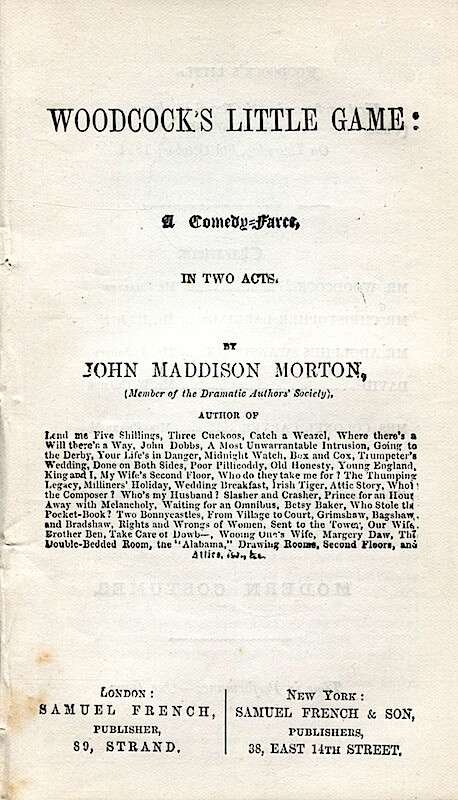
Transcriber’s Note
This transcription is based on a copy of the Samuel French edition, scans of which have been posted on the Internet Archive at:
archive.org/details/MortonWoodcocksLittleGame
Because of the print quality of the Samuel French edition, an American reprint published by Harold Roorbach in 1889 was used as an additional resource. Scans of the copy held by the Library of Congress are posted at:
archive.org/details/woodcockslittleg00mort
In general, this transcription attempts to retain the formatting, punctuation and spelling of the source text. Variant spellings such as “bran-new” and “trowsers” have been retained as have some inconsistencies in spelling, such as “ball room” vs. “ball-room” and “thank’ee” vs. “thankee”. Some changes were made to correct for printing errors and for minor inconsistencies in formatting, punctuation and spelling.
The following changes were made to the text:
- p. 2: The upper right side of this page in the Samuel French edition was blank. Thus, the name of the theater and the last names of the actors were corrected or added based on the Roorbach edition.
- p. 4: there’s not the slightest doubt about it’s being all over!—Change “it’s” to “its”.
- pp. 6-7: Yes, fair lady. I entered the holy state of wedlock—Changed what appears to be a period to a comma in keeping with the Roorbach edition.
- p. 8: The gap! she is under twenty, while you —how old shall we say?—Inserted “are” in the blank space after “you” based on the Roorbach edition.
- p. 10: I could’nt have believed it of you—Changed “could’nt” to “couldn’t”.
- p. 11: (taking hold of MRS. LARKING’S hand)—Changed “LARKING’S” to “LARKINGS’S” for consistency.
- p. 13: he actually expressed his his intention of laying aside—Deleted the second “his”.
- pp. 13-14: (banging her hand on one of the parcels to Woodcock’s great alarm)—Changed “Woodcock’s” to “WOODCOCK’S” for consistency.
- p. 14: Yes; embroidered, no doubt, by some unhappy creature he had professed to me as he did me.—Changed “me” after “professed to” to “love” based on the Roorbach edition.
- p. 17: Enter MRS LARKINGS in travelling dress, door R. 2 E.—Inserted a period after “MRS”.
- p. 19: (taking off Mrs. Woodcock’s cloak)—Changed “Mrs. Woodcock’s” to “MRS. WOODCOCK’S” for consistency.
- p. 19: (taking hold of Mrs. Carver’s cloak behind and giving it a violent tug)—Changed “Mrs. Carver’s” to “MRS. CARVER’S” for consistency.
- p. 20: Enter MRS. LARKINGS, at C., in fashionable evening dress.—LADIES and GENTLEMEN are seen promenading within—Music)—Changed the closing parenthesis to a period.
- p. 22: (to MRS. LARKINGS) we’ve settled our costume, my dear!—Capitalized “we’ve”.
- p. 28: WOOD. (still dancing after them, and aside to MRS. SWANSDOWN) Don’t tell him that, mum—As Mrs. Larkings has the previous line, changed “MRS. SWANSDOWN” to “MRS. LARKINGS”.
- p. 28: MR. L. Luckily, I’m not jealous!—Changed the character title “MR. L.” to “MRS. L.” in keeping with the Roorbach edition.
- p. 29: MRS C. (R. C.) My dear friend, never indulge in a plurality of epithets—Inserted a period after “MRS”.
- p. 31: But how is Mrs Larkings to know anything about it?—Inserted a period after “Mrs”.
- p. 33: Confound it! how she’s hurting me?—Changed the question mark to an exclamation mark in keeping with the Roorbach edition.
- p. 34: DAVID. So he opens it, ma’am, and (to LARKINGS who is making violent signs to him to hold his tongue) What’s the matter, sir?—Inserted an em dash after “and”.